PRESENT PERFECT TENSE ( P.P.T.)
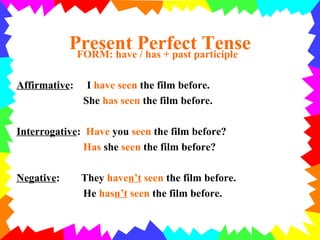
Present Perfect Tense FORM: have / has + past participle Affirmative :   I  have seen  the film before. She  has seen  the film before. Interrogative :   Have  you  seen  the film before? Has  she  seen  the film before? Negative :  They  have n’t  seen  the film before. He  has n’t  seen  the film before.
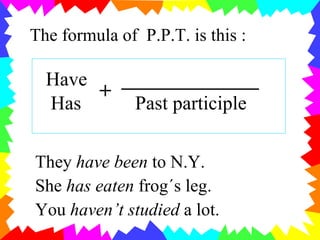
The formula of  P.P.T. is this : Have  ______________ Has  Past participle + They  have been  to N.Y. She  has eaten  frog´s leg. You  haven’t studied  a lot.
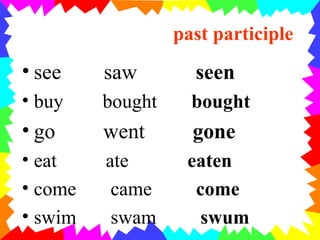
past participle see  saw  seen buy  bought  bought go  went  gone eat  ate  eaten come  came  come swim  swam  swum
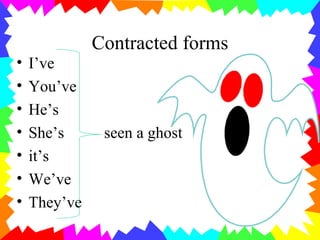
Contracted forms I’ve You’ve He’s She’s  seen a ghost it’s We’ve They’ve
Interrogative form You have traveled to Japan twice. (aff) Have you traveled to Japan twice?  (interrogative)
Have you traveled to Japan twice? Yes, I have. No, I haven’t.
Negative form I have visited the Taj Mahal. I have .... visited the Taj Mahal. I have  NOT  visited the Taj Mahal. I haven’t seen you for weeks ! He hasn’t arrived home.
1-  Recent events : It is used to describe  recent events without a definite  time . The idea of time or place in the speaker’s mind makes the event recent. A time expression may emphasize recentness:  just, recently, lately Uses of the present perfect Why are they so happy? They have  just   won a prize so  they are really pleased
JUST I have  just  finished my exercise. He has  just  had lunch.
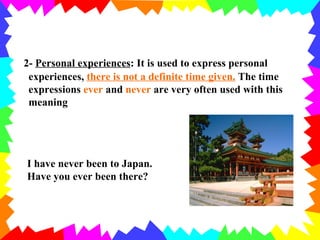
2-   Personal experiences : It is used to express personal experiences,  there is not a definite time given.   The time expressions  ever  and  never  are very often used with this meaning I have never been to Japan. Have you ever been there?
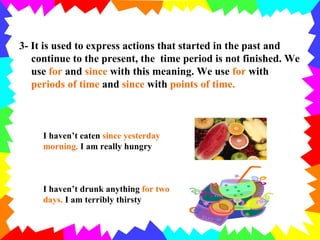
3- It is used to express actions that started in the past and continue to the present, the  time period is not finished. We use  for  and  since  with this meaning. We use  for  with  periods of time  and  since  with  points of time. I haven’t eaten  since yesterday morning.  I am really hungry I haven’t drunk anything  for two days.  I am terribly thirsty
Indefinite time We use PPT to indicate an action that happened in the past but we don’t know exactly when. ( indefinitive time ). The verb in Portuguese is in the past . Eg.: He  has bought  a car. ( When ? ) They  have been  to Europe. ( When ? )
Indefinite Time I have been to New York. ( When ?? ) She has eaten frog´s leg. ( When ?? )
An action started in the past  We use PPT to indicate an action that began in the past and continues up to the present. (the verb in Portuguese is in the present). Eg.: I’ve lived  in Limeira for three years. She  has studied English  since January.
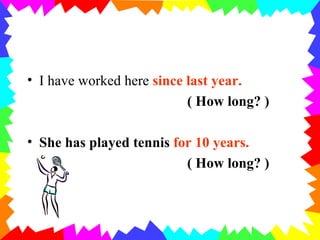
I have worked here  since last year. ( How long? ) She has played tennis  for 10 years. ( How long? )
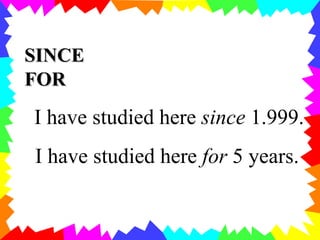
SINCE FOR I have studied here  since  1.999. I have studied here  for  5 years.
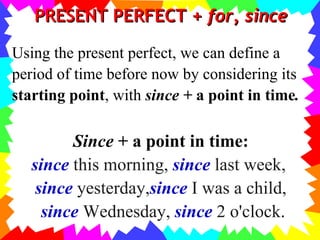
PRESENT PERFECT +  for, since Using the present perfect, we can define a period of time before now by considering its  starting point , with  since +  a point in time . Since   + a point in time: since   this   morning,   since   last   week,   since   yesterday, since   I was   a   child, since   Wednesday,   since   2   o'clock .
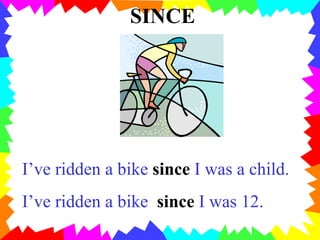
SINCE I’ve ridden a bike  since  I was a child. I’ve ridden a bike  since  I was 12.
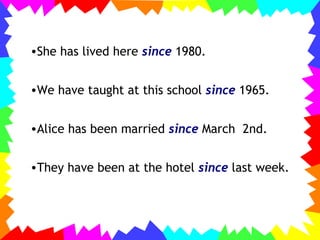
She has lived here  since   1980. We have taught at this school  since  1965. Alice has been married  since  March  2nd. They have been at the hotel  since  last week.
Using the present perfect, we can define a period of time before now by considering its  duration,  with  for +  a period of time. For   + a period of time: for   six years,   for   a week,   for   a   month ,  for   hours,   for   two   hours .
FOR They’ve been married  for  1 year. They’ve dated  for  3 years.
She has lived here  for  twenty years. We have taught at this school  for   a long time. Alice has been married  for   three months. They have been at the hotel  for   a week.
Note: For   and  since  can both be used with the past perfect. Since  can only be used with perfect tenses,  for  can also be used with the simple past
I’VE STUDIED ENGLISH  SINCE... FOR....
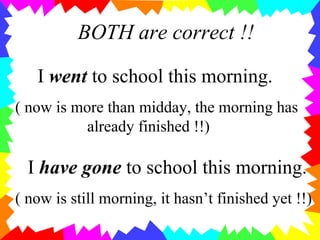
I  went  to school this morning. I  have gone  to school this morning. Which one is correct? ?
BOTH are correct !! I  went  to school this morning. ( now is more than midday, the morning has  already finished !!) I  have gone  to school this morning. ( now is still morning, it hasn’t finished yet !!)
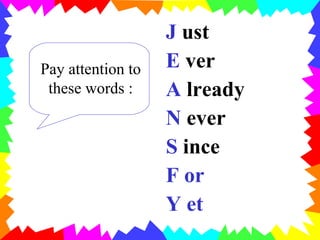
J  ust  E  ver A  lready N  ever S  ince F or   Y et Pay attention to these words :
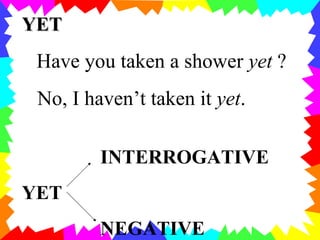
YET Have you taken a shower  yet  ? No, I haven’t taken it  yet . INTERROGATIVE YET  NEGATIVE
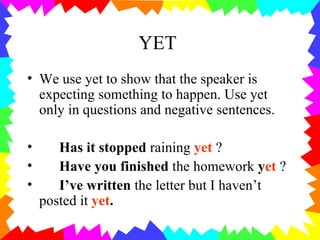
YET  We use yet to show that the speaker is expecting something to happen. Use yet only in questions and negative sentences. Has it stopped  raining  yet  ? Have you finished  the homework  y et  ? I’ve written  the letter but I haven’t posted it  yet .
ALREADY I have  already  taken a shower. AFFIRMATIVE ALREADY INTERROGATIVE
ALREADY We use already to say that something happened sooner than expected. Don’t forget to post the letter ! I’ve  already  posted  it. What time is Mark leaving ? He’s  already  gone .
Already   refers to an action that has happened at an unspecified time before now. It suggests that there is no need for repetition. I've  already   drunk three coffees this morning . (and you're offering me another one!) Don't write to John, I've  already  done it.
It is also used in questions: Have you  already  written to John? Has she finished her homework  already ? Position:  already  can be placed before the main verb (past participle) or at the end of the sentence: I have  already   been to Tokyo. I have been to Tokyo  already .
Yet   is used in negative statements and questions, to mean  (not) in the period of time between before now and now, (not) up to and including the present.  Have you met Judy  yet ? I haven't visited the Tate Gallery  yet . Has he arrived   yet ? They haven't eaten  yet . Position: Yet   is usually placed at the end of the sentence .
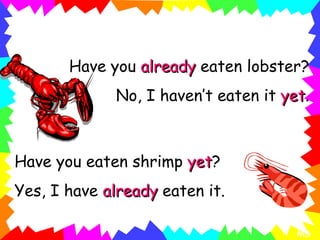
Have you  already  eaten lobster? No, I haven’t eaten it  yet . Have you eaten shrimp  yet ? Yes, I have  already  eaten it. MD
EVER NEVER Have you  ever  ridden a horse? I have  never  ridden a horse.
EVER AND NEVER  Have  you  ever  studied  German? No,  I’ve n ever  studied  German. Has  she  ever  been  to the USA ? No,  she has  never  been  to the USA
Have you ever seen a witch? No, I haven’t. I’ve never seen a witch.
Have you ever sung in a choir? Yes, I have.
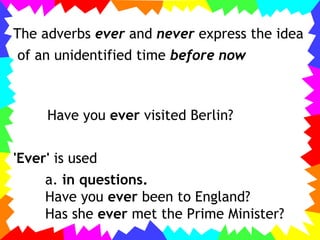
The adverbs  ever  and  never  express the idea of an unidentified time  before now   Have you  ever  visited Berlin? 'Ever'  is used  a.  in questions.  Have you  ever  been to England? Has she  ever  met the Prime Minister?
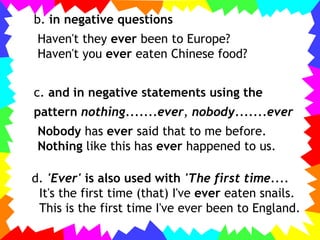
b.  in negative questions  Haven't they  ever  been to Europe?  Haven't you  ever  eaten Chinese food? c.  and in negative statements using the  pattern  nothing.......ever ,  nobody.......ever  Nobody  has  ever  said that to me before.   Nothing  like this has  ever  happened to us.  d.  'Ever'  is also used with  'The first time....    It's the first time (that) I've  ever  eaten snails.    This is the first time I've ever been to England.
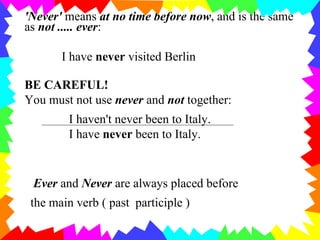
'Never'  means  at no time before now , and is the same as  not ..... ever : I have  never  visited Berlin BE CAREFUL! You must not use  never  and  not  together: I haven't never been to Italy.   I have  never  been to Italy. Ever  and  Never  are always placed before the main verb ( past  participle )
And there are more words... Lately / Recently / for a while I haven’t seen him  lately . She has practiced tennis  recently . You haven’t tried it  for a while .
... and more , Once / twice / 3 times / 4 times /  etc. We have fought  once . He has traveled to Chicago  twice . I have had a cold  3 times  this year.
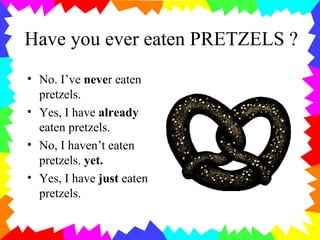
Have you ever eaten PRETZELS ? No. I’ve  neve r eaten pretzels.  Yes, I have  already  eaten pretzels.  No, I haven’t eaten pretzels.  yet. Yes, I have  just  eaten pretzels.
 
To fail - failed - failed
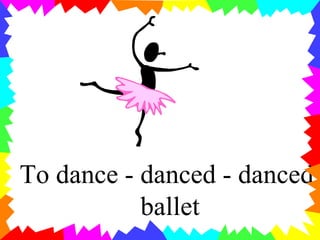
To dance - danced - danced  ballet
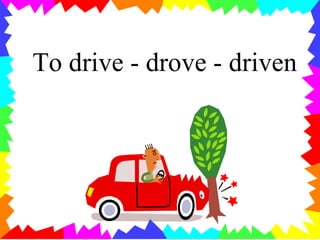
To drive - drove - driven
To have - had - had
To fly - flew - flown
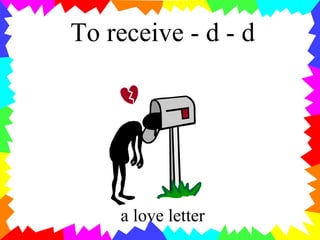
To receive - d - d a love letter
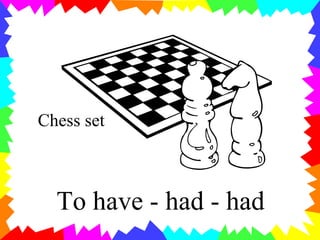
Chess set To have - had - had
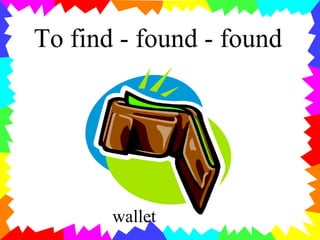
wallet To find - found - found
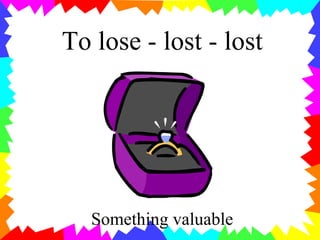
To lose - lost - lost Something valuable
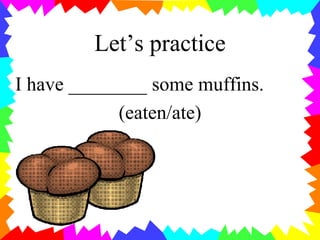
Let’s practice I have ________ some muffins. (eaten/ate)
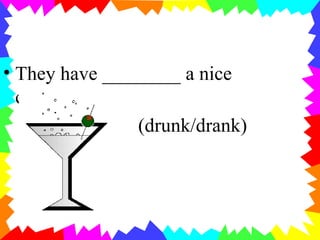
They have ________ a nice cocktail. (drunk/drank)
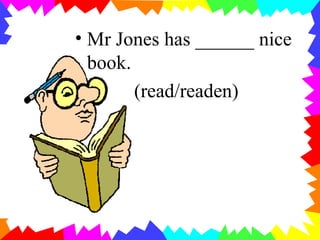
Mr Jones has ______ nice book. (read/readen)
We’ve _________ to the circus.  (gone/went)
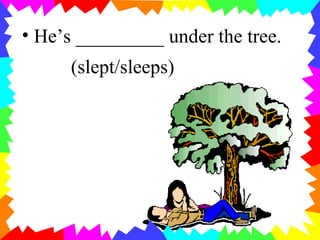
He’s _________ under the tree. (slept/sleeps)
Have you ______ seen a mummy? (ever/yet) I’ve ______ eaten snails.  (never/ever) Doug has _______ had his breakfast. (already/yet)
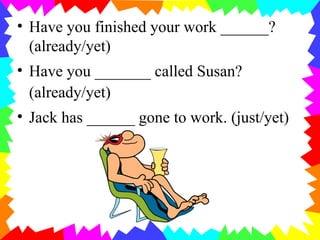
Have you finished your work ______?  (already/yet) Have you _______ called Susan? (already/yet) Jack has ______ gone to work. (just/yet)
Make up sentences... NEVER
ALREADY - AFF.
EVER
NEVER
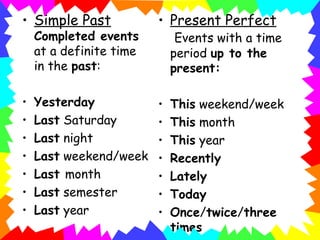
Simple Past  or  Present Perfect
Simple Past   Completed events  at a definite time in the  past : Yesterday Last  Saturday Last  night Last  weekend/week Last  month Last  semester Last  year Present Perfect   Events with a time period  up to the present: This  weekend/week This  month This  year Recently Lately Today Once / twice / three times
Compare these sentences
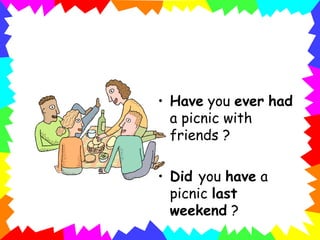
Have  you  ever   had  a picnic with friends ? Did  you  have  a picnic  last weekend  ?
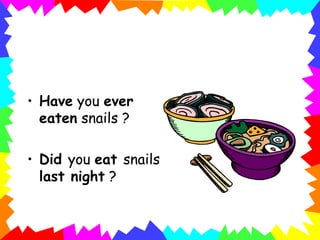
Have  you  ever   eaten  snails ? Did  you  eat  snails  last night  ?
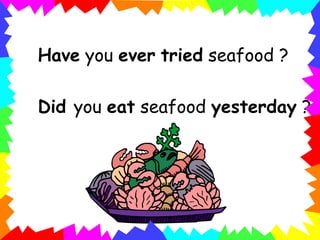
Have  you  ever   tried  seafood ? Did  you  eat  seafood  yesterday  ?
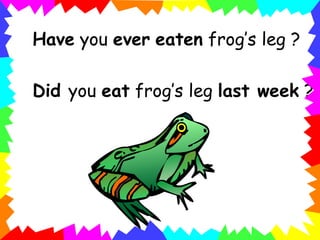
Have  you  ever   eaten  frog’s leg ? Did  you  eat  frog’s leg  last week  ?
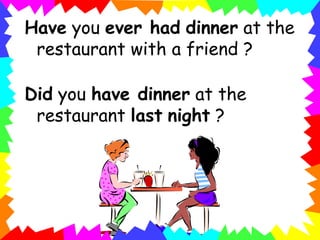
Have  you  ever had   dinner  at the restaurant with a friend ? Did  you  have dinner  at the restaurant  last   night  ?
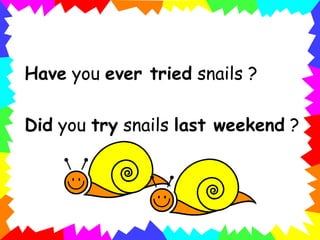
Have  you  ever tried  snails ? Did  you  try  snails  last weekend  ?
Have  you  ever visited   New York ? Did  you  visit  New York  last year  ?
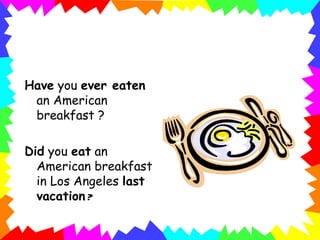
Have  you  ever eaten  an American breakfast ? Did  you  eat  an American breakfast in Los Angeles  last vacation  ?
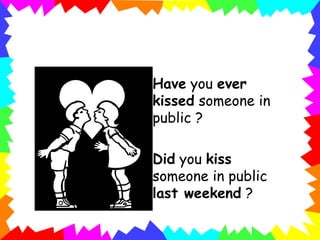
Have  you  ever kissed  someone in public ? Did  you  kiss  someone in public  last weekend  ?
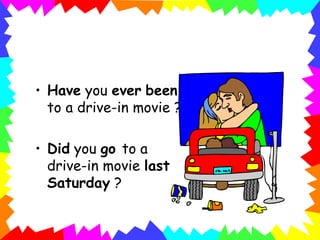
Have  you  ever   been  to a drive-in movie ? Did  you  go  to a drive-in movie  last Saturday  ?
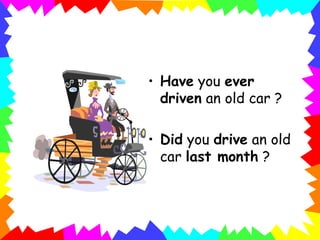
Have  you  ever driven  an old car ? Did  you  drive  an old car  last month  ?
Let’s Practice
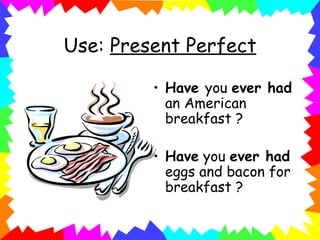
Use:  Present Perfect Have  you  ever had  an American breakfast ? Have  you  ever had  eggs and bacon for breakfast ?
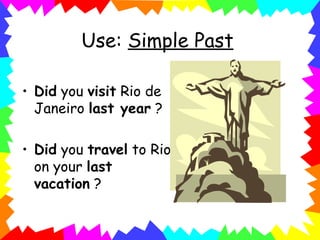
Use:  Simple Past Did  you  visit  Rio de Janeiro  last year  ? Did  you  travel  to Rio on your  last vacation  ?
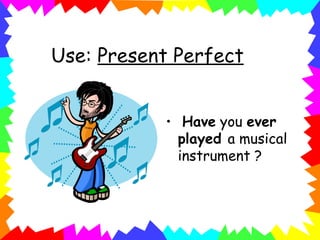
Use:  Present Perfect Have  you  ever played  a musical instrument ?
Use:  Present Perfect   and  Simple Past Have  you  ever been  to Rome ? Did  you  visit  Rome on your  last vacation  ?
Use:  Simple Past Did  you  have  a barbecue at home  last holiday  ?
Use:  Present Perfect Have  you  ever   fried  an egg ?
Use:  Simple Past Did  you  drive  your father’s car  yesterday  ?
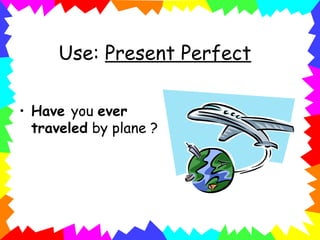
Use:  Present Perfect Have  you  ever traveled  by plane ?
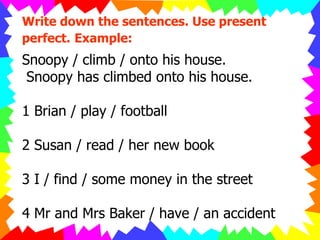
Write down the sentences. Use present perfect.   Example:   Snoopy / climb / onto his house. Snoopy has climbed onto his house. 1 Brian / play / football 2 Susan / read / her new book  3 I / find / some money in the street 4 Mr and Mrs Baker / have / an accident
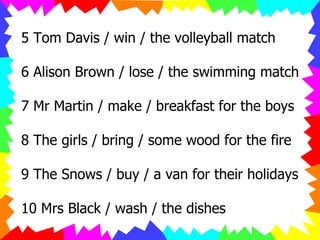
5 Tom Davis / win / the volleyball match 6 Alison Brown / lose / the swimming match 7 Mr Martin / make / breakfast for the boys 8 The girls / bring / some wood for the fire 9 The Snows / buy / a van for their holidays 10 Mrs Black / wash / the dishes
SIMPLE PAST OR PRESENT PERFECT ? ? ? ? ? ? ? ?
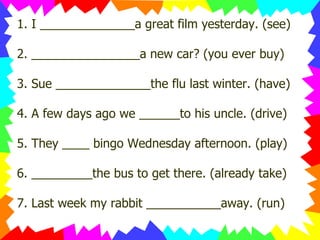
1. I ______________a great film yesterday. (see) 2. ________________a new car? (you ever buy) 3. Sue ______________the flu last winter. (have) 4. A few days ago we ______to his uncle. (drive) 5. They ____ bingo Wednesday afternoon. (play) 6. _________the bus to get there. (already take) 7. Last week my rabbit ___________away. (run)
EXERCISES  P.P.T. SINCE - FOR
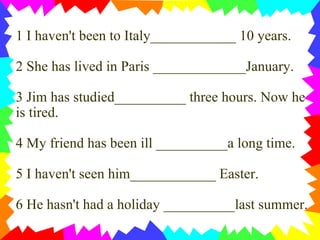
1 I haven't been to Italy____________ 10 years. 2 She has lived in Paris _____________January. 3 Jim has studied__________ three hours. Now he is tired. 4 My friend has been ill __________a long time. 5 I haven't seen him____________ Easter. 6 He hasn't had a holiday __________last summer.
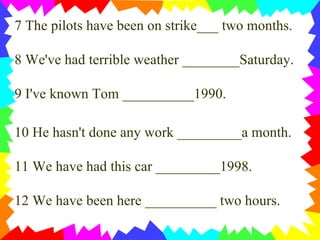
7 The pilots have been on strike___ two months. 8 We've had terrible weather ________Saturday. 9 I've known Tom __________1990. 10 He hasn't done any work _________a month. 11 We have had this car _________1998. 12 We have been here __________ two hours.
SITES http://www.englisch-hilfen.de/en/grammar/pres_perf.htm http://www.englishpage.com/verbpage/presentperfect.html http://www.geocities.com/SiliconValley/2527/presentperfect.html http://www.ego4u.com/en/cram-up/grammar/present-perfect-simple
http://web2.uvcs.uvic.ca/elc/studyzone/330/grammar/prperf1.htm http://www.learnenglish.be/EX_gram2_prpe.htm http://www.eclecticenglish.com/grammar/PresentPerfect1A.html http://www.english-4u.de/grammar_exercises.htm