Have to vs. must
Should vs. ought to
 Have to
= have got to – in spoken English
Must
Should
Ought to
What is must and have to?
Is there any difference in meaning or usage?
What is the difference between these two
sentences :
I have to hand in a report tomorrow morning.
I must hand in a report tomorrow morning.
?
I have to hand in a report tomorrow morning.
(otherwise my boss will be very angry and can fine
me, I don’t want to brake the company rules )
I must hand in a report tomorrow morning.
(I want to be a good employee, and to get a
promotion one day, I’ll make my report on time
and perhaps my boss even praise me )
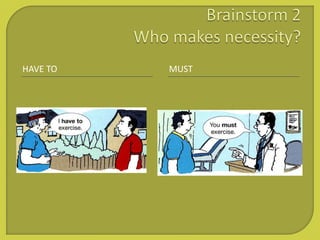
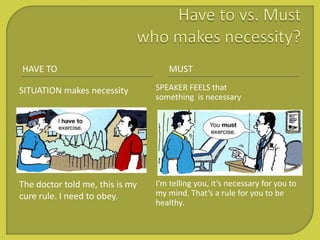
HAVE TO MUST
HAVE TO MUST
SITUATION makes necessity
The doctor told me, this is my
cure rule. I need to obey.
SPEAKER FEELS that
something is necessary
I’m telling you, it’s necessary for you to
my mind. That’s a rule for you to be
healthy.
 So, what are the differences? What is referred to
personal obligation, and what is for external
ones?
 Could be “have to” and “must” used with the
same meaning?
 Discuss the situations:
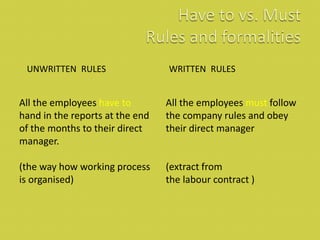
All the employees have to hand in the reports at the
end of the months to their direct manager.
All the employees must follow the company rules
and obey their direct manager
Have to
IMPERSONAL
OBLIGATION from
external sources
Is more common for
spoken English
Must
Obligation comes from the
speaker
Can be used with a same
meaning as have to.
UNWRITTEN RULES WRITTEN RULES
All the employees have to
hand in the reports at the end
of the months to their direct
manager.
(the way how working process
is organised)
All the employees must follow
the company rules and obey
their direct manager
(extract from
the labour contract )
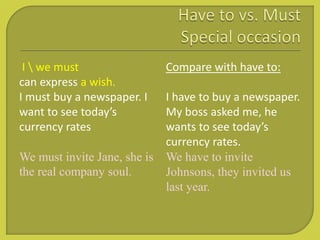
I  we must
can express a wish.
I must buy a newspaper. I
want to see today’s
currency rates
We must invite Jane, she is
the real company soul.
Compare with have to:
I have to buy a newspaper.
My boss asked me, he
wants to see today’s
currency rates.
We have to invite
Johnsons, they invited us
last year.
What are the grammar features of have to and
must?
Do you remember all the grammar forms for
past-present-future?
Can you use must only for present? If not, can
you tell the situation when it can be used
otherwise?
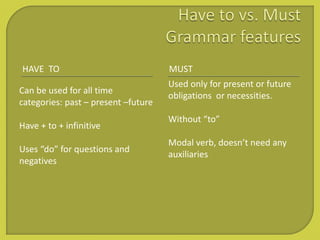
HAVE TO MUST
Can be used for all time
categories: past – present –future
Have + to + infinitive
Uses “do” for questions and
negatives
Used only for present or future
obligations or necessities.
Without “to”
Modal verb, doesn’t need any
auxiliaries
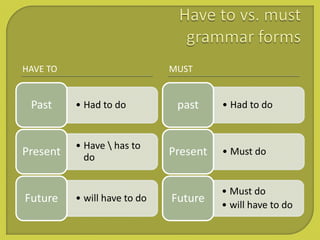
HAVE TO MUST
• Had to doPast
• Have  has to
do
Present
• will have to doFuture
• Had to dopast
• Must doPresent
• Must do
• will have to do
Future
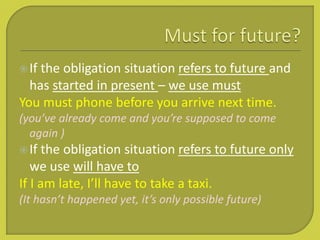
If the obligation situation refers to future and
has started in present – we use must
You must phone before you arrive next time.
(you’ve already come and you’re supposed to come
again )
If the obligation situation refers to future only
we use will have to
If I am late, I’ll have to take a taxi.
(It hasn’t happened yet, it’s only possible future)
How do we form questions?
Is it possible to make question form for must?
How is the negative form made?
Is there any difference in meaning?
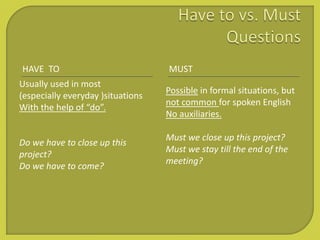
HAVE TO MUST
Usually used in most
(especially everyday )situations
With the help of “do”.
Do we have to close up this
project?
Do we have to come?
Possible in formal situations, but
not common for spoken English
No auxiliaries.
Must we close up this project?
Must we stay till the end of the
meeting?
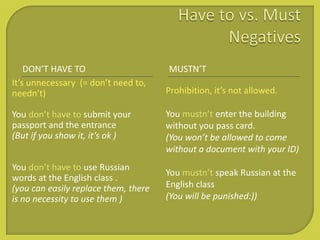
DON’T HAVE TO MUSTN’T
It’s unnecessary (= don’t need to,
needn’t)
You don’t have to submit your
passport and the entrance
(But if you show it, it’s ok )
You don’t have to use Russian
words at the English class .
(you can easily replace them, there
is no necessity to use them )
Prohibition, it’s not allowed.
You mustn’t enter the building
without you pass card.
(You won’t be allowed to come
without a document with your ID)
You mustn’t speak Russian at the
English class
(You will be punished:))
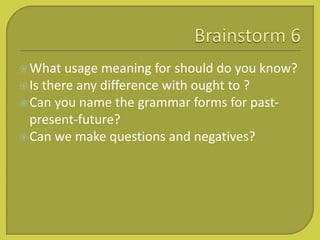
What usage meaning for should do you know?
Is there any difference with ought to ?
Can you name the grammar forms for past-
present-future?
Can we make questions and negatives?
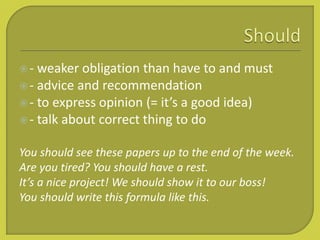
- weaker obligation than have to and must
- advice and recommendation
- to express opinion (= it’s a good idea)
- talk about correct thing to do
You should see these papers up to the end of the week.
Are you tired? You should have a rest.
It’s a nice project! We should show it to our boss!
You should write this formula like this.
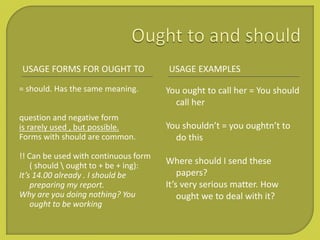
USAGE FORMS FOR OUGHT TO USAGE EXAMPLES
= should. Has the same meaning.
question and negative form
is rarely used , but possible.
Forms with should are common.
!! Can be used with continuous form
( should  ought to + be + ing):
It’s 14.00 already . I should be
preparing my report.
Why are you doing nothing? You
ought to be working
You ought to call her = You should
call her
You shouldn’t = you oughtn’t to
do this
Where should I send these
papers?
It’s very serious matter. How
ought we to deal with it?
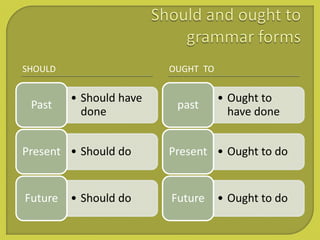
SHOULD OUGHT TO
• Should have
done
Past
• Should doPresent
• Should doFuture
• Ought to
have done
past
• Ought to doPresent
• Ought to doFuture
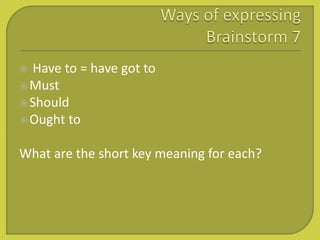
 Have to = have got to
Must
Should
Ought to
What are the short key meaning for each?
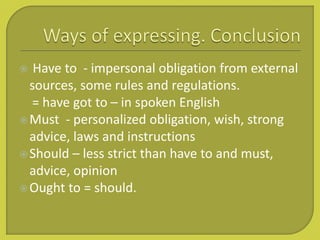
 Have to - impersonal obligation from external
sources, some rules and regulations.
= have got to – in spoken English
Must - personalized obligation, wish, strong
advice, laws and instructions
Should – less strict than have to and must,
advice, opinion
Ought to = should.

Obligation, necessity, advice with brainstorm

  • 1.
    Have to vs.must Should vs. ought to
  • 2.
     Have to =have got to – in spoken English Must Should Ought to
  • 3.
    What is mustand have to? Is there any difference in meaning or usage? What is the difference between these two sentences : I have to hand in a report tomorrow morning. I must hand in a report tomorrow morning. ?
  • 4.
    I have tohand in a report tomorrow morning. (otherwise my boss will be very angry and can fine me, I don’t want to brake the company rules ) I must hand in a report tomorrow morning. (I want to be a good employee, and to get a promotion one day, I’ll make my report on time and perhaps my boss even praise me )
  • 5.
  • 6.
    HAVE TO MUST SITUATIONmakes necessity The doctor told me, this is my cure rule. I need to obey. SPEAKER FEELS that something is necessary I’m telling you, it’s necessary for you to my mind. That’s a rule for you to be healthy.
  • 7.
     So, whatare the differences? What is referred to personal obligation, and what is for external ones?  Could be “have to” and “must” used with the same meaning?  Discuss the situations: All the employees have to hand in the reports at the end of the months to their direct manager. All the employees must follow the company rules and obey their direct manager
  • 8.
    Have to IMPERSONAL OBLIGATION from externalsources Is more common for spoken English Must Obligation comes from the speaker Can be used with a same meaning as have to.
  • 9.
    UNWRITTEN RULES WRITTENRULES All the employees have to hand in the reports at the end of the months to their direct manager. (the way how working process is organised) All the employees must follow the company rules and obey their direct manager (extract from the labour contract )
  • 10.
    I wemust can express a wish. I must buy a newspaper. I want to see today’s currency rates We must invite Jane, she is the real company soul. Compare with have to: I have to buy a newspaper. My boss asked me, he wants to see today’s currency rates. We have to invite Johnsons, they invited us last year.
  • 11.
    What are thegrammar features of have to and must? Do you remember all the grammar forms for past-present-future? Can you use must only for present? If not, can you tell the situation when it can be used otherwise?
  • 12.
    HAVE TO MUST Canbe used for all time categories: past – present –future Have + to + infinitive Uses “do” for questions and negatives Used only for present or future obligations or necessities. Without “to” Modal verb, doesn’t need any auxiliaries
  • 13.
    HAVE TO MUST •Had to doPast • Have has to do Present • will have to doFuture • Had to dopast • Must doPresent • Must do • will have to do Future
  • 14.
    If the obligationsituation refers to future and has started in present – we use must You must phone before you arrive next time. (you’ve already come and you’re supposed to come again ) If the obligation situation refers to future only we use will have to If I am late, I’ll have to take a taxi. (It hasn’t happened yet, it’s only possible future)
  • 15.
    How do weform questions? Is it possible to make question form for must? How is the negative form made? Is there any difference in meaning?
  • 16.
    HAVE TO MUST Usuallyused in most (especially everyday )situations With the help of “do”. Do we have to close up this project? Do we have to come? Possible in formal situations, but not common for spoken English No auxiliaries. Must we close up this project? Must we stay till the end of the meeting?
  • 17.
    DON’T HAVE TOMUSTN’T It’s unnecessary (= don’t need to, needn’t) You don’t have to submit your passport and the entrance (But if you show it, it’s ok ) You don’t have to use Russian words at the English class . (you can easily replace them, there is no necessity to use them ) Prohibition, it’s not allowed. You mustn’t enter the building without you pass card. (You won’t be allowed to come without a document with your ID) You mustn’t speak Russian at the English class (You will be punished:))
  • 18.
    What usage meaningfor should do you know? Is there any difference with ought to ? Can you name the grammar forms for past- present-future? Can we make questions and negatives?
  • 19.
    - weaker obligationthan have to and must - advice and recommendation - to express opinion (= it’s a good idea) - talk about correct thing to do You should see these papers up to the end of the week. Are you tired? You should have a rest. It’s a nice project! We should show it to our boss! You should write this formula like this.
  • 20.
    USAGE FORMS FOROUGHT TO USAGE EXAMPLES = should. Has the same meaning. question and negative form is rarely used , but possible. Forms with should are common. !! Can be used with continuous form ( should ought to + be + ing): It’s 14.00 already . I should be preparing my report. Why are you doing nothing? You ought to be working You ought to call her = You should call her You shouldn’t = you oughtn’t to do this Where should I send these papers? It’s very serious matter. How ought we to deal with it?
  • 21.
    SHOULD OUGHT TO •Should have done Past • Should doPresent • Should doFuture • Ought to have done past • Ought to doPresent • Ought to doFuture
  • 22.
     Have to= have got to Must Should Ought to What are the short key meaning for each?
  • 23.
     Have to- impersonal obligation from external sources, some rules and regulations. = have got to – in spoken English Must - personalized obligation, wish, strong advice, laws and instructions Should – less strict than have to and must, advice, opinion Ought to = should.