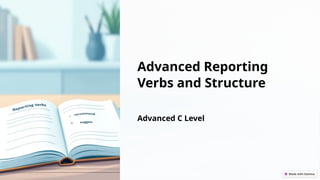
Beyond Basic Reporting
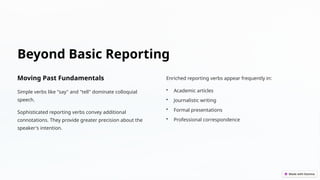
MovingPast Fundamentals
Simple verbs like "say" and "tell" dominate colloquial
speech.
Sophisticated reporting verbs convey additional
connotations. They provide greater precision about the
speaker's intention.
Enriched reporting verbs appear frequently in:
• Academic articles
• Journalistic writing
• Formal presentations
• Professional correspondence
3.
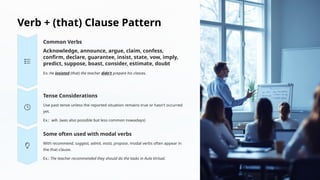
Verb + (that)Clause Pattern
Common Verbs
Acknowledge, announce, argue, claim, confess,
confirm, declare, guarantee, insist, state, vow, imply,
predict, suppose, boast, consider, estimate, doubt
Ex: He insisted (that) the teacher didn’t prepare his classes.
Tense Considerations
Use past tense unless the reported situation remains true or hasn't occurred
yet.
Ex.: wih. (was also possible but less common nowadays)
Some often used with modal verbs
With recommend, suggest, admit, insist, propose, modal verbs often appear in
the that-clause.
Ex.: The teacher recommended they should do the tasks in Aula Virtual.
4.
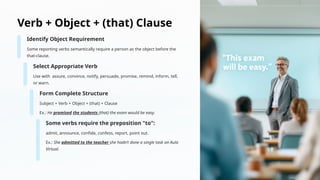
Verb + Object+ (that) Clause
Identify Object Requirement
Some reporting verbs semantically require a person as the object before the
that-clause.
Select Appropriate Verb
Use with assure, convince, notify, persuade, promise, remind, inform, tell,
or warn.
Form Complete Structure
Subject + Verb + Object + (that) + Clause
Ex.: He promised the students (that) the exam would be easy.
Some verbs require the preposition "to":
admit, announce, confide, confess, report, point out.
Ex.: She admitted to the teacher she hadn’t done a single task on Aula
Virtual.
5.
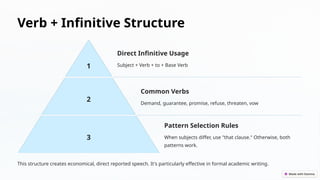
Verb + InfinitiveStructure
1
Direct Infinitive Usage
Subject + Verb + to + Base Verb
2
Common Verbs
Demand, guarantee, promise, refuse, threaten, vow
3
Pattern Selection Rules
When subjects differ, use "that clause." Otherwise, both
patterns work.
This structure creates economical, direct reported speech. It's particularly effective in formal academic writing.
6.
Verb + Object+ Infinitive with To
Structure Formation
Subject + Verb + Object + to + Base Verb
Key Verbs
Demand guarantee promise refuse threaten
vow offer threatern swear refuse
agree beg claim
Ex.: I promised to study harder/
She demanded that I would study
harder (if subject is different)
7.
Verb + -ingForms
Prepositional Verbs
Verb + (object) + preposition + -ing
Common Combinations
Apologize for, accuse of, congratulate/insist
on, blame for/on, boast/complain about
Ex.: He blamed the teacher for his results
He blamed his bad results on the teacher.
Direct -ing Patterns
Admit, advise, deny, consider, discuss,
recommend, regret, suggest
Ex.: The teacher suggested doing more
writing practice.
Dual-Pattern Verbs
Some verbs allow multiple structures
depending on objects
Verbs with two patterns when no object is
used:
Ex.: “the teacher advised studying for the
exam.”
8.
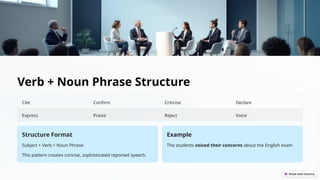
Verb + NounPhrase Structure
Cite Confirm Criticise Declare
Express Praise Reject Voice
Structure Format
Subject + Verb + Noun Phrase
This pattern creates concise, sophisticated reported speech.
Example
The students voiced their concerns about the English exam
9.
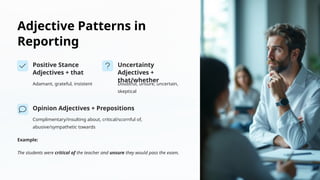
Adjective Patterns in
Reporting
PositiveStance
Adjectives + that
Adamant, grateful, insistent
Uncertainty
Adjectives +
that/whether
Doubtful, unsure, uncertain,
skeptical
Opinion Adjectives + Prepositions
Complimentary/insulting about, critical/scornful of,
abusive/sympathetic towards
Example:
The students were critical of the teacher and unsure they would pass the exam.
10.
Informal Reporting Expressions
ColloquialPhrasal Verbs
Drone on about, bang on about, sound
off at, keep on at
Repetition Expressions
Go on and on, go off at
Quotative Expressions
He went, he was like
Ex.: The teacher droned on about reporting verbs and structures and one student got angry and went off at him.