Infinitives: The Basics
AfterAdjectives
Used in impersonal sentences with
"for" to indicate subject and some
that require it (reluctant, thrilled,
eager, etc.)
Example: It's important (for me) to
study every day.
After Specific Expressions
Used with: have the
chance/opportunity/time
Example: I didn't have the time to do
the homework.
For Purpose
Expresses reason or intention.
Example: I study English to get a
better job.
3.
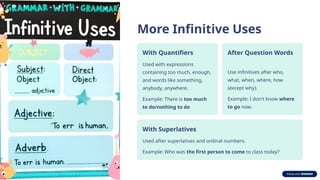
More Infinitive Uses
WithQuantifiers
Used with expressions
containing too much, enough,
and words like something,
anybody, anywhere.
Example: There is too much
to do/nothing to do
After Question Words
Use infinitives after who,
what, when, where, how
(except why).
Example: I don't know where
to go now.
With Superlatives
Used after superlatives and ordinal numbers.
Example: Who was the first person to come to class today?
4.
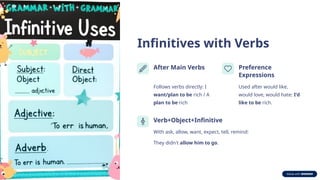
Infinitives with Verbs
AfterMain Verbs
Follows verbs directly: I
want/plan to be rich / A
plan to be rich
Preference
Expressions
Used after would like,
would love, would hate: I'd
like to be rich.
Verb+Object+Infinitive
With ask, allow, want, expect, tell, remind:
They didn't allow him to go.
5.
Gerund Fundamentals
As Subject
Whena verb is the subject: Smoking is bad for you.
After Prepositions
Always use gerunds: I'm tired of studying
After "Go" + Activities
For activities and sports: Did you go shopping last weekend?
After Specific Verbs
"Like" verbs: enjoy, love;
Others: mind, finish, practise, spend, suggest, stop, risk, miss, consider, imagine,
avoid, delay, postpone, involve , deny, discuss
Ex.: I suggest goingto London in summer.
6.
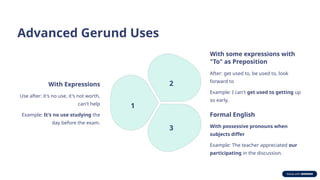
Advanced Gerund Uses
WithExpressions
Use after: it's no use, it's not worth,
can't help
Example: It's no use studying the
day before the exam.
1
With some expressions with
"To" as Preposition
After: get used to, be used to, look
forward to
Example: I can't get used to getting up
so early.
2
Formal English
With possessive pronouns when
subjects differ
Example: The teacher appreciated our
participating in the discussion.
3
7.
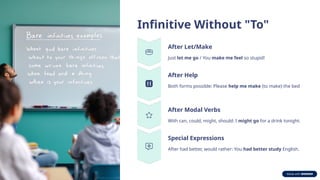
Infinitive Without "To"
AfterLet/Make
Just let me go / You make me feel so stupid!
After Help
Both forms possible: Please help me make (to make) the bed
After Modal Verbs
With can, could, might, should: I might go for a drink tonight.
Special Expressions
After had better, would rather: You had better study English.
8.
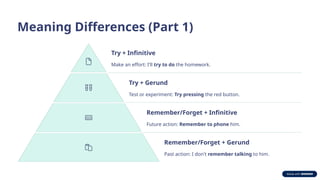
Meaning Differences (Part1)
Try + Infinitive
Make an effort: I'll try to do the homework.
Try + Gerund
Test or experiment: Try pressing the red button.
Remember/Forget + Infinitive
Future action: Remember to phone him.
Remember/Forget + Gerund
Past action: I don't remember talking to him.
9.
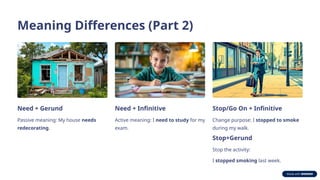
Meaning Differences (Part2)
Need + Gerund
Passive meaning: My house needs
redecorating.
Need + Infinitive
Active meaning: I need to study for my
exam.
Stop/Go On + Infinitive
Change purpose: I stopped to smoke
during my walk.
Stop+Gerund
Stop the activity:
I stopped smoking last week.
10.
Interchangeable Forms
Some verbslike begin, start, continue,
intend, and bother can take both
gerunds and infinitives with little
change in meaning.
Example: I started working/to work
last week.
Note: -ing verbs often take infinitives,
e.g., It's starting to rain.
In American English, both forms are
freely used with preference verbs.