Can – Could – May – Might
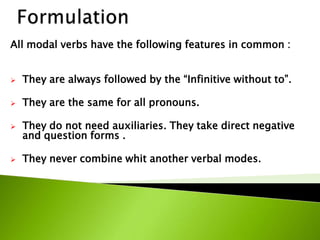
All modal verbs have the following features in common :
 They are always followed by the “Infinitive without to”.
 They are the same for all pronouns.
 They do not need auxiliaries. They take direct negative
and question forms .
 They never combine whit another verbal modes.
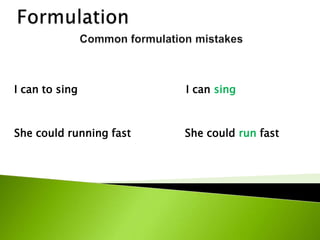
I can to sing I can sing
She could running fast She could run fast
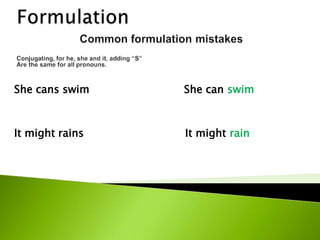
She cans swim She can swim
It might rains It might rain
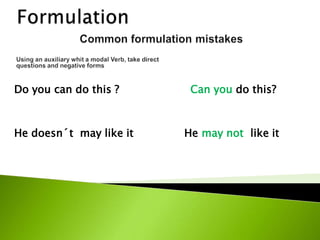
Do you can do this ? Can you do this?
He doesn´t may like it He may not like it
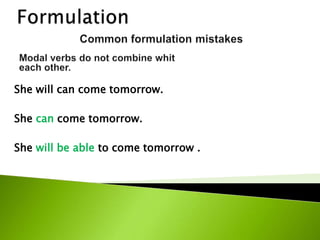
She will can come tomorrow.
She can come tomorrow.
She will be able to come tomorrow .
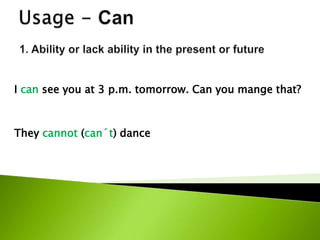
I can see you at 3 p.m. tomorrow. Can you mange that?
They cannot (can´t) dance
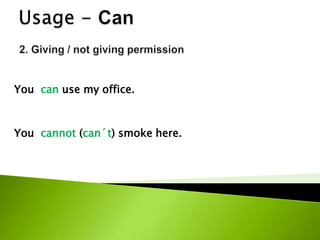
You can use my office.
You cannot (can´t) smoke here.
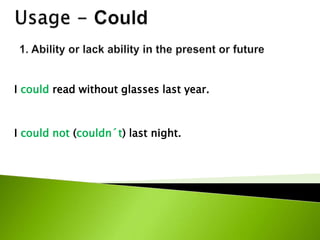
I could read without glasses last year.
I could not (couldn´t) last night.
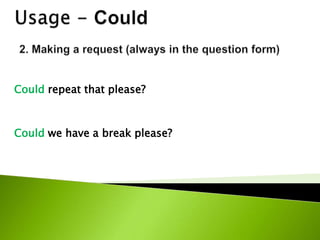
Could repeat that please?
Could we have a break please?
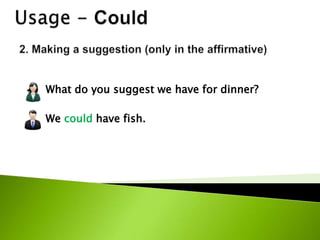
What do you suggest we have for dinner?
We could have fish.
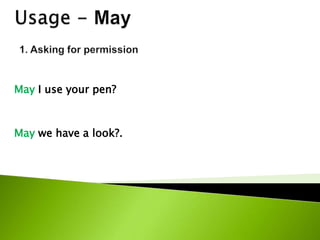
May I use your pen?
May we have a look?.
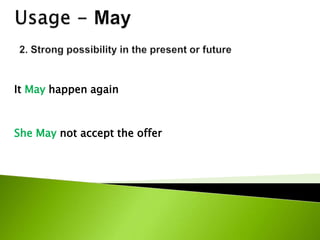
It May happen again
She May not accept the offer
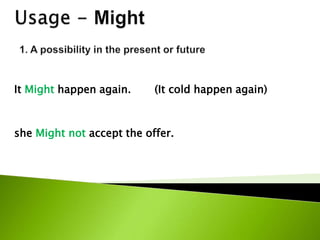
It Might happen again. (It cold happen again)
she Might not accept the offer.
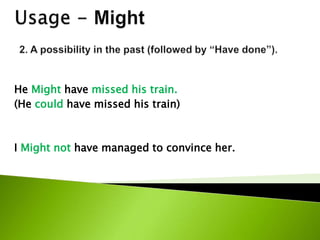
He Might have missed his train.
(He could have missed his train)
I Might not have managed to convince her.
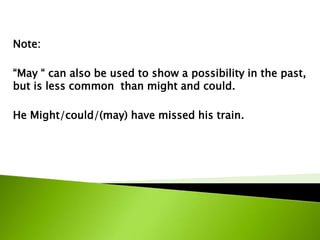
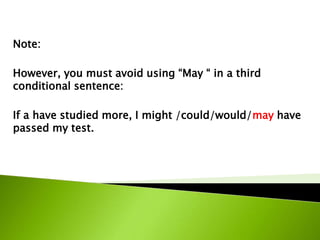
Note:
“May “ can also be used to show a possibility in the past,
but is less common than might and could.
He Might/could/(may) have missed his train.
Note:
However, you must avoid using “May “ in a third
conditional sentence:
If a have studied more, I might /could/would/may have
passed my test.
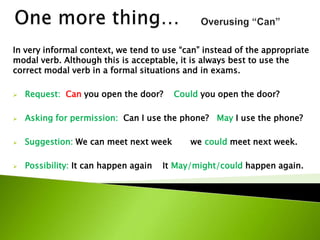
In very informal context, we tend to use “can” instead of the appropriate
modal verb. Although this is acceptable, it is always best to use the
correct modal verb in a formal situations and in exams.
 Request: Can you open the door? Could you open the door?
 Asking for permission: Can I use the phone? May I use the phone?
 Suggestion: We can meet next week we could meet next week.
 Possibility: It can happen again It May/might/could happen again.
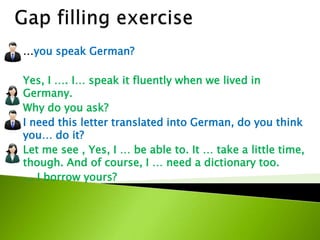
…you speak German?
Yes, I …. I… speak it fluently when we lived in
Germany.
Why do you ask?
I need this letter translated into German, do you think
you… do it?
Let me see , Yes, I … be able to. It … take a little time,
though. And of course, I … need a dictionary too.
… I borrow yours?to
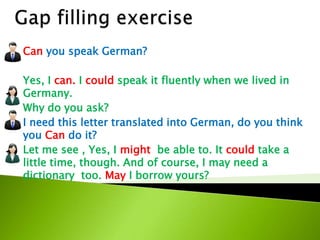
Can you speak German?
Yes, I can. I could speak it fluently when we lived in
Germany.
Why do you ask?
I need this letter translated into German, do you think
you Can do it?
Let me see , Yes, I might be able to. It could take a
little time, though. And of course, I may need a
dictionary too. May I borrow yours?
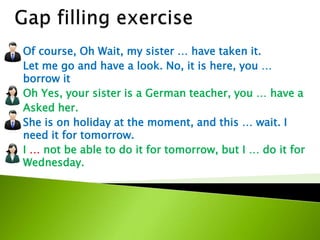
Of course, Oh Wait, my sister … have taken it.
Let me go and have a look. No, it is here, you …
borrow it
Oh Yes, your sister is a German teacher, you … have a
Asked her.
She is on holiday at the moment, and this … wait. I
need it for tomorrow.
I … not be able to do it for tomorrow, but I … do it for
Wednesday.
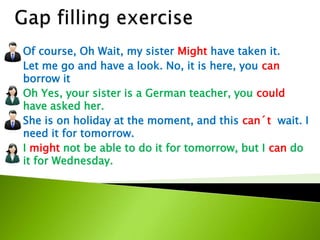
Of course, Oh Wait, my sister Might have taken it.
Let me go and have a look. No, it is here, you can
borrow it
Oh Yes, your sister is a German teacher, you could
have asked her.
She is on holiday at the moment, and this can´t wait. I
need it for tomorrow.
I might not be able to do it for tomorrow, but I can do
it for Wednesday.
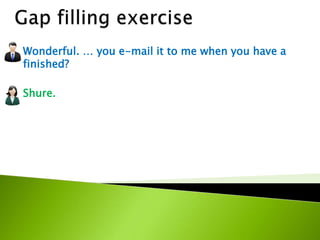
Wonderful. … you e-mail it to me when you have a
finished?
Shure.
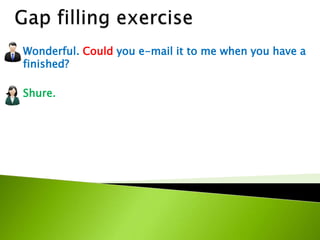
Wonderful. Could you e-mail it to me when you have a
finished?
Shure.

Modal verbs can, could, might, may

  • 1.
    Can – Could– May – Might
  • 2.
    All modal verbshave the following features in common :  They are always followed by the “Infinitive without to”.  They are the same for all pronouns.  They do not need auxiliaries. They take direct negative and question forms .  They never combine whit another verbal modes.
  • 3.
    I can tosing I can sing She could running fast She could run fast
  • 4.
    She cans swimShe can swim It might rains It might rain
  • 5.
    Do you cando this ? Can you do this? He doesn´t may like it He may not like it
  • 6.
    She will cancome tomorrow. She can come tomorrow. She will be able to come tomorrow .
  • 7.
    I can seeyou at 3 p.m. tomorrow. Can you mange that? They cannot (can´t) dance
  • 8.
    You can usemy office. You cannot (can´t) smoke here.
  • 9.
    I could readwithout glasses last year. I could not (couldn´t) last night.
  • 10.
    Could repeat thatplease? Could we have a break please?
  • 11.
    What do yousuggest we have for dinner? We could have fish.
  • 12.
    May I useyour pen? May we have a look?.
  • 13.
    It May happenagain She May not accept the offer
  • 14.
    It Might happenagain. (It cold happen again) she Might not accept the offer.
  • 15.
    He Might havemissed his train. (He could have missed his train) I Might not have managed to convince her.
  • 16.
    Note: “May “ canalso be used to show a possibility in the past, but is less common than might and could. He Might/could/(may) have missed his train.
  • 17.
    Note: However, you mustavoid using “May “ in a third conditional sentence: If a have studied more, I might /could/would/may have passed my test.
  • 18.
    In very informalcontext, we tend to use “can” instead of the appropriate modal verb. Although this is acceptable, it is always best to use the correct modal verb in a formal situations and in exams.  Request: Can you open the door? Could you open the door?  Asking for permission: Can I use the phone? May I use the phone?  Suggestion: We can meet next week we could meet next week.  Possibility: It can happen again It May/might/could happen again.
  • 19.
    …you speak German? Yes,I …. I… speak it fluently when we lived in Germany. Why do you ask? I need this letter translated into German, do you think you… do it? Let me see , Yes, I … be able to. It … take a little time, though. And of course, I … need a dictionary too. … I borrow yours?to
  • 20.
    Can you speakGerman? Yes, I can. I could speak it fluently when we lived in Germany. Why do you ask? I need this letter translated into German, do you think you Can do it? Let me see , Yes, I might be able to. It could take a little time, though. And of course, I may need a dictionary too. May I borrow yours?
  • 21.
    Of course, OhWait, my sister … have taken it. Let me go and have a look. No, it is here, you … borrow it Oh Yes, your sister is a German teacher, you … have a Asked her. She is on holiday at the moment, and this … wait. I need it for tomorrow. I … not be able to do it for tomorrow, but I … do it for Wednesday.
  • 22.
    Of course, OhWait, my sister Might have taken it. Let me go and have a look. No, it is here, you can borrow it Oh Yes, your sister is a German teacher, you could have asked her. She is on holiday at the moment, and this can´t wait. I need it for tomorrow. I might not be able to do it for tomorrow, but I can do it for Wednesday.
  • 23.
    Wonderful. … youe-mail it to me when you have a finished? Shure.
  • 24.
    Wonderful. Could youe-mail it to me when you have a finished? Shure.