Phrasal Verbs:
5                 Separable and
                  Inseparable

            Living in the
             Digital Age

Focus on Grammar 4
Part V, Unit 12
By Ruth Luman, Gabriele Steiner, and BJ Wells
Copyright © 2006. Pearson Education, Inc. All rights reserved.
Cell Phone Help Line

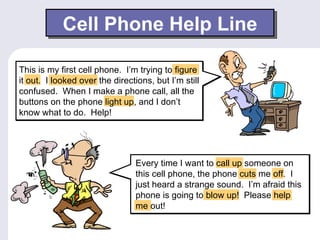
This is my first cell phone. I’m trying to figure
it out. I looked over the directions, but I’m still
confused. When I make a phone call, all the
buttons on the phone light up, and I don’t
know what to do. Help!


                                 Every time I want to call up someone on
                                 this cell phone, the phone cuts me off. I
                                 just heard a strange sound. I’m afraid this
                                 phone is going to blow up! Please help
                                 me out!
Transitive Phrasal Verbs 1
 Most transitive phrasal verbs are separable. This means
 that noun objects can go after the particle or between the
 verb and the particle.


              He can’t figure out the instructions.
                                          noun object


              He can’t figure the instructions out.
                                     noun object
Be Careful!
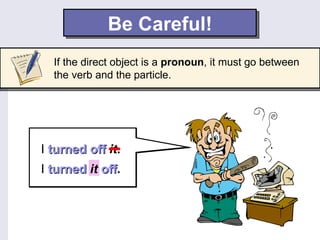
  If the direct object is a pronoun, it must go between
  the verb and the particle.


I turned off it.
I turned it off.
            off
Usage Note
     When the noun object is part of a long phrase, we
     usually do not separate the phrasal verb.


He charged the battery in
the handheld computer up.
                      up

He charged up the battery in
the handheld computer.
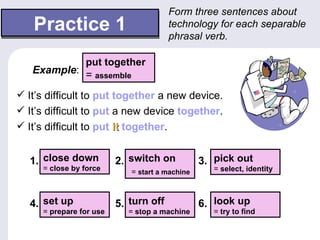
Form three sentences about
   Practice 1                          technology for each separable
                                       phrasal verb.

            put together
   Example: = assemble

 It’s difficult to put together a new device.
 It’s difficult to put a new device together.
 It’s difficult to put it together.


  1. close down          2. switch on           3. pick out
     = close by force       = start a machine      = select, identity


  4. set up              5. turn off            6. look up
     = prepare for use     = stop a machine        = try to find
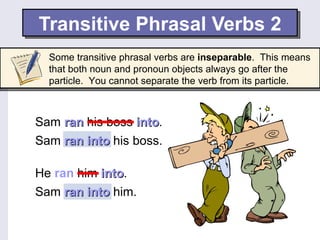
Transitive Phrasal Verbs 2
  Some transitive phrasal verbs are inseparable. This means
  that both noun and pronoun objects always go after the
  particle. You cannot separate the verb from its particle.


Sam ran his boss into.
                  into
Sam ran into his boss.

He ran him into.
           into
Sam ran into him.
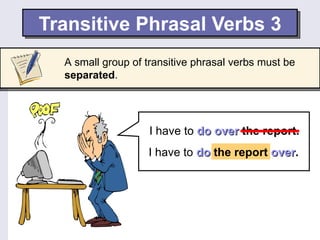
Transitive Phrasal Verbs 3
  A small group of transitive phrasal verbs must be
  separated.


                    I have to do over the report.
                   I have to do the report over.
                                           over
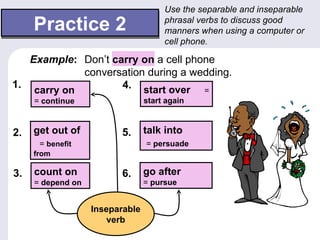
Use the separable and inseparable

     Practice 2                       phrasal verbs to discuss good
                                      manners when using a computer or
                                      cell phone.

   Example: Don’t carry on a cell phone
             conversation during a wedding.
1.                  4. start over =
    carry on
     = continue                  start again


2.   get out of          5.      talk into
      = benefit                  = persuade
     from

3.   count on            6.      go after
     = depend on                 = pursue


                   Inseparable
                       verb
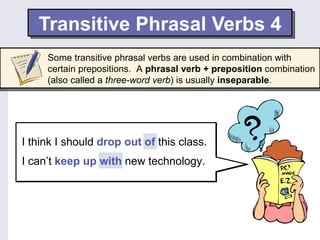
Transitive Phrasal Verbs 4
     Some transitive phrasal verbs are used in combination with
     certain prepositions. A phrasal verb + preposition combination
     (also called a three-word verb) is usually inseparable.


I think I should drop out of this class.
I can’t keep up with new technology.
Ask and answer the questions with a
   Practice 3                    partner using three-word verbs in
                                 your answers.

Example:     Is it difficult for you to keep up with new
             technology? Why or why not?
• It’s difficult to keep up with of a class?
   Have you ever dropped out
new technology because Iany good ideas this week? What
• Have you come up with
haven’t they?
   were learned to use the
old technology yet.
• Who do you usually team up with in class activities?
• If someone makes a decision that you disagree with, do
  you still go along with the decision?
• When do you get out of your classes?
• When was the last time you followed through with
  something? What was it?
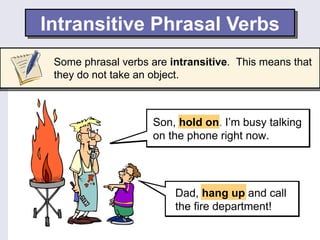
Intransitive Phrasal Verbs
 Some phrasal verbs are intransitive. This means that
 they do not take an object.


                    Son, hold on. I’m busy talking
                    on the phone right now.


                         Dad, hang up and call
                         the fire department!
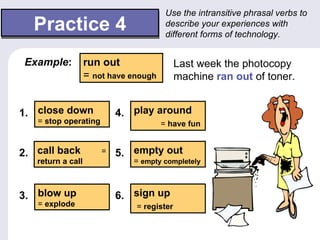
Use the intransitive phrasal verbs to
  Practice 4                            describe your experiences with
                                        different forms of technology.


 Example:          run out                  Last week the photocopy
                   = not have enough        machine ran out of toner.


1. close down              4. play around
   = stop operating                    = have fun


2. call back           =   5. empty out
   return a call              = empty completely


3. blow up                 6. sign up
   = explode                   = register
References


Copyright © 2006 Pearson Education
and its licensors. All rights reserved.

English Phrasal Verbs

  • 1.
    Phrasal Verbs: 5 Separable and Inseparable Living in the Digital Age Focus on Grammar 4 Part V, Unit 12 By Ruth Luman, Gabriele Steiner, and BJ Wells Copyright © 2006. Pearson Education, Inc. All rights reserved.
  • 2.
    Cell Phone HelpLine This is my first cell phone. I’m trying to figure it out. I looked over the directions, but I’m still confused. When I make a phone call, all the buttons on the phone light up, and I don’t know what to do. Help! Every time I want to call up someone on this cell phone, the phone cuts me off. I just heard a strange sound. I’m afraid this phone is going to blow up! Please help me out!
  • 3.
    Transitive Phrasal Verbs1 Most transitive phrasal verbs are separable. This means that noun objects can go after the particle or between the verb and the particle. He can’t figure out the instructions. noun object He can’t figure the instructions out. noun object
  • 4.
    Be Careful! If the direct object is a pronoun, it must go between the verb and the particle. I turned off it. I turned it off. off
  • 5.
    Usage Note When the noun object is part of a long phrase, we usually do not separate the phrasal verb. He charged the battery in the handheld computer up. up He charged up the battery in the handheld computer.
  • 6.
    Form three sentencesabout Practice 1 technology for each separable phrasal verb. put together Example: = assemble  It’s difficult to put together a new device.  It’s difficult to put a new device together.  It’s difficult to put it together. 1. close down 2. switch on 3. pick out = close by force = start a machine = select, identity 4. set up 5. turn off 6. look up = prepare for use = stop a machine = try to find
  • 7.
    Transitive Phrasal Verbs2 Some transitive phrasal verbs are inseparable. This means that both noun and pronoun objects always go after the particle. You cannot separate the verb from its particle. Sam ran his boss into. into Sam ran into his boss. He ran him into. into Sam ran into him.
  • 8.
    Transitive Phrasal Verbs3 A small group of transitive phrasal verbs must be separated. I have to do over the report. I have to do the report over. over
  • 9.
    Use the separableand inseparable Practice 2 phrasal verbs to discuss good manners when using a computer or cell phone. Example: Don’t carry on a cell phone conversation during a wedding. 1. 4. start over = carry on = continue start again 2. get out of 5. talk into = benefit = persuade from 3. count on 6. go after = depend on = pursue Inseparable verb
  • 10.
    Transitive Phrasal Verbs4 Some transitive phrasal verbs are used in combination with certain prepositions. A phrasal verb + preposition combination (also called a three-word verb) is usually inseparable. I think I should drop out of this class. I can’t keep up with new technology.
  • 11.
    Ask and answerthe questions with a Practice 3 partner using three-word verbs in your answers. Example: Is it difficult for you to keep up with new technology? Why or why not? • It’s difficult to keep up with of a class? Have you ever dropped out new technology because Iany good ideas this week? What • Have you come up with haven’t they? were learned to use the old technology yet. • Who do you usually team up with in class activities? • If someone makes a decision that you disagree with, do you still go along with the decision? • When do you get out of your classes? • When was the last time you followed through with something? What was it?
  • 12.
    Intransitive Phrasal Verbs Some phrasal verbs are intransitive. This means that they do not take an object. Son, hold on. I’m busy talking on the phone right now. Dad, hang up and call the fire department!
  • 13.
    Use the intransitivephrasal verbs to Practice 4 describe your experiences with different forms of technology. Example: run out Last week the photocopy = not have enough machine ran out of toner. 1. close down 4. play around = stop operating = have fun 2. call back = 5. empty out return a call = empty completely 3. blow up 6. sign up = explode = register
  • 14.
    References Copyright © 2006Pearson Education and its licensors. All rights reserved.