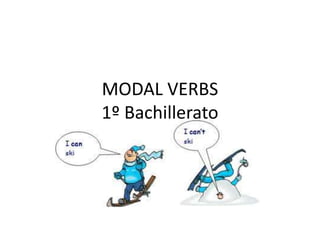
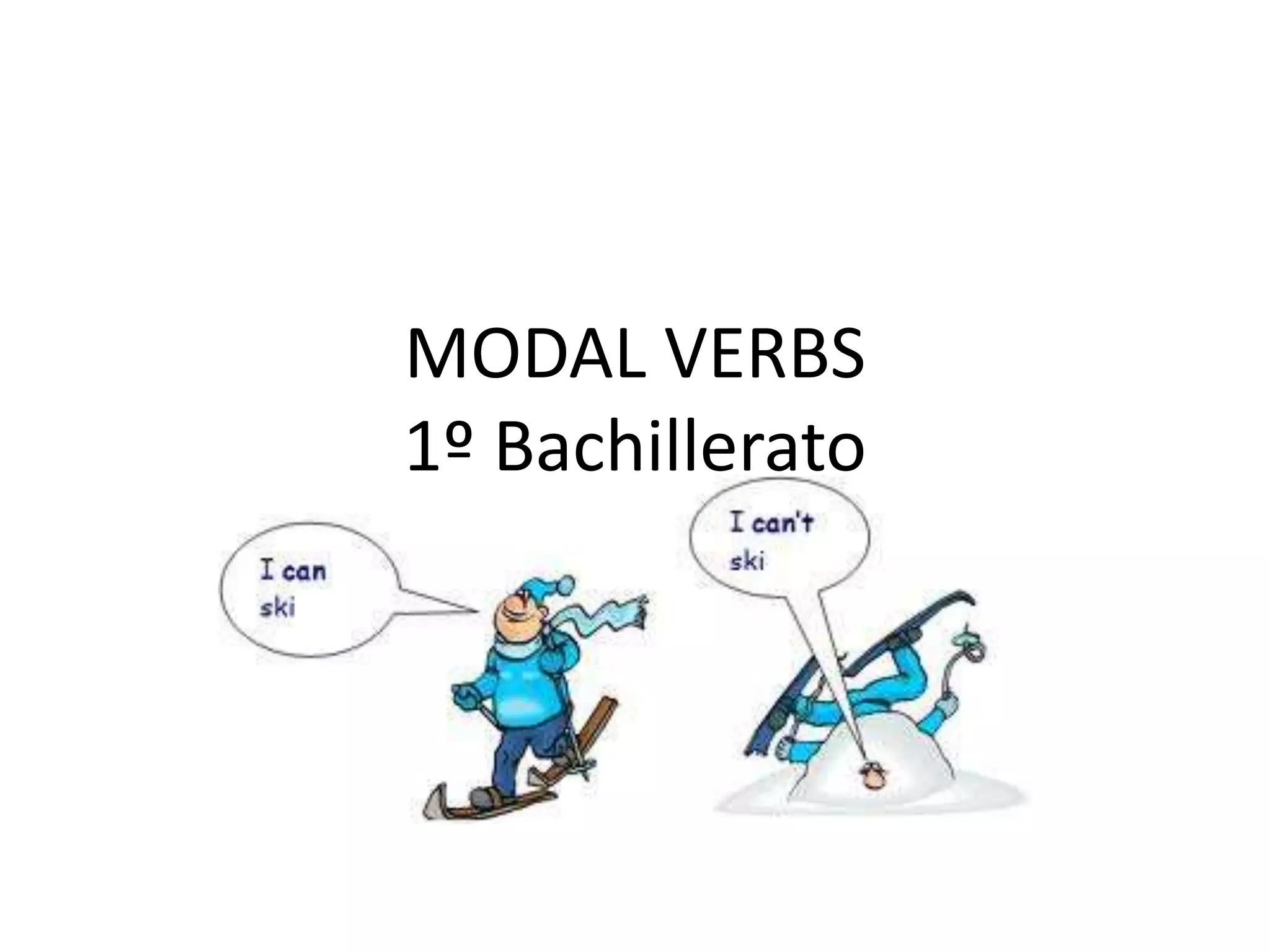
MODAL VERBS
1º Bachillerato
What is special about modal verbs?
1- Modal verbs have no -s on the third person singular.
- She can play the piano.
- He may come tomorrow.
2- Questions and negatives are made without “auxiliary
verbs”
- Can your mother drive?
- Should I dress up to go to the party?
- You shouldn’t speak like that
- You cannot smoke at school
3- They are followed by the infinitive without to of other
verbs (except “ought to”)
- She could be in Paris or London or Tokyo - nobody
knows
but - You ought to stop worrying about your weight.
4 - They have no infinitives, past participles or -
ing forms, and other expressions are used
instead.
For example we use “be able to” instead of can
Compare these examples:
- Mary can speak English very well.
- You will be able to drive a car when you are
18. (infinitive)
- I have never been able to understand my son.
(past participle)
- I love being able to get up late on Sundays. (-
ing forms)
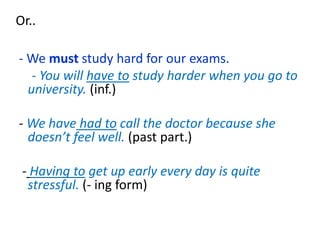
Or..
- We must study hard for our exams.
- You will have to study harder when you go to
university. (inf.)
- We have had to call the doctor because she
doesn’t feel well. (past part.)
- Having to get up early every day is quite
stressful. (- ing form)
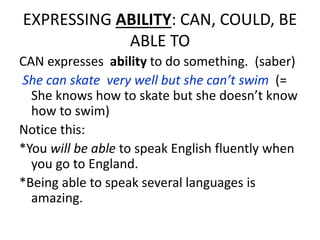
EXPRESSING ABILITY: CAN, COULD, BE
ABLE TO
CAN expresses ability to do something. (saber)
She can skate very well but she can’t swim (=
She knows how to skate but she doesn’t know
how to swim)
Notice this:
*You will be able to speak English fluently when
you go to England.
*Being able to speak several languages is
amazing.
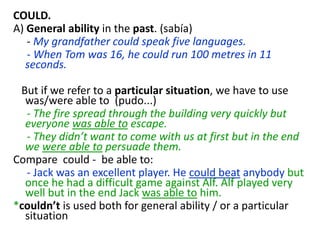
COULD.
A) General ability in the past. (sabía)
- My grandfather could speak five languages.
- When Tom was 16, he could run 100 metres in 11
seconds.
But if we refer to a particular situation, we have to use
was/were able to (pudo...)
- The fire spread through the building very quickly but
everyone was able to escape.
- They didn’t want to come with us at first but in the end
we were able to persuade them.
Compare could - be able to:
- Jack was an excellent player. He could beat anybody but
once he had a difficult game against Alf. Alf played very
well but in the end Jack was able to him.
*couldn’t is used both for general ability / or a particular
situation
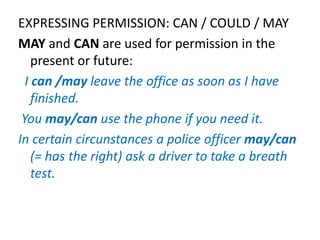
EXPRESSING PERMISSION: CAN / COULD / MAY
MAY and CAN are used for permission in the
present or future:
I can /may leave the office as soon as I have
finished.
You may/can use the phone if you need it.
In certain circunstances a police officer may/can
(= has the right) ask a driver to take a breath
test.
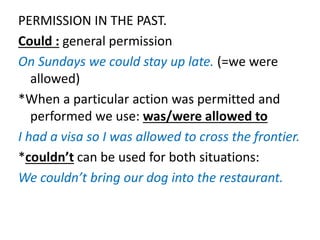
PERMISSION IN THE PAST.
Could : general permission
On Sundays we could stay up late. (=we were
allowed)
*When a particular action was permitted and
performed we use: was/were allowed to
I had a visa so I was allowed to cross the frontier.
*couldn’t can be used for both situations:
We couldn’t bring our dog into the restaurant.
REQUEST FOR PERMISSION:
Can I.. ? / Could I… ? / May I…?
Can I…? Is the most informal
Could I..? Is the most generally used
May I..? Is a little more formal
For other subjects: Can / could
Can Tom use the car whenever he likes?
Is Tom allowed to use the car whenever he likes?
Could students choose what they wanted to study?
Were students allowed to choose what they wanted
to study?
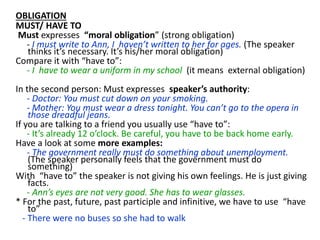
OBLIGATION
MUST/ HAVE TO
Must expresses “moral obligation” (strong obligation)
- I must write to Ann, I haven’t written to her for ages. (The speaker
thinks it’s necessary. It’s his/her moral obligation)
Compare it with “have to”:
- I have to wear a uniform in my school (it means external obligation)
In the second person: Must expresses speaker’s authority:
- Doctor: You must cut down on your smoking.
- Mother: You must wear a dress tonight. You can’t go to the opera in
those dreadful jeans.
If you are talking to a friend you usually use “have to”:
- It’s already 12 o’clock. Be careful, you have to be back home early.
Have a look at some more examples:
- The government really must do something about unemployment.
(The speaker personally feels that the government must do
something)
With “have to” the speaker is not giving his own feelings. He is just giving
facts.
- Ann’s eyes are not very good. She has to wear glasses.
* For the past, future, past participle and infinitive, we have to use “have
to”
- There were no buses so she had to walk
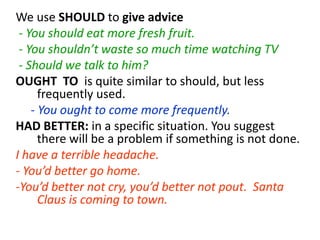
We use SHOULD to give advice
- You should eat more fresh fruit.
- You shouldn’t waste so much time watching TV
- Should we talk to him?
OUGHT TO is quite similar to should, but less
frequently used.
- You ought to come more frequently.
HAD BETTER: in a specific situation. You suggest
there will be a problem if something is not done.
I have a terrible headache.
- You’d better go home.
-You’d better not cry, you’d better not pout. Santa
Claus is coming to town.
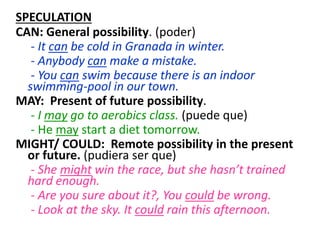
SPECULATION
CAN: General possibility. (poder)
- It can be cold in Granada in winter.
- Anybody can make a mistake.
- You can swim because there is an indoor
swimming-pool in our town.
MAY: Present of future possibility.
- I may go to aerobics class. (puede que)
- He may start a diet tomorrow.
MIGHT/ COULD: Remote possibility in the present
or future. (pudiera ser que)
- She might win the race, but she hasn’t trained
hard enough.
- Are you sure about it?, You could be wrong.
- Look at the sky. It could rain this afternoon.
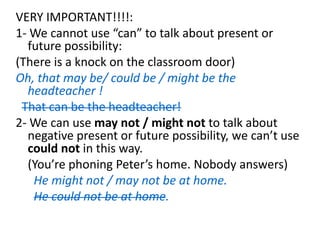
VERY IMPORTANT!!!!:
1- We cannot use “can” to talk about present or
future possibility:
(There is a knock on the classroom door)
Oh, that may be/ could be / might be the
headteacher !
That can be the headteacher!
2- We can use may not / might not to talk about
negative present or future possibility, we can’t use
could not in this way.
(You’re phoning Peter’s home. Nobody answers)
He might not / may not be at home.
He could not be at home.
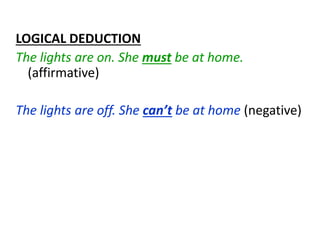
LOGICAL DEDUCTION
The lights are on. She must be at home.
(affirmative)
The lights are off. She can’t be at home (negative)
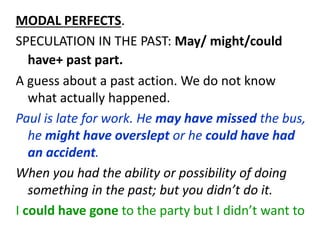
MODAL PERFECTS.
SPECULATION IN THE PAST: May/ might/could
have+ past part.
A guess about a past action. We do not know
what actually happened.
Paul is late for work. He may have missed the bus,
he might have overslept or he could have had
an accident.
When you had the ability or possibility of doing
something in the past; but you didn’t do it.
I could have gone to the party but I didn’t want to
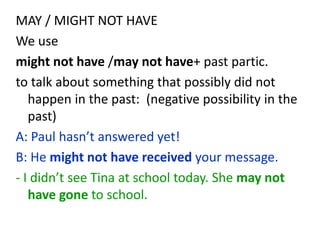
MAY / MIGHT NOT HAVE
We use
might not have /may not have+ past partic.
to talk about something that possibly did not
happen in the past: (negative possibility in the
past)
A: Paul hasn’t answered yet!
B: He might not have received your message.
- I didn’t see Tina at school today. She may not
have gone to school.
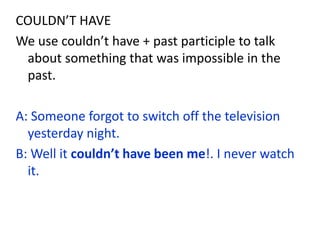
COULDN’T HAVE
We use couldn’t have + past participle to talk
about something that was impossible in the
past.
A: Someone forgot to switch off the television
yesterday night.
B: Well it couldn’t have been me!. I never watch
it.
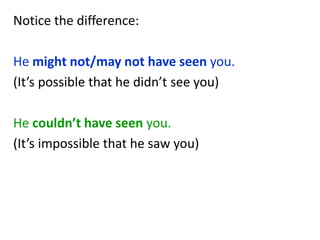
Notice the difference:
He might not/may not have seen you.
(It’s possible that he didn’t see you)
He couldn’t have seen you.
(It’s impossible that he saw you)
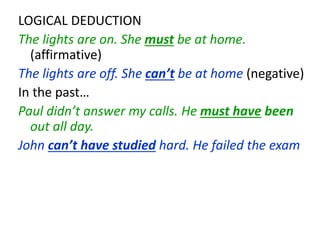
LOGICAL DEDUCTION
The lights are on. She must be at home.
(affirmative)
The lights are off. She can’t be at home (negative)
In the past…
Paul didn’t answer my calls. He must have been
out all day.
John can’t have studied hard. He failed the exam
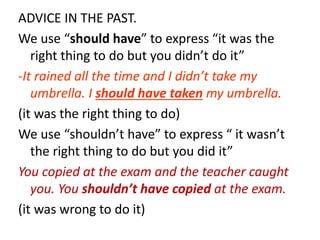
ADVICE IN THE PAST.
We use “should have” to express “it was the
right thing to do but you didn’t do it”
-It rained all the time and I didn’t take my
umbrella. I should have taken my umbrella.
(it was the right thing to do)
We use “shouldn’t have” to express “ it wasn’t
the right thing to do but you did it”
You copied at the exam and the teacher caught
you. You shouldn’t have copied at the exam.
(it was wrong to do it)

Modal verbs1b

  • 1.
  • 2.
    What is specialabout modal verbs? 1- Modal verbs have no -s on the third person singular. - She can play the piano. - He may come tomorrow. 2- Questions and negatives are made without “auxiliary verbs” - Can your mother drive? - Should I dress up to go to the party? - You shouldn’t speak like that - You cannot smoke at school 3- They are followed by the infinitive without to of other verbs (except “ought to”) - She could be in Paris or London or Tokyo - nobody knows but - You ought to stop worrying about your weight.
  • 3.
    4 - Theyhave no infinitives, past participles or - ing forms, and other expressions are used instead. For example we use “be able to” instead of can Compare these examples: - Mary can speak English very well. - You will be able to drive a car when you are 18. (infinitive) - I have never been able to understand my son. (past participle) - I love being able to get up late on Sundays. (- ing forms)
  • 4.
    Or.. - We muststudy hard for our exams. - You will have to study harder when you go to university. (inf.) - We have had to call the doctor because she doesn’t feel well. (past part.) - Having to get up early every day is quite stressful. (- ing form)
  • 5.
    EXPRESSING ABILITY: CAN,COULD, BE ABLE TO CAN expresses ability to do something. (saber) She can skate very well but she can’t swim (= She knows how to skate but she doesn’t know how to swim) Notice this: *You will be able to speak English fluently when you go to England. *Being able to speak several languages is amazing.
  • 6.
    COULD. A) General abilityin the past. (sabía) - My grandfather could speak five languages. - When Tom was 16, he could run 100 metres in 11 seconds. But if we refer to a particular situation, we have to use was/were able to (pudo...) - The fire spread through the building very quickly but everyone was able to escape. - They didn’t want to come with us at first but in the end we were able to persuade them. Compare could - be able to: - Jack was an excellent player. He could beat anybody but once he had a difficult game against Alf. Alf played very well but in the end Jack was able to him. *couldn’t is used both for general ability / or a particular situation
  • 7.
    EXPRESSING PERMISSION: CAN/ COULD / MAY MAY and CAN are used for permission in the present or future: I can /may leave the office as soon as I have finished. You may/can use the phone if you need it. In certain circunstances a police officer may/can (= has the right) ask a driver to take a breath test.
  • 8.
    PERMISSION IN THEPAST. Could : general permission On Sundays we could stay up late. (=we were allowed) *When a particular action was permitted and performed we use: was/were allowed to I had a visa so I was allowed to cross the frontier. *couldn’t can be used for both situations: We couldn’t bring our dog into the restaurant.
  • 9.
    REQUEST FOR PERMISSION: CanI.. ? / Could I… ? / May I…? Can I…? Is the most informal Could I..? Is the most generally used May I..? Is a little more formal For other subjects: Can / could Can Tom use the car whenever he likes? Is Tom allowed to use the car whenever he likes? Could students choose what they wanted to study? Were students allowed to choose what they wanted to study?
  • 10.
    OBLIGATION MUST/ HAVE TO Mustexpresses “moral obligation” (strong obligation) - I must write to Ann, I haven’t written to her for ages. (The speaker thinks it’s necessary. It’s his/her moral obligation) Compare it with “have to”: - I have to wear a uniform in my school (it means external obligation) In the second person: Must expresses speaker’s authority: - Doctor: You must cut down on your smoking. - Mother: You must wear a dress tonight. You can’t go to the opera in those dreadful jeans. If you are talking to a friend you usually use “have to”: - It’s already 12 o’clock. Be careful, you have to be back home early. Have a look at some more examples: - The government really must do something about unemployment. (The speaker personally feels that the government must do something) With “have to” the speaker is not giving his own feelings. He is just giving facts. - Ann’s eyes are not very good. She has to wear glasses. * For the past, future, past participle and infinitive, we have to use “have to” - There were no buses so she had to walk
  • 11.
    We use SHOULDto give advice - You should eat more fresh fruit. - You shouldn’t waste so much time watching TV - Should we talk to him? OUGHT TO is quite similar to should, but less frequently used. - You ought to come more frequently. HAD BETTER: in a specific situation. You suggest there will be a problem if something is not done. I have a terrible headache. - You’d better go home. -You’d better not cry, you’d better not pout. Santa Claus is coming to town.
  • 12.
    SPECULATION CAN: General possibility.(poder) - It can be cold in Granada in winter. - Anybody can make a mistake. - You can swim because there is an indoor swimming-pool in our town. MAY: Present of future possibility. - I may go to aerobics class. (puede que) - He may start a diet tomorrow. MIGHT/ COULD: Remote possibility in the present or future. (pudiera ser que) - She might win the race, but she hasn’t trained hard enough. - Are you sure about it?, You could be wrong. - Look at the sky. It could rain this afternoon.
  • 13.
    VERY IMPORTANT!!!!: 1- Wecannot use “can” to talk about present or future possibility: (There is a knock on the classroom door) Oh, that may be/ could be / might be the headteacher ! That can be the headteacher! 2- We can use may not / might not to talk about negative present or future possibility, we can’t use could not in this way. (You’re phoning Peter’s home. Nobody answers) He might not / may not be at home. He could not be at home.
  • 14.
    LOGICAL DEDUCTION The lightsare on. She must be at home. (affirmative) The lights are off. She can’t be at home (negative)
  • 15.
    MODAL PERFECTS. SPECULATION INTHE PAST: May/ might/could have+ past part. A guess about a past action. We do not know what actually happened. Paul is late for work. He may have missed the bus, he might have overslept or he could have had an accident. When you had the ability or possibility of doing something in the past; but you didn’t do it. I could have gone to the party but I didn’t want to
  • 16.
    MAY / MIGHTNOT HAVE We use might not have /may not have+ past partic. to talk about something that possibly did not happen in the past: (negative possibility in the past) A: Paul hasn’t answered yet! B: He might not have received your message. - I didn’t see Tina at school today. She may not have gone to school.
  • 17.
    COULDN’T HAVE We usecouldn’t have + past participle to talk about something that was impossible in the past. A: Someone forgot to switch off the television yesterday night. B: Well it couldn’t have been me!. I never watch it.
  • 18.
    Notice the difference: Hemight not/may not have seen you. (It’s possible that he didn’t see you) He couldn’t have seen you. (It’s impossible that he saw you)
  • 19.
    LOGICAL DEDUCTION The lightsare on. She must be at home. (affirmative) The lights are off. She can’t be at home (negative) In the past… Paul didn’t answer my calls. He must have been out all day. John can’t have studied hard. He failed the exam
  • 20.
    ADVICE IN THEPAST. We use “should have” to express “it was the right thing to do but you didn’t do it” -It rained all the time and I didn’t take my umbrella. I should have taken my umbrella. (it was the right thing to do) We use “shouldn’t have” to express “ it wasn’t the right thing to do but you did it” You copied at the exam and the teacher caught you. You shouldn’t have copied at the exam. (it was wrong to do it)