MODAL VERBS EXPRESSING PERMISSION EXPRESSING OBLIGATION EXPRESSING PROHIBITION EXPRESSING LACK OF OBLIGATION
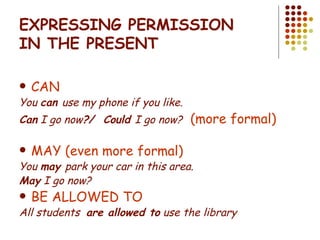
EXPRESSING PERMISSION IN THE PRESENT CAN  You  can  use my phone if you like. Can  I go now ?/  Could  I go now?   (more formal)  MAY (even more formal) You  may  park your car in this area. May  I go now? BE ALLOWED TO All students  are allowed to  use the library
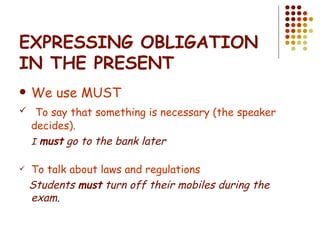
EXPRESSING OBLIGATION IN THE PRESENT We use MUST To say that something is necessary (the speaker decides). I   must  go to the bank later To talk about laws and regulations Students  must  turn off their mobiles during the exam.
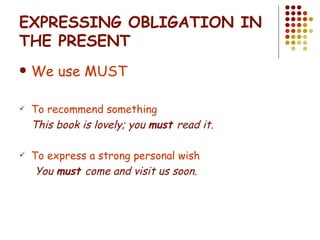
EXPRESSING OBLIGATION IN THE PRESENT We use MUST To recommend something This book is lovely; you  must  read it. To express a strong personal wish You  must  come and visit us soon.
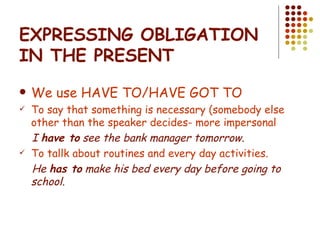
EXPRESSING OBLIGATION IN THE PRESENT We use HAVE TO/HAVE GOT TO To say that something is necessary (somebody else other than the speaker decides- more impersonal I  have to  see the bank manager tomorrow. To tallk about routines and every day activities. He  has to  make his bed every day before going to school.
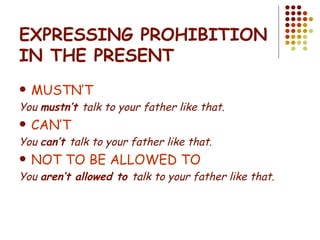
EXPRESSING PROHIBITION IN THE PRESENT MUSTN’T  You  mustn’t  talk to your father like that. CAN’T You  can’t  talk to your father like that. NOT TO BE ALLOWED TO You  aren’t allowed to  talk to your father like that.
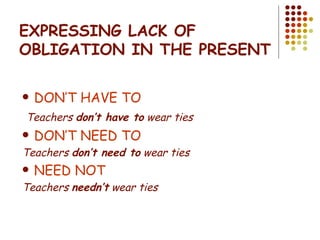
EXPRESSING LACK OF OBLIGATION IN THE PRESENT DON’T HAVE TO Teachers  don’t have to  wear ties DON’T NEED TO Teachers  don’t need to  wear ties NEED NOT Teachers  needn’t  wear ties
Some exercises…. In which of these two sentences: a) does the speaker decide for himself? b) is the speaker told by someone else? I have to take a holiday before the end of May. I must take a holiday before the end of May.
Which sentences are right and which are wrong? I’ve got to give up smoking. I’ve to give up smoking. I have to give up smoking. I often must to work until 7 o’clock at night.
Is there any difference between these sentences? You don’t have to wait. You needn’t wait. You don’t need to wait. You mustn’t wait.
Is there any difference between these sentences? You are not allowed to smoke in here. You can’t smoke in here. You don’t have to smoke in here.
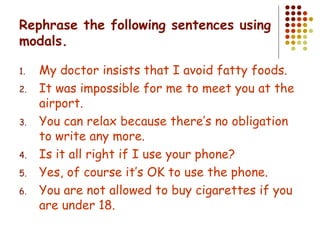
Rephrase the following sentences using modals. My doctor insists that I avoid fatty foods. It was impossible for me to meet you at the airport. You can relax because there’s no obligation to write any more. Is it all right if I use your phone? Yes, of course it’s OK to use the phone. You are not allowed to buy cigarettes if you are under 18.
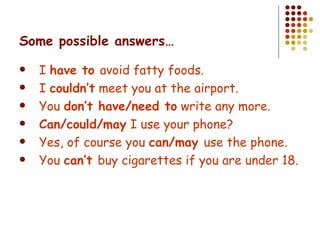
Some possible answers… I  have to  avoid fatty foods. I  couldn’t  meet you at the airport. You  don’t have/need to  write any more. Can/could/may  I use your phone? Yes, of course you  can/may  use the phone. You  can’t  buy cigarettes if you are under 18.
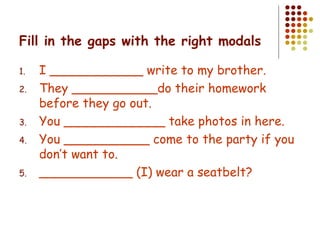
Fill in the gaps with the right modals I ____________ write to my brother. They ___________do their homework before they go out. You _____________ take photos in here. You ___________ come to the party if you don’t want to. ____________ (I) wear a seatbelt?
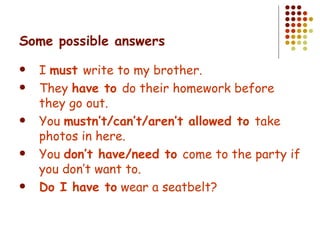
Some possible answers I  must  write to my brother. They  have to  do their homework before they go out. You  mustn’t/can’t/aren’t allowed to  take photos in here. You  don’t have/need to  come to the party if you don’t want to. Do I have to  wear a seatbelt?
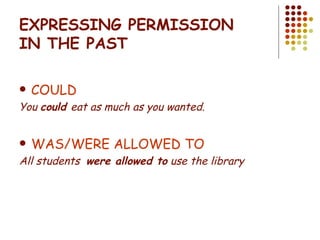
EXPRESSING PERMISSION IN THE PAST COULD You  could  eat as much as you wanted. WAS/WERE ALLOWED TO All students  were allowed to  use the library
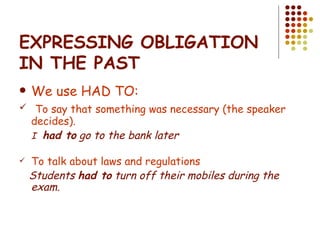
EXPRESSING OBLIGATION IN THE PAST We use HAD TO: To say that something was necessary (the speaker decides). I   had to  go to the bank later To talk about laws and regulations Students  had to  turn off their mobiles during the exam.
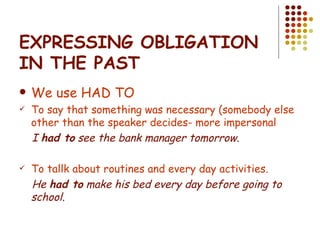
EXPRESSING OBLIGATION IN THE PAST We use HAD TO To say that something was necessary (somebody else other than the speaker decides- more impersonal I  had to  see the bank manager tomorrow. To tallk about routines and every day activities. He  had to  make his bed every day before going to school.
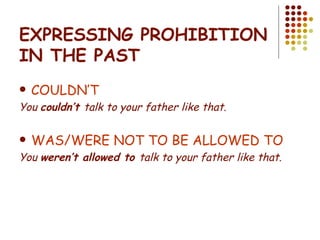
EXPRESSING PROHIBITION IN THE PAST COULDN’T You  couldn’t  talk to your father like that. WAS/WERE NOT TO BE ALLOWED TO You  weren’t allowed to  talk to your father like that.
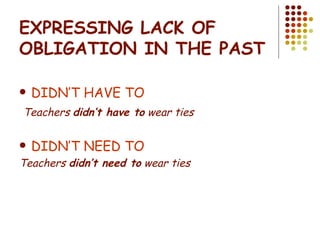
EXPRESSING LACK OF OBLIGATION IN THE PAST DIDN’T HAVE TO Teachers  didn’t have to  wear ties DIDN’T NEED TO Teachers  didn’t need to  wear ties
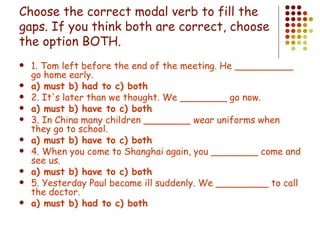
Choose the correct modal verb to fill the gaps. If you think both are correct, choose the option BOTH . 1. Tom left before the end of the meeting. He __________ go home early. a) must b) had to c) both 2. It's later than we thought. We ________ go now. a) must b) have to c) both 3. In China many children ________ wear uniforms when they go to school. a) must b) have to c) both 4. When you come to Shanghai again, you ________ come and see us. a) must b) have to c) both 5. Yesterday Paul became ill suddenly. We _________ to call the doctor. a) must b) had to c) both

Modals

  • 1.
    MODAL VERBS EXPRESSINGPERMISSION EXPRESSING OBLIGATION EXPRESSING PROHIBITION EXPRESSING LACK OF OBLIGATION
  • 2.
    EXPRESSING PERMISSION INTHE PRESENT CAN You can use my phone if you like. Can I go now ?/ Could I go now? (more formal) MAY (even more formal) You may park your car in this area. May I go now? BE ALLOWED TO All students are allowed to use the library
  • 3.
    EXPRESSING OBLIGATION INTHE PRESENT We use MUST To say that something is necessary (the speaker decides). I must go to the bank later To talk about laws and regulations Students must turn off their mobiles during the exam.
  • 4.
    EXPRESSING OBLIGATION INTHE PRESENT We use MUST To recommend something This book is lovely; you must read it. To express a strong personal wish You must come and visit us soon.
  • 5.
    EXPRESSING OBLIGATION INTHE PRESENT We use HAVE TO/HAVE GOT TO To say that something is necessary (somebody else other than the speaker decides- more impersonal I have to see the bank manager tomorrow. To tallk about routines and every day activities. He has to make his bed every day before going to school.
  • 6.
    EXPRESSING PROHIBITION INTHE PRESENT MUSTN’T You mustn’t talk to your father like that. CAN’T You can’t talk to your father like that. NOT TO BE ALLOWED TO You aren’t allowed to talk to your father like that.
  • 7.
    EXPRESSING LACK OFOBLIGATION IN THE PRESENT DON’T HAVE TO Teachers don’t have to wear ties DON’T NEED TO Teachers don’t need to wear ties NEED NOT Teachers needn’t wear ties
  • 8.
    Some exercises…. Inwhich of these two sentences: a) does the speaker decide for himself? b) is the speaker told by someone else? I have to take a holiday before the end of May. I must take a holiday before the end of May.
  • 9.
    Which sentences areright and which are wrong? I’ve got to give up smoking. I’ve to give up smoking. I have to give up smoking. I often must to work until 7 o’clock at night.
  • 10.
    Is there anydifference between these sentences? You don’t have to wait. You needn’t wait. You don’t need to wait. You mustn’t wait.
  • 11.
    Is there anydifference between these sentences? You are not allowed to smoke in here. You can’t smoke in here. You don’t have to smoke in here.
  • 12.
    Rephrase the followingsentences using modals. My doctor insists that I avoid fatty foods. It was impossible for me to meet you at the airport. You can relax because there’s no obligation to write any more. Is it all right if I use your phone? Yes, of course it’s OK to use the phone. You are not allowed to buy cigarettes if you are under 18.
  • 13.
    Some possible answers…I have to avoid fatty foods. I couldn’t meet you at the airport. You don’t have/need to write any more. Can/could/may I use your phone? Yes, of course you can/may use the phone. You can’t buy cigarettes if you are under 18.
  • 14.
    Fill in thegaps with the right modals I ____________ write to my brother. They ___________do their homework before they go out. You _____________ take photos in here. You ___________ come to the party if you don’t want to. ____________ (I) wear a seatbelt?
  • 15.
    Some possible answersI must write to my brother. They have to do their homework before they go out. You mustn’t/can’t/aren’t allowed to take photos in here. You don’t have/need to come to the party if you don’t want to. Do I have to wear a seatbelt?
  • 16.
    EXPRESSING PERMISSION INTHE PAST COULD You could eat as much as you wanted. WAS/WERE ALLOWED TO All students were allowed to use the library
  • 17.
    EXPRESSING OBLIGATION INTHE PAST We use HAD TO: To say that something was necessary (the speaker decides). I had to go to the bank later To talk about laws and regulations Students had to turn off their mobiles during the exam.
  • 18.
    EXPRESSING OBLIGATION INTHE PAST We use HAD TO To say that something was necessary (somebody else other than the speaker decides- more impersonal I had to see the bank manager tomorrow. To tallk about routines and every day activities. He had to make his bed every day before going to school.
  • 19.
    EXPRESSING PROHIBITION INTHE PAST COULDN’T You couldn’t talk to your father like that. WAS/WERE NOT TO BE ALLOWED TO You weren’t allowed to talk to your father like that.
  • 20.
    EXPRESSING LACK OFOBLIGATION IN THE PAST DIDN’T HAVE TO Teachers didn’t have to wear ties DIDN’T NEED TO Teachers didn’t need to wear ties
  • 21.
    Choose the correctmodal verb to fill the gaps. If you think both are correct, choose the option BOTH . 1. Tom left before the end of the meeting. He __________ go home early. a) must b) had to c) both 2. It's later than we thought. We ________ go now. a) must b) have to c) both 3. In China many children ________ wear uniforms when they go to school. a) must b) have to c) both 4. When you come to Shanghai again, you ________ come and see us. a) must b) have to c) both 5. Yesterday Paul became ill suddenly. We _________ to call the doctor. a) must b) had to c) both