
Purshottam, SRF,
Department of Social Work,
KUK
Perceptual organization
 It is the process by which we group outside
stimuli into recognizable and identifiable
patterns and whole objects.
 Perceptual organization is the ability to take in
visual, auditory and sensory information and
use that information effectively to accomplish a
task.
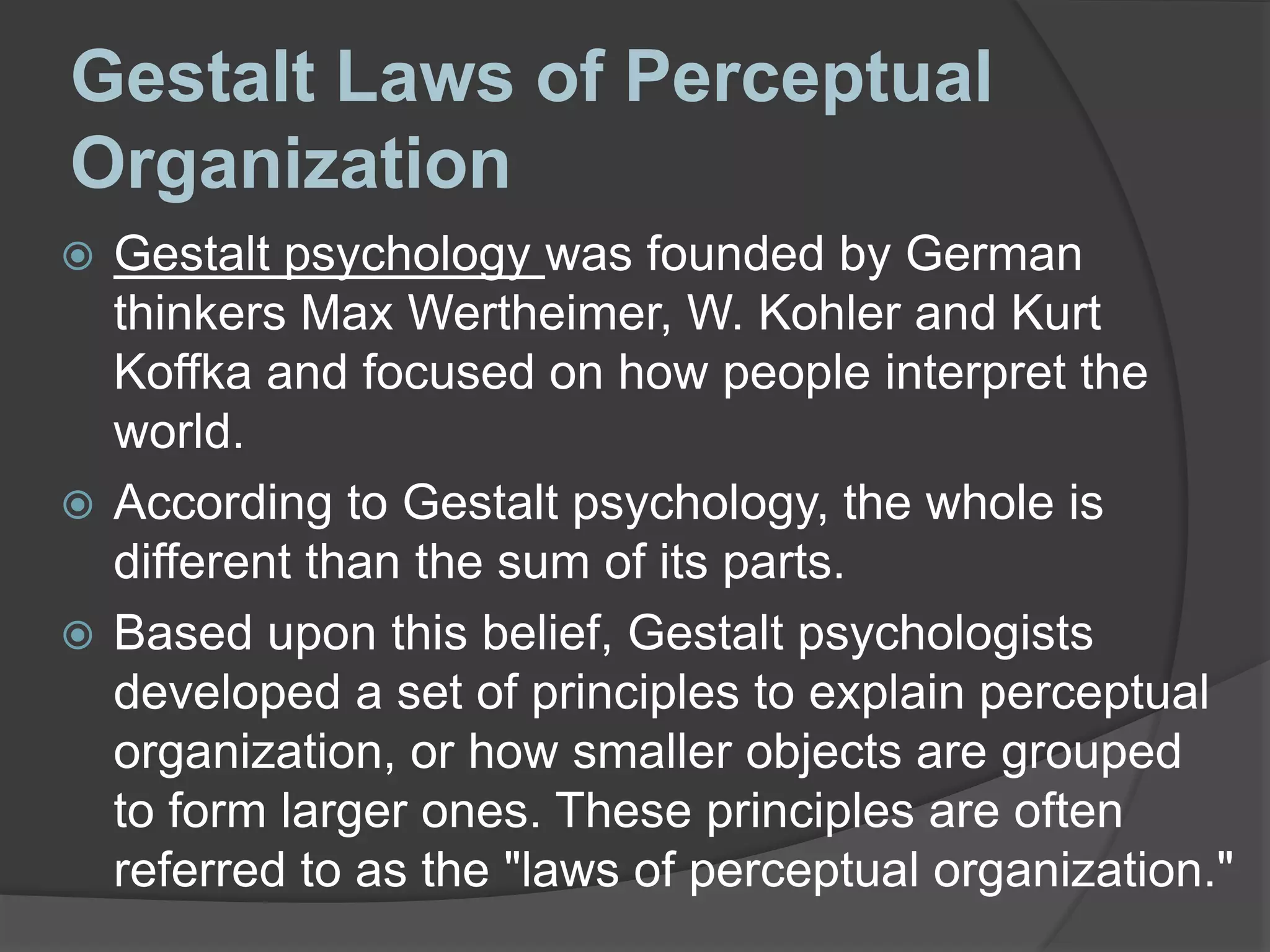
 Without perceptual organization, we would not
be able to distinguish a circle from a square.
 Certain factors are considered to be important
contributors on assembling, organizing and
categorizing information in the human brain.
2
Gestalt Laws of Perceptual
Organization
 Gestalt psychology was founded by German
thinkers Max Wertheimer, W. Kohler and Kurt
Koffka and focused on how people interpret the
world.
 According to Gestalt psychology, the whole is
different than the sum of its parts.
 Based upon this belief, Gestalt psychologists
developed a set of principles to explain perceptual
organization, or how smaller objects are grouped
to form larger ones. These principles are often
referred to as the "laws of perceptual organization."
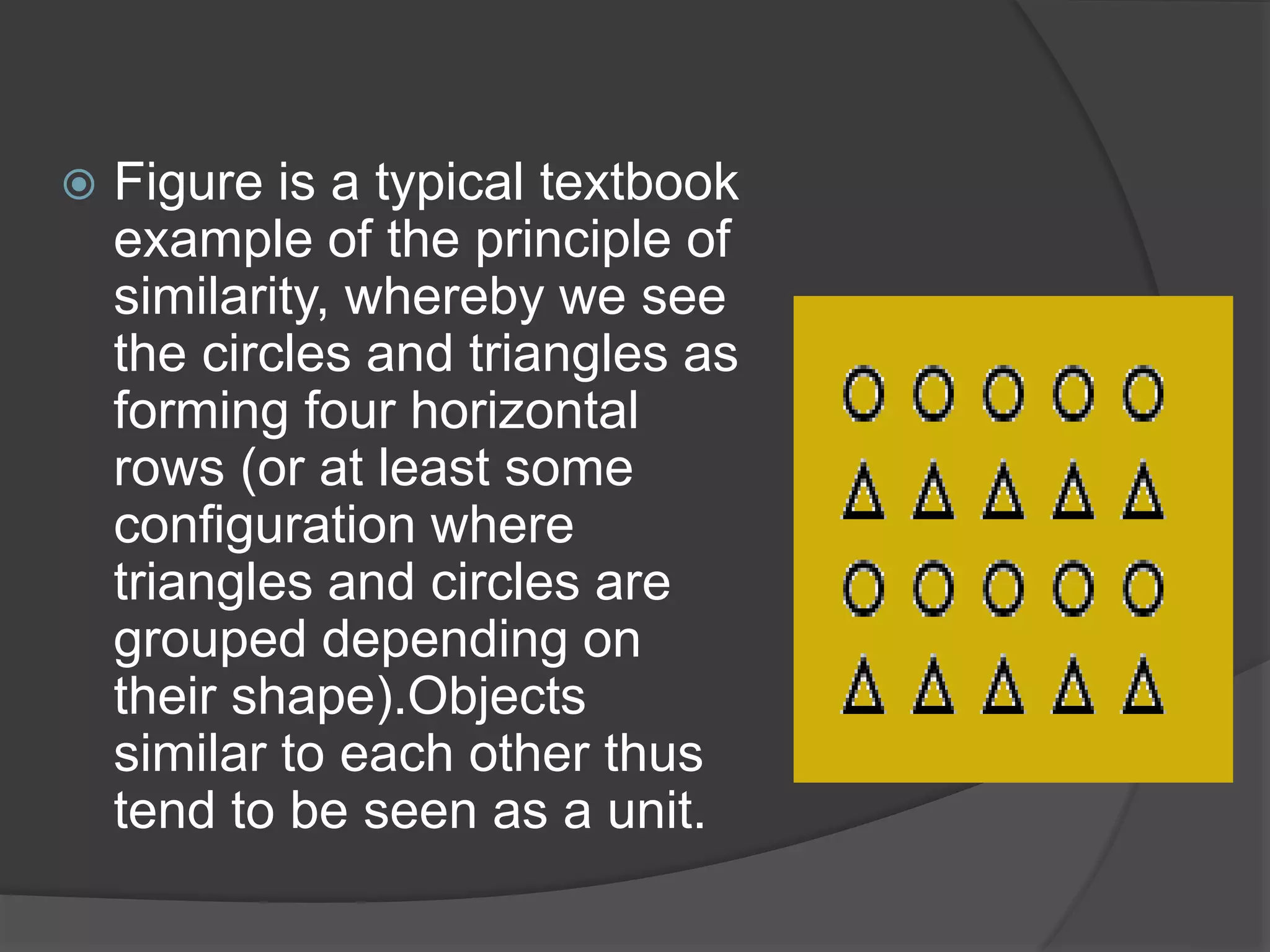
 Figure is a typical textbook
example of the principle of
similarity, whereby we see
the circles and triangles as
forming four horizontal
rows (or at least some
configuration where
triangles and circles are
grouped depending on
their shape).Objects
similar to each other thus
tend to be seen as a unit.
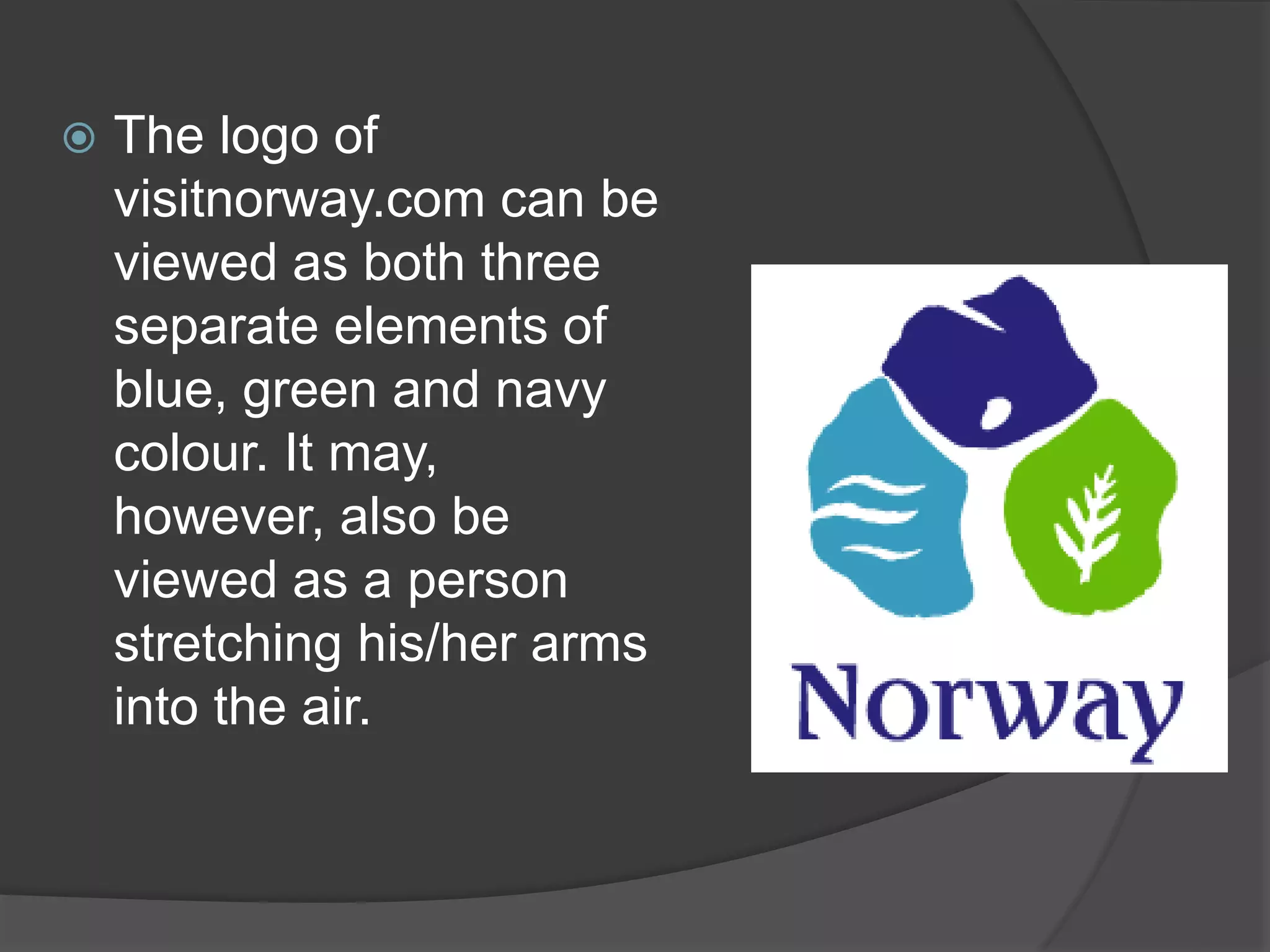
 The logo of
visitnorway.com can be
viewed as both three
separate elements of
blue, green and navy
colour. It may,
however, also be
viewed as a person
stretching his/her arms
into the air.
 We perceive the MTV logo
and the logo for the Europe
Music Awards as forming a
group in the top left corner
and the logos of the sponsors
as forming a group in the
bottom right corner. The white
space separating the two
groups of logos is used to
indicate 'grouping', and the
proximity of the logos of each
groups is thus used to this
end. Thus, a separation of
'organizers' from 'sponsors' is
achieved via structuring the
graphical layout in accordance
with this simple principle of
perceptual organization.
 The law of closure posits that
we perceptually close up, or
complete, objects that are not,
in fact, complete. In the above,
we perceive the letters 'I', 'B',
and 'M' although the shapes we
see, in fact, are only lines of
white space of differing length
hovering above each other.
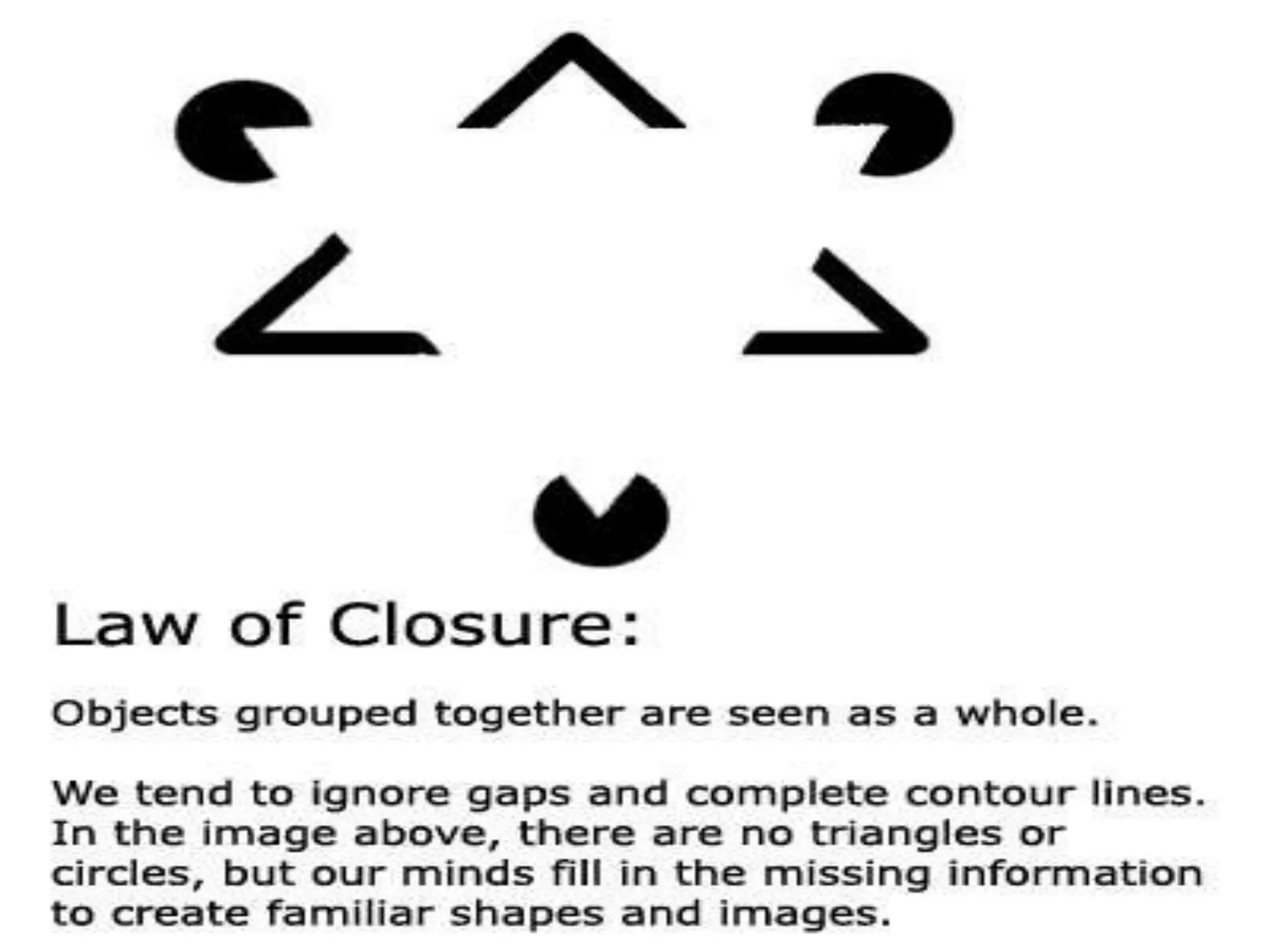
 The typical textbook example of
the law of closure; we perceive
a circle and not 8 individual
circles.
Factors influencing
Perception
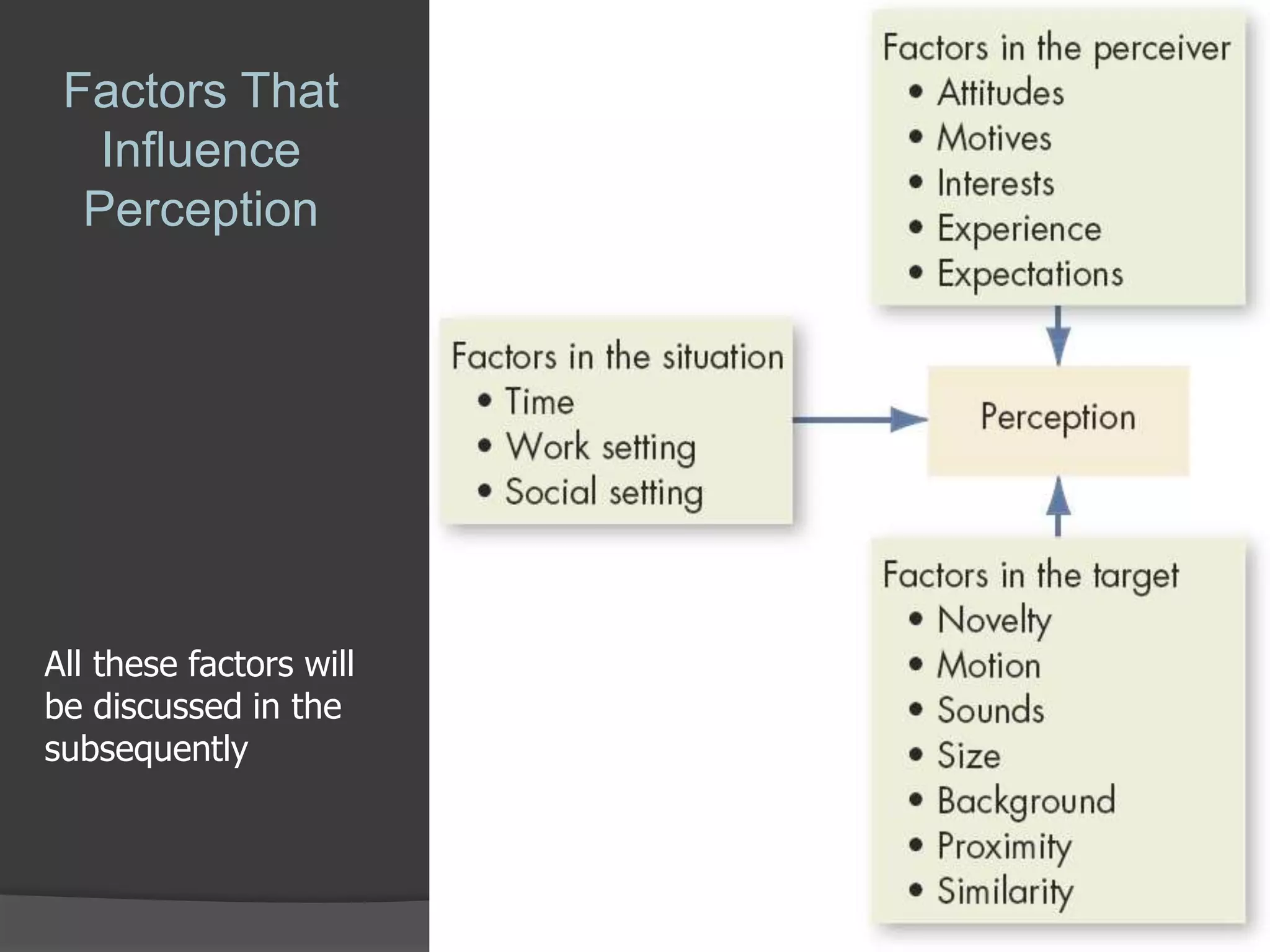
 Characteristics of the perceiver.
 Characteristics of the target.
 Characteristics of the situation.
16
Factors That
Influence
Perception
All these factors will
be discussed in the
subsequently
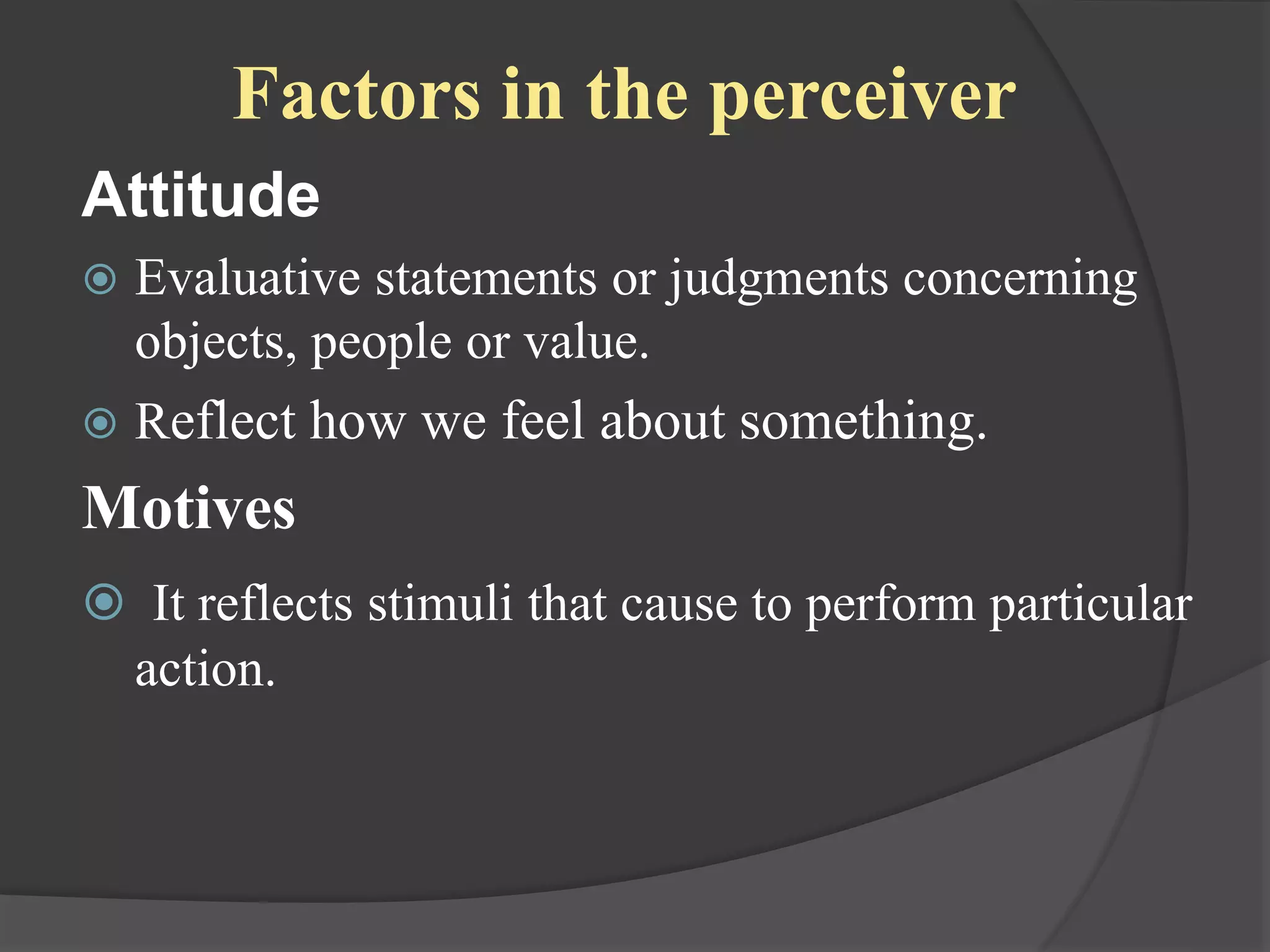
Factors in the perceiver
Attitude
 Evaluative statements or judgments concerning
objects, people or value.
 Reflect how we feel about something.
Motives
 It reflects stimuli that cause to perform particular
action.
Interest
State that power, the force, which is reflected by persons
behavior.
Expectations
 State that anticipation of a particular
behavior from a person .
 Affects what a person perceives.
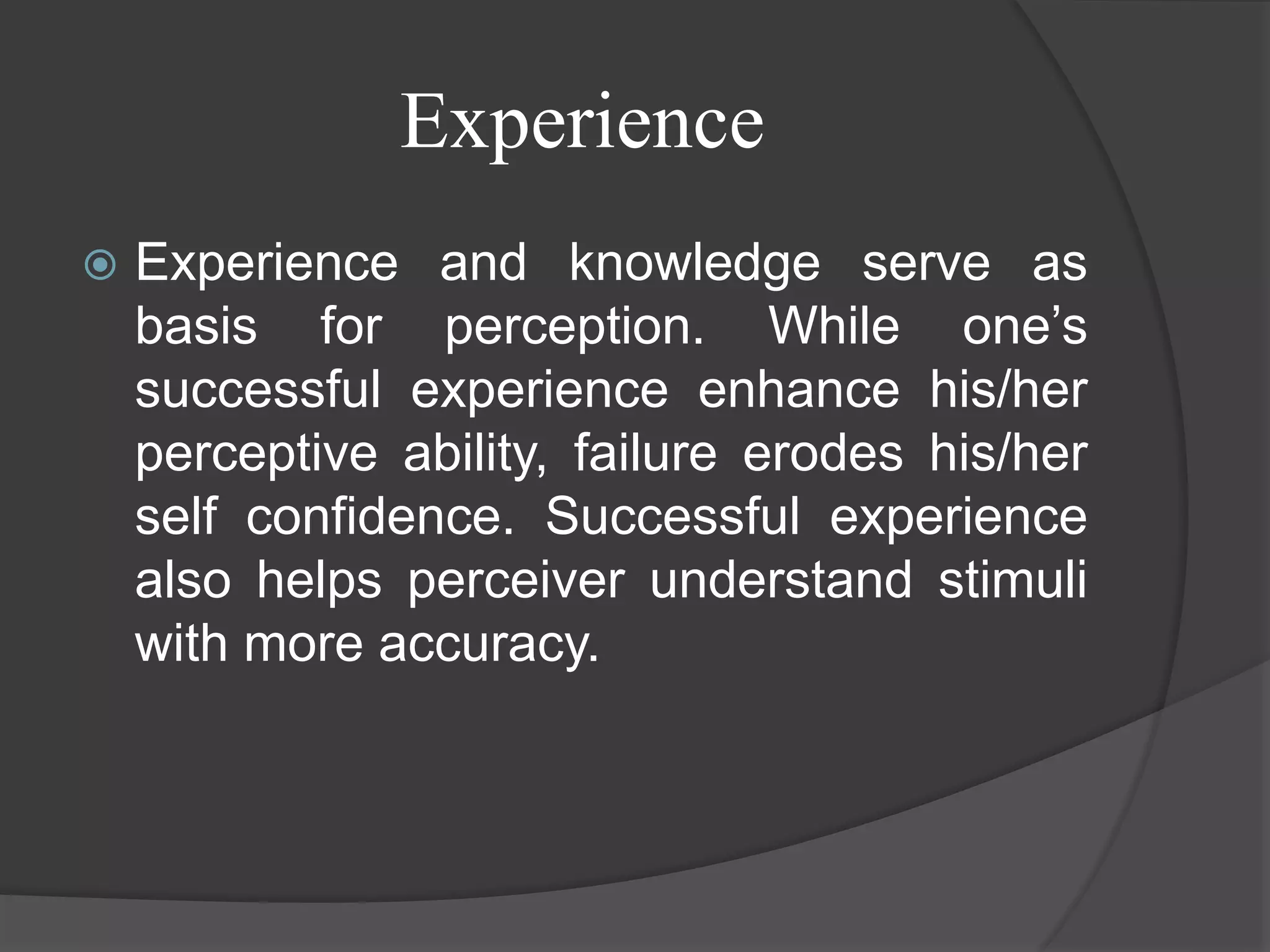
Experience
 Experience and knowledge serve as
basis for perception. While one’s
successful experience enhance his/her
perceptive ability, failure erodes his/her
self confidence. Successful experience
also helps perceiver understand stimuli
with more accuracy.
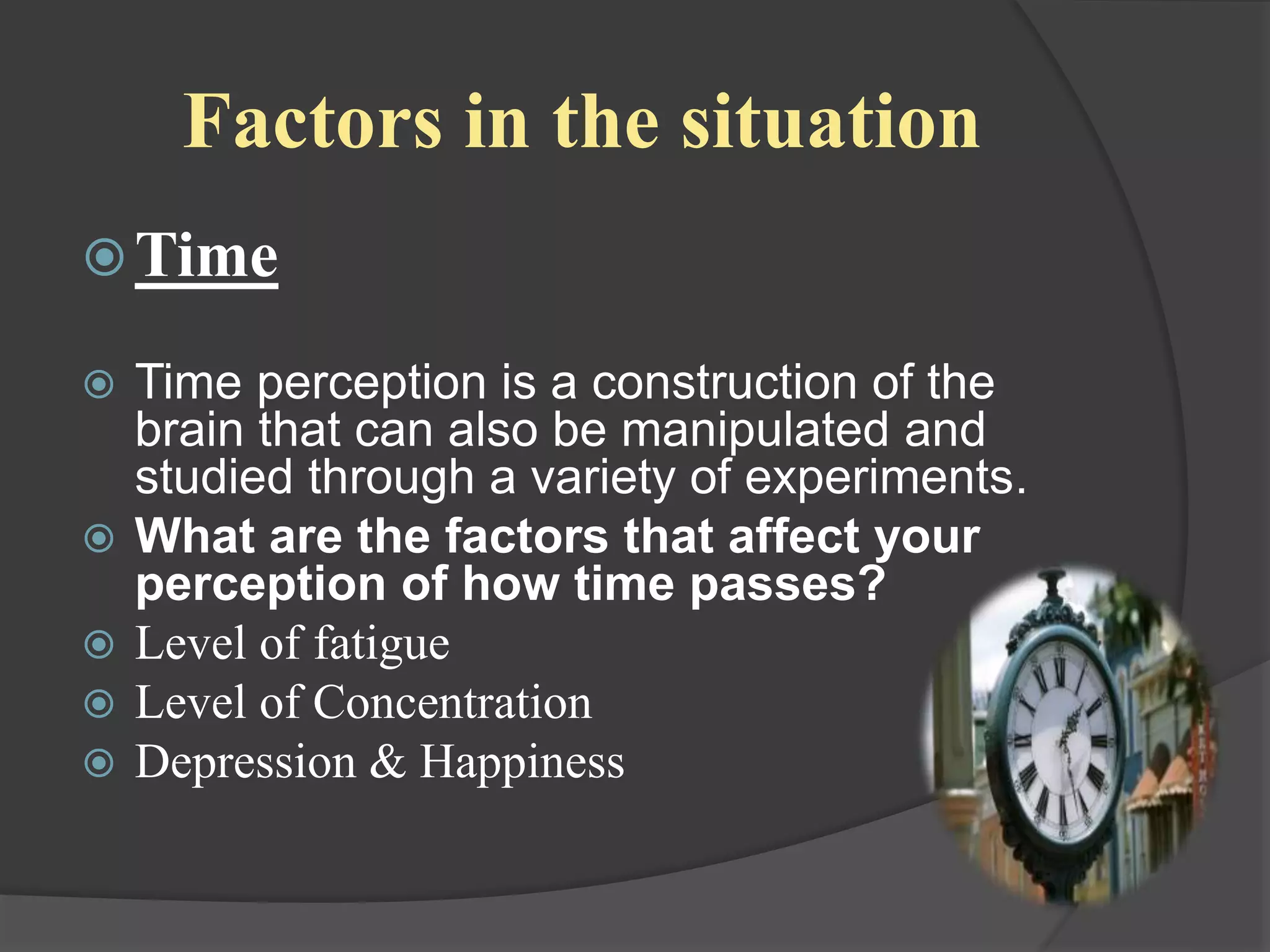
Factors in the situation
Time
 Time perception is a construction of the
brain that can also be manipulated and
studied through a variety of experiments.
 What are the factors that affect your
perception of how time passes?
 Level of fatigue
 Level of Concentration
 Depression & Happiness
Work setting
Social setting(How an individual
perceives other)
 “Social perception is that part of
perception that allows people to
understand the other people in their
social world.”
 Social perceptions can obviously be
flawed - even skilled observers can
misperceive, misjudge, and reach the
wrong conclusions.
Factors in the target
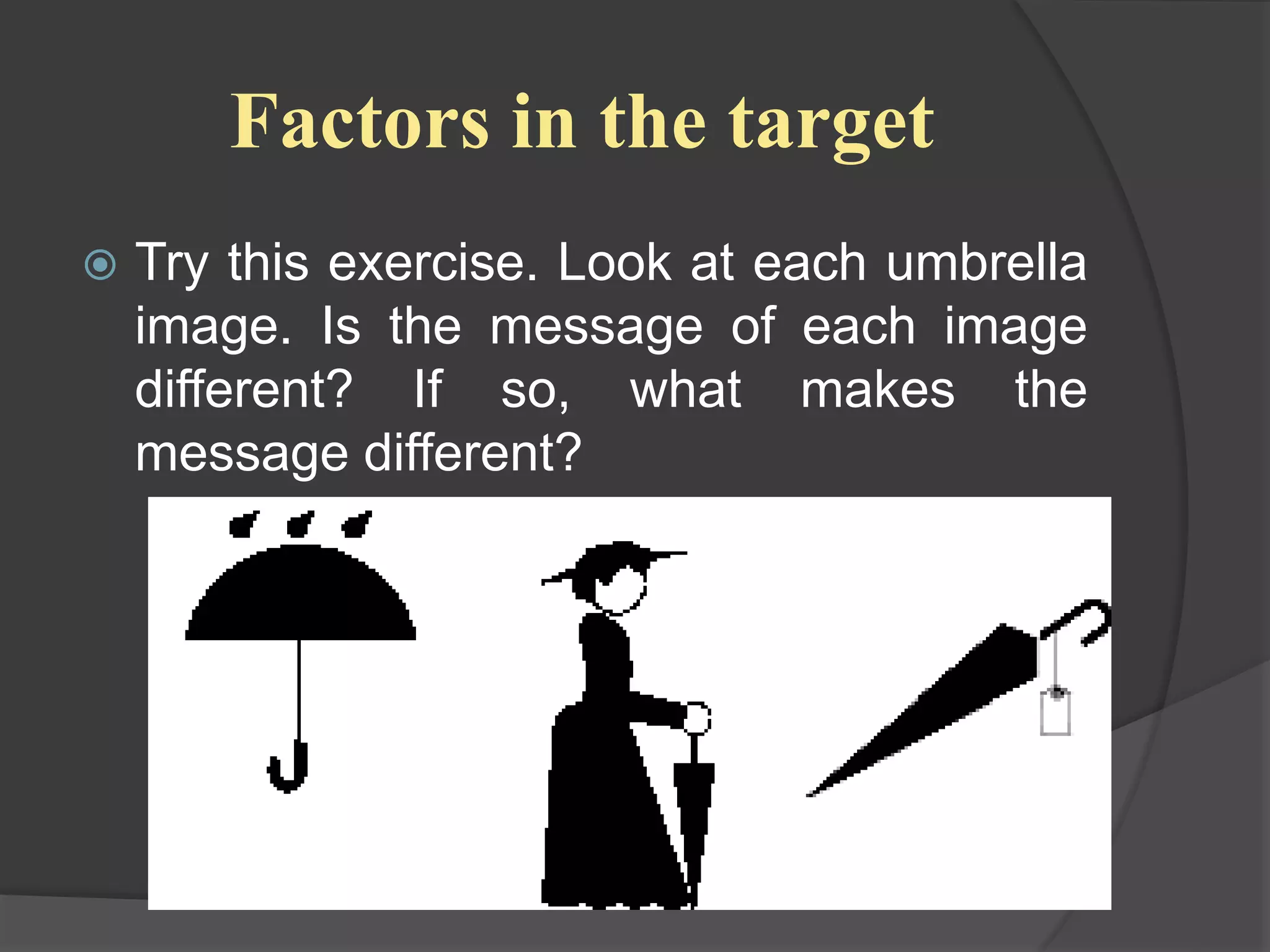
 Try this exercise. Look at each umbrella
image. Is the message of each image
different? If so, what makes the
message different?
Novelty:-
Novel or something unique or a
peculiar idea is likely to attract anyone’s
attention. white person or a black person in
India catches attention faster.
Motion
 People gives more attention to moving
objects than the stationery objects.
 Example:
 Moving object Stationery
object
Sounds
 Sound level or noise level is a physical
quantity measured with measuring
instruments.
 Furthermore, for speech, music, and
many other sounds, the physical
characteristics of the sound produce
hearing sensations in the listener. TV
advertisement, Radio advertisement
Size
Larger object is more likely to be noticed than
a smaller Object.
Example:
 Which you can read fast?
God is great God is great
Perceptual organization & factors influencing perception

Perceptual organization & factors influencing perception

  • 1.
  • 2.
    Perceptual organization  Itis the process by which we group outside stimuli into recognizable and identifiable patterns and whole objects.  Perceptual organization is the ability to take in visual, auditory and sensory information and use that information effectively to accomplish a task.  Without perceptual organization, we would not be able to distinguish a circle from a square.  Certain factors are considered to be important contributors on assembling, organizing and categorizing information in the human brain. 2
  • 3.
    Gestalt Laws ofPerceptual Organization  Gestalt psychology was founded by German thinkers Max Wertheimer, W. Kohler and Kurt Koffka and focused on how people interpret the world.  According to Gestalt psychology, the whole is different than the sum of its parts.  Based upon this belief, Gestalt psychologists developed a set of principles to explain perceptual organization, or how smaller objects are grouped to form larger ones. These principles are often referred to as the "laws of perceptual organization."
  • 5.
     Figure isa typical textbook example of the principle of similarity, whereby we see the circles and triangles as forming four horizontal rows (or at least some configuration where triangles and circles are grouped depending on their shape).Objects similar to each other thus tend to be seen as a unit.
  • 7.
     The logoof visitnorway.com can be viewed as both three separate elements of blue, green and navy colour. It may, however, also be viewed as a person stretching his/her arms into the air.
  • 9.
     We perceivethe MTV logo and the logo for the Europe Music Awards as forming a group in the top left corner and the logos of the sponsors as forming a group in the bottom right corner. The white space separating the two groups of logos is used to indicate 'grouping', and the proximity of the logos of each groups is thus used to this end. Thus, a separation of 'organizers' from 'sponsors' is achieved via structuring the graphical layout in accordance with this simple principle of perceptual organization.
  • 15.
     The lawof closure posits that we perceptually close up, or complete, objects that are not, in fact, complete. In the above, we perceive the letters 'I', 'B', and 'M' although the shapes we see, in fact, are only lines of white space of differing length hovering above each other.  The typical textbook example of the law of closure; we perceive a circle and not 8 individual circles.
  • 16.
    Factors influencing Perception  Characteristicsof the perceiver.  Characteristics of the target.  Characteristics of the situation. 16
  • 17.
    Factors That Influence Perception All thesefactors will be discussed in the subsequently
  • 18.
    Factors in theperceiver Attitude  Evaluative statements or judgments concerning objects, people or value.  Reflect how we feel about something. Motives  It reflects stimuli that cause to perform particular action.
  • 19.
    Interest State that power,the force, which is reflected by persons behavior.
  • 20.
    Expectations  State thatanticipation of a particular behavior from a person .  Affects what a person perceives.
  • 21.
    Experience  Experience andknowledge serve as basis for perception. While one’s successful experience enhance his/her perceptive ability, failure erodes his/her self confidence. Successful experience also helps perceiver understand stimuli with more accuracy.
  • 22.
    Factors in thesituation Time  Time perception is a construction of the brain that can also be manipulated and studied through a variety of experiments.  What are the factors that affect your perception of how time passes?  Level of fatigue  Level of Concentration  Depression & Happiness
  • 23.
  • 24.
    Social setting(How anindividual perceives other)  “Social perception is that part of perception that allows people to understand the other people in their social world.”  Social perceptions can obviously be flawed - even skilled observers can misperceive, misjudge, and reach the wrong conclusions.
  • 25.
    Factors in thetarget  Try this exercise. Look at each umbrella image. Is the message of each image different? If so, what makes the message different?
  • 26.
    Novelty:- Novel or somethingunique or a peculiar idea is likely to attract anyone’s attention. white person or a black person in India catches attention faster.
  • 27.
    Motion  People givesmore attention to moving objects than the stationery objects.  Example:  Moving object Stationery object
  • 28.
    Sounds  Sound levelor noise level is a physical quantity measured with measuring instruments.  Furthermore, for speech, music, and many other sounds, the physical characteristics of the sound produce hearing sensations in the listener. TV advertisement, Radio advertisement
  • 29.
    Size Larger object ismore likely to be noticed than a smaller Object. Example:  Which you can read fast? God is great God is great