CHILDHOOD
Purshottam
R/S Department of Social Work
KUK
• Childhood begins when the relative
dependency of babyhood is over, at
approximately the age of two years , and
extends to the time when the child becomes
sexually mature, at approximately thirteen
years for the average girl and fourteen years
for the average boy.
• After children becomes sexually mature, they
are known as adolescents.
• It is the time when marked changes take place
in the child both physically and
psychologically.
• Today it is widely recognised that childhood
should be subdivided into two separate
periods- Early and Late childhood.
• Early childhood extends from two to six years,
late childhood extends from six to the time
the child becomes sexually mature.
What is Early Childhood
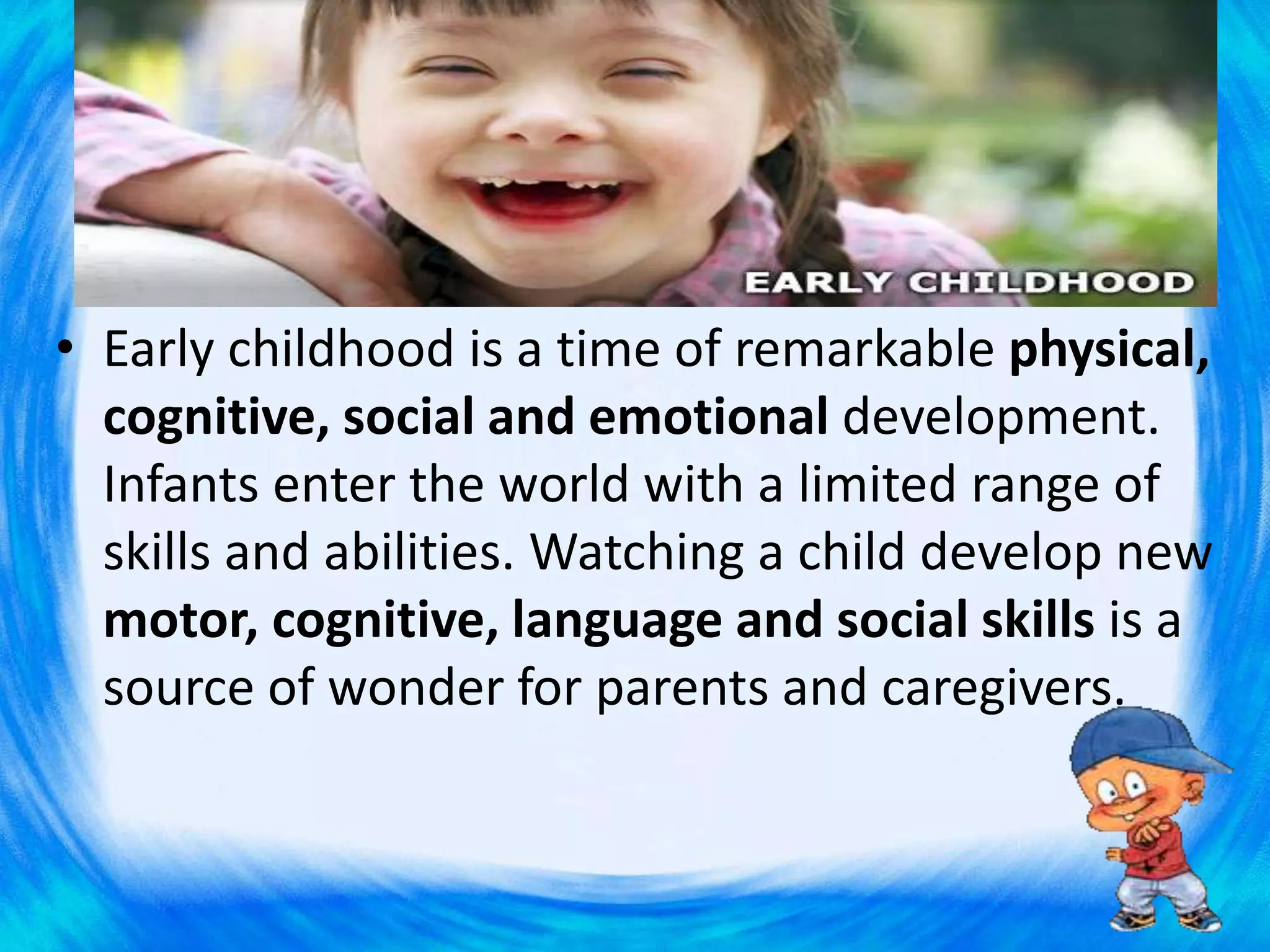
• Early childhood is a time of remarkable physical,
cognitive, social and emotional development.
Infants enter the world with a limited range of
skills and abilities. Watching a child develop new
motor, cognitive, language and social skills is a
source of wonder for parents and caregivers.
Late Childhood:
• The period of late childhood ranges from 6 years
to the attainment of sexual maturity, around 12-
13 years.
• During this stage children develop marked
negativism and because of their desire for
independence seldom obey the parents.
• The child begins going to school and learns the
rudiments of knowledge essential for successful
adult life.
• The peer group has great importance in this
period.
CHARACTERISTICS OF EARLY
CHILDHOOD
Names used by parents:
• Most parents consider early childhood a
problem age or a troublesome age.
• in childhood, behavior problems become
more frequent
• They are demanding an independence which,
in most cases, they are incapable of handling
successfully. So they are often obstinate,
disobedient, negativistic.
• toy age
• Name by Educator: preschool age
Names used by psychologists:
• Psychologists use a number of different
names to describe the outstanding
characteristics of the psychological
development of children during the early
years of childhood.
• Most commonly applied names is the pre
gang age. The time when children are
learning the foundations of social behavior as
a preparation for the more highly organized
social life.
• Many psychologist refer to early childhood as
the exploratory age. One common way of
exploring in early childhood is by asking
questions; thus this period is often referred to
as the Questioning age.
• It is also known as the imitative age.
• More children show more creativity in their
play during early childhood than at any other
time in their lives. For that reason,
psychologists also regard it as the creative
age.
Characteristics of late childhood:
• Names used by Parents: troublesome age
• Names used by Educators: elementary school
age. Critical period…
• Names used by Psychologists: gang age, play
age..
PHYSICAL DEVELOPMENT IN
EARLY CHILDHOOD
I. BODY GROWRTH
• Compared to the rapid physical development
in babyhood, there is a slow down.
• Body proportions are evened out and the head
heavy look is lost.
• Weight gain of about 2 kg per year and an
additional 3 inches of height are gained on an
average.
• Milk teeth are lost and the chubbiness of
babyhood is replaced by a skinny look.
Skills of Early Childhood:
• The young children learn and master a
variety of skills because their immense
curiosity gets them to manipulate and learn.
• Depending on the environmental
opportunities and the family background
children learn a variety of skills.
• Bathing, dressing, combing hair and tying shoe
laces. Catching and throwing a ball, use of
scissors, painting, colouring and drawing all
become a part of early childhood years.
• Skipping, jumping, running, climbing up and
down the stairs show the progress made by
the child.
• Cycling, swimming, skating, walking on the
walls are all activities enjoyed greatly by the
children at this stage.
Speech development:
• Normal speech development
• Learn proper pronunciation
• Making of sentences(even though with poor
grammar)
• Building of vocabulary
Emotional development:
• Emotions during early childhood are intense
with frequent emotional outbursts.
• Temper, jealousies
Developmental tasks of Late Childhood:
• Physical development: there is relatively uniform
but slow physical development. Long arms and
legs giving awkward appearance. Teeth begins to
fall and replaced by permanent teeth except
wisdom teeth.
• Speech development: speech is improved from
immature and unacceptable ways of
communication. Improvement in vocabulary.
• Emotions during late childhood: learn to control
emotional outbursts. Happy and pleasant
expressions expressed by laughing, jumping. Boys
show anger or curiosity while girls experience
fears, worries and feeling of affection.
Social development: the older child shows
strong desire to be an accepted member of
the peer group. Staying at home or playing
with siblings are disliked by them. The main
activity of gangs is to play games, sports and
simply chatting.
Play activities: play for the older child is not a
mere amusement, it is the chief instrument of
socializing which provides opportunities for
social skills.
• Improvement of understanding: the older
child is now in a stage where concepts
become specific and concrete. Cognitive
development. The school plays an important
role in building, improving and clarifying
concepts. They begins to understand social
dimensions of concepts.
• Moral Behavior: the code of conduct and
morality learnt at home is now extended to
the social group. Discipline also helps in this
process. Use of rewards, punishment and
consistent application of rules enables the
child to develop moral behaviour.
HAZARDS OF EARLY CHILDHOOD
Hazards of early childhood:
• Physical hazards such as illness, accidents..
• Serious and prolonged illness restricts the child
and deprives him/her of opportunities and
hence affects him/her psychologically by affecting
adjustments made by the child.
There are also several situations, which threaten
the degree of social adjustment of the child. Such
situations arise from:
Speech and behaviour of the child, if unpopular,
then he/ she is isolated and lacks the opportunity
to learn in the peer group situation.
 Unpleasant social situations.
Those children, who play extensively with
imaginary playmates or pets, tend to be
dominating. This may result in social
maladjustment.
Children who have too many playmates all the
time, do not learn how to handle the situation
when they are alone and hence become
lonely
Moral development:
a) Parents who teach the children right from wrong
must be consistent. Children get confused when
adults teach them that what was wrong
yesterday is considered right today.
b) Inconsistency between two adults also confuse
children.
c) If the mistake of the child is punished by parents
but approved and appreciated by others,
specially peers, then the child has a positive
attitude towards wrong behaviour.
d) Therefore not only the mistake, but also the
attitude towards it needs to be checked.
PEER RELATIONS
Peers - children of about the same
age or maturity.
The peer group provides a source of
information and comparison about
the world outside the family.
Children receive feedback on their
abilities from peers.
Good peer relations appear to be necessary
for normal social development.
Children who are rejected by peers are at risk
for depression.
 Aggressive children are at risk for many
problems.
Hazards in Late Childhood:
Physical hazards:
• Illness
• Obesity
• Sex- inappropriate body build
• Accidents
Psychological hazards:
• Speech, emotional, social, play and family-
relationship hazards..
THANK YOU!!!

Early childhood

  • 1.
  • 2.
    • Childhood beginswhen the relative dependency of babyhood is over, at approximately the age of two years , and extends to the time when the child becomes sexually mature, at approximately thirteen years for the average girl and fourteen years for the average boy. • After children becomes sexually mature, they are known as adolescents. • It is the time when marked changes take place in the child both physically and psychologically.
  • 3.
    • Today itis widely recognised that childhood should be subdivided into two separate periods- Early and Late childhood. • Early childhood extends from two to six years, late childhood extends from six to the time the child becomes sexually mature.
  • 4.
    What is EarlyChildhood
  • 5.
    • Early childhoodis a time of remarkable physical, cognitive, social and emotional development. Infants enter the world with a limited range of skills and abilities. Watching a child develop new motor, cognitive, language and social skills is a source of wonder for parents and caregivers.
  • 6.
    Late Childhood: • Theperiod of late childhood ranges from 6 years to the attainment of sexual maturity, around 12- 13 years. • During this stage children develop marked negativism and because of their desire for independence seldom obey the parents. • The child begins going to school and learns the rudiments of knowledge essential for successful adult life. • The peer group has great importance in this period.
  • 7.
  • 8.
    Names used byparents: • Most parents consider early childhood a problem age or a troublesome age. • in childhood, behavior problems become more frequent • They are demanding an independence which, in most cases, they are incapable of handling successfully. So they are often obstinate, disobedient, negativistic. • toy age • Name by Educator: preschool age
  • 9.
    Names used bypsychologists: • Psychologists use a number of different names to describe the outstanding characteristics of the psychological development of children during the early years of childhood. • Most commonly applied names is the pre gang age. The time when children are learning the foundations of social behavior as a preparation for the more highly organized social life.
  • 11.
    • Many psychologistrefer to early childhood as the exploratory age. One common way of exploring in early childhood is by asking questions; thus this period is often referred to as the Questioning age. • It is also known as the imitative age. • More children show more creativity in their play during early childhood than at any other time in their lives. For that reason, psychologists also regard it as the creative age.
  • 13.
    Characteristics of latechildhood: • Names used by Parents: troublesome age • Names used by Educators: elementary school age. Critical period… • Names used by Psychologists: gang age, play age..
  • 14.
  • 15.
    I. BODY GROWRTH •Compared to the rapid physical development in babyhood, there is a slow down. • Body proportions are evened out and the head heavy look is lost. • Weight gain of about 2 kg per year and an additional 3 inches of height are gained on an average. • Milk teeth are lost and the chubbiness of babyhood is replaced by a skinny look.
  • 16.
    Skills of EarlyChildhood: • The young children learn and master a variety of skills because their immense curiosity gets them to manipulate and learn. • Depending on the environmental opportunities and the family background children learn a variety of skills. • Bathing, dressing, combing hair and tying shoe laces. Catching and throwing a ball, use of scissors, painting, colouring and drawing all become a part of early childhood years.
  • 17.
    • Skipping, jumping,running, climbing up and down the stairs show the progress made by the child. • Cycling, swimming, skating, walking on the walls are all activities enjoyed greatly by the children at this stage.
  • 18.
    Speech development: • Normalspeech development • Learn proper pronunciation • Making of sentences(even though with poor grammar) • Building of vocabulary Emotional development: • Emotions during early childhood are intense with frequent emotional outbursts. • Temper, jealousies
  • 19.
    Developmental tasks ofLate Childhood: • Physical development: there is relatively uniform but slow physical development. Long arms and legs giving awkward appearance. Teeth begins to fall and replaced by permanent teeth except wisdom teeth. • Speech development: speech is improved from immature and unacceptable ways of communication. Improvement in vocabulary. • Emotions during late childhood: learn to control emotional outbursts. Happy and pleasant expressions expressed by laughing, jumping. Boys show anger or curiosity while girls experience fears, worries and feeling of affection.
  • 20.
    Social development: theolder child shows strong desire to be an accepted member of the peer group. Staying at home or playing with siblings are disliked by them. The main activity of gangs is to play games, sports and simply chatting. Play activities: play for the older child is not a mere amusement, it is the chief instrument of socializing which provides opportunities for social skills.
  • 21.
    • Improvement ofunderstanding: the older child is now in a stage where concepts become specific and concrete. Cognitive development. The school plays an important role in building, improving and clarifying concepts. They begins to understand social dimensions of concepts. • Moral Behavior: the code of conduct and morality learnt at home is now extended to the social group. Discipline also helps in this process. Use of rewards, punishment and consistent application of rules enables the child to develop moral behaviour.
  • 22.
  • 23.
    Hazards of earlychildhood: • Physical hazards such as illness, accidents.. • Serious and prolonged illness restricts the child and deprives him/her of opportunities and hence affects him/her psychologically by affecting adjustments made by the child. There are also several situations, which threaten the degree of social adjustment of the child. Such situations arise from: Speech and behaviour of the child, if unpopular, then he/ she is isolated and lacks the opportunity to learn in the peer group situation.
  • 24.
     Unpleasant socialsituations. Those children, who play extensively with imaginary playmates or pets, tend to be dominating. This may result in social maladjustment. Children who have too many playmates all the time, do not learn how to handle the situation when they are alone and hence become lonely
  • 25.
    Moral development: a) Parentswho teach the children right from wrong must be consistent. Children get confused when adults teach them that what was wrong yesterday is considered right today. b) Inconsistency between two adults also confuse children. c) If the mistake of the child is punished by parents but approved and appreciated by others, specially peers, then the child has a positive attitude towards wrong behaviour. d) Therefore not only the mistake, but also the attitude towards it needs to be checked.
  • 26.
    PEER RELATIONS Peers -children of about the same age or maturity. The peer group provides a source of information and comparison about the world outside the family. Children receive feedback on their abilities from peers.
  • 27.
    Good peer relationsappear to be necessary for normal social development. Children who are rejected by peers are at risk for depression.  Aggressive children are at risk for many problems.
  • 28.
    Hazards in LateChildhood: Physical hazards: • Illness • Obesity • Sex- inappropriate body build • Accidents Psychological hazards: • Speech, emotional, social, play and family- relationship hazards..
  • 29.