ByMridu Agarwal
Section C,
CD
• Gestalt theory originated in Austria and Germany toward
the end of the 19th century. Since then, Gestalt theory has
has become fundamental to several related disciplines,
including art, graphic design, web design and interior
design.
• Gestalt theory focuses on
the mind’s perceptive
processes
• The word "Gestalt" has no
direct translation in
English, but refers to "a
way a thing has been
gestellt ; i.e., ‘placed,’ or
‘put together’";
• common translations
include "form" and "shape"
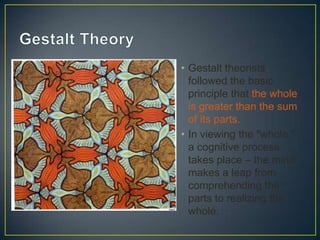
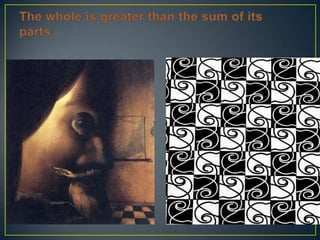
• Gestalt theorists
followed the basic
principle that the whole
is greater than the sum
of its parts.
• In viewing the "whole,"
a cognitive process
takes place – the mind
makes a leap from
comprehending the
parts to realizing the
whole.
• When you look at
the environment,
you look at it as a
whole picture, not
separate parts.
• There are images in
the environment that
people are aware,
this would be the
figure.
• Images people are
not aware of make
up the ground
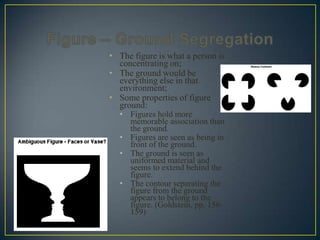
• The figure is what a person is
concentrating on;
• The ground would be
everything else in that
environment;
• Some properties of figure
ground:
• Figures hold more
memorable association than
the ground.
• Figures are seen as being in
front of the ground.
• The ground is seen as
uniformed material and
seems to extend behind the
figure.
• The contour separating the
figure from the ground
appears to belong to the
figure. (Goldstein, pp. 156159)
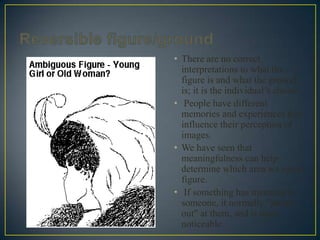
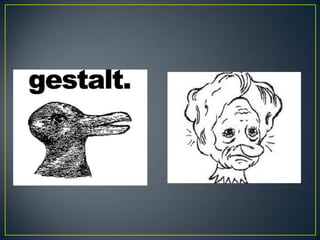
• There are no correct
interpretations to what the
figure is and what the ground
is; it is the individual’s choice.
• People have different
memories and experiences that
influence their perception of
images.
• We have seen that
meaningfulness can help
determine which area we see as
figure.
• If something has meaning to
someone, it normally "jumps
out" at them, and is more
noticeable
1.
2.
3.

4.

proximity - elements tend to be grouped together
according to their nearness
similarity - items similar in some respect tend to be
grouped together
closure - items are grouped together if they tend to
complete some entity
simplicity - items will be organized into simple
figures according to symmetry, regularity, and
smoothness
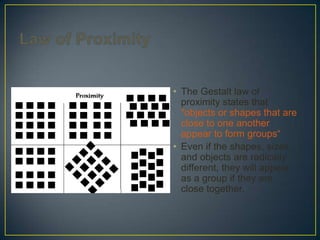
• The Gestalt law of
proximity states that
"objects or shapes that are
close to one another
appear to form groups“
• Even if the shapes, sizes,
and objects are radically
different, they will appear
as a group if they are
close together.
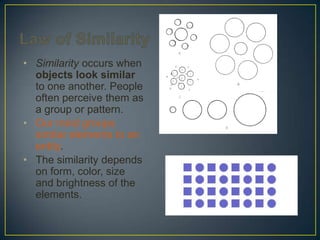
• Similarity occurs when
objects look similar
to one another. People
often perceive them as
a group or pattern.
• Our mind groups
similar elements to an
entity.
• The similarity depends
on form, color, size
and brightness of the
elements.
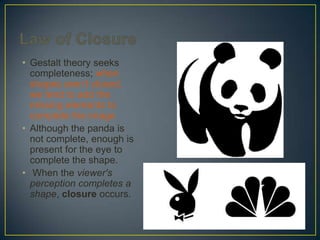
• Gestalt theory seeks
completeness; when
shapes aren’t closed,
we tend to add the
missing elements to
complete the image
• Although the panda is
not complete, enough is
present for the eye to
complete the shape.
• When the viewer's
perception completes a
shape, closure occurs.
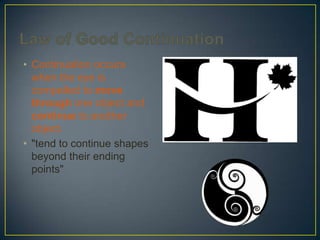
• Continuation occurs
when the eye is
compelled to move
through one object and
continue to another
object.
• "tend to continue shapes
beyond their ending
points"

Gestalt’s principle of perception

  • 1.
  • 2.
    • Gestalt theoryoriginated in Austria and Germany toward the end of the 19th century. Since then, Gestalt theory has has become fundamental to several related disciplines, including art, graphic design, web design and interior design.
  • 3.
    • Gestalt theoryfocuses on the mind’s perceptive processes • The word "Gestalt" has no direct translation in English, but refers to "a way a thing has been gestellt ; i.e., ‘placed,’ or ‘put together’"; • common translations include "form" and "shape"
  • 4.
    • Gestalt theorists followedthe basic principle that the whole is greater than the sum of its parts. • In viewing the "whole," a cognitive process takes place – the mind makes a leap from comprehending the parts to realizing the whole.
  • 6.
    • When youlook at the environment, you look at it as a whole picture, not separate parts. • There are images in the environment that people are aware, this would be the figure. • Images people are not aware of make up the ground
  • 7.
    • The figureis what a person is concentrating on; • The ground would be everything else in that environment; • Some properties of figure ground: • Figures hold more memorable association than the ground. • Figures are seen as being in front of the ground. • The ground is seen as uniformed material and seems to extend behind the figure. • The contour separating the figure from the ground appears to belong to the figure. (Goldstein, pp. 156159)
  • 8.
    • There areno correct interpretations to what the figure is and what the ground is; it is the individual’s choice. • People have different memories and experiences that influence their perception of images. • We have seen that meaningfulness can help determine which area we see as figure. • If something has meaning to someone, it normally "jumps out" at them, and is more noticeable
  • 10.
    1. 2. 3. 4. proximity - elementstend to be grouped together according to their nearness similarity - items similar in some respect tend to be grouped together closure - items are grouped together if they tend to complete some entity simplicity - items will be organized into simple figures according to symmetry, regularity, and smoothness
  • 11.
    • The Gestaltlaw of proximity states that "objects or shapes that are close to one another appear to form groups“ • Even if the shapes, sizes, and objects are radically different, they will appear as a group if they are close together.
  • 12.
    • Similarity occurswhen objects look similar to one another. People often perceive them as a group or pattern. • Our mind groups similar elements to an entity. • The similarity depends on form, color, size and brightness of the elements.
  • 13.
    • Gestalt theoryseeks completeness; when shapes aren’t closed, we tend to add the missing elements to complete the image • Although the panda is not complete, enough is present for the eye to complete the shape. • When the viewer's perception completes a shape, closure occurs.
  • 14.
    • Continuation occurs whenthe eye is compelled to move through one object and continue to another object. • "tend to continue shapes beyond their ending points"