Perception
“Perception refers tothe interpretation of what we
take in through our senses. In terms of optical
illusions this means our eyes.”
16.
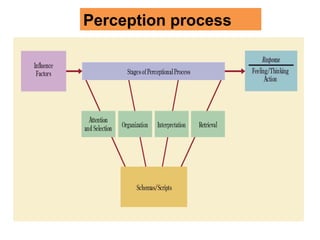
Perception
• Perception (fromthe Latin perceptio, percipio
) is the organization, identification and interpreta
tion of sensory
information in order to represent and
understand the environment.
• For example, vision involves light striking the
retinas of the eyes, smell is mediated by odor
molecules and hearing involves pressure waves.
17.
WHAT IS PERCEPTION?
• Perception Is The Process By Which People
Select, Organize, Interpret and Respond to
Information From The World Around Them.
• It may be described As a
Person’s View Of Reality.
18.
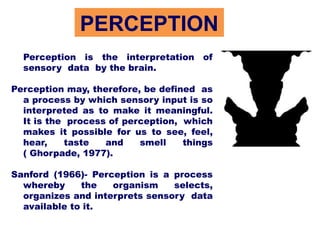
Perception is theinterpretation of
sensory data by the brain.
Perception may, therefore, be defined as
a process by which sensory input is so
interpreted as to make it meaningful.
It is the process of perception, which
makes it possible for us to see, feel,
hear, taste and smell things
( Ghorpade, 1977).
Sanford (1966)- Perception is a process
whereby the organism selects,
organizes and interprets sensory data
available to it.
PERCEPTION
19.
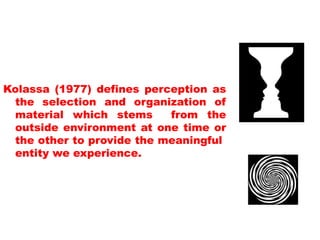
Kolassa (1977) definesperception as
the selection and organization of
material which stems from the
outside environment at one time or
the other to provide the meaningful
entity we experience.
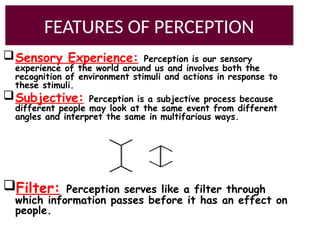
FEATURES OF PERCEPTION
SensoryExperience: Perception is our sensory
experience of the world around us and involves both the
recognition of environment stimuli and actions in response to
these stimuli.
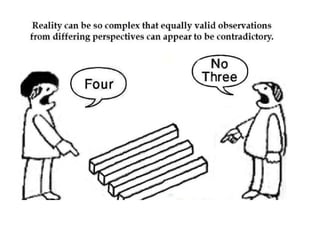
Subjective: Perception is a subjective process because
different people may look at the same event from different
angles and interpret the same in multifarious ways.
Filter: Perception serves like a filter through
which information passes before it has an effect on
people.
22.
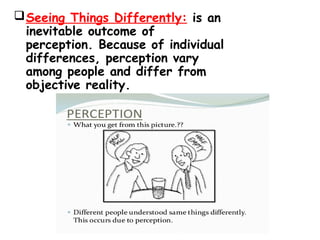
Seeing Things Differently:is an
inevitable outcome of
perception. Because of individual
differences, perception vary
among people and differ from
objective reality.
23.
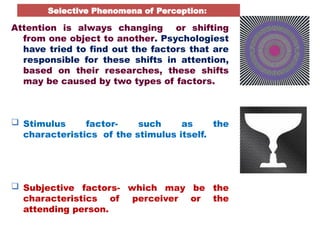
Attention is alwayschanging or shifting
from one object to another. Psychologiest
have tried to find out the factors that are
responsible for these shifts in attention,
based on their researches, these shifts
may be caused by two types of factors.
Stimulus factor- such as the
characteristics of the stimulus itself.
Subjective factors- which may be the
characteristics of perceiver or the
attending person.
Selective Phenomena of Perception:
24.
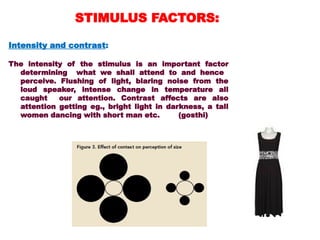
Intensity and contrast:
Theintensity of the stimulus is an important factor
determining what we shall attend to and hence
perceive. Flushing of light, blaring noise from the
loud speaker, intense change in temperature all
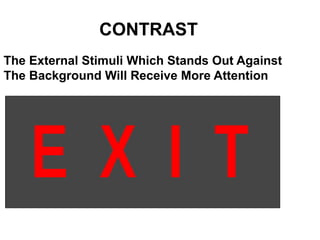
caught our attention. Contrast affects are also
attention getting eg., bright light in darkness, a tall
women dancing with short man etc. (gosthi)
STIMULUS FACTORS:
Change and movement:
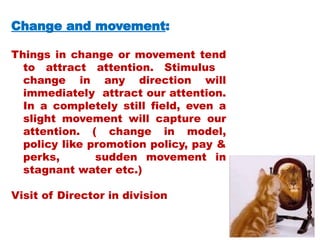
Thingsin change or movement tend
to attract attention. Stimulus
change in any direction will
immediately attract our attention.
In a completely still field, even a
slight movement will capture our
attention. ( change in model,
policy like promotion policy, pay &
perks, sudden movement in
stagnant water etc.)
Visit of Director in division
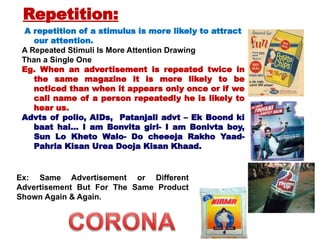
A repetition ofa stimulus is more likely to attract
our attention.
A Repeated Stimuli Is More Attention Drawing
Than a Single One
Eg. When an advertisement is repeated twice in
the same magazine it is more likely to be
noticed than when it appears only once or if we
call name of a person repeatedly he is likely to
hear us.
Advts of polio, AIDs, Patanjali advt – Ek Boond ki
baat hai… I am Bonvita girl- I am Bonivta boy,
Sun Lo Kheto Walo- Do cheeeja Rakho Yaad-
Pahrla Kisan Urea Dooja Kisan Khaad.
Ex: Same Advertisement or Different
Advertisement But For The Same Product
Shown Again & Again.
Repetition:
30.
An Animated SignAttracts More Attention
Than a Billboard. ( earlier slow motion
movie were used to broadcasted by
Doordarshan, Amitabh bachchan movies
were rear on doordarshan earlier)
Motion
31.
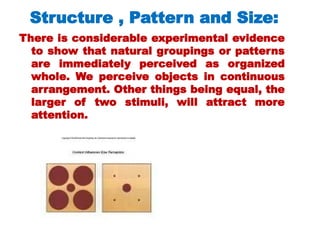
There is considerableexperimental evidence
to show that natural groupings or patterns
are immediately perceived as organized
whole. We perceive objects in continuous
arrangement. Other things being equal, the
larger of two stimuli, will attract more
attention.
Structure , Pattern and Size:
32.
New, Unfamiliar orNovel stimuli:
Other things being equal, our attention is
drawn to new, unfamiliar or novel things in
our environment. But what is new or novel
depends upon the perceivers past
experiences. (Talk on special issue by a
specific speaker)
Ex: An Elephant Walking
Along A City Street Is Noticed
Instantly,in village.
33.
Motive :
Our motiveusually determine what
things we should readily attend. Many
advertisement make skillful use of
beautiful women which is a strong
motive and a person who is attracted
by the picture will also read the
advertisement. Similarly a hungry
man looks for a restaurant.
SUBJECTIVE FACTORS
34.
Interest:
Almost any thingsin which we have developed an
interest may serve to draw our attention.
As for example a botanist and a geologist going down
the same path in forest, will attend to entirely
different things on the way because of their
different interest, the botanist will look for
specimen of plants, while the geologist for rocks
and stones.
The direction of our attention is often provided by our
short term interests rather than long-term interest.
If you are preoccupied with a personal problem,
you may find it hard to be attentive in class.
SUBJECTIVE FACTORS
35.
PERSONALITY
Personality Also AffectsWhat Is To Be Perceived
Ex: A Person With Positive Self Concept Is Likely
To Notice Positive Attributes In Another Person.
The person who believes they can do
something is probably right....
And who believes they can’t do they
can't.
36.
VALUES AND BELEIFS
Information is Remembered which is consistent
with our Values and Attitudes and rest is ignored
which is inconsistent with them.
Ex: “In spite of all their mistakes, our employees
are doing the best they can”.
37.
LEARNING
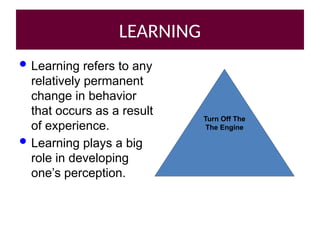
Learning refersto any
relatively permanent
change in behavior
that occurs as a result
of experience.
Learning plays a big
role in developing
one’s perception.
Turn Off The
The Engine
38.
What one perceivesis often determined by
suggestions. Suggestion may be defined as the
uncritical acceptance of some motion, ideas or
meaning. Leading question may be answered in
the way the questioner wishes.
Suggestion
39.
• Just asinterests narrow one’s focus, so do one’s
past experiences.
• You perceive those things to which you can
relate.
• However, in many instances, your past
experiences will act to nullify an object’s interest.
• Eg. You are more likely to notice a machine that
you have never observed before than a standards
typewriter that exactly like a thousand other you
have previously seen.
Past Experiences
40.
Perceptual Organization isthe process by which
people categorize according to their
frame of reference, based on their past
learning and experiences.
Following Principles are kept in mind while
organising the information into a meaningful
one. These are:
Perceptual Grouping
Figure Ground
ON THE BASIS OF TARGET or
Perceptual Organizing:
41.
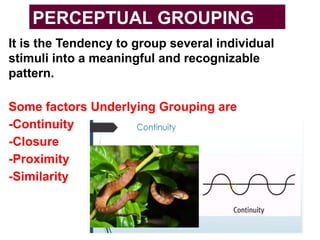
It is theTendency to group several individual
stimuli into a meaningful and recognizable
pattern.
Some factors Underlying Grouping are
-Continuity
-Closure
-Proximity
-Similarity
PERCEPTUAL GROUPING
42.
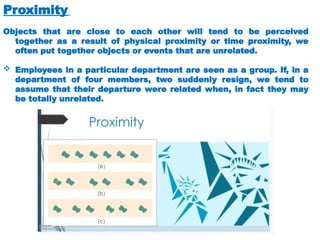
Proximity
Objects that areclose to each other will tend to be perceived
together as a result of physical proximity or time proximity, we
often put together objects or events that are unrelated.
Employees in a particular department are seen as a group. If, in a
department of four members, two suddenly resign, we tend to
assume that their departure were related when, in fact they may
be totally unrelated.
43.
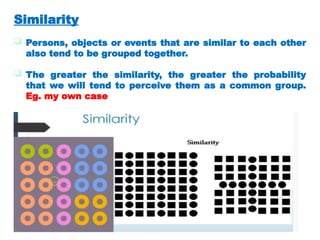
Similarity
Persons, objectsor events that are similar to each other
also tend to be grouped together.
The greater the similarity, the greater the probability
that we will tend to perceive them as a common group.
Eg. my own case
44.
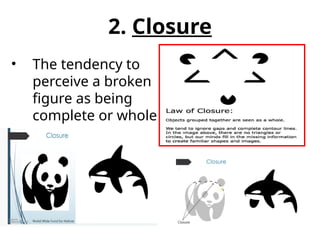
• The tendencyto
perceive a broken
figure as being
complete or whole
2. Closure
45.
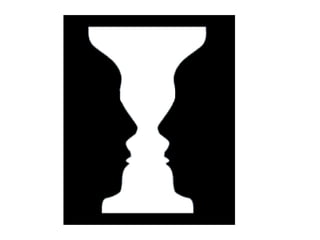
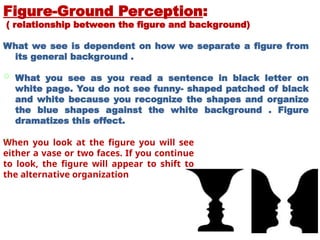
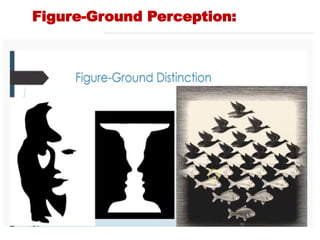
Figure-Ground Perception:
( relationshipbetween the figure and background)
What we see is dependent on how we separate a figure from
its general background .
What you see as you read a sentence in black letter on
white page. You do not see funny- shaped patched of black
and white because you recognize the shapes and organize
the blue shapes against the white background . Figure
dramatizes this effect.
When you look at the figure you will see
either a vase or two faces. If you continue
to look, the figure will appear to shift to
the alternative organization
COMMON PERCETUAL ERROR/
DISTORTIONS
Errors in Perceptual Judgement are called
Perceptual Judgement.
Following are Barriers To Perceptual
Accuracy:
Barriers to Perceptual Accuracy
• Stereotyping Halo effect
• Projection Expectancy
Effect
• Primacy Effect:First impressions Recency Effect
• Perceptual Defense Attribution
51.
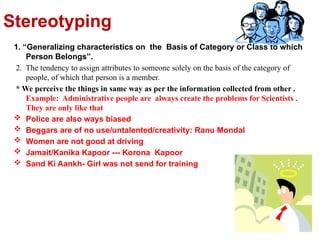
Stereotyping
1. “Generalizing characteristicson the Basis of Category or Class to which
Person Belongs”.
2. The tendency to assign attributes to someone solely on the basis of the category of
people, of which that person is a member.
* We perceive the things in same way as per the information collected from other .
Example: Administrative people are always create the problems for Scientists .
They are only like that
Police are also ways biased
Beggars are of no use/untalented/creativity: Ranu Mondal
Women are not good at driving
Jamait/Kanika Kapoor --- Korona Kapoor
Sand Ki Aankh- Girl was not send for training
52.
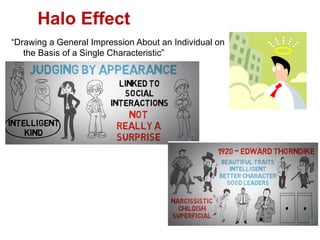
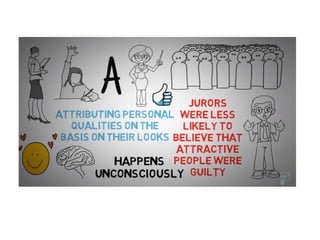
Halo Effect
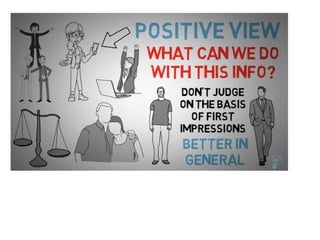
“Drawing aGeneral Impression About an Individual on
the Basis of a Single Characteristic”
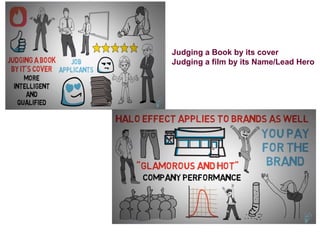
54.
Judging a Bookby its cover
Judging a film by its Name/Lead Hero
56.
Projection
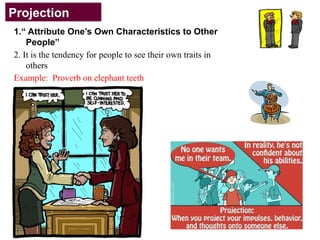
1.“ Attribute One’sOwn Characteristics to Other
People”
2. It is the tendency for people to see their own traits in
others
Example: Proverb on elephant teeth
57.
Expectancy Effect
ExpectancyEffects are the extent to which prior
expectations bias perceptions of events, objects and
people. Extent to which expectations bias how events, objects,
and people are actually perceived. Good welcome/response, high
expectation from the students .
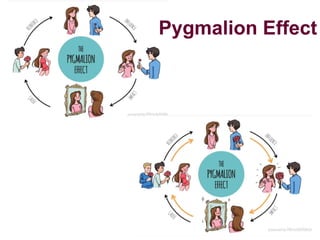
Self-fulfilling prophecy (Pygmalion effect): The lower
or higher performance of employees reflects
preconceived leader expectations about employee
capabilities.
Higher expectation for higher performance
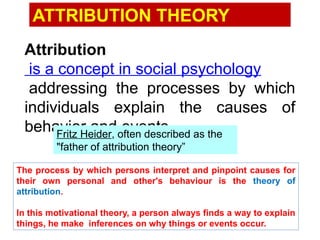
ATTRIBUTION THEORY
Attribution
is aconcept in social psychology
addressing the processes by which
individuals explain the causes of
behavior and events.
Fritz Heider, often described as the
"father of attribution theory”
The process by which persons interpret and pinpoint causes for
their own personal and other's behaviour is the theory of
attribution.
In this motivational theory, a person always finds a way to explain
things, he make inferences on why things or events occur.
60.
Attribution Theory isa way
to figure out why people
think and behave the way
they do.
Why?
Skill?
Luck ?
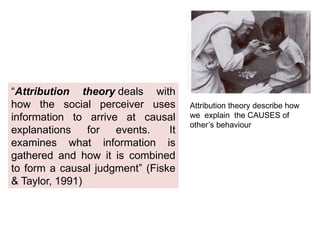
61.
“Attribution theory dealswith
how the social perceiver uses
information to arrive at causal
explanations for events. It
examines what information is
gathered and how it is combined
to form a causal judgment” (Fiske
& Taylor, 1991)
Attribution theory describe how
we explain the CAUSES of
other’s behaviour
62.
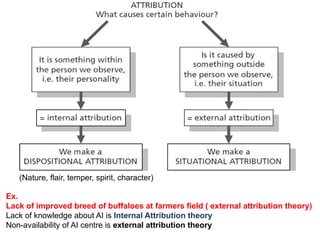
Ex.
Lack of improvedbreed of buffaloes at farmers field ( external attribution theory)
Lack of knowledge about AI is Internal Attribution theory
Non-availability of AI centre is external attribution theory
(Nature, flair, temper, spirit, character)
63.
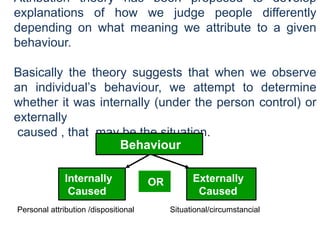
Attribution theory hasbeen proposed to develop
explanations of how we judge people differently
depending on what meaning we attribute to a given
behaviour.
Basically the theory suggests that when we observe
an individual’s behaviour, we attempt to determine
whether it was internally (under the person control) or
externally
caused , that may be the situation.
Behaviour
Internally
Caused
Externally
Caused
OR
Personal attribution /dispositional Situational/circumstancial
65.
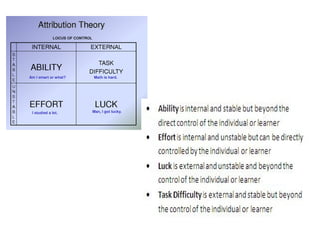
Attribution Dimension Consequence
AbilityInternal Competence or incompetence;
Pride or shame
Stable Pride or shame magnified
Failure = resignation/apathy
Uncontrollable Failure = resignation/apathy magnified
Effort Internal Pride in success
Unstable Does not decrease success expectancy
Controllable Magnifies pride or guilt
Luck External Self image not altered
Unstable No decrease in success expectancy
Uncontrollable Surprise at either success or failure
Help from
others
External Self image not altered
Unstable No decrease in success expectancy
Uncontrollable Gratitude for help
Anger for hindrance
Task difficulty External No enhancement of self-esteem for
success outcome
stable Same outcome expected again
Uncontrollable Depression and frustration for failure
outcomes
66.
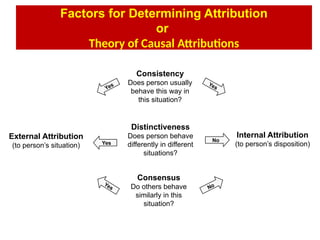
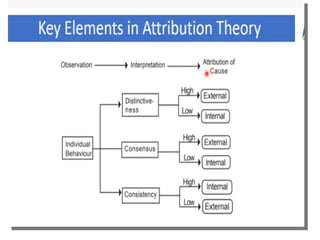
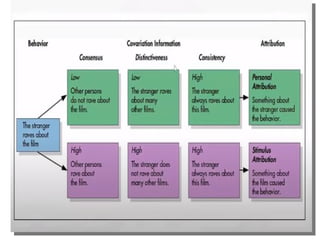
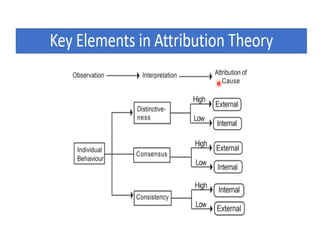
Factors for DeterminingAttribution
or
Theory of Causal Attributions
Consistency
Does person usually
behave this way in
this situation?
Distinctiveness
Does person behave
differently in different
situations?
Consensus
Do others behave
similarly in this
situation?
No
No
Yes
Internal Attribution
(to person’s disposition)
Yes
Yes
Yes
External Attribution
(to person’s situation)
67.
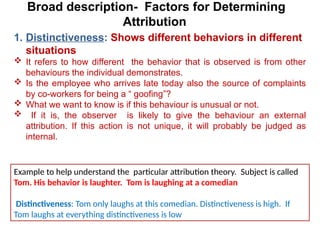
Broad description- Factorsfor Determining
Attribution
1. Distinctiveness: Shows different behaviors in different
situations
It refers to how different the behavior that is observed is from other
behaviours the individual demonstrates.
Is the employee who arrives late today also the source of complaints
by co-workers for being a “ goofing”?
What we want to know is if this behaviour is unusual or not.
If it is, the observer is likely to give the behaviour an external
attribution. If this action is not unique, it will probably be judged as
internal.
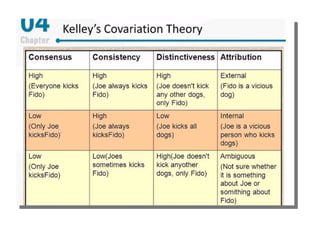
Example to help understand the particular attribution theory. Subject is called
Tom. His behavior is laughter. Tom is laughing at a comedian
Distinctiveness: Tom only laughs at this comedian. Distinctiveness is high. If
Tom laughs at everything distinctiveness is low
68.
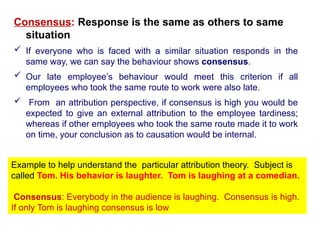
Consensus: Response isthe same as others to same
situation
If everyone who is faced with a similar situation responds in the
same way, we can say the behaviour shows consensus.
Our late employee’s behaviour would meet this criterion if all
employees who took the same route to work were also late.
From an attribution perspective, if consensus is high you would be
expected to give an external attribution to the employee tardiness;
whereas if other employees who took the same route made it to work
on time, your conclusion as to causation would be internal.
Example to help understand the particular attribution theory. Subject is
called Tom. His behavior is laughter. Tom is laughing at a comedian.
Consensus: Everybody in the audience is laughing. Consensus is high.
If only Tom is laughing consensus is low
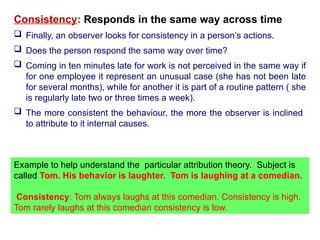
69.
Consistency: Responds inthe same way across time
Finally, an observer looks for consistency in a person’s actions.
Does the person respond the same way over time?
Coming in ten minutes late for work is not perceived in the same way if
for one employee it represent an unusual case (she has not been late
for several months), while for another it is part of a routine pattern ( she
is regularly late two or three times a week).
The more consistent the behaviour, the more the observer is inclined
to attribute to it internal causes.
Example to help understand the particular attribution theory. Subject is
called Tom. His behavior is laughter. Tom is laughing at a comedian.
Consistency: Tom always laughs at this comedian. Consistency is high.
Tom rarely laughs at this comedian consistency is low.
74.
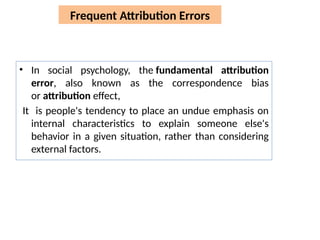
Frequent Attribution Errors
•In social psychology, the fundamental attribution
error, also known as the correspondence bias
or attribution effect,
It is people's tendency to place an undue emphasis on
internal characteristics to explain someone else's
behavior in a given situation, rather than considering
external factors.
75.
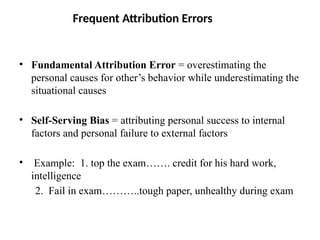
Frequent Attribution Errors
•Fundamental Attribution Error = overestimating the
personal causes for other’s behavior while underestimating the
situational causes
• Self-Serving Bias = attributing personal success to internal
factors and personal failure to external factors
• Example: 1. top the exam……. credit for his hard work,
intelligence
2. Fail in exam………..tough paper, unhealthy during exam
76.
76
Techniques foreffectively managing
perceptions and attributions.
– Be self-aware.
– Seek a wide range of differing information.
– Try to see a situation as others would.
– Be aware of different kinds of schemes.
– Be aware of perceptual distortions.
– Be aware of self and impression management
(Behaving in ways so that others perceive us how
we want to be perceived)
– Be aware of attribution theory implications.
77.
Role of Perceptionin
Decision Making Process
The perception of a situation is central to
the decision making process.
To make effective decisions a manager
must not only perceive but understand
other people.
The individual decision maker’s perceptual
process will have a large bearing on the
final outcome.
78.
Perception in Decision-makingis
based on a person’s internal
understanding of reality rather than
reality itself.
CONCLUSION