1) Perception Meaning – A Cognitive
Process
 It is collection, organization, and
 interpretation of data from the
 environment to obtain a meaning from it
 It differs from person to person and
 situation to situation between
 organizations, leading to disciplinary or
 team culture and cooperation to enhance
 performance
2) Sensation vs Perception
 Sensation is the basic behavior of
 individuals caused by their physiological
 functions

 Perception is the assimilation of raw data
 through senses to organize and modify with
 cognitive thinking
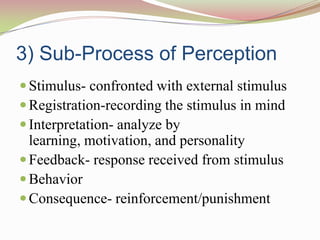
3) Sub-Process of Perception
 Stimulus- confronted with external stimulus
 Registration-recording the stimulus in mind
 Interpretation- analyze by
  learning, motivation, and personality
 Feedback- response received from stimulus
 Behavior
 Consequence- reinforcement/punishment
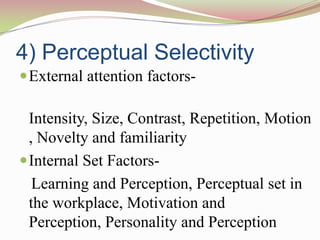
4) Perceptual Selectivity
 External attention factors-

  Intensity, Size, Contrast, Repetition, Motion
  , Novelty and familiarity
 Internal Set Factors-
   Learning and Perception, Perceptual set in
  the workplace, Motivation and
  Perception, Personality and Perception
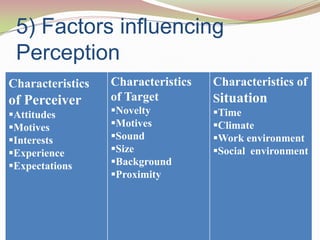
5) Factors influencing
 Perception
Characteristics   Characteristics   Characteristics of
of Perceiver      of Target         Situation
Attitudes        Novelty          Time
Motives          Motives          Climate
Interests        Sound            Work environment
Experience       Size             Social environment
Expectations     Background
                  Proximity
6) Perceptual Organization

 Perceptual Organization emphasize the
 activities that take place in the perceptual
 process subsequent to the stimulus being
 received
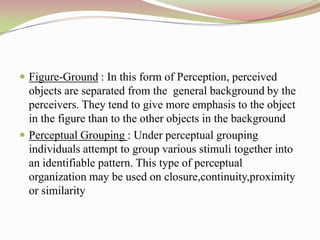
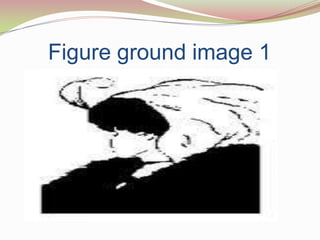
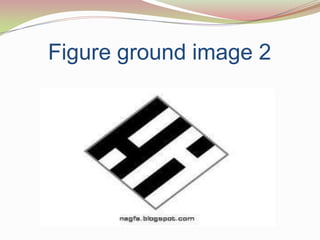
 Figure-Ground : In this form of Perception, perceived
  objects are separated from the general background by the
  perceivers. They tend to give more emphasis to the object
  in the figure than to the other objects in the background
 Perceptual Grouping : Under perceptual grouping
  individuals attempt to group various stimuli together into
  an identifiable pattern. This type of perceptual
  organization may be used on closure,continuity,proximity
  or similarity
Figure ground image 1
Figure ground image 2
Figure ground image 3
Figure ground image 4
Closure : According to this principle, a person may
  sometimes perceive a whole where it does not exist and at
  times may not be able to perceive a whole although one
  exists – Org.Theory

Continuity : Continuity, unlike closure where the individual
 fills the missing stimulus, refers to the process wherein the
 individual perceives the extension of a missing stimulus.
 However this is limited to obvious, continuous lines or
 patterns
Proximity : According to this principle, people perceive
  stimuli that are physically close to each other as belonging
  to one group
Similarity : According to this principle, stimuli that are
  similar are grouped together by the individual
Perceptual Constancy : Is one of the advanced forms of
  perceptual organization. Individuals‟ perception of certain
  elements in objects like size,shape,color,brightness and
  location is constant and does not change from person to
  person. For instance, even though the picture of an apple
  is printed in black and white, we still perceive the color of
  the fruit as red. Perceptual constancy is enhanced by
  learning. Learning helps individuals perceive certain
  patterns of cues in a similar way and this leads to
  perceptual constancy
 Perceptual Context : The context of the situation also
  plays a major role in shaping the perception of
  individuals. Different contexts convey different meanings
  to people. For example, if a manager pats his two year old
  son, it is considered a sign of love and affection. However,
  if he gives an employee a pat on back, it is considered a
 Perceptual Defence :The process of defence mechanism
  against a threatening in nature stimulus that clashes values or
  culture of the individuals is Perceptual Defence.
 People refuse to perceive information which they believe will
  disturb their emotions
 People substitute the orginal perception caused by disturbing
  stimuli and information with favorable perceptions to cope
  with the situation
 Although some information may actually arouse emotions in an
  individual, he she may purposely distort and direct the emotion
  else where

    It helps in understanding relationship between union and
     management, superior and subordinate
7) Social Perception
 It‟s a cognitive process through which other individuals are
  perceived by the perceiver
 It involves the study of how and individual gets to know
  other individuals
 Its influenced by the characteristics of both the perceiver and
  the perceived
 Social perception is influenced by the
         1.Personality of the perceiver

         2. Personal characteristics of the perceiver; Ones own
          characterstics affect the characterstics one is likely to
          seen in others
 Self esteem of the perceiver; People who
  accept themselves are more likely to be able to
  see favorable aspects of other people
 Fact that an individual perceives others
  depending upon many skills and not just one
  skill
There are certain factors of the person being
  perceived that influence social perception
 Status of the person perceived will greatly
  influence others perception of the person
 The person being perceived is usually placed
  into categories to simplify the viewers
  perceptual activities. Two common categories
  are status and role
 The visible traits of the person perceived will
  greatly influence others, perceptions of the
  person
 These characteristics of the perceiver and perceived
  suggest extreme complexities of social perception
 Thus organizational participants must realize that their
  perceptions of another person are greatly influenced
  by their own and the other persons characterstics
 For ex- Manager with high and low esteem vs
  pleasant and timely sales man and arrogant sales man
 Participants in formal organizations constantly
  perceive one another
 Managers perceive workers and vice versa, line
  personnel perceive staff personal , front line employee
  perceive customers and viceversa
 Numerous complex factors enter into such social
  perception, but most important are the problems
  associated with
 Stereo Typing : Refers to the tendency to perceive
  another person as belonging to a single class or
  category
 In1922 Walter Lippman applied this word to percption
 Since then „stereo typing‟ has become a frequently
  used term to describe perceptual errors especially in
  analzing prejudices
 It may attribute favorable or un favorable traits to the
  person perceived
 Most often the perceived person is put into over all
  category of which the person belongs making him/her
  stereotype though each person has individual unique
  traits
 Common stereo typed groups include managers,
  supervisors, knowledge workers,union members,young
  people,old people,minorities,women, white and blue collar
  workers,various functional and staff specialists ex;
  Accountants, sales people, computer programmers and
  engineers
 There may be general consensus about the traits possessed
  by each group but in reality there is often a discrepancy
  between agreed upon traits and actual traits of the
  category ex not all engineers rational or the same for HR
 Organization members making common
  Blanket Perceptions in example with GM
  blame their problems on the famous sterotyped
  „them‟ instead of recognizing the need for
  fundamental corporate culture change
 Long exposure to negative stereo types may
  result in the members having an inferiority
  anxiety or lowered expectations
 Numerous research studies on stereo typing
  and its problems that occur in organizational
  life
 The Halo Effect :
 Similar to Stereo Typing
 In Stereo Typing the person is perceived
  according to a single category but under the
  Halo Effect the person perceived on the basis
  of one trait
 Halo is discussed in performance appraisal
  when a rater makes an error in judging a
  person‟s total personality or performance on
  the basis of a single positive trait such as
  intelligence, appearance, dependability or
  cooperativeness.
 The particular trait may override all other traits
 A persons physical appearance or dress may override
  in making a selection or in appraising the person‟s
  performance
 The opposite sometimes called “horns effect”
 Here a an individual is down graded because of single
  negative characterstics or incident
 A comprehensive review of the performance appraisal
  literature founds that Halo effect was dependent
  variable in over a third of the studies and was the
  major problem affecting appraisal accuracy
 Halo Effect :
 Is a common error made in performance appraisals
 Has two components- true and illusory
 Emphasize only a particular trait of an employee and
  does not take into account the overall picture
 Has negative consequences which have to be avoided
Conditions under which Halo Effect might occur :
 - when the perceiver is not familiar with certain traits or
   does not frequently encounter them
- When the traits are ambiguous and cannot be clearly
   expressed in behavioral terms
- When the traits have moral implications.
 Even after considerable research we still do not know
  much about the impact of the Halo Effect and attempts at
  solving the problem have not been very successful
 Overcoming perceptual problems such as Stereotyping
  and the Halo Effect remains an important challenge for
  effective human resource management
Attribution: It‟s the way in which people explain the
  causes for their own or others behavior.
- With the help of attribution, individuals try to
  understand the reasons behind the behavior of one
  another and also draw conclusion about the factors
  that influenced that behavior
- There are two types of attributions
- Dispositional attribution : In this type of
  attribution, People‟s behavior is explained with the
  help of internal factors such as their personality
  traits, their motivation, ability etc
 Situational attribution : People‟s behavior is attributed to
   the external factors in the environment. These could be the
   social influences they are subject to, equipment being
   handled, etc
Impression Management
 -Reffered to as self perception
-It is a process by which people try to manage or control the
   perceptions formed by others about themselves
-Individuals might adopt various management techniques to
   make an impact on others
 The Process of Impression Management :
   - Earlier researchers attempted to study the relation
   ship of impression management with respect to
   aggression, attitude changes, attributions, social
   facilitation, and so on
 - In recent times behavior theorists have identified two
   components of impression management
Impression motivation : Impression motivation is
   usually applicable in organizations where employees
   try to control the perception of managers or superiors
   about themselves .
Factors that affect Impression Management are
- Relevance that the impression has to the employees in
  attaining their goals
- Value of these goals to the employees
- Discrepancy between the desired image and image
  which individuals believe others already have about
  them
Impression Construction : It refers to the methods and
  techniques adopted by the individual in order to create
  the desired image in the minds of other individuals.
The factors are
- The self-concept, desired and undesired
  identified images, role constraints, target‟s
  values, and current social image.
- There is still little known of how they select the
  way to manage others‟ perception of them for
  ex; do they directly tell their boss things such
  as “I‟m really competitive and want to get
  ahead” or do they make indirect statements
  such as “I really like racquet ball ; it is really
  competitive”
 Managers regulate and control themselves
  based on situational and interpersonal cues
 They are more senstive and responsive to
  adjusting their self-presentations or
  impressions
 These high self monitored managers are more
  likely to be promoted, but they are also more
  likely to change employers or to make a job
  related move to a different state or country
 Employee Impression Management Strategies
 Two Basic Strategies
 Demotion – Preventive Strategy; When the
  employees are trying to minimize responsibility
  for some negative event or to stay out of trouble
 Promotion Enhancing Strategy; When the
  employees are seeking to maximize responsibility
  for a positive outcome or to look better than they
  really are.
Demotion Preventive Strategy is characterized by
 1. Accounts. These are employees attempts to
 excuse or justify their actions- not feeling well-
 another high priority assignment.
 2.Apologies. When there is no logical way out,
 the employee may apologize to the boss for
 some negative. Such an apology may not only
 gives the impression that the individual is sorry
 but also indicates that it will not happen again.
3. Disassociation : When employees are indirectly
 associated when something that went wrong For
 ex; they are the members of a committee or
 work team that made a bad decision, they may
 secretly tell their boss that they fought for the
 right thing but were over ruled- employees using
 this approach try to remove themselves both
 from the group and from responsibility for the
 problem
Promotion Enhancing Strategy involve,
 1. Entitlements. Employees feel that they have not
 been given credit for a positive outcome – they
 make sure that it is known through formal channel
 or they may informally note to key people that
 they are pleased their suggestions or efforts worked
 out well.
  2. Enhancements. Here, employees may have
 received credit, but they really did more and had a
 bigger impact than orginally thought. For example,
 their effort or idea not only served a customer well
 or met a difficult deadline, but can be used in the
3. Obstacle Disclosures; In this strategy, employees
  identify either personal (health or family) or
  organization (lack of resources or cooperation)
  obstacles they had to overcome to accomplish an
  outcome. They are trying to create the perception
  that because they obtained the positive out come
  despite big obstacles, they really deserve a lot of
  credit
4. Associations ; Employees make sure to be seen
  with the right people at the right times to get
  connected and associated with successful projects
 The motivation on the part of employees may
  or may not be a deliberate attempt to enhance
  themselves in terms of political
  power, promotions or money rewards
 A recent analysis indicated that Impression
  Management might motivate employee
  citizenship behaviors [going beyond normally
  required and rewarded behavior]
 The motivation in this case may be to look
  good (impression management) instead of
  doing well for its own sake (citizen ship
  behavior)
 The specific impression management strategy
  that is used will depend on situation eg:
  employment interview, performance appraisal
  or training session
 Managers should be aware of deliberate
  manipulations of perceptions when making
  evaluation of their people
 By the same token , such impression
  management could be positively used to get
  ahead in an organization or keep good relation
  with customers
 Guide lines to help recognize various impression
 management tactics and the motives behind them
 1. One should be on the lookout for high
 probability impression management strategies.
 For ex; recruiters should be careful to separate
 pure self promotion and legitimate claims of
 competence, and those in positions of power or
 status should be aware of subordinates‟ efforts to
 ingratiate themselves (“buttering up the boss”
 and “apple-polishing”)
2. There should be an attempt to minimize
 personal, situational and organizational features
 features that foster undesirable impression
 management for ex; organizations in which task
 performance is ambigious and or resources scarce
 tend to generate relatively high levels of
 ingratation
3. One should look for the ulterior motives and
 avoid being overly influenced by impression
 management. For ex; a manager who is able to
 distinguish between pure self promotion and true
 competence is likely to be biased by an invalid
 claim when appraising a staff member‟s
 performance
 To conclude with William Gardner in his
 analysis of Impression Management states
 “When selecting an image, never try to do
 something you are not. People see through the
 facade . In sum make every effort to put your
 best foot forward- but never at the cost of your
 identity or integrity” put in other words we
 project the face we believe is ours , hope is
 ours wish was ours – the persona that best suits
 our personality, weakness, stage in life and
 immediate needs.
T.S. Eliot and S.Alfred Prufrock say, “There will
  be time /To prepare a face to meet the faces
  that you meet”.


                THANK YOU !!

Presentation 1 perception

  • 2.
    1) Perception Meaning– A Cognitive Process  It is collection, organization, and interpretation of data from the environment to obtain a meaning from it  It differs from person to person and situation to situation between organizations, leading to disciplinary or team culture and cooperation to enhance performance
  • 3.
    2) Sensation vsPerception  Sensation is the basic behavior of individuals caused by their physiological functions  Perception is the assimilation of raw data through senses to organize and modify with cognitive thinking
  • 4.
    3) Sub-Process ofPerception  Stimulus- confronted with external stimulus  Registration-recording the stimulus in mind  Interpretation- analyze by learning, motivation, and personality  Feedback- response received from stimulus  Behavior  Consequence- reinforcement/punishment
  • 5.
    4) Perceptual Selectivity External attention factors- Intensity, Size, Contrast, Repetition, Motion , Novelty and familiarity  Internal Set Factors- Learning and Perception, Perceptual set in the workplace, Motivation and Perception, Personality and Perception
  • 6.
    5) Factors influencing Perception Characteristics Characteristics Characteristics of of Perceiver of Target Situation Attitudes Novelty Time Motives Motives Climate Interests Sound Work environment Experience Size Social environment Expectations Background Proximity
  • 7.
    6) Perceptual Organization Perceptual Organization emphasize the activities that take place in the perceptual process subsequent to the stimulus being received
  • 8.
     Figure-Ground :In this form of Perception, perceived objects are separated from the general background by the perceivers. They tend to give more emphasis to the object in the figure than to the other objects in the background  Perceptual Grouping : Under perceptual grouping individuals attempt to group various stimuli together into an identifiable pattern. This type of perceptual organization may be used on closure,continuity,proximity or similarity
  • 9.
  • 10.
  • 11.
  • 12.
  • 13.
    Closure : Accordingto this principle, a person may sometimes perceive a whole where it does not exist and at times may not be able to perceive a whole although one exists – Org.Theory Continuity : Continuity, unlike closure where the individual fills the missing stimulus, refers to the process wherein the individual perceives the extension of a missing stimulus. However this is limited to obvious, continuous lines or patterns
  • 14.
    Proximity : Accordingto this principle, people perceive stimuli that are physically close to each other as belonging to one group Similarity : According to this principle, stimuli that are similar are grouped together by the individual
  • 15.
    Perceptual Constancy :Is one of the advanced forms of perceptual organization. Individuals‟ perception of certain elements in objects like size,shape,color,brightness and location is constant and does not change from person to person. For instance, even though the picture of an apple is printed in black and white, we still perceive the color of the fruit as red. Perceptual constancy is enhanced by learning. Learning helps individuals perceive certain patterns of cues in a similar way and this leads to perceptual constancy
  • 16.
     Perceptual Context: The context of the situation also plays a major role in shaping the perception of individuals. Different contexts convey different meanings to people. For example, if a manager pats his two year old son, it is considered a sign of love and affection. However, if he gives an employee a pat on back, it is considered a
  • 17.
     Perceptual Defence:The process of defence mechanism against a threatening in nature stimulus that clashes values or culture of the individuals is Perceptual Defence.  People refuse to perceive information which they believe will disturb their emotions  People substitute the orginal perception caused by disturbing stimuli and information with favorable perceptions to cope with the situation  Although some information may actually arouse emotions in an individual, he she may purposely distort and direct the emotion else where  It helps in understanding relationship between union and management, superior and subordinate
  • 18.
    7) Social Perception It‟s a cognitive process through which other individuals are perceived by the perceiver  It involves the study of how and individual gets to know other individuals  Its influenced by the characteristics of both the perceiver and the perceived  Social perception is influenced by the  1.Personality of the perceiver  2. Personal characteristics of the perceiver; Ones own characterstics affect the characterstics one is likely to seen in others
  • 19.
     Self esteemof the perceiver; People who accept themselves are more likely to be able to see favorable aspects of other people  Fact that an individual perceives others depending upon many skills and not just one skill There are certain factors of the person being perceived that influence social perception
  • 20.
     Status ofthe person perceived will greatly influence others perception of the person  The person being perceived is usually placed into categories to simplify the viewers perceptual activities. Two common categories are status and role  The visible traits of the person perceived will greatly influence others, perceptions of the person
  • 21.
     These characteristicsof the perceiver and perceived suggest extreme complexities of social perception  Thus organizational participants must realize that their perceptions of another person are greatly influenced by their own and the other persons characterstics  For ex- Manager with high and low esteem vs pleasant and timely sales man and arrogant sales man  Participants in formal organizations constantly perceive one another
  • 22.
     Managers perceiveworkers and vice versa, line personnel perceive staff personal , front line employee perceive customers and viceversa  Numerous complex factors enter into such social perception, but most important are the problems associated with  Stereo Typing : Refers to the tendency to perceive another person as belonging to a single class or category
  • 23.
     In1922 WalterLippman applied this word to percption  Since then „stereo typing‟ has become a frequently used term to describe perceptual errors especially in analzing prejudices  It may attribute favorable or un favorable traits to the person perceived  Most often the perceived person is put into over all category of which the person belongs making him/her stereotype though each person has individual unique traits
  • 24.
     Common stereotyped groups include managers, supervisors, knowledge workers,union members,young people,old people,minorities,women, white and blue collar workers,various functional and staff specialists ex; Accountants, sales people, computer programmers and engineers  There may be general consensus about the traits possessed by each group but in reality there is often a discrepancy between agreed upon traits and actual traits of the category ex not all engineers rational or the same for HR
  • 25.
     Organization membersmaking common Blanket Perceptions in example with GM blame their problems on the famous sterotyped „them‟ instead of recognizing the need for fundamental corporate culture change  Long exposure to negative stereo types may result in the members having an inferiority anxiety or lowered expectations  Numerous research studies on stereo typing and its problems that occur in organizational life
  • 26.
     The HaloEffect :  Similar to Stereo Typing  In Stereo Typing the person is perceived according to a single category but under the Halo Effect the person perceived on the basis of one trait  Halo is discussed in performance appraisal when a rater makes an error in judging a person‟s total personality or performance on the basis of a single positive trait such as intelligence, appearance, dependability or cooperativeness.
  • 27.
     The particulartrait may override all other traits  A persons physical appearance or dress may override in making a selection or in appraising the person‟s performance  The opposite sometimes called “horns effect”  Here a an individual is down graded because of single negative characterstics or incident  A comprehensive review of the performance appraisal literature founds that Halo effect was dependent variable in over a third of the studies and was the major problem affecting appraisal accuracy
  • 28.
     Halo Effect:  Is a common error made in performance appraisals  Has two components- true and illusory  Emphasize only a particular trait of an employee and does not take into account the overall picture  Has negative consequences which have to be avoided Conditions under which Halo Effect might occur : - when the perceiver is not familiar with certain traits or does not frequently encounter them - When the traits are ambiguous and cannot be clearly expressed in behavioral terms - When the traits have moral implications.
  • 29.
     Even afterconsiderable research we still do not know much about the impact of the Halo Effect and attempts at solving the problem have not been very successful  Overcoming perceptual problems such as Stereotyping and the Halo Effect remains an important challenge for effective human resource management
  • 30.
    Attribution: It‟s theway in which people explain the causes for their own or others behavior. - With the help of attribution, individuals try to understand the reasons behind the behavior of one another and also draw conclusion about the factors that influenced that behavior - There are two types of attributions - Dispositional attribution : In this type of attribution, People‟s behavior is explained with the help of internal factors such as their personality traits, their motivation, ability etc
  • 31.
     Situational attribution: People‟s behavior is attributed to the external factors in the environment. These could be the social influences they are subject to, equipment being handled, etc Impression Management -Reffered to as self perception -It is a process by which people try to manage or control the perceptions formed by others about themselves -Individuals might adopt various management techniques to make an impact on others
  • 32.
     The Processof Impression Management : - Earlier researchers attempted to study the relation ship of impression management with respect to aggression, attitude changes, attributions, social facilitation, and so on - In recent times behavior theorists have identified two components of impression management Impression motivation : Impression motivation is usually applicable in organizations where employees try to control the perception of managers or superiors about themselves .
  • 33.
    Factors that affectImpression Management are - Relevance that the impression has to the employees in attaining their goals - Value of these goals to the employees - Discrepancy between the desired image and image which individuals believe others already have about them Impression Construction : It refers to the methods and techniques adopted by the individual in order to create the desired image in the minds of other individuals.
  • 34.
    The factors are -The self-concept, desired and undesired identified images, role constraints, target‟s values, and current social image. - There is still little known of how they select the way to manage others‟ perception of them for ex; do they directly tell their boss things such as “I‟m really competitive and want to get ahead” or do they make indirect statements such as “I really like racquet ball ; it is really competitive”
  • 35.
     Managers regulateand control themselves based on situational and interpersonal cues  They are more senstive and responsive to adjusting their self-presentations or impressions  These high self monitored managers are more likely to be promoted, but they are also more likely to change employers or to make a job related move to a different state or country
  • 36.
     Employee ImpressionManagement Strategies  Two Basic Strategies  Demotion – Preventive Strategy; When the employees are trying to minimize responsibility for some negative event or to stay out of trouble  Promotion Enhancing Strategy; When the employees are seeking to maximize responsibility for a positive outcome or to look better than they really are.
  • 37.
    Demotion Preventive Strategyis characterized by 1. Accounts. These are employees attempts to excuse or justify their actions- not feeling well- another high priority assignment. 2.Apologies. When there is no logical way out, the employee may apologize to the boss for some negative. Such an apology may not only gives the impression that the individual is sorry but also indicates that it will not happen again.
  • 38.
    3. Disassociation :When employees are indirectly associated when something that went wrong For ex; they are the members of a committee or work team that made a bad decision, they may secretly tell their boss that they fought for the right thing but were over ruled- employees using this approach try to remove themselves both from the group and from responsibility for the problem
  • 39.
    Promotion Enhancing Strategyinvolve, 1. Entitlements. Employees feel that they have not been given credit for a positive outcome – they make sure that it is known through formal channel or they may informally note to key people that they are pleased their suggestions or efforts worked out well. 2. Enhancements. Here, employees may have received credit, but they really did more and had a bigger impact than orginally thought. For example, their effort or idea not only served a customer well or met a difficult deadline, but can be used in the
  • 40.
    3. Obstacle Disclosures;In this strategy, employees identify either personal (health or family) or organization (lack of resources or cooperation) obstacles they had to overcome to accomplish an outcome. They are trying to create the perception that because they obtained the positive out come despite big obstacles, they really deserve a lot of credit 4. Associations ; Employees make sure to be seen with the right people at the right times to get connected and associated with successful projects
  • 41.
     The motivationon the part of employees may or may not be a deliberate attempt to enhance themselves in terms of political power, promotions or money rewards  A recent analysis indicated that Impression Management might motivate employee citizenship behaviors [going beyond normally required and rewarded behavior]
  • 42.
     The motivationin this case may be to look good (impression management) instead of doing well for its own sake (citizen ship behavior)  The specific impression management strategy that is used will depend on situation eg: employment interview, performance appraisal or training session
  • 43.
     Managers shouldbe aware of deliberate manipulations of perceptions when making evaluation of their people  By the same token , such impression management could be positively used to get ahead in an organization or keep good relation with customers
  • 44.
     Guide linesto help recognize various impression management tactics and the motives behind them 1. One should be on the lookout for high probability impression management strategies. For ex; recruiters should be careful to separate pure self promotion and legitimate claims of competence, and those in positions of power or status should be aware of subordinates‟ efforts to ingratiate themselves (“buttering up the boss” and “apple-polishing”)
  • 45.
    2. There shouldbe an attempt to minimize personal, situational and organizational features features that foster undesirable impression management for ex; organizations in which task performance is ambigious and or resources scarce tend to generate relatively high levels of ingratation 3. One should look for the ulterior motives and avoid being overly influenced by impression management. For ex; a manager who is able to distinguish between pure self promotion and true competence is likely to be biased by an invalid claim when appraising a staff member‟s performance
  • 46.
     To concludewith William Gardner in his analysis of Impression Management states “When selecting an image, never try to do something you are not. People see through the facade . In sum make every effort to put your best foot forward- but never at the cost of your identity or integrity” put in other words we project the face we believe is ours , hope is ours wish was ours – the persona that best suits our personality, weakness, stage in life and immediate needs.
  • 47.
    T.S. Eliot andS.Alfred Prufrock say, “There will be time /To prepare a face to meet the faces that you meet”. THANK YOU !!