Perception
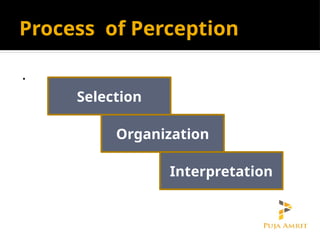
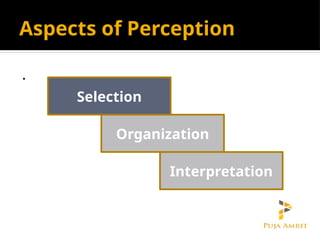
The processby which an individual
selects, organizes, and interprets
stimuli into a meaningful and
coherent picture of the world
How we see the world around us
7.
Perception
Concept:
Perceptionis another most important aspect of life of
organization. Many problems of the organization and
that of its members may be traced to the distortion in
perception. Perception means the ability to perceive i.e.
understanding or knowledge, mental grasp of qualities
by means of senses or awareness.
Communication is influenced by one’s perception of
individual. When we communicate with someone, the
language we used, the tone of the language and gesture
we make portray an individual’s character and a kind of
relationship he wants to develop
8.
Perception
We seean object but it is understood differently by different
people. It is perception. Perception is vividly defined by experts.
Some of the definitions are given below which make the meaning
of perception clear.
Slephen P. Robbins — “A process by which individuals organize
and interpret their sensory impressions in order to give meaning
to their environment.”
B. Von Haller Gilmer — “Perception is the process of becoming
aware of situations, of adding meaningful associations to
sensations.”
Udai Prateek — “The process of receiving, selecting, organising,
interpreting, checking and reacting to sensory stimuli or data.”
9.
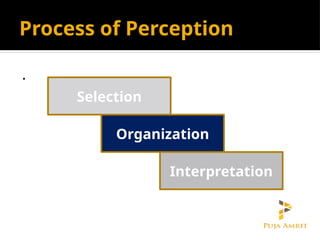
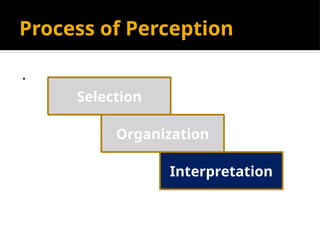
Process of Perception
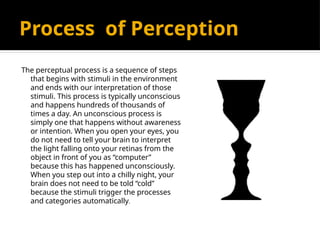
Theperceptual process is a sequence of steps
that begins with stimuli in the environment
and ends with our interpretation of those
stimuli. This process is typically unconscious
and happens hundreds of thousands of
times a day. An unconscious process is
simply one that happens without awareness
or intention. When you open your eyes, you
do not need to tell your brain to interpret
the light falling onto your retinas from the
object in front of you as “computer”
because this has happened unconsciously.
When you step out into a chilly night, your
brain does not need to be told “cold”
because the stimuli trigger the processes
and categories automatically.
Perceptual Selection
Theworld around us is filled with an infinite number
of stimuli that we might attend to, but our brains do
not have the resources to pay attention to
everything. Thus, the first step of perception is the
(usually unconscious, but sometimes intentional)
decision of what to attend to. Depending on the
environment, and depending on us as individuals, we
might focus on a familiar stimulus or something new.
When we attend to one specific thing in our
environment—whether it is a smell, a feeling, a
sound, or something else entirely—it becomes the
attended stimulus
13.
Perceptual Selectivity
Though peopleare exposed to several stimuli , they tend to select only a few at a given point of
time, this is perceptual selectivity. Selectivity in Perception which stimuli get selected depends on
two major factors :-
1) Consumers previous experience as it affects their expectations.
2) Their motives at that time for one’s needs, desire & interest etc.
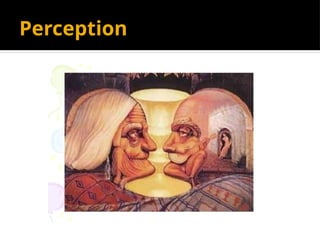
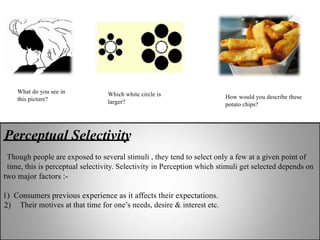
What do you see in
this picture?
Which white circle is
larger?
How would you describe these
potato chips?
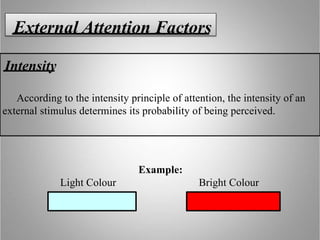
Intensity
According to theintensity principle of attention, the intensity of an
external stimulus determines its probability of being perceived.
External Attention Factors
Example:
Light Colour Bright Colour
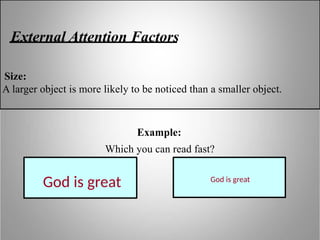
Size:
A larger objectis more likely to be noticed than a smaller object.
God is great God is great
External Attention Factors
Example:
Which you can read fast?
18.
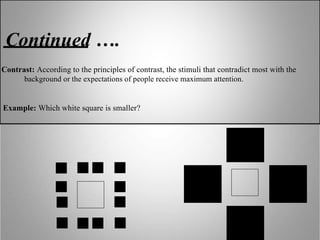
Continued ….
Contrast: Accordingto the principles of contrast, the stimuli that contradict most with the
background or the expectations of people receive maximum attention.
Example: Which white square is smaller?
19.
Continued ….
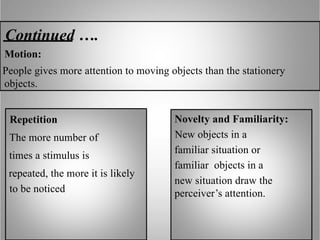
Motion:
People givesmore attention to moving objects than the stationery
objects.
Repetition
The more number of
times a stimulus is
repeated, the more it is likely
to be noticed
Novelty and Familiarity:
New objects in a
familiar situation or
familiar objects in a
new situation draw the
perceiver’s attention.
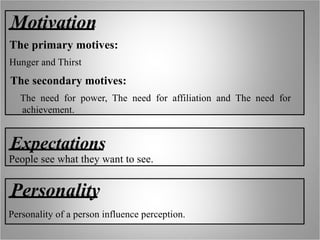
Motivation
The primary motives:
Hungerand Thirst
The secondary motives:
The need for power, The need for affiliation and The need for
achievement.
Personality
Personality of a person influence perception.
Expectations
People see what they want to see.
22.
Perceptual Selection
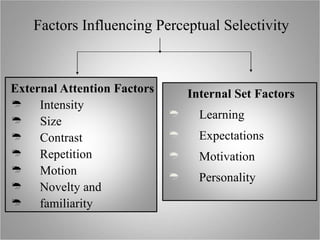
Stimuliget selected on two factors:-
People previous experience affects their
expectation
Motives at the time
Nature of the stimulus
Nature of the product, physical attributes
CONTRAST – Difference creates more attention
towards the ad.
23.
Perceptual Selection
1) Expectations:-
People see what they want to see, based on previous
experience, familiarity and preconditioned set of
expectations.
2) Motives
People perceive the things they need and want –
Stronger the need – Greater tendency to ignore
unrelated things.
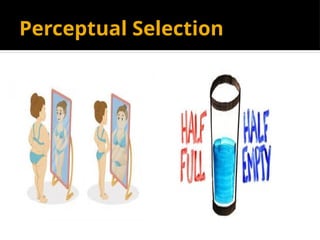
People who are obese see ads related to gyms and diet.
Perceptual Organization
Organization
Once we have chosen to attend to a stimulus in the
environment (consciously or unconsciously, though
usually the latter), the choice sets off a series of reactions
in our brain. This neural process starts with the activation
of our sensory receptors (touch, taste, smell, sight, and
hearing). The receptors transduce the input energy into
neural activity, which is transmitted to our brains, where
we construct a mental representation of the stimulus (or,
in most cases, the multiple related stimuli) called a
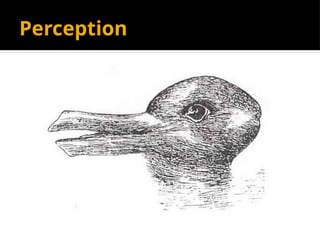
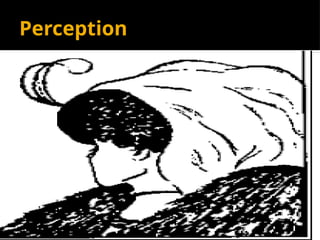
percept. An ambiguous stimulus may be translated into
multiple percepts, experienced randomly, one at a time, in
what is called “multistable perception.”
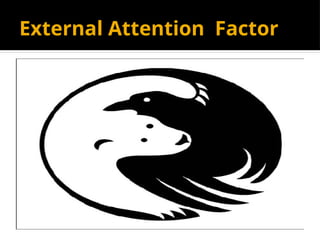
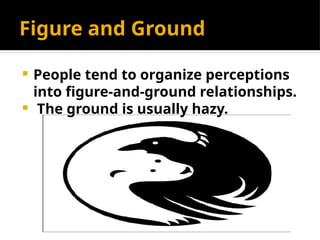
Figure and Ground
People tend to organize perceptions
into figure-and-ground relationships.
The ground is usually hazy.
29.
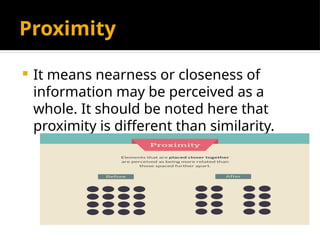
Proximity
It meansnearness or closeness of
information may be perceived as a
whole. It should be noted here that
proximity is different than similarity.
30.
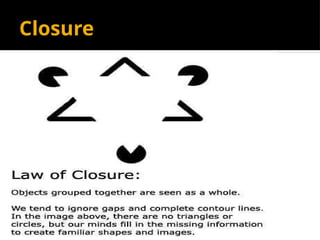
Closure
People havea need for closure and
organize perceptions to form a
complete picture.
Will often fill in missing pieces
Incomplete messages remembered
more than complete
Interpretation
Interpretation
Afterwe have attended to a stimulus, and our brains have
received and organized the information, we interpret it in a way
that makes sense using our existing information about the world.
Interpretation simply means that we take the information that we
have sensed and organized and turn it into something that we
can categorize. For instance, in the Rubin’s Vase illusion
mentioned earlier, some individuals will interpret the sensory
information as “vase,” while some will interpret it as “faces.” This
happens unconsciously thousands of times a day. By putting
different stimuli into categories, we can better understand and
react to the world around us.
Meaning
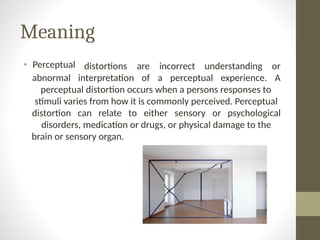
• Perceptual distortionsare incorrect understanding or
abnormal interpretation of a perceptual experience. A
perceptual distortion occurs when a persons responses to
stimuli varies from how it is commonly perceived. Perceptual
distortion can relate to either sensory or psychological
disorders, medication or drugs, or physical damage to the
brain or sensory organ.
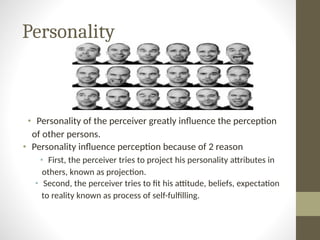
Personality
• Personality ofthe perceiver greatly influence the perception
of other persons.
• Personality influence perception because of 2 reason
• First, the perceiver tries to project his personality attributes in
others, known as projection.
• Second, the perceiver tries to fit his attitude, beliefs, expectation
to reality known as process of self-fulfilling.
38.
Mental Set
• Mentalset is the tendency on has to react in a certain way to a
given situation.
• In organization setting, people have tendency to perceive about
others on the
misperception.
basis of this mental set which cause
• For ex. Suppose you are a contestant in a track meet and are
positioning yourself in your starting blocks as you hear the
preparatory command, get ready, get set when you hear the
command, Go you take off at once since you are already set and
ready to this command.
39.
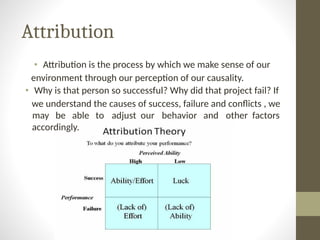
Attribution
• Attribution isthe process by which we make sense of our
environment through our perception of our causality.
• Why is that person so successful? Why did that project fail? If
we understand the causes of success, failure and conflicts , we
may be able to adjust our behavior and other factors
accordingly.
40.
Cont..
• Attribution issimply the process of attaching or attributing
causes or reason to the actions and events we see. Causality is
usually described in terms of internal causality and external
causality.
• For ex. We may explain a particular individuals success or
promotion with reference to his/her superior skills and
knowledge (internal causality) or with reference to luck,
'friends in high places’ and coincidence (external causality).
41.
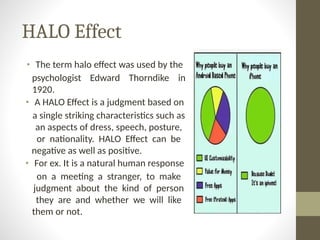
HALO Effect
• Theterm halo effect was used by the
psychologist Edward Thorndike in
1920.
• A HALO Effect is a judgment based on
a single striking characteristics such as
an aspects of dress, speech, posture,
or nationality. HALO Effect can be
negative as well as positive.
• For ex. It is a natural human response
on a meeting a stranger, to make
judgment about the kind of person
they are and whether we will like
them or not.
42.
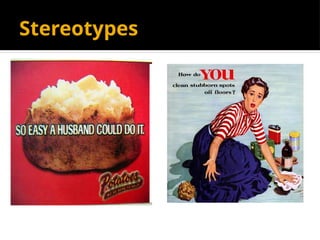
Stereotyping
Stereotyping occurs whenthe perceiver judges or perceives a
person on the basis of characteristics of the group to which he
belongs.
• The person is not perceived as an individual with specific set
of his characteristics but on the basis of his group
characteristics.
• For ex. There are some stereotyping at the international level
like; Japanese are industrious, Italian are quick tempered
American are materialistic and ambitious.
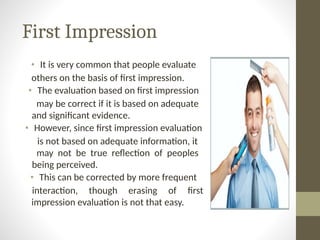
First Impression
• Itis very common that people evaluate
others on the basis of first impression.
• The evaluation based on first impression
may be correct if it is based on adequate
and significant evidence.
• However, since first impression evaluation
is not based on adequate information, it
may not be true reflection of peoples
being perceived.
• This can be corrected by more frequent
interaction, though erasing of first
impression evaluation is not that easy.