PRESENTED BY:NAME

ROLL NO.

ANIL PANDAV

22

ANURAG AGARWAL

23

SHRUTI PODDAR

24
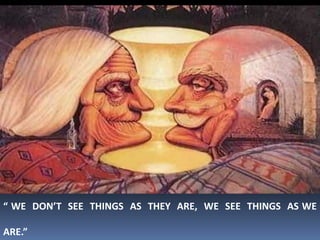
“ WE DON’T SEE THINGS AS THEY ARE, WE SEE THINGS AS WE
ARE.”
MEANING OF PERCEPTION
 The process by which people select, organize,
interpret, retrieve, and respond to information.

 Perceptions differ from person to person.
 Each individual
differently.

perceives

the

same

situation

 Individuals organize and interpret things based on
their past experiences and the important values they
consider important.
 Employees tend to behave and act on certain things on

the basis of their perception.
DEFINITIONS
 STEPHEN ROBBINS
“ Perception is a process by which individual’s organize
and interpret the sensory impressions in order to give
meaning to their environment.”

 FRED LUTHANS
“Perception is an important mediating cognitive
process through which persons make interpretations of
the stimulus or situation they are forced with.”
Cntd…….
 In general, it can be defined as “ a process that
involves seeing, receiving, selecting, organizing,
interpreting and giving meaning to the environment”.
NATURE OF PERCEPTION
1. Perception is the process by which an individual gives
meaning to the environment.

2. It is a cognitive and psychological process.
3. People’s action, emotions, thoughts and feelings are
triggered by their perceptions.
4. Since perception refers to the acquisition of specific
knowledge about objects or events at any particular

moment, it occurs whenever stimuli activate the sense
organs.
5. Though perception has been defined in a variety of ways,
it basically refers to the manner in which a person
experiences the world.
6. Perception is an almost automatic process and works in
much the same way within each individual, yet typically

yields different perceptions.
7. A stimulus that is not perceived has no effect on behavior.
8. Perception is a process that operates constantly between
us and reality.
9. Since perception is subjective process, different people
may perceive the same environment differently. So
perception is like beauty, that lies in the eyes of the
beholder.
10. Perception involves the creation of gestalts.

11. Perception is a unique interpretation of the situation,
not an exact recording of the situation.
12. Perception is more complex and much broader than
sensation.
IMPORTANCE OF PERCEPTION
 Perception plays a very important role in shaping the

personality of an individual.
 Perception is central in interpreting the world around us.
 Perception affects the outcome of our behavior because we

act on the basis of what we see.
 Managers should be able to distinguish between a perceived

world and the reality.
 An understanding of perception is important to understand

and control the human behavior .
FACTORS INFLUENCING THE PERCEPTUAL
PROCESS

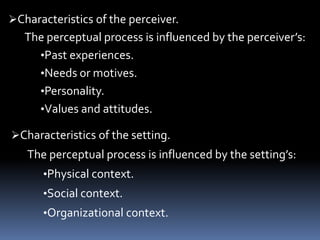
Characteristics of the perceiver.
Characteristics of the setting.
Characteristics of the perceived.
Characteristics of the perceiver.

The perceptual process is influenced by the perceiver’s:
•Past experiences.
•Needs or motives.
•Personality.
•Values and attitudes.
Characteristics of the setting.

The perceptual process is influenced by the setting’s:
•Physical context.

•Social context.
•Organizational context.
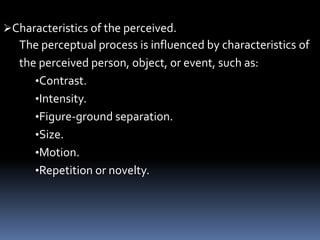
Characteristics of the perceived.

The perceptual process is influenced by characteristics of
the perceived person, object, or event, such as:
•Contrast.
•Intensity.
•Figure-ground separation.
•Size.
•Motion.
•Repetition or novelty.
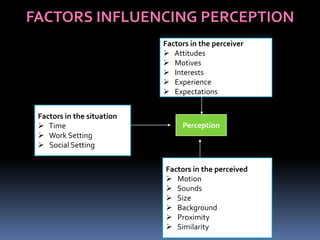
FACTORS INFLUENCING PERCEPTION
Factors in the perceiver
 Attitudes
 Motives
 Interests
 Experience
 Expectations
Factors in the situation
 Time
 Work Setting
 Social Setting

Perception

Factors in the perceived
 Motion
 Sounds
 Size
 Background
 Proximity
 Similarity
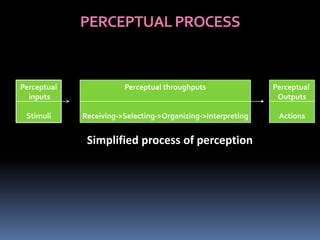
PERCEPTUAL PROCESS

Perceptual
inputs

Perceptual throughputs

Perceptual
Outputs

Stimuli

Receiving->Selecting->Organizing->Interpreting

Actions

Simplified process of perception
 Perceptual inputs – Objects, Events and people.

All those things in the setting where events occur or
contribute to the occurrence of events can be termed as
Perceptual inputs.
 Perceptual Mechanism -involves three elements viz. selection

of stimuli, organization of stimuli and interpretation of
stimuli.
 Perceptual outputs –Attitudes, Opinions, Feelings & Values.
 The result is the “ BEHAVIOUR”
WHAT ARE COMMON
PERCEPTUAL DISTORTIONS?
Or
PERCEPTUAL ERRORS
Stereotypes or prototypes.

Halo effects.
Selective perception.

Projection.
Contrast effects.

Self-fulfilling prophecy.
Cntd…….
 Stereotypes or prototypes.
 Combines information based on the category or class to

which a person, situation, or object belongs.

 Halo effects.
 Occur when one attribute of a person or situation is

used to develop an overall impression of the individual
or situation.
Cntd……..
 Selective perception.
 The tendency to single out those aspects of a

situation, person, or object that are consistent with
one’s needs, values, or attitudes.

 Projection.
 The assignment of one’s personal attributes to other

individuals.
 Projection can be controlled through a high degree of

self-awareness and empathy.
Cntd…….
 Contrast effects.
 Occur when an individual is compared to other people

on the same characteristics on which the others rank
higher or lower.

 Self-fulfilling prophecy.
 The tendency to create or find in another situation or

individual that which one expected to find.
 Managers

should

adopt

positive

approaches to people at work.

and

optimistic
HOW CAN THE PERCEPTUAL
PROCESS BE MANAGED?
 Impression management.
A person’s systematic attempt to behave in ways that

create and maintain desired impressions in others’ eyes.
Successful managers:
 Use impression management to enhance their own

images.
 Are sensitive to other people’s use of impression

management.
Cntd…….
 Distortion management.
Managers should:
 Balance

automatic

and

controlled

information

processing at the attention and selection stage.
 Broaden their schemas at the organizing stage.

 Be attuned to attributions at the interpretation stage.
Perception
Perception

Perception

  • 1.
    PRESENTED BY:NAME ROLL NO. ANILPANDAV 22 ANURAG AGARWAL 23 SHRUTI PODDAR 24
  • 3.
    “ WE DON’TSEE THINGS AS THEY ARE, WE SEE THINGS AS WE ARE.”
  • 4.
    MEANING OF PERCEPTION The process by which people select, organize, interpret, retrieve, and respond to information.  Perceptions differ from person to person.  Each individual differently. perceives the same situation  Individuals organize and interpret things based on their past experiences and the important values they consider important.  Employees tend to behave and act on certain things on the basis of their perception.
  • 5.
    DEFINITIONS  STEPHEN ROBBINS “Perception is a process by which individual’s organize and interpret the sensory impressions in order to give meaning to their environment.”  FRED LUTHANS “Perception is an important mediating cognitive process through which persons make interpretations of the stimulus or situation they are forced with.”
  • 6.
    Cntd…….  In general,it can be defined as “ a process that involves seeing, receiving, selecting, organizing, interpreting and giving meaning to the environment”.
  • 7.
    NATURE OF PERCEPTION 1.Perception is the process by which an individual gives meaning to the environment. 2. It is a cognitive and psychological process. 3. People’s action, emotions, thoughts and feelings are triggered by their perceptions. 4. Since perception refers to the acquisition of specific knowledge about objects or events at any particular moment, it occurs whenever stimuli activate the sense organs.
  • 8.
    5. Though perceptionhas been defined in a variety of ways, it basically refers to the manner in which a person experiences the world. 6. Perception is an almost automatic process and works in much the same way within each individual, yet typically yields different perceptions. 7. A stimulus that is not perceived has no effect on behavior. 8. Perception is a process that operates constantly between us and reality.
  • 9.
    9. Since perceptionis subjective process, different people may perceive the same environment differently. So perception is like beauty, that lies in the eyes of the beholder. 10. Perception involves the creation of gestalts. 11. Perception is a unique interpretation of the situation, not an exact recording of the situation. 12. Perception is more complex and much broader than sensation.
  • 10.
    IMPORTANCE OF PERCEPTION Perception plays a very important role in shaping the personality of an individual.  Perception is central in interpreting the world around us.  Perception affects the outcome of our behavior because we act on the basis of what we see.  Managers should be able to distinguish between a perceived world and the reality.  An understanding of perception is important to understand and control the human behavior .
  • 11.
    FACTORS INFLUENCING THEPERCEPTUAL PROCESS Characteristics of the perceiver. Characteristics of the setting. Characteristics of the perceived.
  • 12.
    Characteristics of theperceiver. The perceptual process is influenced by the perceiver’s: •Past experiences. •Needs or motives. •Personality. •Values and attitudes. Characteristics of the setting. The perceptual process is influenced by the setting’s: •Physical context. •Social context. •Organizational context.
  • 13.
    Characteristics of theperceived. The perceptual process is influenced by characteristics of the perceived person, object, or event, such as: •Contrast. •Intensity. •Figure-ground separation. •Size. •Motion. •Repetition or novelty.
  • 14.
    FACTORS INFLUENCING PERCEPTION Factorsin the perceiver  Attitudes  Motives  Interests  Experience  Expectations Factors in the situation  Time  Work Setting  Social Setting Perception Factors in the perceived  Motion  Sounds  Size  Background  Proximity  Similarity
  • 15.
  • 16.
     Perceptual inputs– Objects, Events and people. All those things in the setting where events occur or contribute to the occurrence of events can be termed as Perceptual inputs.  Perceptual Mechanism -involves three elements viz. selection of stimuli, organization of stimuli and interpretation of stimuli.  Perceptual outputs –Attitudes, Opinions, Feelings & Values.  The result is the “ BEHAVIOUR”
  • 17.
    WHAT ARE COMMON PERCEPTUALDISTORTIONS? Or PERCEPTUAL ERRORS Stereotypes or prototypes. Halo effects. Selective perception. Projection. Contrast effects. Self-fulfilling prophecy.
  • 18.
    Cntd…….  Stereotypes orprototypes.  Combines information based on the category or class to which a person, situation, or object belongs.  Halo effects.  Occur when one attribute of a person or situation is used to develop an overall impression of the individual or situation.
  • 19.
    Cntd……..  Selective perception. The tendency to single out those aspects of a situation, person, or object that are consistent with one’s needs, values, or attitudes.  Projection.  The assignment of one’s personal attributes to other individuals.  Projection can be controlled through a high degree of self-awareness and empathy.
  • 20.
    Cntd…….  Contrast effects. Occur when an individual is compared to other people on the same characteristics on which the others rank higher or lower.  Self-fulfilling prophecy.  The tendency to create or find in another situation or individual that which one expected to find.  Managers should adopt positive approaches to people at work. and optimistic
  • 21.
    HOW CAN THEPERCEPTUAL PROCESS BE MANAGED?  Impression management. A person’s systematic attempt to behave in ways that create and maintain desired impressions in others’ eyes. Successful managers:  Use impression management to enhance their own images.  Are sensitive to other people’s use of impression management.
  • 22.
    Cntd…….  Distortion management. Managersshould:  Balance automatic and controlled information processing at the attention and selection stage.  Broaden their schemas at the organizing stage.  Be attuned to attributions at the interpretation stage.