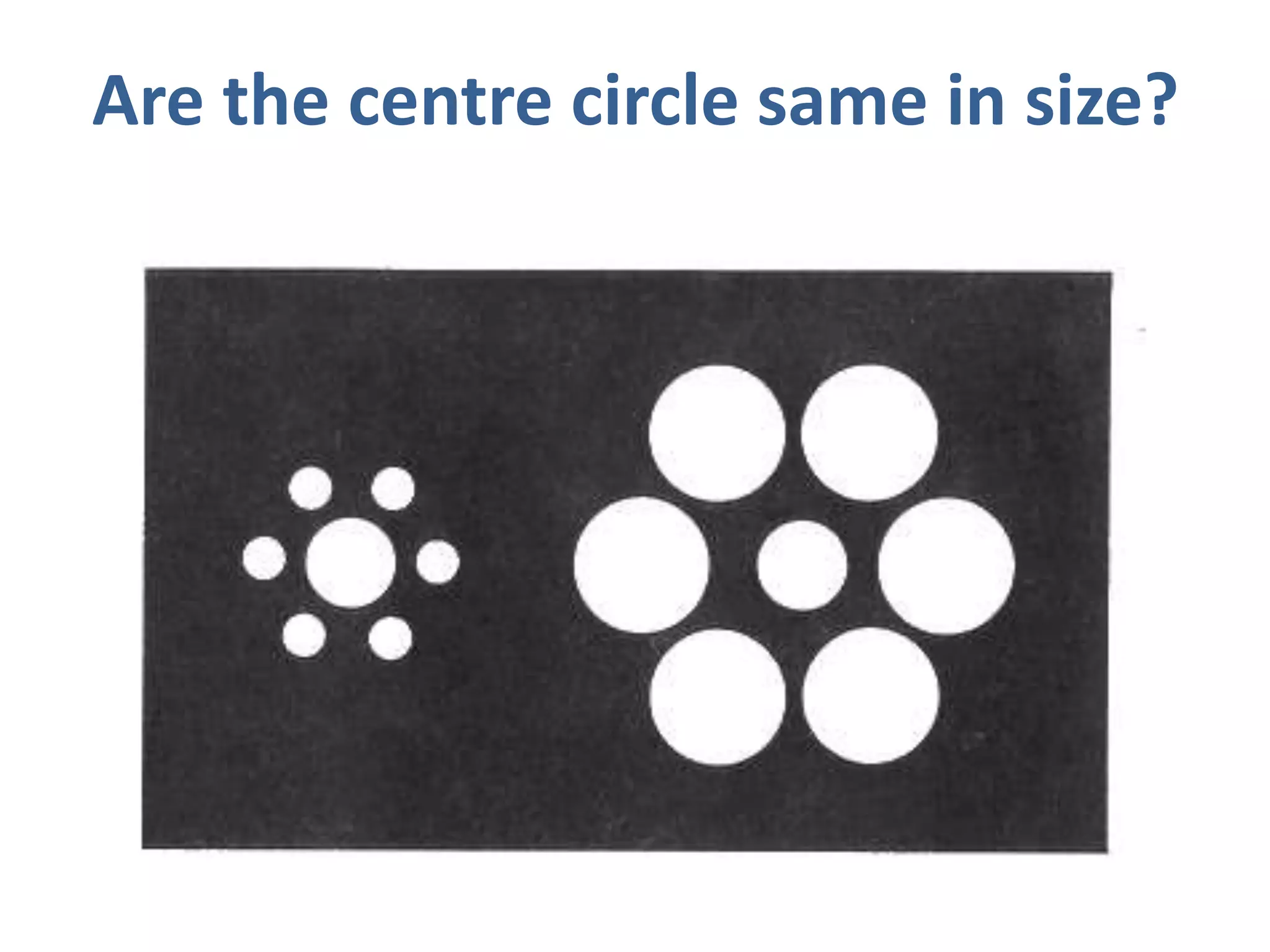
Are the centre circle same in size?
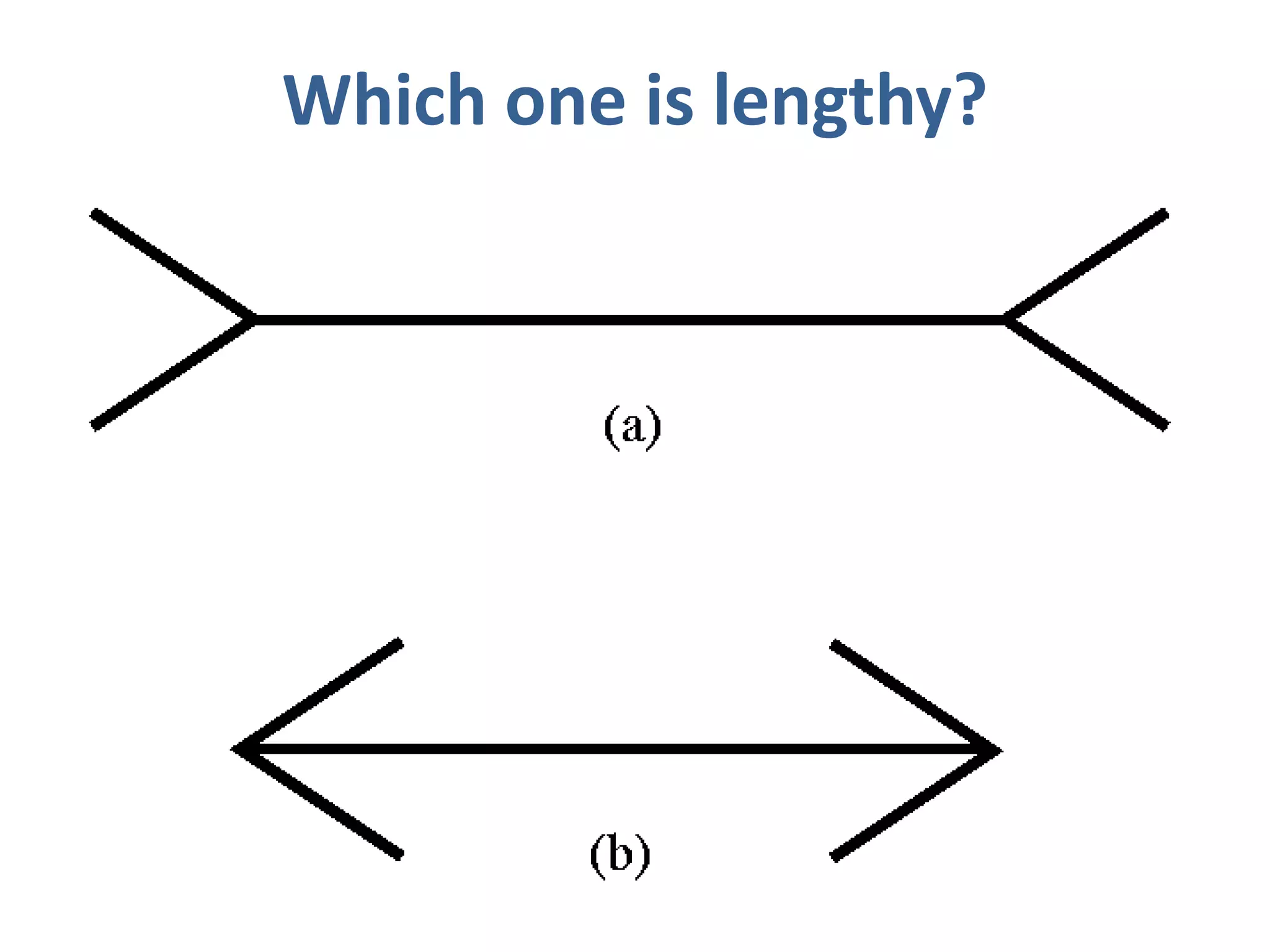
Which one is lengthy?
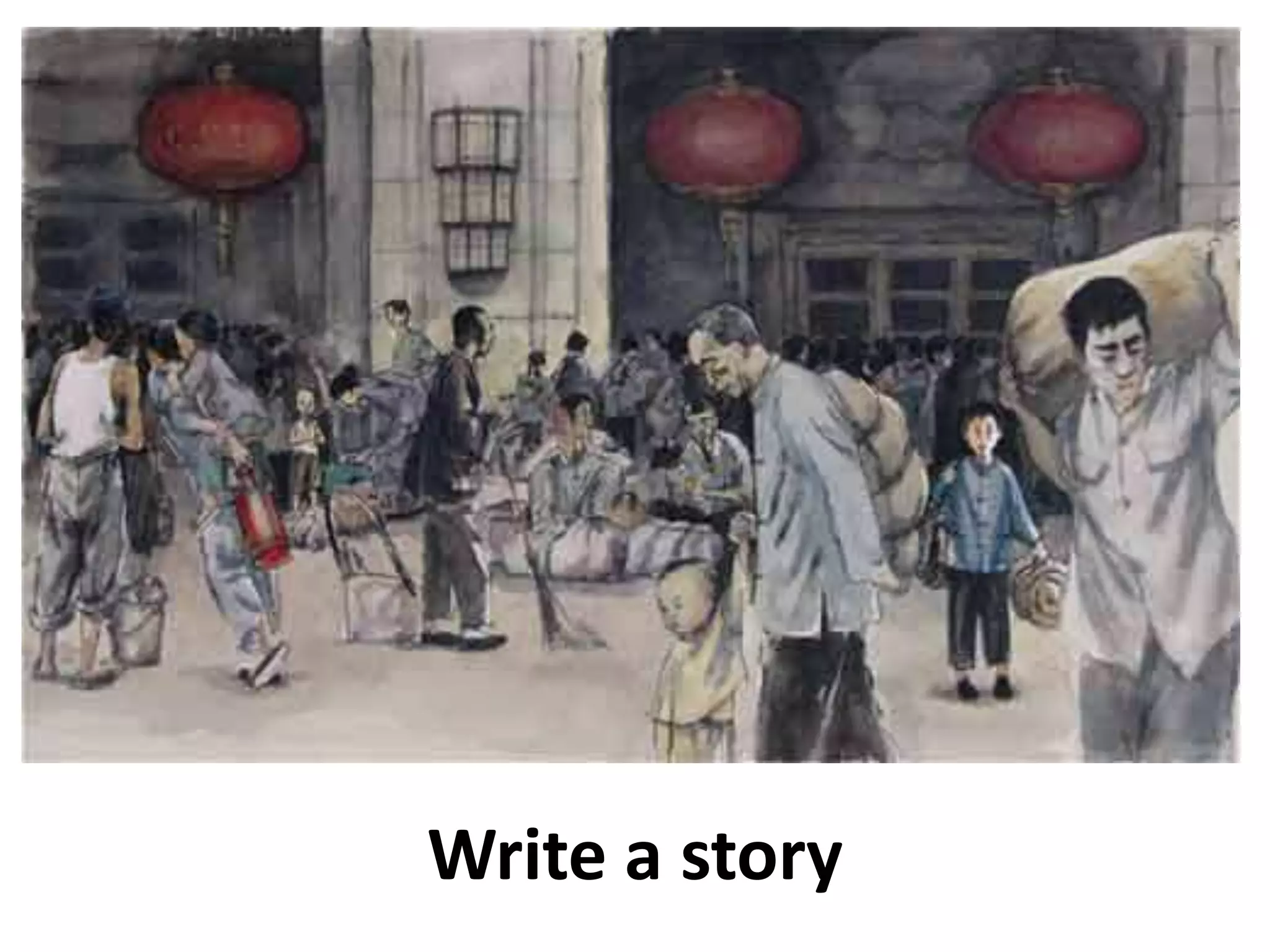
Write a story
PERCEPTION
• The process by which an individual selects,
organizes, and interprets stimuli into a
meaningful and coherent picture of the world
• Perception is how we see the world around us
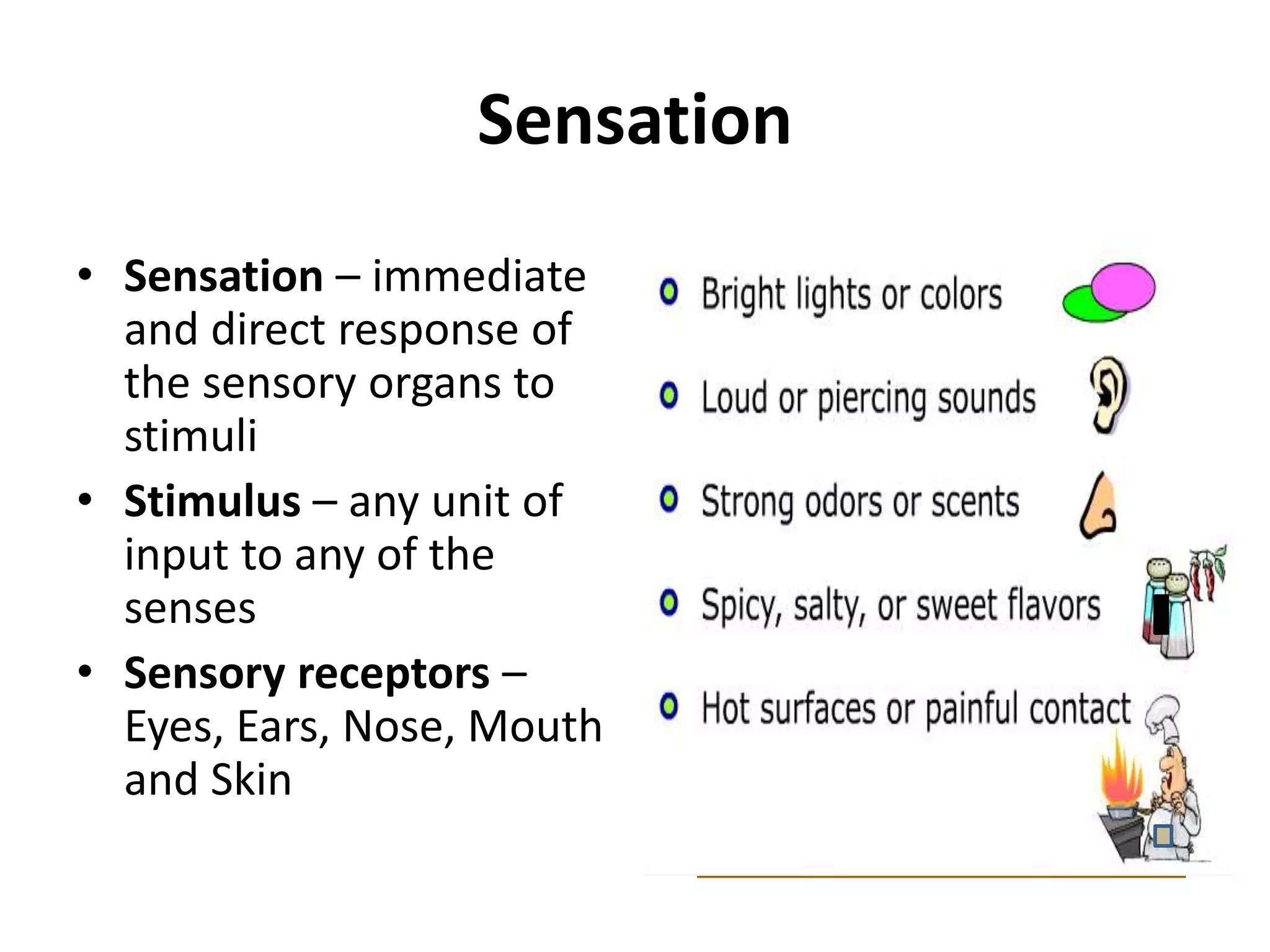
Sensation
• Sensation – immediate
and direct response of
the sensory organs to
stimuli
• Stimulus – any unit of
input to any of the
senses
• Sensory receptors –
Eyes, Ears, Nose, Mouth
and Skin
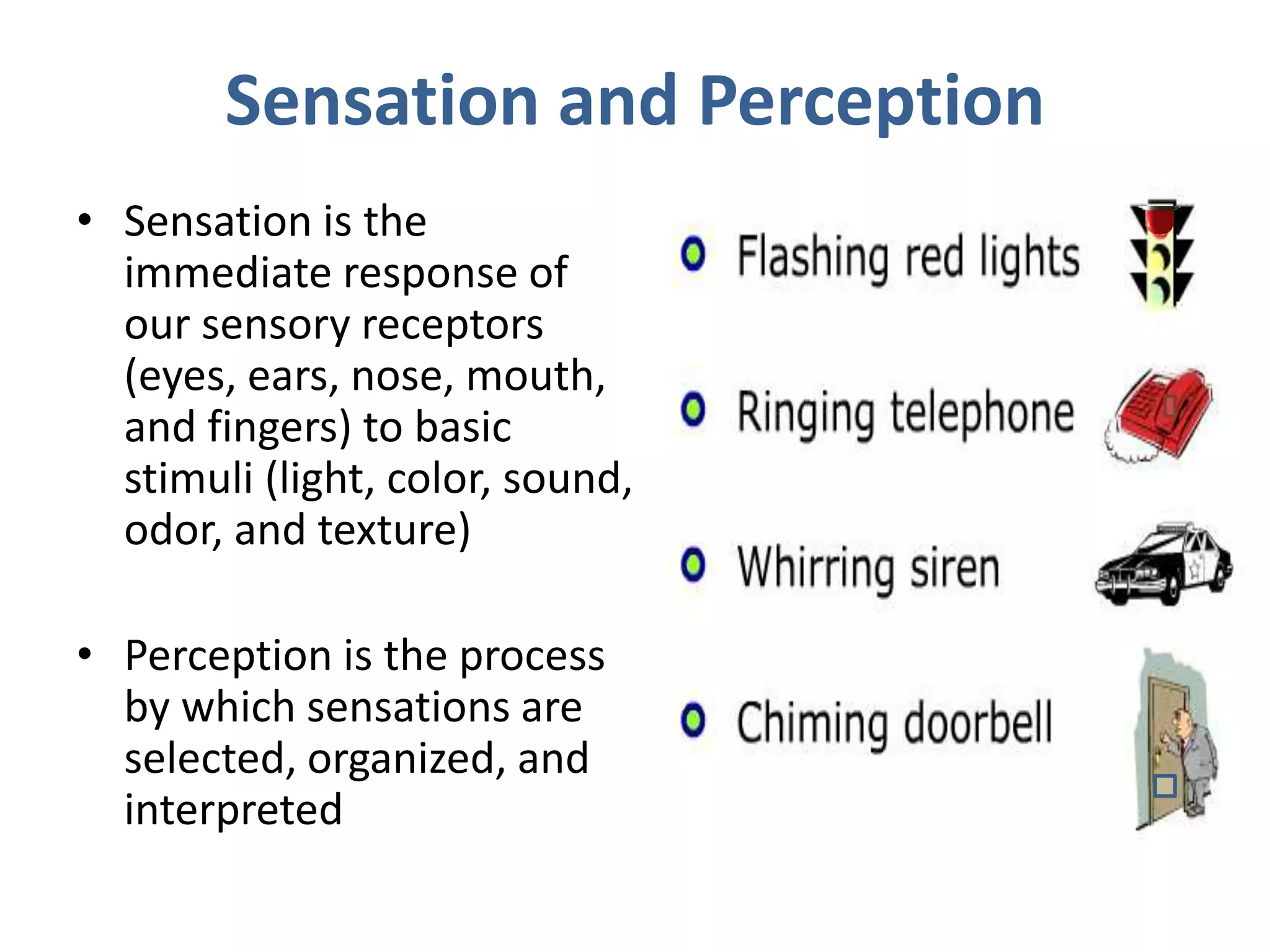
Sensation and Perception
• Sensation is the
immediate response of
our sensory receptors
(eyes, ears, nose, mouth,
and fingers) to basic
stimuli (light, color, sound,
odor, and texture)
• Perception is the process
by which sensations are
selected, organized, and
interpreted
Sensory Systems
Vision
• Color provokes emotion
• Reactions to color are
biological and cultural
• Trade dress: colors
associated with specific
companies
Scents
• Odors creates mood and
promote memories:
– Coffee : College days
– Maggi: Home
– Starbucks/Odonil
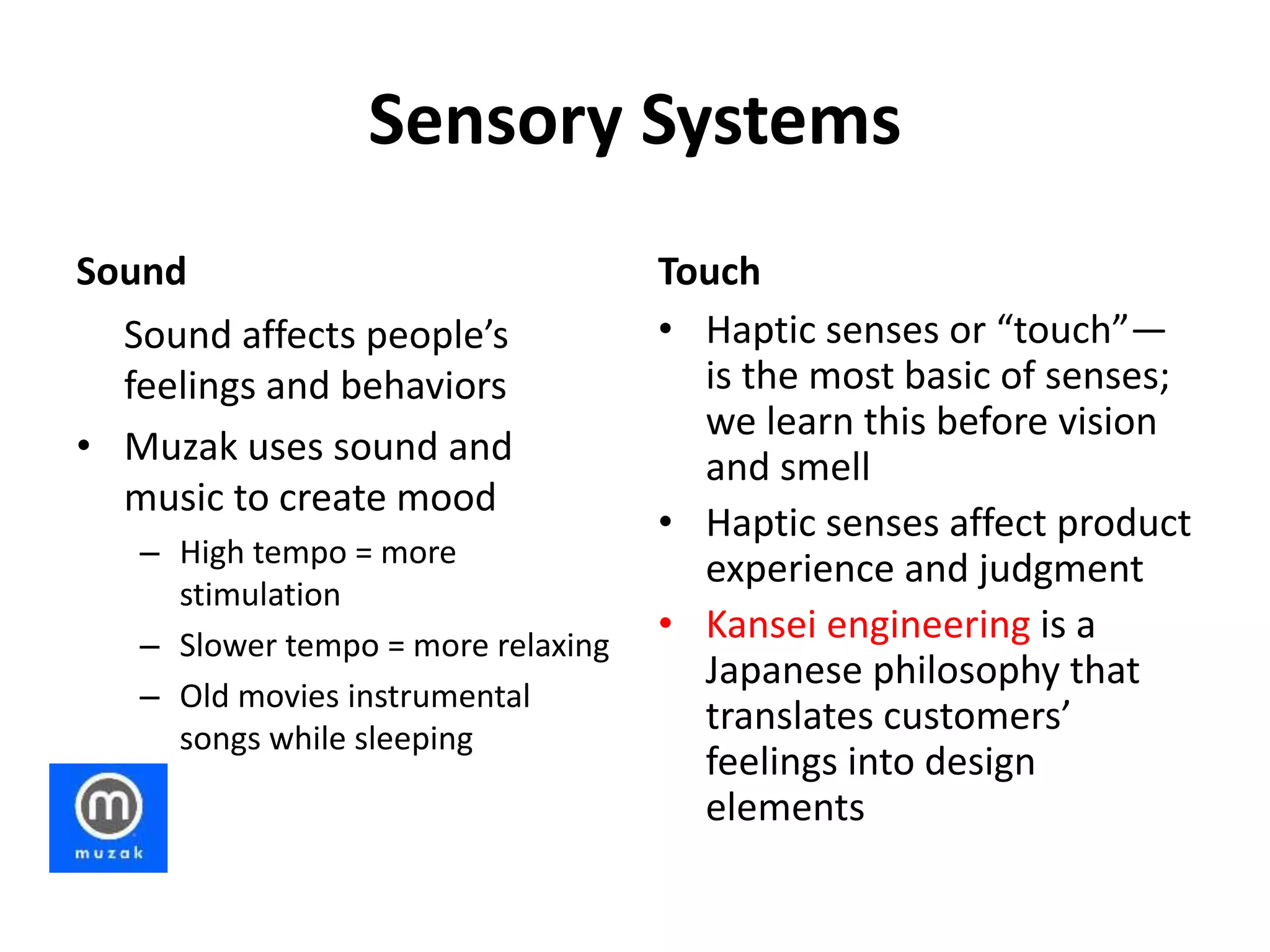
Sensory Systems
Sound
Sound affects people’s
feelings and behaviors
• Muzak uses sound and
music to create mood
– High tempo = more
stimulation
– Slower tempo = more relaxing
– Old movies instrumental
songs while sleeping
Touch
• Haptic senses or “touch”—
is the most basic of senses;
we learn this before vision
and smell
• Haptic senses affect product
experience and judgment
• Kansei engineering is a
Japanese philosophy that
translates customers’
feelings into design
elements
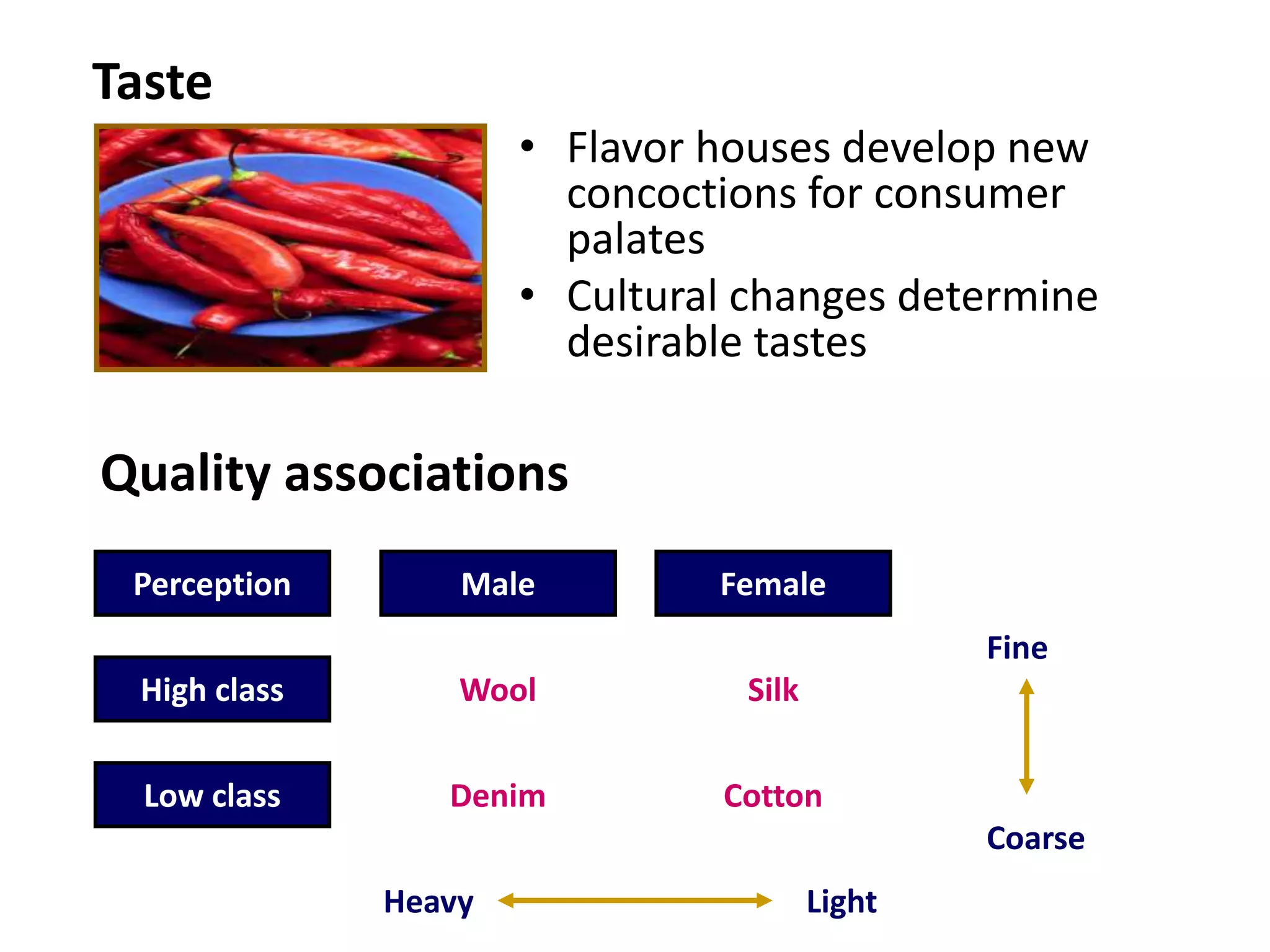
Taste
• Flavor houses develop new
concoctions for consumer
palates
• Cultural changes determine
desirable tastes
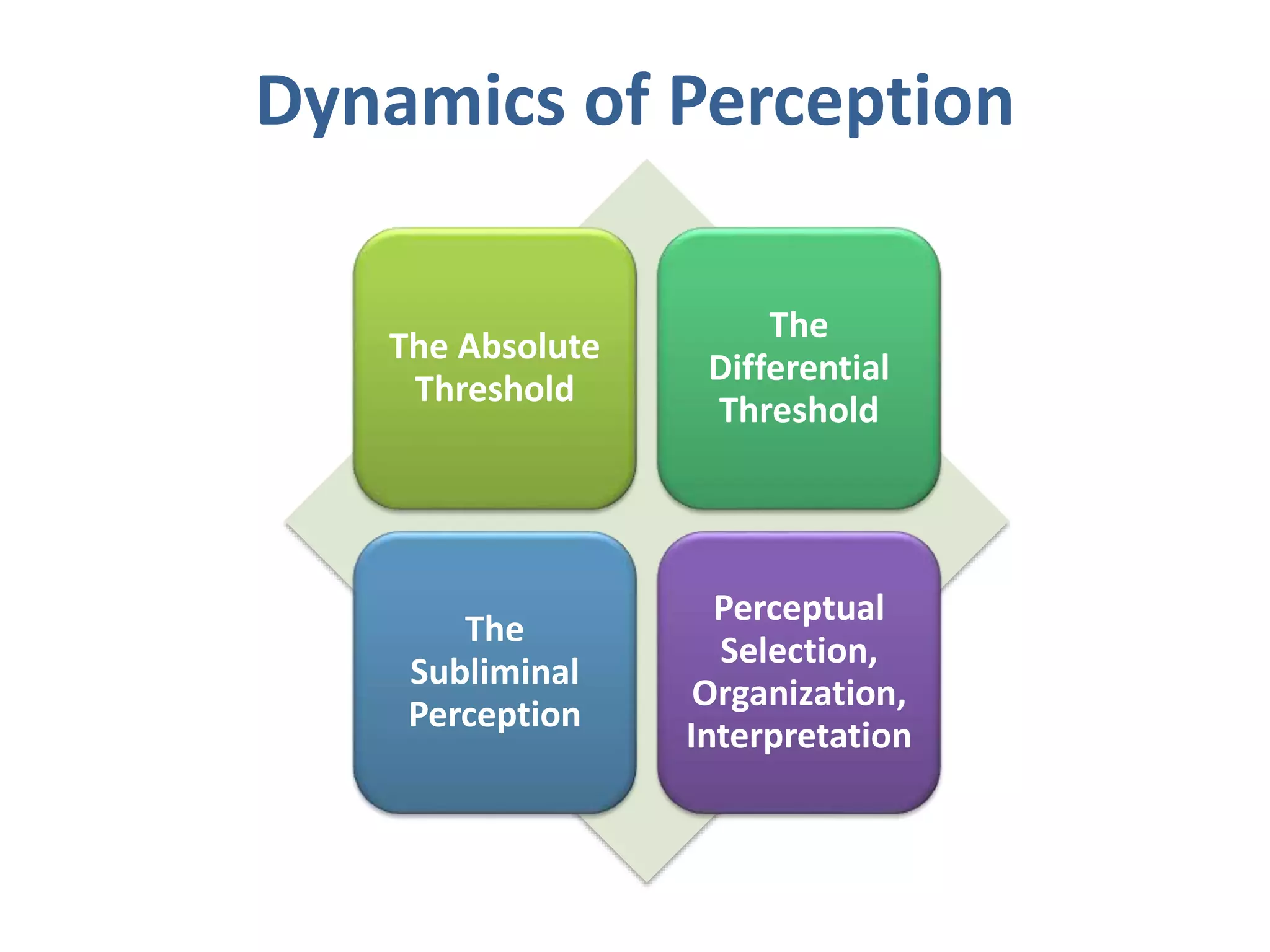
Quality associations
Male Female
High class
Low class
Perception
Wool Silk
Denim Cotton
Fine
Coarse
Heavy Light
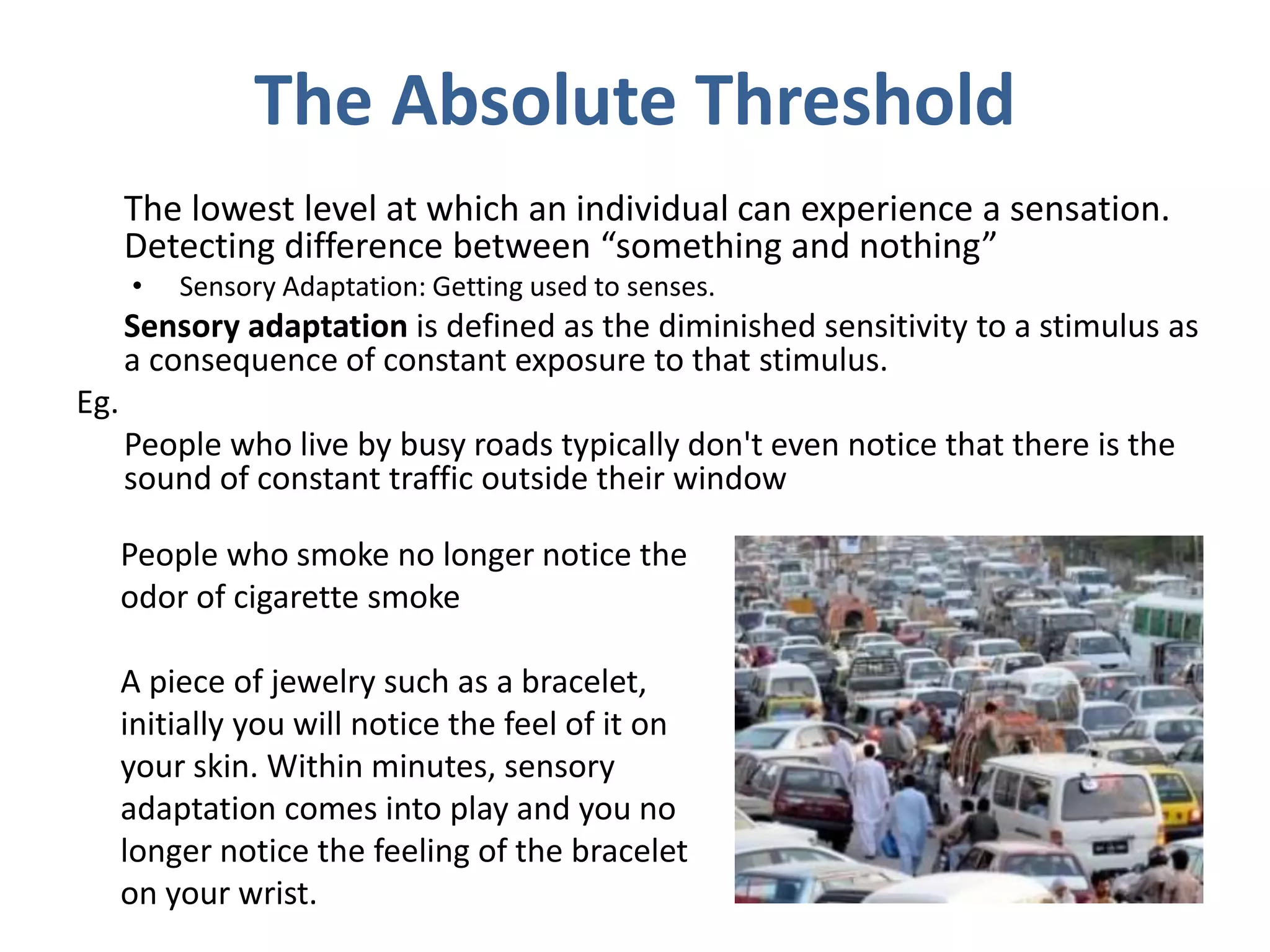
Dynamics of Perception
The Absolute
Threshold
The
Differential
Threshold
The
Subliminal
Perception
Perceptual
Selection,
Organization,
Interpretation
The Absolute Threshold
The lowest level at which an individual can experience a sensation.
Detecting difference between “something and nothing”
• Sensory Adaptation: Getting used to senses.
Sensory adaptation is defined as the diminished sensitivity to a stimulus as
a consequence of constant exposure to that stimulus.
Eg.
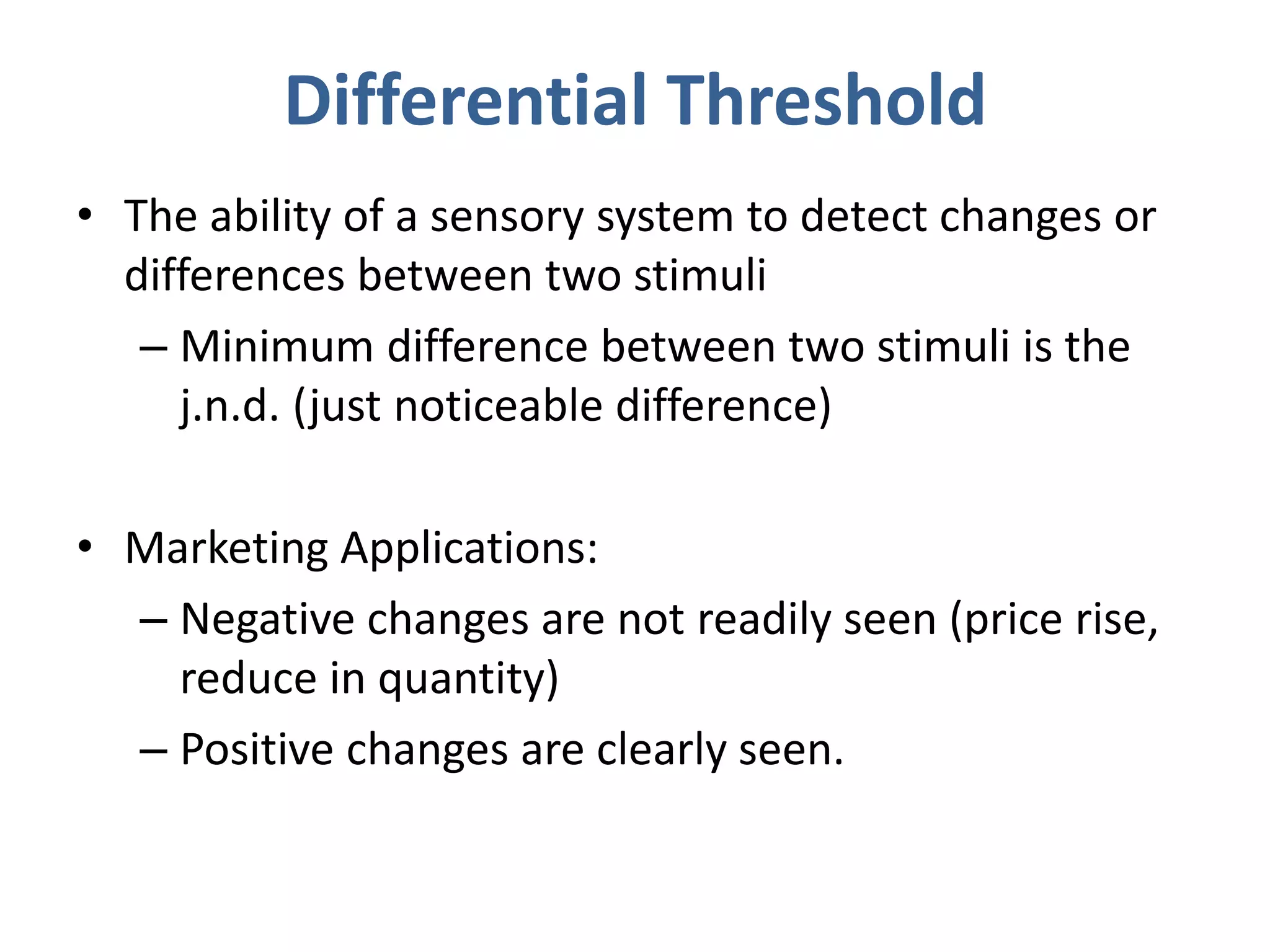
People who live by busy roads typically don't even notice that there is the
sound of constant traffic outside their window
People who smoke no longer notice the
odor of cigarette smoke
A piece of jewelry such as a bracelet,
initially you will notice the feel of it on
your skin. Within minutes, sensory
adaptation comes into play and you no
longer notice the feeling of the bracelet
on your wrist.
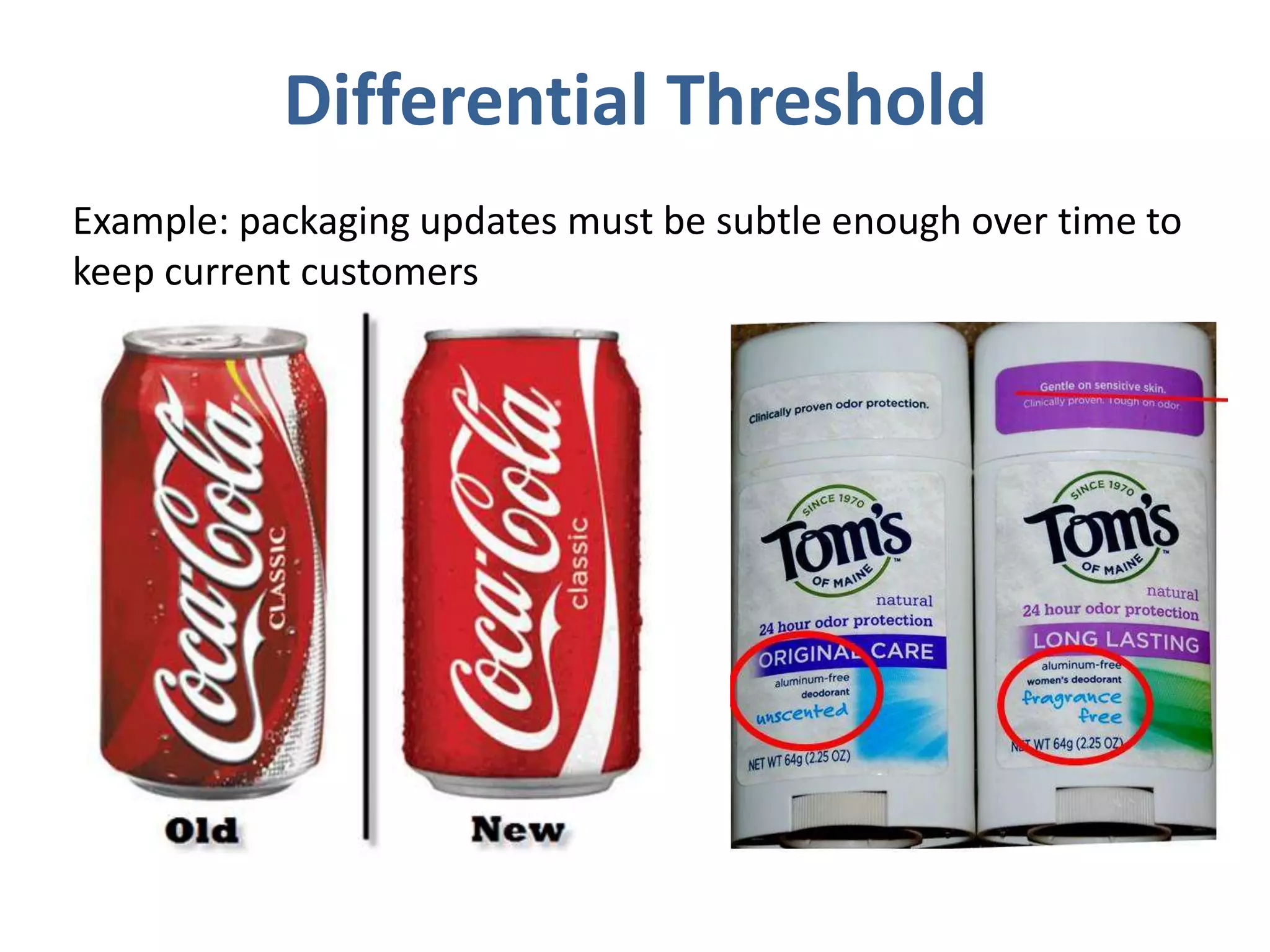
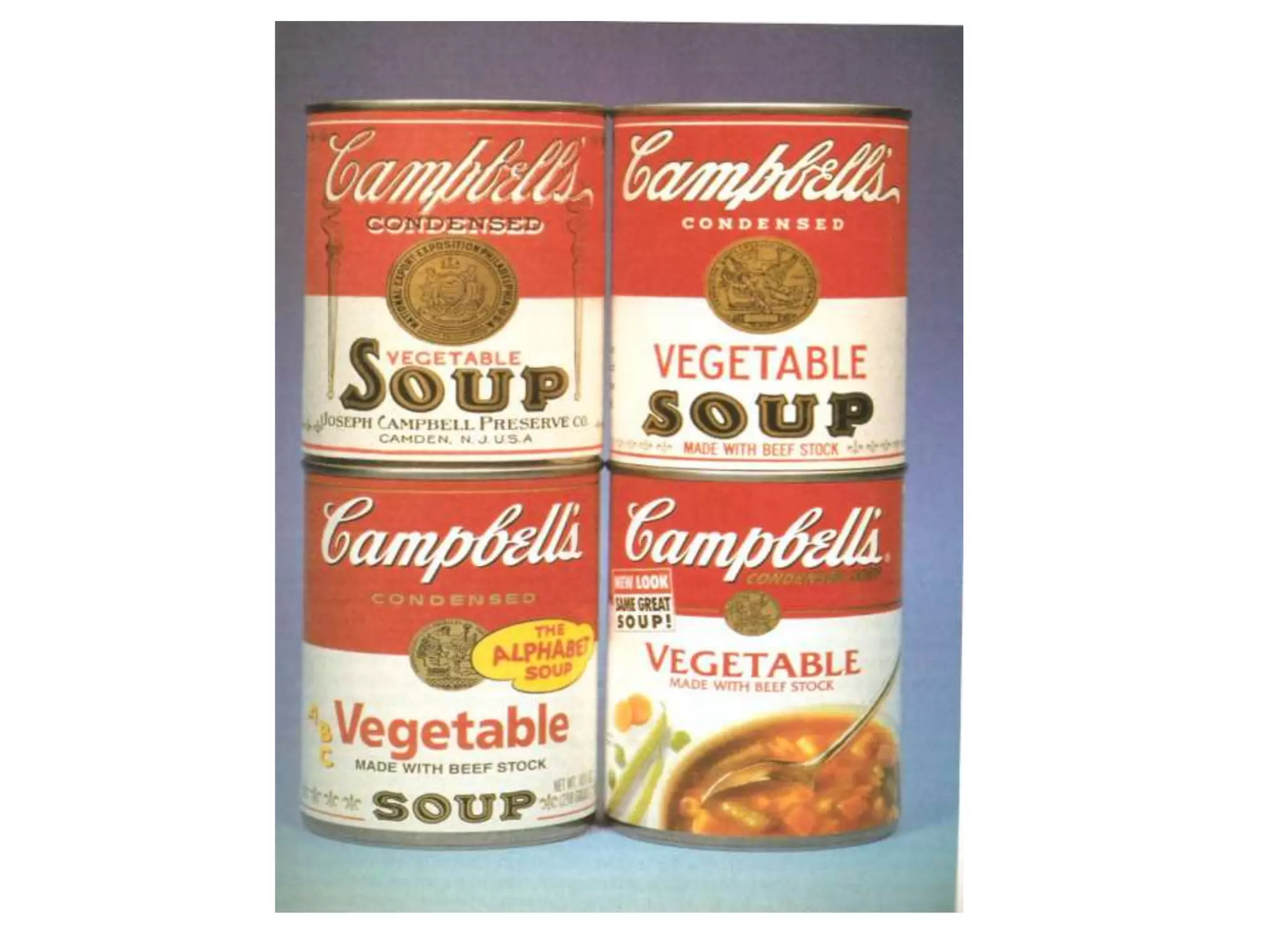
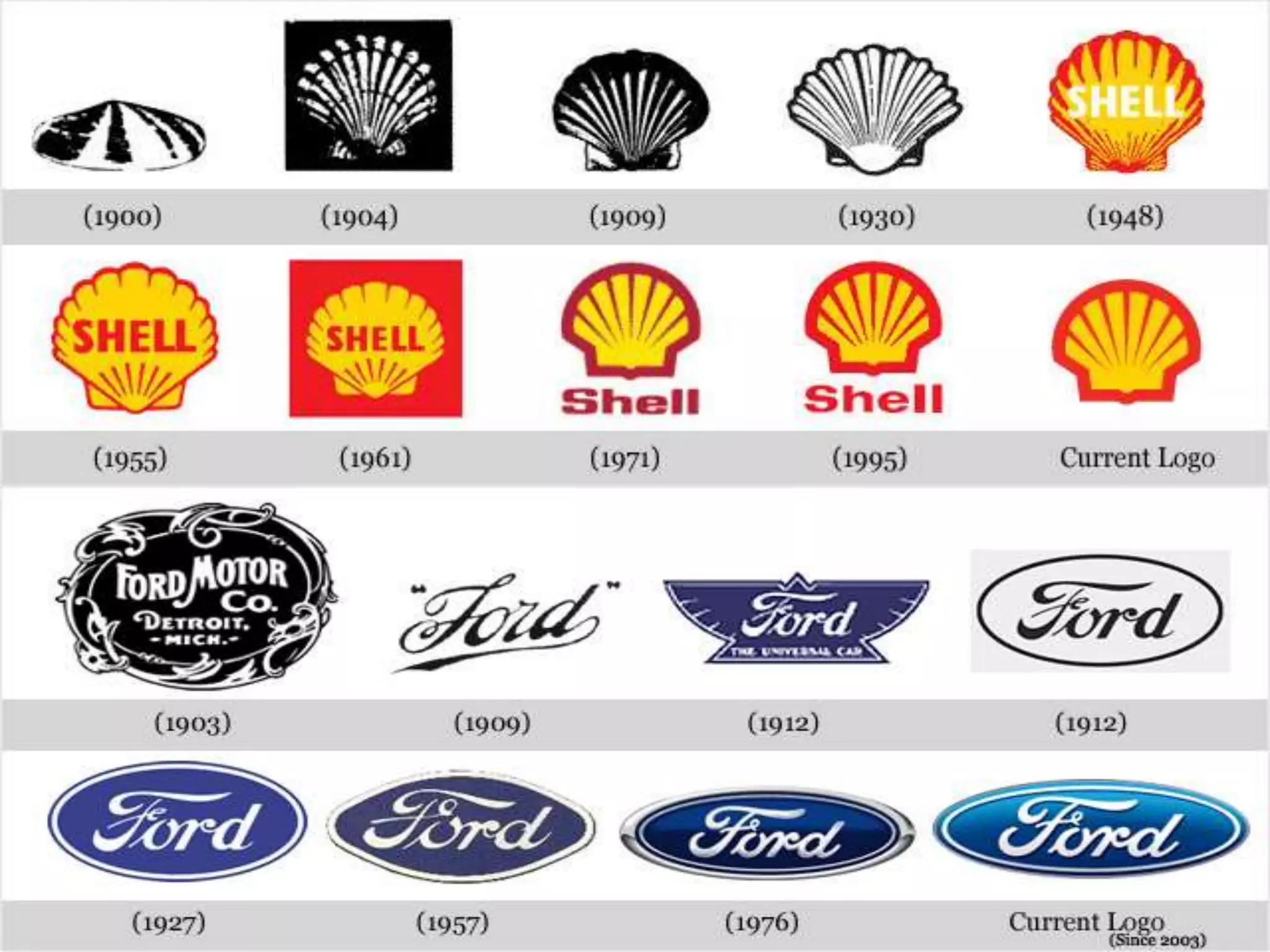
Differential Threshold
• The ability of a sensory system to detect changes or
differences between two stimuli
– Minimum difference between two stimuli is the
j.n.d. (just noticeable difference)
• Marketing Applications:
– Negative changes are not readily seen (price rise,
reduce in quantity)
– Positive changes are clearly seen.
Differential Threshold
Example: packaging updates must be subtle enough over time to
keep current customers
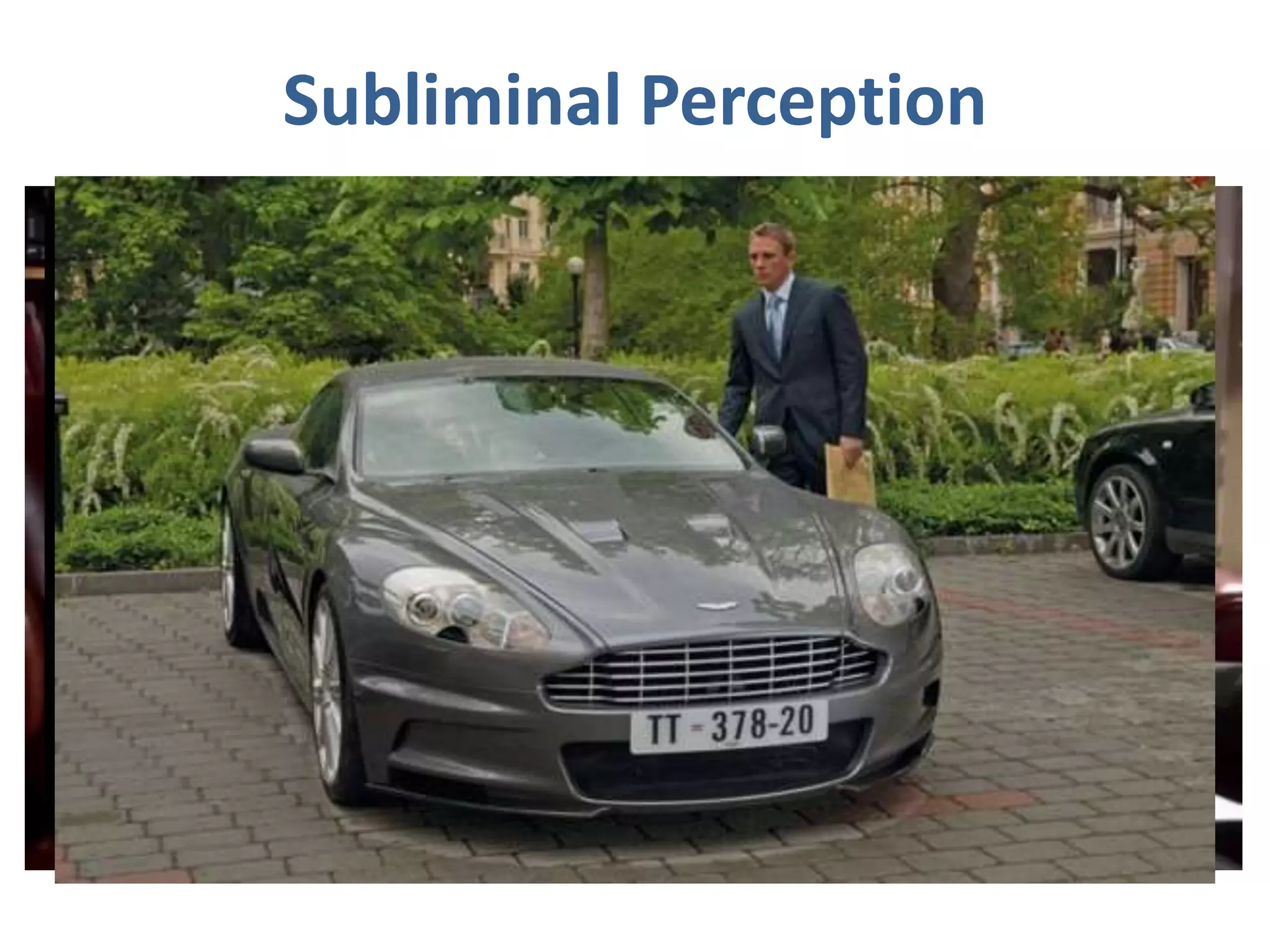
Subliminal Perception
• Message below the threshold level – below the
conscious level
– Takes place in movies:
• Nokia Lumia Mobile Phone with Shah Rukh Khan in Chennai
Express
• Sheldon’s Alienware Lappy
• John Abhraham using Sony Vaio in Kaal
• All Tata cars in Singham returns
• Cadbury Dairy Milk in Parineeta
• Aston Martin in James Bond
• MRF Tiers in Indian Movies
Elements of Perception
Perceptual Selection
Perceptual Organization
Perceptual Interpretation
Perceptual Process
• The perceptual process is the sequence of psychological steps that a
person uses to organize and interpret information from the outside world.
The steps are:
– Objects are present in the world.
– A person observes.
– The person uses perception to select objects.
– The person organizes the perception of objects.
– The person interprets the perceptions.
– The person responds.
The selection, organization, and interpretation of perceptions can
differ among different people . Therefore, when people react
differently in a situation, part of their behavior can be explained
by examining their perceptual process, and how their perceptions
are leading to their responses.
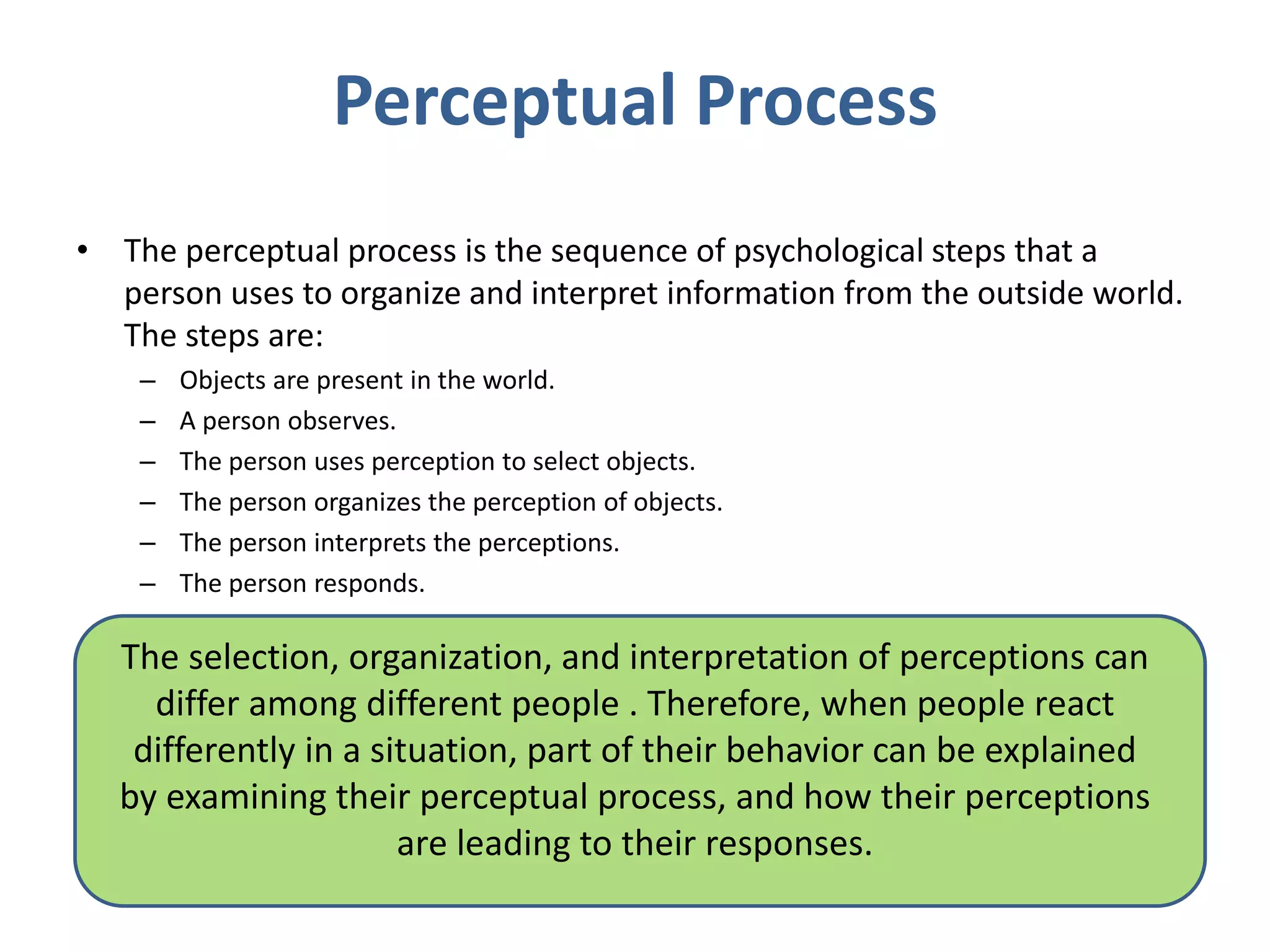
Perceptual Selection (or
selective perception)
Internal factors include:
• Personality - Personality traits influence
how a person selects perceptions. For
instance, conscientious people tend to
select details and external stimuli to a
greater degree
• Motivation - People will select
perceptions according to what they need
in the moment. They will favor selections
that they think will help them with their
current needs, and be more likely to
ignore what is irrelevant to their
needs.
• Experience - The patterns of
occurrences or associations one has
learned in the past affect current
perceptions. The person will select
perceptions in a way that fits with
what they found in the past.
Perceptual Selection
Perceptual Organization
Perceptual Interpretation
Perceptual Selection (or selective perception)
External factors include:
• Size - A larger size makes it more likely an
object will be selected.
• Intensity - Greater intensity, in brightness,
for example, also increases perceptual
selection.
• Contrast - When a perception stands
clearly out against a background, there is
a greater likelihood of selection.
• Motion - A moving perception is more
likely to be selected.
• Repetition & Interpretation - Repetition
increases perceptual selection.
• Novelty and familiarity - Both of these
increase selection. When a perception is
new, it stands out in a person's
experience. When it is familiar, it is likely
to be selected because of this familiarity.
SELECTIVE PERCEPTION
• Selective exposure:-
– People look for pleasant and sympathetic
messages and avoid painful or
threatening ones
• Selective attention:-
– People look into ads which will satisfy
their need
• Perceptual Defense:-
– People avoid psychologically threatening
ones. Hence constantly change the ad
nature. [ Smoking – warning with words,
and now with images ]
Perceptual Organization
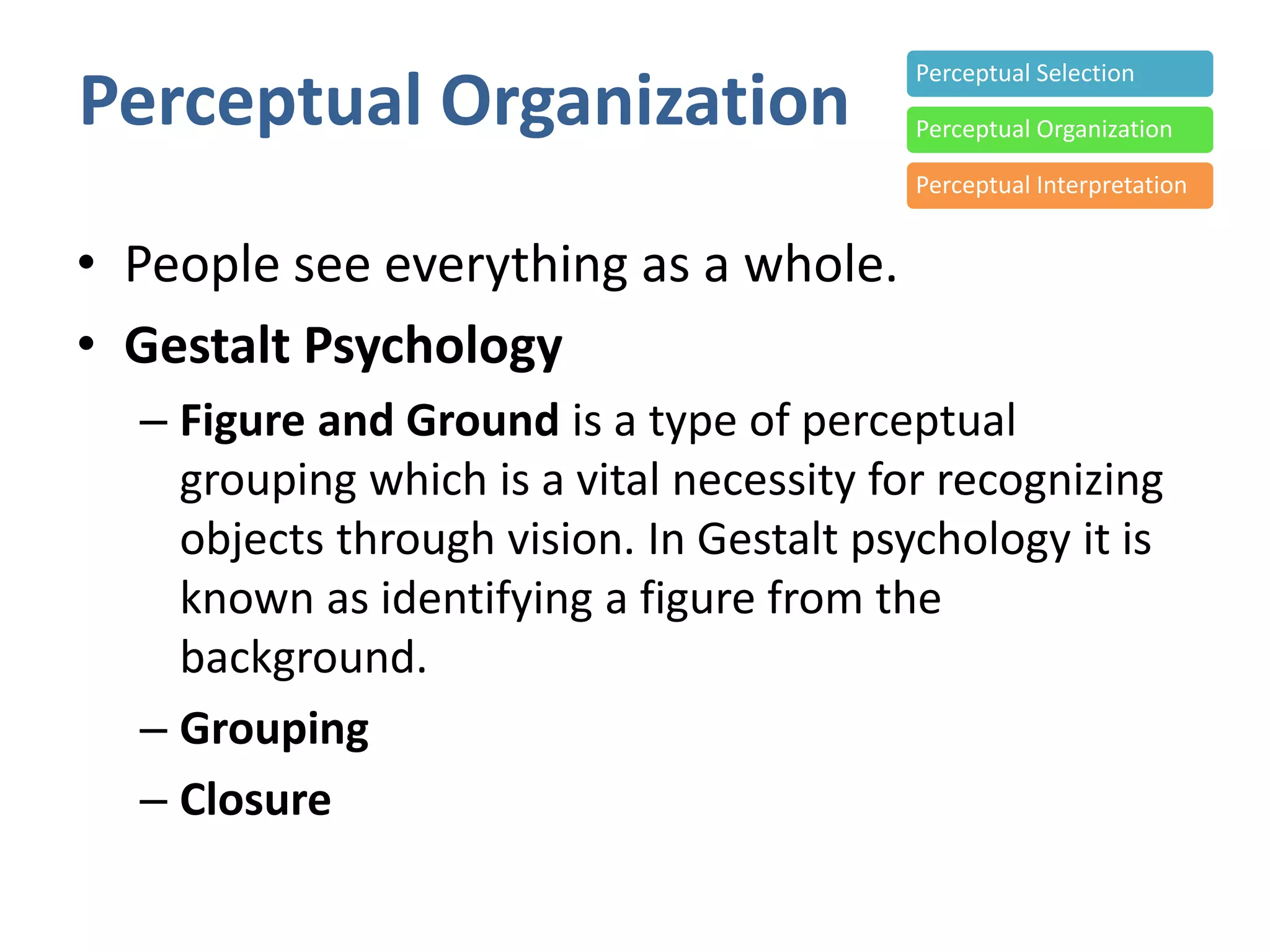
• People see everything as a whole.
• Gestalt Psychology
– Figure and Ground is a type of perceptual
grouping which is a vital necessity for recognizing
objects through vision. In Gestalt psychology it is
known as identifying a figure from the
background.
– Grouping
– Closure
Perceptual Selection
Perceptual Organization
Perceptual Interpretation
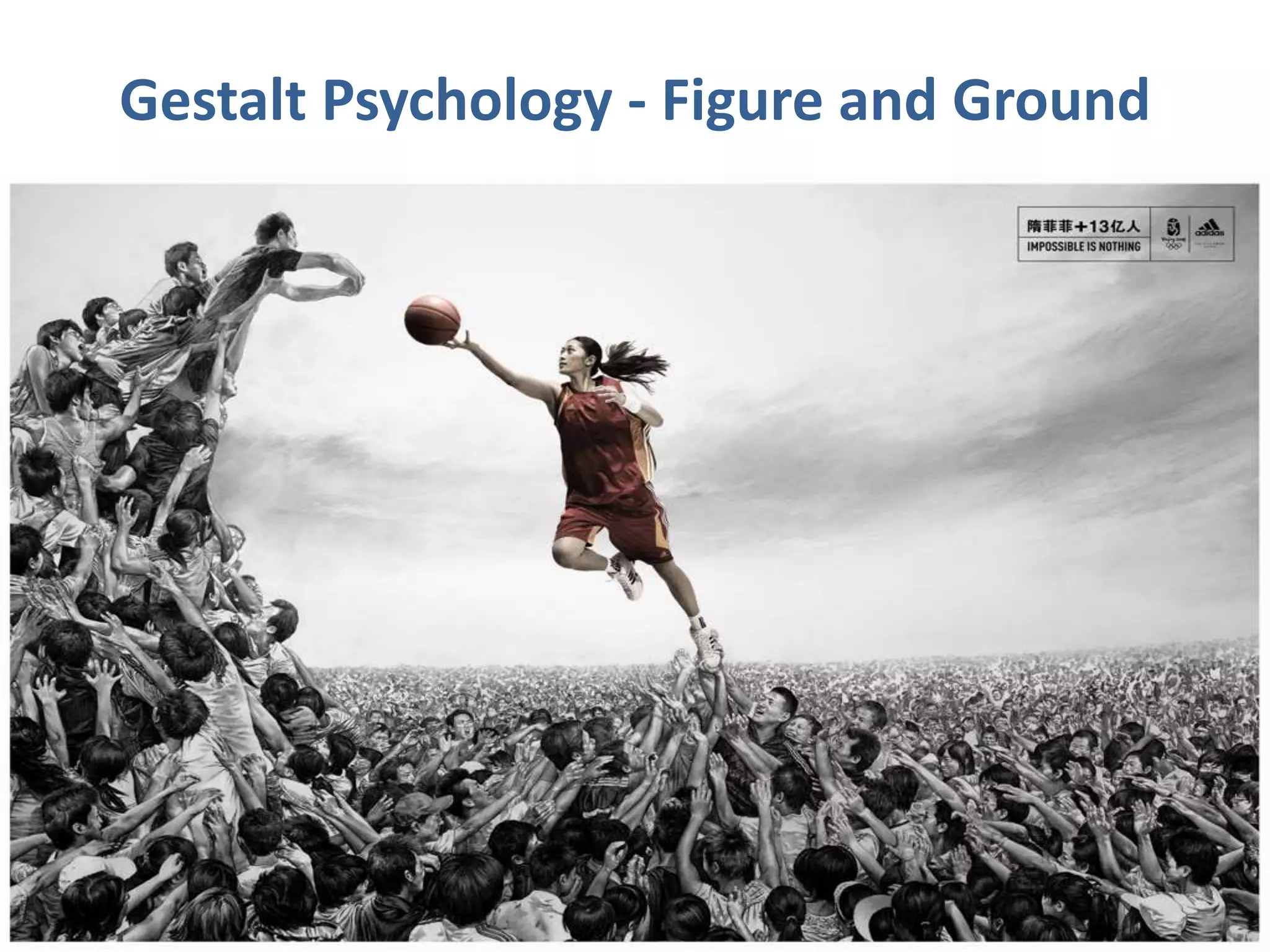
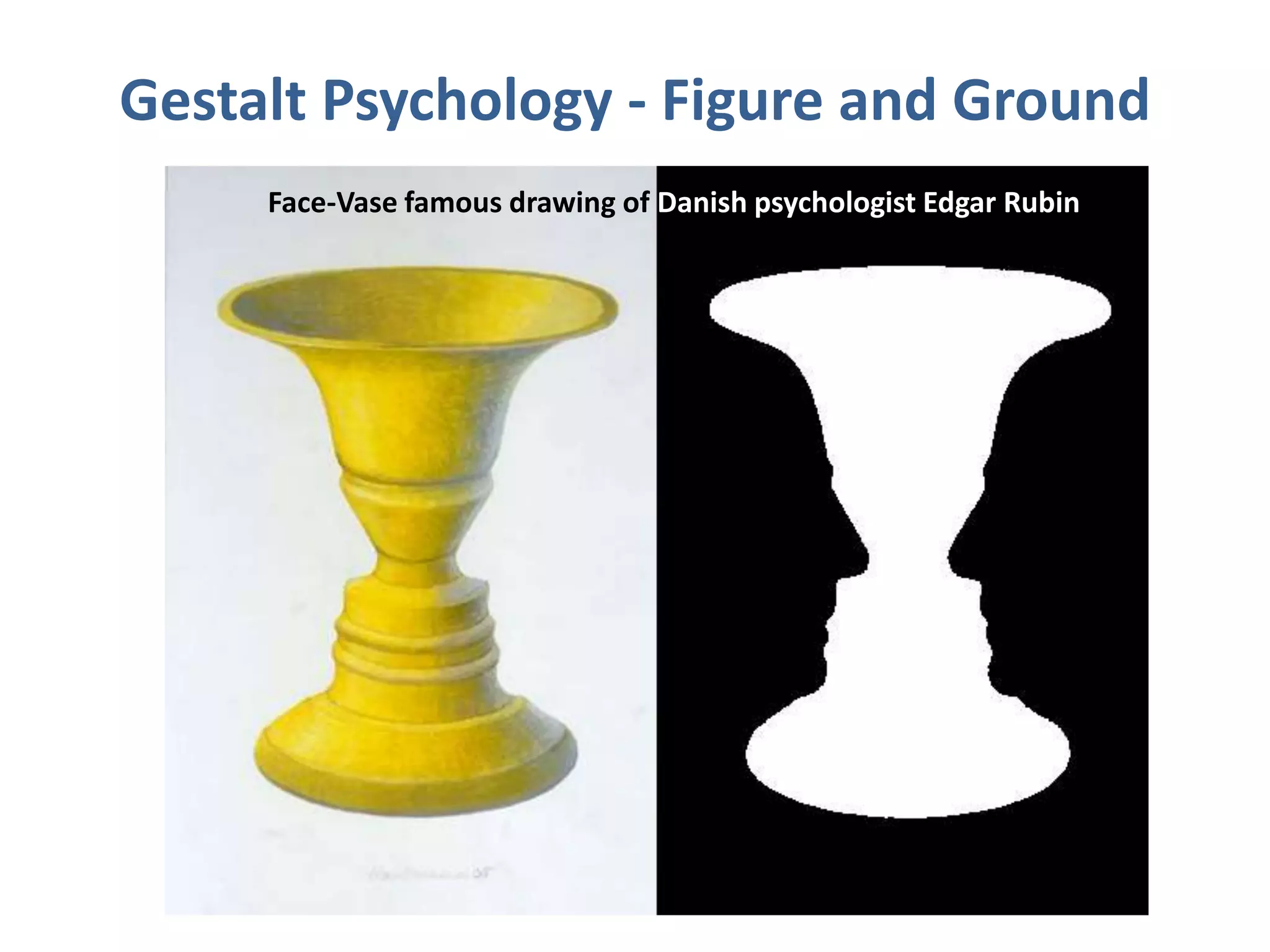
Gestalt Psychology - Figure and Ground
Face-Vase famous drawing of Danish psychologist Edgar Rubin
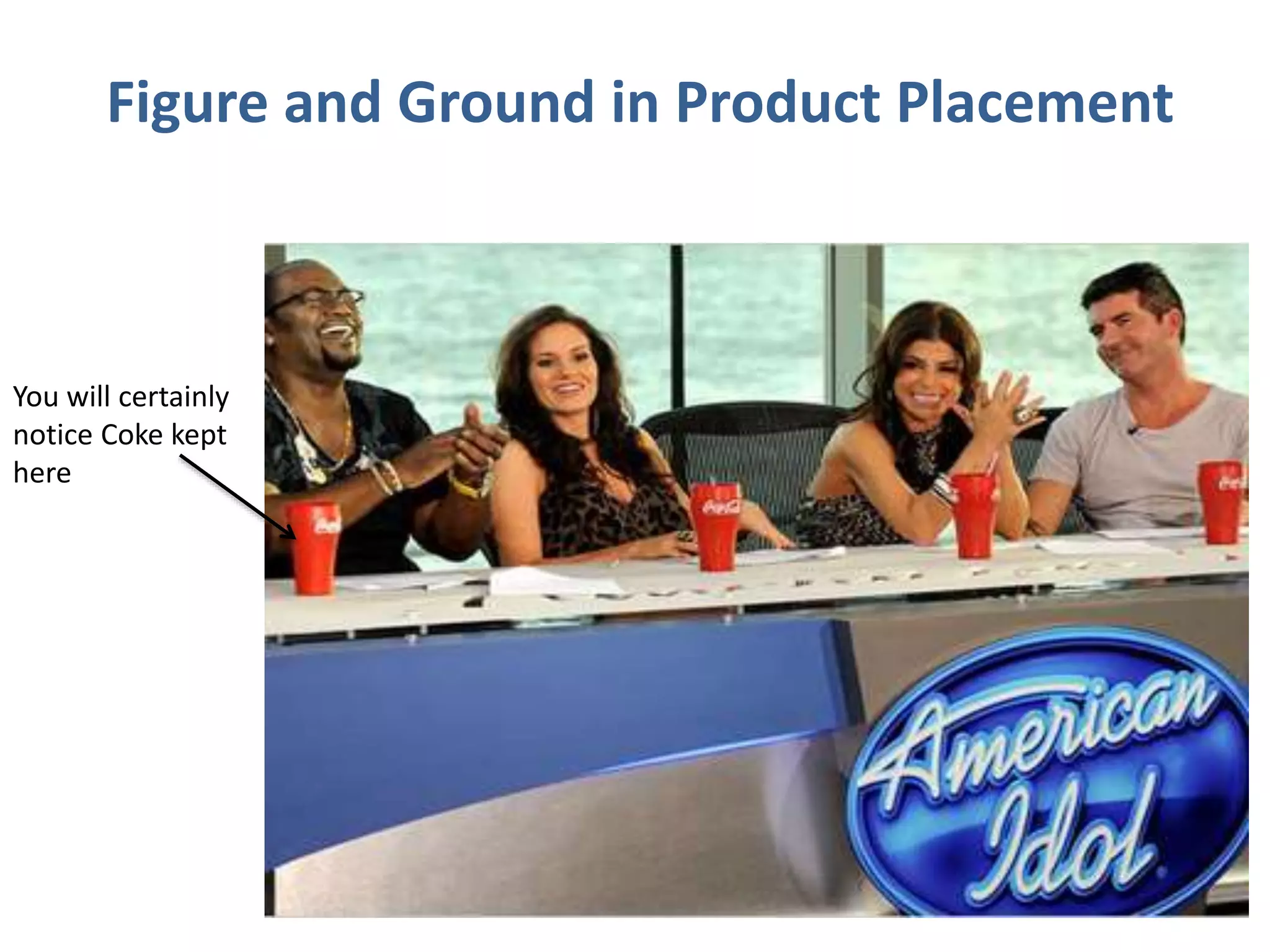
Figure and Ground in Product Placement
You will certainly
notice Coke kept
here
Gestalt Psychology - Grouping
• Grouping: Humans naturally perceive objects as
organized patterns and objects. Gestalt
psychologists argued that these principles exist
because the mind has an innate disposition to
perceive patterns in the stimulus based on
certain rules.
• These principles are organized into six categories:
Proximity, Similarity, Closure, Good
Continuation, Common Fate, and Good Form
Gestalt Psychology - Grouping
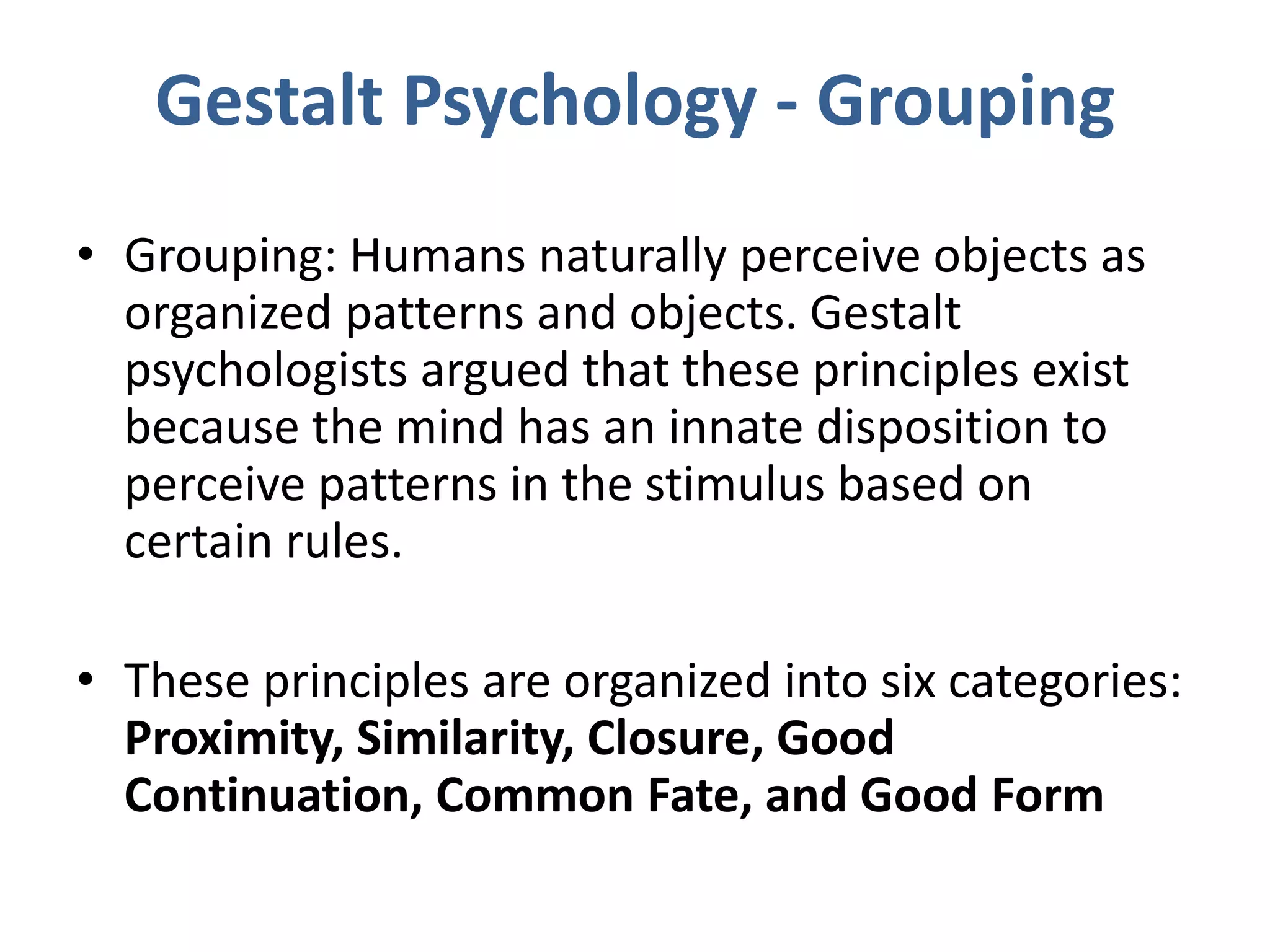
Proximity
Similarity
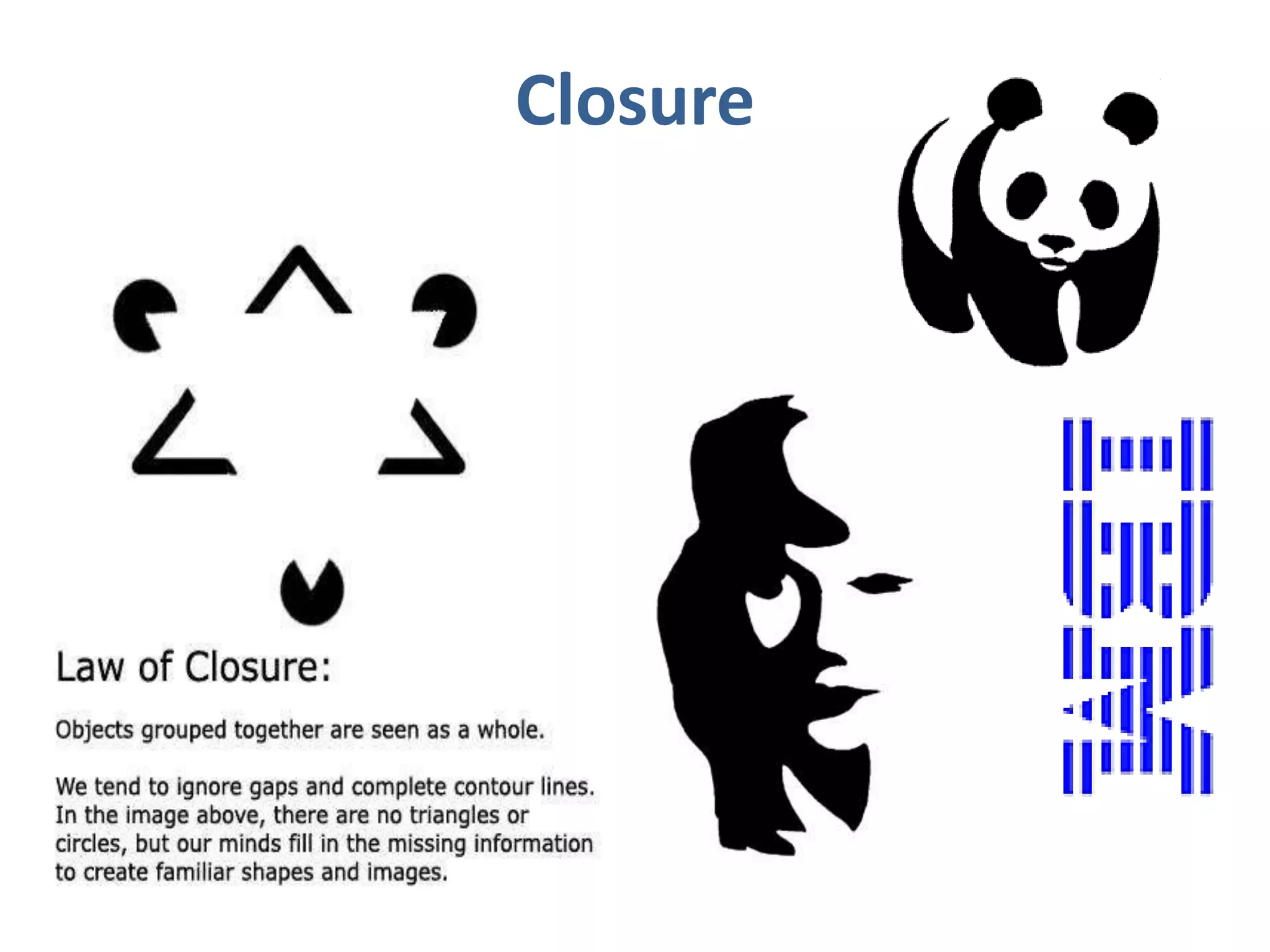
Closure
All else being equal, perception tends to group
stimuli that are close together as part of the
same object, and stimuli that are far apart as
two separate objects.
All else being equal, perception lends itself to
seeing stimuli that physically resemble each
other as part of the same object, and stimuli
that are different as part of a different object.
The mind’s tendency to see complete figures
or forms even if a picture is incomplete,
partially hidden by other objects, or if part of
the information needed to make a complete
picture in our minds is missing.
Gestalt Psychology - Grouping
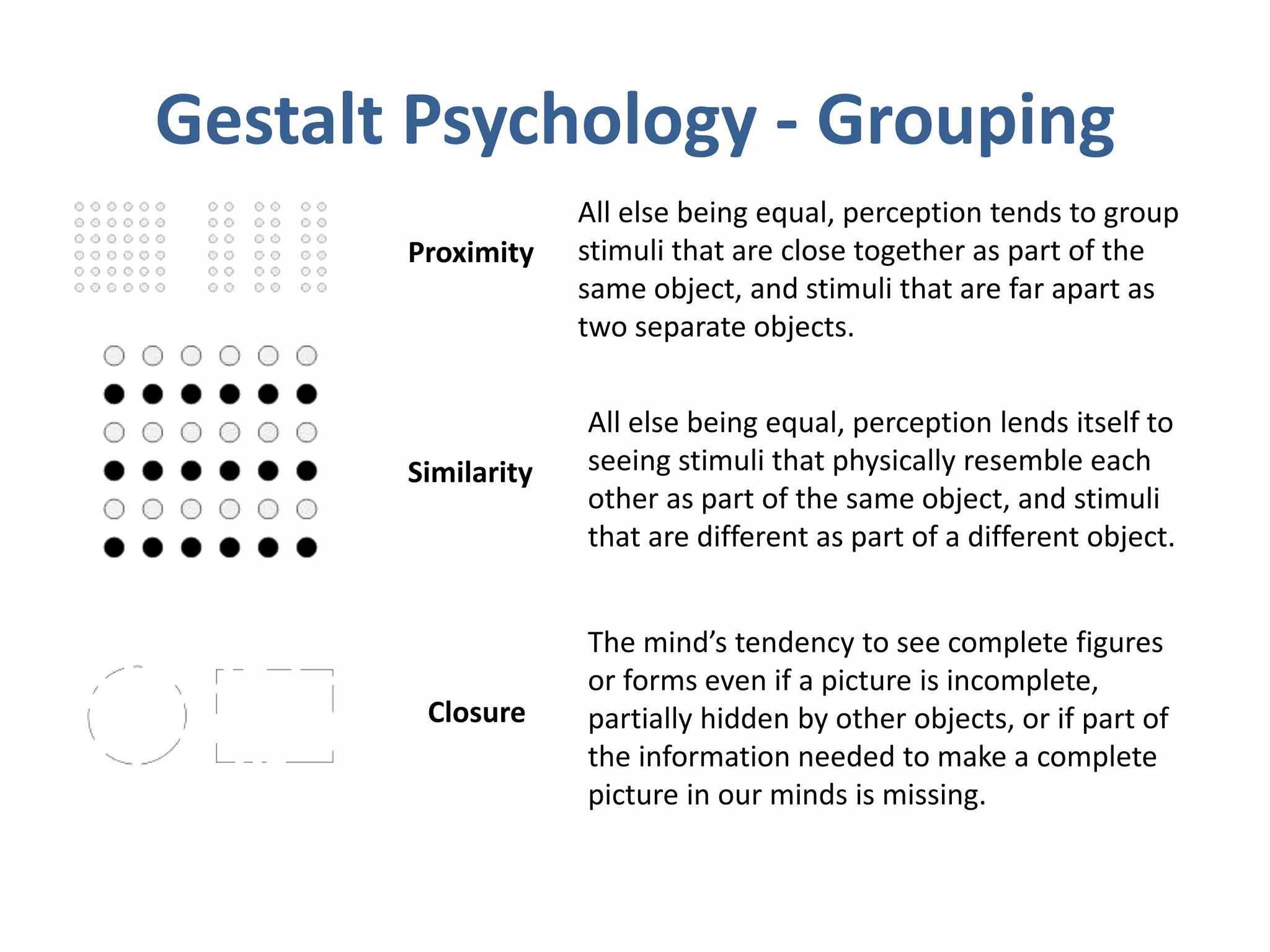
When there is an intersection between two or
more objects, people tend to perceive each
object as a single uninterrupted object.Good Continuation
Common Fate
When visual elements are seen moving
in the same direction at the same rate
(optical flow), perception associates the
movement as part of the same
stimulus.
Good Form
The principle of good form refers to the tendency to group together
forms of similar shape, pattern, color, etc. Even in cases where two or
more forms clearly overlap, the human brain interprets them in a way
that allows people to differentiate different patterns and/or shapes.
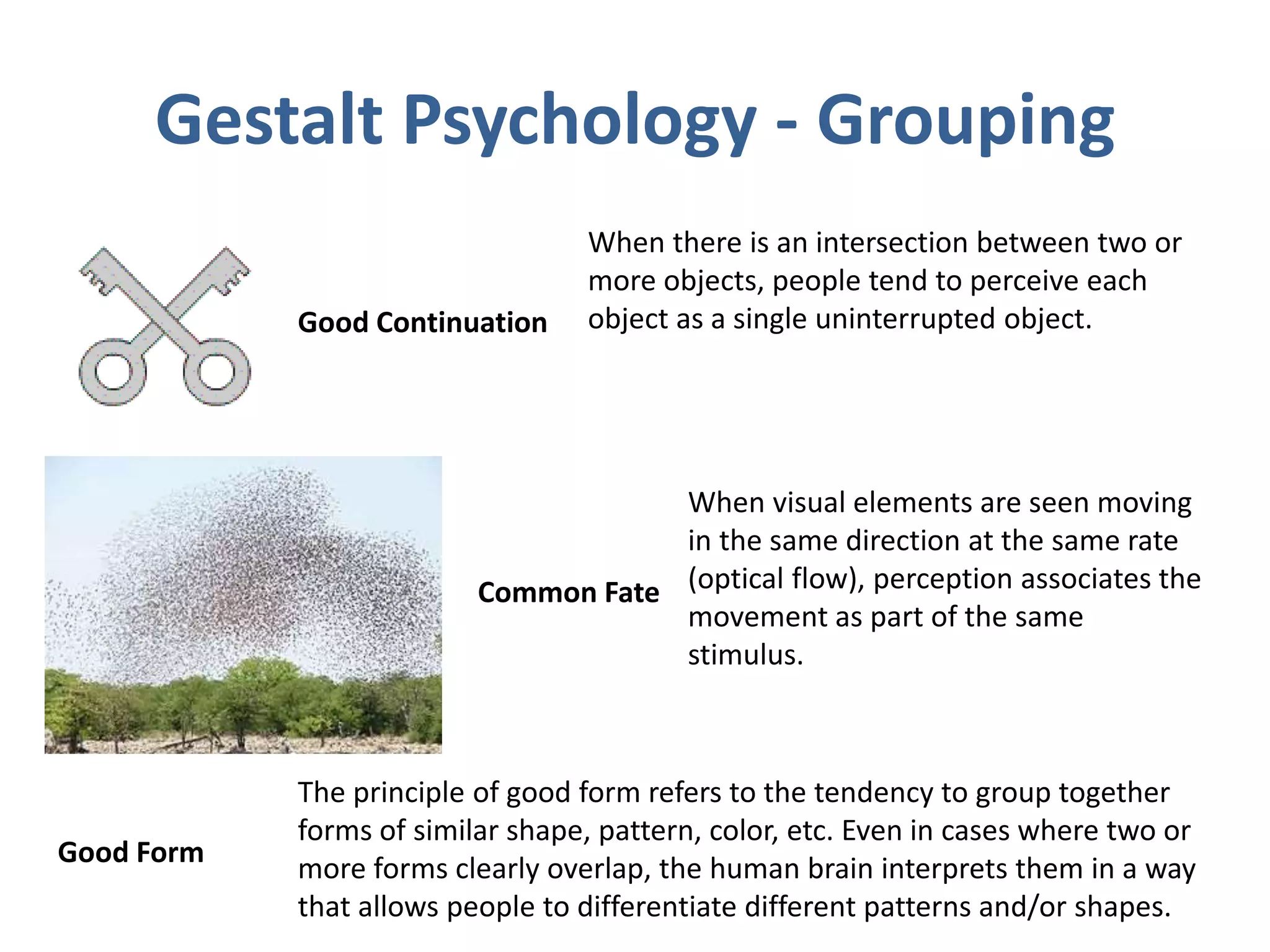
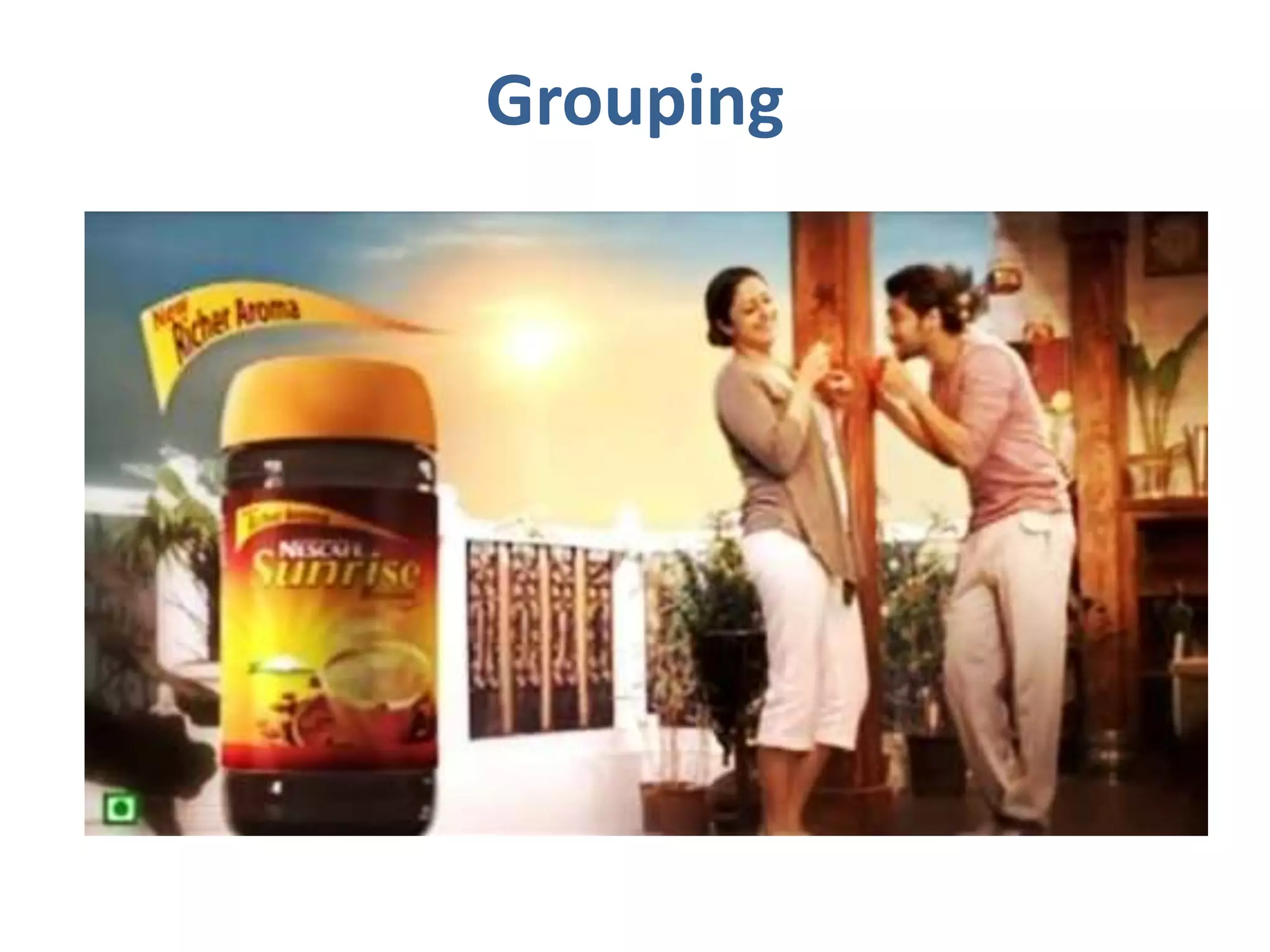
Grouping
Closure
PERCEPTUAL INTERPRETATION
• Stimulus are often highly ambiguous or weak
Perceptual Selection
Perceptual Organization
Perceptual Interpretation
Types of Perceptual
Interpretations
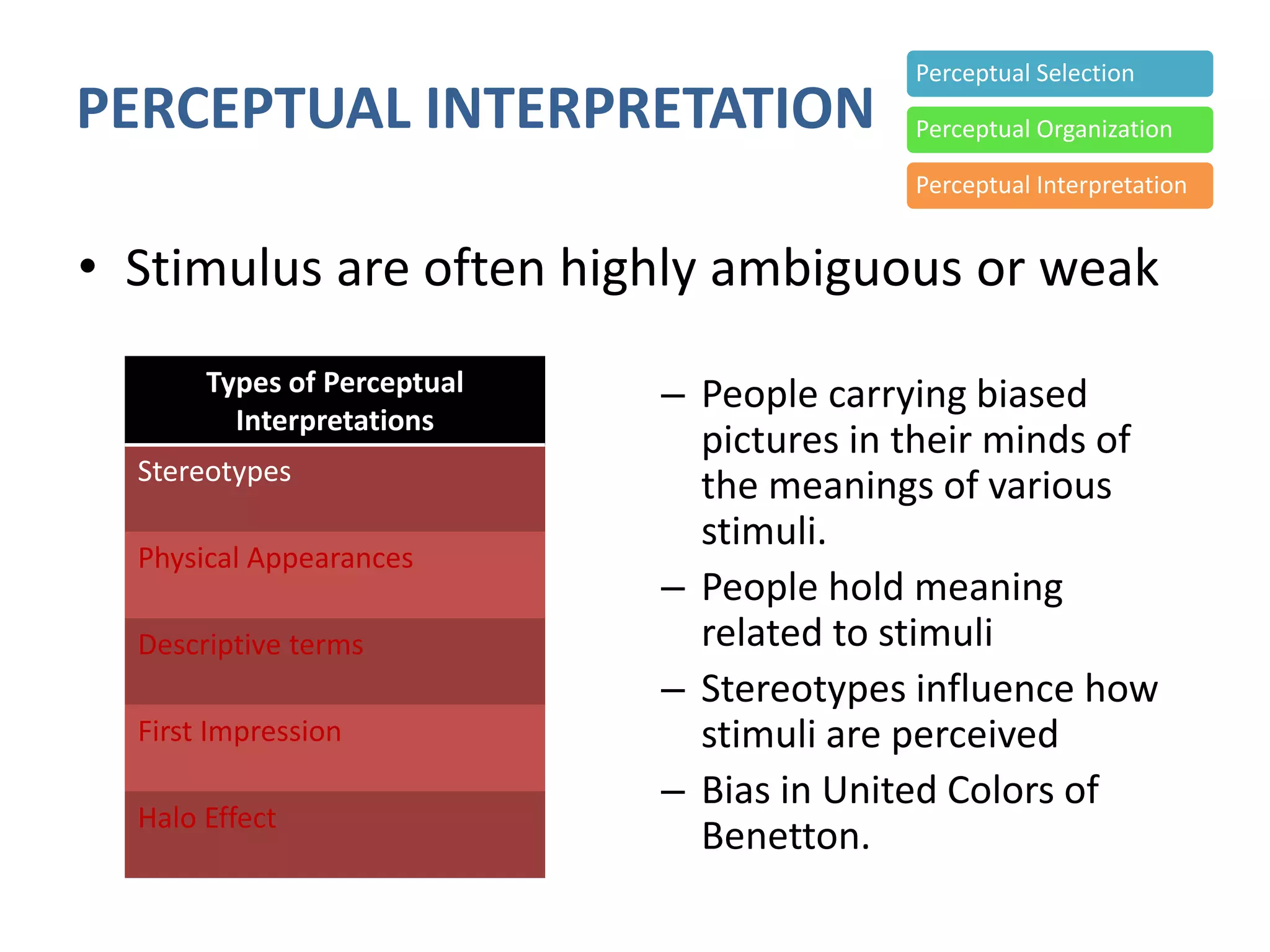
Stereotypes
Physical Appearances
Descriptive terms
First Impression
Halo Effect
PERCEPTUAL INTERPRETATION
• Stimulus are often highly ambiguous or weak
Perceptual Selection
Perceptual Organization
Perceptual Interpretation
Types of Perceptual
Interpretations
Stereotypes
Physical Appearances
Descriptive terms
First Impression
Halo Effect
– People carrying biased
pictures in their minds of
the meanings of various
stimuli.
– People hold meaning
related to stimuli
– Stereotypes influence how
stimuli are perceived
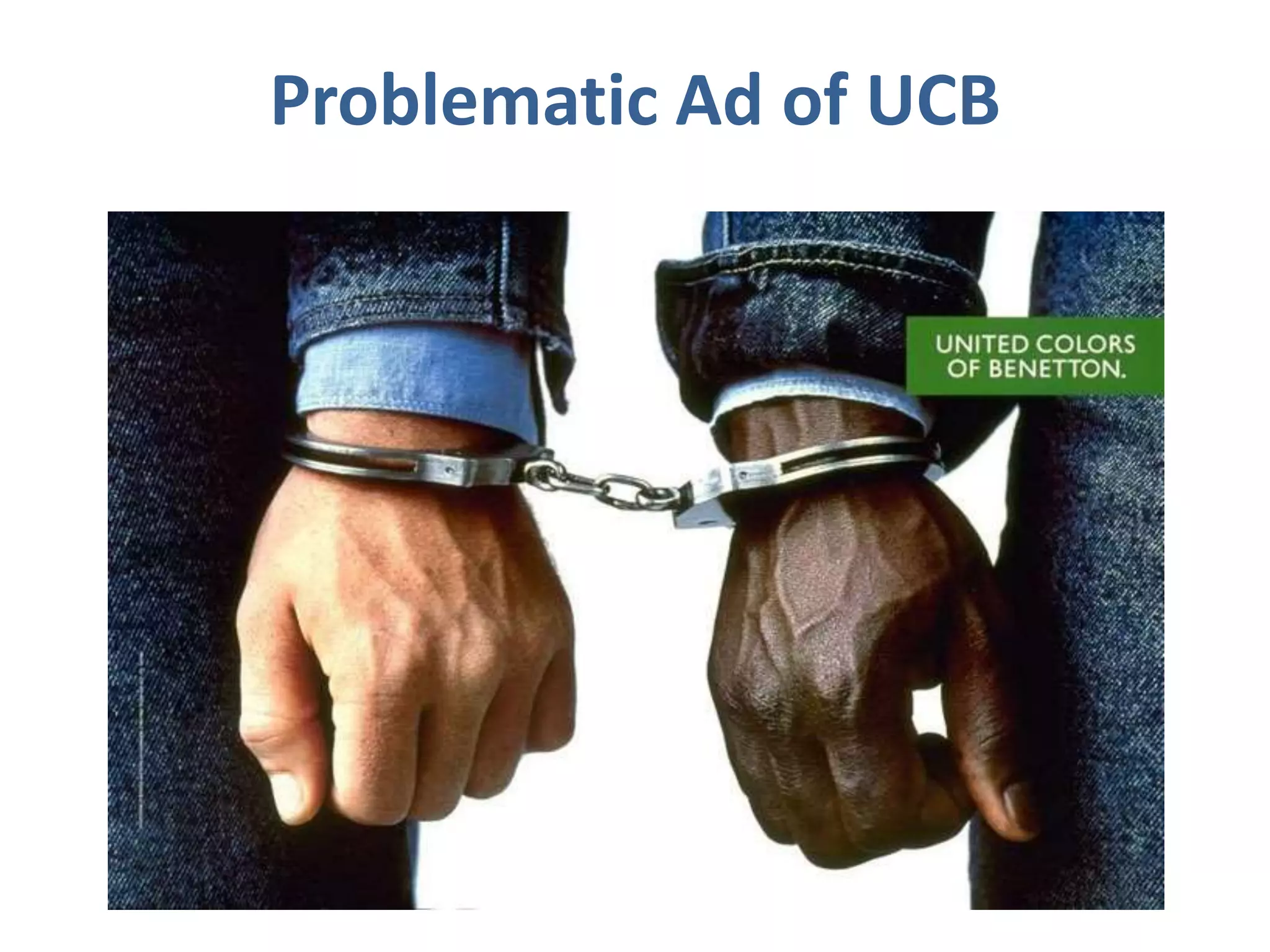
– Bias in United Colors of
Benetton.
Problematic Ad of UCB
PERCEPTUAL INTERPRETATION
• Stimulus are often highly ambiguous or weak
Perceptual Selection
Perceptual Organization
Perceptual Interpretation
Types of Perceptual
Interpretations
Stereotypes
Physical Appearances
Descriptive terms
First Impression
Halo Effect
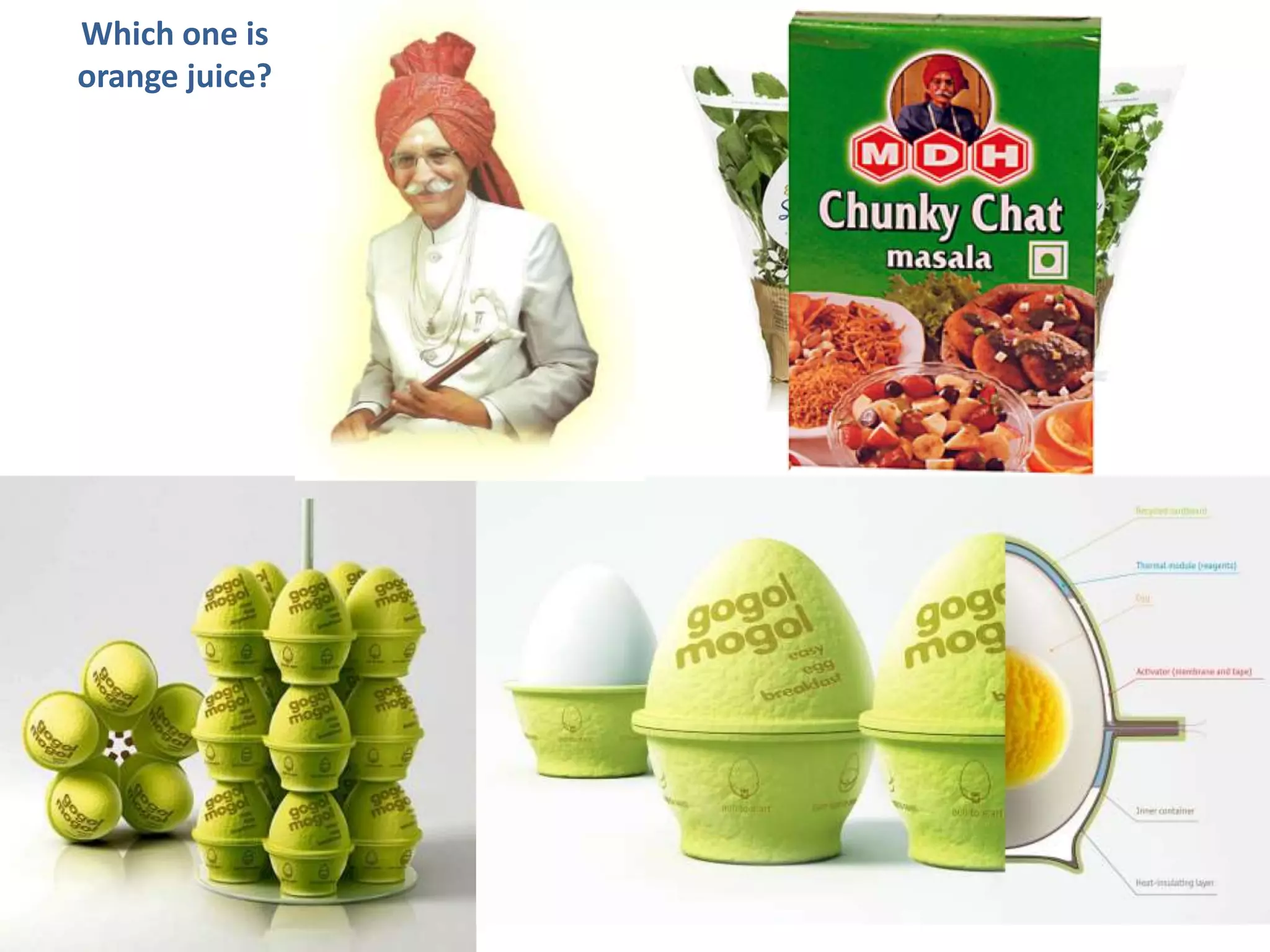
– People associate quality with
people in the ads
– Attractive models have
positive influence
– Colors of juices
– Shape of the package
– Average men are not
considered as businessman
Which one is
orange juice?
PERCEPTUAL INTERPRETATION
• Stimulus are often highly ambiguous or weak
Perceptual Selection
Perceptual Organization
Perceptual Interpretation
Types of Perceptual
Interpretations
Stereotypes
Physical Appearances
Descriptive terms
First Impression
Halo Effect
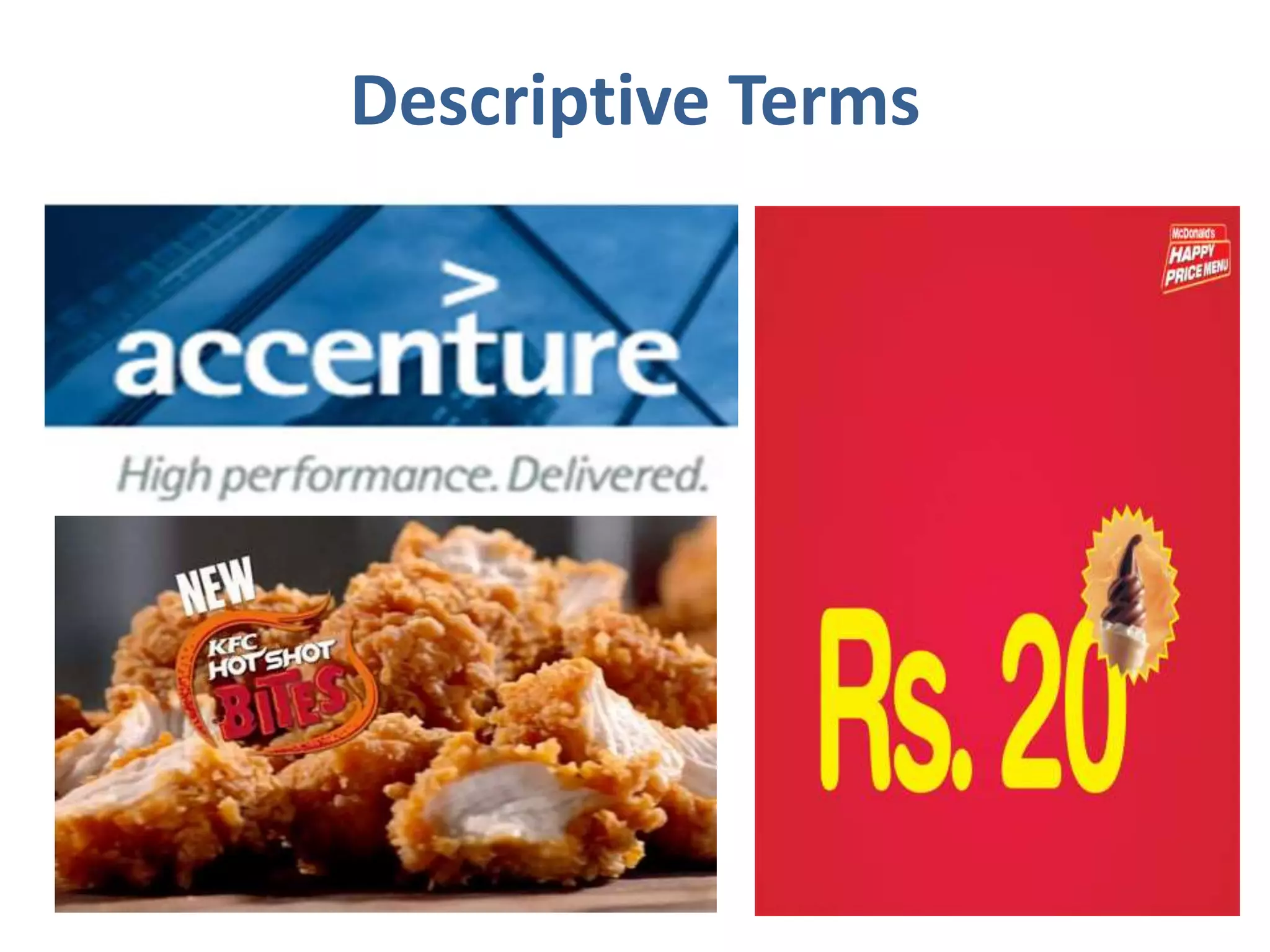
– Accenture – High
Performance, Delivered.
– KFC – Spicy Chicken
– McDonald – Happy price
(targeting Indians who
are price conscious)
Descriptive Terms
PERCEPTUAL INTERPRETATION
• Stimulus are often highly ambiguous or weak
Perceptual Selection
Perceptual Organization
Perceptual Interpretation
Types of Perceptual
Interpretations
Stereotypes
Physical Appearances
Descriptive terms
First Impression
Halo Effect
• First impressions, last long
• The perceiver is trying to
determine which stimuli are
relevant, important, or
predictive
PERCEPTUAL INTERPRETATION
• Stimulus are often highly ambiguous or weak
Perceptual Selection
Perceptual Organization
Perceptual Interpretation
Types of Perceptual
Interpretations
Stereotypes
Physical Appearances
Descriptive terms
First Impression
Halo Effect
• Consumers perceive and evaluate
product or service or even product
line based on just one dimension.
• Important with spokesperson
choice.
• Tampering the halo effect is
detrimental to the organization.
Toyota – Quality
Ford – Safety
Sony - Music
The halo effect
helps Adidas
break into new
product
categories
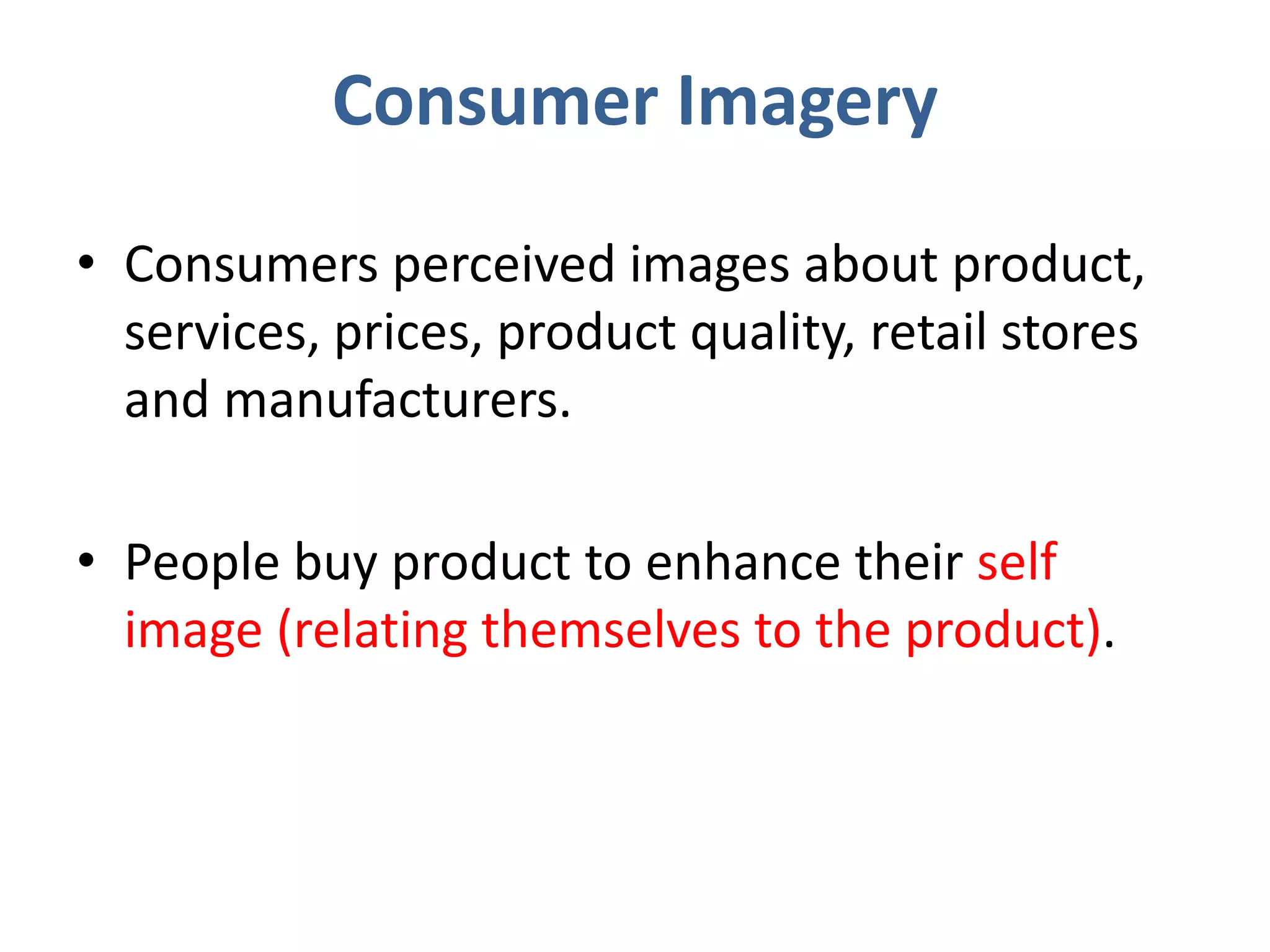
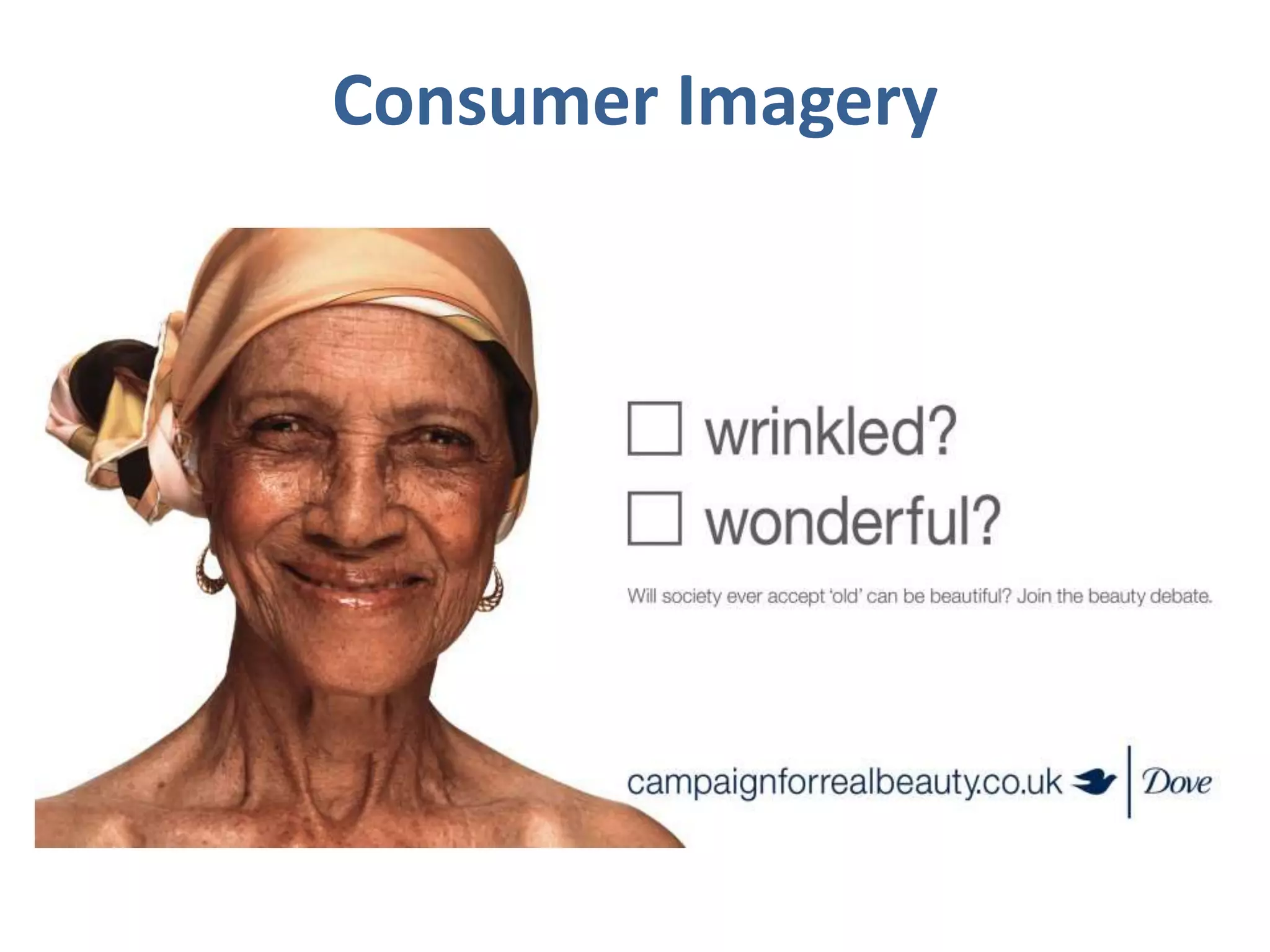
Consumer Imagery
• Consumers perceived images about product,
services, prices, product quality, retail stores
and manufacturers.
• People buy product to enhance their self
image (relating themselves to the product).
Consumer Imagery
POSITIONING
• Image of the product in the minds of the
customer is called Positioning
• Image of your product gear up your sales, but
the product should also deliver its
performance.
• Product BENEFITS should be focused more
than it’s physical attributes.
Umbrella Positioning
• Nicolo Pome, UK marketing director for Nivea’s
parent company Beiersdorf, said: “We wanted to
find a more relevant role for the Nivea brand in
our target markets' minds”. The awareness of the
Nivea brand is vast but we needed to find a way
to engage with the audience to a greater degree.
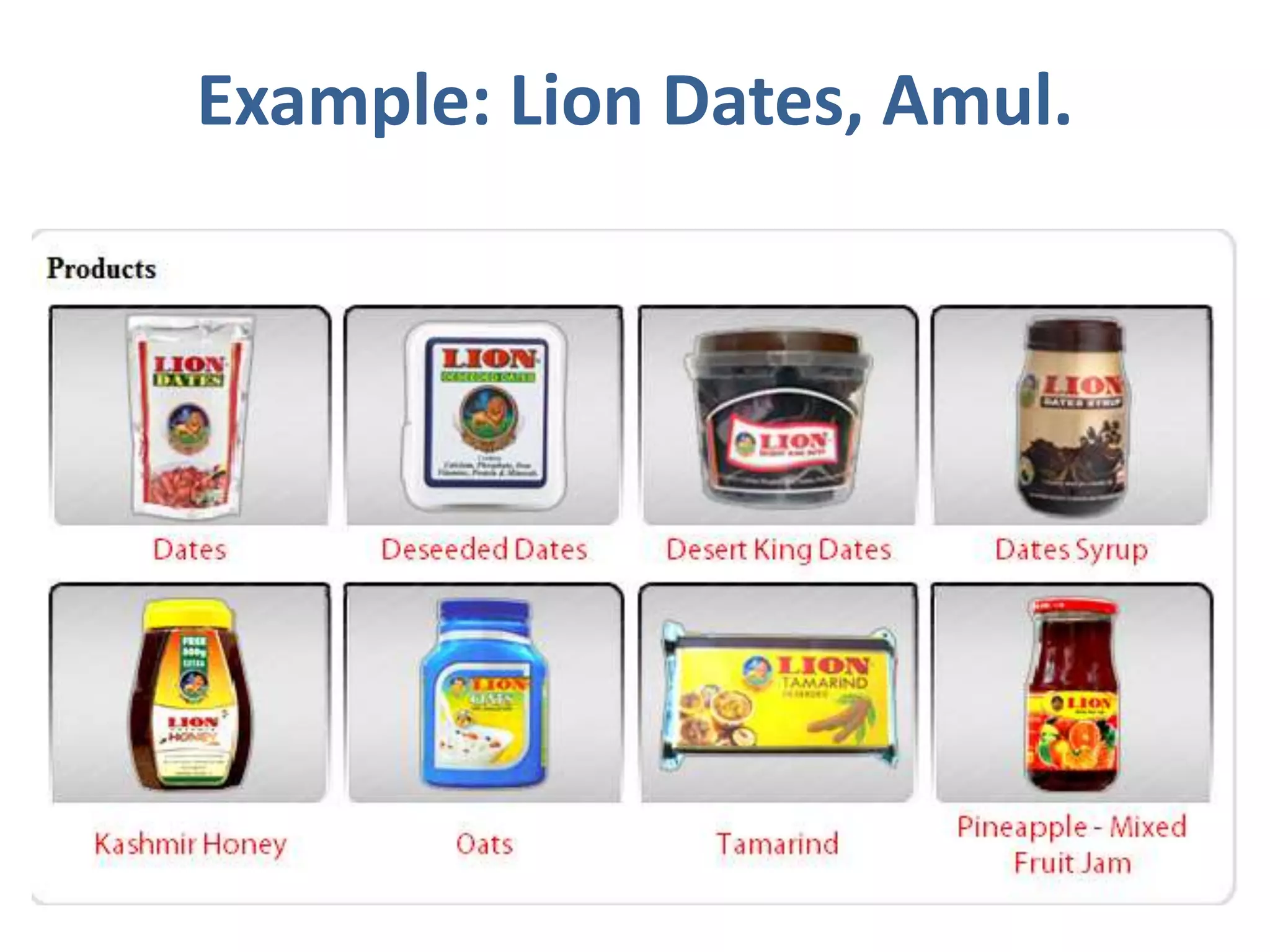
• An umbrella branding strategy, is
marketing practice that involves selling many
related products under a single brand name.
Example: Lion Dates, Amul.
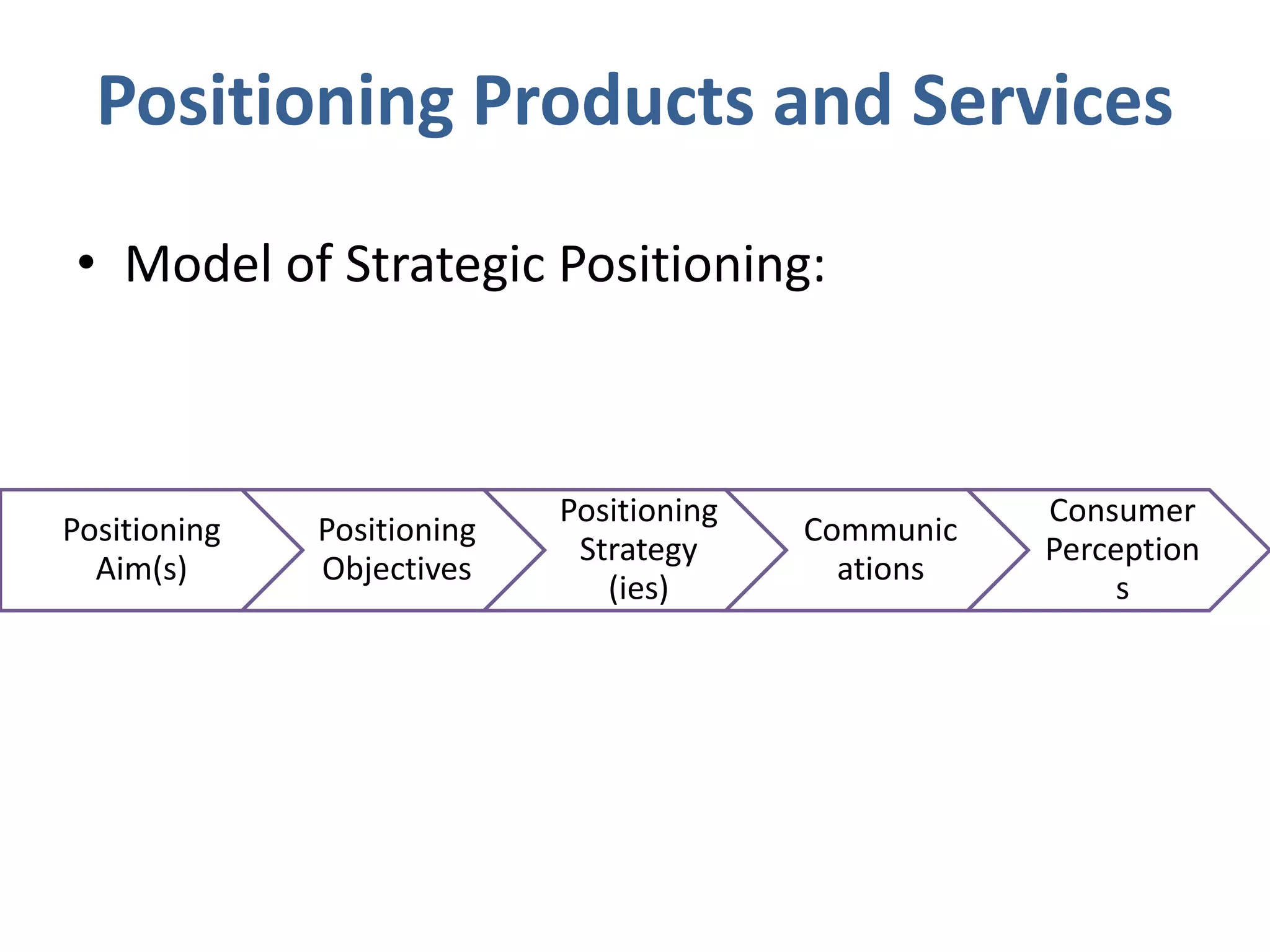
Positioning Products and Services
• Model of Strategic Positioning:
Positioning
Aim(s)
Positioning
Objectives
Positioning
Strategy
(ies)
Communic
ations
Consumer
Perception
s
Typology of Strategic Positioning
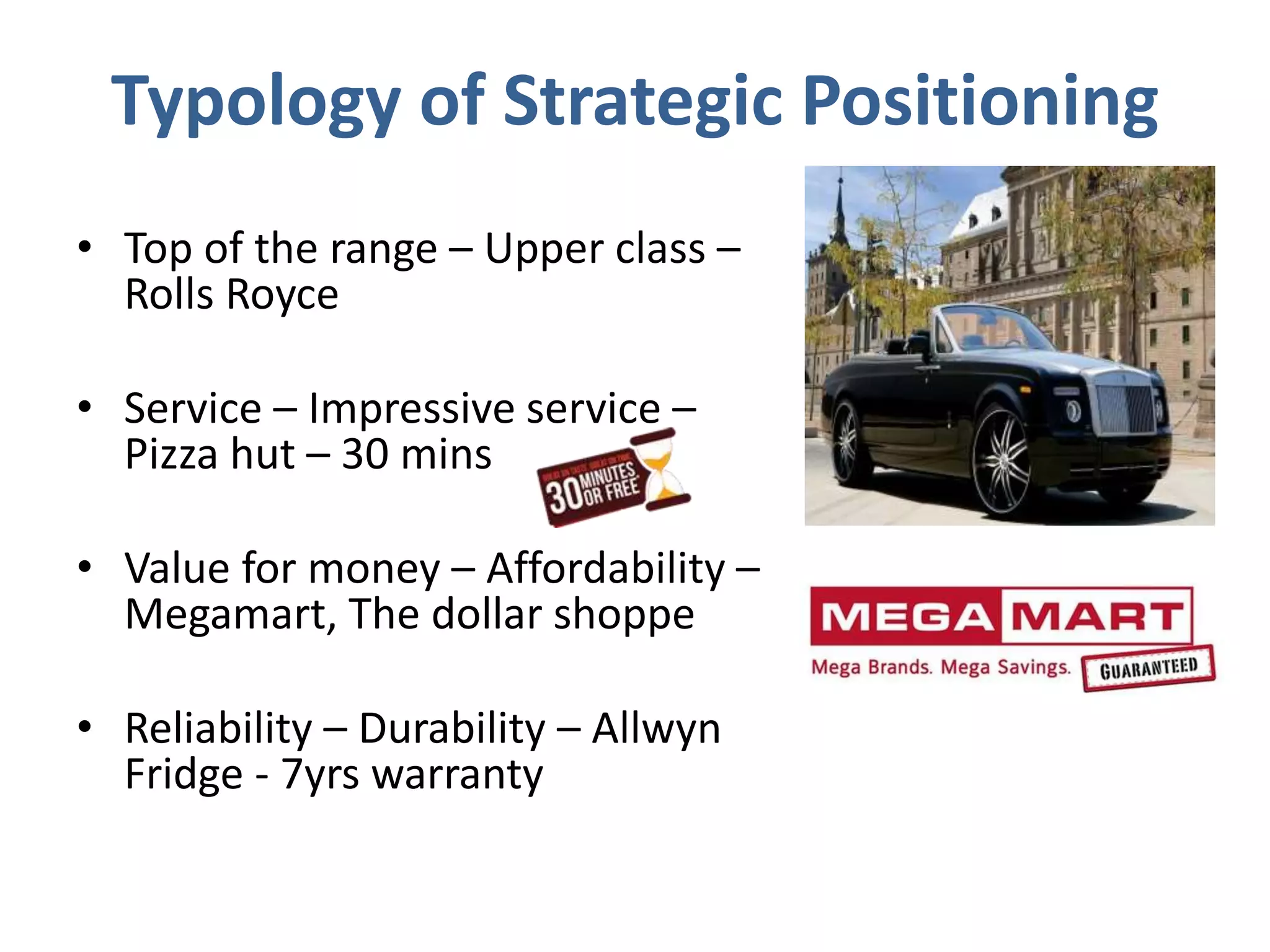
• Top of the range – Upper class –
Rolls Royce
• Service – Impressive service –
Pizza hut – 30 mins
• Value for money – Affordability –
Megamart, The dollar shoppe
• Reliability – Durability – Allwyn
Fridge - 7yrs warranty
Typology of Strategic Positioning
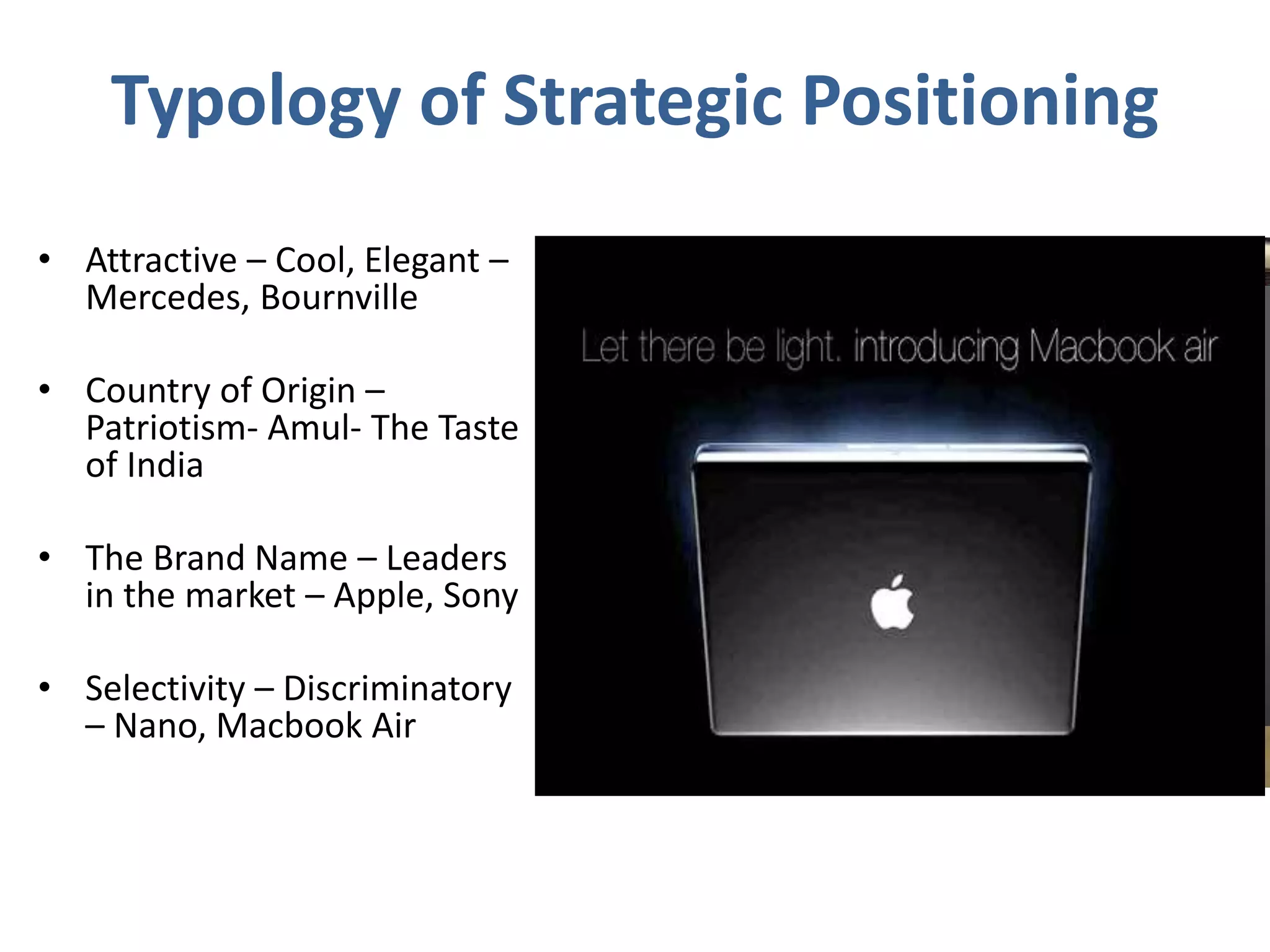
• Attractive – Cool, Elegant –
Mercedes, Bournville
• Country of Origin –
Patriotism- Amul- The Taste
of India
• The Brand Name – Leaders
in the market – Apple, Sony
• Selectivity – Discriminatory
– Nano, Macbook Air
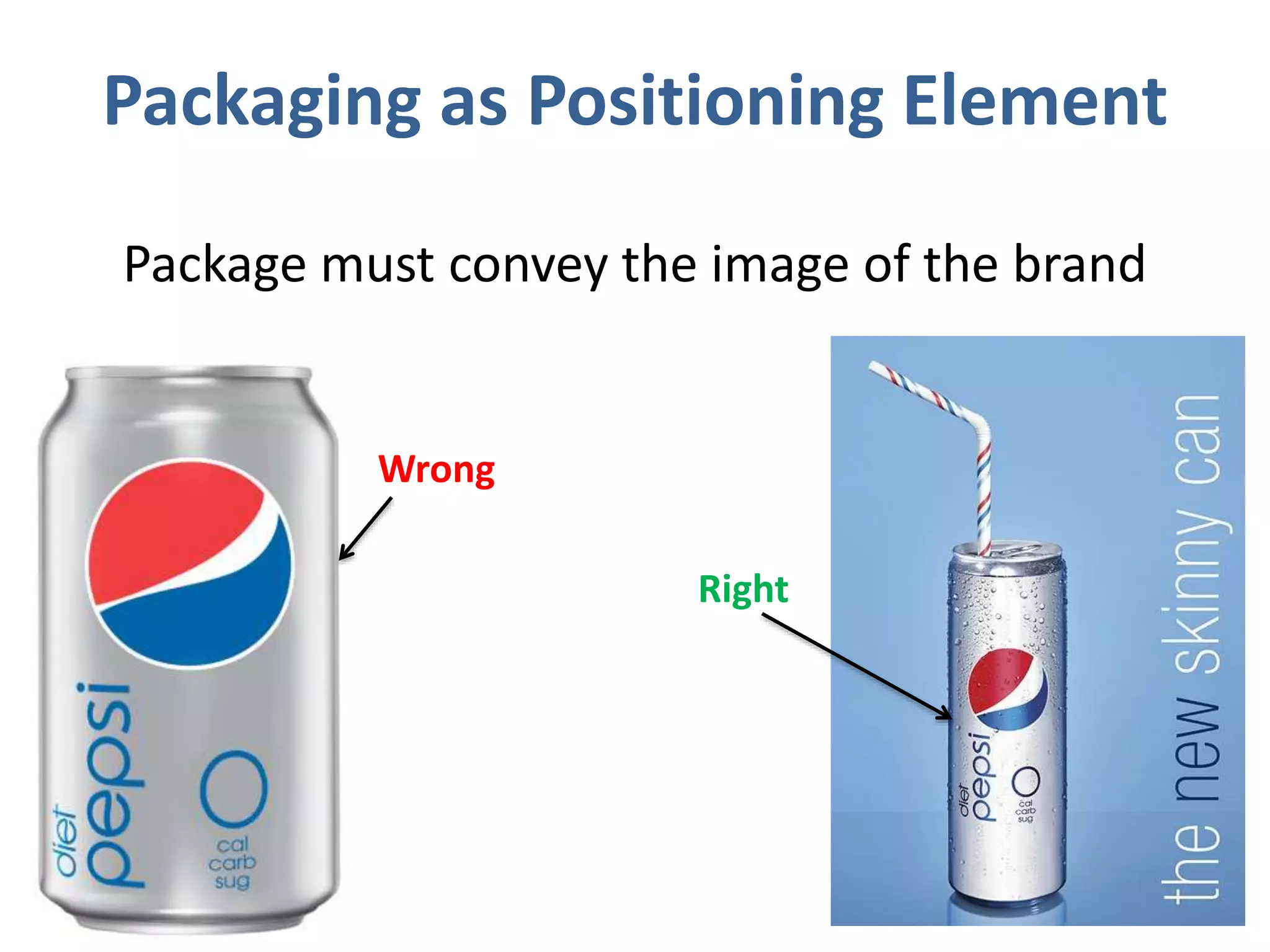
Packaging as Positioning Element
Package must convey the image of the brand
Right
Wrong
Product Repositioning
• To face the competitors,
who offer new products
or services
• Changing lifestyle of
people - need to suit the
current trend. Eg.
Evolution of Tabs and
Apple
• When brand need to
change their target
segment (happens rarely)
Eg. Gems
Why repositioning is required?
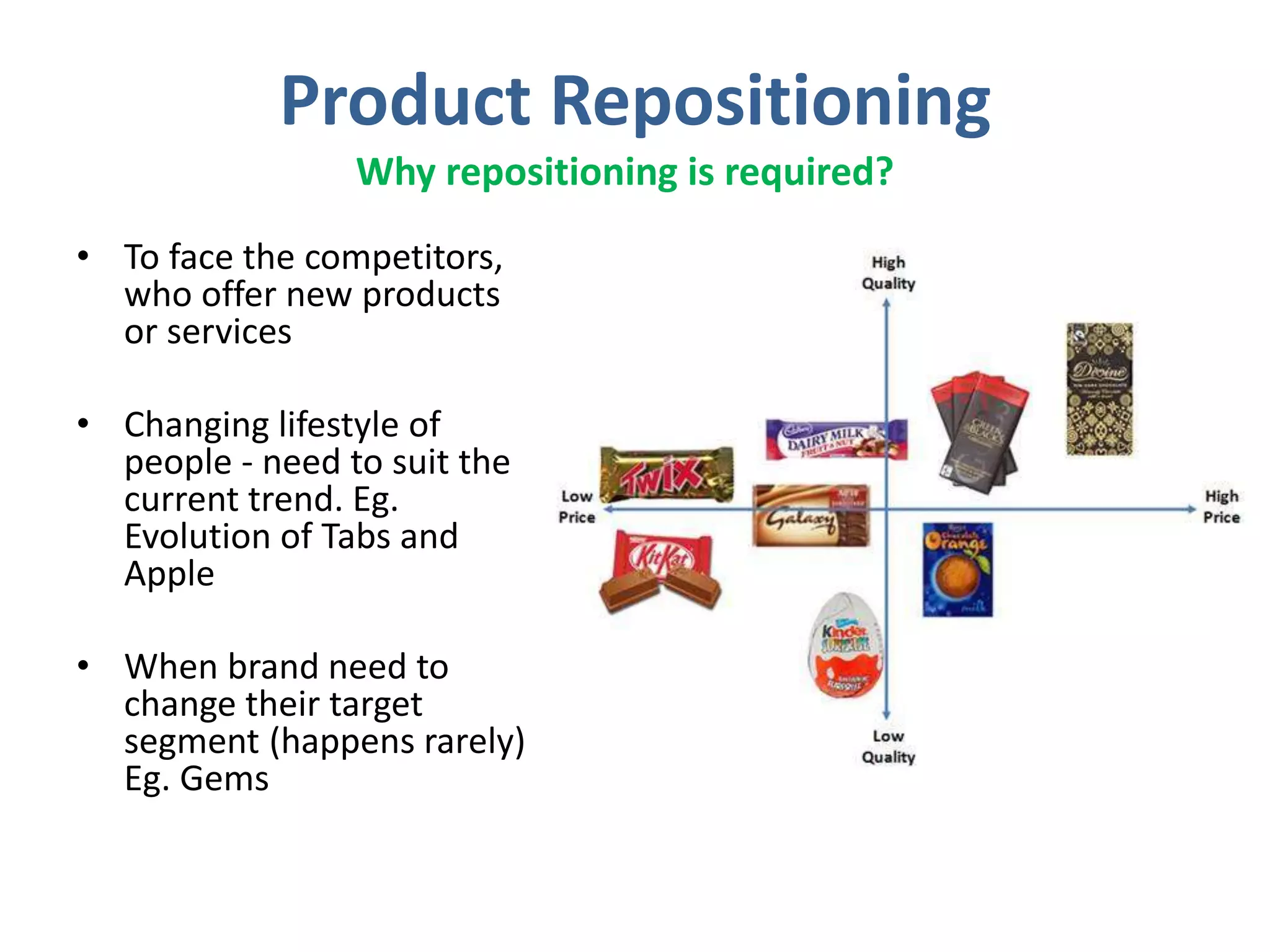
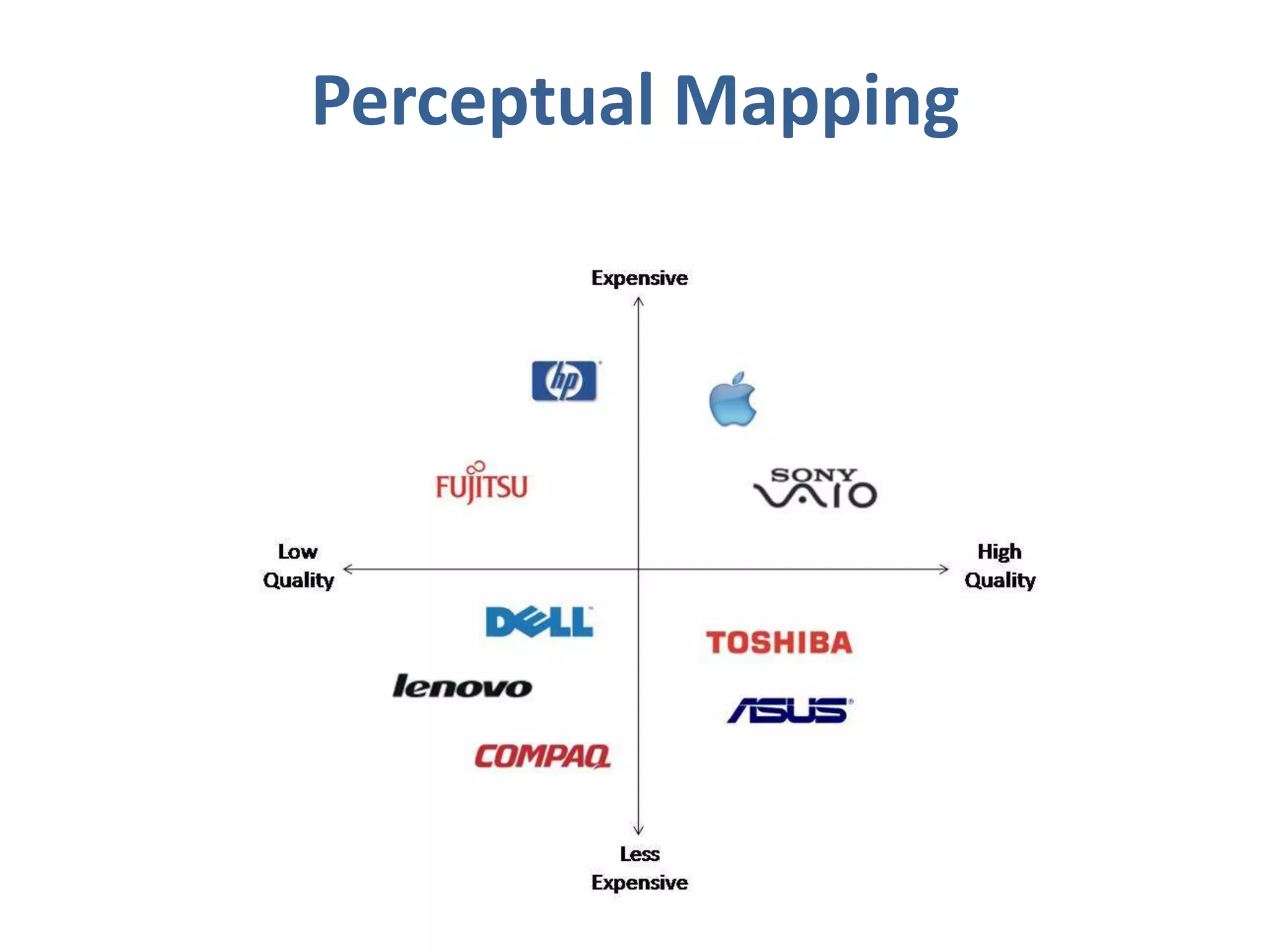
Perceptual Mapping
Positioning of Services
• It’s difficult to position a service because it’s
intangible.
• Only Image differentiation helps to position
better among their competitors.
• Examples:
– Flipkart.com – Reliable
– Smoking Joe’s – I will chose to die starving!

Consumer Perception

  • 1.
    Are the centrecircle same in size?
  • 2.
    Which one islengthy?
  • 3.
  • 4.
    PERCEPTION • The processby which an individual selects, organizes, and interprets stimuli into a meaningful and coherent picture of the world • Perception is how we see the world around us
  • 5.
    Sensation • Sensation –immediate and direct response of the sensory organs to stimuli • Stimulus – any unit of input to any of the senses • Sensory receptors – Eyes, Ears, Nose, Mouth and Skin
  • 6.
    Sensation and Perception •Sensation is the immediate response of our sensory receptors (eyes, ears, nose, mouth, and fingers) to basic stimuli (light, color, sound, odor, and texture) • Perception is the process by which sensations are selected, organized, and interpreted
  • 7.
    Sensory Systems Vision • Colorprovokes emotion • Reactions to color are biological and cultural • Trade dress: colors associated with specific companies Scents • Odors creates mood and promote memories: – Coffee : College days – Maggi: Home – Starbucks/Odonil
  • 8.
    Sensory Systems Sound Sound affectspeople’s feelings and behaviors • Muzak uses sound and music to create mood – High tempo = more stimulation – Slower tempo = more relaxing – Old movies instrumental songs while sleeping Touch • Haptic senses or “touch”— is the most basic of senses; we learn this before vision and smell • Haptic senses affect product experience and judgment • Kansei engineering is a Japanese philosophy that translates customers’ feelings into design elements
  • 9.
    Taste • Flavor housesdevelop new concoctions for consumer palates • Cultural changes determine desirable tastes Quality associations Male Female High class Low class Perception Wool Silk Denim Cotton Fine Coarse Heavy Light
  • 10.
    Dynamics of Perception TheAbsolute Threshold The Differential Threshold The Subliminal Perception Perceptual Selection, Organization, Interpretation
  • 11.
    The Absolute Threshold Thelowest level at which an individual can experience a sensation. Detecting difference between “something and nothing” • Sensory Adaptation: Getting used to senses. Sensory adaptation is defined as the diminished sensitivity to a stimulus as a consequence of constant exposure to that stimulus. Eg. People who live by busy roads typically don't even notice that there is the sound of constant traffic outside their window People who smoke no longer notice the odor of cigarette smoke A piece of jewelry such as a bracelet, initially you will notice the feel of it on your skin. Within minutes, sensory adaptation comes into play and you no longer notice the feeling of the bracelet on your wrist.
  • 12.
    Differential Threshold • Theability of a sensory system to detect changes or differences between two stimuli – Minimum difference between two stimuli is the j.n.d. (just noticeable difference) • Marketing Applications: – Negative changes are not readily seen (price rise, reduce in quantity) – Positive changes are clearly seen.
  • 13.
    Differential Threshold Example: packagingupdates must be subtle enough over time to keep current customers
  • 16.
    Subliminal Perception • Messagebelow the threshold level – below the conscious level – Takes place in movies: • Nokia Lumia Mobile Phone with Shah Rukh Khan in Chennai Express • Sheldon’s Alienware Lappy • John Abhraham using Sony Vaio in Kaal • All Tata cars in Singham returns • Cadbury Dairy Milk in Parineeta • Aston Martin in James Bond • MRF Tiers in Indian Movies
  • 17.
    Elements of Perception PerceptualSelection Perceptual Organization Perceptual Interpretation
  • 18.
    Perceptual Process • Theperceptual process is the sequence of psychological steps that a person uses to organize and interpret information from the outside world. The steps are: – Objects are present in the world. – A person observes. – The person uses perception to select objects. – The person organizes the perception of objects. – The person interprets the perceptions. – The person responds. The selection, organization, and interpretation of perceptions can differ among different people . Therefore, when people react differently in a situation, part of their behavior can be explained by examining their perceptual process, and how their perceptions are leading to their responses.
  • 19.
    Perceptual Selection (or selectiveperception) Internal factors include: • Personality - Personality traits influence how a person selects perceptions. For instance, conscientious people tend to select details and external stimuli to a greater degree • Motivation - People will select perceptions according to what they need in the moment. They will favor selections that they think will help them with their current needs, and be more likely to ignore what is irrelevant to their needs. • Experience - The patterns of occurrences or associations one has learned in the past affect current perceptions. The person will select perceptions in a way that fits with what they found in the past. Perceptual Selection Perceptual Organization Perceptual Interpretation
  • 20.
    Perceptual Selection (orselective perception) External factors include: • Size - A larger size makes it more likely an object will be selected. • Intensity - Greater intensity, in brightness, for example, also increases perceptual selection. • Contrast - When a perception stands clearly out against a background, there is a greater likelihood of selection. • Motion - A moving perception is more likely to be selected. • Repetition & Interpretation - Repetition increases perceptual selection. • Novelty and familiarity - Both of these increase selection. When a perception is new, it stands out in a person's experience. When it is familiar, it is likely to be selected because of this familiarity.
  • 21.
    SELECTIVE PERCEPTION • Selectiveexposure:- – People look for pleasant and sympathetic messages and avoid painful or threatening ones • Selective attention:- – People look into ads which will satisfy their need • Perceptual Defense:- – People avoid psychologically threatening ones. Hence constantly change the ad nature. [ Smoking – warning with words, and now with images ]
  • 22.
    Perceptual Organization • Peoplesee everything as a whole. • Gestalt Psychology – Figure and Ground is a type of perceptual grouping which is a vital necessity for recognizing objects through vision. In Gestalt psychology it is known as identifying a figure from the background. – Grouping – Closure Perceptual Selection Perceptual Organization Perceptual Interpretation
  • 23.
    Gestalt Psychology -Figure and Ground
  • 24.
    Gestalt Psychology -Figure and Ground Face-Vase famous drawing of Danish psychologist Edgar Rubin
  • 25.
    Figure and Groundin Product Placement You will certainly notice Coke kept here
  • 26.
    Gestalt Psychology -Grouping • Grouping: Humans naturally perceive objects as organized patterns and objects. Gestalt psychologists argued that these principles exist because the mind has an innate disposition to perceive patterns in the stimulus based on certain rules. • These principles are organized into six categories: Proximity, Similarity, Closure, Good Continuation, Common Fate, and Good Form
  • 27.
    Gestalt Psychology -Grouping Proximity Similarity Closure All else being equal, perception tends to group stimuli that are close together as part of the same object, and stimuli that are far apart as two separate objects. All else being equal, perception lends itself to seeing stimuli that physically resemble each other as part of the same object, and stimuli that are different as part of a different object. The mind’s tendency to see complete figures or forms even if a picture is incomplete, partially hidden by other objects, or if part of the information needed to make a complete picture in our minds is missing.
  • 28.
    Gestalt Psychology -Grouping When there is an intersection between two or more objects, people tend to perceive each object as a single uninterrupted object.Good Continuation Common Fate When visual elements are seen moving in the same direction at the same rate (optical flow), perception associates the movement as part of the same stimulus. Good Form The principle of good form refers to the tendency to group together forms of similar shape, pattern, color, etc. Even in cases where two or more forms clearly overlap, the human brain interprets them in a way that allows people to differentiate different patterns and/or shapes.
  • 29.
  • 30.
  • 31.
    PERCEPTUAL INTERPRETATION • Stimulusare often highly ambiguous or weak Perceptual Selection Perceptual Organization Perceptual Interpretation Types of Perceptual Interpretations Stereotypes Physical Appearances Descriptive terms First Impression Halo Effect
  • 32.
    PERCEPTUAL INTERPRETATION • Stimulusare often highly ambiguous or weak Perceptual Selection Perceptual Organization Perceptual Interpretation Types of Perceptual Interpretations Stereotypes Physical Appearances Descriptive terms First Impression Halo Effect – People carrying biased pictures in their minds of the meanings of various stimuli. – People hold meaning related to stimuli – Stereotypes influence how stimuli are perceived – Bias in United Colors of Benetton.
  • 33.
  • 34.
    PERCEPTUAL INTERPRETATION • Stimulusare often highly ambiguous or weak Perceptual Selection Perceptual Organization Perceptual Interpretation Types of Perceptual Interpretations Stereotypes Physical Appearances Descriptive terms First Impression Halo Effect – People associate quality with people in the ads – Attractive models have positive influence – Colors of juices – Shape of the package – Average men are not considered as businessman
  • 35.
  • 36.
    PERCEPTUAL INTERPRETATION • Stimulusare often highly ambiguous or weak Perceptual Selection Perceptual Organization Perceptual Interpretation Types of Perceptual Interpretations Stereotypes Physical Appearances Descriptive terms First Impression Halo Effect – Accenture – High Performance, Delivered. – KFC – Spicy Chicken – McDonald – Happy price (targeting Indians who are price conscious)
  • 37.
  • 38.
    PERCEPTUAL INTERPRETATION • Stimulusare often highly ambiguous or weak Perceptual Selection Perceptual Organization Perceptual Interpretation Types of Perceptual Interpretations Stereotypes Physical Appearances Descriptive terms First Impression Halo Effect • First impressions, last long • The perceiver is trying to determine which stimuli are relevant, important, or predictive
  • 39.
    PERCEPTUAL INTERPRETATION • Stimulusare often highly ambiguous or weak Perceptual Selection Perceptual Organization Perceptual Interpretation Types of Perceptual Interpretations Stereotypes Physical Appearances Descriptive terms First Impression Halo Effect • Consumers perceive and evaluate product or service or even product line based on just one dimension. • Important with spokesperson choice. • Tampering the halo effect is detrimental to the organization. Toyota – Quality Ford – Safety Sony - Music
  • 40.
    The halo effect helpsAdidas break into new product categories
  • 41.
    Consumer Imagery • Consumersperceived images about product, services, prices, product quality, retail stores and manufacturers. • People buy product to enhance their self image (relating themselves to the product).
  • 42.
  • 43.
    POSITIONING • Image ofthe product in the minds of the customer is called Positioning • Image of your product gear up your sales, but the product should also deliver its performance. • Product BENEFITS should be focused more than it’s physical attributes.
  • 44.
    Umbrella Positioning • NicoloPome, UK marketing director for Nivea’s parent company Beiersdorf, said: “We wanted to find a more relevant role for the Nivea brand in our target markets' minds”. The awareness of the Nivea brand is vast but we needed to find a way to engage with the audience to a greater degree. • An umbrella branding strategy, is marketing practice that involves selling many related products under a single brand name.
  • 45.
  • 46.
    Positioning Products andServices • Model of Strategic Positioning: Positioning Aim(s) Positioning Objectives Positioning Strategy (ies) Communic ations Consumer Perception s
  • 47.
    Typology of StrategicPositioning • Top of the range – Upper class – Rolls Royce • Service – Impressive service – Pizza hut – 30 mins • Value for money – Affordability – Megamart, The dollar shoppe • Reliability – Durability – Allwyn Fridge - 7yrs warranty
  • 48.
    Typology of StrategicPositioning • Attractive – Cool, Elegant – Mercedes, Bournville • Country of Origin – Patriotism- Amul- The Taste of India • The Brand Name – Leaders in the market – Apple, Sony • Selectivity – Discriminatory – Nano, Macbook Air
  • 49.
    Packaging as PositioningElement Package must convey the image of the brand Right Wrong
  • 50.
    Product Repositioning • Toface the competitors, who offer new products or services • Changing lifestyle of people - need to suit the current trend. Eg. Evolution of Tabs and Apple • When brand need to change their target segment (happens rarely) Eg. Gems Why repositioning is required?
  • 51.
  • 52.
    Positioning of Services •It’s difficult to position a service because it’s intangible. • Only Image differentiation helps to position better among their competitors. • Examples: – Flipkart.com – Reliable – Smoking Joe’s – I will chose to die starving!