Welcome 
To My Presentation Of 
*PERCEPTION* 
By Pra-YasH New-Pane
Introduction 
 Perception is one of the important cognitive factors of individual 
Behaviours. 
 Perception is a process by which an individual selects, organizes and 
interprets stimuli into a meaningful picture of the environment. 
 Differs from one person to another depending upon needs, values and 
expectation. 
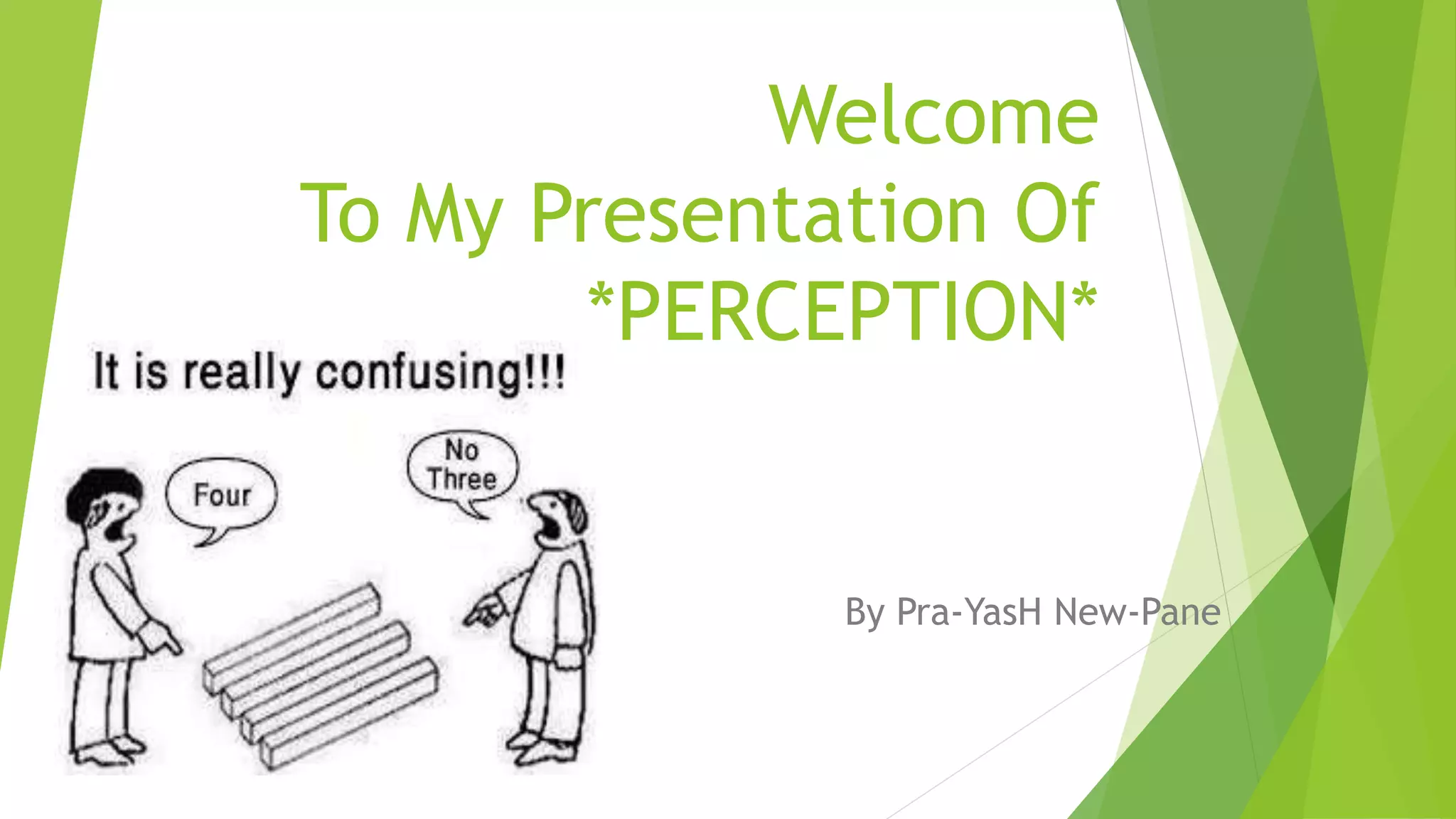
 People respond to situations on the basis of their perception about the 
reality rather than reality itself.
Nature/Feature of Perception 
 Base of every individual’s Behaviour. 
 Psychological/cognitive process. 
 Differs from person to person and situation to situation. 
 Not always based on reality. 
 Directly related to motivation and personality. 
 Can be developed.
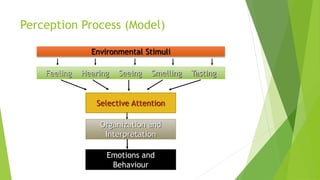
Perception Process (Model) 
Environmental Stimuli 
Feeling Hearing Seeing Smelling Tasting 
Selective Attention 
Organization and 
Interpretation 
Emotions and 
Behaviour
INPUTS 
 Perceived inputs are the objectives, events, people etc. 
 They are received by the perceiver. 
 It begins when environmental stimuli are received through our five 
sense organs. 
 Five sense organs are Eye(Seeing), Ear(Hearing), Skin(Feeling), Nose 
(Smelling), Toung(Tasting).
PROCESSES 
 The inputs received through sense organs are processed through the three sub-processes. 
 Selection : The process of filtering information received by our sense organ is 
called selective perception. The selective perception involves two 
psychological principles: 
a) Figure – Ground principle 
b) Relevancy principle 
 Organization: Perceptual organization is the process by which we group 
selected information. 
a) Grouping 
b) Closure (Bridging the gap) 
c) Simplification 
 Interpretation: It is highly subjective and judgmental in nature which is 
influenced by many factors and without it perceive information would be 
meaningless.
OUTPUTS 
 The output of perception can be seen in the form of Behaviours and 
emotion. 
 They can be feelings, actions, attitudes etc.
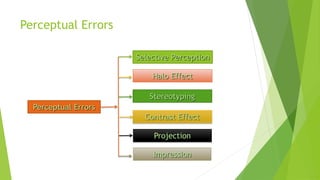
Perceptual Errors 
Perceptual Errors 
Selective Perception 
Halo Effect 
Stereotyping 
Contrast Effect 
Projection 
Impression
Contd. 
 Selective Perception: People selectively interpret what they see on 
the basis of their interest, background, experiences and attitudes. 
 Halo Effect: It refers to the tendency of judging person entirely on the 
basis of a single trait which may be favorable or unfavorable. 
 Stereotyping: It means classifying people and event into already 
known general categories or groups. 
 Contrast Effect: It occurs when we evaluate a person’s characteristics 
that are affect by the comparison with other people. 
 Projection: It refers to the tendency of the people to see their own 
trails in other people. 
 Impression: We frequently from impression of others on the first sight. 
( First impression is the last impression )
Principle of Perpetual Selection 
 Intensity: More intense the stimulus, the more likely it is to be 
perceived. 
 Size: Larger an external factor, the more likely it is to be perceived and vice 
versa. 
 Contrast: The external stimuli that stand out against the background or that 
are not what people are expecting will perceive more attention. 
 Repetition: The Repeated external stimulus is more attention getting than a 
single one. 
 Motion: People will pay more attention to moving objects in their field of 
vision. 
 Novelty: Either a familiar or a new factor in environment can attract more 
attention.
Social Perception 
 Social perception is directly concerned with how one individual 
perceives other individuals. 
 To learn about other people, they rely on information from their 
physical appearance, and verbal and nonverbal communication 
 There can be ways in which people communicate without words— 
including through facial expressions, tone of voice, gestures, body 
position and movement, touch, and gaze. 
 A different perceptual activity ,called the attribution process 
(theory), help us to interpret the world around us.
Attribution Theory 
 When people attach cause and effect explanation to their Behaviour, 
it is known as attribution. 
 “Attribution theory deals with how the social perceiver uses 
information to explain events. It examines what information is 
gathered and how it is combined to form a causal judgment” (Fiske & 
Taylor, 1991) 
 Perception of a person depends to a large extent on whether he 
attributes the observed Behaviour.
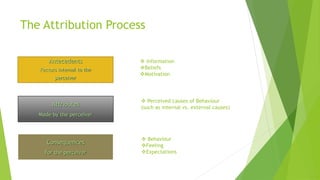
The Attribution Process 
Antecedents 
Factors internal to the 
perceiver 
Attributes 
Made by the perceiver 
Consequences 
For the perceiver 
 Information 
Beliefs 
Motivation 
 Perceived causes of Behaviour 
(such as internal vs. external causes) 
 Behaviour 
Feeling 
Expectations
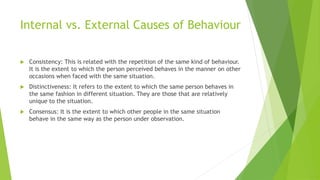
Internal vs. External Causes of Behaviour 
 Consistency: This is related with the repetition of the same kind of behaviour. 
It is the extent to which the person perceived behaves in the manner on other 
occasions when faced with the same situation. 
 Distinctiveness: It refers to the extent to which the same person behaves in 
the same fashion in different situation. They are those that are relatively 
unique to the situation. 
 Consensus: It is the extent to which other people in the same situation 
behave in the same way as the person under observation.
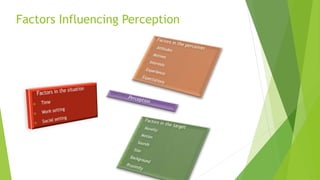
Factors Influencing Perception
Feedbacksssss?????????????????

Perception

  • 1.
    Welcome To MyPresentation Of *PERCEPTION* By Pra-YasH New-Pane
  • 2.
    Introduction  Perceptionis one of the important cognitive factors of individual Behaviours.  Perception is a process by which an individual selects, organizes and interprets stimuli into a meaningful picture of the environment.  Differs from one person to another depending upon needs, values and expectation.  People respond to situations on the basis of their perception about the reality rather than reality itself.
  • 3.
    Nature/Feature of Perception  Base of every individual’s Behaviour.  Psychological/cognitive process.  Differs from person to person and situation to situation.  Not always based on reality.  Directly related to motivation and personality.  Can be developed.
  • 4.
    Perception Process (Model) Environmental Stimuli Feeling Hearing Seeing Smelling Tasting Selective Attention Organization and Interpretation Emotions and Behaviour
  • 5.
    INPUTS  Perceivedinputs are the objectives, events, people etc.  They are received by the perceiver.  It begins when environmental stimuli are received through our five sense organs.  Five sense organs are Eye(Seeing), Ear(Hearing), Skin(Feeling), Nose (Smelling), Toung(Tasting).
  • 6.
    PROCESSES  Theinputs received through sense organs are processed through the three sub-processes.  Selection : The process of filtering information received by our sense organ is called selective perception. The selective perception involves two psychological principles: a) Figure – Ground principle b) Relevancy principle  Organization: Perceptual organization is the process by which we group selected information. a) Grouping b) Closure (Bridging the gap) c) Simplification  Interpretation: It is highly subjective and judgmental in nature which is influenced by many factors and without it perceive information would be meaningless.
  • 7.
    OUTPUTS  Theoutput of perception can be seen in the form of Behaviours and emotion.  They can be feelings, actions, attitudes etc.
  • 8.
    Perceptual Errors PerceptualErrors Selective Perception Halo Effect Stereotyping Contrast Effect Projection Impression
  • 9.
    Contd.  SelectivePerception: People selectively interpret what they see on the basis of their interest, background, experiences and attitudes.  Halo Effect: It refers to the tendency of judging person entirely on the basis of a single trait which may be favorable or unfavorable.  Stereotyping: It means classifying people and event into already known general categories or groups.  Contrast Effect: It occurs when we evaluate a person’s characteristics that are affect by the comparison with other people.  Projection: It refers to the tendency of the people to see their own trails in other people.  Impression: We frequently from impression of others on the first sight. ( First impression is the last impression )
  • 10.
    Principle of PerpetualSelection  Intensity: More intense the stimulus, the more likely it is to be perceived.  Size: Larger an external factor, the more likely it is to be perceived and vice versa.  Contrast: The external stimuli that stand out against the background or that are not what people are expecting will perceive more attention.  Repetition: The Repeated external stimulus is more attention getting than a single one.  Motion: People will pay more attention to moving objects in their field of vision.  Novelty: Either a familiar or a new factor in environment can attract more attention.
  • 11.
    Social Perception Social perception is directly concerned with how one individual perceives other individuals.  To learn about other people, they rely on information from their physical appearance, and verbal and nonverbal communication  There can be ways in which people communicate without words— including through facial expressions, tone of voice, gestures, body position and movement, touch, and gaze.  A different perceptual activity ,called the attribution process (theory), help us to interpret the world around us.
  • 12.
    Attribution Theory When people attach cause and effect explanation to their Behaviour, it is known as attribution.  “Attribution theory deals with how the social perceiver uses information to explain events. It examines what information is gathered and how it is combined to form a causal judgment” (Fiske & Taylor, 1991)  Perception of a person depends to a large extent on whether he attributes the observed Behaviour.
  • 13.
    The Attribution Process Antecedents Factors internal to the perceiver Attributes Made by the perceiver Consequences For the perceiver  Information Beliefs Motivation  Perceived causes of Behaviour (such as internal vs. external causes)  Behaviour Feeling Expectations
  • 14.
    Internal vs. ExternalCauses of Behaviour  Consistency: This is related with the repetition of the same kind of behaviour. It is the extent to which the person perceived behaves in the manner on other occasions when faced with the same situation.  Distinctiveness: It refers to the extent to which the same person behaves in the same fashion in different situation. They are those that are relatively unique to the situation.  Consensus: It is the extent to which other people in the same situation behave in the same way as the person under observation.
  • 15.
  • 16.