ORGANIZATIONAL
BEHVIOUR
ASSIGNMENT- 03
PERCEPTION
By – Anurag Priyadarshi
BFT/15/1145
NIFT Patna
What is PERCEPTION?
Perception is a process by which an individual organizes and interpret their sensory
impressions in order to give meaning to their environment.
OR
The process by which individuals select, organize, and interpret the input from their
senses to give meaning and order to the world around them.
Perceptions vary from person to person. Different people perceive different things about the same
situation. But more than that, we assign different meanings to what we perceive. And the
meanings might change for a certain person.
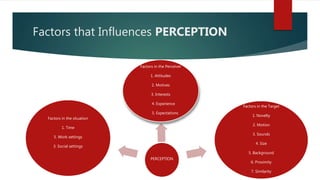
Factors that Influences PERCEPTION
PERCEPTION
Factors in the Perceiver
1. Attitudes
2. Motives
3. Interests
4. Experience
5. Expectations
Factors in the Target
1. Novelty
2. Motion
3. Sounds
4. Size
5. Background
6. Proximity
7. Similarity
Factors in the situation
1. Time
5. Work settings
3. Social settings
The Accuracy Of Perception
The accuracy of perceptions is critical, however, for a number of managerial functions.
• Motivating sub-ordinates
• Treating sub-ordinates fairly and equitably.
• Making ethical decisions
Managers who understand what perceptions are, how they are formed and what
influences them are in a good position to ensure that their perceptions are as
accurate as possible.
DYNAMICS OF PERCEPTION
Perceptual Selection
 With all the stimulation impinging upon people through the environment, how and why do they select
out only a very few stimuli at a given time ?
 Factors of Selectivity
 Intensity
 Size
 Contrast
 Repetition
 Motion
 Novelty and familiarity
 Intensity-
 The intensity principle state that the more intense the external stimulus,
the more likely it is to be perceived.
 A loud noise, strong odor, will be noticed more than soft sound, weak odor.
 Supervisors may yell at their subordinates to gain attention.
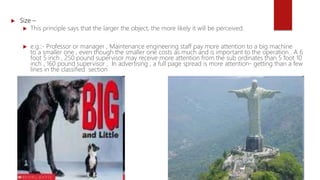
 Size –
 This principle says that the larger the object, the more likely it will be perceived.
 e.g.:- Professor or manager , Maintenance engineering staff pay more attention to a big machine
to a smaller one , even though the smaller one costs as much and is important to the operation . A 6
foot 5 inch , 250 pound supervisor may receive more attention from the sub ordinates than 5 foot 10
inch , 160 pound supervisor , In advertising , a full page spread is more attention- getting than a few
lines in the classified section
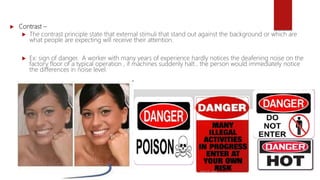
 Contrast –
 The contrast principle state that external stimuli that stand out against the background or which are
what people are expecting will receive their attention.
 Ex: sign of danger. A worker with many years of experience hardly notices the deafening noise on the
factory floor of a typical operation , if machines suddenly halt , the person would immediately notice
the differences in noise level.
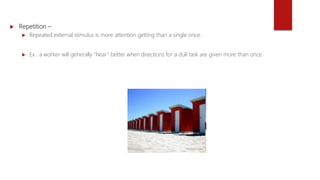
 Repetition –
 Repeated external stimulus is more attention getting than a single once.
 Ex : a worker will generally “hear” better when directions for a dull task are given more than once .
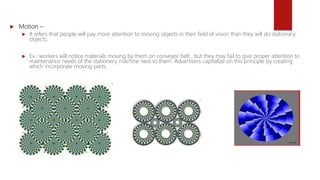
 Motion –
 It refers that people will pay more attention to moving objects in their field of vision than they will do stationary
objects.
 Ex : workers will notice materials moving by them on conveyor belt , but they may fail to give proper attention to
maintenance needs of the stationery machine next to them. Advertisers capitalize on this principle by creating
which incorporate moving parts.
 Novelty & familiarity –
 Novel or Familiar external situation can serve as an attention getter. New objects or events in the familiar setting
familiar objects or events in a new setting will draw the attention of the perceiver.
 Ex : Job rotation
Internal factors of selectivity
ATTRIBUTION THEORY OF
PERCEPTION
Persons Perception: Making Judgement about others
Internal and External Behaviours
 Internal Behaviours - Internally caused behaviours are those we believe to be
under the personal control of the individual.
 External Behaviours – Externally caused behaviour is what we imagine the situation
forced the individual to do.
Attribution Theory
 Attribution theory tries to explain the ways in which we judge people differently,
depending on the meaning we perceive to a given behaviour.
 It suggests that we perceive an individuals behaviour and attempts to determine
whether it was externally or internally caused.
 The determination depends on three factors –
 Distinctiveness
 Consensus
 Consistency
 Social perception is directly concerned with how one individual perceives other
individuals: how we get to know others.
 Participants in formal organization are constantly perceiving one another.
Managers are perceiving workers, workers are perceiving managers etc…
 There are numerous factors enter into social perception i.e., attributions people
make and the problems associated with stereotyping and the halo effect.
Social Perception
Link Between Perception and Individual
Decision Making
Individuals in organization make decision. That is, they make choices from
among two or more alternatives. Top managers, for instance determine their
organization's goals, what produces or services to offer, how best to finance
operations, or where to locate a new manufacturing plant. Middle and lower
level managers determine production schedules, select new employees, and
decide how pay raises are to be allocated. Of-course making decision is not
the sole province of managers. Non-managerial employees also make
decisions that affect their jobs and the organizations for which they work.
Perception and Individual Decision
Making
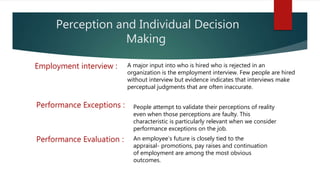
Employment interview : A major input into who is hired who is rejected in an
organization is the employment interview. Few people are hired
without interview but evidence indicates that interviews make
perceptual judgments that are often inaccurate.
Performance Exceptions : People attempt to validate their perceptions of reality
even when those perceptions are faulty. This
characteristic is particularly relevant when we consider
performance exceptions on the job.
Performance Evaluation : An employee’s future is closely tied to the
appraisal- promotions, pay raises and continuation
of employment are among the most obvious
outcomes.
Thank you

Organizational Behavior : Perception

  • 1.
  • 2.
    PERCEPTION By – AnuragPriyadarshi BFT/15/1145 NIFT Patna
  • 3.
    What is PERCEPTION? Perceptionis a process by which an individual organizes and interpret their sensory impressions in order to give meaning to their environment. OR The process by which individuals select, organize, and interpret the input from their senses to give meaning and order to the world around them. Perceptions vary from person to person. Different people perceive different things about the same situation. But more than that, we assign different meanings to what we perceive. And the meanings might change for a certain person.
  • 4.
    Factors that InfluencesPERCEPTION PERCEPTION Factors in the Perceiver 1. Attitudes 2. Motives 3. Interests 4. Experience 5. Expectations Factors in the Target 1. Novelty 2. Motion 3. Sounds 4. Size 5. Background 6. Proximity 7. Similarity Factors in the situation 1. Time 5. Work settings 3. Social settings
  • 5.
    The Accuracy OfPerception The accuracy of perceptions is critical, however, for a number of managerial functions. • Motivating sub-ordinates • Treating sub-ordinates fairly and equitably. • Making ethical decisions Managers who understand what perceptions are, how they are formed and what influences them are in a good position to ensure that their perceptions are as accurate as possible.
  • 6.
  • 7.
    Perceptual Selection  Withall the stimulation impinging upon people through the environment, how and why do they select out only a very few stimuli at a given time ?  Factors of Selectivity  Intensity  Size  Contrast  Repetition  Motion  Novelty and familiarity
  • 8.
     Intensity-  Theintensity principle state that the more intense the external stimulus, the more likely it is to be perceived.  A loud noise, strong odor, will be noticed more than soft sound, weak odor.  Supervisors may yell at their subordinates to gain attention.
  • 9.
     Size – This principle says that the larger the object, the more likely it will be perceived.  e.g.:- Professor or manager , Maintenance engineering staff pay more attention to a big machine to a smaller one , even though the smaller one costs as much and is important to the operation . A 6 foot 5 inch , 250 pound supervisor may receive more attention from the sub ordinates than 5 foot 10 inch , 160 pound supervisor , In advertising , a full page spread is more attention- getting than a few lines in the classified section
  • 10.
     Contrast – The contrast principle state that external stimuli that stand out against the background or which are what people are expecting will receive their attention.  Ex: sign of danger. A worker with many years of experience hardly notices the deafening noise on the factory floor of a typical operation , if machines suddenly halt , the person would immediately notice the differences in noise level.
  • 11.
     Repetition – Repeated external stimulus is more attention getting than a single once.  Ex : a worker will generally “hear” better when directions for a dull task are given more than once .
  • 12.
     Motion – It refers that people will pay more attention to moving objects in their field of vision than they will do stationary objects.  Ex : workers will notice materials moving by them on conveyor belt , but they may fail to give proper attention to maintenance needs of the stationery machine next to them. Advertisers capitalize on this principle by creating which incorporate moving parts.
  • 13.
     Novelty &familiarity –  Novel or Familiar external situation can serve as an attention getter. New objects or events in the familiar setting familiar objects or events in a new setting will draw the attention of the perceiver.  Ex : Job rotation Internal factors of selectivity
  • 14.
    ATTRIBUTION THEORY OF PERCEPTION PersonsPerception: Making Judgement about others
  • 15.
    Internal and ExternalBehaviours  Internal Behaviours - Internally caused behaviours are those we believe to be under the personal control of the individual.  External Behaviours – Externally caused behaviour is what we imagine the situation forced the individual to do.
  • 16.
    Attribution Theory  Attributiontheory tries to explain the ways in which we judge people differently, depending on the meaning we perceive to a given behaviour.  It suggests that we perceive an individuals behaviour and attempts to determine whether it was externally or internally caused.  The determination depends on three factors –  Distinctiveness  Consensus  Consistency
  • 17.
     Social perceptionis directly concerned with how one individual perceives other individuals: how we get to know others.  Participants in formal organization are constantly perceiving one another. Managers are perceiving workers, workers are perceiving managers etc…  There are numerous factors enter into social perception i.e., attributions people make and the problems associated with stereotyping and the halo effect. Social Perception
  • 18.
    Link Between Perceptionand Individual Decision Making Individuals in organization make decision. That is, they make choices from among two or more alternatives. Top managers, for instance determine their organization's goals, what produces or services to offer, how best to finance operations, or where to locate a new manufacturing plant. Middle and lower level managers determine production schedules, select new employees, and decide how pay raises are to be allocated. Of-course making decision is not the sole province of managers. Non-managerial employees also make decisions that affect their jobs and the organizations for which they work.
  • 19.
    Perception and IndividualDecision Making Employment interview : A major input into who is hired who is rejected in an organization is the employment interview. Few people are hired without interview but evidence indicates that interviews make perceptual judgments that are often inaccurate. Performance Exceptions : People attempt to validate their perceptions of reality even when those perceptions are faulty. This characteristic is particularly relevant when we consider performance exceptions on the job. Performance Evaluation : An employee’s future is closely tied to the appraisal- promotions, pay raises and continuation of employment are among the most obvious outcomes.
  • 20.