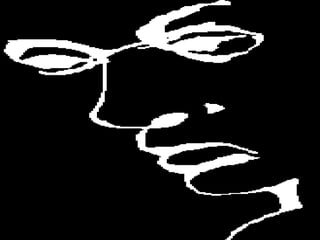
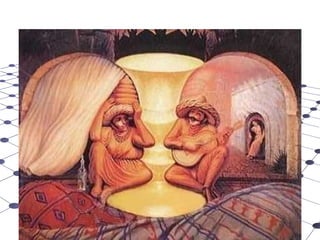
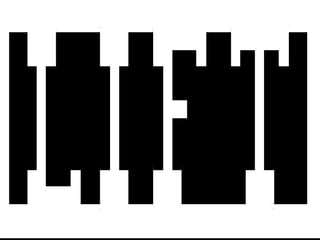
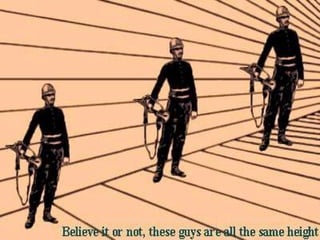
“  WE  DON’T  SEE  THINGS  AS  THEY  ARE,  WE  SEE  THINGS  AS WE  ARE.”
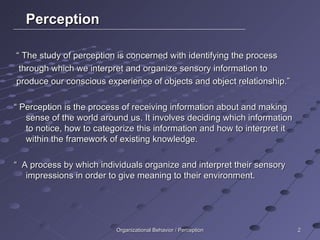
Perception “  The study of perception is concerned with identifying the process through which we interpret and organize sensory information to produce our conscious experience of objects and object relationship.” “  Perception is the process of receiving information about and making sense of the world around us. It involves deciding which information to notice, how to categorize this information and how to interpret it within the framework of existing knowledge. “  A process by which individuals organize and interpret their sensory impressions in order to give meaning to their environment. Organizational Behavior / Perception
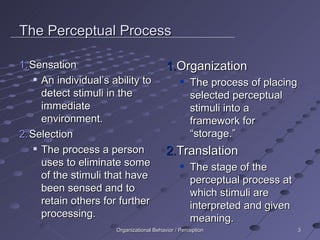
The Perceptual Process Sensation An individual’s ability to detect stimuli in the immediate environment. Selection The process a person uses to eliminate some of the stimuli that have been sensed and to retain others for further processing. Organization The process of placing selected perceptual stimuli into a framework for “storage.” Translation The stage of the perceptual process at which stimuli are interpreted and given meaning. Organizational Behavior / Perception
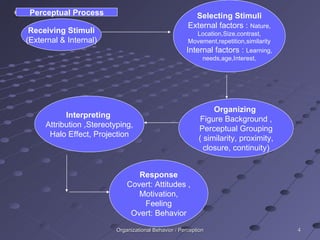
Organizational Behavior / Perception Receiving Stimuli (External & Internal) Selecting Stimuli External factors :  Nature, Location,Size,contrast, Movement,repetition,similarity Internal factors :  Learning, needs,age,Interest, Organizing  Figure Background , Perceptual Grouping ( similarity, proximity, closure, continuity) Response Covert: Attitudes , Motivation, Feeling Overt: Behavior Perceptual Process Interpreting  Attribution ,Stereotyping, Halo Effect, Projection
Factors influencing perception A number of factors operate to shape and sometimes distort perception. These factors can reside in the  perceiver , in the object or  target  being perceived or in the context of the  situation  in which the perception is made. Organizational Behavior / Perception
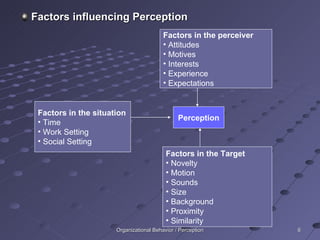
Factors influencing Perception Organizational Behavior / Perception Factors in the perceiver Attitudes Motives Interests Experience Expectations Perception Factors in the Target Novelty Motion Sounds Size Background Proximity Similarity Factors in the situation Time Work Setting Social Setting
Perceptual organization It is the process by which we group outside stimuli into recognizable and identifiable patterns and whole objects. Certain factors are considered to be important contributors on assembling, organizing and categorizing information in the human brain. These are Figure ground Perceptual grouping Organizational Behavior / Perception
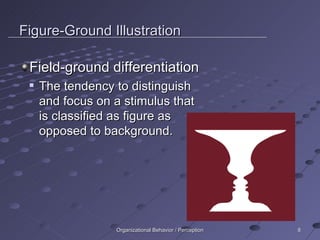
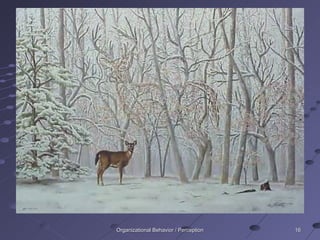
Figure-Ground Illustration Field-ground differentiation The tendency to distinguish  and focus on a stimulus that  is classified as figure as  opposed to background. Organizational Behavior / Perception
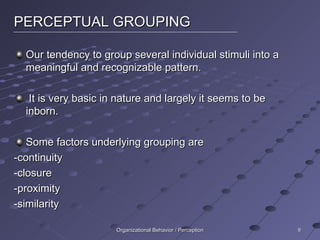
PERCEPTUAL GROUPING Our tendency to group several individual stimuli into a meaningful and recognizable pattern. It is very basic in nature and largely it seems to be inborn. Some factors underlying grouping are -continuity -closure -proximity -similarity Organizational Behavior / Perception
Person Perception: Making Judgments About Others Organizational Behavior / Perception
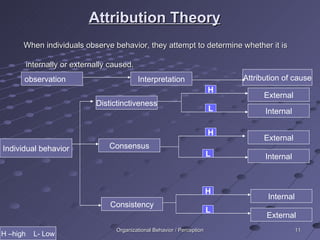
Attribution Theory When individuals observe behavior, they attempt to determine whether it is internally or externally caused. Organizational Behavior / Perception observation Interpretation Attribution of cause Consistency Consensus Distictinctiveness Individual behavior Internal External Internal External Internal External H L H L H L H –high  L- Low
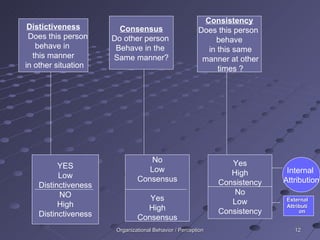
External Attribution Organizational Behavior / Perception Distictiveness Does this person  behave in  this manner in other situation Yes High Consistency No Low Consistency No Low Consensus Yes High Consensus YES Low Distinctiveness NO High Distinctiveness Consensus Do other person  Behave in the  Same manner? Consistency Does this person  behave in this same manner at other times ? Internal  Attribution
Shortcuts in judging others Selective Perception  :  People selectively interpret what they see on the basis of their interests, background, experience and attitudes. Halo Effect  : Drawing a general impressions about an individual on the basis of a single charecteristics. Organizational Behavior / Perception
Contrast Effect : Evaluation of a person’s characteristics that are effected by comparisons with other people recently encountered who rank higher or lower on the same characteristics. Projection : Attributing one's own characteristics to other people. Stereotyping : Judging someone on the basis of one’s perception of the group to which that persons belongs. Organizational Behavior / Perception
Organizational Behavior / Perception

Perception1

  • 1.
    “ WE DON’T SEE THINGS AS THEY ARE, WE SEE THINGS AS WE ARE.”
  • 2.
    Perception “ The study of perception is concerned with identifying the process through which we interpret and organize sensory information to produce our conscious experience of objects and object relationship.” “ Perception is the process of receiving information about and making sense of the world around us. It involves deciding which information to notice, how to categorize this information and how to interpret it within the framework of existing knowledge. “ A process by which individuals organize and interpret their sensory impressions in order to give meaning to their environment. Organizational Behavior / Perception
  • 3.
    The Perceptual ProcessSensation An individual’s ability to detect stimuli in the immediate environment. Selection The process a person uses to eliminate some of the stimuli that have been sensed and to retain others for further processing. Organization The process of placing selected perceptual stimuli into a framework for “storage.” Translation The stage of the perceptual process at which stimuli are interpreted and given meaning. Organizational Behavior / Perception
  • 4.
    Organizational Behavior /Perception Receiving Stimuli (External & Internal) Selecting Stimuli External factors : Nature, Location,Size,contrast, Movement,repetition,similarity Internal factors : Learning, needs,age,Interest, Organizing Figure Background , Perceptual Grouping ( similarity, proximity, closure, continuity) Response Covert: Attitudes , Motivation, Feeling Overt: Behavior Perceptual Process Interpreting Attribution ,Stereotyping, Halo Effect, Projection
  • 5.
    Factors influencing perceptionA number of factors operate to shape and sometimes distort perception. These factors can reside in the perceiver , in the object or target being perceived or in the context of the situation in which the perception is made. Organizational Behavior / Perception
  • 6.
    Factors influencing PerceptionOrganizational Behavior / Perception Factors in the perceiver Attitudes Motives Interests Experience Expectations Perception Factors in the Target Novelty Motion Sounds Size Background Proximity Similarity Factors in the situation Time Work Setting Social Setting
  • 7.
    Perceptual organization Itis the process by which we group outside stimuli into recognizable and identifiable patterns and whole objects. Certain factors are considered to be important contributors on assembling, organizing and categorizing information in the human brain. These are Figure ground Perceptual grouping Organizational Behavior / Perception
  • 8.
    Figure-Ground Illustration Field-grounddifferentiation The tendency to distinguish and focus on a stimulus that is classified as figure as opposed to background. Organizational Behavior / Perception
  • 9.
    PERCEPTUAL GROUPING Ourtendency to group several individual stimuli into a meaningful and recognizable pattern. It is very basic in nature and largely it seems to be inborn. Some factors underlying grouping are -continuity -closure -proximity -similarity Organizational Behavior / Perception
  • 10.
    Person Perception: MakingJudgments About Others Organizational Behavior / Perception
  • 11.
    Attribution Theory Whenindividuals observe behavior, they attempt to determine whether it is internally or externally caused. Organizational Behavior / Perception observation Interpretation Attribution of cause Consistency Consensus Distictinctiveness Individual behavior Internal External Internal External Internal External H L H L H L H –high L- Low
  • 12.
    External Attribution OrganizationalBehavior / Perception Distictiveness Does this person behave in this manner in other situation Yes High Consistency No Low Consistency No Low Consensus Yes High Consensus YES Low Distinctiveness NO High Distinctiveness Consensus Do other person Behave in the Same manner? Consistency Does this person behave in this same manner at other times ? Internal Attribution
  • 13.
    Shortcuts in judgingothers Selective Perception : People selectively interpret what they see on the basis of their interests, background, experience and attitudes. Halo Effect : Drawing a general impressions about an individual on the basis of a single charecteristics. Organizational Behavior / Perception
  • 14.
    Contrast Effect :Evaluation of a person’s characteristics that are effected by comparisons with other people recently encountered who rank higher or lower on the same characteristics. Projection : Attributing one's own characteristics to other people. Stereotyping : Judging someone on the basis of one’s perception of the group to which that persons belongs. Organizational Behavior / Perception
  • 15.
  • 16.
  • 17.
  • 18.
  • 19.
  • 20.
  • 21.
  • 22.
  • 23.
  • 24.
  • 25.