Perception
Dr. Swapnil Mackasare
Area Chair & Associate Professor - HR
School of Management
Presidency University
Concentrate on the +
Concentrate on the + and see the difference
Perception
 A process by which an individual selects,
organizes & interprets stimuli into a
meaningful & coherent picture of the
environment.
 It’s a complex cognitive process differing
from one individual to another depending on
needs & expectations of the individual.
 Sensation
 Subliminal perception .
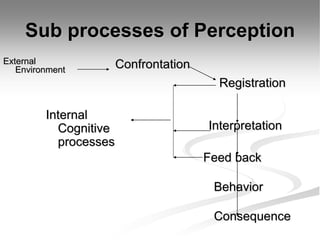
Sub processes of Perception
External
Environment Confrontation
Registration
Interpretation
Feed back
Behavior
Consequence
Internal
Cognitive
processes
Perceptual selectivity
 Intensity
 Size
 Contrast
 Repetition
 Motion
 Novelty &
familiarity
External attention
factors
Internal set factors
 Learning &
perception
 Motivation &
perception
 Personality &
perception
Learning & Perception
 I R A C H
 L C P I E N
 E O R S H
 U N E Q E
 S L S G A
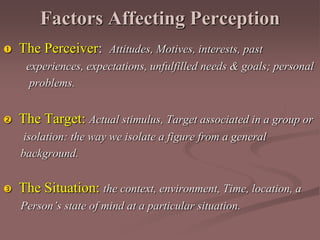
Factors Affecting Perception
 The Perceiver: Attitudes, Motives, interests, past
experiences, expectations, unfulfilled needs & goals; personal
problems.
 The Target: Actual stimulus, Target associated in a group or
isolation: the way we isolate a figure from a general
background.
 The Situation: the context, environment, Time, location, a
Person’s state of mind at a particular situation.
Perceptual Organization: -
Figure Ground:-
• A form of perception , where perceived objects are
separated from their general background by the
perceiver.
e.g.- perceiving patches of irregular white and black
shapes. A person with knowledge of the language
will perceive the black shapes in the form of letters,
words or sentences against a white background.
•Organizing the incoming stimuli into recognizable
figures (words), seen against a ground (a white
surface).
 Perceptual Grouping:
** Principle of Closure:
Individual tendency to
complete familiar objects that
have gaps in them.
* A person may sometimes
perceive a whole where it
does not exist. Here the gaps
that remain unfulfilled from
the sensory input are bridged
by the person’s perceptual
process.
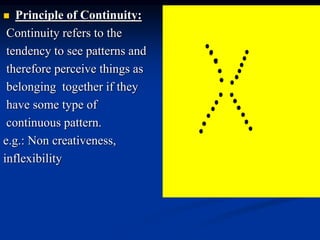
 Principle of Continuity:
Continuity refers to the
tendency to see patterns and
therefore perceive things as
belonging together if they
have some type of
continuous pattern.
e.g.: Non creativeness,
inflexibility
 Principle of Similarity :
Tendency to group things
together based upon how similar
they are to each other. Here we
tend to see Two rows of red dots
and two rows of Blue dots. The
dots are grouped based on their
similar color.
E.G Problems due to
stereotyping.
 Principle of proximity:
A group of stimuli that are
physically close to each
other are perceived as sets or
Parts belonging to each
other.
** Practical application:
Consolidate Team strength
&
promotes team work.
 Perceptual Constancy:
Perception of elements like Size, Shape, color, brightness, and
location of an object remains constant and does not change
form one individual to other. E.G- Photographs in
Newspapers.
 Learning helps individuals perceive certain patterns of cues
in a similar way and leads to perceptual constancy.
 Most simple example of perceptual constancy :
identification of the sight of an apple. The Image of the
apple remains constant in our mind, irrespective of the color
of the picture.
 Perceptual context:
Sometimes visual stimuli, by themselves do not convey any
Meaning, its only when they are placed in a particular context
that its meaning and value can be perceived.
If a manager pats the back of his two year old son, his gesture
conveys love and affection. However when he pats the back of
His Employee, it would imply appreciation for doing a good
job. If the Manager asks the son to do something and if the son
fails to do it, He may not take it seriously. But at office if an
employee fails the compliance of any tasks that had been
assigned; it will be perceived as indiscipline and may result in
a serious action.
Some gestures and actions: A verbal order, raising an
eyebrow, a Suggestion, shrugging of shoulders, etc. are
different contexts prevailing in the Work environment.
 Perceptual defense:
The tendency of a person to establish a defense against some
situational Events or Stimuli for the reason that they might be
clashing with the individual’s personal values or culture or
may be threatening in nature.
Perceptual Defense Mechanism:-
1. Denial
2. Modification & Distortion
3. Change in perception
4. Recognition but refusal to change.
 Social Perception:
 Characteristics influencing Individual’s Perception:
1. Understanding one’s own personality well, helps in
understanding others personality well.
2. Personal characteristics of an individual may affect the
way he perceives others.
3. Individual with high self esteem are likely to perceive
others in the same way.
4. How accurately a person perceives others is based not just
on one trait/skill but involves many things.
1. Attribution: The way in which a person explains the cause
of their own or others behavior. This also involves
drawing conclusions about the factors influencing
behavior. There are two types of attributions made by
people:-
 Dispositional attributions:- persons behavior is
attributed to internal factors such as personality traits, his
motivation or ability.
 Situational attribution:- External factors like the
equipment that the individual may be handling, or the
social influence that he may be a subject to.
 Certain problems associated with Social perception:
 Stereotyping:-
The tendency of generalizing the characteristics of all
members in a group. When a perceiver judges people based on
the perception about the group to which the person belongs, its
called Stereotyping.
 Politicians have been stereotyped as being manipulative,
corrupt, or having an insatiable greed for the position.
 Women are stereotyped as being sensitive, caring, or
patient.
Stereotyping is common in society, despite the fact that in may
involve any truth or that it may be irrelevant.
 The Halo Effect:-
The tendency of people to draw a general impression of a
person based on a single trait such as Intellect, sociability,
aggressiveness, etc . Here perceptions are formed on the
basis of a Dominant Trait.
 Commonly seen in performance appraisals, when the
appraiser or rater commits an error in evaluating the
performance of the appraisee on the basis of a single trait as
Punctuality, cooperativeness, etc.
 A certain positive Trait outweighs all the other characteristics that
have to be considered while evaluating performance or making
decisions.
 Halo effect is a common error made by the performance evaluators.
 Two sides or components- TRUE & ILLUSORY.
Impression Management
 Self presentation
 A process by people try to manage/control the
perceptions formed by other people about
themselves.
 E.g- Self Promotion,
Supplication- (weak & irresponsible),
Exemplification: (ethically/ socially responsible),
Intimidation: fear
Ingratiation : Likeable
Process of Impression
management
 Impression motivation:
 Relevance of these impressions in helping individuals attain
goals.
 The value of goals to the individual
 The discrepancy between the image the individual would like
to create about himself in others mind, & the actual image he
believes, others already have about him.
 Impression construction: factors such as
personal characteristics, values, attitudes,
interests.
Impression Management
strategies
 Accounts
 Apologies
 Disassociation
Demotion Prevention strategy
Promotion enhancing strategy
 Entitlements
 Enhancements
 Obstacle disclosures
 Association.

Perception

  • 1.
    Perception Dr. Swapnil Mackasare AreaChair & Associate Professor - HR School of Management Presidency University
  • 2.
    Concentrate on the+ Concentrate on the + and see the difference
  • 3.
    Perception  A processby which an individual selects, organizes & interprets stimuli into a meaningful & coherent picture of the environment.  It’s a complex cognitive process differing from one individual to another depending on needs & expectations of the individual.  Sensation  Subliminal perception .
  • 4.
    Sub processes ofPerception External Environment Confrontation Registration Interpretation Feed back Behavior Consequence Internal Cognitive processes
  • 5.
    Perceptual selectivity  Intensity Size  Contrast  Repetition  Motion  Novelty & familiarity External attention factors Internal set factors  Learning & perception  Motivation & perception  Personality & perception
  • 6.
    Learning & Perception I R A C H  L C P I E N  E O R S H  U N E Q E  S L S G A
  • 7.
    Factors Affecting Perception The Perceiver: Attitudes, Motives, interests, past experiences, expectations, unfulfilled needs & goals; personal problems.  The Target: Actual stimulus, Target associated in a group or isolation: the way we isolate a figure from a general background.  The Situation: the context, environment, Time, location, a Person’s state of mind at a particular situation.
  • 8.
    Perceptual Organization: - FigureGround:- • A form of perception , where perceived objects are separated from their general background by the perceiver. e.g.- perceiving patches of irregular white and black shapes. A person with knowledge of the language will perceive the black shapes in the form of letters, words or sentences against a white background. •Organizing the incoming stimuli into recognizable figures (words), seen against a ground (a white surface).
  • 9.
     Perceptual Grouping: **Principle of Closure: Individual tendency to complete familiar objects that have gaps in them. * A person may sometimes perceive a whole where it does not exist. Here the gaps that remain unfulfilled from the sensory input are bridged by the person’s perceptual process.
  • 10.
     Principle ofContinuity: Continuity refers to the tendency to see patterns and therefore perceive things as belonging together if they have some type of continuous pattern. e.g.: Non creativeness, inflexibility
  • 11.
     Principle ofSimilarity : Tendency to group things together based upon how similar they are to each other. Here we tend to see Two rows of red dots and two rows of Blue dots. The dots are grouped based on their similar color. E.G Problems due to stereotyping.
  • 12.
     Principle ofproximity: A group of stimuli that are physically close to each other are perceived as sets or Parts belonging to each other. ** Practical application: Consolidate Team strength & promotes team work.
  • 13.
     Perceptual Constancy: Perceptionof elements like Size, Shape, color, brightness, and location of an object remains constant and does not change form one individual to other. E.G- Photographs in Newspapers.  Learning helps individuals perceive certain patterns of cues in a similar way and leads to perceptual constancy.  Most simple example of perceptual constancy : identification of the sight of an apple. The Image of the apple remains constant in our mind, irrespective of the color of the picture.
  • 14.
     Perceptual context: Sometimesvisual stimuli, by themselves do not convey any Meaning, its only when they are placed in a particular context that its meaning and value can be perceived. If a manager pats the back of his two year old son, his gesture conveys love and affection. However when he pats the back of His Employee, it would imply appreciation for doing a good job. If the Manager asks the son to do something and if the son fails to do it, He may not take it seriously. But at office if an employee fails the compliance of any tasks that had been assigned; it will be perceived as indiscipline and may result in a serious action. Some gestures and actions: A verbal order, raising an eyebrow, a Suggestion, shrugging of shoulders, etc. are different contexts prevailing in the Work environment.
  • 15.
     Perceptual defense: Thetendency of a person to establish a defense against some situational Events or Stimuli for the reason that they might be clashing with the individual’s personal values or culture or may be threatening in nature. Perceptual Defense Mechanism:- 1. Denial 2. Modification & Distortion 3. Change in perception 4. Recognition but refusal to change.
  • 16.
     Social Perception: Characteristics influencing Individual’s Perception: 1. Understanding one’s own personality well, helps in understanding others personality well. 2. Personal characteristics of an individual may affect the way he perceives others. 3. Individual with high self esteem are likely to perceive others in the same way. 4. How accurately a person perceives others is based not just on one trait/skill but involves many things.
  • 17.
    1. Attribution: Theway in which a person explains the cause of their own or others behavior. This also involves drawing conclusions about the factors influencing behavior. There are two types of attributions made by people:-  Dispositional attributions:- persons behavior is attributed to internal factors such as personality traits, his motivation or ability.  Situational attribution:- External factors like the equipment that the individual may be handling, or the social influence that he may be a subject to.
  • 18.
     Certain problemsassociated with Social perception:  Stereotyping:- The tendency of generalizing the characteristics of all members in a group. When a perceiver judges people based on the perception about the group to which the person belongs, its called Stereotyping.  Politicians have been stereotyped as being manipulative, corrupt, or having an insatiable greed for the position.  Women are stereotyped as being sensitive, caring, or patient. Stereotyping is common in society, despite the fact that in may involve any truth or that it may be irrelevant.
  • 19.
     The HaloEffect:- The tendency of people to draw a general impression of a person based on a single trait such as Intellect, sociability, aggressiveness, etc . Here perceptions are formed on the basis of a Dominant Trait.  Commonly seen in performance appraisals, when the appraiser or rater commits an error in evaluating the performance of the appraisee on the basis of a single trait as Punctuality, cooperativeness, etc.  A certain positive Trait outweighs all the other characteristics that have to be considered while evaluating performance or making decisions.  Halo effect is a common error made by the performance evaluators.  Two sides or components- TRUE & ILLUSORY.
  • 20.
    Impression Management  Selfpresentation  A process by people try to manage/control the perceptions formed by other people about themselves.  E.g- Self Promotion, Supplication- (weak & irresponsible), Exemplification: (ethically/ socially responsible), Intimidation: fear Ingratiation : Likeable
  • 21.
    Process of Impression management Impression motivation:  Relevance of these impressions in helping individuals attain goals.  The value of goals to the individual  The discrepancy between the image the individual would like to create about himself in others mind, & the actual image he believes, others already have about him.  Impression construction: factors such as personal characteristics, values, attitudes, interests.
  • 22.
    Impression Management strategies  Accounts Apologies  Disassociation Demotion Prevention strategy
  • 23.
    Promotion enhancing strategy Entitlements  Enhancements  Obstacle disclosures  Association.