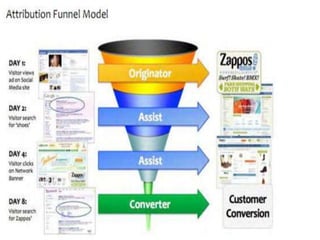

 In advertising, an attribution model will allow marketers to
  look at the team of ads that contribute to a sale or
  conversion over an extended period of time. So instead of
  the traditional method of crediting a sale or conversion to
  the last ad clicked or viewed, an attribution model will
  attribute credit to each ad or “touch point” within the sales
  funnel.
 The goal behind attribution modelling is to obtain a full
  picture of what is happening along each marketing channel
  and to understand the degree of influence each ad has on a
  consumers’ decision. By using an attribution model to
  track and analyze multiple touch points, marketers can gain
  new insights, optimize campaigns, and get a more accurate
  reading on ROI.
 An article published in 2009 by Search Engine
 “Findings from a recent Forrester/IProspect study.
 The study shows that 27 percent of internet users initially
  respond to display ads by conducting a search on the
  company, product, or service mentioned in the ad. In
  addition, that figure jumps to 49 percent when latency is
  taken into account. This data clearly highlights the need
  to consider display’s value in driving people to search.
  This is exactly the type of opportunity attribution
  modelling can help you uncover.”
 The biggest challenge to setting up an attribution
  model is identifying how much credit to assign
  each attribution. In other words, a marketer must
  determine how much influence to assign each
  touch point or ad. Does the initial ad get most of
  the credit or was it the third ad in the sales funnel
  that was most influential? This can prove
  extremely difficult when we consider that there
  are many other contributing factors, such as the
  timing of the ad, decay rate of the ad, what
  products were sold, the amount spent, etc.
 A good attribution model should also
  account for the factor of uncertainty. Was the
  buyer recommended by a friend? Did they
  see the product in a magazine ad or on a TV
  commercial?
 In order to ensure accuracy in the credit
  attributed to each ad, analysts must
  continually test and re-calibrate attribution
  models for extended periods of time. Only
  then will they have successful models that
  will allow them to make effective marketing
  decisions.
Attribution model

Attribution model

  • 2.
     In advertising,an attribution model will allow marketers to look at the team of ads that contribute to a sale or conversion over an extended period of time. So instead of the traditional method of crediting a sale or conversion to the last ad clicked or viewed, an attribution model will attribute credit to each ad or “touch point” within the sales funnel.  The goal behind attribution modelling is to obtain a full picture of what is happening along each marketing channel and to understand the degree of influence each ad has on a consumers’ decision. By using an attribution model to track and analyze multiple touch points, marketers can gain new insights, optimize campaigns, and get a more accurate reading on ROI.
  • 4.
     An articlepublished in 2009 by Search Engine  “Findings from a recent Forrester/IProspect study.  The study shows that 27 percent of internet users initially respond to display ads by conducting a search on the company, product, or service mentioned in the ad. In addition, that figure jumps to 49 percent when latency is taken into account. This data clearly highlights the need to consider display’s value in driving people to search. This is exactly the type of opportunity attribution modelling can help you uncover.”
  • 5.
     The biggestchallenge to setting up an attribution model is identifying how much credit to assign each attribution. In other words, a marketer must determine how much influence to assign each touch point or ad. Does the initial ad get most of the credit or was it the third ad in the sales funnel that was most influential? This can prove extremely difficult when we consider that there are many other contributing factors, such as the timing of the ad, decay rate of the ad, what products were sold, the amount spent, etc.
  • 6.
     A goodattribution model should also account for the factor of uncertainty. Was the buyer recommended by a friend? Did they see the product in a magazine ad or on a TV commercial?  In order to ensure accuracy in the credit attributed to each ad, analysts must continually test and re-calibrate attribution models for extended periods of time. Only then will they have successful models that will allow them to make effective marketing decisions.