Attitude
What is Attitude???
Introduction Attitude constitute an important psychological attribute of individuals which shape their behaviour. Attitude is defined as the way a person feels about something- a person, a place, a commodity, a situation or an idea. Attitude expresses an individual’s positive or negative feelings about some object. Attitude describes an individual’s feelings, thoughts and predisposition to act towards some object in the environment.
Nature Of Attitude   Attitudes refer to feelings and beliefs of individuals or groups of individuals. Attitudes tend to result in behaviour or action. All people, irrespective of their status or intelligence, hold attitudes.
Factors To Determine Attitude Experience  Education Environment  Triple E’s of Attitude
Components Of Attitude Cognitive or Informational Component Affective or Emotional Component Behavioural Component
Three Types of People, Three Types of Attitudes we focus on three broad categories of people and their attitudes : Positive Negative Neutral
The “Players” with Positive Attitudes The following list describes some of the thoughts of a “player” with a positive attitude: There is something good in every situation. A problem is an opportunity to do something different. Change is a sign of growth. A mistake is a valuable step toward success. I have control over my life.
Contd… The following list describes some of the  feelings   of a “player” with a positive attitude: Happy Confident Satisfied Optimistic Loving
The “Critics” with Negative Attitudes The following list describes some of the thoughts of a “critic” with a negative attitude: There is always something wrong. Other people cause problems. Change is a thorn in my side. A mistake is a failure. I have little or no control over my life.
Contd… The following list describes some of the feelings of a “critic” with a negative attitude: Anger Doubt Frustration Pessimism Hate
The “Spectators” with Neutral Attitudes The following list describes some of the thoughts of a “spectator” with a neutral attitude: The situation or the other person is unimportant. Someone else will solve the problem. Change is unnecessary. The future will come and go with or without me. I won’t even try to control my life.
Contd… The following list describes some of the feelings of a “spectator” with a neutral attitude: Unemotional Tired Indifferent Detached
Functions Of Attitude Value-Expressive Function: Enable us to express who we are and what we believe in. Knowledge Function: Enable us to know the world. Utilitarian Function: Enable us to gain rewards and avoid punishment.
Sources Of Attitude Acquired from parents, teachers, and friends. There are “genetic” predispositions. Observations, attitudes that we imitate. Attitudes are less stable than values
Three Principles Of Attitude General attitudes best predict general behaviors. Specific attitudes best predict specific behaviors. The less time that elapses between attitude measurement and behavior, the more consistent will be the relationship between them.
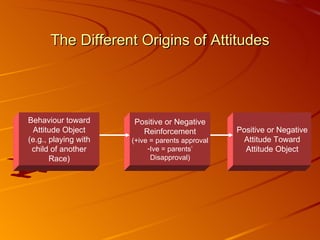
The Different Origins of Attitudes Behaviour toward Attitude Object (e.g., playing with child of another Race) Positive or Negative Reinforcement (+ive = parents approval Ive = parents’ Disapproval) Positive or Negative Attitude Toward Attitude Object
Attitudes And Beliefs Attitudes are different from beliefs:  Attitudes are defined as a tendency to respond in a particular way whereas, beliefs are concerned with what is known about the world; they centres around on what “is” in reality.
Finally!!! “ The greatest discovery of my generation is that a human being can alter his life by changing his attitude”.    William James… And so it is with you – you are in charge of your attitude.
Bibliography www. attitude iseverything.com/  www. attitude .org.nz/  en.wikipedia.org/wiki/ Attitude _(psychology)  ibs.derby.ac.uk/~lovemore/social/Lecture3_ Attitude s.ppt

Attitudes

  • 1.
  • 2.
  • 3.
    Introduction Attitude constitutean important psychological attribute of individuals which shape their behaviour. Attitude is defined as the way a person feels about something- a person, a place, a commodity, a situation or an idea. Attitude expresses an individual’s positive or negative feelings about some object. Attitude describes an individual’s feelings, thoughts and predisposition to act towards some object in the environment.
  • 4.
    Nature Of Attitude Attitudes refer to feelings and beliefs of individuals or groups of individuals. Attitudes tend to result in behaviour or action. All people, irrespective of their status or intelligence, hold attitudes.
  • 5.
    Factors To DetermineAttitude Experience Education Environment Triple E’s of Attitude
  • 6.
    Components Of AttitudeCognitive or Informational Component Affective or Emotional Component Behavioural Component
  • 7.
    Three Types ofPeople, Three Types of Attitudes we focus on three broad categories of people and their attitudes : Positive Negative Neutral
  • 8.
    The “Players” withPositive Attitudes The following list describes some of the thoughts of a “player” with a positive attitude: There is something good in every situation. A problem is an opportunity to do something different. Change is a sign of growth. A mistake is a valuable step toward success. I have control over my life.
  • 9.
    Contd… The followinglist describes some of the feelings of a “player” with a positive attitude: Happy Confident Satisfied Optimistic Loving
  • 10.
    The “Critics” withNegative Attitudes The following list describes some of the thoughts of a “critic” with a negative attitude: There is always something wrong. Other people cause problems. Change is a thorn in my side. A mistake is a failure. I have little or no control over my life.
  • 11.
    Contd… The followinglist describes some of the feelings of a “critic” with a negative attitude: Anger Doubt Frustration Pessimism Hate
  • 12.
    The “Spectators” withNeutral Attitudes The following list describes some of the thoughts of a “spectator” with a neutral attitude: The situation or the other person is unimportant. Someone else will solve the problem. Change is unnecessary. The future will come and go with or without me. I won’t even try to control my life.
  • 13.
    Contd… The followinglist describes some of the feelings of a “spectator” with a neutral attitude: Unemotional Tired Indifferent Detached
  • 14.
    Functions Of AttitudeValue-Expressive Function: Enable us to express who we are and what we believe in. Knowledge Function: Enable us to know the world. Utilitarian Function: Enable us to gain rewards and avoid punishment.
  • 15.
    Sources Of AttitudeAcquired from parents, teachers, and friends. There are “genetic” predispositions. Observations, attitudes that we imitate. Attitudes are less stable than values
  • 16.
    Three Principles OfAttitude General attitudes best predict general behaviors. Specific attitudes best predict specific behaviors. The less time that elapses between attitude measurement and behavior, the more consistent will be the relationship between them.
  • 17.
    The Different Originsof Attitudes Behaviour toward Attitude Object (e.g., playing with child of another Race) Positive or Negative Reinforcement (+ive = parents approval Ive = parents’ Disapproval) Positive or Negative Attitude Toward Attitude Object
  • 18.
    Attitudes And BeliefsAttitudes are different from beliefs: Attitudes are defined as a tendency to respond in a particular way whereas, beliefs are concerned with what is known about the world; they centres around on what “is” in reality.
  • 19.
    Finally!!! “ Thegreatest discovery of my generation is that a human being can alter his life by changing his attitude”. William James… And so it is with you – you are in charge of your attitude.
  • 20.
    Bibliography www. attitudeiseverything.com/ www. attitude .org.nz/ en.wikipedia.org/wiki/ Attitude _(psychology) ibs.derby.ac.uk/~lovemore/social/Lecture3_ Attitude s.ppt