PERCEPTION AND PERSONALITY IN ORGANIZATIONS .
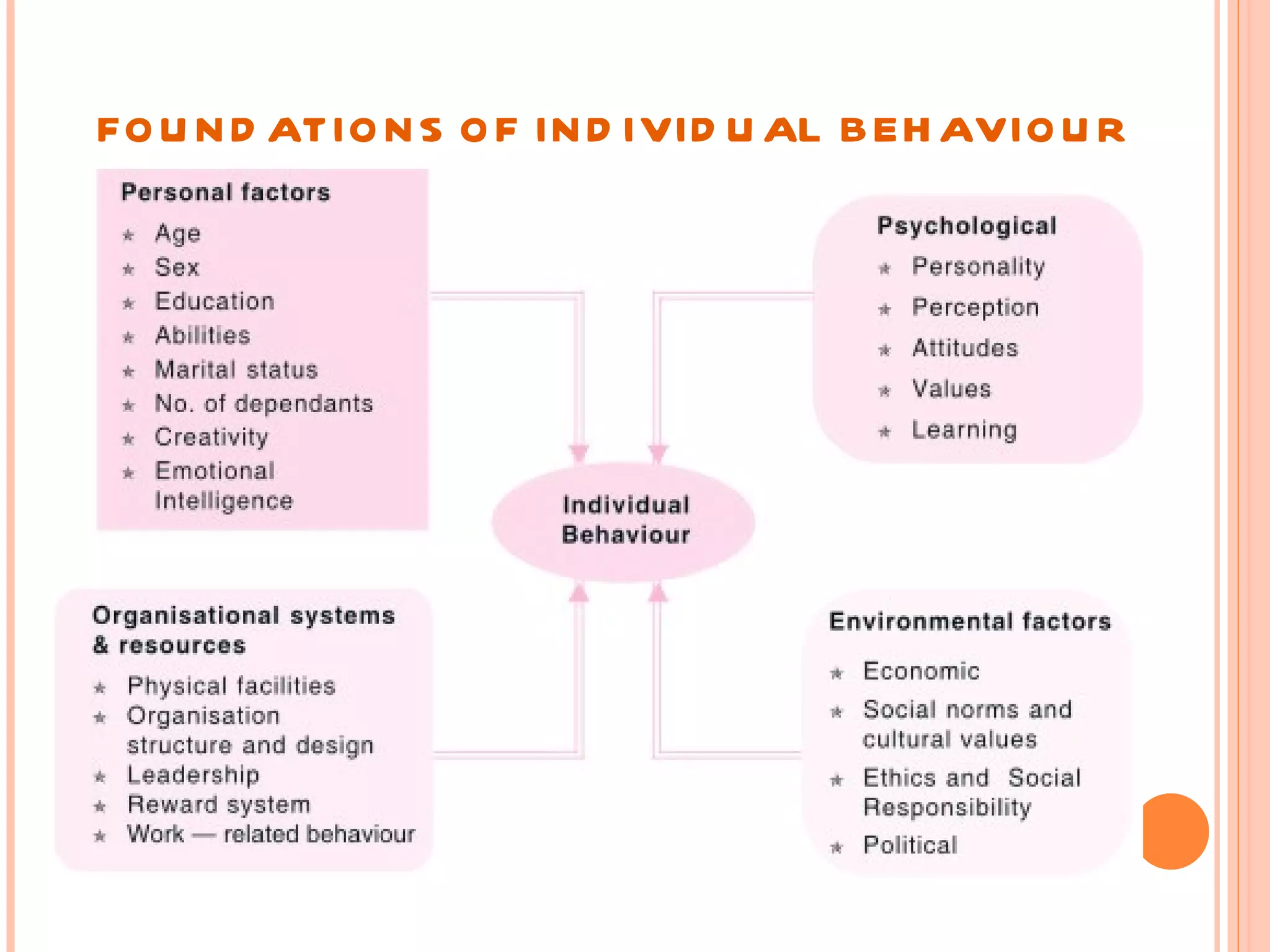
FOUNDATIONS OF INDIVIDUAL BEHAVIOUR
“  WE  DON’T  SEE  THINGS  AS  THEY  ARE,  WE  SEE  THINGS  AS WE  ARE.”
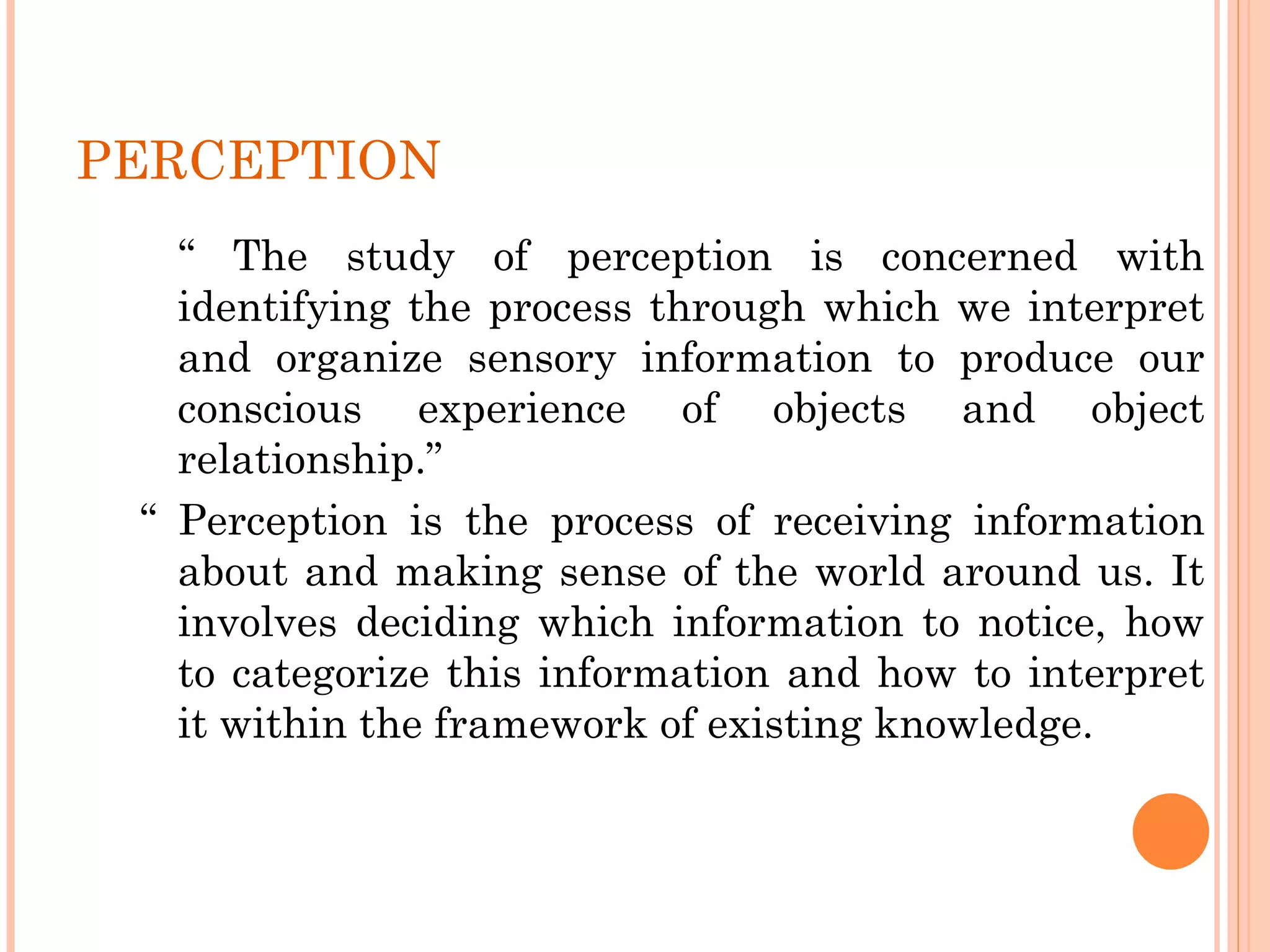
PERCEPTION “  The study of perception is concerned with identifying the process through which we interpret and organize sensory information to produce our conscious experience of objects and object relationship.” “  Perception is the process of receiving information about and making sense of the world around us. It involves deciding which information to notice, how to categorize this information and how to interpret it within the framework of existing knowledge.
PERCEPTION “  A process by which individuals organize and interpret their sensory impressions in order to give meaning to their environment ”.
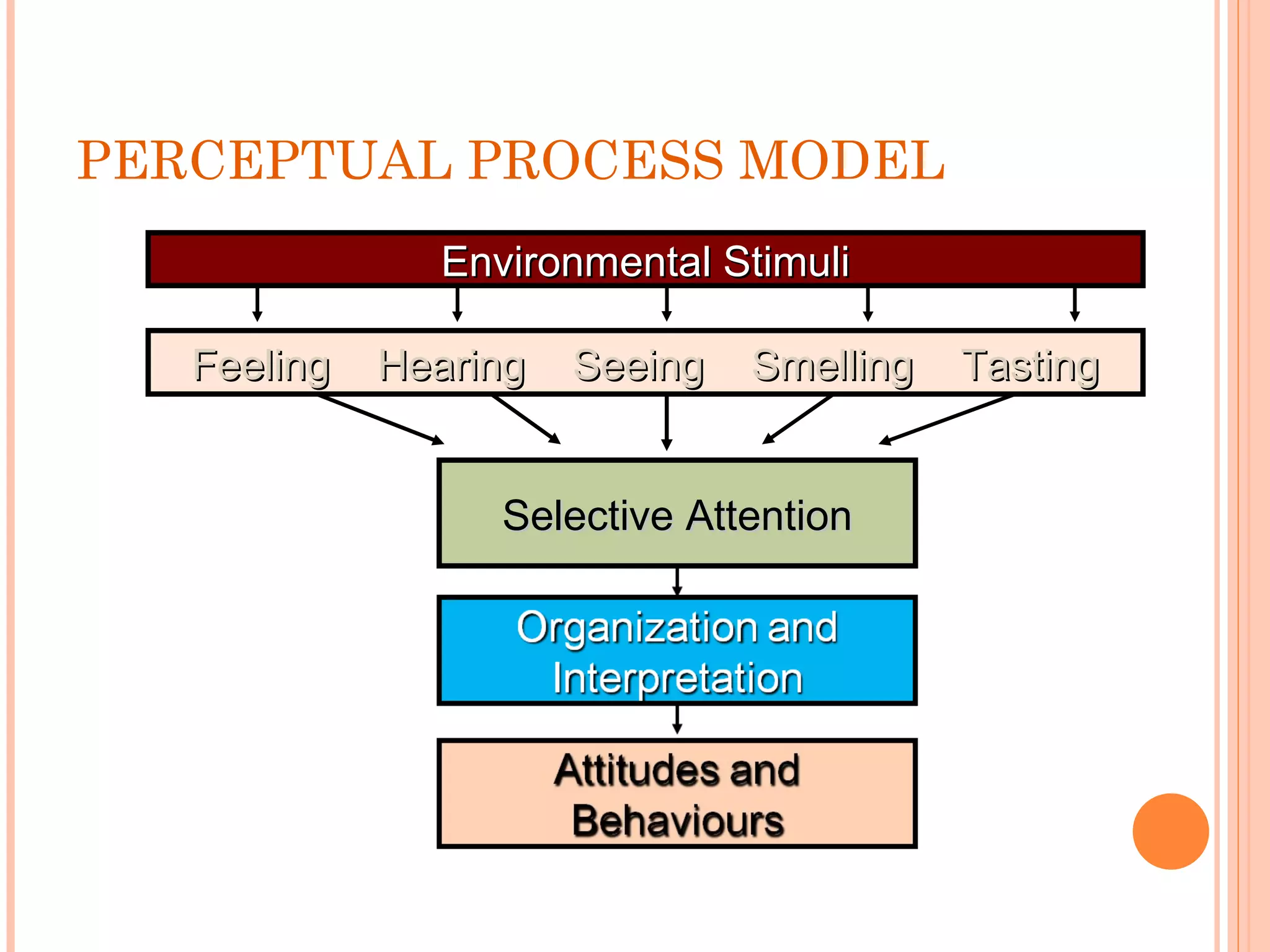
PERCEPTUAL PROCESS MODEL Environmental Stimuli Selective Attention Feeling  Hearing  Seeing  Smelling  Tasting
THE PERCEPTUAL PROCESS Sensation An individual’s ability to detect stimuli in the immediate environment. Selection The process a person uses to eliminate some of the stimuli that have been sensed and to retain others for further processing. Organization The process of placing selected perceptual stimuli into a framework for “storage.” Interpretation The stage of the perceptual process at which stimuli are interpreted and given meaning.
SELECTIVE ATTENTION Characteristics of the object size, intensity, motion, repetition, novelty Perceptual context Characteristics of the perceiver attitudes perceptual defense expectations -- condition us to expect events
Factors in the perceiver Attitudes Motives Interests Experience Expectations Perception Factors in the Target Motion Novelty Sounds Size Background Proximity Similarity  Factors in the situation Time Work Setting Social Setting
FIGURE-GROUND ILLUSTRATION Field-ground differentiation The tendency to distinguish  and focus on a stimulus that  is classified as figure as  opposed to background.
 
 
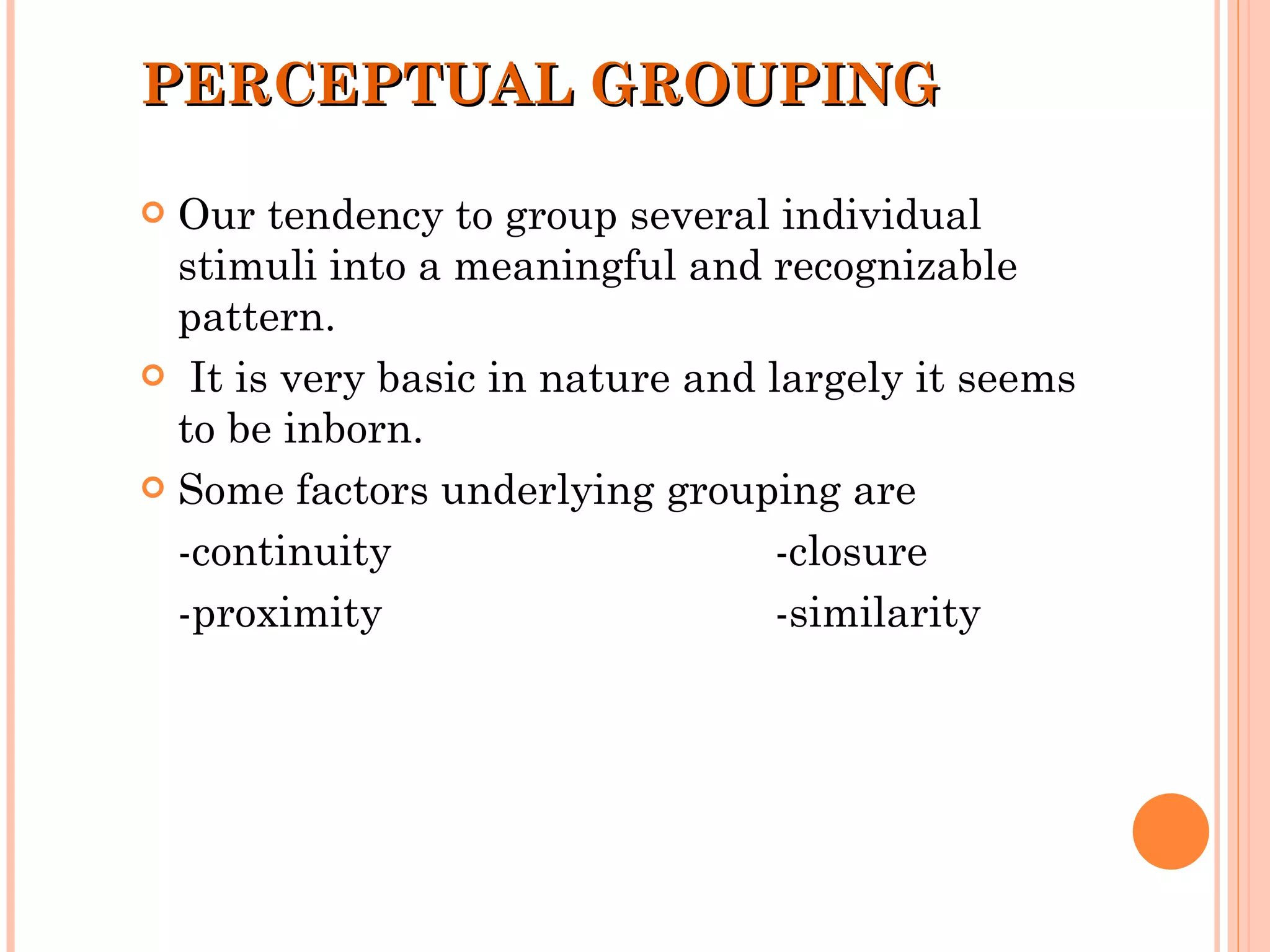
PERCEPTUAL GROUPING Our tendency to group several individual stimuli into a meaningful and recognizable pattern. It is very basic in nature and largely it seems to be inborn. Some factors underlying grouping are -continuity  -closure -proximity -similarity


ATTRIBUTION THEORY IS THE CAUSE OF THE BEHAVIOR SEEN AS INTERNAL OR EXTERNAL?  WE LOOK FOR THREE TYPES OF INFORMATION TO DECIDE: DISTINCTIVENESS :  Is this person’s performance different    on other tasks and in other situations? CONSISTENCY :  Over time, is there a change in behavior or    results on this  task by this person? CONSENSUS :  Do others perform or behave similarly when in    a similar position? “ YES”  answers lead to  EXTERNAL attributions  (Environmental causes) “ NO”  answers lead to  INTERNAL attributions  (Personal causes)
ATTRIBUTION THEORY When individuals observe behavior, they attempt to determine whether it is internally or externally caused. observation Attribution of cause Consistency Consensus Distictinctiveness Individual  behavior Internal External Internal External Internal External H L H L H L H –high  L- Low Interpretation
External Attribution Distinctiveness Does this person  behave in  this manner in other situation Yes High Consistency No Low Consistency No Low Consensus Yes High Consensus YES Low Distinctiveness NO High Distinctiveness Consensus Do other person  Behave in the  Same manner? Consistency Does this person  behave in this same manner at other times ? Internal  Attribution
PERCEPTUAL ERRORS & ATTRIBUTIONS STEREOTYPES :  Based on appearance HALO (HORN) EFFECTS :  One outstanding characteristic noted CONTRAST EFFECT :  Ordering RECENCY EFFECT :  Limited recall PROJECTION :  “Similar to me” Error SKEWING ERRORS :  Central tendency, leniency, strictness bias SELF-FULFILLING PROPHECY :  People respond the way you “expected” they would SELECTIVE PERCEPTION (MIND SETS) :  Filtering, selection,
ATTRIBUTION ERRORS THE FUNDAMENTAL ATTRIBUTION ERROR the cause of poor performance ( by others ) is due to personal factors  (lazy…didn’t try very hard) SELF-SERVING BIAS the cause of poor performance ( by myself ) is due to situational factors  (poor support), not because of a lack of effort
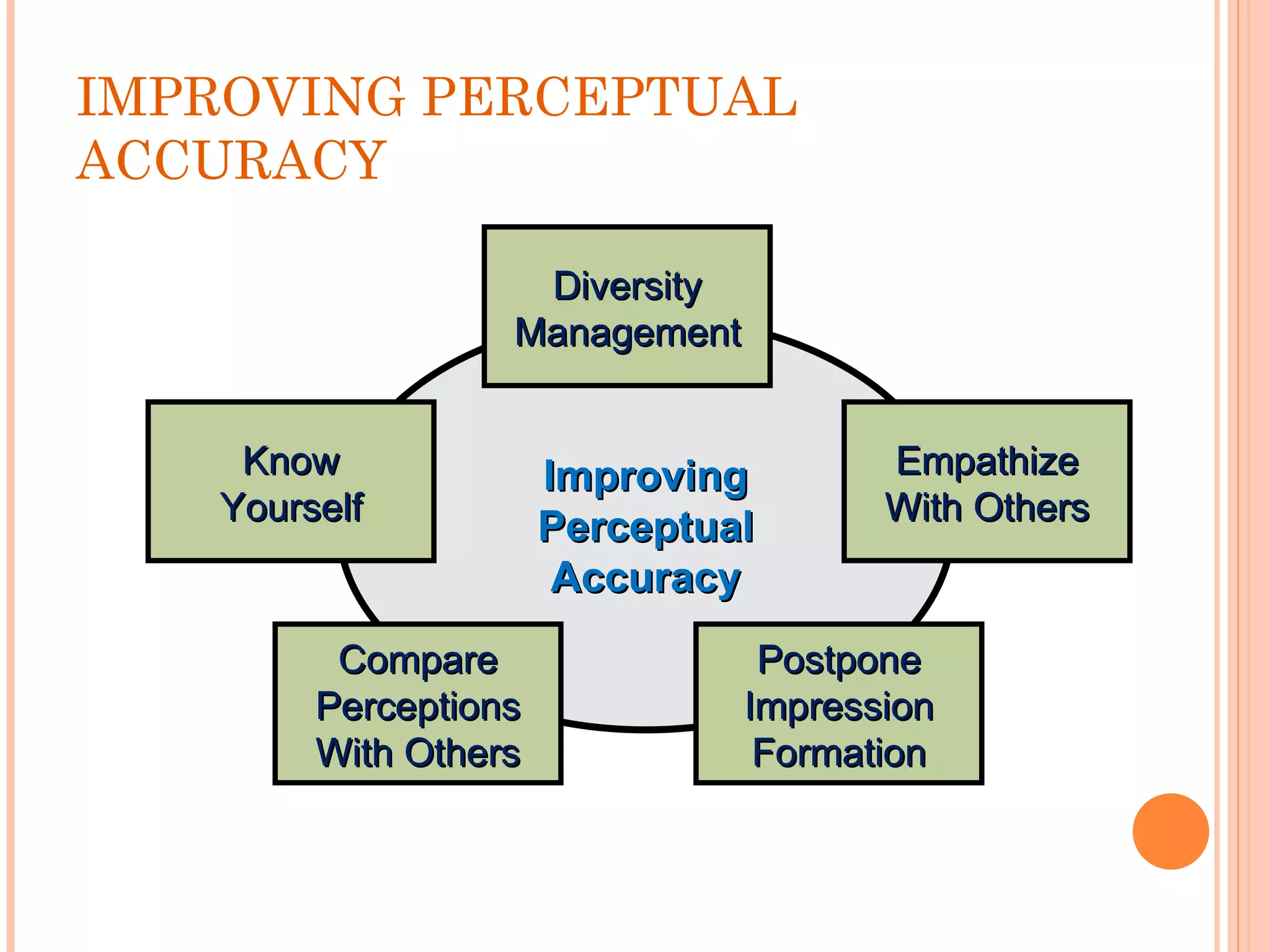
IMPROVING PERCEPTUAL ACCURACY Improving Perceptual Accuracy Diversity Management Empathize With Others Postpone Impression Formation Know Yourself Compare Perceptions With Others
KNOW YOURSELF (JOHARI WINDOW) Known to Self Unknown to Self Known to Others Unknown to Others Open Area Blind Area Unknown Area Hidden Area Open Area Blind Area Hidden Area Unknown Area Disclosure Feedback
DEFINING PERSONALITY Relatively stable pattern of behaviours and consistent internal states that explain a person's behavioural tendencies Sum total of ways in which an individual reacts and interacts with others and environment
DETERMINANTS OF PERSONALITY
BIG FIVE PERSONALITY DIMENSIONS Outgoing, talkative Courteous, empathic Caring, dependable Poised, secure Sensitive, flexible Extraversion Agreeableness
MYERS-BRIGGS TYPE INDICATOR Extroversion versus introversion Sensing versus intuition  Thinking versus feeling  Judging versus perceiving  Courtesy of Thompson Doyle Hennessey & Everest
 
 
LOCUS OF CONTROL AND SELF-MONITORING Locus of control Internals believe in their effort and ability Externals believe events are mainly due to external causes Self-monitoring personality Sensitivity to situational cues, and ability to adapt your behaviour to that situation
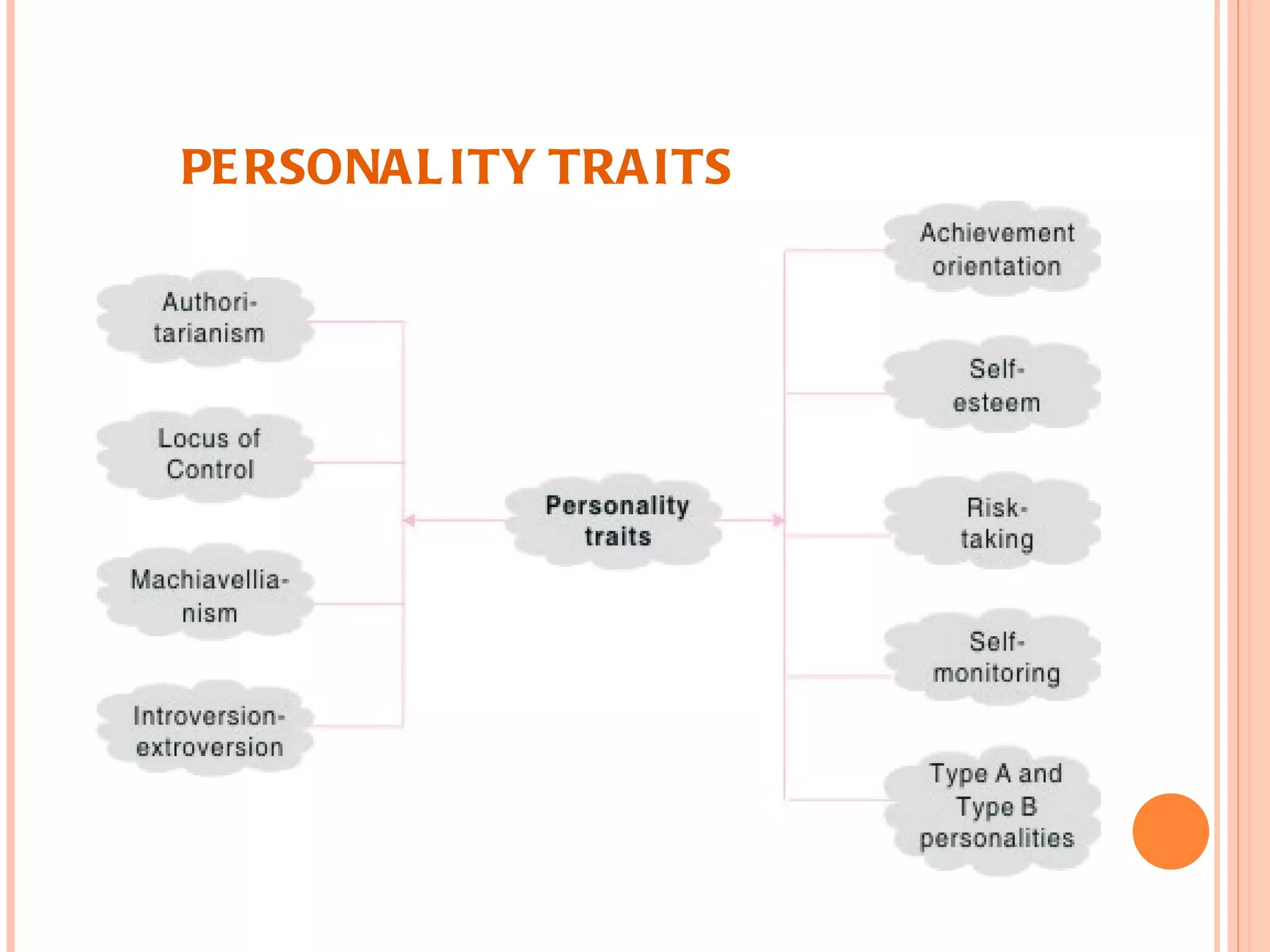
PERSONALITY TRAITS

Perception & personality

  • 1.
    PERCEPTION AND PERSONALITYIN ORGANIZATIONS .
  • 2.
  • 3.
    “ WE DON’T SEE THINGS AS THEY ARE, WE SEE THINGS AS WE ARE.”
  • 4.
    PERCEPTION “ The study of perception is concerned with identifying the process through which we interpret and organize sensory information to produce our conscious experience of objects and object relationship.” “ Perception is the process of receiving information about and making sense of the world around us. It involves deciding which information to notice, how to categorize this information and how to interpret it within the framework of existing knowledge.
  • 5.
    PERCEPTION “ A process by which individuals organize and interpret their sensory impressions in order to give meaning to their environment ”.
  • 6.
    PERCEPTUAL PROCESS MODELEnvironmental Stimuli Selective Attention Feeling Hearing Seeing Smelling Tasting
  • 7.
    THE PERCEPTUAL PROCESSSensation An individual’s ability to detect stimuli in the immediate environment. Selection The process a person uses to eliminate some of the stimuli that have been sensed and to retain others for further processing. Organization The process of placing selected perceptual stimuli into a framework for “storage.” Interpretation The stage of the perceptual process at which stimuli are interpreted and given meaning.
  • 8.
    SELECTIVE ATTENTION Characteristicsof the object size, intensity, motion, repetition, novelty Perceptual context Characteristics of the perceiver attitudes perceptual defense expectations -- condition us to expect events
  • 9.
    Factors in theperceiver Attitudes Motives Interests Experience Expectations Perception Factors in the Target Motion Novelty Sounds Size Background Proximity Similarity Factors in the situation Time Work Setting Social Setting
  • 10.
    FIGURE-GROUND ILLUSTRATION Field-grounddifferentiation The tendency to distinguish and focus on a stimulus that is classified as figure as opposed to background.
  • 11.
  • 12.
  • 13.
    PERCEPTUAL GROUPING Ourtendency to group several individual stimuli into a meaningful and recognizable pattern. It is very basic in nature and largely it seems to be inborn. Some factors underlying grouping are -continuity -closure -proximity -similarity
  • 14.
  • 15.
  • 16.
  • 17.
  • 18.
    ATTRIBUTION THEORY ISTHE CAUSE OF THE BEHAVIOR SEEN AS INTERNAL OR EXTERNAL? WE LOOK FOR THREE TYPES OF INFORMATION TO DECIDE: DISTINCTIVENESS : Is this person’s performance different on other tasks and in other situations? CONSISTENCY : Over time, is there a change in behavior or results on this task by this person? CONSENSUS : Do others perform or behave similarly when in a similar position? “ YES” answers lead to EXTERNAL attributions (Environmental causes) “ NO” answers lead to INTERNAL attributions (Personal causes)
  • 19.
    ATTRIBUTION THEORY Whenindividuals observe behavior, they attempt to determine whether it is internally or externally caused. observation Attribution of cause Consistency Consensus Distictinctiveness Individual behavior Internal External Internal External Internal External H L H L H L H –high L- Low Interpretation
  • 20.
    External Attribution DistinctivenessDoes this person behave in this manner in other situation Yes High Consistency No Low Consistency No Low Consensus Yes High Consensus YES Low Distinctiveness NO High Distinctiveness Consensus Do other person Behave in the Same manner? Consistency Does this person behave in this same manner at other times ? Internal Attribution
  • 21.
    PERCEPTUAL ERRORS &ATTRIBUTIONS STEREOTYPES : Based on appearance HALO (HORN) EFFECTS : One outstanding characteristic noted CONTRAST EFFECT : Ordering RECENCY EFFECT : Limited recall PROJECTION : “Similar to me” Error SKEWING ERRORS : Central tendency, leniency, strictness bias SELF-FULFILLING PROPHECY : People respond the way you “expected” they would SELECTIVE PERCEPTION (MIND SETS) : Filtering, selection,
  • 22.
    ATTRIBUTION ERRORS THEFUNDAMENTAL ATTRIBUTION ERROR the cause of poor performance ( by others ) is due to personal factors (lazy…didn’t try very hard) SELF-SERVING BIAS the cause of poor performance ( by myself ) is due to situational factors (poor support), not because of a lack of effort
  • 23.
    IMPROVING PERCEPTUAL ACCURACYImproving Perceptual Accuracy Diversity Management Empathize With Others Postpone Impression Formation Know Yourself Compare Perceptions With Others
  • 24.
    KNOW YOURSELF (JOHARIWINDOW) Known to Self Unknown to Self Known to Others Unknown to Others Open Area Blind Area Unknown Area Hidden Area Open Area Blind Area Hidden Area Unknown Area Disclosure Feedback
  • 25.
    DEFINING PERSONALITY Relativelystable pattern of behaviours and consistent internal states that explain a person's behavioural tendencies Sum total of ways in which an individual reacts and interacts with others and environment
  • 26.
  • 27.
    BIG FIVE PERSONALITYDIMENSIONS Outgoing, talkative Courteous, empathic Caring, dependable Poised, secure Sensitive, flexible Extraversion Agreeableness
  • 28.
    MYERS-BRIGGS TYPE INDICATORExtroversion versus introversion Sensing versus intuition Thinking versus feeling Judging versus perceiving Courtesy of Thompson Doyle Hennessey & Everest
  • 29.
  • 30.
  • 31.
    LOCUS OF CONTROLAND SELF-MONITORING Locus of control Internals believe in their effort and ability Externals believe events are mainly due to external causes Self-monitoring personality Sensitivity to situational cues, and ability to adapt your behaviour to that situation
  • 32.