Our Personality shapes our  behavior. To understand the behavior of someone in an organization ,it helps to know  something about his/her  personality. Values shapes  many of our work- related behavior. The word "personality" originates from the  Latin  persona , which means  mask.
personality Why  are  some people quite and passive ,while  others are loud and  aggressive ??? Are certain personality  types better adapted for certain job types..??? SO  LETS  DISCUSS  WHAT IS  PERSONALITY …????????
It  doesn`t mean that  a person  has  charm , a positive attitude  towards  life, a smiling  face, or is  a finalist  for “  Happiest  and  Friendliest “ in this  year`s  Miss  World  contest .  Personality  can be defined as a dynamic and organized set of characteristics possessed by a  person that uniquely influences his or her  cognitions  , motivations, and behaviors  in various situations .
According to  psycholosists  : Personality means a dynamic concept describing the growth and development of a person`s whole psychological system . Personality is the  dynamic organization within the individual of those  psychophysical systems that determine his unique  adjustments  to his  environment. According to gorden allport
For  our  purposes , You  should think of personality as the sum total of ways in which  an individual  reacts to and interacts with others.
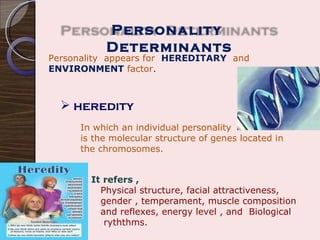
Personality  appears for  HEREDITARY   and  ENVIRONMENT   factor . heredity   It refers , Physical structure, facial attractiveness, gender , temperament, muscle composition and reflexes, energy level , and  Biological ryththms. In which an individual personality is the molecular structure of genes located in the chromosomes. Personality  Determinants
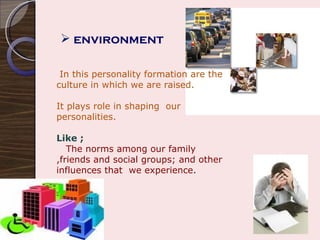
environment  In this personality formation are the culture in which we are raised. It plays role in shaping  our personalities. Like ; The norms among our family ,friends and social groups; and other influences that  we experience .
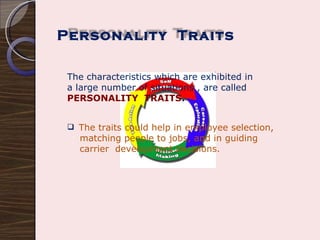
The characteristics which are exhibited in a large number of situations , are called  PERSONALITY  TRAITS . The traits could help in employee selection,  matching people to jobs, and in guiding  carrier  development decisions.  Personality  Traits
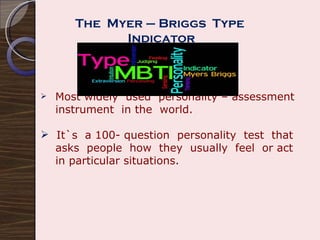
The  Myer – Briggs  Type  Indicator Most widely  used  personality – assessment instrument  in the  world. It`s  a 100- question  personality  test  that  asks  people  how  they  usually  feel  or act in particular situations .
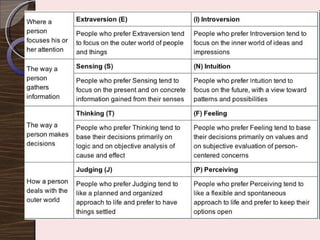
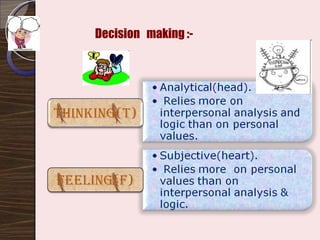
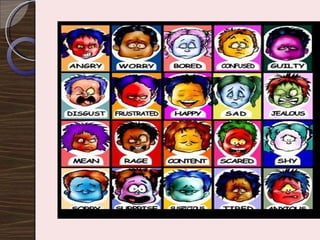
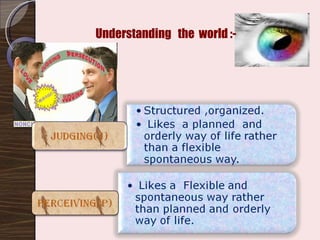
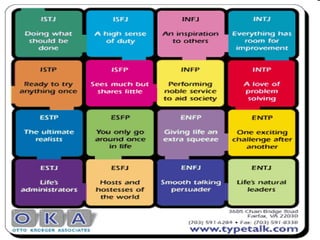
On the basis  of  The answers  individual give  to  the  test and Classified  as  following  4   aspects according  to their  characteristic : Source  Of  Energy Collecting  Information Decision  Making Understanding  The world. This  is  known  as  MBTI  Framework
 
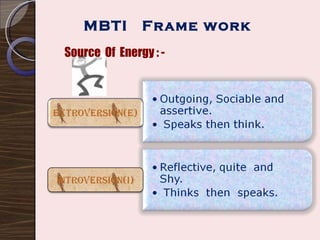
MBTI  Frame work Source  Of  Energy : -
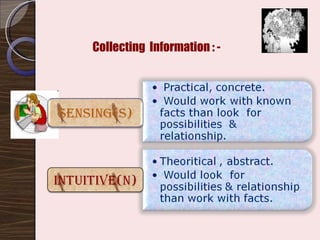
Collecting  Information : -
 
Decision  making :-
 
Understanding  the  world :-
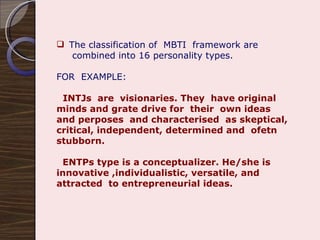
The classification of  MBTI  framework are combined into 16 personality types. FOR  EXAMPLE: INTJs  are  visionaries. They  have original minds and grate drive for  their  own ideas and perposes  and characterised  as skeptical, critical, independent, determined and  ofetn stubborn. ENTPs type is a conceptualizer. He/she is innovative ,individualistic, versatile, and attracted  to entrepreneurial ideas.
 
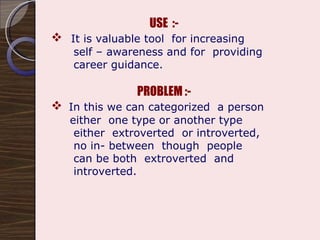
USE  :- It is valuable tool  for increasing  self – awareness and for  providing  career guidance. PROBLEM :- In this we can categorized  a person  either  one type or another type  either  extroverted  or introverted, no in- between  though  people can be both  extroverted  and  introverted.
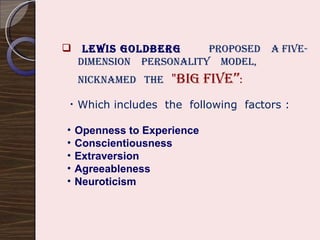
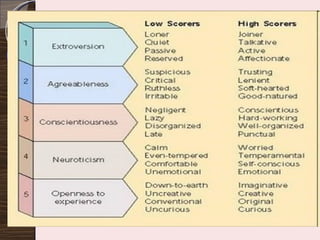
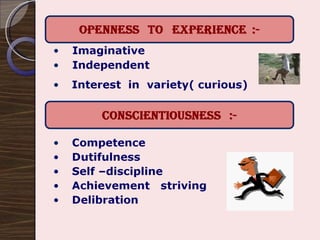
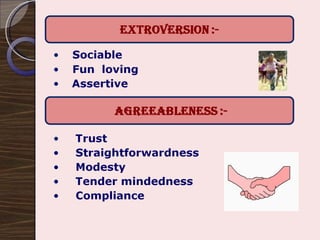
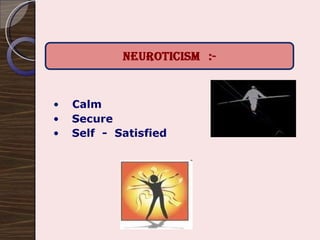
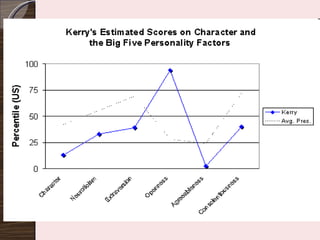
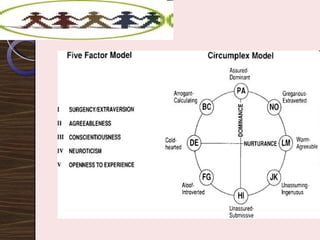
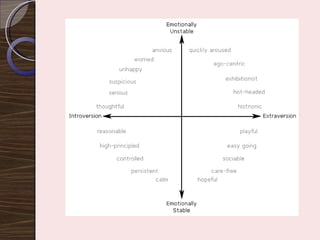
Lewis Goldberg  proposed  a five-  dimension  personality  model, nicknamed  the  "Big Five ” : Which includes  the  following  factors : Openness to Experience   Conscientiousness Extraversion Agreeableness Neuroticism


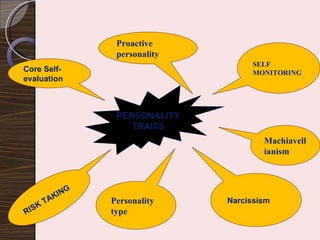
Core Self-evaluation RISK TAKING SELF MONITORING Narcissism Proactive personality Personality type Machiavellianism PERSONALITY TRAITS
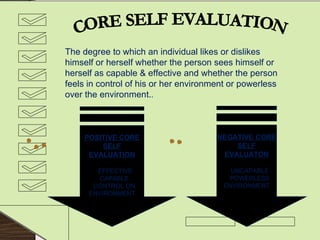
The degree to which an individual likes or dislikes himself or herself whether the person sees himself or herself as capable & effective and whether the person feels in control of his or her environment or powerless over the environment. .  CORE SELF EVALUATION POSITIVE CORE SELF EVALUATION EFFECTIVE CAPABLE  CONTROL ON  ENVIRONMENT NEGATIVE CORE SELF EVALUATON UNCAPABLE POWERLESS ENVIRONMENT
Machiavellianism Machiavellianism (Mach) Degree to which an individual is pragmatic, maintains emotional distance, and believes that ends can justify means. Conditions Favoring High Machs Direct interaction with others Minimal rules and regulations Emotions distract for others
A Narcissistic Person  Has grandiose sense of self-importance Requires excessive admiration Has a sense of entitlement Is arrogant Tends to be rated as less effective NARCISSISM
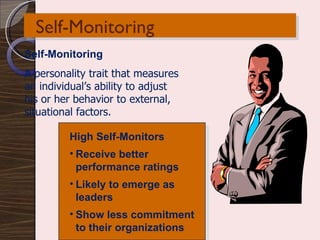
Self-Monitoring Self-Monitoring A personality trait that measures an individual’s ability to adjust his or her behavior to external, situational factors.  High Self-Monitors Receive better performance ratings Likely to emerge as leaders Show less commitment to their organizations
High Risk-taking Managers Make quicker decisions Use less information to make decisions Operate in smaller and more entrepreneurial organizations Low Risk-taking Managers Are slower to make decisions Require more information before making decisions Exist in larger organizations with stable environments RISK TAKING
always moving, walking, and eating rapidly; feel impatient with the rate at which most events take place; strive to think or do two or more things at once; cannot cope with leisure time; are obsessed with numbers, measuring their success in terms of how many or how much of everything they acquire. Type A’s personality
never suffer from a sense of time urgency with its accompanying impatience; feel no need to display or discuss either their achievements or accomplishments; play for fun and relaxation, rather than to exhibit their superiority at any cost; can relax without guilt. TYPE B’s PERSONALITY
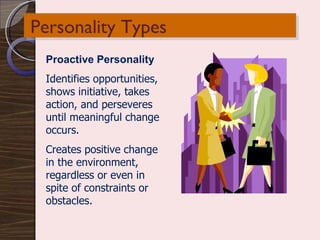
Personality Types Proactive Personality Identifies opportunities, shows initiative, takes action, and perseveres until meaningful change occurs.  Creates positive change in the environment, regardless or even in spite of constraints or obstacles.
Definition of value. Values represent basic convictions that a specific mode of conduct is socially or personally preferable to an opposite mode of conduct. What is value? Values’ are one of the major forces  which shape the behavior of individuals.
Values… Induce a person to do or not to do something. Value contain a judgmental element in that they carry an individuals idea As to what is right ,good or desirable. What is ethical and what is unethical.
IMPORTANCE  OF  VALUES Part of culture. Value lay the foundation for our understanding of people’s attitudes and motivation because they influence our perception.  Learned responses. Social phenomenon. Adaptive process.
Rokeach Value survey Terminal values This values are the goals of person would like to achieve during his or her  lifetime. like A comfortable life, Family security, Self respect, Freedom, Happiness… Instrumental values It refers to means of achieving the  Terminal values. like Capable, Courageous, Helpful, Honest, Responsible….
Personality and values to the workplace Importance of both Personality and values. Employee’s performance and satisfaction are likely to be higher if their values fit well with the organization.
 

Personality & values

  • 1.
  • 2.
    Our Personality shapesour behavior. To understand the behavior of someone in an organization ,it helps to know something about his/her personality. Values shapes many of our work- related behavior. The word "personality" originates from the Latin persona , which means mask.
  • 3.
    personality Why are some people quite and passive ,while others are loud and aggressive ??? Are certain personality types better adapted for certain job types..??? SO LETS DISCUSS WHAT IS PERSONALITY …????????
  • 4.
    It doesn`tmean that a person has charm , a positive attitude towards life, a smiling face, or is a finalist for “ Happiest and Friendliest “ in this year`s Miss World contest . Personality can be defined as a dynamic and organized set of characteristics possessed by a person that uniquely influences his or her cognitions , motivations, and behaviors in various situations .
  • 5.
    According to psycholosists : Personality means a dynamic concept describing the growth and development of a person`s whole psychological system . Personality is the dynamic organization within the individual of those psychophysical systems that determine his unique adjustments to his environment. According to gorden allport
  • 6.
    For our purposes , You should think of personality as the sum total of ways in which an individual reacts to and interacts with others.
  • 7.
    Personality appearsfor HEREDITARY and ENVIRONMENT factor . heredity It refers , Physical structure, facial attractiveness, gender , temperament, muscle composition and reflexes, energy level , and Biological ryththms. In which an individual personality is the molecular structure of genes located in the chromosomes. Personality Determinants
  • 8.
    environment Inthis personality formation are the culture in which we are raised. It plays role in shaping our personalities. Like ; The norms among our family ,friends and social groups; and other influences that we experience .
  • 9.
    The characteristics whichare exhibited in a large number of situations , are called PERSONALITY TRAITS . The traits could help in employee selection, matching people to jobs, and in guiding carrier development decisions. Personality Traits
  • 10.
    The Myer– Briggs Type Indicator Most widely used personality – assessment instrument in the world. It`s a 100- question personality test that asks people how they usually feel or act in particular situations .
  • 11.
    On the basis of The answers individual give to the test and Classified as following 4 aspects according to their characteristic : Source Of Energy Collecting Information Decision Making Understanding The world. This is known as MBTI Framework
  • 12.
  • 13.
    MBTI Framework Source Of Energy : -
  • 14.
  • 15.
  • 16.
  • 17.
  • 18.
  • 19.
    The classification of MBTI framework are combined into 16 personality types. FOR EXAMPLE: INTJs are visionaries. They have original minds and grate drive for their own ideas and perposes and characterised as skeptical, critical, independent, determined and ofetn stubborn. ENTPs type is a conceptualizer. He/she is innovative ,individualistic, versatile, and attracted to entrepreneurial ideas.
  • 20.
  • 21.
    USE :-It is valuable tool for increasing self – awareness and for providing career guidance. PROBLEM :- In this we can categorized a person either one type or another type either extroverted or introverted, no in- between though people can be both extroverted and introverted.
  • 22.
    Lewis Goldberg proposed a five- dimension personality model, nicknamed the "Big Five ” : Which includes the following factors : Openness to Experience Conscientiousness Extraversion Agreeableness Neuroticism
  • 23.
  • 24.
  • 25.
  • 26.
  • 27.
  • 28.
  • 29.
  • 30.
    Core Self-evaluation RISKTAKING SELF MONITORING Narcissism Proactive personality Personality type Machiavellianism PERSONALITY TRAITS
  • 31.
    The degree towhich an individual likes or dislikes himself or herself whether the person sees himself or herself as capable & effective and whether the person feels in control of his or her environment or powerless over the environment. . CORE SELF EVALUATION POSITIVE CORE SELF EVALUATION EFFECTIVE CAPABLE CONTROL ON ENVIRONMENT NEGATIVE CORE SELF EVALUATON UNCAPABLE POWERLESS ENVIRONMENT
  • 32.
    Machiavellianism Machiavellianism (Mach)Degree to which an individual is pragmatic, maintains emotional distance, and believes that ends can justify means. Conditions Favoring High Machs Direct interaction with others Minimal rules and regulations Emotions distract for others
  • 33.
    A Narcissistic Person Has grandiose sense of self-importance Requires excessive admiration Has a sense of entitlement Is arrogant Tends to be rated as less effective NARCISSISM
  • 34.
    Self-Monitoring Self-Monitoring Apersonality trait that measures an individual’s ability to adjust his or her behavior to external, situational factors. High Self-Monitors Receive better performance ratings Likely to emerge as leaders Show less commitment to their organizations
  • 35.
    High Risk-taking ManagersMake quicker decisions Use less information to make decisions Operate in smaller and more entrepreneurial organizations Low Risk-taking Managers Are slower to make decisions Require more information before making decisions Exist in larger organizations with stable environments RISK TAKING
  • 36.
    always moving, walking,and eating rapidly; feel impatient with the rate at which most events take place; strive to think or do two or more things at once; cannot cope with leisure time; are obsessed with numbers, measuring their success in terms of how many or how much of everything they acquire. Type A’s personality
  • 37.
    never suffer froma sense of time urgency with its accompanying impatience; feel no need to display or discuss either their achievements or accomplishments; play for fun and relaxation, rather than to exhibit their superiority at any cost; can relax without guilt. TYPE B’s PERSONALITY
  • 38.
    Personality Types ProactivePersonality Identifies opportunities, shows initiative, takes action, and perseveres until meaningful change occurs. Creates positive change in the environment, regardless or even in spite of constraints or obstacles.
  • 39.
    Definition of value.Values represent basic convictions that a specific mode of conduct is socially or personally preferable to an opposite mode of conduct. What is value? Values’ are one of the major forces which shape the behavior of individuals.
  • 40.
    Values… Induce aperson to do or not to do something. Value contain a judgmental element in that they carry an individuals idea As to what is right ,good or desirable. What is ethical and what is unethical.
  • 41.
    IMPORTANCE OF VALUES Part of culture. Value lay the foundation for our understanding of people’s attitudes and motivation because they influence our perception. Learned responses. Social phenomenon. Adaptive process.
  • 42.
    Rokeach Value surveyTerminal values This values are the goals of person would like to achieve during his or her lifetime. like A comfortable life, Family security, Self respect, Freedom, Happiness… Instrumental values It refers to means of achieving the Terminal values. like Capable, Courageous, Helpful, Honest, Responsible….
  • 43.
    Personality and valuesto the workplace Importance of both Personality and values. Employee’s performance and satisfaction are likely to be higher if their values fit well with the organization.
  • 44.