Management, Eleventh Edition by Stephen P. Robbins & Mary Coulter ©2012 Pearson Education, Inc. publishing as Prentice Hall 2-1
Management, Eleventh Edition by Stephen P. Robbins & Mary Coulter ©2012 Pearson Education, Inc. publishing as Prentice Hall
2-2
• Contrast the actions of managers according to the
omnipotent and symbolic views
• Describe the constraints and challenges facing managers in
today’s external environment
• Discuss the characteristics and importance of organizational
culture
• Describe current issues in organizational culture
Management, Eleventh Edition by Stephen P. Robbins & Mary Coulter ©2012 Pearson Education, Inc. publishing as Prentice Hall
2-3
The Manager:
Omnipotent or Symbolic?
• Omnipotent View of Management - the view
that managers are directly responsible for an
organization’s success or failure.
• Symbolic view of Management - the view
that much of an organization’s success or
failure is due to external forces outside
managers’ control.
Management, Eleventh Edition by Stephen P. Robbins & Mary Coulter ©2012 Pearson Education, Inc. publishing as Prentice Hall
2-4
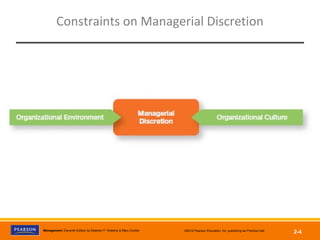
Constraints on Managerial Discretion
Management, Eleventh Edition by Stephen P. Robbins & Mary Coulter ©2012 Pearson Education, Inc. publishing as Prentice Hall
2-5
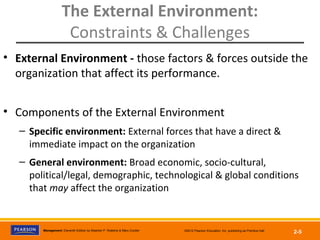
The External Environment:
Constraints & Challenges
• External Environment - those factors & forces outside the
organization that affect its performance.
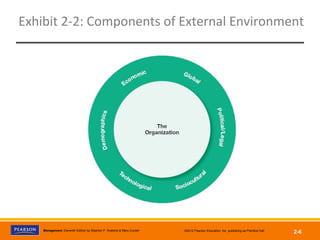
• Components of the External Environment
– Specific environment: External forces that have a direct &
immediate impact on the organization
– General environment: Broad economic, socio-cultural,
political/legal, demographic, technological & global conditions
that may affect the organization
Management, Eleventh Edition by Stephen P. Robbins & Mary Coulter ©2012 Pearson Education, Inc. publishing as Prentice Hall
2-6
Exhibit 2-2: Components of External Environment
Management, Eleventh Edition by Stephen P. Robbins & Mary Coulter ©2012 Pearson Education, Inc. publishing as Prentice Hall
2-7
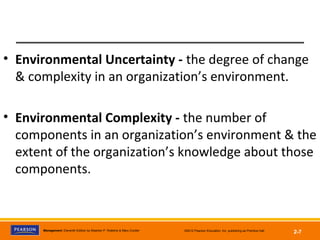
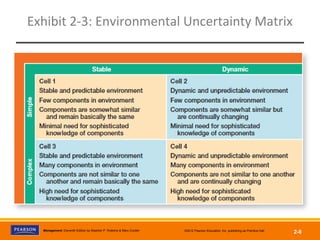
• Environmental Uncertainty - the degree of change
& complexity in an organization’s environment.
• Environmental Complexity - the number of
components in an organization’s environment & the
extent of the organization’s knowledge about those
components.
Management, Eleventh Edition by Stephen P. Robbins & Mary Coulter ©2012 Pearson Education, Inc. publishing as Prentice Hall
2-8
Exhibit 2-3: Environmental Uncertainty Matrix
Management, Eleventh Edition by Stephen P. Robbins & Mary Coulter ©2012 Pearson Education, Inc. publishing as Prentice Hall
2-9
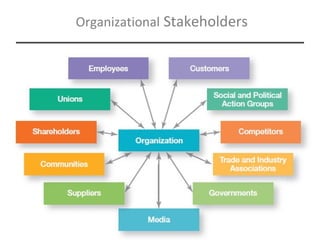
Who Are Stakeholders?
• Stakeholders - any constituencies in the
organization’s environment that are affected by an
organization’s decisions & actions.
Management, Eleventh Edition by Stephen P. Robbins & Mary Coulter ©2012 Pearson Education, Inc. publishing as Prentice Hall
2-10
Organizational Stakeholders
Management, Eleventh Edition by Stephen P. Robbins & Mary Coulter ©2012 Pearson Education, Inc. publishing as Prentice Hall
2-11
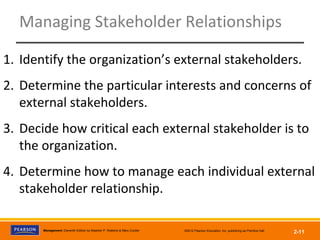
Managing Stakeholder Relationships
1. Identify the organization’s external stakeholders.
2. Determine the particular interests and concerns of
external stakeholders.
3. Decide how critical each external stakeholder is to
the organization.
4. Determine how to manage each individual external
stakeholder relationship.
Management, Eleventh Edition by Stephen P. Robbins & Mary Coulter ©2012 Pearson Education, Inc. publishing as Prentice Hall
2-12
What Is Organizational Culture?
• Organizational Culture - The shared values,
principles, traditions, and ways of doing things that
influence the way organizational members act. In
most organizations, these shared values and practices
have evolved over time and determine to a large
extent, how “things are done around here.”
Management, Eleventh Edition by Stephen P. Robbins & Mary Coulter ©2012 Pearson Education, Inc. publishing as Prentice Hall
2-13
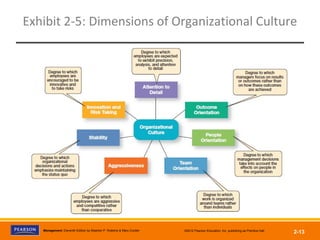
Exhibit 2-5: Dimensions of Organizational Culture
Management, Eleventh Edition by Stephen P. Robbins & Mary Coulter ©2012 Pearson Education, Inc. publishing as Prentice Hall
2-14
• Strong Cultures - Organizational cultures in
which key values are intensely held and widely
shared.
Management, Eleventh Edition by Stephen P. Robbins & Mary Coulter ©2012 Pearson Education, Inc. publishing as Prentice Hall
2-15
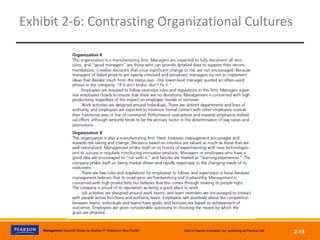
Exhibit 2-6: Contrasting Organizational Cultures
Management, Eleventh Edition by Stephen P. Robbins & Mary Coulter ©2012 Pearson Education, Inc. publishing as Prentice Hall
2-16
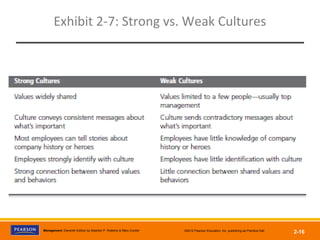
Exhibit 2-7: Strong vs. Weak Cultures
Management, Eleventh Edition by Stephen P. Robbins & Mary Coulter ©2012 Pearson Education, Inc. publishing as Prentice Hall 2-17
• Decision –
Making a choice from two or more alternatives.
2 -Copyright © 2016 by Pearson
Education, Inc.
Management, Eleventh Edition by Stephen P. Robbins & Mary Coulter ©2012 Pearson Education, Inc. publishing as Prentice Hall 2-18
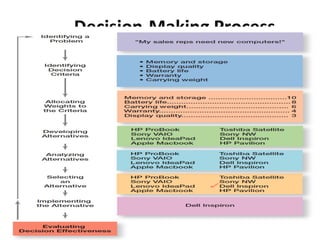
Decision-Making Process
2 -Copyright © 2016 by Pearson
Education, Inc.
Management, Eleventh Edition by Stephen P. Robbins & Mary Coulter ©2012 Pearson Education, Inc. publishing as Prentice Hall
2-19
The Decision-Making Process
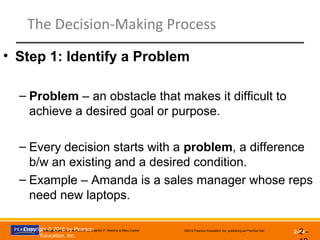
• Step 1: Identify a Problem
– Problem – an obstacle that makes it difficult to
achieve a desired goal or purpose.
– Every decision starts with a problem, a difference
b/w an existing and a desired condition.
– Example – Amanda is a sales manager whose reps
need new laptops.
2 -Copyright © 2016 by Pearson
Education, Inc.
Management, Eleventh Edition by Stephen P. Robbins & Mary Coulter ©2012 Pearson Education, Inc. publishing as Prentice Hall
2-20
The Decision-Making Process
• Step 2: Identify Decision Criteria
–Decision criteria are factors that are
important (relevant) to resolving the problem.
–E.G – Amanda decides that memory and
storage capabilities, display quality, battery
life, warranty, and carrying weight are the
relevant criteria in her decision.
2 -Copyright © 2016 by Pearson
Education, Inc.
Management, Eleventh Edition by Stephen P. Robbins & Mary Coulter ©2012 Pearson Education, Inc. publishing as Prentice Hall
2-21
The Decision-Making Process
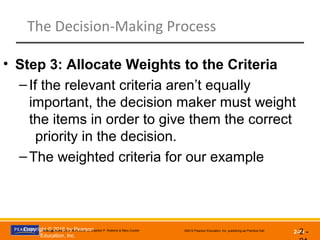
• Step 3: Allocate Weights to the Criteria
–If the relevant criteria aren’t equally
important, the decision maker must weight
the items in order to give them the correct
priority in the decision.
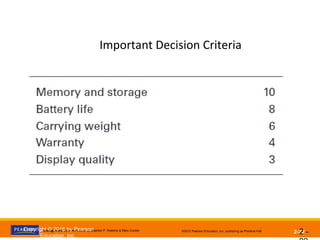
–The weighted criteria for our example
2 -Copyright © 2016 by Pearson
Education, Inc.
Management, Eleventh Edition by Stephen P. Robbins & Mary Coulter ©2012 Pearson Education, Inc. publishing as Prentice Hall 2-22
Important Decision Criteria
2 -Copyright © 2016 by Pearson
Education, Inc.
Management, Eleventh Edition by Stephen P. Robbins & Mary Coulter ©2012 Pearson Education, Inc. publishing as Prentice Hall
2-23
The Decision-Making Process
• Step 4: Develop Alternatives
–List viable alternatives that could resolve the
problem
–Example – Amanda, identifies eight laptops
as possible choices.
2-Copyright © 2016 by Pearson
Education, Inc.
Management, Eleventh Edition by Stephen P. Robbins & Mary Coulter ©2012 Pearson Education, Inc. publishing as Prentice Hall
2-24
Possible Alternatives
2 -Copyright © 2016 by Pearson
Education, Inc.
Management, Eleventh Edition by Stephen P. Robbins & Mary Coulter ©2012 Pearson Education, Inc. publishing as Prentice Hall
2-25
The Decision-Making Process
• Step 5: Analyze Alternatives
–Appraising each alternative’s strengths and
weaknesses.
–An alternative’s appraisal is based on its
ability to resolve the issues related to the
criteria & criteria weight.
2 -Copyright © 2016 by Pearson
Education, Inc.
Management, Eleventh Edition by Stephen P. Robbins & Mary Coulter ©2012 Pearson Education, Inc. publishing as Prentice Hall
2-26
The Decision-Making Process
2 -
• Step 6: Select an Alternative
• Choosing the best alternative
– The alternative with the highest total weight is
chosen.
Copyright © 2016 by Pearson
Education, Inc.
Management, Eleventh Edition by Stephen P. Robbins & Mary Coulter ©2012 Pearson Education, Inc. publishing as Prentice Hall
2-27
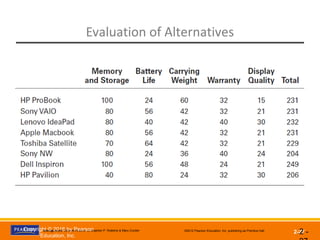
Evaluation of Alternatives
2 -Copyright © 2016 by Pearson
Education, Inc.
Management, Eleventh Edition by Stephen P. Robbins & Mary Coulter ©2012 Pearson Education, Inc. publishing as Prentice Hall
2-28
The Decision-Making Process
• Step 7: Implement the Alternative
• Putting the chosen alternative into action
• Conveying the decision to and gaining commitment
from those who will carry out the alternative
2 -Copyright © 2016 by Pearson
Education, Inc.
Management, Eleventh Edition by Stephen P. Robbins & Mary Coulter ©2012 Pearson Education, Inc. publishing as Prentice Hall
2-29
The Decision-Making Process
2 -
• Step 8: Evaluate Decision Effectiveness
– The soundness of the decision is judged by its
outcomes.
– How effectively was the problem resolved by
outcomes resulting from the chosen alternatives?
– If the problem was not resolved, what went wrong?
Copyright © 2016 by Pearson
Education, Inc.
Management, Eleventh Edition by Stephen P. Robbins & Mary Coulter ©2012 Pearson Education, Inc. publishing as Prentice Hall
2-30
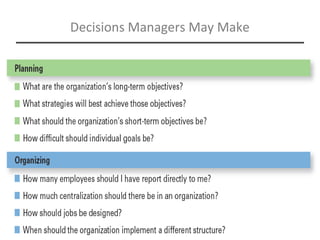
Decisions Managers May Make
2 -Copyright © 2016 by Pearson
Education, Inc.
Management, Eleventh Edition by Stephen P. Robbins & Mary Coulter ©2012 Pearson Education, Inc. publishing as Prentice Hall
2-31
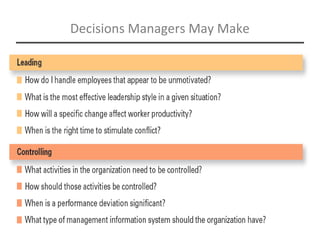
Decisions Managers May Make
2 -Copyright © 2016 by Pearson
Education, Inc.
Management, Eleventh Edition by Stephen P. Robbins & Mary Coulter ©2012 Pearson Education, Inc. publishing as Prentice Hall
2-32
Making Decisions: Rationality
2 -
• Rational Decision-Making – describes choices that
are logical and consistent while maximizing value.
• Assumptions of Rationality
– The decision maker would be fully objective and logical
– The problem faced would be clear and unambiguous
– The decision maker would have a clear and specific goal
and know all possible alternatives and consequences and
consistently select the alternative that maximizes achieving
that goal
Copyright © 2016 by Pearson
Education, Inc.
Management, Eleventh Edition by Stephen P. Robbins & Mary Coulter ©2012 Pearson Education, Inc. publishing as Prentice Hall
2-33
Making Decisions: Bounded Rationality
2 -
• Bounded Rationality – decision-making that’s
rational, but limited (bounded) by an individual’s ability
to process information.
• Satisfice – accepting solutions that are “good
enough.”
• Escalation of commitment – an increased
commitment to a previous decision despite evidence it
may have been wrong.
Copyright © 2016 by Pearson
Education, Inc.
Management, Eleventh Edition by Stephen P. Robbins & Mary Coulter ©2012 Pearson Education, Inc. publishing as Prentice Hall
2-34
Making Decisions: The Role of Intuition
2 -
• Intuitive decision- making
– Making decisions on the basis of experience, feelings,
and accumulated judgment.
Copyright © 2016 by Pearson
Education, Inc.
Management, Eleventh Edition by Stephen P. Robbins & Mary Coulter ©2012 Pearson Education, Inc. publishing as Prentice Hall
2-35
What Is Intuition?
2 -Copyright © 2016 by Pearson
Education, Inc.
Management, Eleventh Edition by Stephen P. Robbins & Mary Coulter ©2012 Pearson Education, Inc. publishing as Prentice Hall
2-36
Making Decisions: The Role of Evidence-Based
Management
2 -
• Evidence-based management (EBMgt) – the
systematic use of the best available evidence to
improve management practice.
Copyright © 2016 by Pearson
Education, Inc.

Robbins mgmt11 ppt02(1)

  • 1.
    Management, Eleventh Editionby Stephen P. Robbins & Mary Coulter ©2012 Pearson Education, Inc. publishing as Prentice Hall 2-1
  • 2.
    Management, Eleventh Editionby Stephen P. Robbins & Mary Coulter ©2012 Pearson Education, Inc. publishing as Prentice Hall 2-2 • Contrast the actions of managers according to the omnipotent and symbolic views • Describe the constraints and challenges facing managers in today’s external environment • Discuss the characteristics and importance of organizational culture • Describe current issues in organizational culture
  • 3.
    Management, Eleventh Editionby Stephen P. Robbins & Mary Coulter ©2012 Pearson Education, Inc. publishing as Prentice Hall 2-3 The Manager: Omnipotent or Symbolic? • Omnipotent View of Management - the view that managers are directly responsible for an organization’s success or failure. • Symbolic view of Management - the view that much of an organization’s success or failure is due to external forces outside managers’ control.
  • 4.
    Management, Eleventh Editionby Stephen P. Robbins & Mary Coulter ©2012 Pearson Education, Inc. publishing as Prentice Hall 2-4 Constraints on Managerial Discretion
  • 5.
    Management, Eleventh Editionby Stephen P. Robbins & Mary Coulter ©2012 Pearson Education, Inc. publishing as Prentice Hall 2-5 The External Environment: Constraints & Challenges • External Environment - those factors & forces outside the organization that affect its performance. • Components of the External Environment – Specific environment: External forces that have a direct & immediate impact on the organization – General environment: Broad economic, socio-cultural, political/legal, demographic, technological & global conditions that may affect the organization
  • 6.
    Management, Eleventh Editionby Stephen P. Robbins & Mary Coulter ©2012 Pearson Education, Inc. publishing as Prentice Hall 2-6 Exhibit 2-2: Components of External Environment
  • 7.
    Management, Eleventh Editionby Stephen P. Robbins & Mary Coulter ©2012 Pearson Education, Inc. publishing as Prentice Hall 2-7 • Environmental Uncertainty - the degree of change & complexity in an organization’s environment. • Environmental Complexity - the number of components in an organization’s environment & the extent of the organization’s knowledge about those components.
  • 8.
    Management, Eleventh Editionby Stephen P. Robbins & Mary Coulter ©2012 Pearson Education, Inc. publishing as Prentice Hall 2-8 Exhibit 2-3: Environmental Uncertainty Matrix
  • 9.
    Management, Eleventh Editionby Stephen P. Robbins & Mary Coulter ©2012 Pearson Education, Inc. publishing as Prentice Hall 2-9 Who Are Stakeholders? • Stakeholders - any constituencies in the organization’s environment that are affected by an organization’s decisions & actions.
  • 10.
    Management, Eleventh Editionby Stephen P. Robbins & Mary Coulter ©2012 Pearson Education, Inc. publishing as Prentice Hall 2-10 Organizational Stakeholders
  • 11.
    Management, Eleventh Editionby Stephen P. Robbins & Mary Coulter ©2012 Pearson Education, Inc. publishing as Prentice Hall 2-11 Managing Stakeholder Relationships 1. Identify the organization’s external stakeholders. 2. Determine the particular interests and concerns of external stakeholders. 3. Decide how critical each external stakeholder is to the organization. 4. Determine how to manage each individual external stakeholder relationship.
  • 12.
    Management, Eleventh Editionby Stephen P. Robbins & Mary Coulter ©2012 Pearson Education, Inc. publishing as Prentice Hall 2-12 What Is Organizational Culture? • Organizational Culture - The shared values, principles, traditions, and ways of doing things that influence the way organizational members act. In most organizations, these shared values and practices have evolved over time and determine to a large extent, how “things are done around here.”
  • 13.
    Management, Eleventh Editionby Stephen P. Robbins & Mary Coulter ©2012 Pearson Education, Inc. publishing as Prentice Hall 2-13 Exhibit 2-5: Dimensions of Organizational Culture
  • 14.
    Management, Eleventh Editionby Stephen P. Robbins & Mary Coulter ©2012 Pearson Education, Inc. publishing as Prentice Hall 2-14 • Strong Cultures - Organizational cultures in which key values are intensely held and widely shared.
  • 15.
    Management, Eleventh Editionby Stephen P. Robbins & Mary Coulter ©2012 Pearson Education, Inc. publishing as Prentice Hall 2-15 Exhibit 2-6: Contrasting Organizational Cultures
  • 16.
    Management, Eleventh Editionby Stephen P. Robbins & Mary Coulter ©2012 Pearson Education, Inc. publishing as Prentice Hall 2-16 Exhibit 2-7: Strong vs. Weak Cultures
  • 17.
    Management, Eleventh Editionby Stephen P. Robbins & Mary Coulter ©2012 Pearson Education, Inc. publishing as Prentice Hall 2-17 • Decision – Making a choice from two or more alternatives. 2 -Copyright © 2016 by Pearson Education, Inc.
  • 18.
    Management, Eleventh Editionby Stephen P. Robbins & Mary Coulter ©2012 Pearson Education, Inc. publishing as Prentice Hall 2-18 Decision-Making Process 2 -Copyright © 2016 by Pearson Education, Inc.
  • 19.
    Management, Eleventh Editionby Stephen P. Robbins & Mary Coulter ©2012 Pearson Education, Inc. publishing as Prentice Hall 2-19 The Decision-Making Process • Step 1: Identify a Problem – Problem – an obstacle that makes it difficult to achieve a desired goal or purpose. – Every decision starts with a problem, a difference b/w an existing and a desired condition. – Example – Amanda is a sales manager whose reps need new laptops. 2 -Copyright © 2016 by Pearson Education, Inc.
  • 20.
    Management, Eleventh Editionby Stephen P. Robbins & Mary Coulter ©2012 Pearson Education, Inc. publishing as Prentice Hall 2-20 The Decision-Making Process • Step 2: Identify Decision Criteria –Decision criteria are factors that are important (relevant) to resolving the problem. –E.G – Amanda decides that memory and storage capabilities, display quality, battery life, warranty, and carrying weight are the relevant criteria in her decision. 2 -Copyright © 2016 by Pearson Education, Inc.
  • 21.
    Management, Eleventh Editionby Stephen P. Robbins & Mary Coulter ©2012 Pearson Education, Inc. publishing as Prentice Hall 2-21 The Decision-Making Process • Step 3: Allocate Weights to the Criteria –If the relevant criteria aren’t equally important, the decision maker must weight the items in order to give them the correct priority in the decision. –The weighted criteria for our example 2 -Copyright © 2016 by Pearson Education, Inc.
  • 22.
    Management, Eleventh Editionby Stephen P. Robbins & Mary Coulter ©2012 Pearson Education, Inc. publishing as Prentice Hall 2-22 Important Decision Criteria 2 -Copyright © 2016 by Pearson Education, Inc.
  • 23.
    Management, Eleventh Editionby Stephen P. Robbins & Mary Coulter ©2012 Pearson Education, Inc. publishing as Prentice Hall 2-23 The Decision-Making Process • Step 4: Develop Alternatives –List viable alternatives that could resolve the problem –Example – Amanda, identifies eight laptops as possible choices. 2-Copyright © 2016 by Pearson Education, Inc.
  • 24.
    Management, Eleventh Editionby Stephen P. Robbins & Mary Coulter ©2012 Pearson Education, Inc. publishing as Prentice Hall 2-24 Possible Alternatives 2 -Copyright © 2016 by Pearson Education, Inc.
  • 25.
    Management, Eleventh Editionby Stephen P. Robbins & Mary Coulter ©2012 Pearson Education, Inc. publishing as Prentice Hall 2-25 The Decision-Making Process • Step 5: Analyze Alternatives –Appraising each alternative’s strengths and weaknesses. –An alternative’s appraisal is based on its ability to resolve the issues related to the criteria & criteria weight. 2 -Copyright © 2016 by Pearson Education, Inc.
  • 26.
    Management, Eleventh Editionby Stephen P. Robbins & Mary Coulter ©2012 Pearson Education, Inc. publishing as Prentice Hall 2-26 The Decision-Making Process 2 - • Step 6: Select an Alternative • Choosing the best alternative – The alternative with the highest total weight is chosen. Copyright © 2016 by Pearson Education, Inc.
  • 27.
    Management, Eleventh Editionby Stephen P. Robbins & Mary Coulter ©2012 Pearson Education, Inc. publishing as Prentice Hall 2-27 Evaluation of Alternatives 2 -Copyright © 2016 by Pearson Education, Inc.
  • 28.
    Management, Eleventh Editionby Stephen P. Robbins & Mary Coulter ©2012 Pearson Education, Inc. publishing as Prentice Hall 2-28 The Decision-Making Process • Step 7: Implement the Alternative • Putting the chosen alternative into action • Conveying the decision to and gaining commitment from those who will carry out the alternative 2 -Copyright © 2016 by Pearson Education, Inc.
  • 29.
    Management, Eleventh Editionby Stephen P. Robbins & Mary Coulter ©2012 Pearson Education, Inc. publishing as Prentice Hall 2-29 The Decision-Making Process 2 - • Step 8: Evaluate Decision Effectiveness – The soundness of the decision is judged by its outcomes. – How effectively was the problem resolved by outcomes resulting from the chosen alternatives? – If the problem was not resolved, what went wrong? Copyright © 2016 by Pearson Education, Inc.
  • 30.
    Management, Eleventh Editionby Stephen P. Robbins & Mary Coulter ©2012 Pearson Education, Inc. publishing as Prentice Hall 2-30 Decisions Managers May Make 2 -Copyright © 2016 by Pearson Education, Inc.
  • 31.
    Management, Eleventh Editionby Stephen P. Robbins & Mary Coulter ©2012 Pearson Education, Inc. publishing as Prentice Hall 2-31 Decisions Managers May Make 2 -Copyright © 2016 by Pearson Education, Inc.
  • 32.
    Management, Eleventh Editionby Stephen P. Robbins & Mary Coulter ©2012 Pearson Education, Inc. publishing as Prentice Hall 2-32 Making Decisions: Rationality 2 - • Rational Decision-Making – describes choices that are logical and consistent while maximizing value. • Assumptions of Rationality – The decision maker would be fully objective and logical – The problem faced would be clear and unambiguous – The decision maker would have a clear and specific goal and know all possible alternatives and consequences and consistently select the alternative that maximizes achieving that goal Copyright © 2016 by Pearson Education, Inc.
  • 33.
    Management, Eleventh Editionby Stephen P. Robbins & Mary Coulter ©2012 Pearson Education, Inc. publishing as Prentice Hall 2-33 Making Decisions: Bounded Rationality 2 - • Bounded Rationality – decision-making that’s rational, but limited (bounded) by an individual’s ability to process information. • Satisfice – accepting solutions that are “good enough.” • Escalation of commitment – an increased commitment to a previous decision despite evidence it may have been wrong. Copyright © 2016 by Pearson Education, Inc.
  • 34.
    Management, Eleventh Editionby Stephen P. Robbins & Mary Coulter ©2012 Pearson Education, Inc. publishing as Prentice Hall 2-34 Making Decisions: The Role of Intuition 2 - • Intuitive decision- making – Making decisions on the basis of experience, feelings, and accumulated judgment. Copyright © 2016 by Pearson Education, Inc.
  • 35.
    Management, Eleventh Editionby Stephen P. Robbins & Mary Coulter ©2012 Pearson Education, Inc. publishing as Prentice Hall 2-35 What Is Intuition? 2 -Copyright © 2016 by Pearson Education, Inc.
  • 36.
    Management, Eleventh Editionby Stephen P. Robbins & Mary Coulter ©2012 Pearson Education, Inc. publishing as Prentice Hall 2-36 Making Decisions: The Role of Evidence-Based Management 2 - • Evidence-based management (EBMgt) – the systematic use of the best available evidence to improve management practice. Copyright © 2016 by Pearson Education, Inc.

Editor's Notes

  • #18 Managers at all levels and in all areas of organizations make decisions. That is, they make choices. Although decision-making is typically described as choosing among alternatives, this view is too simplistic. Why? Because decision-making is (and should be) a process, not just a simple act of choosing among alternatives.
  • #20 Every decision starts with a problem, a discrepancy between an existing and a desired condition. For our example, Amanda is a sales manager whose reps need new laptops because their old ones are outdated and inadequate for doing their job. To make it simple, assume it’s not economical to add memory to the old computers and it’s the company’s policy to purchase, not lease. Now we have a problem—a disparity between the sales reps’ current computers (existing condition) and their need to have more efficient ones (desired condition). Amanda has a decision to make.
  • #21 Once a manager has identified a problem, he or she must identify the decision criteria important or relevant to resolving the problem. Every decision maker has criteria guiding his or her decisions even if they’re not explicitly stated. In our example, Amanda decides after careful consideration that memory and storage capabilities, display quality, battery life, warranty, and carrying weight are the relevant criteria in her decision.
  • #22 If the relevant criteria aren’t equally important, the decision maker must weight the items in order to give them the correct priority in the decision. How? A simple way is to give the most important criterion a weight of 10 and then assign weights to the rest using that standard. Of course, you could use any number as the highest weight. The weighted criteria for our example is shown in Exhibit 2-2.
  • #24 The fourth step in the decision-making process requires the decision maker to list viable alternatives that could resolve the problem. In this step, a decision maker needs to be creative, and the alternatives are only listed—not evaluated—just yet. Our sales manager, Amanda, identifies eight laptops as possible choices. (See Exhibit 2-3.)
  • #26 Once alternatives have been identified, a decision maker must evaluate each one. How? By using the criteria established in Step 2. Exhibit 2-3 shows the assessed values that Amanda gave each alternative after doing some research on them. Keep in mind that this data represents an assessment of the eight alternatives using the decision criteria, but not the weighting. When you multiply each alternative by the assigned weight, you get the weighted alternatives as shown in Exhibit 2-4. The total score for each alternative, then, is the sum of its weighted criteria. Sometimes a decision maker might be able to skip this step. If one alternative scores highest on every criterion, you wouldn’t need to consider the weights because that alternative would already be the top choice. Or if the weights were all equal, you could evaluate an alternative merely by summing up the assessed values for each one. (Look again at Exhibit 2-3.) For example, the score for the HP ProBook would be 36, and the score for the Sony NW would be 35.
  • #27 The sixth step in the decision-making process is choosing the best alternative or the one that generated the highest total in Step 5. In our example (Exhibit 2-4), Amanda would choose the Dell Inspiron because it scored higher than all other alternatives (249 total).
  • #29 In Step 7 in the decision-making process, you put the decision into action by conveying it to those affected and getting their commitment to it. We know that if the people who must implement a decision participate in the process, they’re more likely to support it than if you just tell them what to do. Another thing managers may need to do during implementation is reassess the environment for any changes, especially if it’s a long-term decision. Are the criteria, alternatives, and choice still the best ones, or has the environment changed in such a way that we need to reevaluate?
  • #30 The last step in the decision-making process involves evaluating the outcome or result of the decision to see whether the problem was resolved. If the evaluation shows that the problem still exists, then the manager needs to assess what went wrong. Was the problem incorrectly defined? Were errors made when evaluating alternatives? Was the right alternative selected but poorly implemented? The answers might lead you to redo an earlier step or might even require starting the whole process over.
  • #31 Although everyone in an organization makes decisions, decision-making is particularly important to managers. As Exhibit 6-5 shows, it’s part of all four managerial functions. In fact, that’s why we say that decision-making is the essence of management. And that’s why managers—when they plan, organize, lead, and control—are called decision makers.
  • #33 We assume that managers will use rational decision-making; that is, they’ll make logical and consistent choices to maximize value. After all, managers have all sorts of tools and techniques to help them be rational decision makers. Managers aren’t always rational. What does it mean to be a “rational” decision maker? A rational decision maker would be fully objective and logical. The problem faced would be clear and unambiguous, and the decision maker would have a clear and specific goal and know all possible alternatives and consequences. Finally, making decisions rationally would consistently lead to selecting the alternative that maximizes the likelihood of achieving that goal.
  • #34 A more realistic approach to describing how managers make decisions is the concept of bounded rationality, which says that managers make decisions rationally, but are limited (bounded) by their ability to process information. Because they can’t possibly analyze all information on all alternatives, managers satisfice, rather than maximize. That is, they accept solutions that are “good enough.” They’re being rational within the limits (bounds) of their ability to process information. However, keep in mind that their decision-making is also likely influenced by the organization’s culture, internal politics, power considerations, and by a phenomenon called escalation of commitment, an increased commitment to a previous decision despite evidence that it may have been wrong.
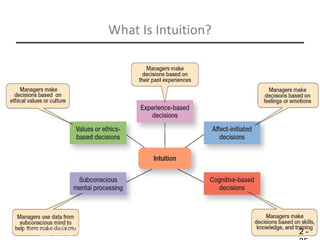
  • #35 What is intuitive decision making? It’s making decisions on the basis of experience, feelings, and accumulated judgment. Researchers studying managers’ use of intuitive decision-making have identified five different aspects of intuition, which are described in Exhibit 6-6.
  • #37 “Any decision-making process is likely to be enhanced through the use of relevant and reliable evidence, whether it’s buying someone a birthday present or wondering which new washing machine to buy.” That’s the premise behind evidence-based management (EBMgt), the “systematic use of the best available evidence to improve management practice. EBMgt is quite relevant to managerial decision-making. The four essential elements of EBMgt are the decision maker’s expertise and judgment; external evidence that’s been evaluated by the decision maker; opinions, preferences, and values of those who have a stake in the decision; and relevant organizational (internal) factors such as context, circumstances, and organizational members.