PERCEPTION AND INDIVIDUAL
DECISION MAKING
• PRESENTED BY
TAHAWWAD YOUSAF
MP/2025-S-14
PERCEPTION
AND
INDIVIDUAL
DECISION
MAKING
Ways
TABLE OF CONTENT
Introduction Importance
Types
Intiutions
After studying this chapter, you should be able
to:
• 1. Explain how two people can see the same thing
and interpret it differently.
• 2. List three determinants of attribution.
• 3. Describe how shortcuts can assist in or distort
our judgment of others.
• 4. Explain how perception affects the decision-
making process.
• 5. Outline the six steps in the rational decision-
making model.
After studying this chapter, you should be able to:
● 6. Describe the actions of a boundedly rational decision maker.
● 7. Identify the conditions in which individuals are most
likely to use intuition in decision making.
● 8. Describe four styles of decision making.
● 9. Define heuristics and explain how they bias decisions.
● 10. Contrast the three ethical decision criteria.
Perception and Factors that
Influence Perception
Perception
A process by which individuals
organize and interpret their sensory
impressions in order to give meaning
to their environment.
What Is Perception, and Why Is It Important?
People's behavior is
based on their
perception of what
reality is, not on reality
itself.
The world as it is
perceived is the world
that is behaviorally
important
perception
1. Some time what we perceive can be different
from reality. For example, all employees in a
firm may view it as a great place to work,
favorable working conditions, responsible
management, excellent benefits, but most of us
know, it is unusual to find such agreement.
Factors that Influence Perception
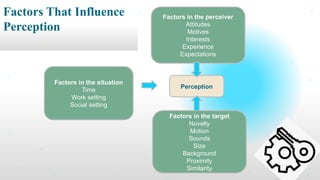
 A number of factors operate to shape and sometimes
distort perception. These factors can reside in perceiver,
or target, being perceived; or in the context of the
situation in which the perception is made.
 Let look at the figure in next slides to better understand
this.
Factors That Influence
Perception
Factors in the perceiver
Attitudes
Motives
Interests
Experience
Expectations
Factors in the target
Novelty
Motion
Sounds
Size
Background
Proximity
Similarity
Factors in the situation
Time
Work setting
Social setting
Perception
Factors that Influence Perception
 When you look at target to interpret what you see, your interpretation is
influence by your personal characteristics such as attitudes,
personality, motives, interest, past experience, expectation. For
example, if you expect young people to be lazy, you may perceive them
as such, regardless of their actual traits.
 Characteristics of the target we observe can affect what we perceive.
Loud people are more likely to be noticed in a group than quiet ones.
Factors that Influence Perception
 Context is also important. The time at which we see an object or
event can influence our attention. For example at a nightclub on
Saturday night. You may no notice a young guest dressed in a modern
way. Yet that same person wear that same modern dress for your
Monday morning management class would certainly catch you
attention.
 Nor the perceiver change not the target but situation is different
Attribution Theory
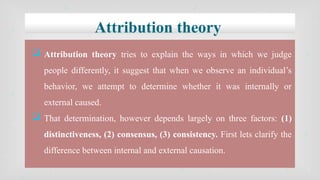
Attribution theory
 Attribution theory tries to explain the ways in which we judge
people differently, it suggest that when we observe an individual’s
behavior, we attempt to determine whether it was internally or
external caused.
 That determination, however depends largely on three factors: (1)
distinctiveness, (2) consensus, (3) consistency. First lets clarify the
difference between internal and external causation.
Attribution Theory
When individuals observe behavior, they attempt to
determine whether it is internally or externally
caused.
Person Perception: Making Judgments About Others
Distinctiveness: shows different behaviors in different situations.
Consensus: response is the same as others to same situation.
Consistency: responds in the same way over time.
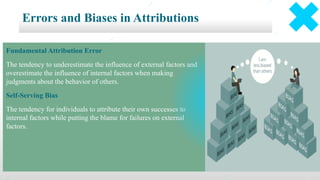
Fundamental Attribution Error
The tendency to underestimate the influence of external factors and
overestimate the influence of internal factors when making
judgments about the behavior of others.
Self-Serving Bias
The tendency for individuals to attribute their own successes to
internal factors while putting the blame for failures on external
factors.
Errors and Biases in Attributions
01
Selective Perception
People selectively interpret what they see on the basis of their interests, background, experience,
and attitudes.
Halo Effect
Drawing a general impression about an individual on the basis of a single characteristic
Contrast Effects
Evaluation of a person's characteristics that are affected by comparisons with other people recently
encountered who rank higher or lower on the same characteristics.
Frequently Used Shortcuts in Judging Others
Projection Stereotyping
Attributing one's own characteristics to other people. Judging someone on the basis of one's perception of
the group to which that person belongs.
➤ Employment Interview
Perceptual biases of raters affect the accuracy of interviewers' judgments of applicants.
➤ Performance Expectations
Self-fulfilling prophecy (pygmalion effect): The lower or higher performance of employees
reflects preconceived leader expectations about employee capabilities.
➤ Ethnic Profiling
A form of stereotyping in which a group of individuals is singled out typically on the basis of race
or ethnicity
➤ Performance Evaluations
Appraisals are often the subjective (judgmental) perceptions of appraisers of another employee's
job performance.
Specific Applications of Shortcuts in
Organizations
Link Between Perception and Decision
Making
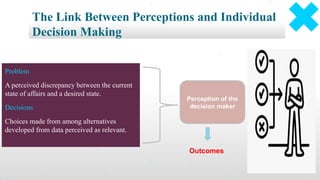
Problem
A perceived discrepancy between the current
state of affairs and a desired state.
Decisions
Choices made from among alternatives
developed from data perceived as relevant.
The Link Between Perceptions and Individual
Decision Making
Perception of the
decision maker
Outcomes
Link Between Perception and Decision
Making
Perception and Decision
 Every decision requires us to interpret and evaluate information. We
typically receive data from multiple sources and need to screen,
process, and interpret them. Which data are relevant to the decision,
and which are not?
 Our perceptions will answer that question. We also need to develop
alternatives and evaluate their strengths and weaknesses.
 Again, our perceptual process will affect the final outcome
The Decision Making Process
 There are 8 steps in decision making process.
1. Identifying a Problem
2. Identifying Decision Criteria (Standard of selecting something)
3. Allocating Weight of the Criteria
4. Developing Alternatives
5. Analysis Alternatives
6. Selecting an Alternatives
7. Implementing the Alternatives
8. Evaluating Decision Effectiveness
The Rational Model, Bounded
Rationality, and Intuition
The Rational Model, Bounded
Rationality, and Intuition
 Everyone in the organization makes decisions, but decision making
is particularly important to managers. It is part of all four managerial
functions that is why managers when plan, organize, lead and control
are called “decision making”.
 Manager make dozen of decisions in routine such as which
employee will work, what information is needed in report etc.
 There are three perspectives on how managers make decisions.
Rational Decision Making
 Rational Decision Making
 A type of decision making in which choices are logical and
consistent and maximize value. We assume that manager’s decision
making will be rational, but decision of Nokia Company of not using
android is an example of not making decision rationally.
1. Define the problem.
2. Identify the decision criteria.
3. Allocate weights to the criteria.
4. Develop the alternatives.
5. Evaluate the alternatives.
6. Select the best alternative.
Steps in the Rational Decision-Making Model
Bounded Rationality
 More realistic approach to describe how managers make decision is the concept of
bounded rationality. Which says that manager make decision rationally but are
limited (bounded) by their ability to process information.
 They can’t analyze all information on all alternatives , managers satisfies rather
than maximize. Because the human mind cannot formulate and solve complex
problems with full rationality, we operate within the confines of bounded
rationality .
Intuition (‫ام‬ ‫ال‬
‫ہ‬ )
 Intuition decision making is making decision on the basis of experience,
feeling and judgment. While intuition isn’t rational, it isn’t necessarily wrong.
Nor does it always contradict rational analysis; rather, the two can
complement each other.
 Researchers say, managers use five different aspect of intuitions in decision
making.
i. Experience-Based Decision
ii. Affect-Initiated Decision
iii. Cognitive-Based Decision
iv. Subconscious Mental Processing
v. Value or Ethics Based Decision
➤ Intuitive Decision Making
An unconscious process created out of distilled experience.
➤ Conditions Favoring Intuitive Decision Making
• A high level of uncertainty exists
• There is little precedent to draw on
• Variables are less scientifically predictable
• "Facts" are limited
• Facts don't clearly point the way
• Analytical data are of little use
• Several plausible alternative solutions exist
• Time is limited and pressing for the right decision
Intuition
Analytical Conceptual
Directive Behavioral
Tolerance
for
ambiguity
Way of thinking
➤ Overconfidence Bias
Believing too much in our own decision competencies.
➤ Anchoring Bias
Fixating on early, first received information.
➤ Confirmation Bias
Using only the facts that support our decision.
➤ Availability Bias
Using information that is most readily at hand.
➤ Representative Bias
Assessing the likelihood of an occurrence by trying to match it with a preexisting category.
Common Biases and Errors in decision
making
Influences on Decision Making
Individual Differences and
Organizational Constraints
Key Idea: Many factors influence how
people make decisions and how much
they are affected by errors or biases.
Individual Differences
1. Decision making differs from person to person.
2. Influenced by:
3. Personality
4. Gender Identity
5. Intellectual abilities
6. Cultural background
Personality and Decision Making
1. Personality traits affect how people make
choices.
2. Some rely more on intuition, others on logic.
3. High self-esteem: may blame others for failure &
take credit for success.
4. Narcissists: tend to be overconfident and self-
serving.
Big Five Personality Traits
1. Openness: open-minded people avoid confirmation bias.
2. Extroversion: linked to risk-taking (e.g., CEOs making bold
acquisitions).
3. Conscientiousness : Achievement-oriented → continue wrong
decisions to avoid failure (escalation of commitment).
4. Dutiful people → focus on what’s best for the organization.
5. Hindsight bias: achievement-striving people justify past actions.
Gender and Decision Making
1. Gender Similarities Hypothesis: little to no major
difference.
2. However, some patterns exist.
3. Men: more risk-taking and sensation seeking.
4. Women: more careful, health-conscious (COVID
example).
5. Men: more likely to show gender-role bias in hiring for
masculine jobs.
6. Women: less likely to show this bias.
Intellectual Abilities
1. High intelligence :
2. Better at problem-solving and learning.
3. Still can make emotional or overconfident errors.
4. Cognitive flexibility: helps choose right strategy for
different problems → better decisions.
Cultural Differences
1. Culture shapes:
2. How problems are seen
3. How decisions are made
4. Who makes the final decision (leader vs. group)
5. Examples:
6. Sweden: slow, consensus-based decisions
7. Germany: quick, formal, role-based decisions
8. Turkey: expect leaders to decide but like to be consulted
9. Japan: group harmony and consensus emphasized
Summary
1. Decision-making is not the same for everyone.
2. Influenced by:
3. Personality
4. Traits
5. Gender
6. Intelligence
7. Culture
8. These differences explain why people act differently
under the same situation.
Topic: Organizational Constraints on
Decision Making
Introduction
1. Key Idea:
2. Organizations limit how decisions are made.
3. These constraints cause deviations from rational decision-making.
4. Examples of Constraints:
5. Performance
6. Evaluation Systems
7. Reward Systems
8. Formal Regulations
9. Time Constraints
10. Historical Precedents
11. Decision Making in Crisis
Performance Evaluation Systems
1. Managers make decisions based on how they are
evaluated.
2. If performance is judged by no negative
feedback, employees will hide problems.
3. Example: Managers may focus on keeping
reports positive instead of solving real issues.
Reward Systems
1. Rewards influence what kind of decisions people
make.
2. If rewards depend on targets or incentives,
employees may take unethical shortcuts.
3. Example: Wells Fargo employees opened 2
million fake accounts to meet sales goals.
Formal Regulations
1. Rules and policies limit decision freedom.
2. Example: A shift manager at Taco Bell must follow strict
rules for everything — from food prep to cleaning.
3. Regulations reduce choice but prevent bias and mistakes.
4. Example: Structured CEO succession planning improves
hiring decisions.
Time Constraints
1. Managers often face deadlines.
2. Not enough time to collect all information →
poor decision quality.
3. Example: Report due for executive review limits
analysis time.
Historical Precedents
1. Past decisions influence present choices.
2. “Today’s decisions are shaped by yesterday’s decisions.”
3. Example:
4. Budgets are based on last year’s numbers.
5. MBA graduates before 1970 → preferred diversification.
6. MBA graduates after 1970 → preferred focus strategies.
Decision Making in Times of Crisis
1. Crises (like COVID-19) create chaos and
uncertainty.
2. People make emotional and intuitive decisions.
3. Example: Health workers deciding who gets
treatment during COVID.
4. Companies’ justice and ethics become visible
through their actions.
Summary
1. Organizational constraints affect every step of decision
making:
2. Performance evaluations limit honesty.
3. Rewards push risky/unethical actions.
4. Rules restrict creativity.
5. Time limits reduce analysis.
6. Past decisions shape current ones.
7. Crises increase emotional, intuitive decisions.
Topic: Ethics in Decision Making
Introduction
1. Ethics means deciding what is right or wrong.
2. Organizations should ensure decisions are fair, honest, and responsible.
3. There are three major ethical criteria used in decision making.
4. Three Ethical Decision Criteria1.
5. Utilitarianism – Greatest good for the greatest number
6. Rights – Protecting basic human rights
7. Justice – Fair and impartial treatment for everyone
8. Utilitarianism
9. Focus: Consequences of the decision.
10. Goal: Maximum good for maximum people.
11. Common in business for efficiency, profit, productivity.
12. Example: Laying off some workers to save the company (for greater good).
Rights Criterion
1. Focus on individual freedoms:
2. privacy, free speech, fairness.
3. Example: Protecting whistleblowers who expose
corruption.
4. Ensures people are treated with dignity.
Justice Criterion
1. Focus: Fair and equal treatment for everyone.
2. Based on rules, laws, moral principles.
3. Example: Equal salary for equal work.
4. Employees follow this because they feel they
ought to do right.
Choosing Between Criteria
1. In business, utilitarianism is most common.
2. But it may conflict with rights and justice.
3. Example: Layoffs may be good for profit
(utilitarian) but bad for employees’ rights.
4. Modern view: Combine all three ethically.
Role of CSR (Corporate Social Responsibility)
1. CSR means doing socially responsible business.
2. Helps companies:
3. Build trust and reputation
4. Attract talented employees
5. Get government incentives
6. Example: Companies promoting eco-friendly
products.
Behavioral Ethics
1. Studies why people act ethically or unethically.
2. Even good people can do bad things.
3. Focus: psychological and emotional reasons
behind unethical behavior.
4. Works at three levels:
5. 1. Individual (personality, values)
6. 2. Group (leadership, corruption)
7. 3. Organization (policies, culture).
Cultural Differences in Ethics
1.Ethics vary across cultures.
2.What is ethical in one country may be
unethical in another.
3.Example: Bribery may be “normal” in one
country but illegal in another.
Lying and Ethics
1. Lying is common but harmful to decision
making.
2. People detect lies only 47% of the time (less than
random guessing!).
3. Body language or facial cues are unreliable.
4. Lying ruins trust and leads to bad decisions.
5. Best solution: Build honest organizational
culture.
Summary
1. Ethics in Decision Making
2. Criteria:
3. Utilitarianism,
4. Rights,
5. Justice
6. Combine all three for balanced decisions
7. CSR encourages ethical behavior
8. Behavioral ethics explains why people act unethically
9. Lying destroys trust and fairness
Title: Creativity, Creative Decision
Making, and Innovation in
Organizations
Subtitle: Understanding the process of
generating and applying new ideas in
the workplace
Creativity
The ability to produce novel and
useful ideas..
Three-Component Model of
Creativity
Proposition that individual creativity
requires expertise, creative-thinking
skills, and intrinsic task motivation.
The Three Components Of Creativity
What is Creativity?
1. Creativity = ability to produce novel and useful
ideas
2. Novel = new and original
3. Useful = relevant and appropriate
4. Helps decision makers understand and solve
problems in new ways
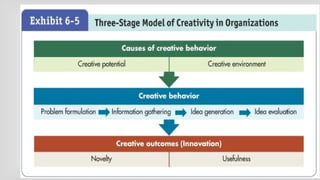
Three-Stage Model of Creativity in Organizations
1. Stages:
2. 1. Causes of Creative Behavior
3. 2. Creative Behavior
4. 3. Creative Outcomes (Innovation)
5. Stage 1 – Causes of Creative Behavior
6. Creative Potential Factors
7. Intelligence
8. Personality traits (openness, risk-taking, confidence)
9. Expertise and experience
10. Ethics (moral thinking)
11. Creative Environment
12. Factors: Motivation (especially intrinsic)
13. Supportive and free work environment
14. Empowerment and recognition
15. Encouraging leadership
Stage 2 – Creative Behavior (4 Steps)
1. 1. Problem Formulation: Identify problem or
opportunity
2. 2. Information Gathering: Collect and analyze
knowledge
3. 3. Idea Generation: Create new ideas or solutions
4. 4. Idea Evaluation: Choose the best solution
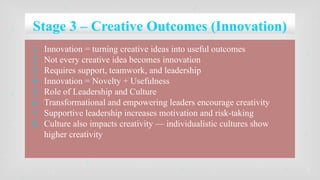
Stage 3 – Creative Outcomes (Innovation)
1. Innovation = turning creative ideas into useful outcomes
2. Not every creative idea becomes innovation
3. Requires support, teamwork, and leadership
4. Innovation = Novelty + Usefulness
5. Role of Leadership and Culture
6. Transformational and empowering leaders encourage creativity
7. Supportive leadership increases motivation and risk-taking
8. Culture also impacts creativity — individualistic cultures show
higher creativity
Implications for Managers
1.Understand employees’ perceptions
2.Encourage creative problem solving
3.Use ethical decision-making frameworks
4.Build an environment that rewards
creativity and innovation
Summary
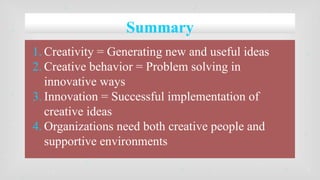
1. Creativity = Generating new and useful ideas
2. Creative behavior = Problem solving in
innovative ways
3. Innovation = Successful implementation of
creative ideas
4. Organizations need both creative people and
supportive environments
Summary
1. Creativity = Generating new and useful ideas
2. Creative behavior = Problem solving in
innovative ways
3. Innovation = Successful implementation of
creative ideas
4. Organizations need both creative people and
supportive environments
Case:Max’s Burger- The Dollar Value Of Ethics
Max’s Burgers is a famous American fast-food chain that has outlets all over the world.In Dubai, the
franchise was bought by Nassar Group, a well-known company run by Houssam Nassar — a respected
and honest businessman.After taking charge, Nassar gave a strict directive to all his managers:> “Do
not accept any frozen meat shipment that doesn’t meet our company’s quality standards.”A few weeks
later, a meat shipment arrived at the warehouse. The temperature of the frozen meat was a few degrees
higher than the company’s set limit. According to government rules, this difference didn’t make the
meat unsafe for people — but according to company standards, it was not acceptable because it could
slightly affect the taste and texture.Before Nassar took over, the warehouse manager always accepted
such shipments without thinking twice.There were no complaints or cases of food poisoning before,
and interestingly, the supplier of this meat was also the manager’s relative.Now the manager was
confused:If he rejects the meat, his relative will lose money and might get angry.If he accepts it, no one
may find out — but he’ll be breaking company rules and Nassar’s trust.This is where his ethical
dilemma begins.
Questions for Class Discussion
1 Does the decision to accept or refuse the frozen meat
shipment call for ethical or legal considerations?
2 Why Identify the stakeholders who will be influenced by
the decision?
3 What type of decision-making framework would you
advise the warehouse manager to adopt to reach an
optimal decision? How will your suggestion help?
Answers and Deep Understanding
Question 1: Ethical or Legal Consideration?
Answer:This decision is an ethical consideration, not a legal one.
Legally, the meat is safe — so accepting it wouldn’t break any law. But
ethically, it breaks company rules and honesty standards.
The manager must decide between doing what is right or what is easy.
Question 2: Stakeholders Affected
Answer:1. Houssam Nassar – his reputation and brand image depend on
honesty.
2. Warehouse Manager – his moral values and job integrity are at stake.
3. Supplier (Relative) – his financial benefit will be affected.
4. Customers – they expect high-quality food.
5. Other Employees – this decision sets an ethical example for everyone.
Answers and Deep Understanding
Question 3: Decision-Making Framework
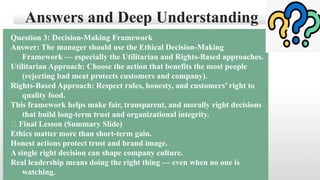
Answer: The manager should use the Ethical Decision-Making
Framework — especially the Utilitarian and Rights-Based approaches.
Utilitarian Approach: Choose the action that benefits the most people
(rejecting bad meat protects customers and company).
Rights-Based Approach: Respect rules, honesty, and customers’ right to
quality food.
This framework helps make fair, transparent, and morally right decisions
that build long-term trust and organizational integrity.
🌱 Final Lesson (Summary Slide)
Ethics matter more than short-term gain.
Honest actions protect trust and brand image.
A single right decision can shape company culture.
Real leadership means doing the right thing — even when no one is
watching.
🌱 Final Lesson
1. Ethics matter more than short-term gain.
2. Honest actions protect trust and brand image.
3. A single right decision can shape company
culture.
4. Real leadership means doing the right thing
— even when no one is watching.
THANK
YOU

PERCEPTION and individual decision making

  • 2.
    PERCEPTION AND INDIVIDUAL DECISIONMAKING • PRESENTED BY TAHAWWAD YOUSAF MP/2025-S-14
  • 3.
  • 4.
    Ways TABLE OF CONTENT IntroductionImportance Types Intiutions
  • 5.
    After studying thischapter, you should be able to: • 1. Explain how two people can see the same thing and interpret it differently. • 2. List three determinants of attribution. • 3. Describe how shortcuts can assist in or distort our judgment of others. • 4. Explain how perception affects the decision- making process. • 5. Outline the six steps in the rational decision- making model.
  • 6.
    After studying thischapter, you should be able to: ● 6. Describe the actions of a boundedly rational decision maker. ● 7. Identify the conditions in which individuals are most likely to use intuition in decision making. ● 8. Describe four styles of decision making. ● 9. Define heuristics and explain how they bias decisions. ● 10. Contrast the three ethical decision criteria.
  • 7.
    Perception and Factorsthat Influence Perception
  • 8.
    Perception A process bywhich individuals organize and interpret their sensory impressions in order to give meaning to their environment. What Is Perception, and Why Is It Important? People's behavior is based on their perception of what reality is, not on reality itself. The world as it is perceived is the world that is behaviorally important
  • 9.
    perception 1. Some timewhat we perceive can be different from reality. For example, all employees in a firm may view it as a great place to work, favorable working conditions, responsible management, excellent benefits, but most of us know, it is unusual to find such agreement.
  • 10.
    Factors that InfluencePerception  A number of factors operate to shape and sometimes distort perception. These factors can reside in perceiver, or target, being perceived; or in the context of the situation in which the perception is made.  Let look at the figure in next slides to better understand this.
  • 11.
    Factors That Influence Perception Factorsin the perceiver Attitudes Motives Interests Experience Expectations Factors in the target Novelty Motion Sounds Size Background Proximity Similarity Factors in the situation Time Work setting Social setting Perception
  • 12.
    Factors that InfluencePerception  When you look at target to interpret what you see, your interpretation is influence by your personal characteristics such as attitudes, personality, motives, interest, past experience, expectation. For example, if you expect young people to be lazy, you may perceive them as such, regardless of their actual traits.  Characteristics of the target we observe can affect what we perceive. Loud people are more likely to be noticed in a group than quiet ones.
  • 13.
    Factors that InfluencePerception  Context is also important. The time at which we see an object or event can influence our attention. For example at a nightclub on Saturday night. You may no notice a young guest dressed in a modern way. Yet that same person wear that same modern dress for your Monday morning management class would certainly catch you attention.  Nor the perceiver change not the target but situation is different
  • 14.
  • 15.
    Attribution theory  Attributiontheory tries to explain the ways in which we judge people differently, it suggest that when we observe an individual’s behavior, we attempt to determine whether it was internally or external caused.  That determination, however depends largely on three factors: (1) distinctiveness, (2) consensus, (3) consistency. First lets clarify the difference between internal and external causation.
  • 16.
    Attribution Theory When individualsobserve behavior, they attempt to determine whether it is internally or externally caused. Person Perception: Making Judgments About Others Distinctiveness: shows different behaviors in different situations. Consensus: response is the same as others to same situation. Consistency: responds in the same way over time.
  • 18.
    Fundamental Attribution Error Thetendency to underestimate the influence of external factors and overestimate the influence of internal factors when making judgments about the behavior of others. Self-Serving Bias The tendency for individuals to attribute their own successes to internal factors while putting the blame for failures on external factors. Errors and Biases in Attributions
  • 19.
    01 Selective Perception People selectivelyinterpret what they see on the basis of their interests, background, experience, and attitudes. Halo Effect Drawing a general impression about an individual on the basis of a single characteristic Contrast Effects Evaluation of a person's characteristics that are affected by comparisons with other people recently encountered who rank higher or lower on the same characteristics. Frequently Used Shortcuts in Judging Others Projection Stereotyping Attributing one's own characteristics to other people. Judging someone on the basis of one's perception of the group to which that person belongs.
  • 20.
    ➤ Employment Interview Perceptualbiases of raters affect the accuracy of interviewers' judgments of applicants. ➤ Performance Expectations Self-fulfilling prophecy (pygmalion effect): The lower or higher performance of employees reflects preconceived leader expectations about employee capabilities. ➤ Ethnic Profiling A form of stereotyping in which a group of individuals is singled out typically on the basis of race or ethnicity ➤ Performance Evaluations Appraisals are often the subjective (judgmental) perceptions of appraisers of another employee's job performance. Specific Applications of Shortcuts in Organizations
  • 21.
    Link Between Perceptionand Decision Making
  • 22.
    Problem A perceived discrepancybetween the current state of affairs and a desired state. Decisions Choices made from among alternatives developed from data perceived as relevant. The Link Between Perceptions and Individual Decision Making Perception of the decision maker Outcomes
  • 23.
    Link Between Perceptionand Decision Making Perception and Decision  Every decision requires us to interpret and evaluate information. We typically receive data from multiple sources and need to screen, process, and interpret them. Which data are relevant to the decision, and which are not?  Our perceptions will answer that question. We also need to develop alternatives and evaluate their strengths and weaknesses.  Again, our perceptual process will affect the final outcome
  • 24.
    The Decision MakingProcess  There are 8 steps in decision making process. 1. Identifying a Problem 2. Identifying Decision Criteria (Standard of selecting something) 3. Allocating Weight of the Criteria 4. Developing Alternatives 5. Analysis Alternatives 6. Selecting an Alternatives 7. Implementing the Alternatives 8. Evaluating Decision Effectiveness
  • 25.
    The Rational Model,Bounded Rationality, and Intuition
  • 26.
    The Rational Model,Bounded Rationality, and Intuition  Everyone in the organization makes decisions, but decision making is particularly important to managers. It is part of all four managerial functions that is why managers when plan, organize, lead and control are called “decision making”.  Manager make dozen of decisions in routine such as which employee will work, what information is needed in report etc.  There are three perspectives on how managers make decisions.
  • 27.
    Rational Decision Making Rational Decision Making  A type of decision making in which choices are logical and consistent and maximize value. We assume that manager’s decision making will be rational, but decision of Nokia Company of not using android is an example of not making decision rationally.
  • 28.
    1. Define theproblem. 2. Identify the decision criteria. 3. Allocate weights to the criteria. 4. Develop the alternatives. 5. Evaluate the alternatives. 6. Select the best alternative. Steps in the Rational Decision-Making Model
  • 29.
    Bounded Rationality  Morerealistic approach to describe how managers make decision is the concept of bounded rationality. Which says that manager make decision rationally but are limited (bounded) by their ability to process information.  They can’t analyze all information on all alternatives , managers satisfies rather than maximize. Because the human mind cannot formulate and solve complex problems with full rationality, we operate within the confines of bounded rationality .
  • 30.
    Intuition (‫ام‬ ‫ال‬ ‫ہ‬)  Intuition decision making is making decision on the basis of experience, feeling and judgment. While intuition isn’t rational, it isn’t necessarily wrong. Nor does it always contradict rational analysis; rather, the two can complement each other.  Researchers say, managers use five different aspect of intuitions in decision making. i. Experience-Based Decision ii. Affect-Initiated Decision iii. Cognitive-Based Decision iv. Subconscious Mental Processing v. Value or Ethics Based Decision
  • 31.
    ➤ Intuitive DecisionMaking An unconscious process created out of distilled experience. ➤ Conditions Favoring Intuitive Decision Making • A high level of uncertainty exists • There is little precedent to draw on • Variables are less scientifically predictable • "Facts" are limited • Facts don't clearly point the way • Analytical data are of little use • Several plausible alternative solutions exist • Time is limited and pressing for the right decision Intuition Analytical Conceptual Directive Behavioral Tolerance for ambiguity Way of thinking
  • 32.
    ➤ Overconfidence Bias Believingtoo much in our own decision competencies. ➤ Anchoring Bias Fixating on early, first received information. ➤ Confirmation Bias Using only the facts that support our decision. ➤ Availability Bias Using information that is most readily at hand. ➤ Representative Bias Assessing the likelihood of an occurrence by trying to match it with a preexisting category. Common Biases and Errors in decision making
  • 33.
    Influences on DecisionMaking Individual Differences and Organizational Constraints Key Idea: Many factors influence how people make decisions and how much they are affected by errors or biases.
  • 34.
    Individual Differences 1. Decisionmaking differs from person to person. 2. Influenced by: 3. Personality 4. Gender Identity 5. Intellectual abilities 6. Cultural background
  • 35.
    Personality and DecisionMaking 1. Personality traits affect how people make choices. 2. Some rely more on intuition, others on logic. 3. High self-esteem: may blame others for failure & take credit for success. 4. Narcissists: tend to be overconfident and self- serving.
  • 36.
    Big Five PersonalityTraits 1. Openness: open-minded people avoid confirmation bias. 2. Extroversion: linked to risk-taking (e.g., CEOs making bold acquisitions). 3. Conscientiousness : Achievement-oriented → continue wrong decisions to avoid failure (escalation of commitment). 4. Dutiful people → focus on what’s best for the organization. 5. Hindsight bias: achievement-striving people justify past actions.
  • 37.
    Gender and DecisionMaking 1. Gender Similarities Hypothesis: little to no major difference. 2. However, some patterns exist. 3. Men: more risk-taking and sensation seeking. 4. Women: more careful, health-conscious (COVID example). 5. Men: more likely to show gender-role bias in hiring for masculine jobs. 6. Women: less likely to show this bias.
  • 38.
    Intellectual Abilities 1. Highintelligence : 2. Better at problem-solving and learning. 3. Still can make emotional or overconfident errors. 4. Cognitive flexibility: helps choose right strategy for different problems → better decisions.
  • 39.
    Cultural Differences 1. Cultureshapes: 2. How problems are seen 3. How decisions are made 4. Who makes the final decision (leader vs. group) 5. Examples: 6. Sweden: slow, consensus-based decisions 7. Germany: quick, formal, role-based decisions 8. Turkey: expect leaders to decide but like to be consulted 9. Japan: group harmony and consensus emphasized
  • 40.
    Summary 1. Decision-making isnot the same for everyone. 2. Influenced by: 3. Personality 4. Traits 5. Gender 6. Intelligence 7. Culture 8. These differences explain why people act differently under the same situation.
  • 41.
  • 42.
    Introduction 1. Key Idea: 2.Organizations limit how decisions are made. 3. These constraints cause deviations from rational decision-making. 4. Examples of Constraints: 5. Performance 6. Evaluation Systems 7. Reward Systems 8. Formal Regulations 9. Time Constraints 10. Historical Precedents 11. Decision Making in Crisis
  • 43.
    Performance Evaluation Systems 1.Managers make decisions based on how they are evaluated. 2. If performance is judged by no negative feedback, employees will hide problems. 3. Example: Managers may focus on keeping reports positive instead of solving real issues.
  • 44.
    Reward Systems 1. Rewardsinfluence what kind of decisions people make. 2. If rewards depend on targets or incentives, employees may take unethical shortcuts. 3. Example: Wells Fargo employees opened 2 million fake accounts to meet sales goals.
  • 45.
    Formal Regulations 1. Rulesand policies limit decision freedom. 2. Example: A shift manager at Taco Bell must follow strict rules for everything — from food prep to cleaning. 3. Regulations reduce choice but prevent bias and mistakes. 4. Example: Structured CEO succession planning improves hiring decisions.
  • 46.
    Time Constraints 1. Managersoften face deadlines. 2. Not enough time to collect all information → poor decision quality. 3. Example: Report due for executive review limits analysis time.
  • 47.
    Historical Precedents 1. Pastdecisions influence present choices. 2. “Today’s decisions are shaped by yesterday’s decisions.” 3. Example: 4. Budgets are based on last year’s numbers. 5. MBA graduates before 1970 → preferred diversification. 6. MBA graduates after 1970 → preferred focus strategies.
  • 48.
    Decision Making inTimes of Crisis 1. Crises (like COVID-19) create chaos and uncertainty. 2. People make emotional and intuitive decisions. 3. Example: Health workers deciding who gets treatment during COVID. 4. Companies’ justice and ethics become visible through their actions.
  • 49.
    Summary 1. Organizational constraintsaffect every step of decision making: 2. Performance evaluations limit honesty. 3. Rewards push risky/unethical actions. 4. Rules restrict creativity. 5. Time limits reduce analysis. 6. Past decisions shape current ones. 7. Crises increase emotional, intuitive decisions.
  • 50.
    Topic: Ethics inDecision Making
  • 51.
    Introduction 1. Ethics meansdeciding what is right or wrong. 2. Organizations should ensure decisions are fair, honest, and responsible. 3. There are three major ethical criteria used in decision making. 4. Three Ethical Decision Criteria1. 5. Utilitarianism – Greatest good for the greatest number 6. Rights – Protecting basic human rights 7. Justice – Fair and impartial treatment for everyone 8. Utilitarianism 9. Focus: Consequences of the decision. 10. Goal: Maximum good for maximum people. 11. Common in business for efficiency, profit, productivity. 12. Example: Laying off some workers to save the company (for greater good).
  • 52.
    Rights Criterion 1. Focuson individual freedoms: 2. privacy, free speech, fairness. 3. Example: Protecting whistleblowers who expose corruption. 4. Ensures people are treated with dignity.
  • 53.
    Justice Criterion 1. Focus:Fair and equal treatment for everyone. 2. Based on rules, laws, moral principles. 3. Example: Equal salary for equal work. 4. Employees follow this because they feel they ought to do right.
  • 54.
    Choosing Between Criteria 1.In business, utilitarianism is most common. 2. But it may conflict with rights and justice. 3. Example: Layoffs may be good for profit (utilitarian) but bad for employees’ rights. 4. Modern view: Combine all three ethically.
  • 55.
    Role of CSR(Corporate Social Responsibility) 1. CSR means doing socially responsible business. 2. Helps companies: 3. Build trust and reputation 4. Attract talented employees 5. Get government incentives 6. Example: Companies promoting eco-friendly products.
  • 56.
    Behavioral Ethics 1. Studieswhy people act ethically or unethically. 2. Even good people can do bad things. 3. Focus: psychological and emotional reasons behind unethical behavior. 4. Works at three levels: 5. 1. Individual (personality, values) 6. 2. Group (leadership, corruption) 7. 3. Organization (policies, culture).
  • 57.
    Cultural Differences inEthics 1.Ethics vary across cultures. 2.What is ethical in one country may be unethical in another. 3.Example: Bribery may be “normal” in one country but illegal in another.
  • 58.
    Lying and Ethics 1.Lying is common but harmful to decision making. 2. People detect lies only 47% of the time (less than random guessing!). 3. Body language or facial cues are unreliable. 4. Lying ruins trust and leads to bad decisions. 5. Best solution: Build honest organizational culture.
  • 59.
    Summary 1. Ethics inDecision Making 2. Criteria: 3. Utilitarianism, 4. Rights, 5. Justice 6. Combine all three for balanced decisions 7. CSR encourages ethical behavior 8. Behavioral ethics explains why people act unethically 9. Lying destroys trust and fairness
  • 60.
    Title: Creativity, CreativeDecision Making, and Innovation in Organizations Subtitle: Understanding the process of generating and applying new ideas in the workplace
  • 61.
    Creativity The ability toproduce novel and useful ideas.. Three-Component Model of Creativity Proposition that individual creativity requires expertise, creative-thinking skills, and intrinsic task motivation. The Three Components Of Creativity
  • 62.
    What is Creativity? 1.Creativity = ability to produce novel and useful ideas 2. Novel = new and original 3. Useful = relevant and appropriate 4. Helps decision makers understand and solve problems in new ways
  • 63.
    Three-Stage Model ofCreativity in Organizations 1. Stages: 2. 1. Causes of Creative Behavior 3. 2. Creative Behavior 4. 3. Creative Outcomes (Innovation) 5. Stage 1 – Causes of Creative Behavior 6. Creative Potential Factors 7. Intelligence 8. Personality traits (openness, risk-taking, confidence) 9. Expertise and experience 10. Ethics (moral thinking) 11. Creative Environment 12. Factors: Motivation (especially intrinsic) 13. Supportive and free work environment 14. Empowerment and recognition 15. Encouraging leadership
  • 64.
    Stage 2 –Creative Behavior (4 Steps) 1. 1. Problem Formulation: Identify problem or opportunity 2. 2. Information Gathering: Collect and analyze knowledge 3. 3. Idea Generation: Create new ideas or solutions 4. 4. Idea Evaluation: Choose the best solution
  • 65.
    Stage 3 –Creative Outcomes (Innovation) 1. Innovation = turning creative ideas into useful outcomes 2. Not every creative idea becomes innovation 3. Requires support, teamwork, and leadership 4. Innovation = Novelty + Usefulness 5. Role of Leadership and Culture 6. Transformational and empowering leaders encourage creativity 7. Supportive leadership increases motivation and risk-taking 8. Culture also impacts creativity — individualistic cultures show higher creativity
  • 67.
    Implications for Managers 1.Understandemployees’ perceptions 2.Encourage creative problem solving 3.Use ethical decision-making frameworks 4.Build an environment that rewards creativity and innovation
  • 68.
    Summary 1. Creativity =Generating new and useful ideas 2. Creative behavior = Problem solving in innovative ways 3. Innovation = Successful implementation of creative ideas 4. Organizations need both creative people and supportive environments
  • 69.
    Summary 1. Creativity =Generating new and useful ideas 2. Creative behavior = Problem solving in innovative ways 3. Innovation = Successful implementation of creative ideas 4. Organizations need both creative people and supportive environments
  • 70.
    Case:Max’s Burger- TheDollar Value Of Ethics Max’s Burgers is a famous American fast-food chain that has outlets all over the world.In Dubai, the franchise was bought by Nassar Group, a well-known company run by Houssam Nassar — a respected and honest businessman.After taking charge, Nassar gave a strict directive to all his managers:> “Do not accept any frozen meat shipment that doesn’t meet our company’s quality standards.”A few weeks later, a meat shipment arrived at the warehouse. The temperature of the frozen meat was a few degrees higher than the company’s set limit. According to government rules, this difference didn’t make the meat unsafe for people — but according to company standards, it was not acceptable because it could slightly affect the taste and texture.Before Nassar took over, the warehouse manager always accepted such shipments without thinking twice.There were no complaints or cases of food poisoning before, and interestingly, the supplier of this meat was also the manager’s relative.Now the manager was confused:If he rejects the meat, his relative will lose money and might get angry.If he accepts it, no one may find out — but he’ll be breaking company rules and Nassar’s trust.This is where his ethical dilemma begins.
  • 71.
    Questions for ClassDiscussion 1 Does the decision to accept or refuse the frozen meat shipment call for ethical or legal considerations? 2 Why Identify the stakeholders who will be influenced by the decision? 3 What type of decision-making framework would you advise the warehouse manager to adopt to reach an optimal decision? How will your suggestion help?
  • 72.
    Answers and DeepUnderstanding Question 1: Ethical or Legal Consideration? Answer:This decision is an ethical consideration, not a legal one. Legally, the meat is safe — so accepting it wouldn’t break any law. But ethically, it breaks company rules and honesty standards. The manager must decide between doing what is right or what is easy. Question 2: Stakeholders Affected Answer:1. Houssam Nassar – his reputation and brand image depend on honesty. 2. Warehouse Manager – his moral values and job integrity are at stake. 3. Supplier (Relative) – his financial benefit will be affected. 4. Customers – they expect high-quality food. 5. Other Employees – this decision sets an ethical example for everyone.
  • 73.
    Answers and DeepUnderstanding Question 3: Decision-Making Framework Answer: The manager should use the Ethical Decision-Making Framework — especially the Utilitarian and Rights-Based approaches. Utilitarian Approach: Choose the action that benefits the most people (rejecting bad meat protects customers and company). Rights-Based Approach: Respect rules, honesty, and customers’ right to quality food. This framework helps make fair, transparent, and morally right decisions that build long-term trust and organizational integrity. 🌱 Final Lesson (Summary Slide) Ethics matter more than short-term gain. Honest actions protect trust and brand image. A single right decision can shape company culture. Real leadership means doing the right thing — even when no one is watching.
  • 74.
    🌱 Final Lesson 1.Ethics matter more than short-term gain. 2. Honest actions protect trust and brand image. 3. A single right decision can shape company culture. 4. Real leadership means doing the right thing — even when no one is watching.
  • 75.