
PERSONALITY     AND VALUES
                 IN
ORGANIZATIONAL BEHAVIOR----BY Nilormi Das.
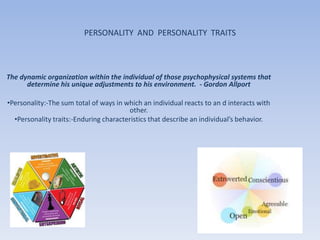
PERSONALITY AND PERSONALITY TRAITS


The dynamic organization within the individual of those psychophysical systems that
      determine his unique adjustments to his environment. - Gordon Allport

•Personality:-The sum total of ways in which an individual reacts to an d interacts with
                                        other.
  •Personality traits:-Enduring characteristics that describe an individual’s behavior.
RORSCHACH INKBLOT TEST AND THEMATIC APPRECIATION TEST


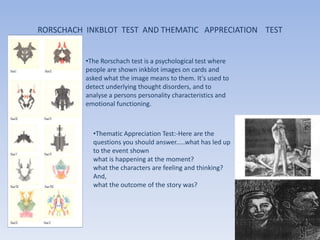
          •The Rorschach test is a psychological test where
          people are shown inkblot images on cards and
          asked what the image means to them. It's used to
          detect underlying thought disorders, and to
          analyse a persons personality characteristics and
          emotional functioning.


            •Thematic Appreciation Test:-Here are the
            questions you should answer.....what has led up
            to the event shown
            what is happening at the moment?
            what the characters are feeling and thinking?
            And,
            what the outcome of the story was?
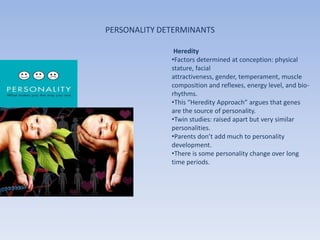
PERSONALITY DETERMINANTS

               Heredity
              •Factors determined at conception: physical
              stature, facial
              attractiveness, gender, temperament, muscle
              composition and reflexes, energy level, and bio-
              rhythms.
              •This “Heredity Approach” argues that genes
              are the source of personality.
              •Twin studies: raised apart but very similar
              personalities.
              •Parents don’t add much to personality
              development.
              •There is some personality change over long
              time periods.
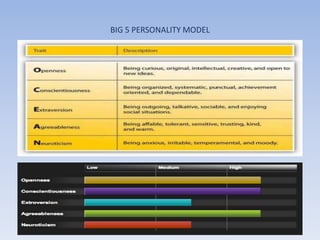
BIG 5 PERSONALITY MODEL
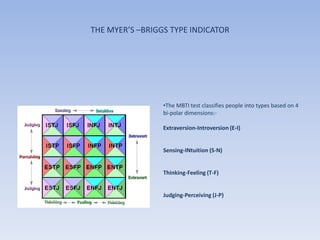
THE MYER’S –BRIGGS TYPE INDICATOR


                 •The MBTI test classifies people into types based on 4
                 bi-polar dimensions:-

                 Extraversion-Introversion (E-I)


                 Sensing-INtuition (S-N)


                 Thinking-Feeling (T-F)


                 Judging-Perceiving (J-P)
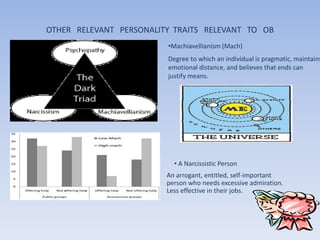
OTHER RELEVANT PERSONALITY TRAITS RELEVANT TO OB
                         •Machiavellianism (Mach)
                         Degree to which an individual is pragmatic, maintains
                         emotional distance, and believes that ends can
                         justify means.


                           • A Narcissistic Person
                         An arrogant, entitled, self-important
                         person who needs excessive admiration.
                         Less effective in their jobs.
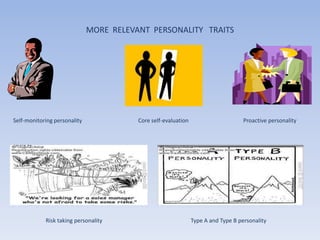
MORE RELEVANT PERSONALITY TRAITS


Self-monitoring personality              Core self-evaluation                       Proactive personality


            Risk taking personality                             Type A and Type B personality
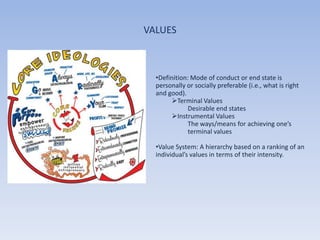
VALUES


  •Definition: Mode of conduct or end state is
  personally or socially preferable (i.e., what is right
  and good).
       Terminal Values
              Desirable end states
       Instrumental Values
              The ways/means for achieving one’s
              terminal values

  •Value System: A hierarchy based on a ranking of an
  individual’s values in terms of their intensity.
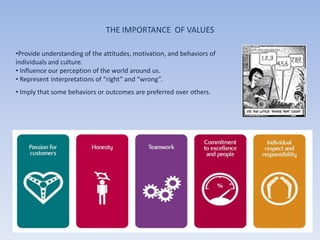
THE IMPORTANCE OF VALUES

•Provide understanding of the attitudes, motivation, and behaviors of
individuals and culture.
• Influence our perception of the world around us.
• Represent interpretations of “right” and “wrong”.
• Imply that some behaviors or outcomes are preferred over others.
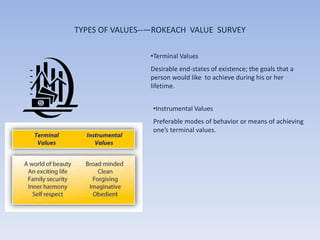
TYPES OF VALUES--—ROKEACH VALUE SURVEY

                •Terminal Values
                Desirable end-states of existence; the goals that a
                person would like to achieve during his or her
                lifetime.


                 •Instrumental Values
                 Preferable modes of behavior or means of achieving
                 one’s terminal values.
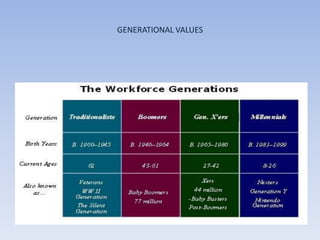
GENERATIONAL VALUES
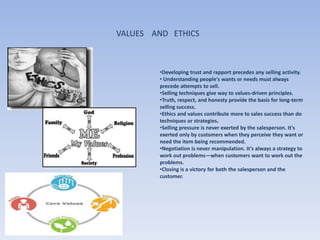
VALUES AND ETHICS


        •Developing trust and rapport precedes any selling activity.
        • Understanding people's wants or needs must always
        precede attempts to sell.
        •Selling techniques give way to values-driven principles.
        •Truth, respect, and honesty provide the basis for long-term
        selling success.
        •Ethics and values contribute more to sales success than do
        techniques or strategies.
        •Selling pressure is never exerted by the salesperson. It's
        exerted only by customers when they perceive they want or
        need the item being recommended.
        •Negotiation is never manipulation. It's always a strategy to
        work out problems—when customers want to work out the
        problems.
        •Closing is a victory for both the salesperson and the
        customer.
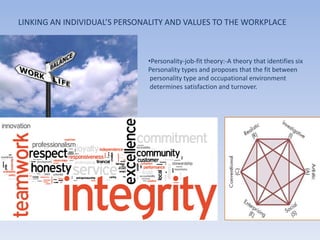
LINKING AN INDIVIDUAL’S PERSONALITY AND VALUES TO THE WORKPLACE


                              •Personality-job-fit theory:-A theory that identifies six
                              Personality types and proposes that the fit between
                               personality type and occupational environment
                               determines satisfaction and turnover.
Personality and values

Personality and values

  • 1.
    PERSONALITY AND VALUES IN ORGANIZATIONAL BEHAVIOR----BY Nilormi Das.
  • 2.
    PERSONALITY AND PERSONALITYTRAITS The dynamic organization within the individual of those psychophysical systems that determine his unique adjustments to his environment. - Gordon Allport •Personality:-The sum total of ways in which an individual reacts to an d interacts with other. •Personality traits:-Enduring characteristics that describe an individual’s behavior.
  • 3.
    RORSCHACH INKBLOT TESTAND THEMATIC APPRECIATION TEST •The Rorschach test is a psychological test where people are shown inkblot images on cards and asked what the image means to them. It's used to detect underlying thought disorders, and to analyse a persons personality characteristics and emotional functioning. •Thematic Appreciation Test:-Here are the questions you should answer.....what has led up to the event shown what is happening at the moment? what the characters are feeling and thinking? And, what the outcome of the story was?
  • 4.
    PERSONALITY DETERMINANTS Heredity •Factors determined at conception: physical stature, facial attractiveness, gender, temperament, muscle composition and reflexes, energy level, and bio- rhythms. •This “Heredity Approach” argues that genes are the source of personality. •Twin studies: raised apart but very similar personalities. •Parents don’t add much to personality development. •There is some personality change over long time periods.
  • 5.
  • 6.
    THE MYER’S –BRIGGSTYPE INDICATOR •The MBTI test classifies people into types based on 4 bi-polar dimensions:- Extraversion-Introversion (E-I) Sensing-INtuition (S-N) Thinking-Feeling (T-F) Judging-Perceiving (J-P)
  • 7.
    OTHER RELEVANT PERSONALITYTRAITS RELEVANT TO OB •Machiavellianism (Mach) Degree to which an individual is pragmatic, maintains emotional distance, and believes that ends can justify means. • A Narcissistic Person An arrogant, entitled, self-important person who needs excessive admiration. Less effective in their jobs.
  • 8.
    MORE RELEVANT PERSONALITYTRAITS Self-monitoring personality Core self-evaluation Proactive personality Risk taking personality Type A and Type B personality
  • 9.
    VALUES •Definition:Mode of conduct or end state is personally or socially preferable (i.e., what is right and good). Terminal Values Desirable end states Instrumental Values The ways/means for achieving one’s terminal values •Value System: A hierarchy based on a ranking of an individual’s values in terms of their intensity.
  • 10.
    THE IMPORTANCE OFVALUES •Provide understanding of the attitudes, motivation, and behaviors of individuals and culture. • Influence our perception of the world around us. • Represent interpretations of “right” and “wrong”. • Imply that some behaviors or outcomes are preferred over others.
  • 11.
    TYPES OF VALUES--—ROKEACHVALUE SURVEY •Terminal Values Desirable end-states of existence; the goals that a person would like to achieve during his or her lifetime. •Instrumental Values Preferable modes of behavior or means of achieving one’s terminal values.
  • 12.
  • 13.
    VALUES AND ETHICS •Developing trust and rapport precedes any selling activity. • Understanding people's wants or needs must always precede attempts to sell. •Selling techniques give way to values-driven principles. •Truth, respect, and honesty provide the basis for long-term selling success. •Ethics and values contribute more to sales success than do techniques or strategies. •Selling pressure is never exerted by the salesperson. It's exerted only by customers when they perceive they want or need the item being recommended. •Negotiation is never manipulation. It's always a strategy to work out problems—when customers want to work out the problems. •Closing is a victory for both the salesperson and the customer.
  • 14.
    LINKING AN INDIVIDUAL’SPERSONALITY AND VALUES TO THE WORKPLACE •Personality-job-fit theory:-A theory that identifies six Personality types and proposes that the fit between personality type and occupational environment determines satisfaction and turnover.