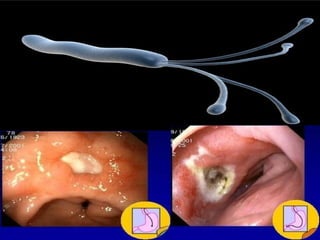
PEPTIC ULCER DISEASE
www.medrockets.com
Fb:Medrockets
DEFINITION AND DESCRIPTIONDEFINITION AND DESCRIPTION
♥ Peptic ulcers are produced by an imbalance between the
gastro-duodenal mucosal defense mechanisms and damaging
forces of gastric acid and pepsin, combined with superimposed
injury from environmental or immunologic agents.
♥It is a focal or circumscribed defect in the mucosa
extending into the submucosa or deeper ,due to acid or
pepsin digestion
♥The mucous membrane lining the digestive tract erodes and
causes a gradual breakdown of tissue. This breakdown causes
a gnawing or burning pain in the upper middle part of the belly
(abdomen). www.medrockets.com
Fb:Medrockets
EPIDEMIOLOGY
₪ As many as 80% of ulcers are associated with Helicobacter
pylori, a spiral-shaped bacterium that lives in the acidic
environment of the stomach.
₪ Ulcers can also be caused or worsened by drugs such as
aspirin and other NSAIDs.
₪ Although H. pylori infection is usually contracted in
childhood, perhaps through food, water, or close contact with
an infected individual. usually doesn't cause problems in
childhood, if left untreated it can cause gastritis (the irritation
and inflammation of the lining of the stomach), peptic ulcer
disease, and even stomach cancer later in life.
www.medrockets.com
Fb:Medrockets
EPIDEMIOLOGY
₪ Contrary to general belief, more peptic ulcers arise in the
duodenum (first part of the small intestine, just after the
stomach) than in the stomach.
₪ Duodenal ulcers usually first occur between the ages of 30-50
years and are twice as common in men as in women.
₪ Stomach (or gastric) ulcers usually occur in people older than
60 years and are more common in women.
www.medrockets.com
Fb:Medrockets
EPIDEMIOLOGY
• It is one of the most prevalent GI diseases
• Commoner in males
• Peak age of occurrence for DU is 35years.
• Gastric ulcers usually occurs in the older age
group (45-65 years)
www.medrockets.com
Fb:Medrockets
LOCATIONS
•It can occur in any of these locations- lower
esophagus, stomach, duodenum, jejunum,
meckel’s diverticulum
•Mostly occur at/or near mucosa junctions e.g-
oesophago-gastric, antra-pyloric;pyloro-
duodenal ,gastrojejunostomy sites.
www.medrockets.com
Fb:Medrockets
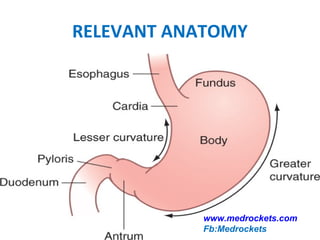
RELEVANT ANATOMY
www.medrockets.com
Fb:Medrockets
PATHOGENESIS
• Peptic ulcer usually occurs as a result of
imbalance between noxious agents and the
gastro duodenal defence barrier
• These mechanisms prevent and repair injury
to the mucosa.It includes the following
– Mucus bicarbonate layer-bicarbonate and mucous
are produced by surface epithelium of the
stomach and duodenum
• It neutralizes diffusing H+ ions.
www.medrockets.com
Fb:Medrockets
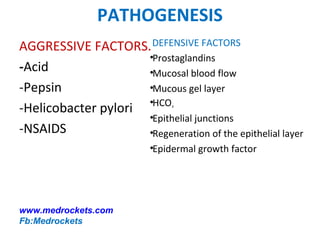
PATHOGENESIS
AGGRESSIVE FACTORS.
-Acid
-Pepsin
-Helicobacter pylori
-NSAIDS
DEFENSIVE FACTORS
•Prostaglandins
•Mucosal blood flow
•Mucous gel layer
•HCO3
•Epithelial junctions
•Regeneration of the epithelial layer
•Epidermal growth factor
www.medrockets.com
Fb:Medrockets
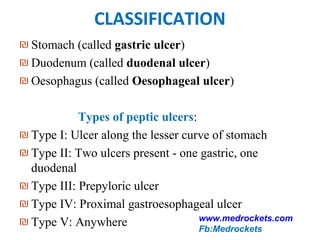
CLASSIFICATION
₪ Stomach (called gastric ulcer)
₪ Duodenum (called duodenal ulcer)
₪ Oesophagus (called Oesophageal ulcer)
Types of peptic ulcers:
₪ Type I: Ulcer along the lesser curve of stomach
₪ Type II: Two ulcers present - one gastric, one
duodenal
₪ Type III: Prepyloric ulcer
₪ Type IV: Proximal gastroesophageal ulcer
₪ Type V: Anywhere www.medrockets.com
Fb:Medrockets
ETIOLOGICAL FACTORS
ETIOLOGICAL FACTORS
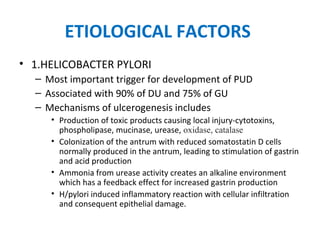
• 1.HELICOBACTER PYLORI
– Most important trigger for development of PUD
– Associated with 90% of DU and 75% of GU
– Mechanisms of ulcerogenesis includes
• Production of toxic products causing local injury-cytotoxins,
phospholipase, mucinase, urease, oxidase, catalase
• Colonization of the antrum with reduced somatostatin D cells
normally produced in the antrum, leading to stimulation of gastrin
and acid production
• Ammonia from urease activity creates an alkaline environment
which has a feedback effect for increased gastrin production
• H/pylori induced inflammatory reaction with cellular infiltration
and consequent epithelial damage.
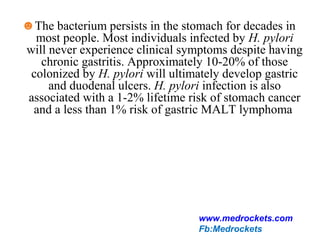
☻The bacterium persists in the stomach for decades in
most people. Most individuals infected by H. pylori
will never experience clinical symptoms despite having
chronic gastritis. Approximately 10-20% of those
colonized by H. pylori will ultimately develop gastric
and duodenal ulcers. H. pylori infection is also
associated with a 1-2% lifetime risk of stomach cancer
and a less than 1% risk of gastric MALT lymphoma
www.medrockets.com
Fb:Medrockets
ETIOLOGICAL FACTORS
• 2.NSAIDS
– It is the next most important factor in ulcer
pathogenesis after H/pylori
– Mechanisms of ulcerogenesis include
• Inhibition of mucosa prostaglandin synthesis by
suppressing COX-1 activity
• NSAIDs are weak acids that are able to migrate into
surface epithelial cells
• NSAIDs decrease the hydrophobicity of gastric mucus
which normally repels acid
www.medrockets.com
Fb:Medrockets
ETIOLOGY FACTORS
3. Increased gastric acid secretion
– This may result from the following
• Increased vagal stimulation from worry, anxiety, stress, alcohol
• Increased parietal cell mass-this may be genetic or acquired (e.g
gastrinoma)
• Hypercalcemia-stimulates increased gastrin secretion
4.Alcohol
stimulates increased acid production
Leaches out glycolipid under the mucus coat
5.Smoking
increases gastric acid production
decreases gastroduodenal PGH and HCO3 production
increases duodenogastric reflux
www.medrockets.com
Fb:Medrockets
ETIOLOGICAL FACTORS
• 6.Ischemia
– Reduces the mucosa defence barrier
• 7.Enterogastric bile reflux
– This occurs if the pyloric sphincter is incompetent
or following a gastrojejunostomy
– Bile acids and pancreatic secretions stimulate
gastrin release with increased acid output as well
as repair the mocosa barrier allowing acid back
diffusion
www.medrockets.com
Fb:Medrockets
PATHOLOGY
• Duodenal ulcer
– Most involve the first part of the duodenum
– May be anterior, posterior, antero-posterior(kissing
ulcer), anterosuperior, posterosuperior
– Anterior ulcers tend to perforate while posterior
ulcers tend to penetrate sometimes into large
vessels like the GD artery causing UGI bleeding
– Chronic ulcers may heal with fibrosis with extensive
cicatrisation leading to gastric outlet obstruction.
– They are not usually associated with malignancy
www.medrockets.com
Fb:Medrockets
PATHOLOGY
• Gastric ulcer
– Most are found in the lesser curvature especially
at the incisura angularis
– Tend to be larger than DU
– May also be complicated by perforation or
penetration
– Unlike DU,they tend to be more associated with
malignancy,which must be excluded in all cases.
www.medrockets.com
Fb:Medrockets
• You’re at risk for peptic ulcer disease if you:
• Are 50 years old or older.
• Diabetes may increase your risk of having H. pylori
• Drink alcohol excessively
• Smoke cigarettes or use tobacco.
• Have a family history of ulcer disease.
• You’re at risk for NSAID-induced ulcers if you:
• Are age 60 or older (your stomach lining becomes more fragile with age).
• Have had past experiences with ulcers and internal bleeding
• Take steroid medications, such as prednisone.
• Take blood thinners, such as warfarin.
• Consume alcohol or use tobacco on a regular basis.
• Experience certain side effects after taking NSAIDs, such as upset stomach and
heartburn.
• Take NSAIDs in amounts higher than recommended
• Take NSAIDs for long periods of time
• Stress does not cause an ulcer, but may be a contributing factor
• Chronic disorders such as liver disease, emphysema, rheumatoid arthritis may
increase vulnerability to ulcers
• Improper diet, irregular or skipped meals
• Type O blood (for duodenal ulcers) www.medrockets.com
Fb:Medrockets
Clinical presentation
Symptoms
•Burning abdominal pain
•Haematemesis
•Melena
•Nausea or vomiting
•Unexplained weight loss
•Anorexia
•Abdominal fullness
Symptoms of H. pylori
•Abdominal pain
•Feeling of Fullness
•Indigestion
•Feeling very hungry 1 to 3
hours after eating
•Mild nausea
•Pain Starts 2/3 hours after
meals, or in the middle of
the night
www.medrockets.com
Fb:Medrockets
• Pain(most common presentation-90% of cases)
– Usually a gnawing or burning pain in the
epigastrum,intermittent and may radiate to the back.
– Pain may be aggravated by meals as in GU,or
aggravated by hunger and relieved by meals or
antacids(DU)
– Diurnal variation(DU)
• Vomiting
– More common in cases of gastric outlet obstruction
but may occur even in acute PUD exercebation
Gastric versus duodenal ulcer — Although there is much 
overlap, symptoms of a gastric ulcer may be different than those of 
a duodenal ulcer.
Duodenal ulcer — "Classic" symptoms of a duodenal ulcer 
include burning, gnawing, aching, or hunger-like pain, primarily in 
the upper middle region of the abdomen below the breastbone (the 
epigastric region). Pain may occur or worsen when the stomach is 
empty, usually two to five hours after a meal. Symptoms may 
occur at night between 11 PM and 2 AM, when acid secretion 
tends to be greatest.
Feel better when you eat or drink and then worse 1 or 2 hours later 
(duodenal ulcer).
Gastric ulcer — Symptoms of a gastric ulcer typically include 
pain soon after eating. Symptoms are sometimes not relieved by 
eating or taking antacids.
Feel worse when you eat or drink (gastric ulcer)
www.medrockets.com
Fb:Medrockets
www.medrockets.com
Fb:Medrockets
Differential diagnosis
• Reflux oesophagitis
• Cholelithiasis
• Pancreatitis
• Gastric cancer
• Ca transverse colon
www.medrockets.com
Fb:Medrockets
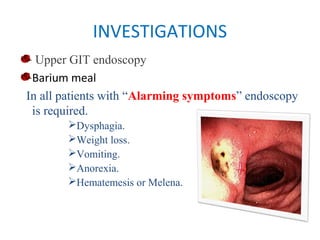
INVESTIGATIONS
 Upper GIT endoscopy
Barium meal
  In all patients with “Alarming symptoms” endoscopy  
is required. 
Dysphagia.
Weight loss.
Vomiting.
Anorexia.
Hematemesis or Melena.
Test for diagnosing H.pylori
Urea breath test :by measuring the
amount of co2 in exhaled breath.
Blood test: by identifying H.pylori
antibodies by ELISA test.
Stool test :stool sample tested with
H.pylori antigen and occult blood
Rapid urea test
Culture www.medrockets.com
Fb:Medrockets
TREATMENT
GOALS OF TREATMENT
☻ lowering the amount of acid that stomach makes, 
☻neutralizing the acid 
☻ protecting the injured area so it can heal
☻ It's also very important to stop smoking and drinking alcohol
☻Prevent complications (bleeding, perforation, penetration, 
obstruction) 
☻Minimize recurrences 
☻Reduce financial costs
www.medrockets.com
Fb:Medrockets
Treatment
• Medical management is the main stay of
treatment of uncomplicated peptic ulcer disease.
– Life style modification
– Neutralization of the acid: antacids e.g magnesium
trisilicate, Alumilium hydroxide
– Reduction of acid secretion-H2 receptor
blockers(cimetidine, ranitidine), proton pump
inhibitors(omeprazole, rabeprazole)
– H/pylori eradication therapy is currently the main stay
of treatment
www.medrockets.com
Fb:Medrockets
• Stop smoking
• Limit alcohol intake
• Avoid spicy foods
• Avoid caffeine containing foods
• Good rest and sleep
• Exercise
• Eat fruits often
• Avoid NSAIDS
• USE OLIVE OIL
Life-style modification in PUD
www.medrockets.com
Fb:Medrockets
REDUCTION OF GASTRIC ACID SECRETION
• Histamine antagonist: Cimetidine,
ranitidine
• Proton pump inhibitors: omeprazole,
pantaprazole
• Acetyl choline antagonist: pirenzepine,
propantheline
• Prostaglandin analogue: misoprostol
www.medrockets.com
Fb:Medrockets
 Neutralization of gastric acid(antacids)
Systemic : Sodium bicarbonate, Sodium
citrate
Nonsystemic : Magnesium hydroxide ,
Aluminium hydroxides
Ulcer protectives : Sucralfate
Anti helicobacter pylori: amoxicillin,
clarithromycin etc
www.medrockets.com
Fb:Medrockets
www.medrockets.com
Fb:Medrockets
• Cimetidine
• .Histamine antagonists inhibit the action of histamine on
the acid-producing cells of the stomach and reduce
stomach acid
SIDE EFFECTS; it include constipation, diarrhea, fatigue,
headache, insomnia, muscle pain, and vomiting. Major
side effects include confusion and hallucinations,
gynacomastia (enlargement of the breasts); impotence.
• USES: it is used in treatment of duodenal ulcer,
Gastric ulcer, stress ulcer, GERD, zollinger ellison syndrome
Histamine antagonist
PROTON PUMP INHIBITORS
www.medrockets.com
Fb:Medrockets
• Proton pump inhibitors act by irreversibly blocking
the hydrogen/potassium adenosine
triphosphatase enzyme system of the
gastric parietal cells.
• The proton pump is the terminal stage in gastric acid
secretion
• SIDE EFFECTS Stomach pain,
Diarrhea,Constipation,Dizziness,Pain,Hives,
Itching,seizures
ACETYL CHOLINE ANTAGONIST
PIRENZEPINE
 MECHANISM:
• It selectively block M1 muscaranic
recptors and inhibits gastric secretion.
• Because of their relatively poor efficacy,
side effects, and risk of blood disorders,
they are rarely used today
www.medrockets.com
Fb:Medrockets
AGENTS THAT ENHANCE MUCOSAL DEFENSE
Prostaglandin Analogues:
prostaglandins are produced in the gastric
mucosa and appear to serve a protective role by
inhibiting acid secretion and promoting mucus
and bicarbonate secretion.
In addition, PGs inhibits gastrin production, increase
mucosal blood flow and probably have an ill defined
cytoprotective action.
DRUGS: Misoprostol
www.medrockets.com
Fb:Medrockets
ULCER PROTECTIVES
www.medrockets.com
Fb:Medrockets
SUCRALFATE
MECHANISM:
• Sucralfate is a locally acting substance that in an acidic environment
(pH < 4), reacts with hydrochloric acid in the stomach to form a
cross-linking, viscous, paste-like material capable of acting as an acid
buffer for as long as 6 to 8 hours after a single dose. It also attaches
to proteins on the surface of ulcers, such as albumin and fibrinogen,
to form stable insoluble complexes. These complexes serve as
protective barriers at the ulcer surface, preventing further damage
from acid, pepsin, and bile.
• USES: It is used in treatment of Gastritis, Stress ulcers
• Side effects
The most common side effects seen are constipation. Less commonly
reported include flatulence, cephalalgia (headache), xerostomia (dry
mouth).
Sodium bicarbonate (antacid)
It is water soluble, acts instantaneously, but
duration of action is short. It is a potent
neutralizer, pH may raises above 7.
Adverse reactions
It causes systemic alkalosis, gastric distention,
rebound acidity and milk-alkali syndrome
Uses
It is restricted to casual treatment of heartburn
and to treat acidosis
ANTI H.PYLORI DRUGS
www.medrockets.com
Fb:Medrockets
 Anti microbials that have been found clinically
effective against H.pylori are: amoxicillin,
clarithromycin, tetracycline and metronidazole.
A combination regimen is preferred, using gastric
acid inhibitors and antibiotics. TRIPLE THERAPY
Example:
A proton pump inhibitor or H2 blocker +
amoxicillin + clarithromycin or metronidazole
Surgical Treatment
• The role of surgery has reduced significantly since
the advent of H/pylori eradication therapy
• Indicated only in intractable cases and in the
management of complications.
• Acid reducing procedures include
• Truncal vagotomy+drainage
• Selective vagotomy+drainage(preservation of the coeliac
and hepatic branches)
• Highly selective vagotomy-preservation of the nerve of
latarjet(no need for drainage)
• Vagotomy+antrectomy
• Bilroth 1 Partial gastrectomy
www.medrockets.com
Fb:Medrockets
Complications
• Upper gastrointestinal bleeding
• Perforation leading to peritonitis
• Penetration
• Gastric outlet obstruction
• Malignization
www.medrockets.com
Fb:Medrockets
Thank you
www.medrockets.com
Fb:Medrockets

Peptic ulcer disease

  • 1.
  • 2.
    DEFINITION AND DESCRIPTIONDEFINITIONAND DESCRIPTION ♥ Peptic ulcers are produced by an imbalance between the gastro-duodenal mucosal defense mechanisms and damaging forces of gastric acid and pepsin, combined with superimposed injury from environmental or immunologic agents. ♥It is a focal or circumscribed defect in the mucosa extending into the submucosa or deeper ,due to acid or pepsin digestion ♥The mucous membrane lining the digestive tract erodes and causes a gradual breakdown of tissue. This breakdown causes a gnawing or burning pain in the upper middle part of the belly (abdomen). www.medrockets.com Fb:Medrockets
  • 3.
    EPIDEMIOLOGY ₪ As manyas 80% of ulcers are associated with Helicobacter pylori, a spiral-shaped bacterium that lives in the acidic environment of the stomach. ₪ Ulcers can also be caused or worsened by drugs such as aspirin and other NSAIDs. ₪ Although H. pylori infection is usually contracted in childhood, perhaps through food, water, or close contact with an infected individual. usually doesn't cause problems in childhood, if left untreated it can cause gastritis (the irritation and inflammation of the lining of the stomach), peptic ulcer disease, and even stomach cancer later in life. www.medrockets.com Fb:Medrockets
  • 4.
    EPIDEMIOLOGY ₪ Contrary togeneral belief, more peptic ulcers arise in the duodenum (first part of the small intestine, just after the stomach) than in the stomach. ₪ Duodenal ulcers usually first occur between the ages of 30-50 years and are twice as common in men as in women. ₪ Stomach (or gastric) ulcers usually occur in people older than 60 years and are more common in women. www.medrockets.com Fb:Medrockets
  • 5.
    EPIDEMIOLOGY • It isone of the most prevalent GI diseases • Commoner in males • Peak age of occurrence for DU is 35years. • Gastric ulcers usually occurs in the older age group (45-65 years) www.medrockets.com Fb:Medrockets
  • 6.
    LOCATIONS •It can occurin any of these locations- lower esophagus, stomach, duodenum, jejunum, meckel’s diverticulum •Mostly occur at/or near mucosa junctions e.g- oesophago-gastric, antra-pyloric;pyloro- duodenal ,gastrojejunostomy sites. www.medrockets.com Fb:Medrockets
  • 7.
  • 8.
    PATHOGENESIS • Peptic ulcerusually occurs as a result of imbalance between noxious agents and the gastro duodenal defence barrier • These mechanisms prevent and repair injury to the mucosa.It includes the following – Mucus bicarbonate layer-bicarbonate and mucous are produced by surface epithelium of the stomach and duodenum • It neutralizes diffusing H+ ions. www.medrockets.com Fb:Medrockets
  • 9.
    PATHOGENESIS AGGRESSIVE FACTORS. -Acid -Pepsin -Helicobacter pylori -NSAIDS DEFENSIVEFACTORS •Prostaglandins •Mucosal blood flow •Mucous gel layer •HCO3 •Epithelial junctions •Regeneration of the epithelial layer •Epidermal growth factor www.medrockets.com Fb:Medrockets
  • 10.
    CLASSIFICATION ₪ Stomach (calledgastric ulcer) ₪ Duodenum (called duodenal ulcer) ₪ Oesophagus (called Oesophageal ulcer) Types of peptic ulcers: ₪ Type I: Ulcer along the lesser curve of stomach ₪ Type II: Two ulcers present - one gastric, one duodenal ₪ Type III: Prepyloric ulcer ₪ Type IV: Proximal gastroesophageal ulcer ₪ Type V: Anywhere www.medrockets.com Fb:Medrockets
  • 11.
  • 12.
    ETIOLOGICAL FACTORS • 1.HELICOBACTERPYLORI – Most important trigger for development of PUD – Associated with 90% of DU and 75% of GU – Mechanisms of ulcerogenesis includes • Production of toxic products causing local injury-cytotoxins, phospholipase, mucinase, urease, oxidase, catalase • Colonization of the antrum with reduced somatostatin D cells normally produced in the antrum, leading to stimulation of gastrin and acid production • Ammonia from urease activity creates an alkaline environment which has a feedback effect for increased gastrin production • H/pylori induced inflammatory reaction with cellular infiltration and consequent epithelial damage.
  • 13.
    ☻The bacterium persistsin the stomach for decades in most people. Most individuals infected by H. pylori will never experience clinical symptoms despite having chronic gastritis. Approximately 10-20% of those colonized by H. pylori will ultimately develop gastric and duodenal ulcers. H. pylori infection is also associated with a 1-2% lifetime risk of stomach cancer and a less than 1% risk of gastric MALT lymphoma www.medrockets.com Fb:Medrockets
  • 15.
    ETIOLOGICAL FACTORS • 2.NSAIDS –It is the next most important factor in ulcer pathogenesis after H/pylori – Mechanisms of ulcerogenesis include • Inhibition of mucosa prostaglandin synthesis by suppressing COX-1 activity • NSAIDs are weak acids that are able to migrate into surface epithelial cells • NSAIDs decrease the hydrophobicity of gastric mucus which normally repels acid www.medrockets.com Fb:Medrockets
  • 16.
    ETIOLOGY FACTORS 3. Increasedgastric acid secretion – This may result from the following • Increased vagal stimulation from worry, anxiety, stress, alcohol • Increased parietal cell mass-this may be genetic or acquired (e.g gastrinoma) • Hypercalcemia-stimulates increased gastrin secretion 4.Alcohol stimulates increased acid production Leaches out glycolipid under the mucus coat 5.Smoking increases gastric acid production decreases gastroduodenal PGH and HCO3 production increases duodenogastric reflux www.medrockets.com Fb:Medrockets
  • 17.
    ETIOLOGICAL FACTORS • 6.Ischemia –Reduces the mucosa defence barrier • 7.Enterogastric bile reflux – This occurs if the pyloric sphincter is incompetent or following a gastrojejunostomy – Bile acids and pancreatic secretions stimulate gastrin release with increased acid output as well as repair the mocosa barrier allowing acid back diffusion www.medrockets.com Fb:Medrockets
  • 18.
    PATHOLOGY • Duodenal ulcer –Most involve the first part of the duodenum – May be anterior, posterior, antero-posterior(kissing ulcer), anterosuperior, posterosuperior – Anterior ulcers tend to perforate while posterior ulcers tend to penetrate sometimes into large vessels like the GD artery causing UGI bleeding – Chronic ulcers may heal with fibrosis with extensive cicatrisation leading to gastric outlet obstruction. – They are not usually associated with malignancy www.medrockets.com Fb:Medrockets
  • 19.
    PATHOLOGY • Gastric ulcer –Most are found in the lesser curvature especially at the incisura angularis – Tend to be larger than DU – May also be complicated by perforation or penetration – Unlike DU,they tend to be more associated with malignancy,which must be excluded in all cases. www.medrockets.com Fb:Medrockets
  • 20.
    • You’re atrisk for peptic ulcer disease if you: • Are 50 years old or older. • Diabetes may increase your risk of having H. pylori • Drink alcohol excessively • Smoke cigarettes or use tobacco. • Have a family history of ulcer disease. • You’re at risk for NSAID-induced ulcers if you: • Are age 60 or older (your stomach lining becomes more fragile with age). • Have had past experiences with ulcers and internal bleeding • Take steroid medications, such as prednisone. • Take blood thinners, such as warfarin. • Consume alcohol or use tobacco on a regular basis. • Experience certain side effects after taking NSAIDs, such as upset stomach and heartburn. • Take NSAIDs in amounts higher than recommended • Take NSAIDs for long periods of time • Stress does not cause an ulcer, but may be a contributing factor • Chronic disorders such as liver disease, emphysema, rheumatoid arthritis may increase vulnerability to ulcers • Improper diet, irregular or skipped meals • Type O blood (for duodenal ulcers) www.medrockets.com Fb:Medrockets
  • 21.
    Clinical presentation Symptoms •Burning abdominalpain •Haematemesis •Melena •Nausea or vomiting •Unexplained weight loss •Anorexia •Abdominal fullness Symptoms of H. pylori •Abdominal pain •Feeling of Fullness •Indigestion •Feeling very hungry 1 to 3 hours after eating •Mild nausea •Pain Starts 2/3 hours after meals, or in the middle of the night www.medrockets.com Fb:Medrockets
  • 22.
    • Pain(most commonpresentation-90% of cases) – Usually a gnawing or burning pain in the epigastrum,intermittent and may radiate to the back. – Pain may be aggravated by meals as in GU,or aggravated by hunger and relieved by meals or antacids(DU) – Diurnal variation(DU) • Vomiting – More common in cases of gastric outlet obstruction but may occur even in acute PUD exercebation
  • 23.
    Gastric versus duodenalulcer — Although there is much  overlap, symptoms of a gastric ulcer may be different than those of  a duodenal ulcer. Duodenal ulcer — "Classic" symptoms of a duodenal ulcer  include burning, gnawing, aching, or hunger-like pain, primarily in  the upper middle region of the abdomen below the breastbone (the  epigastric region). Pain may occur or worsen when the stomach is  empty, usually two to five hours after a meal. Symptoms may  occur at night between 11 PM and 2 AM, when acid secretion  tends to be greatest. Feel better when you eat or drink and then worse 1 or 2 hours later  (duodenal ulcer). Gastric ulcer — Symptoms of a gastric ulcer typically include  pain soon after eating. Symptoms are sometimes not relieved by  eating or taking antacids. Feel worse when you eat or drink (gastric ulcer)
  • 24.
  • 25.
  • 26.
    Differential diagnosis • Refluxoesophagitis • Cholelithiasis • Pancreatitis • Gastric cancer • Ca transverse colon www.medrockets.com Fb:Medrockets
  • 27.
  • 28.
    Test for diagnosingH.pylori Urea breath test :by measuring the amount of co2 in exhaled breath. Blood test: by identifying H.pylori antibodies by ELISA test. Stool test :stool sample tested with H.pylori antigen and occult blood Rapid urea test Culture www.medrockets.com Fb:Medrockets
  • 29.
  • 30.
    Treatment • Medical managementis the main stay of treatment of uncomplicated peptic ulcer disease. – Life style modification – Neutralization of the acid: antacids e.g magnesium trisilicate, Alumilium hydroxide – Reduction of acid secretion-H2 receptor blockers(cimetidine, ranitidine), proton pump inhibitors(omeprazole, rabeprazole) – H/pylori eradication therapy is currently the main stay of treatment www.medrockets.com Fb:Medrockets
  • 31.
    • Stop smoking •Limit alcohol intake • Avoid spicy foods • Avoid caffeine containing foods • Good rest and sleep • Exercise • Eat fruits often • Avoid NSAIDS • USE OLIVE OIL Life-style modification in PUD www.medrockets.com Fb:Medrockets
  • 32.
    REDUCTION OF GASTRICACID SECRETION • Histamine antagonist: Cimetidine, ranitidine • Proton pump inhibitors: omeprazole, pantaprazole • Acetyl choline antagonist: pirenzepine, propantheline • Prostaglandin analogue: misoprostol www.medrockets.com Fb:Medrockets
  • 33.
     Neutralization ofgastric acid(antacids) Systemic : Sodium bicarbonate, Sodium citrate Nonsystemic : Magnesium hydroxide , Aluminium hydroxides Ulcer protectives : Sucralfate Anti helicobacter pylori: amoxicillin, clarithromycin etc www.medrockets.com Fb:Medrockets
  • 34.
    www.medrockets.com Fb:Medrockets • Cimetidine • .Histamineantagonists inhibit the action of histamine on the acid-producing cells of the stomach and reduce stomach acid SIDE EFFECTS; it include constipation, diarrhea, fatigue, headache, insomnia, muscle pain, and vomiting. Major side effects include confusion and hallucinations, gynacomastia (enlargement of the breasts); impotence. • USES: it is used in treatment of duodenal ulcer, Gastric ulcer, stress ulcer, GERD, zollinger ellison syndrome Histamine antagonist
  • 35.
    PROTON PUMP INHIBITORS www.medrockets.com Fb:Medrockets •Proton pump inhibitors act by irreversibly blocking the hydrogen/potassium adenosine triphosphatase enzyme system of the gastric parietal cells. • The proton pump is the terminal stage in gastric acid secretion • SIDE EFFECTS Stomach pain, Diarrhea,Constipation,Dizziness,Pain,Hives, Itching,seizures
  • 36.
    ACETYL CHOLINE ANTAGONIST PIRENZEPINE MECHANISM: • It selectively block M1 muscaranic recptors and inhibits gastric secretion. • Because of their relatively poor efficacy, side effects, and risk of blood disorders, they are rarely used today www.medrockets.com Fb:Medrockets
  • 37.
    AGENTS THAT ENHANCEMUCOSAL DEFENSE Prostaglandin Analogues: prostaglandins are produced in the gastric mucosa and appear to serve a protective role by inhibiting acid secretion and promoting mucus and bicarbonate secretion. In addition, PGs inhibits gastrin production, increase mucosal blood flow and probably have an ill defined cytoprotective action. DRUGS: Misoprostol www.medrockets.com Fb:Medrockets
  • 38.
    ULCER PROTECTIVES www.medrockets.com Fb:Medrockets SUCRALFATE MECHANISM: • Sucralfateis a locally acting substance that in an acidic environment (pH < 4), reacts with hydrochloric acid in the stomach to form a cross-linking, viscous, paste-like material capable of acting as an acid buffer for as long as 6 to 8 hours after a single dose. It also attaches to proteins on the surface of ulcers, such as albumin and fibrinogen, to form stable insoluble complexes. These complexes serve as protective barriers at the ulcer surface, preventing further damage from acid, pepsin, and bile. • USES: It is used in treatment of Gastritis, Stress ulcers • Side effects The most common side effects seen are constipation. Less commonly reported include flatulence, cephalalgia (headache), xerostomia (dry mouth).
  • 39.
    Sodium bicarbonate (antacid) Itis water soluble, acts instantaneously, but duration of action is short. It is a potent neutralizer, pH may raises above 7. Adverse reactions It causes systemic alkalosis, gastric distention, rebound acidity and milk-alkali syndrome Uses It is restricted to casual treatment of heartburn and to treat acidosis
  • 40.
    ANTI H.PYLORI DRUGS www.medrockets.com Fb:Medrockets Anti microbials that have been found clinically effective against H.pylori are: amoxicillin, clarithromycin, tetracycline and metronidazole. A combination regimen is preferred, using gastric acid inhibitors and antibiotics. TRIPLE THERAPY Example: A proton pump inhibitor or H2 blocker + amoxicillin + clarithromycin or metronidazole
  • 41.
    Surgical Treatment • Therole of surgery has reduced significantly since the advent of H/pylori eradication therapy • Indicated only in intractable cases and in the management of complications. • Acid reducing procedures include • Truncal vagotomy+drainage • Selective vagotomy+drainage(preservation of the coeliac and hepatic branches) • Highly selective vagotomy-preservation of the nerve of latarjet(no need for drainage) • Vagotomy+antrectomy • Bilroth 1 Partial gastrectomy www.medrockets.com Fb:Medrockets
  • 42.
    Complications • Upper gastrointestinalbleeding • Perforation leading to peritonitis • Penetration • Gastric outlet obstruction • Malignization www.medrockets.com Fb:Medrockets
  • 43.