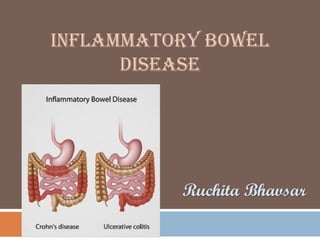
INFLAMMATORY BOWEL
DISEASE
Ruchita Bhavsar
2
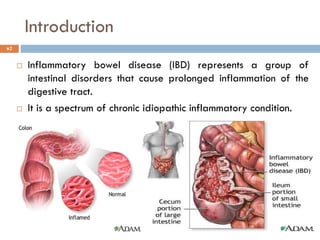
 Inflammatory bowel disease (IBD) represents a group of
intestinal disorders that cause prolonged inflammation of the
digestive tract.
 It is a spectrum of chronic idiopathic inflammatory condition.
Introduction
Classification
3
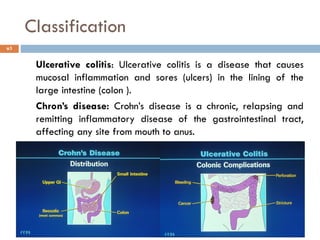
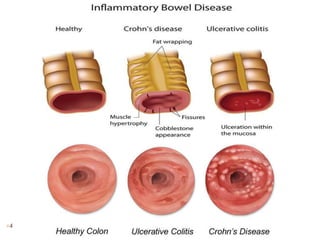
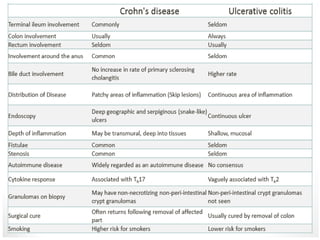
Ulcerative colitis: Ulcerative colitis is a disease that causes
mucosal inflammation and sores (ulcers) in the lining of the
large intestine (colon ).
Chron’s disease: Crohn’s disease is a chronic, relapsing and
remitting inflammatory disease of the gastrointestinal tract,
affecting any site from mouth to anus.
4
Epidemiology
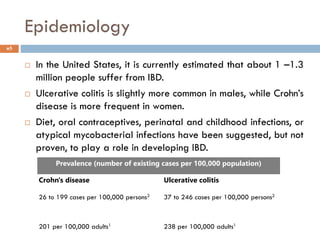
 In the United States, it is currently estimated that about 1 –1.3
million people suffer from IBD.
 Ulcerative colitis is slightly more common in males, while Crohn’s
disease is more frequent in women.
 Diet, oral contraceptives, perinatal and childhood infections, or
atypical mycobacterial infections have been suggested, but not
proven, to play a role in developing IBD.
5
Prevalence (number of existing cases per 100,000 population)
Crohn's disease Ulcerative colitis
26 to 199 cases per 100,000 persons2 37 to 246 cases per 100,000 persons2
201 per 100,000 adults1 238 per 100,000 adults1
6
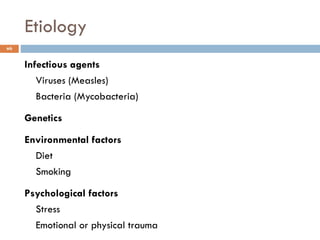
Infectious agents
Viruses (Measles)
Bacteria (Mycobacteria)
Genetics
Environmental factors
Diet
Smoking
Psychological factors
Stress
Emotional or physical trauma
Etiology
Pathophysiology
7
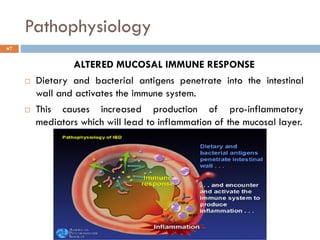
ALTERED MUCOSAL IMMUNE RESPONSE
 Dietary and bacterial antigens penetrate into the intestinal
wall and activates the immune system.
 This causes increased production of pro-inflammatory
mediators which will lead to inflammation of the mucosal layer.
Pathophysiology
8
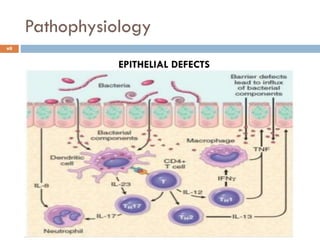
EPITHELIAL DEFECTS
Cont.
9
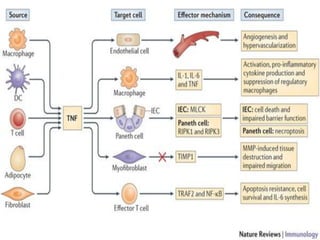
 Variety of epithelial defects have been described in Crohn’s
disease and Ulcerative Colitis.
 Defects in epithelial cells will lead to influx of bacterial
components such as dendritic cells and macrophages which
activates CD+4 cells.
 Activated CD+4 cells activate other inflammatory cells like B-cells
and variable T-cells or recruit more inflammatory cells by
stimulation of homing receptor on leucocytes and vascular
epithelium.
 Inflammation in IBD is maintained by an influx of leukocytes from
the vascular system into sites of active disease. This influx is
promoted by expression of adhesion molecules (such as α 4-
integrins) on the surface of endothelial cells in the
microvasculature in the area of inflammation.
10
Clinical Manifestations
11
Clinical symptoms are same in both case.
 Diarrhoea
 Abdominal pain, cramping & bloating due to bowel
obstruction
 Hematochezia : Blood in stool
 Low fever
 Decreased appetite
 Weight loss and anorexia
 Fatigue
 Arthritis
Diagnosis
12
 Physical Examination
 Endoscopy
 Biopsy
 Radiology
 Blood Test
Physical Examination
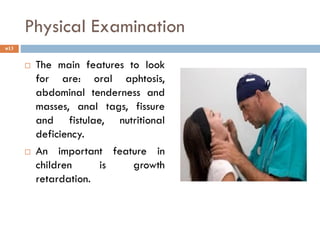
 The main features to look
for are: oral aphtosis,
abdominal tenderness and
masses, anal tags, fissure
and fistulae, nutritional
deficiency.
 An important feature in
children is growth
retardation.
13
Endoscopy/ Colonoscopy/ Sigmoidoscopy
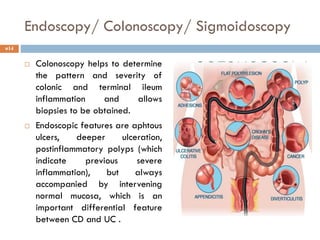
 Colonoscopy helps to determine
the pattern and severity of
colonic and terminal ileum
inflammation and allows
biopsies to be obtained.
 Endoscopic features are aphtous
ulcers, deeper ulceration,
postinflammatory polyps (which
indicate previous severe
inflammation), but always
accompanied by intervening
normal mucosa, which is an
important differential feature
between CD and UC .
14
Biopsy
15
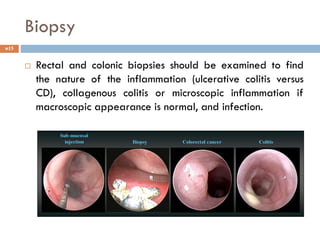
 Rectal and colonic biopsies should be examined to find
the nature of the inflammation (ulcerative colitis versus
CD), collagenous colitis or microscopic inflammation if
macroscopic appearance is normal, and infection.
Radiology
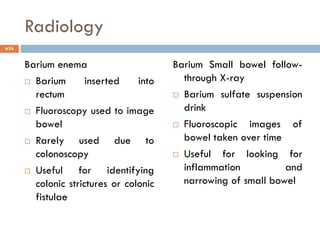
Barium enema
 Barium inserted into
rectum
 Fluoroscopy used to image
bowel
 Rarely used due to
colonoscopy
 Useful for identifying
colonic strictures or colonic
fistulae
Barium Small bowel follow-
through X-ray
 Barium sulfate suspension
drink
 Fluoroscopic images of
bowel taken over time
 Useful for looking for
inflammation and
narrowing of small bowel
16
Blood Test
17
 Anemia may be present due to blood loss (iron deficiency),
chronic inflammation or B12 malabsorption (macrocytic).
 Hypoalbuminemia suggests severe disease with denutrition.
The best markers of inflammation severity are elevation of
the C-reactive protein and platelet count.
 Anti-saccharomyces cerevisiae antibodies (ASCA) are
positive in 50-60% of CD patients while anti-neutrophil
polynuclear antibodies (ANCA) are positive in 50-60% of
UC patients.
18
19
 Maintain or improve quality of life.
 Terminate the acute attack and induce clinical remission.
 Prevent symptoms during chronic symptomatic periods.
 Prevent or reduce complication.
 Use the most cost-effective drug treatment.
 Avoid surgery if possible.
 Replacement of vitamin A, D, K if necessary in case of
malabsorption.
Goals of Treatment
Non-Pharmacological Treatment
 To avoid smoking cessation
 To reduce alcohol consumption
 To avoid the use of NSAIDs
 To avoid spicy and fried/oily food
 To take fiber rich diet as tolerated that include tender
cooked vegetables, canned or cooked fruits, and starches
like cooked cereals and whole wheat noodles and tortillas.
 To incorporate more omega-3 fatty acids in the diet. These
fats may have an anti-inflammatory effect. They are found
most probably in fish.
20
21
Surgery for Ulcerative Colitis
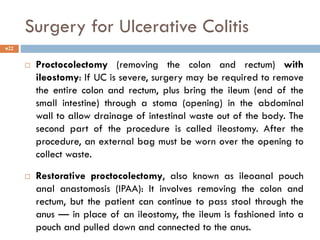
 Proctocolectomy (removing the colon and rectum) with
ileostomy: If UC is severe, surgery may be required to remove
the entire colon and rectum, plus bring the ileum (end of the
small intestine) through a stoma (opening) in the abdominal
wall to allow drainage of intestinal waste out of the body. The
second part of the procedure is called ileostomy. After the
procedure, an external bag must be worn over the opening to
collect waste.
 Restorative proctocolectomy, also known as ileoanal pouch
anal anastomosis (IPAA): It involves removing the colon and
rectum, but the patient can continue to pass stool through the
anus — in place of an ileostomy, the ileum is fashioned into a
pouch and pulled down and connected to the anus.
22
Surgery for Crohn’s Disease
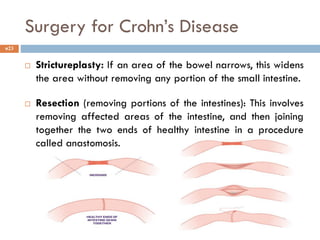
 Strictureplasty: If an area of the bowel narrows, this widens
the area without removing any portion of the small intestine.
 Resection (removing portions of the intestines): This involves
removing affected areas of the intestine, and then joining
together the two ends of healthy intestine in a procedure
called anastomosis.
23
Cont..
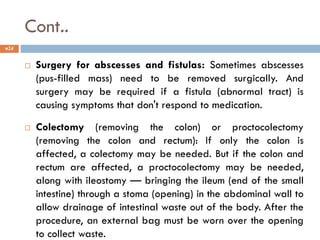
 Surgery for abscesses and fistulas: Sometimes abscesses
(pus-filled mass) need to be removed surgically. And
surgery may be required if a fistula (abnormal tract) is
causing symptoms that don't respond to medication.
 Colectomy (removing the colon) or proctocolectomy
(removing the colon and rectum): If only the colon is
affected, a colectomy may be needed. But if the colon and
rectum are affected, a proctocolectomy may be needed,
along with ileostomy — bringing the ileum (end of the small
intestine) through a stoma (opening) in the abdominal wall to
allow drainage of intestinal waste out of the body. After the
procedure, an external bag must be worn over the opening
to collect waste.
24
Pharmacological Treatment
25
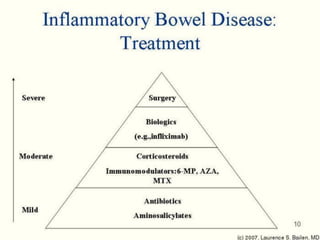
The major types of drug therapy used in IBD include
 Aminosalicylates
 Corticosteroids
 Immunosuppressive agents
 TNF – Tumor Necrosis Factor Inhibitor
 Antimicrobials
Aminosalicylates / 5-ASA
 These agents have anti-inflammatory effects. They are used
to maintain remission and to induce remission of mild flares
of disease.
 Egs., Sulfasalazine, Mesalamine
 Sulfasalazine and mesalamine are used to treat mild to
moderate disease and to maintain remission induced by
corticosteroids.
 Sulfasalazine is useful for ileocolonic and colonic disease.
 The side effects are hemolytic anemia & pruritic dermatitis.
 Pentasa is a recently developed sustained-release
preparation (coated with ethylcellulose) that delivers 5-ASA
to the distal ileum and colon.
26
Corticosteroids
 Corticosteroids (I mg/kg/day) are effective in decreasing
disease activity and inducing remission in most patients.
However, due to undesirable side effects, long-term use of
corticosteroids is not recommended.
 Oral or parenteral corticosteroids are indicated for the
treatment of ambulatory patients with moderate to severe
colitis whose symptoms cannot be controlled by
aminosalicylates.
 The adverse effects include cosmetic effects, suppression of
linear growth in children and osteopenia.
 Egs., Prednisolone, Budenoside
27
Cont..
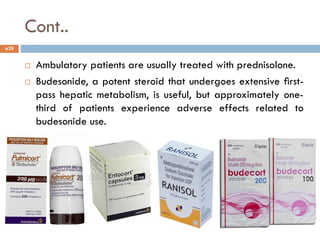
 Ambulatory patients are usually treated with prednisolone.
 Budesonide, a potent steroid that undergoes extensive first-
pass hepatic metabolism, is useful, but approximately one-
third of patients experience adverse effects related to
budesonide use.
28
Immunosupressive Agents
 If it is impossible to taper corticosteroids or frequent
relapses occur, immunomodulating therapy should be
considered. However, the use of immunomodulators is not
approved by the national health insurance scheme.
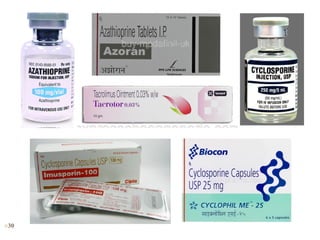
 Azathioprine and 6-mercaptopurine are used due to their
steroid - sparing or steroid - reducing effects, since
approximately 50% of patients experience adverse effects
from corticosteroids.
 Due to delayed onset of action, these agents are not used to
treat acute colitis.
 Cyclosporine and tacrolimus have been used to treat acute
steroid-refractory UC when surgery seemed inevitable.
29
30
TNF Inhibitors
 Increased production of inflammatory cytokines, especially
tumor necrosis factor alpha (TNF-α), has been described in
both normal and inflamed mucosa.
 These agents prevent the endogenous cytokine from binding
to the cell surface receptor and exerting biological activity.
These agents adversely affect normal immune responses.
 Thalidomide, originally used for its sedative and antiemetic
properties, has recently been shown to inhibit TNF-α
production by monocytes and other cells.
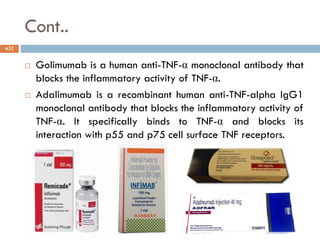
 Infliximab is a chimeric mouse-human monoclonal antibody
to TNF. It binds free and membrane-bound TNF and thus
prevents the cytokine from binding to its cell surface
receptor .
31
Cont..
 Golimumab is a human anti-TNF-α monoclonal antibody that
blocks the inflammatory activity of TNF-α.
 Adalimumab is a recombinant human anti-TNF-alpha IgG1
monoclonal antibody that blocks the inflammatory activity of
TNF-α. It specifically binds to TNF-α and blocks its
interaction with p55 and p75 cell surface TNF receptors.
32
Antimicrobial Agents
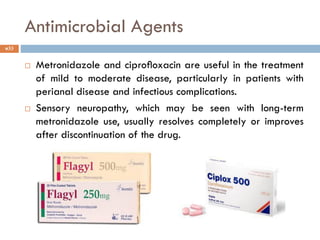
 Metronidazole and ciprofloxacin are useful in the treatment
of mild to moderate disease, particularly in patients with
perianal disease and infectious complications.
 Sensory neuropathy, which may be seen with long-term
metronidazole use, usually resolves completely or improves
after discontinuation of the drug.
33
Inflammatory bowel disease

Inflammatory bowel disease

  • 1.
  • 2.
    2  Inflammatory boweldisease (IBD) represents a group of intestinal disorders that cause prolonged inflammation of the digestive tract.  It is a spectrum of chronic idiopathic inflammatory condition. Introduction
  • 3.
    Classification 3 Ulcerative colitis: Ulcerativecolitis is a disease that causes mucosal inflammation and sores (ulcers) in the lining of the large intestine (colon ). Chron’s disease: Crohn’s disease is a chronic, relapsing and remitting inflammatory disease of the gastrointestinal tract, affecting any site from mouth to anus.
  • 4.
  • 5.
    Epidemiology  In theUnited States, it is currently estimated that about 1 –1.3 million people suffer from IBD.  Ulcerative colitis is slightly more common in males, while Crohn’s disease is more frequent in women.  Diet, oral contraceptives, perinatal and childhood infections, or atypical mycobacterial infections have been suggested, but not proven, to play a role in developing IBD. 5 Prevalence (number of existing cases per 100,000 population) Crohn's disease Ulcerative colitis 26 to 199 cases per 100,000 persons2 37 to 246 cases per 100,000 persons2 201 per 100,000 adults1 238 per 100,000 adults1
  • 6.
    6 Infectious agents Viruses (Measles) Bacteria(Mycobacteria) Genetics Environmental factors Diet Smoking Psychological factors Stress Emotional or physical trauma Etiology
  • 7.
    Pathophysiology 7 ALTERED MUCOSAL IMMUNERESPONSE  Dietary and bacterial antigens penetrate into the intestinal wall and activates the immune system.  This causes increased production of pro-inflammatory mediators which will lead to inflammation of the mucosal layer.
  • 8.
  • 9.
    Cont. 9  Variety ofepithelial defects have been described in Crohn’s disease and Ulcerative Colitis.  Defects in epithelial cells will lead to influx of bacterial components such as dendritic cells and macrophages which activates CD+4 cells.  Activated CD+4 cells activate other inflammatory cells like B-cells and variable T-cells or recruit more inflammatory cells by stimulation of homing receptor on leucocytes and vascular epithelium.  Inflammation in IBD is maintained by an influx of leukocytes from the vascular system into sites of active disease. This influx is promoted by expression of adhesion molecules (such as α 4- integrins) on the surface of endothelial cells in the microvasculature in the area of inflammation.
  • 10.
  • 11.
    Clinical Manifestations 11 Clinical symptomsare same in both case.  Diarrhoea  Abdominal pain, cramping & bloating due to bowel obstruction  Hematochezia : Blood in stool  Low fever  Decreased appetite  Weight loss and anorexia  Fatigue  Arthritis
  • 12.
    Diagnosis 12  Physical Examination Endoscopy  Biopsy  Radiology  Blood Test
  • 13.
    Physical Examination  Themain features to look for are: oral aphtosis, abdominal tenderness and masses, anal tags, fissure and fistulae, nutritional deficiency.  An important feature in children is growth retardation. 13
  • 14.
    Endoscopy/ Colonoscopy/ Sigmoidoscopy Colonoscopy helps to determine the pattern and severity of colonic and terminal ileum inflammation and allows biopsies to be obtained.  Endoscopic features are aphtous ulcers, deeper ulceration, postinflammatory polyps (which indicate previous severe inflammation), but always accompanied by intervening normal mucosa, which is an important differential feature between CD and UC . 14
  • 15.
    Biopsy 15  Rectal andcolonic biopsies should be examined to find the nature of the inflammation (ulcerative colitis versus CD), collagenous colitis or microscopic inflammation if macroscopic appearance is normal, and infection.
  • 16.
    Radiology Barium enema  Bariuminserted into rectum  Fluoroscopy used to image bowel  Rarely used due to colonoscopy  Useful for identifying colonic strictures or colonic fistulae Barium Small bowel follow- through X-ray  Barium sulfate suspension drink  Fluoroscopic images of bowel taken over time  Useful for looking for inflammation and narrowing of small bowel 16
  • 17.
    Blood Test 17  Anemiamay be present due to blood loss (iron deficiency), chronic inflammation or B12 malabsorption (macrocytic).  Hypoalbuminemia suggests severe disease with denutrition. The best markers of inflammation severity are elevation of the C-reactive protein and platelet count.  Anti-saccharomyces cerevisiae antibodies (ASCA) are positive in 50-60% of CD patients while anti-neutrophil polynuclear antibodies (ANCA) are positive in 50-60% of UC patients.
  • 18.
  • 19.
    19  Maintain orimprove quality of life.  Terminate the acute attack and induce clinical remission.  Prevent symptoms during chronic symptomatic periods.  Prevent or reduce complication.  Use the most cost-effective drug treatment.  Avoid surgery if possible.  Replacement of vitamin A, D, K if necessary in case of malabsorption. Goals of Treatment
  • 20.
    Non-Pharmacological Treatment  Toavoid smoking cessation  To reduce alcohol consumption  To avoid the use of NSAIDs  To avoid spicy and fried/oily food  To take fiber rich diet as tolerated that include tender cooked vegetables, canned or cooked fruits, and starches like cooked cereals and whole wheat noodles and tortillas.  To incorporate more omega-3 fatty acids in the diet. These fats may have an anti-inflammatory effect. They are found most probably in fish. 20
  • 21.
  • 22.
    Surgery for UlcerativeColitis  Proctocolectomy (removing the colon and rectum) with ileostomy: If UC is severe, surgery may be required to remove the entire colon and rectum, plus bring the ileum (end of the small intestine) through a stoma (opening) in the abdominal wall to allow drainage of intestinal waste out of the body. The second part of the procedure is called ileostomy. After the procedure, an external bag must be worn over the opening to collect waste.  Restorative proctocolectomy, also known as ileoanal pouch anal anastomosis (IPAA): It involves removing the colon and rectum, but the patient can continue to pass stool through the anus — in place of an ileostomy, the ileum is fashioned into a pouch and pulled down and connected to the anus. 22
  • 23.
    Surgery for Crohn’sDisease  Strictureplasty: If an area of the bowel narrows, this widens the area without removing any portion of the small intestine.  Resection (removing portions of the intestines): This involves removing affected areas of the intestine, and then joining together the two ends of healthy intestine in a procedure called anastomosis. 23
  • 24.
    Cont..  Surgery forabscesses and fistulas: Sometimes abscesses (pus-filled mass) need to be removed surgically. And surgery may be required if a fistula (abnormal tract) is causing symptoms that don't respond to medication.  Colectomy (removing the colon) or proctocolectomy (removing the colon and rectum): If only the colon is affected, a colectomy may be needed. But if the colon and rectum are affected, a proctocolectomy may be needed, along with ileostomy — bringing the ileum (end of the small intestine) through a stoma (opening) in the abdominal wall to allow drainage of intestinal waste out of the body. After the procedure, an external bag must be worn over the opening to collect waste. 24
  • 25.
    Pharmacological Treatment 25 The majortypes of drug therapy used in IBD include  Aminosalicylates  Corticosteroids  Immunosuppressive agents  TNF – Tumor Necrosis Factor Inhibitor  Antimicrobials
  • 26.
    Aminosalicylates / 5-ASA These agents have anti-inflammatory effects. They are used to maintain remission and to induce remission of mild flares of disease.  Egs., Sulfasalazine, Mesalamine  Sulfasalazine and mesalamine are used to treat mild to moderate disease and to maintain remission induced by corticosteroids.  Sulfasalazine is useful for ileocolonic and colonic disease.  The side effects are hemolytic anemia & pruritic dermatitis.  Pentasa is a recently developed sustained-release preparation (coated with ethylcellulose) that delivers 5-ASA to the distal ileum and colon. 26
  • 27.
    Corticosteroids  Corticosteroids (Img/kg/day) are effective in decreasing disease activity and inducing remission in most patients. However, due to undesirable side effects, long-term use of corticosteroids is not recommended.  Oral or parenteral corticosteroids are indicated for the treatment of ambulatory patients with moderate to severe colitis whose symptoms cannot be controlled by aminosalicylates.  The adverse effects include cosmetic effects, suppression of linear growth in children and osteopenia.  Egs., Prednisolone, Budenoside 27
  • 28.
    Cont..  Ambulatory patientsare usually treated with prednisolone.  Budesonide, a potent steroid that undergoes extensive first- pass hepatic metabolism, is useful, but approximately one- third of patients experience adverse effects related to budesonide use. 28
  • 29.
    Immunosupressive Agents  Ifit is impossible to taper corticosteroids or frequent relapses occur, immunomodulating therapy should be considered. However, the use of immunomodulators is not approved by the national health insurance scheme.  Azathioprine and 6-mercaptopurine are used due to their steroid - sparing or steroid - reducing effects, since approximately 50% of patients experience adverse effects from corticosteroids.  Due to delayed onset of action, these agents are not used to treat acute colitis.  Cyclosporine and tacrolimus have been used to treat acute steroid-refractory UC when surgery seemed inevitable. 29
  • 30.
  • 31.
    TNF Inhibitors  Increasedproduction of inflammatory cytokines, especially tumor necrosis factor alpha (TNF-α), has been described in both normal and inflamed mucosa.  These agents prevent the endogenous cytokine from binding to the cell surface receptor and exerting biological activity. These agents adversely affect normal immune responses.  Thalidomide, originally used for its sedative and antiemetic properties, has recently been shown to inhibit TNF-α production by monocytes and other cells.  Infliximab is a chimeric mouse-human monoclonal antibody to TNF. It binds free and membrane-bound TNF and thus prevents the cytokine from binding to its cell surface receptor . 31
  • 32.
    Cont..  Golimumab isa human anti-TNF-α monoclonal antibody that blocks the inflammatory activity of TNF-α.  Adalimumab is a recombinant human anti-TNF-alpha IgG1 monoclonal antibody that blocks the inflammatory activity of TNF-α. It specifically binds to TNF-α and blocks its interaction with p55 and p75 cell surface TNF receptors. 32
  • 33.
    Antimicrobial Agents  Metronidazoleand ciprofloxacin are useful in the treatment of mild to moderate disease, particularly in patients with perianal disease and infectious complications.  Sensory neuropathy, which may be seen with long-term metronidazole use, usually resolves completely or improves after discontinuation of the drug. 33