EPIDURAL ANESTHESIA
Epidural anesthesia is a regional anesthesia that
blocks pain in a particular region of the body
The goal of an epidural is to provide analgesia, or
pain relief, rather than anesthesia, which leads
to total lack of feeling. Epidurals block the nerve
impulses from the lower spinal segments. This results
in decreased sensation in the lower half of the body.
EPIDURAL ANESTHESIA
• Anatomy
– Epidural space – base of skull (foramen magnum) to the coccyx
(sacrococcygeal membrane)
– Distance from skin to epidural space – 4-5 cm
– Epidural space contains loose areolar tissue, fat, arterial and venous
networks, lymphatics, spinal nerve roots
• LA deposited in epidural space
• Block spinal nerve roots that traverse peridural space
• Blocks sympathetic nerves traveling with the anterior roots
• Applications range from sensory analgesia, minimal motor block, or
dense anesthesia and full motor block – controlled by drug choice,
concentration, dosage
EPIDURAL ANESTHESIA
Types – selective blockade possible because
it can be performed at any level of spine
• Cervical epidural
• Thoracic epidural
• Lumbar epidural
• Caudal epidural
Factors Influencing Spread of Solution
• Height of patient
• Drugs used
• Volume
• Concentration
• Level of puncture and catheter insertion
Technique
• Method
– Single dose injection
– Fractional – continuous epidural – repeated
injections of LA through catheter inserted into
epidural space
• Position
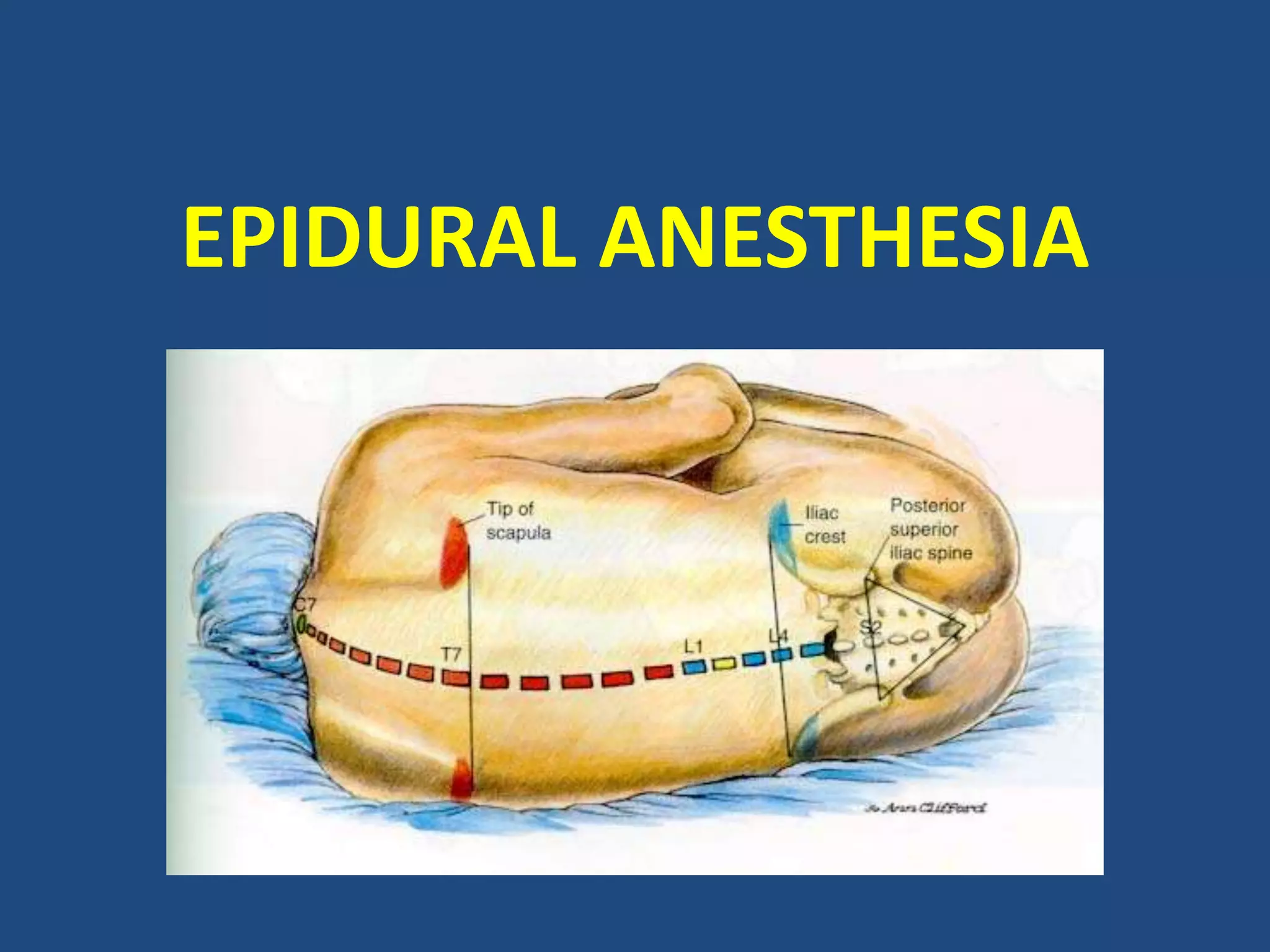
– Cervical epidural – sitting (C7)
– Thoracic epidural (T7)
– Lumbar epidural
(L1-L2, L2-L3, L3-L4, L4-L5)
Lateral
Decubitus, full
flexion
Method of Identifying Epidural Space
Principle: negative pressure in space
• Loss of resistance
– Plunger of syringe pushed without resistance once
epidural needle is in
• Hanging Drop
– Drop of saline at hub of epidural needle is sucked in
once it enters space
Indications
• All operations below diaphragm
• May be used in
– Poor risk patients
– Cardiac diseases
– Pulmonary diseases
– Metabolic disturbances
– When GA is contraindicated
– When spinal anesthesia is contraindicated
– Painful conditions including post-op pain relief
Contraindications – similar to spinal
• Severe hemorrhage
• Coagulation defects
• Previous laminectomy
• Uncooperative / apprehensive
• Local inflammation at site
• Patient refusal
Advantages
• Well-defined area of anesthesia
• Longer duration
• More severe disturbances of spinal anesthesia minimized
• GI complaints minimized
• Catheterization minimized
• Less respiratory effects
Disadvantages
• Technically more difficult
• Muscle relaxation not complete
• Large volume necessary
• Danger of dural puncture
• Incomplete / patchy block
Physiologic Effects
• Similar to those observed in spinal anesthesia
• Slower onset
• Less intensity of motor and sensory block
Drugs: low-dose LA, opiods
Epidural anathesia Spinal anathesia
Site of injection In the epidural space Subarachnoid space
Onset and duration Slow onset and continous duration
(use catheter)
Rapid onset and limited
duration
advantages Can be used in analgesia Not used
Needle
dose
Curved,longand blunt (touhy)
10_30ml
Small and sharp
1_4ml
space Any space usually lumber lumber
Quality of sensory and
motor nerve block
less More liable
toxicity Hypotention gradual
total spinal +++
systemic toxicity +++
Sudden
+
+
THANK YOU

Epidural anesthesia

  • 1.
  • 2.
    Epidural anesthesia isa regional anesthesia that blocks pain in a particular region of the body The goal of an epidural is to provide analgesia, or pain relief, rather than anesthesia, which leads to total lack of feeling. Epidurals block the nerve impulses from the lower spinal segments. This results in decreased sensation in the lower half of the body. EPIDURAL ANESTHESIA
  • 3.
    • Anatomy – Epiduralspace – base of skull (foramen magnum) to the coccyx (sacrococcygeal membrane) – Distance from skin to epidural space – 4-5 cm – Epidural space contains loose areolar tissue, fat, arterial and venous networks, lymphatics, spinal nerve roots • LA deposited in epidural space • Block spinal nerve roots that traverse peridural space • Blocks sympathetic nerves traveling with the anterior roots • Applications range from sensory analgesia, minimal motor block, or dense anesthesia and full motor block – controlled by drug choice, concentration, dosage EPIDURAL ANESTHESIA
  • 4.
    Types – selectiveblockade possible because it can be performed at any level of spine • Cervical epidural • Thoracic epidural • Lumbar epidural • Caudal epidural Factors Influencing Spread of Solution • Height of patient • Drugs used • Volume • Concentration • Level of puncture and catheter insertion
  • 5.
    Technique • Method – Singledose injection – Fractional – continuous epidural – repeated injections of LA through catheter inserted into epidural space • Position – Cervical epidural – sitting (C7) – Thoracic epidural (T7) – Lumbar epidural (L1-L2, L2-L3, L3-L4, L4-L5) Lateral Decubitus, full flexion
  • 8.
    Method of IdentifyingEpidural Space Principle: negative pressure in space • Loss of resistance – Plunger of syringe pushed without resistance once epidural needle is in • Hanging Drop – Drop of saline at hub of epidural needle is sucked in once it enters space
  • 10.
    Indications • All operationsbelow diaphragm • May be used in – Poor risk patients – Cardiac diseases – Pulmonary diseases – Metabolic disturbances – When GA is contraindicated – When spinal anesthesia is contraindicated – Painful conditions including post-op pain relief
  • 11.
    Contraindications – similarto spinal • Severe hemorrhage • Coagulation defects • Previous laminectomy • Uncooperative / apprehensive • Local inflammation at site • Patient refusal Advantages • Well-defined area of anesthesia • Longer duration • More severe disturbances of spinal anesthesia minimized • GI complaints minimized • Catheterization minimized • Less respiratory effects
  • 12.
    Disadvantages • Technically moredifficult • Muscle relaxation not complete • Large volume necessary • Danger of dural puncture • Incomplete / patchy block Physiologic Effects • Similar to those observed in spinal anesthesia • Slower onset • Less intensity of motor and sensory block Drugs: low-dose LA, opiods
  • 13.
    Epidural anathesia Spinalanathesia Site of injection In the epidural space Subarachnoid space Onset and duration Slow onset and continous duration (use catheter) Rapid onset and limited duration advantages Can be used in analgesia Not used Needle dose Curved,longand blunt (touhy) 10_30ml Small and sharp 1_4ml space Any space usually lumber lumber Quality of sensory and motor nerve block less More liable toxicity Hypotention gradual total spinal +++ systemic toxicity +++ Sudden + +
  • 14.