Prostatic cancer
Medrockets.com
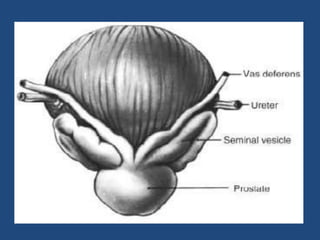
prostate gland is a pyramidal shaped
fibromuscular and glandular organ which
surrounds the prostatic urethra.
develops in the 12th week of embryonic life
under androgens from the fetal testis.
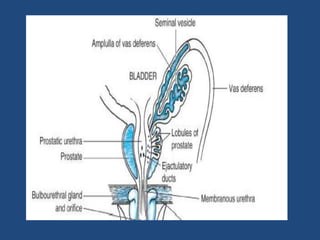
contains a number of individual glands
composed of 30-50 lobules leading to 15-30
secretory ducts that open into the urethra
lateral to the colliculus seminalis.
Anatomy
Medrockets.com
 from the bladder neck to the urogenital
diaphragm.measures about 3.5 X 2.5cm,
averages 20G.
The prostate is found in the male while its
homologous in the female, formerly
known as the paraurethral gland of skene
now named female prostate.
Medrockets.com
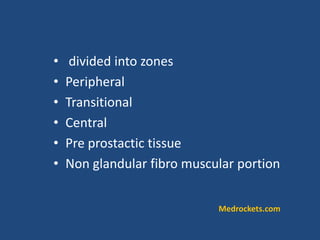
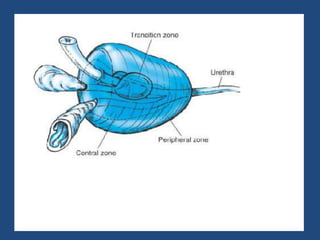
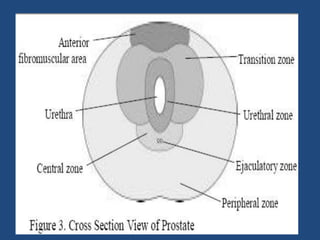
• divided into zones
• Peripheral
• Transitional
• Central
• Pre prostactic tissue
• Non glandular fibro muscular portion
Medrockets.com
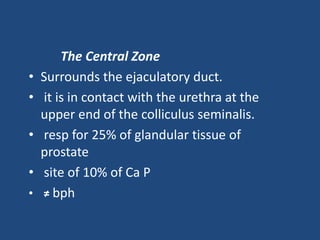
The Central Zone
• Surrounds the ejaculatory duct.
• it is in contact with the urethra at the
upper end of the colliculus seminalis.
• resp for 25% of glandular tissue of
prostate
• site of 10% of Ca P
• ≠ bph
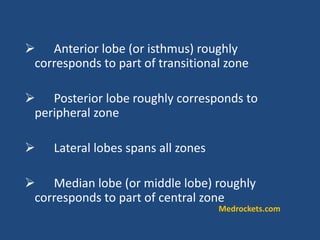
 Anterior lobe (or isthmus) roughly
corresponds to part of transitional zone
 Posterior lobe roughly corresponds to
peripheral zone
 Lateral lobes spans all zones
 Median lobe (or middle lobe) roughly
corresponds to part of central zone
Medrockets.com
The prostatic capsule
These are normally two, pathologically three, in
number.
1. The true capsule
2. Fibrous Sheath – condensed extraperitoneal
fascia. Between layers 1 and 2 lies the prostatic
venous plexus.
3. the pathological capsule- occurs in BPH in
which the normal peripheral part of the gland
becomes compressed into a capsule .
Medrockets.com
The prostate gland comprises secretory epithelium
which consists of
a. Epithelial
b. Basal
c. Neuroendocrine cells
d. Connective tissue
e. Smooth muscles
Only the epithelia1 cells secrete PSA and so cancer of
the neuroendocrine cells, connective tissue, smooth
muscle, transitional epithelium and
anaplastic cells can be present with a normal PSA
Medrockets.com
smooth muscle is regulated by the
autonomic nervous system primarily; the
alpha-1A adrenergic receptors constitute
70%.
Medrockets.com
The arterial blood supply of the prostate
gland arises from the middle rectal and
inferior vessical artery.
The venous drainage is into the prostati
plexus. The plexus also receives the dorsal
vein of the penis and drains into the internal
iliac veins. There are connections with no
valves between the prostatic plexus and
vertebral veins.
Hence retrogression to the vertebrae.
Blood supply
Medrockets.com
Lymphatic drainage
The prostatic lymphatics drain into lymph
nodes lying alongside the internal iliac
vessels. They also have a connection with
the sacral spinal lymphatics.
Medrockets.com
The prostatic fluid helps maintain the vitality
of the sperms, and contains calcium,
sodium, potassium, magnesium, chloride,
bicarbonate, zinc, spermine, citrate, lipid
cholesterol and 4 major proteins
◦ the prostatic specific antigen {PSA),
◦ prostatic acid phosphatase (PAP),
◦ the prostatic specific membrane antigen (PSMA)
and
◦ prostatic specific protein - 94(PSP-94).
functions
Medrockets.com
Epidemiology
• The commonest diagnosed malignancy affecting
men beyond the middle age
• Rare <50yrs and 80% of pxs are above 70yrs
• Incidence rises steadily after the age of 50years.
INCIDENCE
-African american 149/100,000
-Caucasians 139/100,000
-Orientals 107/100,000
-Chinese 28/100,000
 Ageing (strongest risk factor)
 Familial/genetic factors (hereditary,familial, sporadic.)
-susceptibility locus on long arm of chr 1 (1q24-25)
-9% of P.ca have hereditary basis and there is 3fold
increase incidence in men whom 1st degree relative
has it.
 Race
 Dietary fat
 Hormones (testosterone and DHT) ; Not usually seen
in eunuchs and people deficient in 5@reductase
Risk factors.
• Other possible risk factors.
- Vasectomy (Increased risk if done <35yrs)
- Cadmium ( from ciggarete and batteries)
- Vit. A / Retinol. (High intake leads to increased
incidence)
- Vit. D (Deficiency increases risk of P.ca). It induces
cell differentiation and slows the growth of P.ca)
- Sexual behaviour (early, multiple,STD)
- Viral : HSV type 2 implicated . Not widely accepted.
- Chemical. Medrockets.com
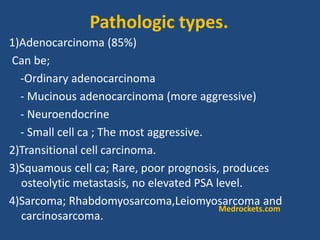
1)Adenocarcinoma (85%)
Can be;
-Ordinary adenocarcinoma
- Mucinous adenocarcinoma (more aggressive)
- Neuroendocrine
- Small cell ca ; The most aggressive.
2)Transitional cell carcinoma.
3)Squamous cell ca; Rare, poor prognosis, produces
osteolytic metastasis, no elevated PSA level.
4)Sarcoma; Rhabdomyosarcoma,Leiomyosarcoma and
carcinosarcoma.
Pathologic types.
Medrockets.com
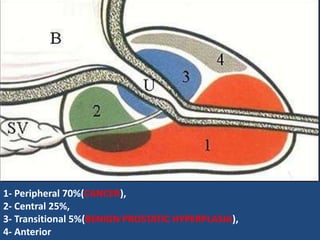
1- Peripheral 70%(CANCER),
2- Central 25%,
3- Transitional 5%(BENIGN PROSTATIC HYPERPLASIA),
4- Anterior
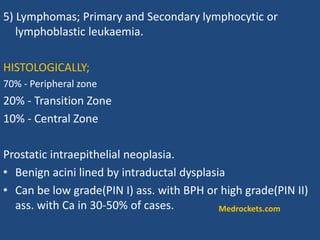
5) Lymphomas; Primary and Secondary lymphocytic or
lymphoblastic leukaemia.
HISTOLOGICALLY;
70% - Peripheral zone
20% - Transition Zone
10% - Central Zone
Prostatic intraepithelial neoplasia.
• Benign acini lined by intraductal dysplasia
• Can be low grade(PIN I) ass. with BPH or high grade(PIN II)
ass. with Ca in 30-50% of cases. Medrockets.com
a) Local spread
b) Haematogenous.
- Mostly to the cancellous bones, spine, pelvis,
upper femur, ribs , sternum, skull e.t.c
- Lumbar and sacral bones are involved thru
the connection btw the prostatic venous plexus
and vertebral veins by the valveless veins of
Batson.
- Bone metastasis are osteoblastic (85%) or
osteolytic(15%)
- There can also be matastasis to the liver,
SPREAD.
SPREAD CONTINUED....
3) Lymphatic spread; Internal and external
Iliac, paraaortic and mediastinal nodes.
Medrockets.com
• Assymptomatic
• As a local disease ( Obstructive and irritative
symptoms.)
• As a locally invasive disease
- Haematuria -Dysuria -Suprapubic pain
- Urinary incontinence -Erectile dysfunction
- Haemospermia - Rectal symptoms.
• As metastatic disease
- Low back pain - Pathological fracture
- Paraplegia - LN enlargement - Lymphoedema.
Clinical features.
• Widespread metastasis
- Cerebral ( haeadache, nausea, epilepsy)
- Bone marrow  Anaemia
- Wt. Loss and cachexia
• Features from complications.
- Acute or chronic retention - UTI
- Renal failure  Ureamia
- Jaundice
Clinical features.
• History ( Ask about local and metastatic symptoms and
their progression.)
• IPSS
• Examination ( Pallor, oedema, distended bladder, ascites,
abd. Mass, lymphadenopathy, pathological fracture.)
• DRE. Features suggestive of P.ca are;
- Assymetry of the gland
- Hard in consistency
- Nodules or induration in parts or the whole of the organ
Diagnosis and Investigation.
- Lack of mobility of the overlying rectal mucossa
- Obliteration of lat & median sulcus
- Palpaable seminal vessicle.
We have to note that what we feel depends on the extent
of the disease.
False positives is seen on;
- BPH ( may be hard from from large amt. Of fibrous tissue)
- Prostatic calculi - Ejaculatory duct abnormalities
- Granulomatous, tuberculous or schistosomal prostatitis.
- Rectal wall phleboliths and rectal mucossa polyps
Medrockets.com
• PSA estimation
- The most efficient single test for P.ca
- 30% P.ca has PSA >4ng/ml and
60% has P.ca >10ng/ml
- PSA alone provides no accurate info on the extent
or staging of the dx. But its noticed that;
* Organ confined Ca has <4ng/ml (70-80%)
Capsular penetration >10ng/ml (30%)
LN involvement > 50ng/ml (75%)
- Bone scan not neccessary in PSA <10ng/ml
Investigations
 Urinalysis and Urine MC
 PFR ,PVR
 Hb concentration , E U and Cr
Imaging procedures.
 Abd. Pelvic US
 Trans rectal US
*Hypoechoic (71%) Iso(28%) and hyperechoic(1%)
Loss of differentiation btw zones
Assymetry in size and shape
Capsular and S.vessicle distortion or penetration.
TRUS is also useful when doing TRUS guided biopsy
Medrockets.com
• Bone radiograph and CXR
• Radionuclide bone scan ( most sensitive for bone
metastasis)
• IVU ( Not routinely done)
• CT scan and MRI
Medrockets.com
To : No demonstrable tumour
Tx : Tumour inaccessible
T1: clinically undetectable tumour, normal DRE and
TRUS
T2: Macroscopic tumour confined to prostate
T3: tumour extends to capsule and/or seminal vessicle
T4: tumour invades adjacent structures (besides
seminal vesicles)
N: spread to regional lymph nodes
M: distant metastasis
TUMOUR GRADE (Gleason score out of 10)
• 1-4 = well differentiated
• 5-6 = moderately differentiated
• 8-10 = poorly differentiated
GRADING
Medrockets.com
 T1a, T1b and T1c:these are incidentally found in a clinically
benign gland after histological examination of a prostatectomy
specimen.
T1a: is a well or moderately well-differentiated tumour
involving < 5% of the resected specimen.
T1b: is a poorly differentiated tumour or a tumour involving
>5% of the resected specimen.
T1c: tumours are impalpable tumours found following PSA
screening
 T2a: disease presents as a suspicious nodule on rectal
examination of <2 cm
T2b: disease is a nodule involving > 2 cm
T2c: is tumour in both lobes but still clinically confined
Medrockets.com
• T3a : Unilateral extracapsular extension
T3b : Bilateral extracapsular extension
T3c: S.vessicle involvement.
• T4a: Bladder neck and/or external sphincter
involved
T4b: Levator M and/or fixed to pelvic wall.
• No: No nodal involvement
N1: Single RLN <2cm in greatest dimension
N2: Single RLN btw 2-5cm in greatest diameter or
multiple LN none >5cm in diameter
N3: RLN >5cm in diameter Medrockets.com
 Mo: No evidence of metastasis
M1a: Involves non regional LN
M1b: Involves bones
M1c: Other distant metastasis.
 GLEASON’S histological grading.
- Based on the glandular pattern of the tumour.
Since Ca prostate is heterogenous, both the
predominant and secondary architectural patterns
are identified and assigned a grade from 1-5.
- The numbers are added to give the combined
Gleason score.
- GS > 4 ( increased risk of more rapid dx and lower
survival with poor prognosis.) Medrockets.com
Brain metastasis- epilepsy, hemiplegia,vertigo
Bone metastasis – Pathologic #
Spinal cord metastasis - paraplegia
Visceral metastasis
Acute/chronic urinary retention
UTI , cystitis, pyelonephritis,
Heamaturia and clot retention
Renal failure Anaemia
Lymphoedema.
Mortality
Complications
Medrockets.com
• Depends on the extent of the disease.
For localized tumour ( T1 and T2)
a. Watchful waiting
b. Radical prostatectomy (Walsh technique)
Complications are: Clot retention, bleeding, impotence,
rectal injury, urinary incontinence, stricture.
c. Radiotherapy ( for patients that have poor medical
condition and are unsuitable for surgery)
Criteria for radio are;
- Histological evidence of tumour
Management.
Medrockets.com
- Regionally localized P.Ca
- Sufficient life expectancy
- Absence of bladder outflow obstruction
- Absence of colorectal dx.
Adv of Radio: Potential cure and avoidance of surgery
Disadv of radio: Prolonged therapy, difficulty in
accessing cure, impossibility of definite staging, Offers
no benefit to LUT symptoms or symptoms due to BPH.
Complications: Rectal injury and enteritis, incontinence,
stricture, impotence, bladder damage, haematuria.
Medrockets.com
d) Other therapies;
- Cryo-ablation
- Laser therapy
- High intensity focused US
Tx of locally advanced Ca.(T3,N0,M0)
- Neoadjuvant therapy ff by surgery
- Neoadjuvant therapy ff by radiation
- Hormonal treatment alone
- Watchful waiting Medrockets.com
Neoadjuvants hormonal therapy:
• Helps to down staging and reduce tumour bulk. Hence
allowing prostatectomy after about 2-3mths.
• Its by giving anti androgen (casodex/flutamide) or
cyproterone acetate and LHRH agonists
(gosereline,busereline) or bilateral total orchidectomy.
• Diethyl stillboesterol (3mg/d) can also be given if the above
can’t be done.
Hormonal therapy alone:
By using LHRH agonists, Anti androgens ( steroidal, pure anti
androgens, oestrogens) ,bilateral orchidectomy or by using
DES Medrockets.com
Tx of metastatic dx.:
They are known to av a 70% mortality in 5yrs
Management is by:
- Endocrine therapy
- Localized radiotherapy
Mgt of H. Resistant Ca.
- Anti androgen withdrawal
- Cytotoxic chemotherapy (Doxytaxel)
- Hormonal (corticosteroids) and chemohormonal
therapy (Estramustine phosphate)
- Inhibition of growth factors
- Others.( Prolactin / 5@reductase inhibitors)
Medrockets.com
Prevention of P. Cancer.
1) Screening strategies;
2) Avoidance of known risk factors
3) Chemoprevention.
Medrockets.com
Prognosis.
• Stage T1-T2: excellent, compatible with
normal life expectancy
• Stage T3-T4: 40-70 % survival at 10 years
• Stage N + and/or M+ : 40% survival at 5
years
• prognostic factors: tumour stage, tumour
grade, PSA value
Medrockets.com
THANK YOU
Medrockets.com

Prostatic cancer

  • 1.
  • 2.
    prostate gland isa pyramidal shaped fibromuscular and glandular organ which surrounds the prostatic urethra. develops in the 12th week of embryonic life under androgens from the fetal testis. contains a number of individual glands composed of 30-50 lobules leading to 15-30 secretory ducts that open into the urethra lateral to the colliculus seminalis. Anatomy Medrockets.com
  • 3.
     from thebladder neck to the urogenital diaphragm.measures about 3.5 X 2.5cm, averages 20G. The prostate is found in the male while its homologous in the female, formerly known as the paraurethral gland of skene now named female prostate. Medrockets.com
  • 6.
    • divided intozones • Peripheral • Transitional • Central • Pre prostactic tissue • Non glandular fibro muscular portion Medrockets.com
  • 7.
    The Central Zone •Surrounds the ejaculatory duct. • it is in contact with the urethra at the upper end of the colliculus seminalis. • resp for 25% of glandular tissue of prostate • site of 10% of Ca P • ≠ bph
  • 9.
     Anterior lobe(or isthmus) roughly corresponds to part of transitional zone  Posterior lobe roughly corresponds to peripheral zone  Lateral lobes spans all zones  Median lobe (or middle lobe) roughly corresponds to part of central zone Medrockets.com
  • 10.
    The prostatic capsule Theseare normally two, pathologically three, in number. 1. The true capsule 2. Fibrous Sheath – condensed extraperitoneal fascia. Between layers 1 and 2 lies the prostatic venous plexus. 3. the pathological capsule- occurs in BPH in which the normal peripheral part of the gland becomes compressed into a capsule . Medrockets.com
  • 11.
    The prostate glandcomprises secretory epithelium which consists of a. Epithelial b. Basal c. Neuroendocrine cells d. Connective tissue e. Smooth muscles Only the epithelia1 cells secrete PSA and so cancer of the neuroendocrine cells, connective tissue, smooth muscle, transitional epithelium and anaplastic cells can be present with a normal PSA Medrockets.com
  • 12.
    smooth muscle isregulated by the autonomic nervous system primarily; the alpha-1A adrenergic receptors constitute 70%. Medrockets.com
  • 13.
    The arterial bloodsupply of the prostate gland arises from the middle rectal and inferior vessical artery. The venous drainage is into the prostati plexus. The plexus also receives the dorsal vein of the penis and drains into the internal iliac veins. There are connections with no valves between the prostatic plexus and vertebral veins. Hence retrogression to the vertebrae. Blood supply Medrockets.com
  • 14.
    Lymphatic drainage The prostaticlymphatics drain into lymph nodes lying alongside the internal iliac vessels. They also have a connection with the sacral spinal lymphatics. Medrockets.com
  • 15.
    The prostatic fluidhelps maintain the vitality of the sperms, and contains calcium, sodium, potassium, magnesium, chloride, bicarbonate, zinc, spermine, citrate, lipid cholesterol and 4 major proteins ◦ the prostatic specific antigen {PSA), ◦ prostatic acid phosphatase (PAP), ◦ the prostatic specific membrane antigen (PSMA) and ◦ prostatic specific protein - 94(PSP-94). functions Medrockets.com
  • 16.
    Epidemiology • The commonestdiagnosed malignancy affecting men beyond the middle age • Rare <50yrs and 80% of pxs are above 70yrs • Incidence rises steadily after the age of 50years. INCIDENCE -African american 149/100,000 -Caucasians 139/100,000 -Orientals 107/100,000 -Chinese 28/100,000
  • 17.
     Ageing (strongestrisk factor)  Familial/genetic factors (hereditary,familial, sporadic.) -susceptibility locus on long arm of chr 1 (1q24-25) -9% of P.ca have hereditary basis and there is 3fold increase incidence in men whom 1st degree relative has it.  Race  Dietary fat  Hormones (testosterone and DHT) ; Not usually seen in eunuchs and people deficient in 5@reductase Risk factors.
  • 18.
    • Other possiblerisk factors. - Vasectomy (Increased risk if done <35yrs) - Cadmium ( from ciggarete and batteries) - Vit. A / Retinol. (High intake leads to increased incidence) - Vit. D (Deficiency increases risk of P.ca). It induces cell differentiation and slows the growth of P.ca) - Sexual behaviour (early, multiple,STD) - Viral : HSV type 2 implicated . Not widely accepted. - Chemical. Medrockets.com
  • 19.
    1)Adenocarcinoma (85%) Can be; -Ordinaryadenocarcinoma - Mucinous adenocarcinoma (more aggressive) - Neuroendocrine - Small cell ca ; The most aggressive. 2)Transitional cell carcinoma. 3)Squamous cell ca; Rare, poor prognosis, produces osteolytic metastasis, no elevated PSA level. 4)Sarcoma; Rhabdomyosarcoma,Leiomyosarcoma and carcinosarcoma. Pathologic types. Medrockets.com
  • 21.
    1- Peripheral 70%(CANCER), 2-Central 25%, 3- Transitional 5%(BENIGN PROSTATIC HYPERPLASIA), 4- Anterior
  • 22.
    5) Lymphomas; Primaryand Secondary lymphocytic or lymphoblastic leukaemia. HISTOLOGICALLY; 70% - Peripheral zone 20% - Transition Zone 10% - Central Zone Prostatic intraepithelial neoplasia. • Benign acini lined by intraductal dysplasia • Can be low grade(PIN I) ass. with BPH or high grade(PIN II) ass. with Ca in 30-50% of cases. Medrockets.com
  • 23.
    a) Local spread b)Haematogenous. - Mostly to the cancellous bones, spine, pelvis, upper femur, ribs , sternum, skull e.t.c - Lumbar and sacral bones are involved thru the connection btw the prostatic venous plexus and vertebral veins by the valveless veins of Batson. - Bone metastasis are osteoblastic (85%) or osteolytic(15%) - There can also be matastasis to the liver, SPREAD.
  • 24.
    SPREAD CONTINUED.... 3) Lymphaticspread; Internal and external Iliac, paraaortic and mediastinal nodes. Medrockets.com
  • 25.
    • Assymptomatic • Asa local disease ( Obstructive and irritative symptoms.) • As a locally invasive disease - Haematuria -Dysuria -Suprapubic pain - Urinary incontinence -Erectile dysfunction - Haemospermia - Rectal symptoms. • As metastatic disease - Low back pain - Pathological fracture - Paraplegia - LN enlargement - Lymphoedema. Clinical features.
  • 26.
    • Widespread metastasis -Cerebral ( haeadache, nausea, epilepsy) - Bone marrow  Anaemia - Wt. Loss and cachexia • Features from complications. - Acute or chronic retention - UTI - Renal failure  Ureamia - Jaundice Clinical features.
  • 27.
    • History (Ask about local and metastatic symptoms and their progression.) • IPSS • Examination ( Pallor, oedema, distended bladder, ascites, abd. Mass, lymphadenopathy, pathological fracture.) • DRE. Features suggestive of P.ca are; - Assymetry of the gland - Hard in consistency - Nodules or induration in parts or the whole of the organ Diagnosis and Investigation.
  • 28.
    - Lack ofmobility of the overlying rectal mucossa - Obliteration of lat & median sulcus - Palpaable seminal vessicle. We have to note that what we feel depends on the extent of the disease. False positives is seen on; - BPH ( may be hard from from large amt. Of fibrous tissue) - Prostatic calculi - Ejaculatory duct abnormalities - Granulomatous, tuberculous or schistosomal prostatitis. - Rectal wall phleboliths and rectal mucossa polyps Medrockets.com
  • 29.
    • PSA estimation -The most efficient single test for P.ca - 30% P.ca has PSA >4ng/ml and 60% has P.ca >10ng/ml - PSA alone provides no accurate info on the extent or staging of the dx. But its noticed that; * Organ confined Ca has <4ng/ml (70-80%) Capsular penetration >10ng/ml (30%) LN involvement > 50ng/ml (75%) - Bone scan not neccessary in PSA <10ng/ml Investigations
  • 30.
     Urinalysis andUrine MC  PFR ,PVR  Hb concentration , E U and Cr Imaging procedures.  Abd. Pelvic US  Trans rectal US *Hypoechoic (71%) Iso(28%) and hyperechoic(1%) Loss of differentiation btw zones Assymetry in size and shape Capsular and S.vessicle distortion or penetration. TRUS is also useful when doing TRUS guided biopsy Medrockets.com
  • 31.
    • Bone radiographand CXR • Radionuclide bone scan ( most sensitive for bone metastasis) • IVU ( Not routinely done) • CT scan and MRI Medrockets.com
  • 32.
    To : Nodemonstrable tumour Tx : Tumour inaccessible T1: clinically undetectable tumour, normal DRE and TRUS T2: Macroscopic tumour confined to prostate T3: tumour extends to capsule and/or seminal vessicle T4: tumour invades adjacent structures (besides seminal vesicles) N: spread to regional lymph nodes M: distant metastasis TUMOUR GRADE (Gleason score out of 10) • 1-4 = well differentiated • 5-6 = moderately differentiated • 8-10 = poorly differentiated GRADING Medrockets.com
  • 33.
     T1a, T1band T1c:these are incidentally found in a clinically benign gland after histological examination of a prostatectomy specimen. T1a: is a well or moderately well-differentiated tumour involving < 5% of the resected specimen. T1b: is a poorly differentiated tumour or a tumour involving >5% of the resected specimen. T1c: tumours are impalpable tumours found following PSA screening  T2a: disease presents as a suspicious nodule on rectal examination of <2 cm T2b: disease is a nodule involving > 2 cm T2c: is tumour in both lobes but still clinically confined Medrockets.com
  • 34.
    • T3a :Unilateral extracapsular extension T3b : Bilateral extracapsular extension T3c: S.vessicle involvement. • T4a: Bladder neck and/or external sphincter involved T4b: Levator M and/or fixed to pelvic wall. • No: No nodal involvement N1: Single RLN <2cm in greatest dimension N2: Single RLN btw 2-5cm in greatest diameter or multiple LN none >5cm in diameter N3: RLN >5cm in diameter Medrockets.com
  • 35.
     Mo: Noevidence of metastasis M1a: Involves non regional LN M1b: Involves bones M1c: Other distant metastasis.  GLEASON’S histological grading. - Based on the glandular pattern of the tumour. Since Ca prostate is heterogenous, both the predominant and secondary architectural patterns are identified and assigned a grade from 1-5. - The numbers are added to give the combined Gleason score. - GS > 4 ( increased risk of more rapid dx and lower survival with poor prognosis.) Medrockets.com
  • 36.
    Brain metastasis- epilepsy,hemiplegia,vertigo Bone metastasis – Pathologic # Spinal cord metastasis - paraplegia Visceral metastasis Acute/chronic urinary retention UTI , cystitis, pyelonephritis, Heamaturia and clot retention Renal failure Anaemia Lymphoedema. Mortality Complications Medrockets.com
  • 37.
    • Depends onthe extent of the disease. For localized tumour ( T1 and T2) a. Watchful waiting b. Radical prostatectomy (Walsh technique) Complications are: Clot retention, bleeding, impotence, rectal injury, urinary incontinence, stricture. c. Radiotherapy ( for patients that have poor medical condition and are unsuitable for surgery) Criteria for radio are; - Histological evidence of tumour Management. Medrockets.com
  • 38.
    - Regionally localizedP.Ca - Sufficient life expectancy - Absence of bladder outflow obstruction - Absence of colorectal dx. Adv of Radio: Potential cure and avoidance of surgery Disadv of radio: Prolonged therapy, difficulty in accessing cure, impossibility of definite staging, Offers no benefit to LUT symptoms or symptoms due to BPH. Complications: Rectal injury and enteritis, incontinence, stricture, impotence, bladder damage, haematuria. Medrockets.com
  • 39.
    d) Other therapies; -Cryo-ablation - Laser therapy - High intensity focused US Tx of locally advanced Ca.(T3,N0,M0) - Neoadjuvant therapy ff by surgery - Neoadjuvant therapy ff by radiation - Hormonal treatment alone - Watchful waiting Medrockets.com
  • 40.
    Neoadjuvants hormonal therapy: •Helps to down staging and reduce tumour bulk. Hence allowing prostatectomy after about 2-3mths. • Its by giving anti androgen (casodex/flutamide) or cyproterone acetate and LHRH agonists (gosereline,busereline) or bilateral total orchidectomy. • Diethyl stillboesterol (3mg/d) can also be given if the above can’t be done. Hormonal therapy alone: By using LHRH agonists, Anti androgens ( steroidal, pure anti androgens, oestrogens) ,bilateral orchidectomy or by using DES Medrockets.com
  • 41.
    Tx of metastaticdx.: They are known to av a 70% mortality in 5yrs Management is by: - Endocrine therapy - Localized radiotherapy Mgt of H. Resistant Ca. - Anti androgen withdrawal - Cytotoxic chemotherapy (Doxytaxel) - Hormonal (corticosteroids) and chemohormonal therapy (Estramustine phosphate) - Inhibition of growth factors - Others.( Prolactin / 5@reductase inhibitors) Medrockets.com
  • 42.
    Prevention of P.Cancer. 1) Screening strategies; 2) Avoidance of known risk factors 3) Chemoprevention. Medrockets.com
  • 43.
    Prognosis. • Stage T1-T2:excellent, compatible with normal life expectancy • Stage T3-T4: 40-70 % survival at 10 years • Stage N + and/or M+ : 40% survival at 5 years • prognostic factors: tumour stage, tumour grade, PSA value Medrockets.com
  • 44.