ANESTHESIOLOGY
Pain, a Burden to be Borne
 In the early days, most people expected
to experience pain in their lives
 Pain was one of God's punishments for the
wicked and purifying trials for the good;
 For the woman in labor, pain was the
spiritual experience that would transform
her into a self-sacrificing mother.
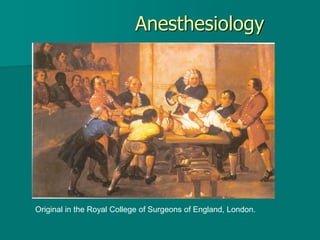
 Before anesthesia, the best surgeons were
the fastest.
 Four Herculean men would hold a patient
on a gurney and surgery would proceed.
(“PIGIL ANESTHESIA”)
 Quick and simple procedures such as
amputations were the majority of
surgeries and most patients would just
faint from the unbearable pain.
Original in the Royal College of Surgeons of England, London.
Anesthesiology
HISTORY of ANESTHESIA
Most commonly used substances to kill pain:
 opium derived from the poppy flower,
Papaver somniferum.
 alcohol or wine,
 mandragora or mandrake from the plant
Atropa mandragora,
 belladonna from the deadly nightshade,
 marijuana or Cannabis indica.
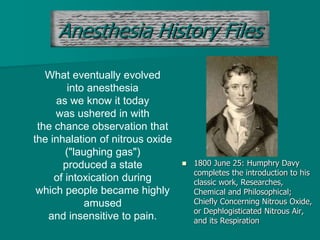
Anesthesia History Files
 1800 June 25: Humphry Davy
completes the introduction to his
classic work, Researches,
Chemical and Philosophical;
Chiefly Concerning Nitrous Oxide,
or Dephlogisticated Nitrous Air,
and its Respiration
What eventually evolved
into anesthesia
as we know it today
was ushered in with
the chance observation that
the inhalation of nitrous oxide
("laughing gas")
produced a state
of intoxication during
which people became highly
amused
and insensitive to pain.
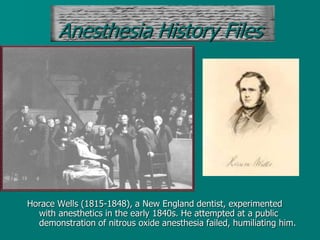
Horace Wells (1815-1848), a New England dentist, experimented
with anesthetics in the early 1840s. He attempted at a public
demonstration of nitrous oxide anesthesia failed, humiliating him.
Anesthesia History Files
Charles Thomas Jackson (Massachusetts)
In 1846, Jackson suggested to Morton (his
student) that he use sulfuric ether
Ether was used :
 as a sedative in the treatment of tuberculosis,
asthma and whooping cough, and as a remedy
for toothache.
 Its anesthetic potential had never been
exploited.
Anesthesia History Files
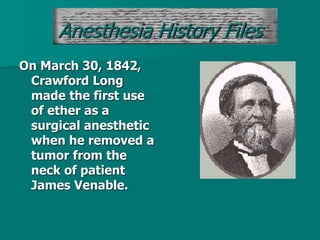
On March 30, 1842,
Crawford Long
made the first use
of ether as a
surgical anesthetic
when he removed a
tumor from the
neck of patient
James Venable.
Anesthesia History Files
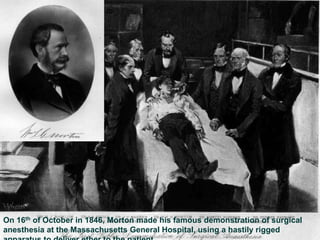
On 16th of October in 1846, Morton made his famous demonstration of surgical
anesthesia at the Massachusetts General Hospital, using a hastily rigged
In the subsequent bitter debate
over who "discovered"
anesthesia, Charles Thomas
Jackson attempted to claim the
achievement for himself. By
1873, however, Jackson had
been admitted to an insane
asylum where he died in 1880
Anesthesia History Files
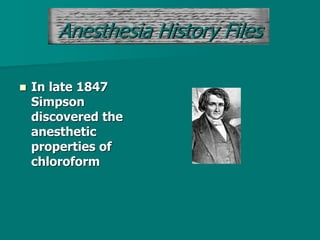
 In late 1847
Simpson
discovered the
anesthetic
properties of
chloroform
Anesthesia History Files
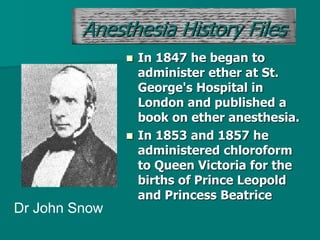
 In 1847 he began to
administer ether at St.
George's Hospital in
London and published a
book on ether anesthesia.
 In 1853 and 1857 he
administered chloroform
to Queen Victoria for the
births of Prince Leopold
and Princess Beatrice
Dr John Snow
 Cocaine was first used to achieve topical
anesthesia in 1884.
 Spinal and epidural anesthesia were
discovered soon after and a combination
of drugs was being used to allow optimal
conditions for physicians to perform
surgery.
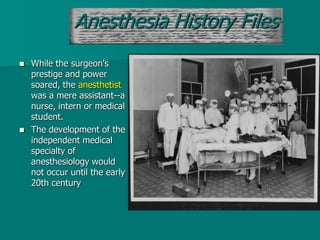
 While the surgeon's
prestige and power
soared, the anesthetist
was a mere assistant--a
nurse, intern or medical
student.
 The development of the
independent medical
specialty of
anesthesiology would
not occur until the early
20th century
Anesthesia History Files
 After World War II ended in 1945,
major developments in the field of
anesthesiology opened new
avenues of medical and surgical
care that were previously
unthinkable. Thus began the
modern era of anesthesia.
Anesthesia History Files
ROLE OF AN ANESTHESIOLOGIST
 Constantly changing and its unique role
expanding  to include but not limit itself to:
1. Provision of insensibility to pain
2. Monitoring and restoration of homeostasis
3. Diagnosis & treatment of painful syndromes
4. Clinical Management of Cardiac and Pulmonary
Resuscitation
5. Evaluation of Respiratory function and
application of Respiratory Therapy
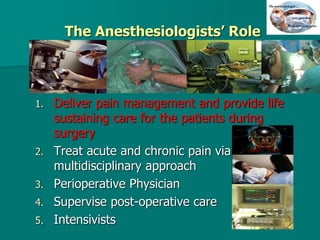
The Anesthesiologists’ Role
1. Deliver pain management and provide life
sustaining care for the patients during
surgery
2. Treat acute and chronic pain via
multidisciplinary approach
3. Perioperative Physician
4. Supervise post-operative care
5. Intensivists
Anesthesiology
 Anesthesia – is a reversible condition of
comfort, quiescence and physiological
stability in a patient before, during and
after performance of a procedure.
 General anesthesia – for surgical
procedure to render the patient unaware /
unresponsive to the painful stimuli.
Anesthesiology
 Surgical stress – evokes Hypothalamus-
Pituitary-Adrenal axis and sympathetic
system.
 Tissue damage during surgery induces
coagulation factors and activates
platelets leading to hypercoagulability of
blood.
 Anesthesia decreases the components of
surgical stress response.
ANESTHESIOLOGISTS’ ROLE
During surgery
1.The Operating theater is still their domain
2.Provide utmost stability of the different vital
organ systems during surgery by vigilant
monitoring and interventions if necessary,
during onslaught due to the stresses of surgery
per se.
3.Provide adequate analgesia during surgery
4. Provide adequate sedation with the objective
of negative recall or awareness
ANESTHESIOLOGISTS’ ROLE
In Pain Management
“ NO PAIN : PATIENTS GAIN”
 Acute pain management - caused by
trauma or other acute illnesses but more
so in postoperative analgesia
 Chronic pain - alleviates patients
sufferings due to chronic pain utilizing
multi modal therapy approach
 Participate in the multidisciplinary
management of cancer
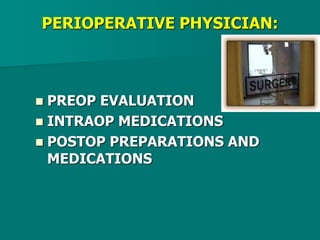
PERIOPERATIVE PHYSICIAN:
 PREOP EVALUATION
 INTRAOP MEDICATIONS
 POSTOP PREPARATIONS AND
MEDICATIONS
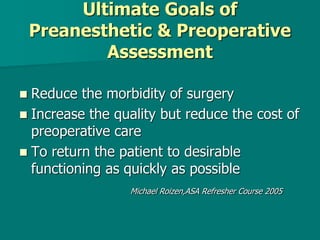
Ultimate Goals of
Preanesthetic & Preoperative
Assessment
 Reduce the morbidity of surgery
 Increase the quality but reduce the cost of
preoperative care
 To return the patient to desirable
functioning as quickly as possible
Michael Roizen,ASA Refresher Course 2005
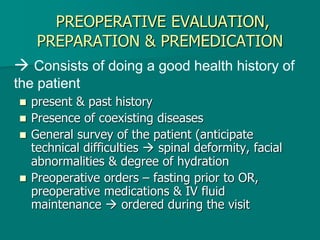
PREOPERATIVE EVALUATION,
PREPARATION & PREMEDICATION
 present & past history
 Presence of coexisting diseases
 General survey of the patient (anticipate
technical difficulties  spinal deformity, facial
abnormalities & degree of hydration
 Preoperative orders – fasting prior to OR,
preoperative medications & IV fluid
maintenance  ordered during the visit
 Consists of doing a good health history of
the patient
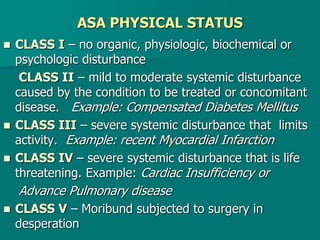
ASA PHYSICAL STATUS
 CLASS I – no organic, physiologic, biochemical or
psychologic disturbance
CLASS II – mild to moderate systemic disturbance
caused by the condition to be treated or concomitant
disease. Example: Compensated Diabetes Mellitus
 CLASS III – severe systemic disturbance that limits
activity. Example: recent Myocardial Infarction
 CLASS IV – severe systemic disturbance that is life
threatening. Example: Cardiac Insufficiency or
Advance Pulmonary disease
 CLASS V – Moribund subjected to surgery in
desperation
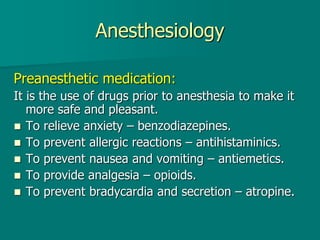
Anesthesiology
Preanesthetic medication:
It is the use of drugs prior to anesthesia to make it
more safe and pleasant.
 To relieve anxiety – benzodiazepines.
 To prevent allergic reactions – antihistaminics.
 To prevent nausea and vomiting – antiemetics.
 To provide analgesia – opioids.
 To prevent bradycardia and secretion – atropine.
TYPES OF ANESTHESIA
A. GENERAL ANESTHESIA
B. REGIONAL ANESTHESIA
C. LOCAL ANESTHESIA

Anesthesiology

  • 1.
  • 2.
    Pain, a Burdento be Borne  In the early days, most people expected to experience pain in their lives  Pain was one of God's punishments for the wicked and purifying trials for the good;  For the woman in labor, pain was the spiritual experience that would transform her into a self-sacrificing mother.
  • 3.
     Before anesthesia,the best surgeons were the fastest.  Four Herculean men would hold a patient on a gurney and surgery would proceed. (“PIGIL ANESTHESIA”)  Quick and simple procedures such as amputations were the majority of surgeries and most patients would just faint from the unbearable pain.
  • 4.
    Original in theRoyal College of Surgeons of England, London. Anesthesiology
  • 5.
    HISTORY of ANESTHESIA Mostcommonly used substances to kill pain:  opium derived from the poppy flower, Papaver somniferum.  alcohol or wine,  mandragora or mandrake from the plant Atropa mandragora,  belladonna from the deadly nightshade,  marijuana or Cannabis indica.
  • 6.
    Anesthesia History Files 1800 June 25: Humphry Davy completes the introduction to his classic work, Researches, Chemical and Philosophical; Chiefly Concerning Nitrous Oxide, or Dephlogisticated Nitrous Air, and its Respiration What eventually evolved into anesthesia as we know it today was ushered in with the chance observation that the inhalation of nitrous oxide ("laughing gas") produced a state of intoxication during which people became highly amused and insensitive to pain.
  • 7.
    Horace Wells (1815-1848),a New England dentist, experimented with anesthetics in the early 1840s. He attempted at a public demonstration of nitrous oxide anesthesia failed, humiliating him. Anesthesia History Files
  • 8.
    Anesthesia History Files CharlesThomas Jackson (Massachusetts) In 1846, Jackson suggested to Morton (his student) that he use sulfuric ether
  • 9.
    Ether was used:  as a sedative in the treatment of tuberculosis, asthma and whooping cough, and as a remedy for toothache.  Its anesthetic potential had never been exploited. Anesthesia History Files
  • 10.
    On March 30,1842, Crawford Long made the first use of ether as a surgical anesthetic when he removed a tumor from the neck of patient James Venable. Anesthesia History Files
  • 11.
    On 16th ofOctober in 1846, Morton made his famous demonstration of surgical anesthesia at the Massachusetts General Hospital, using a hastily rigged
  • 12.
    In the subsequentbitter debate over who "discovered" anesthesia, Charles Thomas Jackson attempted to claim the achievement for himself. By 1873, however, Jackson had been admitted to an insane asylum where he died in 1880 Anesthesia History Files
  • 13.
    Anesthesia History Files In late 1847 Simpson discovered the anesthetic properties of chloroform
  • 14.
    Anesthesia History Files In 1847 he began to administer ether at St. George's Hospital in London and published a book on ether anesthesia.  In 1853 and 1857 he administered chloroform to Queen Victoria for the births of Prince Leopold and Princess Beatrice Dr John Snow
  • 15.
     Cocaine wasfirst used to achieve topical anesthesia in 1884.  Spinal and epidural anesthesia were discovered soon after and a combination of drugs was being used to allow optimal conditions for physicians to perform surgery.
  • 16.
     While thesurgeon's prestige and power soared, the anesthetist was a mere assistant--a nurse, intern or medical student.  The development of the independent medical specialty of anesthesiology would not occur until the early 20th century Anesthesia History Files
  • 17.
     After WorldWar II ended in 1945, major developments in the field of anesthesiology opened new avenues of medical and surgical care that were previously unthinkable. Thus began the modern era of anesthesia. Anesthesia History Files
  • 18.
    ROLE OF ANANESTHESIOLOGIST  Constantly changing and its unique role expanding  to include but not limit itself to: 1. Provision of insensibility to pain 2. Monitoring and restoration of homeostasis 3. Diagnosis & treatment of painful syndromes 4. Clinical Management of Cardiac and Pulmonary Resuscitation 5. Evaluation of Respiratory function and application of Respiratory Therapy
  • 19.
    The Anesthesiologists’ Role 1.Deliver pain management and provide life sustaining care for the patients during surgery 2. Treat acute and chronic pain via multidisciplinary approach 3. Perioperative Physician 4. Supervise post-operative care 5. Intensivists
  • 20.
    Anesthesiology  Anesthesia –is a reversible condition of comfort, quiescence and physiological stability in a patient before, during and after performance of a procedure.  General anesthesia – for surgical procedure to render the patient unaware / unresponsive to the painful stimuli.
  • 21.
    Anesthesiology  Surgical stress– evokes Hypothalamus- Pituitary-Adrenal axis and sympathetic system.  Tissue damage during surgery induces coagulation factors and activates platelets leading to hypercoagulability of blood.  Anesthesia decreases the components of surgical stress response.
  • 22.
    ANESTHESIOLOGISTS’ ROLE During surgery 1.TheOperating theater is still their domain 2.Provide utmost stability of the different vital organ systems during surgery by vigilant monitoring and interventions if necessary, during onslaught due to the stresses of surgery per se. 3.Provide adequate analgesia during surgery 4. Provide adequate sedation with the objective of negative recall or awareness
  • 23.
    ANESTHESIOLOGISTS’ ROLE In PainManagement “ NO PAIN : PATIENTS GAIN”  Acute pain management - caused by trauma or other acute illnesses but more so in postoperative analgesia  Chronic pain - alleviates patients sufferings due to chronic pain utilizing multi modal therapy approach  Participate in the multidisciplinary management of cancer
  • 24.
    PERIOPERATIVE PHYSICIAN:  PREOPEVALUATION  INTRAOP MEDICATIONS  POSTOP PREPARATIONS AND MEDICATIONS
  • 25.
    Ultimate Goals of Preanesthetic& Preoperative Assessment  Reduce the morbidity of surgery  Increase the quality but reduce the cost of preoperative care  To return the patient to desirable functioning as quickly as possible Michael Roizen,ASA Refresher Course 2005
  • 26.
    PREOPERATIVE EVALUATION, PREPARATION &PREMEDICATION  present & past history  Presence of coexisting diseases  General survey of the patient (anticipate technical difficulties  spinal deformity, facial abnormalities & degree of hydration  Preoperative orders – fasting prior to OR, preoperative medications & IV fluid maintenance  ordered during the visit  Consists of doing a good health history of the patient
  • 27.
    ASA PHYSICAL STATUS CLASS I – no organic, physiologic, biochemical or psychologic disturbance CLASS II – mild to moderate systemic disturbance caused by the condition to be treated or concomitant disease. Example: Compensated Diabetes Mellitus  CLASS III – severe systemic disturbance that limits activity. Example: recent Myocardial Infarction  CLASS IV – severe systemic disturbance that is life threatening. Example: Cardiac Insufficiency or Advance Pulmonary disease  CLASS V – Moribund subjected to surgery in desperation
  • 28.
    Anesthesiology Preanesthetic medication: It isthe use of drugs prior to anesthesia to make it more safe and pleasant.  To relieve anxiety – benzodiazepines.  To prevent allergic reactions – antihistaminics.  To prevent nausea and vomiting – antiemetics.  To provide analgesia – opioids.  To prevent bradycardia and secretion – atropine.
  • 29.
    TYPES OF ANESTHESIA A.GENERAL ANESTHESIA B. REGIONAL ANESTHESIA C. LOCAL ANESTHESIA