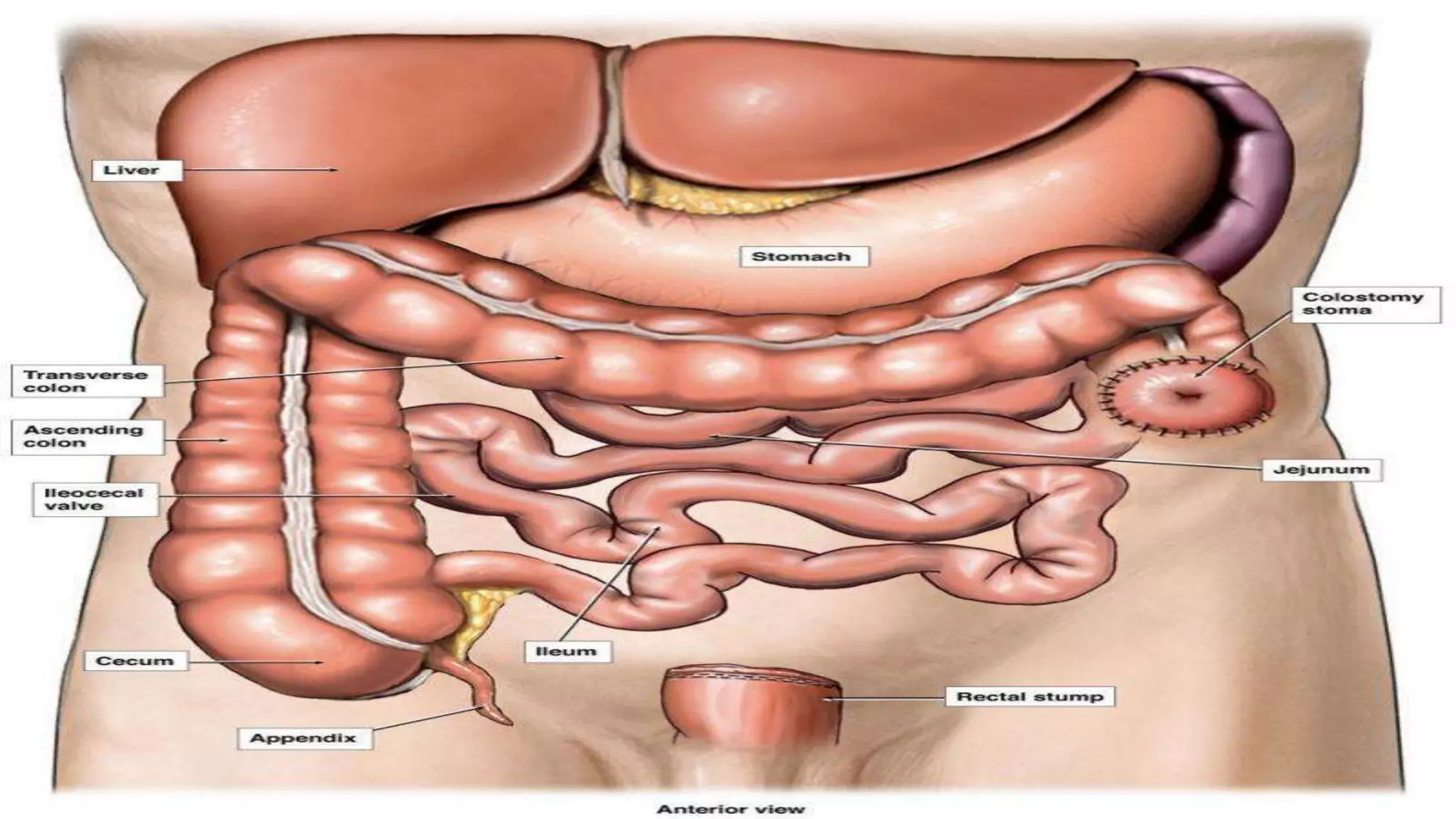
INTESTINAL
OBSTRUCTION
PRESENTED BY
PANKAJ SINGH RANA
NURSE PRACTITIONER IN
CRITICAL CARE
INTRODUCTTION
▪ Intestinal obstruction means blockage of intestinal pathway
that prevents the normal flow of products of intestine.
▪ It is also known as bowel obstruction.
DEFINITION
▪ Intestinal obstruction is a significant or mechanical
blockage of intestine that occurs when food or stool
can not move through the intestine.
▪ These obstruction may be complete or partial.
CAUSES
MECHANICAL CAUSES:
An intraluminal obstruction or a mural obstruction from
pressure on the intestinal wall occurs e.g.. Tumour &
neoplasm, stenosis, hernia, abscess.
FUNCTIONAL OBSTRUCTION:
The intestinal mass culture can’t propel the contents the bowel.
e.g.. Amyloidosis (It is a group of disease in which abnormal
protein known as amyloid fibrils builds up in tissue, it cause &
change in shape, work & also called organ failure.)
-Muscular dystrophy
-Endocrine disorder such as diabetes
-Neurological disorders
CLASSIFICATON
ONTHE BASIS OF CHANGES & MOVEMENTS
Dynamic a dynamic
ONTHE BASIS OF DURATION
Subacute & acute chronic
ONTHE BASIS OF LOCATION
Small bowel obstruction & large bowel obstruction
ONTHE BASIS OF CHANGES & MOVEMENTS
DYNAMIC: It occurs when peristalsis is working against a mechanical
obstruction.
ADYNAMIC: It may occur in two forms:
1.Where peristalsis may be absent. Occurring secondarily to
neuromuscular failure in the mesentery.
2.Where peristalsis may be present in non-propulsive form (pseudo-
obstruction).
* In both form mechanical elements is absent.
ON THE BASIS OF NATURE IT IS
CALSSIFIED INTO
SUBACUTE & ACUTE: It usually occurs in small bowel
obstruction with sudden onset of severe colicky central
abdominal pain distension & early vomiting & constipation.
CHRONIC OBSTRUCTION : Usually seen in large bowel
obstruction with lower abdominal colic and absolute
constipation, followed by distension.
ON THE BASIS OF LOCATION
▪ Small bowel obstruction: duodenum, jejunum, and ilium are
the part of the small intestine, when the obstruction occur in
this part of intestine.
▪ High bowel wash: ascending colon, transverse colon,
descending colon, cecum, rectum when the obstruction occur
in this part of intestine.
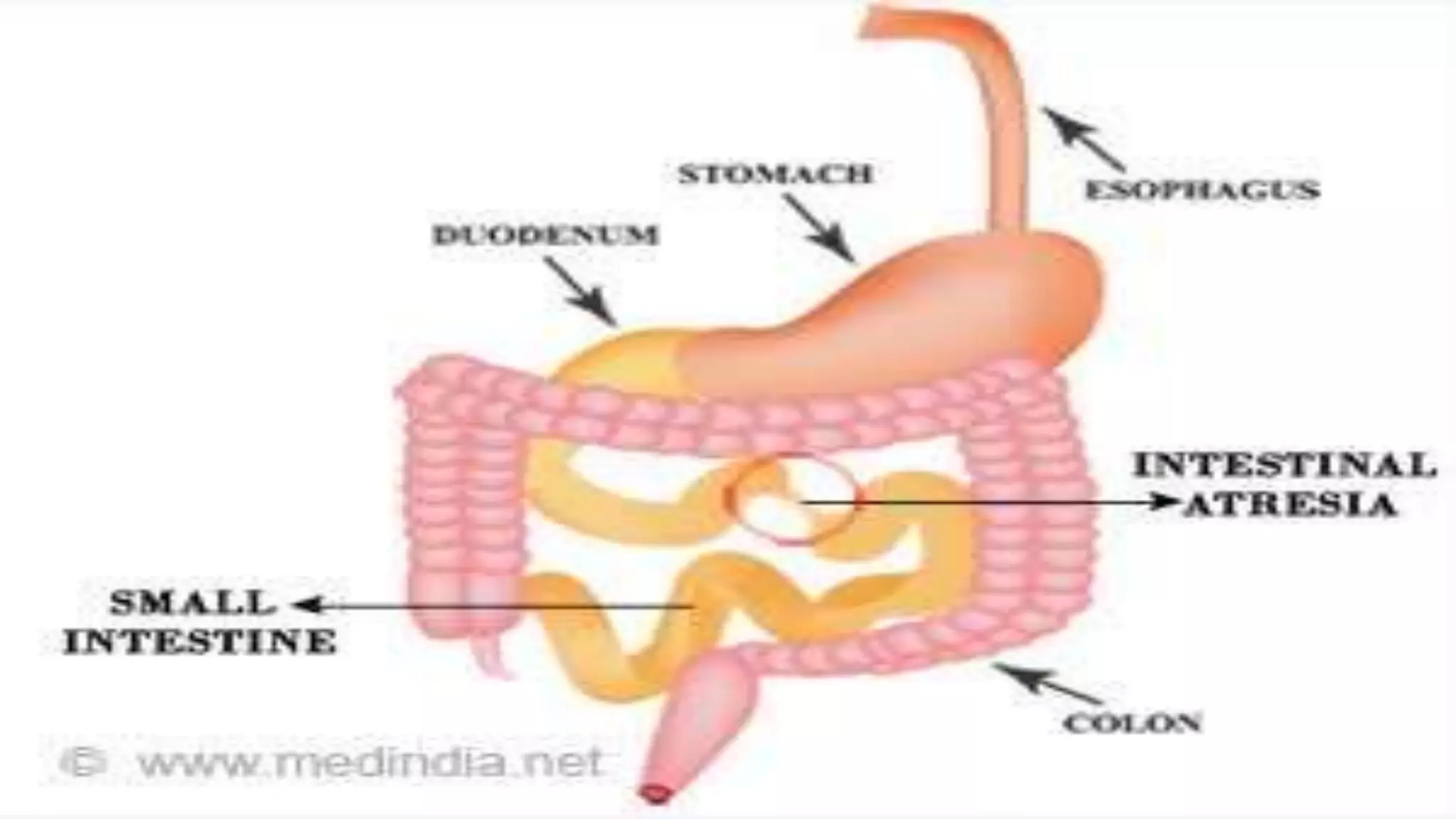
SMALL BOWEL OBSTRUCTION
▪ duodenum, jejunum, and ilium are the part of the small
intestine, when the obstruction occur in this part of
intestine.
CAUSES
Adhesion 60%
Hernia 20%
Neoplasm 5%
Volvulus 5%.
Others: IBD - gall stone - foreign body – intussusception
Atresia
Stenosis
ADHESION
▪ Superior mesenteric artery syndrome: compression of duodenum
by superior mesenteric artery in abdominal aorta
INTUSSUSCEPTION
VOLVLUS
LARGE BOWEL OBSTRUCTION
▪ Descending colon, sigmoid colon rectum and anal canal
is part of large intestine
▪ Large bowel obstruction occur when if obstruction in
these part of intestine
CAUSES
Cancer 60%.
Diverticular disease 15%.
Volvulus 15%.
Others: hernia – fecal impaction - IBD.
Inflammatory bowel disease
Constipation
Adhesion
Faecaloma extreme form of faecal immobilization
Colon atresia- narrowing of colon
PATHOPHYSIOLOGY
Due to etiological factor
Impairment of passage of material through bowel
Accumulation of flatus,feaceas and retention of fluid,
reduce the fluid absorption and stimulate more gastric
secretion
PATHOPHYSIOLOGY
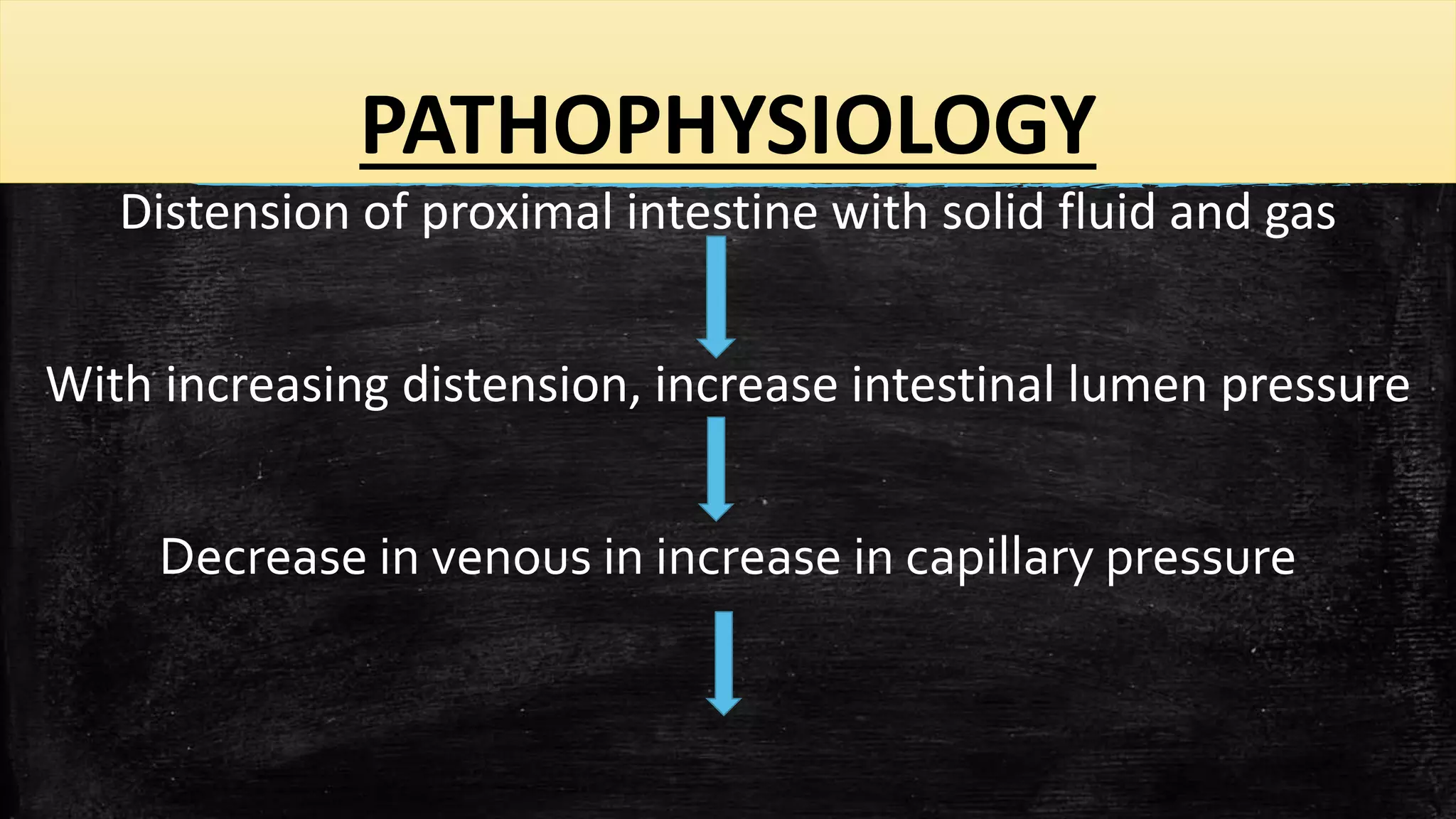
Distension of proximal intestine with solid fluid and gas
With increasing distension, increase intestinal lumen pressure
Decrease in venous in increase in capillary pressure
Oedema, congestion with decrease capillary
pressure
Rapture of perforation of intestine
Peritonitis
CLINICAL MANIFESTATION
▪ Initial symptoms is usually crampy pain that is wave like and colicky.
▪ Classical symptoms is nausea vomiting and constipation
▪ Without treatment abdominal pain may increase as a result of
perforation
▪ Ischemia
▪ Absence of passage of flatus abdominal distension
▪ Fever
▪ Tachycardia
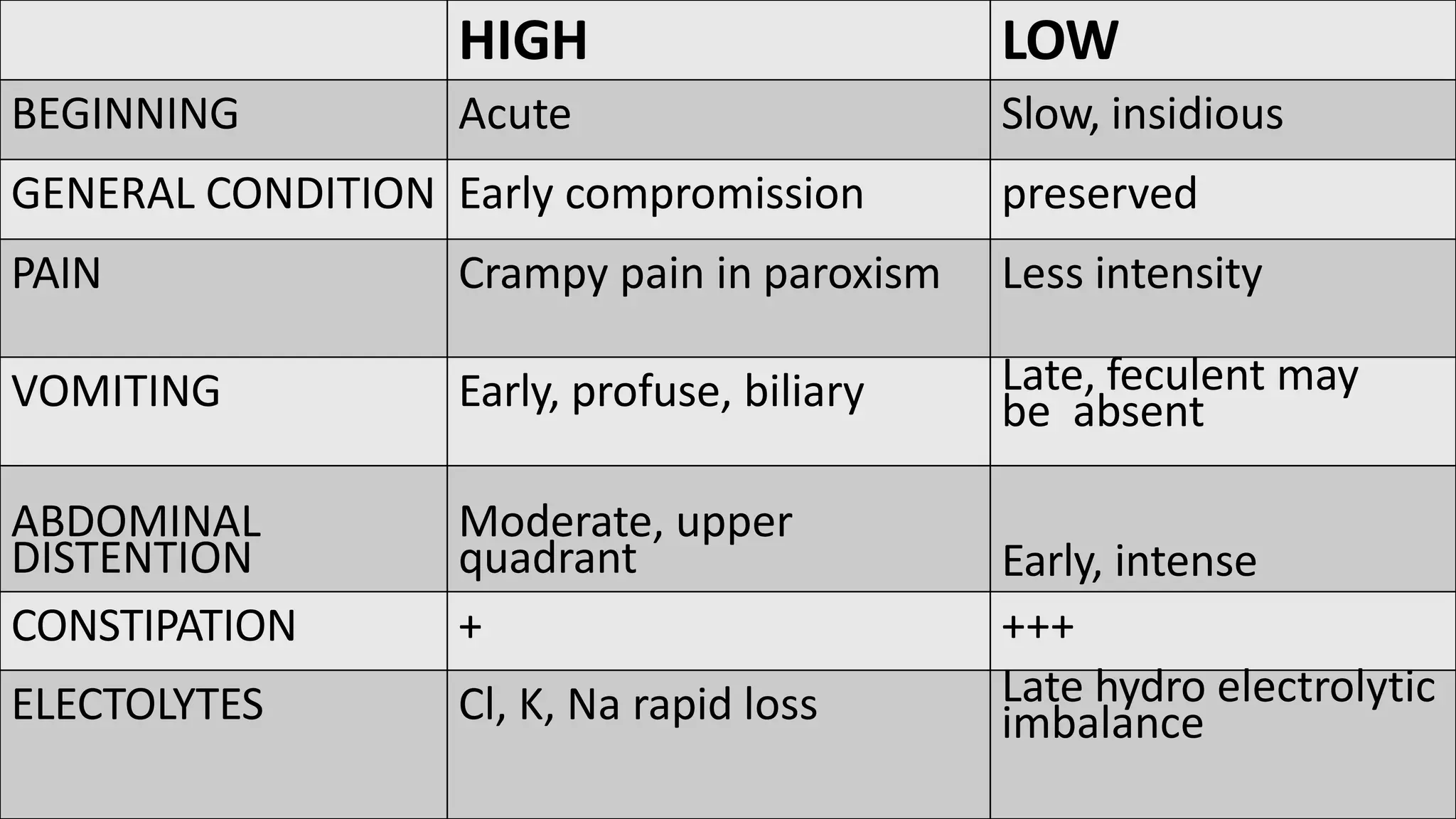
Difference between High & Low
intestinal obstruction
HIGH LOW
BEGINNING Acute Slow, insidious
GENERAL CONDITION Early compromission preserved
PAIN Crampy pain in paroxism Less intensity
VOMITING Early, profuse, biliary Late, feculent may
be absent
ABDOMINAL
DISTENTION
Moderate, upper
quadrant Early, intense
CONSTIPATION + +++
ELECTOLYTES Cl, K, Na rapid loss Late hydro electrolytic
imbalance
COMPLICATION
▪ Intestinal perforation
▪ Peritonitis due to perforation
▪ Sepsis- mostly in which delay in diagnosis or treatment.
▪ Intraabdominal abscess.
▪ Dehydration
▪ Electrolyte disturbance
▪ Multiple organ failure(rarely)
▪ Death
DIAGNOSTIC EVALUATION
HISTORY COLLECTION
present medical and surgical history
past medical and surgical history
PHYSICAL EXAMINATION
LABORATORYTEST
 RADIOLOGICALTEST
PHYSICAL EXAMINATION
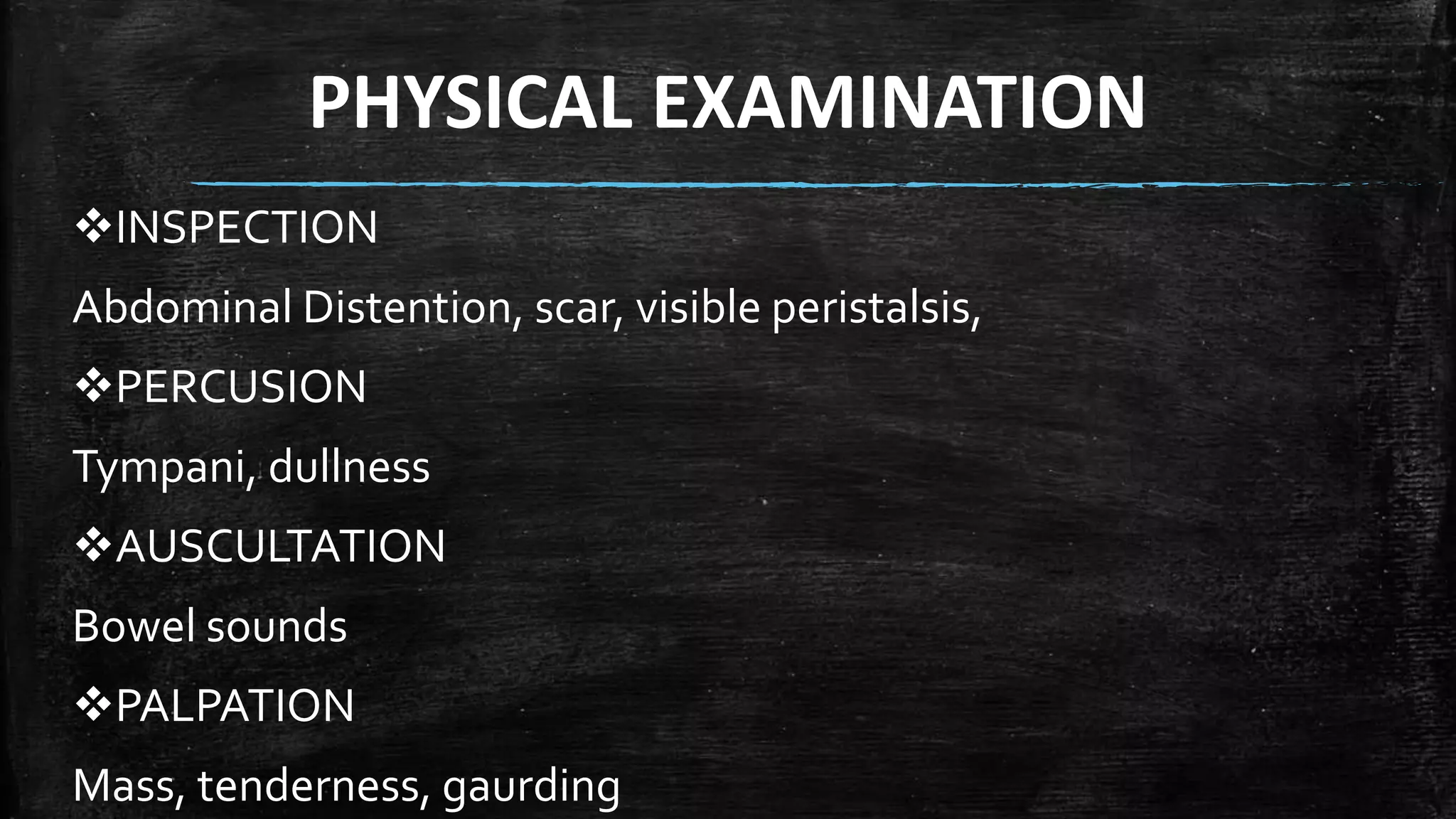
INSPECTION
Abdominal Distention, scar, visible peristalsis,
PERCUSION
Tympani, dullness
AUSCULTATION
Bowel sounds
PALPATION
Mass, tenderness, gaurding
LABORATORY FINDINGS
• CBC:
–Increase PCV (dehydration ) and increase in WBC.
• KFT:
–Increase in BUN and creatinine .
• Lactate concentration-amylase-lactic dehydrogenase useful but
not sensitive
–Torule out necrosis
• ABG:
–metabolic alkalosis and respiratory acidosis.
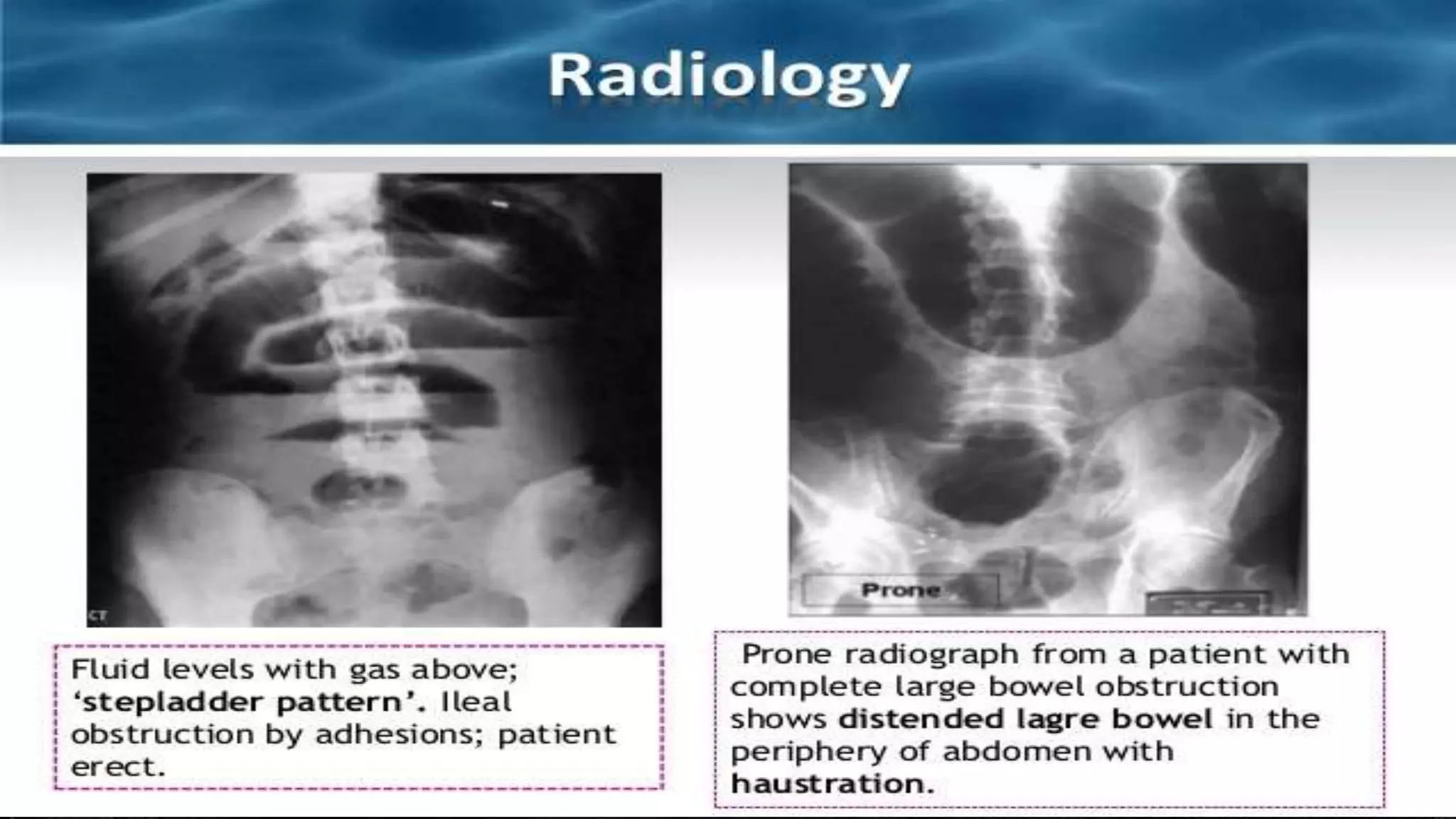
RADIOLOGICAL EVALUATION
SIGMOIDOSCOPY (FLEXIBLE)
▪ it is a minimal invasive endoscopic procedure for large
intestine from the rectum through the last part of the colon
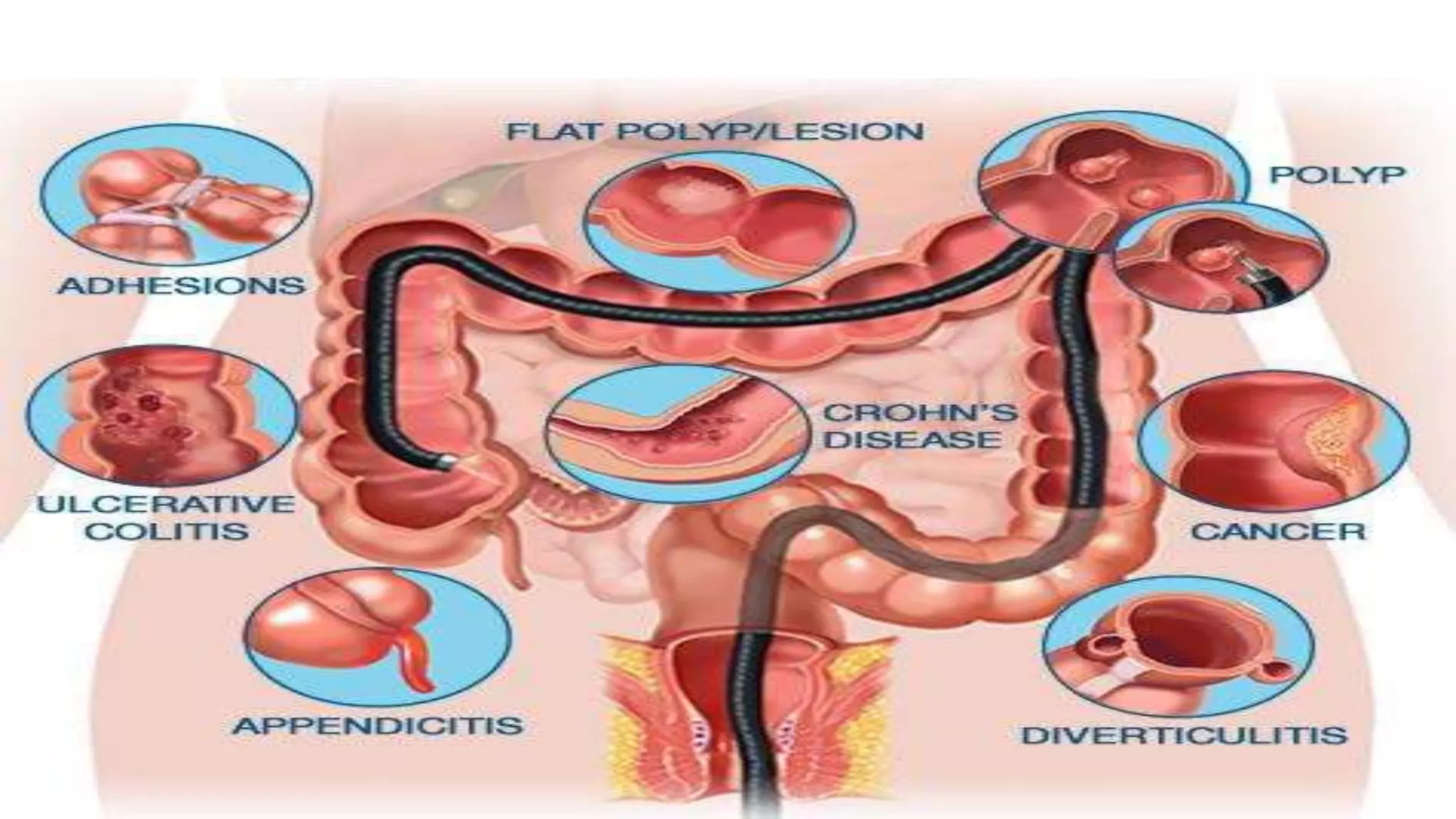
COLONOSCOPY
▪ it is the endoscopic procedure for large intestine and
digital part of the small with fibber optic camera on a
flexible tube passed through the anus and it provide
the visual diagnosis show location of obstruction
CT SCAN
MEDICAL MANAGEMENT
 Fluid replacement with aggressive intravenous resuscitation using
isotonic saline or ringer lactate is indicate.
 Antibiotic therapy for gram negative bacteria such as cefazolin and
cefotaxime and meropenem
 Antiemetic for symptomatic relief of nausea and vomiting such as
ondansetron
 Analgesic to relief pain such as morphine, fentanyl and diclofenac.
▪ Diuretics to reduce the fluid retention such as
furosemide.
▪ Stool softener such as duphalac for relief
constipation
SURGICAL MANAGEMENT
▪ Bowel resection (enterotomy) - it is a surgical procedure in
which a part of bowel is removed, from either small
intestine or large intestine.
▪ Colostomy
▪ Bypass surgery
DIETARY MANAGEMENT
Clear liquid diet- a Clear liquid diet starting with soups and
advancing to half cup to one cup portions.
Food allowed on clear liquid diet, fruit juice after 1 to 2 weeks.
Low fibber diet- temporarily limiting the amount of fibber for
bowel healing
Low fibber rich diet such as white bread with outs nuts and seeds
White rice, plain white pasta
Well cooked vegetables and fruits without skin and seeds
Avoid hot spicy and cholesterol rich diet
Avoid alcohol
Avoid smoking
Acute pain related to intestinal obstruction as
evidence by patient verbalization.
Goal- resolved the pain
Intervention-
▪ assess level, frequently and type of pain.
▪ Provide comfortable position
▪ Administer the prescribed medication provide diversional
therapy
▪ Provide calm environment
Imbalance nutrition less than body requirement related to
altered nutritional absorption as evidence by aversion to
eating
Goal: Enhance the nutritional status
Intervention:
▪ Recommend bed rest before meal
▪ Provide oral hygiene
▪ Avoid food that cause abdominal cramping
▪ Record intake and output
▪ Promote patient participation in dietary planning as possible
Risk for deficit fluid volume related to vomiting as
evidence by skin turgidity
Goal: maintain adequate fluid and volume level
Intervention:
▪ Monitor intake and output
▪ Note possible condition that may lead to deficient fluid loss.
▪ Monitor vital sign
▪ Observe the skin condition
▪ Administration preantral fluid
Anxiety related to changes in health status as
evidence by somatic complaints
Goal: Patient feel relaxed
Intervention
▪ Review physiological factor such as active medical condition
▪ Observe and note behaviour
▪ Encourage verbalization of feeling
A clinical study of intestinal obstruction and its surgical Management in
rural population
Naveen N, Avijeet Mukherjee, Nataraj Y. S, LingeGowda S. N.
The study revealed that Intestinal obstruction is more common in the
age group of 30-60 years. Small bowel obstruction is more common
than large bowel obstruction. Four cardinal features of intestinal
obstruction are pain abdomen, vomiting, distension and constipation.
Most common etiological factor is postoperative adhesions followed
by abdominal hernia. Malignancy as a cause for obstruction is more
common in large bowel than small bowel. Intravenous fluids and
electrolytes, gastrointestinal aspiration, antibiotics and timed
appropriate surgery are still the mainstay of treatment.
CONCLUSION
▪ At last in this topic I would like to say intestinal
obstruction is a digestive system disorder that may
affect the intestinal which are responsible for
movement of digestive food particles, faeces, gases.
▪ if they are not passed it will strangulate in intestine and
cause many problem. It may also cause intestinal
perforation that is life threatening condition and if not
treated it will cause death.
Intestinal obstruction, BOWEL OBSTRUCTION

Intestinal obstruction, BOWEL OBSTRUCTION

  • 1.
    INTESTINAL OBSTRUCTION PRESENTED BY PANKAJ SINGHRANA NURSE PRACTITIONER IN CRITICAL CARE
  • 2.
    INTRODUCTTION ▪ Intestinal obstructionmeans blockage of intestinal pathway that prevents the normal flow of products of intestine. ▪ It is also known as bowel obstruction.
  • 3.
    DEFINITION ▪ Intestinal obstructionis a significant or mechanical blockage of intestine that occurs when food or stool can not move through the intestine. ▪ These obstruction may be complete or partial.
  • 4.
    CAUSES MECHANICAL CAUSES: An intraluminalobstruction or a mural obstruction from pressure on the intestinal wall occurs e.g.. Tumour & neoplasm, stenosis, hernia, abscess.
  • 5.
    FUNCTIONAL OBSTRUCTION: The intestinalmass culture can’t propel the contents the bowel. e.g.. Amyloidosis (It is a group of disease in which abnormal protein known as amyloid fibrils builds up in tissue, it cause & change in shape, work & also called organ failure.) -Muscular dystrophy -Endocrine disorder such as diabetes -Neurological disorders
  • 6.
    CLASSIFICATON ONTHE BASIS OFCHANGES & MOVEMENTS Dynamic a dynamic ONTHE BASIS OF DURATION Subacute & acute chronic ONTHE BASIS OF LOCATION Small bowel obstruction & large bowel obstruction
  • 7.
    ONTHE BASIS OFCHANGES & MOVEMENTS DYNAMIC: It occurs when peristalsis is working against a mechanical obstruction.
  • 8.
    ADYNAMIC: It mayoccur in two forms: 1.Where peristalsis may be absent. Occurring secondarily to neuromuscular failure in the mesentery. 2.Where peristalsis may be present in non-propulsive form (pseudo- obstruction). * In both form mechanical elements is absent.
  • 9.
    ON THE BASISOF NATURE IT IS CALSSIFIED INTO SUBACUTE & ACUTE: It usually occurs in small bowel obstruction with sudden onset of severe colicky central abdominal pain distension & early vomiting & constipation. CHRONIC OBSTRUCTION : Usually seen in large bowel obstruction with lower abdominal colic and absolute constipation, followed by distension.
  • 10.
    ON THE BASISOF LOCATION ▪ Small bowel obstruction: duodenum, jejunum, and ilium are the part of the small intestine, when the obstruction occur in this part of intestine. ▪ High bowel wash: ascending colon, transverse colon, descending colon, cecum, rectum when the obstruction occur in this part of intestine.
  • 11.
    SMALL BOWEL OBSTRUCTION ▪duodenum, jejunum, and ilium are the part of the small intestine, when the obstruction occur in this part of intestine.
  • 12.
    CAUSES Adhesion 60% Hernia 20% Neoplasm5% Volvulus 5%. Others: IBD - gall stone - foreign body – intussusception Atresia Stenosis
  • 13.
  • 14.
    ▪ Superior mesentericartery syndrome: compression of duodenum by superior mesenteric artery in abdominal aorta
  • 15.
  • 16.
  • 17.
    LARGE BOWEL OBSTRUCTION ▪Descending colon, sigmoid colon rectum and anal canal is part of large intestine ▪ Large bowel obstruction occur when if obstruction in these part of intestine
  • 18.
    CAUSES Cancer 60%. Diverticular disease15%. Volvulus 15%. Others: hernia – fecal impaction - IBD. Inflammatory bowel disease Constipation Adhesion Faecaloma extreme form of faecal immobilization Colon atresia- narrowing of colon
  • 20.
    PATHOPHYSIOLOGY Due to etiologicalfactor Impairment of passage of material through bowel Accumulation of flatus,feaceas and retention of fluid, reduce the fluid absorption and stimulate more gastric secretion
  • 21.
    PATHOPHYSIOLOGY Distension of proximalintestine with solid fluid and gas With increasing distension, increase intestinal lumen pressure Decrease in venous in increase in capillary pressure
  • 22.
    Oedema, congestion withdecrease capillary pressure Rapture of perforation of intestine Peritonitis
  • 23.
    CLINICAL MANIFESTATION ▪ Initialsymptoms is usually crampy pain that is wave like and colicky. ▪ Classical symptoms is nausea vomiting and constipation ▪ Without treatment abdominal pain may increase as a result of perforation ▪ Ischemia ▪ Absence of passage of flatus abdominal distension ▪ Fever ▪ Tachycardia
  • 24.
    Difference between High& Low intestinal obstruction HIGH LOW BEGINNING Acute Slow, insidious GENERAL CONDITION Early compromission preserved PAIN Crampy pain in paroxism Less intensity VOMITING Early, profuse, biliary Late, feculent may be absent ABDOMINAL DISTENTION Moderate, upper quadrant Early, intense CONSTIPATION + +++ ELECTOLYTES Cl, K, Na rapid loss Late hydro electrolytic imbalance
  • 25.
    COMPLICATION ▪ Intestinal perforation ▪Peritonitis due to perforation ▪ Sepsis- mostly in which delay in diagnosis or treatment. ▪ Intraabdominal abscess. ▪ Dehydration ▪ Electrolyte disturbance ▪ Multiple organ failure(rarely) ▪ Death
  • 26.
    DIAGNOSTIC EVALUATION HISTORY COLLECTION presentmedical and surgical history past medical and surgical history PHYSICAL EXAMINATION LABORATORYTEST  RADIOLOGICALTEST
  • 27.
    PHYSICAL EXAMINATION INSPECTION Abdominal Distention,scar, visible peristalsis, PERCUSION Tympani, dullness AUSCULTATION Bowel sounds PALPATION Mass, tenderness, gaurding
  • 28.
    LABORATORY FINDINGS • CBC: –IncreasePCV (dehydration ) and increase in WBC. • KFT: –Increase in BUN and creatinine . • Lactate concentration-amylase-lactic dehydrogenase useful but not sensitive –Torule out necrosis • ABG: –metabolic alkalosis and respiratory acidosis.
  • 29.
  • 31.
    SIGMOIDOSCOPY (FLEXIBLE) ▪ itis a minimal invasive endoscopic procedure for large intestine from the rectum through the last part of the colon
  • 32.
    COLONOSCOPY ▪ it isthe endoscopic procedure for large intestine and digital part of the small with fibber optic camera on a flexible tube passed through the anus and it provide the visual diagnosis show location of obstruction
  • 34.
  • 35.
    MEDICAL MANAGEMENT  Fluidreplacement with aggressive intravenous resuscitation using isotonic saline or ringer lactate is indicate.  Antibiotic therapy for gram negative bacteria such as cefazolin and cefotaxime and meropenem  Antiemetic for symptomatic relief of nausea and vomiting such as ondansetron  Analgesic to relief pain such as morphine, fentanyl and diclofenac.
  • 36.
    ▪ Diuretics toreduce the fluid retention such as furosemide. ▪ Stool softener such as duphalac for relief constipation
  • 37.
    SURGICAL MANAGEMENT ▪ Bowelresection (enterotomy) - it is a surgical procedure in which a part of bowel is removed, from either small intestine or large intestine. ▪ Colostomy ▪ Bypass surgery
  • 41.
    DIETARY MANAGEMENT Clear liquiddiet- a Clear liquid diet starting with soups and advancing to half cup to one cup portions. Food allowed on clear liquid diet, fruit juice after 1 to 2 weeks. Low fibber diet- temporarily limiting the amount of fibber for bowel healing
  • 42.
    Low fibber richdiet such as white bread with outs nuts and seeds White rice, plain white pasta Well cooked vegetables and fruits without skin and seeds Avoid hot spicy and cholesterol rich diet Avoid alcohol Avoid smoking
  • 44.
    Acute pain relatedto intestinal obstruction as evidence by patient verbalization. Goal- resolved the pain Intervention- ▪ assess level, frequently and type of pain. ▪ Provide comfortable position ▪ Administer the prescribed medication provide diversional therapy ▪ Provide calm environment
  • 45.
    Imbalance nutrition lessthan body requirement related to altered nutritional absorption as evidence by aversion to eating Goal: Enhance the nutritional status Intervention: ▪ Recommend bed rest before meal ▪ Provide oral hygiene ▪ Avoid food that cause abdominal cramping ▪ Record intake and output ▪ Promote patient participation in dietary planning as possible
  • 46.
    Risk for deficitfluid volume related to vomiting as evidence by skin turgidity Goal: maintain adequate fluid and volume level Intervention: ▪ Monitor intake and output ▪ Note possible condition that may lead to deficient fluid loss. ▪ Monitor vital sign ▪ Observe the skin condition ▪ Administration preantral fluid
  • 47.
    Anxiety related tochanges in health status as evidence by somatic complaints Goal: Patient feel relaxed Intervention ▪ Review physiological factor such as active medical condition ▪ Observe and note behaviour ▪ Encourage verbalization of feeling
  • 48.
    A clinical studyof intestinal obstruction and its surgical Management in rural population Naveen N, Avijeet Mukherjee, Nataraj Y. S, LingeGowda S. N. The study revealed that Intestinal obstruction is more common in the age group of 30-60 years. Small bowel obstruction is more common than large bowel obstruction. Four cardinal features of intestinal obstruction are pain abdomen, vomiting, distension and constipation. Most common etiological factor is postoperative adhesions followed by abdominal hernia. Malignancy as a cause for obstruction is more common in large bowel than small bowel. Intravenous fluids and electrolytes, gastrointestinal aspiration, antibiotics and timed appropriate surgery are still the mainstay of treatment.
  • 49.
    CONCLUSION ▪ At lastin this topic I would like to say intestinal obstruction is a digestive system disorder that may affect the intestinal which are responsible for movement of digestive food particles, faeces, gases. ▪ if they are not passed it will strangulate in intestine and cause many problem. It may also cause intestinal perforation that is life threatening condition and if not treated it will cause death.