DIABETIC HYPOGLYCEMIA
DEFINITION
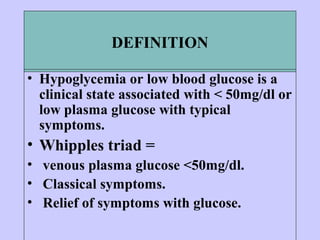
• Hypoglycemia or low blood glucose is a
clinical state associated with < 50mg/dl or
low plasma glucose with typical
symptoms.
• Whipples triad =
• venous plasma glucose <50mg/dl.
• Classical symptoms.
• Relief of symptoms with glucose.
DCCT Definition
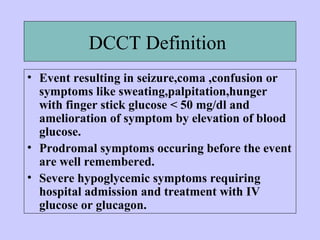
• Event resulting in seizure,coma ,confusion or
symptoms like sweating,palpitation,hunger
with finger stick glucose < 50 mg/dl and
amelioration of symptom by elevation of blood
glucose.
• Prodromal symptoms occuring before the event
are well remembered.
• Severe hypoglycemic symptoms requiring
hospital admission and treatment with IV
glucose or glucagon.
Mechanisms for fasting hypoglycemia
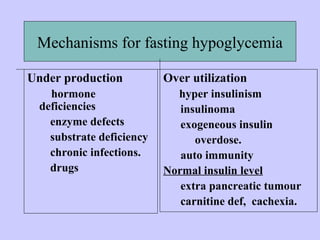
Under production
hormone
deficiencies
enzyme defects
substrate deficiency
chronic infections.
drugs
Over utilization
hyper insulinism
insulinoma
exogeneous insulin
overdose.
auto immunity
Normal insulin level
extra pancreatic tumour
carnitine def, cachexia.
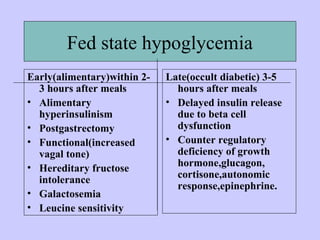
Fed state hypoglycemia
Early(alimentary)within 2-
3 hours after meals
• Alimentary
hyperinsulinism
• Postgastrectomy
• Functional(increased
vagal tone)
• Hereditary fructose
intolerance
• Galactosemia
• Leucine sensitivity
Late(occult diabetic) 3-5
hours after meals
• Delayed insulin release
due to beta cell
dysfunction
• Counter regulatory
deficiency of growth
hormone,glucagon,
cortisone,autonomic
response,epinephrine.
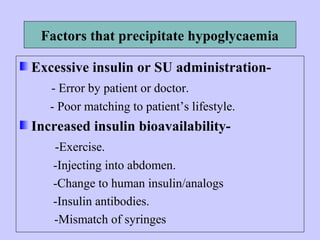
Factors that precipitate hypoglycaemia
Excessive insulin or SU administration-
- Error by patient or doctor.
- Poor matching to patient’s lifestyle.
Increased insulin bioavailability-
-Exercise.
-Injecting into abdomen.
-Change to human insulin/analogs
-Insulin antibodies.
-Mismatch of syringes
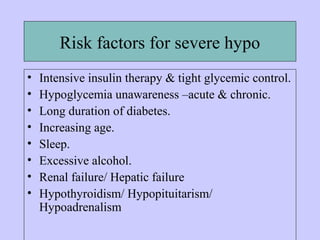
Risk factors for severe hypo
• Intensive insulin therapy & tight glycemic control.
• Hypoglycemia unawareness –acute & chronic.
• Long duration of diabetes.
• Increasing age.
• Sleep.
• Excessive alcohol.
• Renal failure/ Hepatic failure
• Hypothyroidism/ Hypopituitarism/
Hypoadrenalism
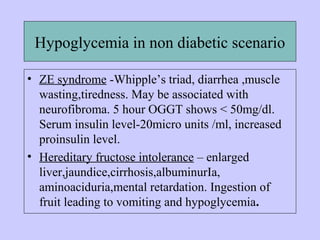
Hypoglycemia in non diabetic scenario
• ZE syndrome -Whipple’s triad, diarrhea ,muscle
wasting,tiredness. May be associated with
neurofibroma. 5 hour OGGT shows < 50mg/dl.
Serum insulin level-20micro units /ml, increased
proinsulin level.
• Hereditary fructose intolerance – enlarged
liver,jaundice,cirrhosis,albuminurIa,
aminoaciduria,mental retardation. Ingestion of
fruit leading to vomiting and hypoglycemia.
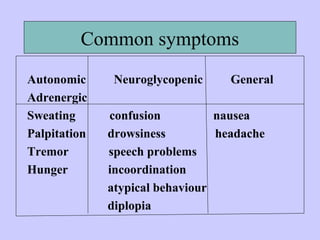
Common symptoms
Autonomic Neuroglycopenic General
Adrenergic
Sweating confusion nausea
Palpitation drowsiness headache
Tremor speech problems
Hunger incoordination
atypical behaviour
diplopia
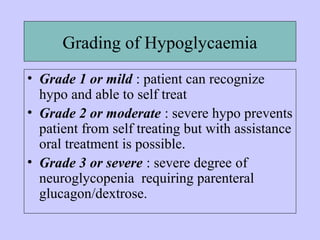
Grading of Hypoglycaemia
• Grade 1 or mild : patient can recognize
hypo and able to self treat
• Grade 2 or moderate : severe hypo prevents
patient from self treating but with assistance
oral treatment is possible.
• Grade 3 or severe : severe degree of
neuroglycopenia requiring parenteral
glucagon/dextrose.
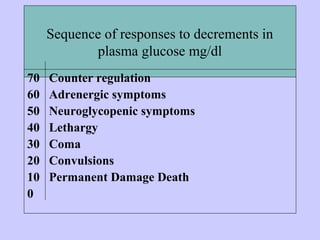
Sequence of responses to decrements in
plasma glucose mg/dl
70 Counter regulation
60 Adrenergic symptoms
50 Neuroglycopenic symptoms
40 Lethargy
30 Coma
20 Convulsions
10 Permanent Damage Death
0
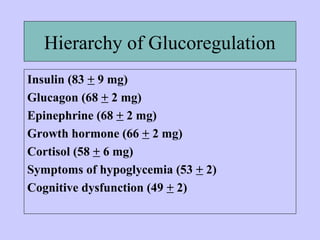
Hierarchy of Glucoregulation
Insulin (83 + 9 mg)
Glucagon (68 + 2 mg)
Epinephrine (68 + 2 mg)
Growth hormone (66 + 2 mg)
Cortisol (58 + 6 mg)
Symptoms of hypoglycemia (53 + 2)
Cognitive dysfunction (49 + 2)
Nocturnal Hypoglycemia
Is common (biochem hypos occur frequently).
Asymptomatic/morning headache/hangover.
Often identified by partner: sweating, fretting.
May lead to sudden death.
Unsatisfactory time action profile of certain
insulins; physio defences against hypo reduced in
flat position; sympathetic responses to hypo
reduced in slow wave sleep
Dawn phenomenon vs Somogyi effect.
Morbidity of Hypoglycemia
CNS — Coma/convulsions/transient
deficits/ataxia/brain damage/ intellectual
impairment.
Psycho —Cognitive disorders/personality
changes/ behavioural disorders/ automatism/
psychosis.
CVS — Arrhythmia/MI/TIA/stroke.
Eye — Vitreous haemorrhage
Musculoskeletal — Fracture/accidental injury.
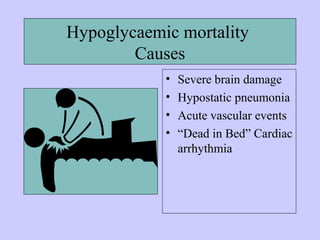
Hypoglycaemic mortality
Causes
• Severe brain damage
• Hypostatic pneumonia
• Acute vascular events
• “Dead in Bed” Cardiac
arrhythmia
Hypoglycaemic Unawareness
• Absence of classical adrenergic warning
symptom,
More vulnerable to develop severe hypoglycaemia
Counter-regulatory failure :
Glucagon failure - 5 yr.to20 yr.
Adrenaline failure - follows then
• 25 times higher risk for severe hypoglycaemia
Hypoglycemia unawareness
Perception of early warning symptoms impaired.
Is not an all-or-none phenomenon.
Affects one quarter of Type 1 diabetic patients.
Correlates with glycemic control ? Duration of
diabetes ?
May be Acute or Chronic (Central autonomic
failure).
Hypoglycaemia in Diabetes
Hypothyroidism
Insulin degradation is
less
Insulin sensitivity is
more
Decreased appetite
Decreased GH
Decreased
glycogenolysis
Hypoglycaemia in Diabetes
Hypocortisolism
Decreased
gluconeogenesis
By decreasing substrate
By decreasing PEPCK
By decreasing Glu-6-
phosphatase.
Decreased permissive
effect on glucagon and
epinephrine
Decreased appetite
Hypoglycaemia in Diabetes
Diabetic Nephropathy
Decreased catabolism
of insulin
Proteinuria
Decreased appetite
Nausea and vomiting
Impaired absorption
Impaired
gluconeogenesis
Alcohol and hypoglycemia
• Reduced
gluconeogenesis
• Reduced hypo
awareness
• Reduced tremors
DD of hypoglycemic and hyperglycemic coma
Symptoms,signs and hypoglycemic coma hyperglycemic
coma
laboratory findings
Physical findings
pulse rate increased increased
pulse volume full weak
temperature may be decreased may be decreased
respiration shallow or normal rapid and deep
blood pressure normal,may be increased decreased
skin clammy,sweating dry
Tongue moist dry
tissue turgor normal reduced
eyeball tension normal reduced
breath no acetone acetone may be
present
reflex brisk reflexes diminished
reflexes
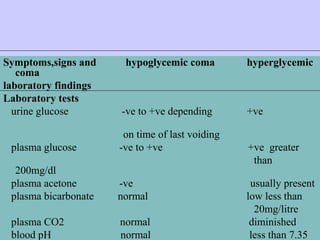
Symptoms,signs and hypoglycemic coma hyperglycemic
coma
laboratory findings
Laboratory tests
urine glucose -ve to +ve depending +ve
on time of last voiding
plasma glucose -ve to +ve +ve greater
than
200mg/dl
plasma acetone -ve usually present
plasma bicarbonate normal low less than
20mg/litre
plasma CO2 normal diminished
blood pH normal less than 7.35
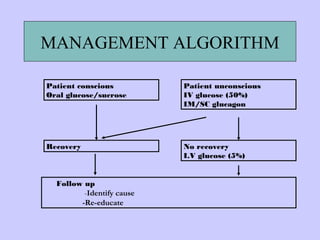
MANAGEMENT ALGORITHM
Patient conscious
Oral glucose/sucrose
Patient unconscious
IV glucose (50%)
IM/SC glucagon
Recovery No recovery
I.V glucose (5%)
Follow up
-Identify cause
-Re-educate
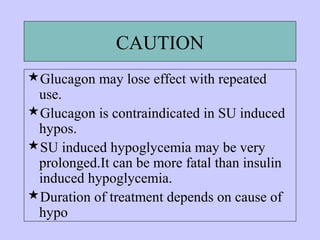
CAUTION
Glucagon may lose effect with repeated
use.
Glucagon is contraindicated in SU induced
hypos.
SU induced hypoglycemia may be very
prolonged.It can be more fatal than insulin
induced hypoglycemia.
Duration of treatment depends on cause of
hypo
Measures to avoid hypoglycemia in patients
on insulin and/or sulfonylureas
• Do not delay,skip or reduce food intake.
• Take a snack before physical exercise.
• Avoid insulin injections in the limb which is actively involved
in the exercise.
• Avoid exercise during the peak time period of insulin action.
• When on human insulins,the time gap between insulin and food
should be 15 minutes.
• When on analogs, keep the time gap less than 5 minutes
• Do not use sulfonylureas in patients with hepatic/ renal
insufficiency.
• Ask the patient to avoid alcohol.
• In older diabetics do not insist on very tight control of blood
glucose;prefer short acting sulfonylureas
• Regularly monitor blood glucose.
Drugs causing hypo
• Increase in SU effect
• Salicylates, probenecid, sulfonamides,
nicoumalone, fluconazole [inhibits CYP2C9 which
metabolizes glimepiride], ketoconazole,
ciprofloxacin [inhibits CYP3A4 which
metabolizes glibenclamide], gatifloxacin
• Direct hypoglycemic effect
• ACE(I), disopyramide, SSRIs, quinine,
sulfamethoxazole, mefloquine, pentamidine,
doxycycline, ethanol
Neonatal hypoglycemia
Hypoglycemia in the immediate
postpartum period needs recognition,as this
phenomenon is transient. Every newborn of
diabetic mothers must be given a 5%
glucose infusion for the first six hours and
subsequently blood glucose monitored to
prevent potentially fatal hypoglycemic
convulsions.
Take home message
• Single most important limiting factor in
maintaining strict glycemic control.
• Can be life threatening
• Delicate balance needs to be kept between
tight control & hypoglycemia.
• BE ON THE LOOK OUT FOR HYPO
ALL THE TIME

Diabetic coma clinical_features

  • 1.
  • 2.
    DEFINITION • Hypoglycemia orlow blood glucose is a clinical state associated with < 50mg/dl or low plasma glucose with typical symptoms. • Whipples triad = • venous plasma glucose <50mg/dl. • Classical symptoms. • Relief of symptoms with glucose.
  • 3.
    DCCT Definition • Eventresulting in seizure,coma ,confusion or symptoms like sweating,palpitation,hunger with finger stick glucose < 50 mg/dl and amelioration of symptom by elevation of blood glucose. • Prodromal symptoms occuring before the event are well remembered. • Severe hypoglycemic symptoms requiring hospital admission and treatment with IV glucose or glucagon.
  • 4.
    Mechanisms for fastinghypoglycemia Under production hormone deficiencies enzyme defects substrate deficiency chronic infections. drugs Over utilization hyper insulinism insulinoma exogeneous insulin overdose. auto immunity Normal insulin level extra pancreatic tumour carnitine def, cachexia.
  • 5.
    Fed state hypoglycemia Early(alimentary)within2- 3 hours after meals • Alimentary hyperinsulinism • Postgastrectomy • Functional(increased vagal tone) • Hereditary fructose intolerance • Galactosemia • Leucine sensitivity Late(occult diabetic) 3-5 hours after meals • Delayed insulin release due to beta cell dysfunction • Counter regulatory deficiency of growth hormone,glucagon, cortisone,autonomic response,epinephrine.
  • 6.
    Factors that precipitatehypoglycaemia Excessive insulin or SU administration- - Error by patient or doctor. - Poor matching to patient’s lifestyle. Increased insulin bioavailability- -Exercise. -Injecting into abdomen. -Change to human insulin/analogs -Insulin antibodies. -Mismatch of syringes
  • 7.
    Risk factors forsevere hypo • Intensive insulin therapy & tight glycemic control. • Hypoglycemia unawareness –acute & chronic. • Long duration of diabetes. • Increasing age. • Sleep. • Excessive alcohol. • Renal failure/ Hepatic failure • Hypothyroidism/ Hypopituitarism/ Hypoadrenalism
  • 8.
    Hypoglycemia in nondiabetic scenario • ZE syndrome -Whipple’s triad, diarrhea ,muscle wasting,tiredness. May be associated with neurofibroma. 5 hour OGGT shows < 50mg/dl. Serum insulin level-20micro units /ml, increased proinsulin level. • Hereditary fructose intolerance – enlarged liver,jaundice,cirrhosis,albuminurIa, aminoaciduria,mental retardation. Ingestion of fruit leading to vomiting and hypoglycemia.
  • 9.
    Common symptoms Autonomic NeuroglycopenicGeneral Adrenergic Sweating confusion nausea Palpitation drowsiness headache Tremor speech problems Hunger incoordination atypical behaviour diplopia
  • 10.
    Grading of Hypoglycaemia •Grade 1 or mild : patient can recognize hypo and able to self treat • Grade 2 or moderate : severe hypo prevents patient from self treating but with assistance oral treatment is possible. • Grade 3 or severe : severe degree of neuroglycopenia requiring parenteral glucagon/dextrose.
  • 11.
    Sequence of responsesto decrements in plasma glucose mg/dl 70 Counter regulation 60 Adrenergic symptoms 50 Neuroglycopenic symptoms 40 Lethargy 30 Coma 20 Convulsions 10 Permanent Damage Death 0
  • 12.
    Hierarchy of Glucoregulation Insulin(83 + 9 mg) Glucagon (68 + 2 mg) Epinephrine (68 + 2 mg) Growth hormone (66 + 2 mg) Cortisol (58 + 6 mg) Symptoms of hypoglycemia (53 + 2) Cognitive dysfunction (49 + 2)
  • 13.
    Nocturnal Hypoglycemia Is common(biochem hypos occur frequently). Asymptomatic/morning headache/hangover. Often identified by partner: sweating, fretting. May lead to sudden death. Unsatisfactory time action profile of certain insulins; physio defences against hypo reduced in flat position; sympathetic responses to hypo reduced in slow wave sleep Dawn phenomenon vs Somogyi effect.
  • 14.
    Morbidity of Hypoglycemia CNS— Coma/convulsions/transient deficits/ataxia/brain damage/ intellectual impairment. Psycho —Cognitive disorders/personality changes/ behavioural disorders/ automatism/ psychosis. CVS — Arrhythmia/MI/TIA/stroke. Eye — Vitreous haemorrhage Musculoskeletal — Fracture/accidental injury.
  • 15.
    Hypoglycaemic mortality Causes • Severebrain damage • Hypostatic pneumonia • Acute vascular events • “Dead in Bed” Cardiac arrhythmia
  • 16.
    Hypoglycaemic Unawareness • Absenceof classical adrenergic warning symptom, More vulnerable to develop severe hypoglycaemia Counter-regulatory failure : Glucagon failure - 5 yr.to20 yr. Adrenaline failure - follows then • 25 times higher risk for severe hypoglycaemia
  • 17.
    Hypoglycemia unawareness Perception ofearly warning symptoms impaired. Is not an all-or-none phenomenon. Affects one quarter of Type 1 diabetic patients. Correlates with glycemic control ? Duration of diabetes ? May be Acute or Chronic (Central autonomic failure).
  • 18.
    Hypoglycaemia in Diabetes Hypothyroidism Insulindegradation is less Insulin sensitivity is more Decreased appetite Decreased GH Decreased glycogenolysis
  • 19.
    Hypoglycaemia in Diabetes Hypocortisolism Decreased gluconeogenesis Bydecreasing substrate By decreasing PEPCK By decreasing Glu-6- phosphatase. Decreased permissive effect on glucagon and epinephrine Decreased appetite
  • 20.
    Hypoglycaemia in Diabetes DiabeticNephropathy Decreased catabolism of insulin Proteinuria Decreased appetite Nausea and vomiting Impaired absorption Impaired gluconeogenesis
  • 21.
    Alcohol and hypoglycemia •Reduced gluconeogenesis • Reduced hypo awareness • Reduced tremors
  • 22.
    DD of hypoglycemicand hyperglycemic coma Symptoms,signs and hypoglycemic coma hyperglycemic coma laboratory findings Physical findings pulse rate increased increased pulse volume full weak temperature may be decreased may be decreased respiration shallow or normal rapid and deep blood pressure normal,may be increased decreased skin clammy,sweating dry Tongue moist dry tissue turgor normal reduced eyeball tension normal reduced breath no acetone acetone may be present reflex brisk reflexes diminished reflexes
  • 23.
    Symptoms,signs and hypoglycemiccoma hyperglycemic coma laboratory findings Laboratory tests urine glucose -ve to +ve depending +ve on time of last voiding plasma glucose -ve to +ve +ve greater than 200mg/dl plasma acetone -ve usually present plasma bicarbonate normal low less than 20mg/litre plasma CO2 normal diminished blood pH normal less than 7.35
  • 24.
    MANAGEMENT ALGORITHM Patient conscious Oralglucose/sucrose Patient unconscious IV glucose (50%) IM/SC glucagon Recovery No recovery I.V glucose (5%) Follow up -Identify cause -Re-educate
  • 25.
    CAUTION Glucagon may loseeffect with repeated use. Glucagon is contraindicated in SU induced hypos. SU induced hypoglycemia may be very prolonged.It can be more fatal than insulin induced hypoglycemia. Duration of treatment depends on cause of hypo
  • 26.
    Measures to avoidhypoglycemia in patients on insulin and/or sulfonylureas • Do not delay,skip or reduce food intake. • Take a snack before physical exercise. • Avoid insulin injections in the limb which is actively involved in the exercise. • Avoid exercise during the peak time period of insulin action. • When on human insulins,the time gap between insulin and food should be 15 minutes. • When on analogs, keep the time gap less than 5 minutes • Do not use sulfonylureas in patients with hepatic/ renal insufficiency. • Ask the patient to avoid alcohol. • In older diabetics do not insist on very tight control of blood glucose;prefer short acting sulfonylureas • Regularly monitor blood glucose.
  • 27.
    Drugs causing hypo •Increase in SU effect • Salicylates, probenecid, sulfonamides, nicoumalone, fluconazole [inhibits CYP2C9 which metabolizes glimepiride], ketoconazole, ciprofloxacin [inhibits CYP3A4 which metabolizes glibenclamide], gatifloxacin • Direct hypoglycemic effect • ACE(I), disopyramide, SSRIs, quinine, sulfamethoxazole, mefloquine, pentamidine, doxycycline, ethanol
  • 28.
    Neonatal hypoglycemia Hypoglycemia inthe immediate postpartum period needs recognition,as this phenomenon is transient. Every newborn of diabetic mothers must be given a 5% glucose infusion for the first six hours and subsequently blood glucose monitored to prevent potentially fatal hypoglycemic convulsions.
  • 29.
    Take home message •Single most important limiting factor in maintaining strict glycemic control. • Can be life threatening • Delicate balance needs to be kept between tight control & hypoglycemia. • BE ON THE LOOK OUT FOR HYPO ALL THE TIME