Lecture outline
 Definition
 Epidemiology
 Causes
 Clinical presentation
 Diagnosis
 Treatment
 Complications
 Prognosis
Definition
 Upper GIT bleeding can be defined as bleeding
occuring from the gastrointestinal tract from any point
proximal to the duodeno-jejunal (DJ) flexure at the
ligament of Trietz.
Epidemiology
 Cases of Upper GIT bleeding have been reported
globally.
 Incidence varies from region to region and depends on
the predominant aetiology.
 Male and female affected.
 Gender disparity also hinges on aetiology.
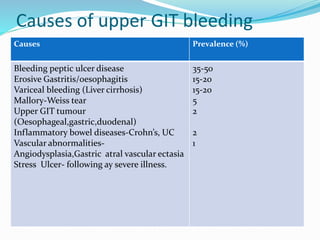
Causes of upper GIT bleeding
Causes Prevalence (%)
Bleeding peptic ulcer disease
Erosive Gastritis/oesophagitis
Variceal bleeding (Liver cirrhosis)
Mallory-Weiss tear
Upper GIT tumour
(Oesophageal,gastric,duodenal)
Inflammatory bowel diseases-Crohn’s, UC
Vascular abnormalities-
Angiodysplasia,Gastric atral vascular ectasia
Stress Ulcer- following ay severe illness.
35-50
15-20
15-20
5
2
2
1
Clinical presentation
 Features of blood loss
 Hematemesis-fresh blood or coffee grounds
 Malena
 Hematochizia
 Pallor
Clinical presentation
 Features of underlying cause
 Liver cirrhosis-ascites,jaundice,wasting,parotid
fullness etc
Clinical presentation
 Features of haemodynamic instability (occurs in
the setting of severe blood loss)
 Hypotension
 Tachycardia
 Bradycardia
 Anaemic heart failure
Diagnosis
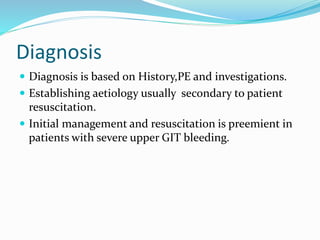
 Diagnosis is based on History,PE and investigations.
 Establishing aetiology usually secondary to patient
resuscitation.
 Initial management and resuscitation is preemient in
patients with severe upper GIT bleeding.
History
History of blood loss-
Hematemesis(fresh blood or coffee
groud),Malena,Haematochizia
History to ascertain haemodynamic instability-
amount of blood loss (volume, clots,
frequency),postural dizziness, fatique, lack of urine,
altered conscious level.
History
 History to ascertain aetiology
 Peptic ulcer disease
 Drug intake-Aspirin,NSAIDs,Steroids
 Alcohol int-
 Mallory Weiss syn- hx of protracted vomitting
 Liver cirrhosis- Hx of previous jaundice,blood
trasfusion,liver disease.
Examination
 Ascertain the extent of blood loss-
Pallor,hypotesion,tachycardia,bradycardia.
 Look out for possible aetiology,eg- stigmata of chronic
liver disease.
 Dont forget to do a rectal examination!
Investigations
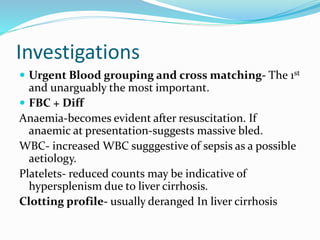
 Urgent Blood grouping and cross matching- The 1st
and unarguably the most important.
 FBC + Diff
Anaemia-becomes evident after resuscitation. If
anaemic at presentation-suggests massive bled.
WBC- increased WBC sugggestive of sepsis as a possible
aetiology.
Platelets- reduced counts may be indicative of
hypersplenism due to liver cirrhosis.
Clotting profile- usually deranged In liver cirrhosis
Investigations contd
 Abdominal ultrasound-may reveal cirrhotic liver,
intra-abdominal mass lesion.
 Upper GI endoscopy-gold standard investigation.
Should be done within 6 hours of presentation in high
risk pts and within 24 hours In low risk patients.
Endoscopy helps to answer 4 questions viz: 1. site of
bleeding,2. activity of bleeders, 3.cause of bleeding, 4.
suitability for endoscopic management.
 Liver function test
 Renal function test
 Septic work up
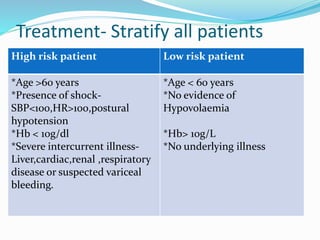
Treatment- Stratify all patients
High risk patient Low risk patient
*Age >60 years
*Presence of shock-
SBP<100,HR>100,postural
hypotension
*Hb < 10g/dl
*Severe intercurrent illness-
Liver,cardiac,renal ,respiratory
disease or suspected variceal
bleeding.
*Age < 60 years
*No evidence of
Hypovolaemia
*Hb> 10g/L
*No underlying illness
Supportive treatment
 Admit patient in High dependency Unit or ICU
 ABC of life.
 A-Ensure airway is patent ,remove artificial dentures
and other foreign bodies,lie patient of the lateral side
to forestall aspiration.
 B-Ensure patient is breathing freely. If not,support
respiration.
 Circulation-Transfuse patients with severe
anaemia,those with hypotension and those with active
(on –going) bleeding.
Definitive treatment
 Dependent of the cause of upper GIT bleeding.
 In cases of erosive gastritis- withdraw offending
agents-NSAIDs, Alcohol, Herbal medications.
 Bleeding PUD-give IV Omeprazole 80mg stat,then
8mg hourly for 48-72 hours.
 Variceal bleeding- give vasopressin, terlipressin or
octreotide, lower portal pressure after
resuscitation,endoscopic injection sclerotherapy or
banding,balloon tamponade.
 Stress Ulcer – Give PPIs
 Mallory Weiss syndrome-give PPI,antiemetics.
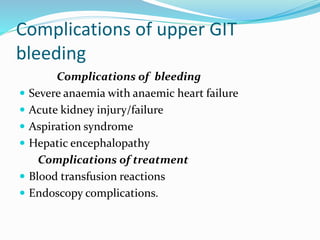
Complications of upper GIT
bleeding
Complications of bleeding
 Severe anaemia with anaemic heart failure
 Acute kidney injury/failure
 Aspiration syndrome
 Hepatic encephalopathy
Complications of treatment
 Blood transfusion reactions
 Endoscopy complications.
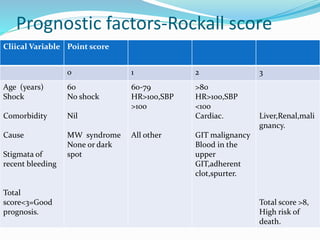
Prognostic factors-Rockall score
Cliical Variable Point score
0 1 2 3
Age (years)
Shock
Comorbidity
Cause
Stigmata of
recent bleeding
Total
score<3=Good
prognosis.
60
No shock
Nil
MW syndrome
None or dark
spot
60-79
HR>100,SBP
>100
All other
>80
HR>100,SBP
<100
Cardiac.
GIT malignancy
Blood in the
upper
GIT,adherent
clot,spurter.
Liver,Renal,mali
gnancy.
Total score >8,
High risk of
death.
Thank you

Upper git bleeding

  • 2.
    Lecture outline  Definition Epidemiology  Causes  Clinical presentation  Diagnosis  Treatment  Complications  Prognosis
  • 3.
    Definition  Upper GITbleeding can be defined as bleeding occuring from the gastrointestinal tract from any point proximal to the duodeno-jejunal (DJ) flexure at the ligament of Trietz.
  • 4.
    Epidemiology  Cases ofUpper GIT bleeding have been reported globally.  Incidence varies from region to region and depends on the predominant aetiology.  Male and female affected.  Gender disparity also hinges on aetiology.
  • 5.
    Causes of upperGIT bleeding Causes Prevalence (%) Bleeding peptic ulcer disease Erosive Gastritis/oesophagitis Variceal bleeding (Liver cirrhosis) Mallory-Weiss tear Upper GIT tumour (Oesophageal,gastric,duodenal) Inflammatory bowel diseases-Crohn’s, UC Vascular abnormalities- Angiodysplasia,Gastric atral vascular ectasia Stress Ulcer- following ay severe illness. 35-50 15-20 15-20 5 2 2 1
  • 6.
    Clinical presentation  Featuresof blood loss  Hematemesis-fresh blood or coffee grounds  Malena  Hematochizia  Pallor
  • 7.
    Clinical presentation  Featuresof underlying cause  Liver cirrhosis-ascites,jaundice,wasting,parotid fullness etc
  • 8.
    Clinical presentation  Featuresof haemodynamic instability (occurs in the setting of severe blood loss)  Hypotension  Tachycardia  Bradycardia  Anaemic heart failure
  • 9.
    Diagnosis  Diagnosis isbased on History,PE and investigations.  Establishing aetiology usually secondary to patient resuscitation.  Initial management and resuscitation is preemient in patients with severe upper GIT bleeding.
  • 10.
    History History of bloodloss- Hematemesis(fresh blood or coffee groud),Malena,Haematochizia History to ascertain haemodynamic instability- amount of blood loss (volume, clots, frequency),postural dizziness, fatique, lack of urine, altered conscious level.
  • 11.
    History  History toascertain aetiology  Peptic ulcer disease  Drug intake-Aspirin,NSAIDs,Steroids  Alcohol int-  Mallory Weiss syn- hx of protracted vomitting  Liver cirrhosis- Hx of previous jaundice,blood trasfusion,liver disease.
  • 12.
    Examination  Ascertain theextent of blood loss- Pallor,hypotesion,tachycardia,bradycardia.  Look out for possible aetiology,eg- stigmata of chronic liver disease.  Dont forget to do a rectal examination!
  • 13.
    Investigations  Urgent Bloodgrouping and cross matching- The 1st and unarguably the most important.  FBC + Diff Anaemia-becomes evident after resuscitation. If anaemic at presentation-suggests massive bled. WBC- increased WBC sugggestive of sepsis as a possible aetiology. Platelets- reduced counts may be indicative of hypersplenism due to liver cirrhosis. Clotting profile- usually deranged In liver cirrhosis
  • 14.
    Investigations contd  Abdominalultrasound-may reveal cirrhotic liver, intra-abdominal mass lesion.  Upper GI endoscopy-gold standard investigation. Should be done within 6 hours of presentation in high risk pts and within 24 hours In low risk patients. Endoscopy helps to answer 4 questions viz: 1. site of bleeding,2. activity of bleeders, 3.cause of bleeding, 4. suitability for endoscopic management.  Liver function test  Renal function test  Septic work up
  • 15.
    Treatment- Stratify allpatients High risk patient Low risk patient *Age >60 years *Presence of shock- SBP<100,HR>100,postural hypotension *Hb < 10g/dl *Severe intercurrent illness- Liver,cardiac,renal ,respiratory disease or suspected variceal bleeding. *Age < 60 years *No evidence of Hypovolaemia *Hb> 10g/L *No underlying illness
  • 16.
    Supportive treatment  Admitpatient in High dependency Unit or ICU  ABC of life.  A-Ensure airway is patent ,remove artificial dentures and other foreign bodies,lie patient of the lateral side to forestall aspiration.  B-Ensure patient is breathing freely. If not,support respiration.  Circulation-Transfuse patients with severe anaemia,those with hypotension and those with active (on –going) bleeding.
  • 17.
    Definitive treatment  Dependentof the cause of upper GIT bleeding.  In cases of erosive gastritis- withdraw offending agents-NSAIDs, Alcohol, Herbal medications.  Bleeding PUD-give IV Omeprazole 80mg stat,then 8mg hourly for 48-72 hours.  Variceal bleeding- give vasopressin, terlipressin or octreotide, lower portal pressure after resuscitation,endoscopic injection sclerotherapy or banding,balloon tamponade.  Stress Ulcer – Give PPIs  Mallory Weiss syndrome-give PPI,antiemetics.
  • 18.
    Complications of upperGIT bleeding Complications of bleeding  Severe anaemia with anaemic heart failure  Acute kidney injury/failure  Aspiration syndrome  Hepatic encephalopathy Complications of treatment  Blood transfusion reactions  Endoscopy complications.
  • 19.
    Prognostic factors-Rockall score CliicalVariable Point score 0 1 2 3 Age (years) Shock Comorbidity Cause Stigmata of recent bleeding Total score<3=Good prognosis. 60 No shock Nil MW syndrome None or dark spot 60-79 HR>100,SBP >100 All other >80 HR>100,SBP <100 Cardiac. GIT malignancy Blood in the upper GIT,adherent clot,spurter. Liver,Renal,mali gnancy. Total score >8, High risk of death.
  • 20.