The Pediatric ECG
DR. ATUL KULKARNI
MD
DR MANDAR HAVAL
DCH DNB
Objectives
Review the cardiac physiology with respect to age, and age
related normals
Discuss wave morphology and axis as it relates to age and
ventricular dominance
Review intervals and other “differences” in the pediatric
ECG
Discuss an approach to interpretation of chamber
enlargement
Review some basic tachyarrythmias common in children
Normal variants and osce on ECG
Background
ECG changes during the first year of life reflect the switch
from fetal to infant circulation, changes in SVR, and the
increasing muscle mass of the LV
The size of the ventricles changes as the infant grows into
childhood and adulthood
The RV is larger and thicker at birth because of the
physiologic stresses on it during fetal development
By approximately 1 month of age, the LV will be slightly
larger
By 6 months of age, the LV is twice the size of the RV,
and by adolescence it is 2.5 times the size
Heart rate
 Average heart rate peaks at second month of life, then
gradually decreases
 Resting HRs start at 140 bpm at birth, fall to 120 bpm
at 1 year, 100 bpm at 5 years, and adult ranges by 10
years
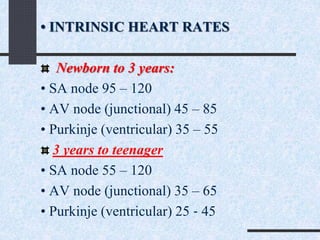
• INTRINSIC HEART RATES
Newborn to 3 years:
• SA node 95 – 120
• AV node (junctional) 45 – 85
• Purkinje (ventricular) 35 – 55
3 years to teenager
• SA node 55 – 120
• AV node (junctional) 35 – 65
• Purkinje (ventricular) 25 ‐ 45
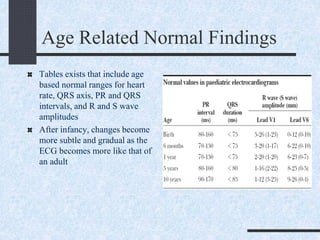
Age Related Normal Findings
Tables exists that include age
based normal ranges for heart
rate, QRS axis, PR and QRS
intervals, and R and S wave
amplitudes
After infancy, changes become
more subtle and gradual as the
ECG becomes more like that of
an adult
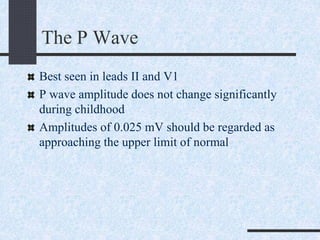
The P Wave
Best seen in leads II and V1
P wave amplitude does not change significantly
during childhood
Amplitudes of 0.025 mV should be regarded as
approaching the upper limit of normal
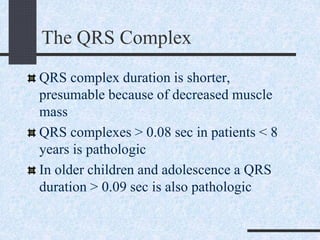
The QRS Complex
QRS complex duration is shorter,
presumable because of decreased muscle
mass
QRS complexes > 0.08 sec in patients < 8
years is pathologic
In older children and adolescence a QRS
duration > 0.09 sec is also pathologic
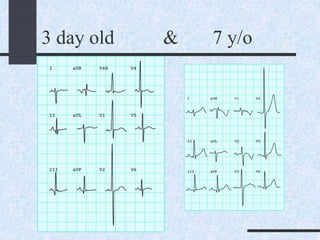
The T Wave
The T waves are frequently upright throughout the
precordium in the first week of life
Thereafter, T waves in V1-V3 invert and remain
inverted from the newborn period until 8 years of
age
This is called the “juvenile T wave pattern”, and
can sometimes persist into adolescence
Upright T waves in the right precordial leads in
children can indicate right ventricular hypertrophy
3 day old & 7 y/o
QRS Axis and Ventricular Dominance
At birth, the axis is markedly rightward
(+60 - +160), the R/S ratio is high in V1 and
V2 (large precordial R waves), and low in
V5 and V6
As the LV muscle mass grows and becomes
dominant the axis gradually shifts (+10 -
+100) by 1 year of age, and the R wave
amplitude decreases in V1 and V2 and
increases in V5 and V6
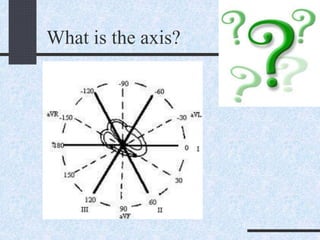
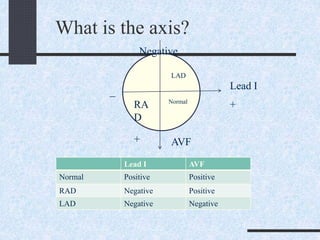
What is the axis?
What is the axis?
LAD
Normal
RA
D
Lead I
AVF
Negative
+
+
_
Lead I AVF
Normal Positive Positive
RAD Negative Positive
LAD Negative Negative
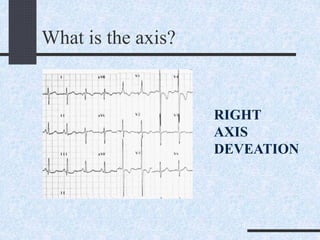
What is the axis?
RIGHT
AXIS
DEVEATION
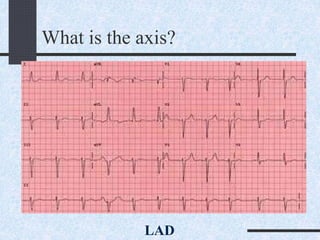
What is the axis?
LAD
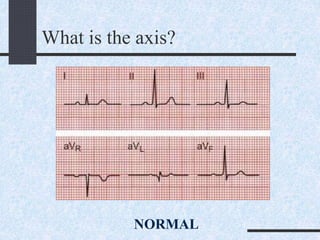
What is the axis?
NORMAL
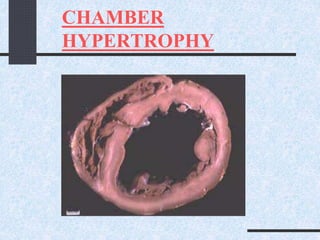
CHAMBER
HYPERTROPHY
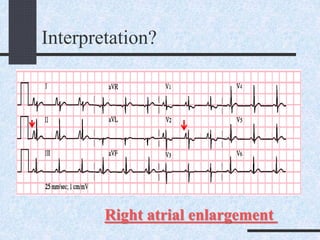
Interpretation?
Right atrial enlargement
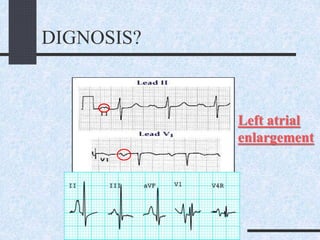
DIGNOSIS?
Left atrial
enlargement
Atrial Enlargement
RAE is diagnosed in the
presence of a peaked tall P
wave in II
In the first 6 months, the P
wave must be >3 mm to
be pathologic; then >2 mm
is abN
LAE can be diagnosed
with a biphasic P wave in
V1 with a terminal inferior
component
The finding of a notched P
wave in II can be a normal
variant in 25% of pediatric
ECGs
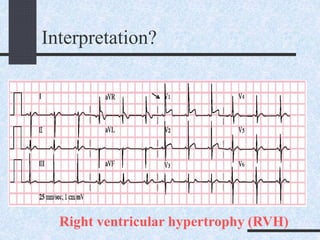
Interpretation?
Right ventricular hypertrophy (RVH)
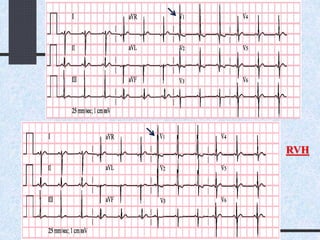
RVH
Large R wave in V1 and
large S wave in V6
Upright T wave in V1-V3
RAD
Persistent pattern of RV
dominance
Right Ventricular
Hypertrophy
Diagnosis depends on age
adjusted values for R
wave and S wave
amplitudes
A qR complex or rSR’
pattern in V1 can also be
seen
Upright T waves in the
right precordial leads,
RAD, and complete
reversal of adult
precordial pattern of R and
S waves all suggest RVH
Lead V1with the R height
> 15 mm IN < 1YR & >10mm
IN > 1 YR
RVH
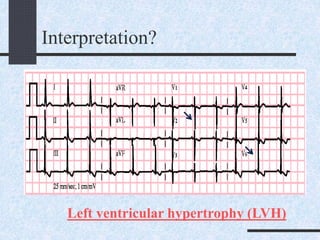
Interpretation?
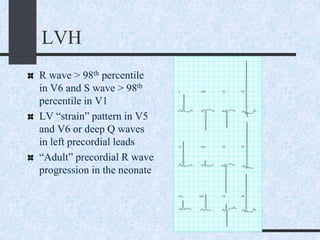
Left ventricular hypertrophy (LVH)
LVH
R wave > 98th percentile
in V6 and S wave > 98th
percentile in V1
LV “strain” pattern in V5
and V6 or deep Q waves
in left precordial leads
“Adult” precordial R wave
progression in the neonate
CONDUCTION
ABNORMALITIES
Bundle branch blocks are diagnosed as they would
be in adults; RBBB occurs most commonly after
repair of congenital heard defects and LBBB is
very rare
First degree AV block and Mobitz type 1
(Wenckebach) can be a normal variant in 10% of
kids
Complete AV block is usually congenital or
secondary to surgery
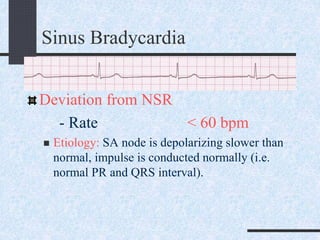
Sinus Bradycardia
Deviation from NSR
- Rate < 60 bpm
 Etiology: SA node is depolarizing slower than
normal, impulse is conducted normally (i.e.
normal PR and QRS interval).
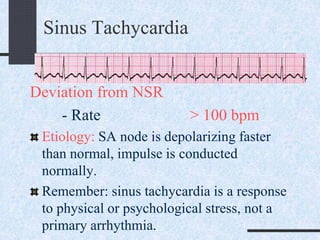
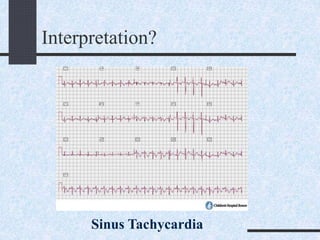
Sinus Tachycardia
Deviation from NSR
- Rate > 100 bpm
Etiology: SA node is depolarizing faster
than normal, impulse is conducted
normally.
Remember: sinus tachycardia is a response
to physical or psychological stress, not a
primary arrhythmia.
Interpretation?
Sinus Tachycardia
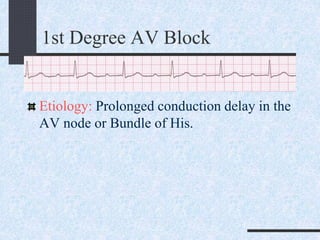
1st Degree AV Block
Etiology: Prolonged conduction delay in the
AV node or Bundle of His.
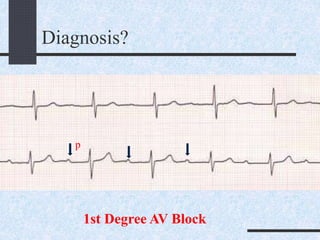
Diagnosis?
p
1st Degree AV Block
FIRST DEGREE HEART
BLOCK
PR interval > 5 small divisions, 0.2 secs
Causes: myocarditis, acute rheumatic fever,
drugs,
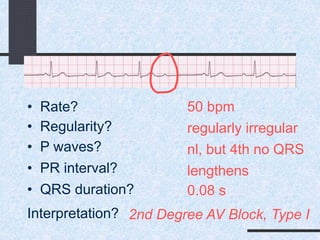
50 bpm• Rate?
• Regularity? regularly irregular
nl, but 4th no QRS
0.08 s
• P waves?
• PR interval? lengthens
• QRS duration?
Interpretation? 2nd Degree AV Block, Type I
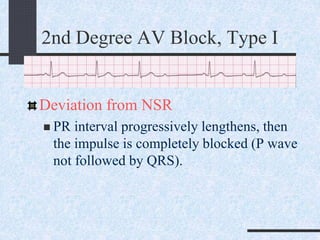
2nd Degree AV Block, Type I
Deviation from NSR
 PR interval progressively lengthens, then
the impulse is completely blocked (P wave
not followed by QRS).
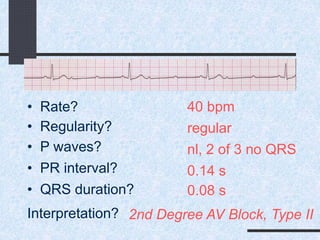
40 bpm• Rate?
• Regularity? regular
nl, 2 of 3 no QRS
0.08 s
• P waves?
• PR interval? 0.14 s
• QRS duration?
Interpretation? 2nd Degree AV Block, Type II
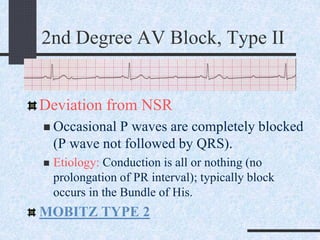
2nd Degree AV Block, Type II
Deviation from NSR
 Occasional P waves are completely blocked
(P wave not followed by QRS).
 Etiology: Conduction is all or nothing (no
prolongation of PR interval); typically block
occurs in the Bundle of His.
MOBITZ TYPE 2
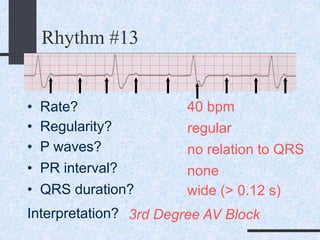
Rhythm #13
40 bpm• Rate?
• Regularity? regular
no relation to QRS
wide (> 0.12 s)
• P waves?
• PR interval? none
• QRS duration?
Interpretation? 3rd Degree AV Block
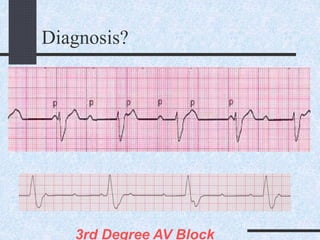
Diagnosis?
3rd Degree AV Block
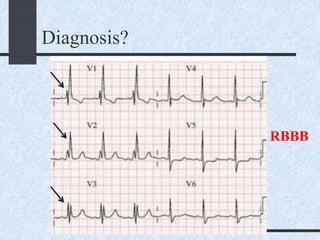
Diagnosis?
RBBB
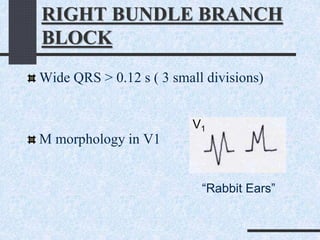
RIGHT BUNDLE BRANCH
BLOCK
Wide QRS > 0.12 s ( 3 small divisions)
M morphology in V1
V1
“Rabbit Ears”
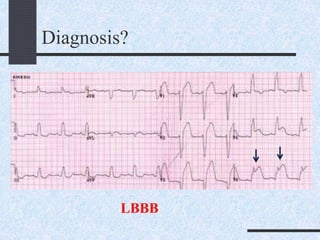
Diagnosis?
LBBB
LEFT BUNDLE BRANCH
BLOCK
Wide QRS > 0.12 s ( > 3 small divisions)
M morphology in V 6 and W in V1
ARRHYTHMIAS
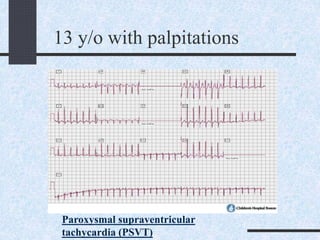
13 y/o with palpitations
Paroxysmal supraventricular
tachycardia (PSVT)
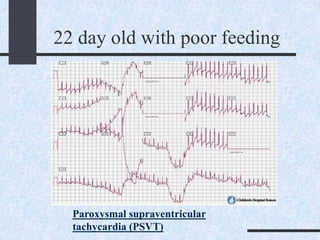
22 day old with poor feeding
Paroxysmal supraventricular
tachycardia (PSVT)
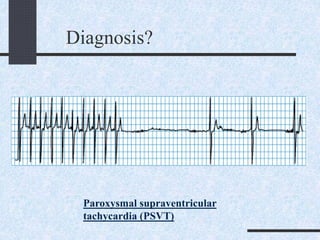
Diagnosis?
Paroxysmal supraventricular
tachycardia (PSVT)
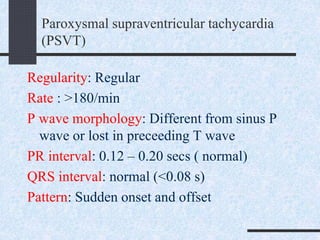
Paroxysmal supraventricular tachycardia
(PSVT)
Regularity: Regular
Rate : >180/min
P wave morphology: Different from sinus P
wave or lost in preceeding T wave
PR interval: 0.12 – 0.20 secs ( normal)
QRS interval: normal (<0.08 s)
Pattern: Sudden onset and offset
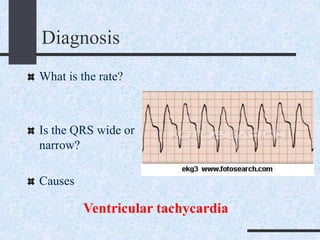
Diagnosis
What is the rate?
Is the QRS wide or
narrow?
Causes
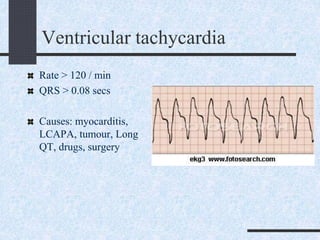
Ventricular tachycardia
Rate > 120 / min
QRS > 0.08 secs
Causes: myocarditis,
LCAPA, tumour, Long
QT, drugs, surgery
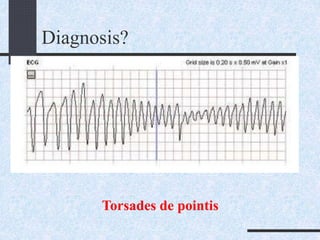
Diagnosis?
Torsades de pointis
Torsades de pointis
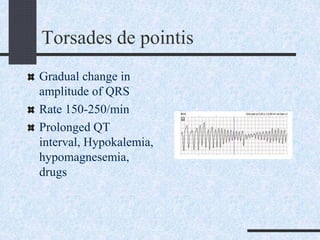
Torsades de pointis
Gradual change in
amplitude of QRS
Rate 150-250/min
Prolonged QT
interval, Hypokalemia,
hypomagnesemia,
drugs
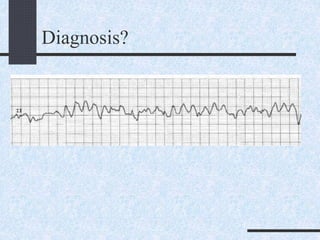
Diagnosis?
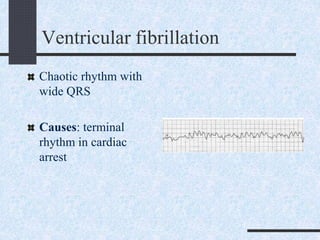
Ventricular fibrillation
Chaotic rhythm with
wide QRS
Causes: terminal
rhythm in cardiac
arrest
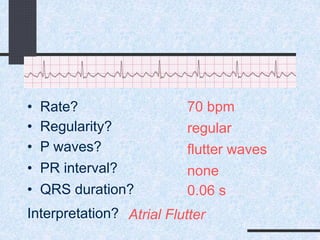
70 bpm• Rate?
• Regularity? regular
flutter waves
0.06 s
• P waves?
• PR interval? none
• QRS duration?
Interpretation? Atrial Flutter
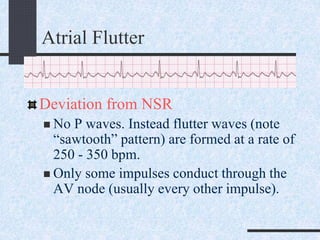
Atrial Flutter
Deviation from NSR
 No P waves. Instead flutter waves (note
“sawtooth” pattern) are formed at a rate of
250 - 350 bpm.
 Only some impulses conduct through the
AV node (usually every other impulse).
QUESTIONS
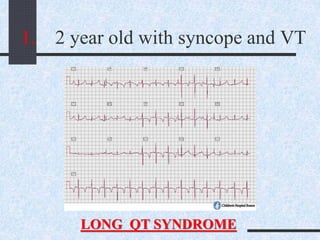
1. 2 year old with syncope and VT
LONG QT SYNDROME
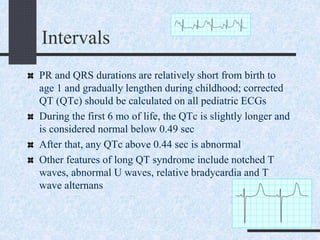
Intervals
PR and QRS durations are relatively short from birth to
age 1 and gradually lengthen during childhood; corrected
QT (QTc) should be calculated on all pediatric ECGs
During the first 6 mo of life, the QTc is slightly longer and
is considered normal below 0.49 sec
After that, any QTc above 0.44 sec is abnormal
Other features of long QT syndrome include notched T
waves, abnormal U waves, relative bradycardia and T
wave alternans
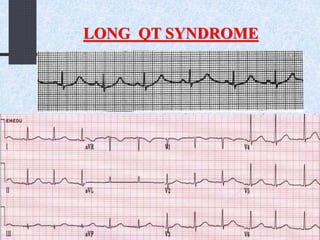
LONG QT SYNDROME
LONG QT – SYNDROME.
N-QTc- Infants 0.44 & NB-0.49sec
1. Beta-Blockers .Avoid drugs known to prolong
QT-interval , electrolyte imbalance.
2. SOS pacemaker . W/F Syndromes associated
with Long QT-interval.
3. Avoid competitive sports and swimming, teach
CPR to the caretakers. Inform about SIDS.
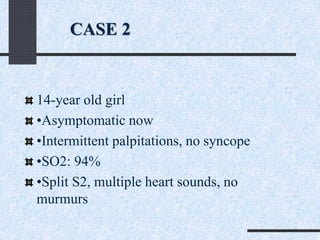
14-year old girl
•Asymptomatic now
•Intermittent palpitations, no syncope
•SO2: 94%
•Split S2, multiple heart sounds, no
murmurs
CASE 2
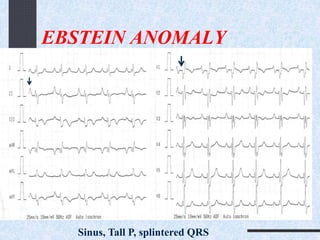
EBSTEIN ANOMALY
Sinus, Tall P, splintered QRS
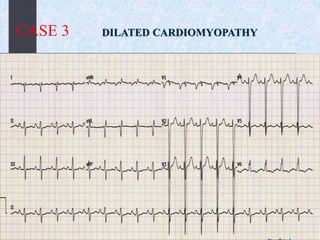
CASE 3 DILATED CARDIOMYOPATHY
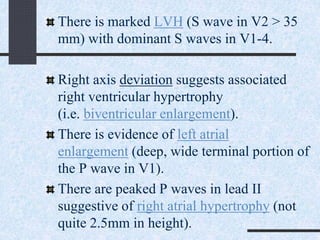
There is marked LVH (S wave in V2 > 35
mm) with dominant S waves in V1-4.
Right axis deviation suggests associated
right ventricular hypertrophy
(i.e. biventricular enlargement).
There is evidence of left atrial
enlargement (deep, wide terminal portion of
the P wave in V1).
There are peaked P waves in lead II
suggestive of right atrial hypertrophy (not
quite 2.5mm in height).
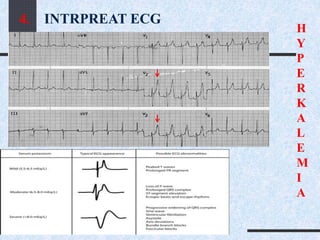
4. INTRPREAT ECG
H
Y
P
E
R
K
A
L
E
M
I
A
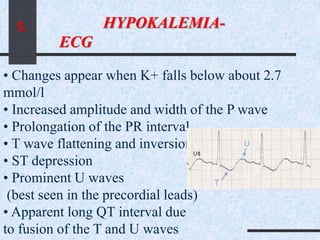
• Changes appear when K+ falls below about 2.7
mmol/l
• Increased amplitude and width of the P wave
• Prolongation of the PR interval
• T wave flattening and inversion
• ST depression
• Prominent U waves
(best seen in the precordial leads)
• Apparent long QT interval due
to fusion of the T and U waves
HYPOKALEMIA-
ECG
5.
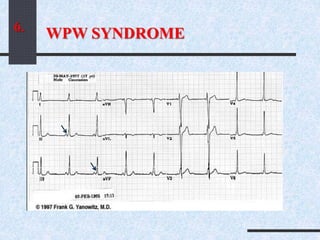
WPW SYNDROME6.
69
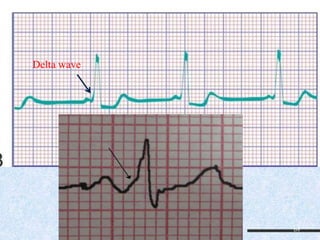
Delta wave
•WPW- 3 features
•Short PR interval ,
•Delta wave on upstroke of QRS
•Slightly wide QRS
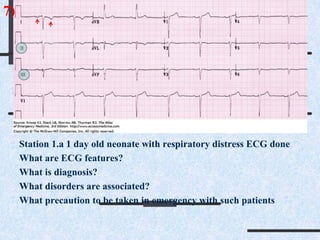
Station 1.a 1 day old neonate with respiratory distress ECG done
What are ECG features?
What is diagnosis?
What disorders are associated?
What precaution to be taken in emergency with such patients
7)
Inverted p/t wave, -ve qrs in lead 1.lead 2 n 3
reversed.lead 2 resemble 3 and 3 resemble 2
DEXTROCARDIA
number of bowel, esophageal, bronchial and
cardiovascular disorders (such as double outlet
right ventricle, endocardial cushion defect and
pulmonary stenosis) Kartagener syndrome
Place rt Up N lt Lo lead on Up lft N Lo rt
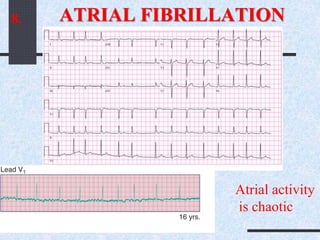
ATRIAL FIBRILLATION8.
Atrial activity
is chaotic
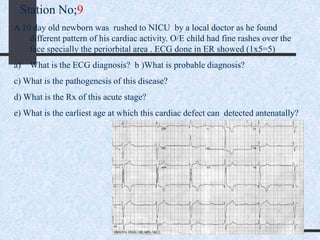
Station No;9
A 10 day old newborn was rushed to NICU by a local doctor as he found
different pattern of his cardiac activity. O/E child had fine rashes over the
face specially the periorbital area . ECG done in ER showed (1x5=5)
a) What is the ECG diagnosis? b )What is probable diagnosis?
c) What is the pathogenesis of this disease?
d) What is the Rx of this acute stage?
e) What is the earliest age at which this cardiac defect can detected antenatally?
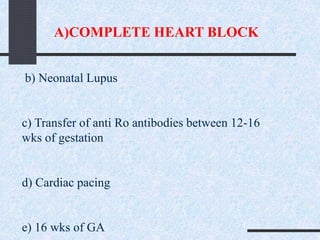
A)COMPLETE HEART BLOCK
b) Neonatal Lupus
c) Transfer of anti Ro antibodies between 12-16
wks of gestation
d) Cardiac pacing
e) 16 wks of GA
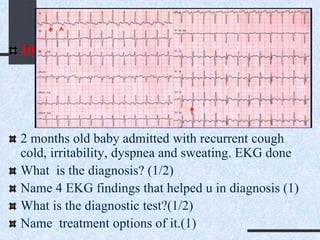
10
2 months old baby admitted with recurrent cough
cold, irritability, dyspnea and sweating. EKG done
What is the diagnosis? (1/2)
Name 4 EKG findings that helped u in diagnosis (1)
What is the diagnostic test?(1/2)
Name treatment options of it.(1)
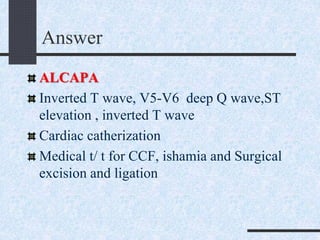
Answer
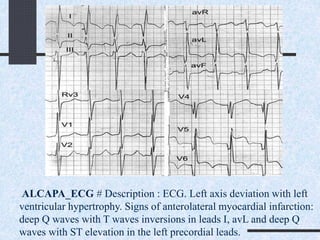
ALCAPA
Inverted T wave, V5-V6 deep Q wave,ST
elevation , inverted T wave
Cardiac catherization
Medical t/ t for CCF, ishamia and Surgical
excision and ligation
ALCAPA_ECG # Description : ECG. Left axis deviation with left
ventricular hypertrophy. Signs of anterolateral myocardial infarction:
deep Q waves with T waves inversions in leads I, avL and deep Q
waves with ST elevation in the left precordial leads.
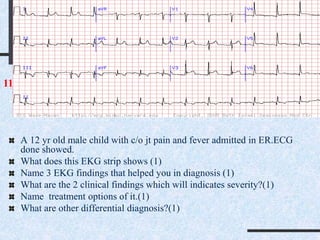
A 12 yr old male child with c/o jt pain and fever admitted in ER.ECG
done showed.
What does this EKG strip shows (1)
Name 3 EKG findings that helped you in diagnosis (1)
What are the 2 clinical findings which will indicates severity?(1)
Name treatment options of it.(1)
What are other differential diagnosis?(1)
11
Answer
RHEUMATIC PERICARDITIS
Low voltage QRS, elevation of ST, Twave
inversion
Friction Rub and Pulsus Paradoxus
steroid
Viral Pericarditis, Benign Pericarditits, JRA
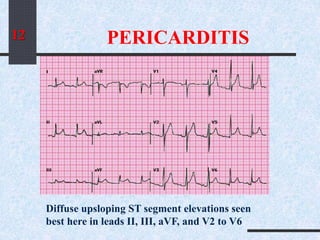
PERICARDITIS
Diffuse upsloping ST segment elevations seen
best here in leads II, III, aVF, and V2 to V6
12
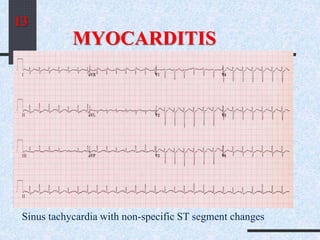
MYOCARDITIS
Sinus tachycardia with non-specific ST segment changes
13
14
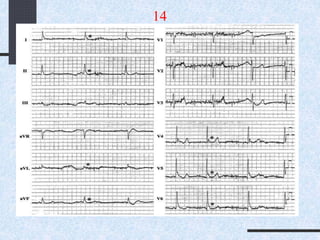
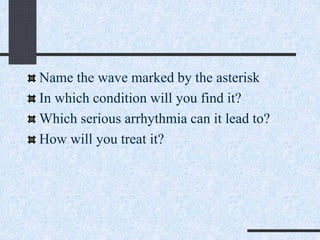
Name the wave marked by the asterisk
In which condition will you find it?
Which serious arrhythmia can it lead to?
How will you treat it?
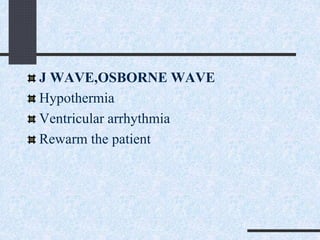
J WAVE,OSBORNE WAVE
Hypothermia
Ventricular arrhythmia
Rewarm the patient
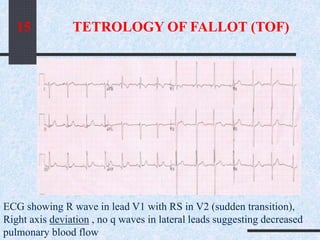
ECG showing R wave in lead V1 with RS in V2 (sudden transition),
Right axis deviation , no q waves in lateral leads suggesting decreased
pulmonary blood flow
TETROLOGY OF FALLOT (TOF)15
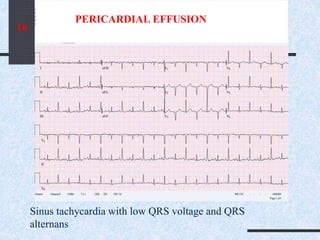
PERICARDIAL EFFUSION
Sinus tachycardia with low QRS voltage and QRS
alternans
16
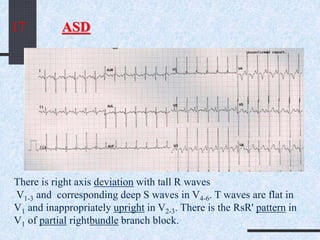
ASD
There is right axis deviation with tall R waves
V1-3 and corresponding deep S waves in V4-6. T waves are flat in
V1 and inappropriately upright in V2-3. There is the RsR' pattern in
V1 of partial rightbundle branch block.
17
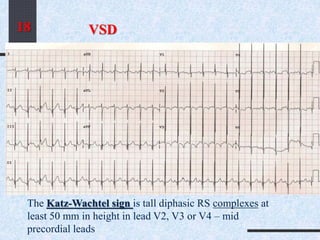
VSD
The Katz-Wachtel sign is tall diphasic RS complexes at
least 50 mm in height in lead V2, V3 or V4 – mid
precordial leads
18
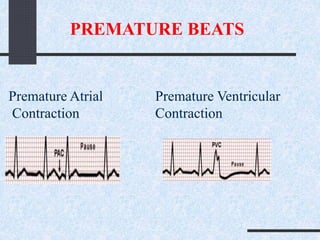
PREMATURE BEATS
Premature Ventricular
Contraction
Premature Atrial
Contraction
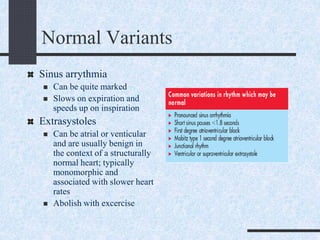
Normal Variants
Sinus arrythmia
 Can be quite marked
 Slows on expiration and
speeds up on inspiration
Extrasystoles
 Can be atrial or venticular
and are usually benign in
the context of a structurally
normal heart; typically
monomorphic and
associated with slower heart
rates
 Abolish with excercise
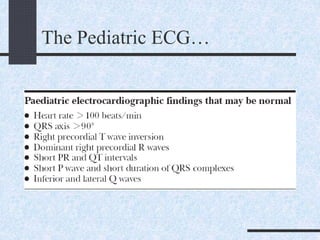
The Pediatric ECG…
In Summary
Consider the age of the child, and the
cardiac forces that may be dominant
Use a structured approach and assess
morphology, axis, and intervals in the
context of age related normals
Evaluate for the presence of structural
disease
Remember the “normal variants”
Pe

Pe

  • 1.
    The Pediatric ECG DR.ATUL KULKARNI MD DR MANDAR HAVAL DCH DNB
  • 2.
    Objectives Review the cardiacphysiology with respect to age, and age related normals Discuss wave morphology and axis as it relates to age and ventricular dominance Review intervals and other “differences” in the pediatric ECG Discuss an approach to interpretation of chamber enlargement Review some basic tachyarrythmias common in children Normal variants and osce on ECG
  • 3.
    Background ECG changes duringthe first year of life reflect the switch from fetal to infant circulation, changes in SVR, and the increasing muscle mass of the LV The size of the ventricles changes as the infant grows into childhood and adulthood The RV is larger and thicker at birth because of the physiologic stresses on it during fetal development By approximately 1 month of age, the LV will be slightly larger By 6 months of age, the LV is twice the size of the RV, and by adolescence it is 2.5 times the size
  • 4.
    Heart rate  Averageheart rate peaks at second month of life, then gradually decreases  Resting HRs start at 140 bpm at birth, fall to 120 bpm at 1 year, 100 bpm at 5 years, and adult ranges by 10 years
  • 5.
    • INTRINSIC HEARTRATES Newborn to 3 years: • SA node 95 – 120 • AV node (junctional) 45 – 85 • Purkinje (ventricular) 35 – 55 3 years to teenager • SA node 55 – 120 • AV node (junctional) 35 – 65 • Purkinje (ventricular) 25 ‐ 45
  • 6.
    Age Related NormalFindings Tables exists that include age based normal ranges for heart rate, QRS axis, PR and QRS intervals, and R and S wave amplitudes After infancy, changes become more subtle and gradual as the ECG becomes more like that of an adult
  • 7.
    The P Wave Bestseen in leads II and V1 P wave amplitude does not change significantly during childhood Amplitudes of 0.025 mV should be regarded as approaching the upper limit of normal
  • 8.
    The QRS Complex QRScomplex duration is shorter, presumable because of decreased muscle mass QRS complexes > 0.08 sec in patients < 8 years is pathologic In older children and adolescence a QRS duration > 0.09 sec is also pathologic
  • 9.
    The T Wave TheT waves are frequently upright throughout the precordium in the first week of life Thereafter, T waves in V1-V3 invert and remain inverted from the newborn period until 8 years of age This is called the “juvenile T wave pattern”, and can sometimes persist into adolescence Upright T waves in the right precordial leads in children can indicate right ventricular hypertrophy
  • 10.
    3 day old& 7 y/o
  • 11.
    QRS Axis andVentricular Dominance At birth, the axis is markedly rightward (+60 - +160), the R/S ratio is high in V1 and V2 (large precordial R waves), and low in V5 and V6 As the LV muscle mass grows and becomes dominant the axis gradually shifts (+10 - +100) by 1 year of age, and the R wave amplitude decreases in V1 and V2 and increases in V5 and V6
  • 12.
  • 13.
    What is theaxis? LAD Normal RA D Lead I AVF Negative + + _ Lead I AVF Normal Positive Positive RAD Negative Positive LAD Negative Negative
  • 14.
    What is theaxis? RIGHT AXIS DEVEATION
  • 15.
    What is theaxis? LAD
  • 16.
    What is theaxis? NORMAL
  • 17.
  • 18.
  • 19.
  • 20.
    Atrial Enlargement RAE isdiagnosed in the presence of a peaked tall P wave in II In the first 6 months, the P wave must be >3 mm to be pathologic; then >2 mm is abN LAE can be diagnosed with a biphasic P wave in V1 with a terminal inferior component The finding of a notched P wave in II can be a normal variant in 25% of pediatric ECGs
  • 21.
  • 22.
    RVH Large R wavein V1 and large S wave in V6 Upright T wave in V1-V3 RAD Persistent pattern of RV dominance Right Ventricular Hypertrophy Diagnosis depends on age adjusted values for R wave and S wave amplitudes A qR complex or rSR’ pattern in V1 can also be seen Upright T waves in the right precordial leads, RAD, and complete reversal of adult precordial pattern of R and S waves all suggest RVH Lead V1with the R height > 15 mm IN < 1YR & >10mm IN > 1 YR
  • 23.
  • 24.
  • 25.
    LVH R wave >98th percentile in V6 and S wave > 98th percentile in V1 LV “strain” pattern in V5 and V6 or deep Q waves in left precordial leads “Adult” precordial R wave progression in the neonate
  • 26.
    CONDUCTION ABNORMALITIES Bundle branch blocksare diagnosed as they would be in adults; RBBB occurs most commonly after repair of congenital heard defects and LBBB is very rare First degree AV block and Mobitz type 1 (Wenckebach) can be a normal variant in 10% of kids Complete AV block is usually congenital or secondary to surgery
  • 27.
    Sinus Bradycardia Deviation fromNSR - Rate < 60 bpm  Etiology: SA node is depolarizing slower than normal, impulse is conducted normally (i.e. normal PR and QRS interval).
  • 28.
    Sinus Tachycardia Deviation fromNSR - Rate > 100 bpm Etiology: SA node is depolarizing faster than normal, impulse is conducted normally. Remember: sinus tachycardia is a response to physical or psychological stress, not a primary arrhythmia.
  • 29.
  • 30.
    1st Degree AVBlock Etiology: Prolonged conduction delay in the AV node or Bundle of His.
  • 31.
  • 32.
    FIRST DEGREE HEART BLOCK PRinterval > 5 small divisions, 0.2 secs Causes: myocarditis, acute rheumatic fever, drugs,
  • 33.
    50 bpm• Rate? •Regularity? regularly irregular nl, but 4th no QRS 0.08 s • P waves? • PR interval? lengthens • QRS duration? Interpretation? 2nd Degree AV Block, Type I
  • 34.
    2nd Degree AVBlock, Type I Deviation from NSR  PR interval progressively lengthens, then the impulse is completely blocked (P wave not followed by QRS).
  • 35.
    40 bpm• Rate? •Regularity? regular nl, 2 of 3 no QRS 0.08 s • P waves? • PR interval? 0.14 s • QRS duration? Interpretation? 2nd Degree AV Block, Type II
  • 36.
    2nd Degree AVBlock, Type II Deviation from NSR  Occasional P waves are completely blocked (P wave not followed by QRS).  Etiology: Conduction is all or nothing (no prolongation of PR interval); typically block occurs in the Bundle of His. MOBITZ TYPE 2
  • 37.
    Rhythm #13 40 bpm•Rate? • Regularity? regular no relation to QRS wide (> 0.12 s) • P waves? • PR interval? none • QRS duration? Interpretation? 3rd Degree AV Block
  • 38.
  • 39.
  • 40.
    RIGHT BUNDLE BRANCH BLOCK WideQRS > 0.12 s ( 3 small divisions) M morphology in V1 V1 “Rabbit Ears”
  • 41.
  • 42.
    LEFT BUNDLE BRANCH BLOCK WideQRS > 0.12 s ( > 3 small divisions) M morphology in V 6 and W in V1
  • 43.
  • 44.
    13 y/o withpalpitations Paroxysmal supraventricular tachycardia (PSVT)
  • 45.
    22 day oldwith poor feeding Paroxysmal supraventricular tachycardia (PSVT)
  • 46.
  • 47.
    Paroxysmal supraventricular tachycardia (PSVT) Regularity:Regular Rate : >180/min P wave morphology: Different from sinus P wave or lost in preceeding T wave PR interval: 0.12 – 0.20 secs ( normal) QRS interval: normal (<0.08 s) Pattern: Sudden onset and offset
  • 48.
    Diagnosis What is therate? Is the QRS wide or narrow? Causes Ventricular tachycardia
  • 49.
    Ventricular tachycardia Rate >120 / min QRS > 0.08 secs Causes: myocarditis, LCAPA, tumour, Long QT, drugs, surgery
  • 50.
  • 51.
  • 52.
    Torsades de pointis Gradualchange in amplitude of QRS Rate 150-250/min Prolonged QT interval, Hypokalemia, hypomagnesemia, drugs
  • 53.
  • 54.
    Ventricular fibrillation Chaotic rhythmwith wide QRS Causes: terminal rhythm in cardiac arrest
  • 55.
    70 bpm• Rate? •Regularity? regular flutter waves 0.06 s • P waves? • PR interval? none • QRS duration? Interpretation? Atrial Flutter
  • 56.
    Atrial Flutter Deviation fromNSR  No P waves. Instead flutter waves (note “sawtooth” pattern) are formed at a rate of 250 - 350 bpm.  Only some impulses conduct through the AV node (usually every other impulse).
  • 57.
  • 58.
    1. 2 yearold with syncope and VT LONG QT SYNDROME
  • 59.
    Intervals PR and QRSdurations are relatively short from birth to age 1 and gradually lengthen during childhood; corrected QT (QTc) should be calculated on all pediatric ECGs During the first 6 mo of life, the QTc is slightly longer and is considered normal below 0.49 sec After that, any QTc above 0.44 sec is abnormal Other features of long QT syndrome include notched T waves, abnormal U waves, relative bradycardia and T wave alternans
  • 60.
  • 61.
    LONG QT –SYNDROME. N-QTc- Infants 0.44 & NB-0.49sec 1. Beta-Blockers .Avoid drugs known to prolong QT-interval , electrolyte imbalance. 2. SOS pacemaker . W/F Syndromes associated with Long QT-interval. 3. Avoid competitive sports and swimming, teach CPR to the caretakers. Inform about SIDS.
  • 62.
    14-year old girl •Asymptomaticnow •Intermittent palpitations, no syncope •SO2: 94% •Split S2, multiple heart sounds, no murmurs CASE 2
  • 63.
    EBSTEIN ANOMALY Sinus, TallP, splintered QRS
  • 64.
    CASE 3 DILATEDCARDIOMYOPATHY
  • 65.
    There is markedLVH (S wave in V2 > 35 mm) with dominant S waves in V1-4. Right axis deviation suggests associated right ventricular hypertrophy (i.e. biventricular enlargement). There is evidence of left atrial enlargement (deep, wide terminal portion of the P wave in V1). There are peaked P waves in lead II suggestive of right atrial hypertrophy (not quite 2.5mm in height).
  • 66.
  • 67.
    • Changes appearwhen K+ falls below about 2.7 mmol/l • Increased amplitude and width of the P wave • Prolongation of the PR interval • T wave flattening and inversion • ST depression • Prominent U waves (best seen in the precordial leads) • Apparent long QT interval due to fusion of the T and U waves HYPOKALEMIA- ECG 5.
  • 68.
  • 69.
  • 70.
    •WPW- 3 features •ShortPR interval , •Delta wave on upstroke of QRS •Slightly wide QRS
  • 71.
    Station 1.a 1day old neonate with respiratory distress ECG done What are ECG features? What is diagnosis? What disorders are associated? What precaution to be taken in emergency with such patients 7)
  • 72.
    Inverted p/t wave,-ve qrs in lead 1.lead 2 n 3 reversed.lead 2 resemble 3 and 3 resemble 2 DEXTROCARDIA number of bowel, esophageal, bronchial and cardiovascular disorders (such as double outlet right ventricle, endocardial cushion defect and pulmonary stenosis) Kartagener syndrome Place rt Up N lt Lo lead on Up lft N Lo rt
  • 73.
  • 74.
    Station No;9 A 10day old newborn was rushed to NICU by a local doctor as he found different pattern of his cardiac activity. O/E child had fine rashes over the face specially the periorbital area . ECG done in ER showed (1x5=5) a) What is the ECG diagnosis? b )What is probable diagnosis? c) What is the pathogenesis of this disease? d) What is the Rx of this acute stage? e) What is the earliest age at which this cardiac defect can detected antenatally?
  • 75.
    A)COMPLETE HEART BLOCK b)Neonatal Lupus c) Transfer of anti Ro antibodies between 12-16 wks of gestation d) Cardiac pacing e) 16 wks of GA
  • 76.
    10 2 months oldbaby admitted with recurrent cough cold, irritability, dyspnea and sweating. EKG done What is the diagnosis? (1/2) Name 4 EKG findings that helped u in diagnosis (1) What is the diagnostic test?(1/2) Name treatment options of it.(1)
  • 77.
    Answer ALCAPA Inverted T wave,V5-V6 deep Q wave,ST elevation , inverted T wave Cardiac catherization Medical t/ t for CCF, ishamia and Surgical excision and ligation
  • 78.
    ALCAPA_ECG # Description: ECG. Left axis deviation with left ventricular hypertrophy. Signs of anterolateral myocardial infarction: deep Q waves with T waves inversions in leads I, avL and deep Q waves with ST elevation in the left precordial leads.
  • 79.
    A 12 yrold male child with c/o jt pain and fever admitted in ER.ECG done showed. What does this EKG strip shows (1) Name 3 EKG findings that helped you in diagnosis (1) What are the 2 clinical findings which will indicates severity?(1) Name treatment options of it.(1) What are other differential diagnosis?(1) 11
  • 80.
    Answer RHEUMATIC PERICARDITIS Low voltageQRS, elevation of ST, Twave inversion Friction Rub and Pulsus Paradoxus steroid Viral Pericarditis, Benign Pericarditits, JRA
  • 81.
    PERICARDITIS Diffuse upsloping STsegment elevations seen best here in leads II, III, aVF, and V2 to V6 12
  • 82.
    MYOCARDITIS Sinus tachycardia withnon-specific ST segment changes 13
  • 83.
  • 84.
    Name the wavemarked by the asterisk In which condition will you find it? Which serious arrhythmia can it lead to? How will you treat it?
  • 85.
    J WAVE,OSBORNE WAVE Hypothermia Ventriculararrhythmia Rewarm the patient
  • 86.
    ECG showing Rwave in lead V1 with RS in V2 (sudden transition), Right axis deviation , no q waves in lateral leads suggesting decreased pulmonary blood flow TETROLOGY OF FALLOT (TOF)15
  • 87.
    PERICARDIAL EFFUSION Sinus tachycardiawith low QRS voltage and QRS alternans 16
  • 88.
    ASD There is rightaxis deviation with tall R waves V1-3 and corresponding deep S waves in V4-6. T waves are flat in V1 and inappropriately upright in V2-3. There is the RsR' pattern in V1 of partial rightbundle branch block. 17
  • 89.
    VSD The Katz-Wachtel signis tall diphasic RS complexes at least 50 mm in height in lead V2, V3 or V4 – mid precordial leads 18
  • 90.
  • 91.
    Normal Variants Sinus arrythmia Can be quite marked  Slows on expiration and speeds up on inspiration Extrasystoles  Can be atrial or venticular and are usually benign in the context of a structurally normal heart; typically monomorphic and associated with slower heart rates  Abolish with excercise
  • 92.
  • 93.
    In Summary Consider theage of the child, and the cardiac forces that may be dominant Use a structured approach and assess morphology, axis, and intervals in the context of age related normals Evaluate for the presence of structural disease Remember the “normal variants”