ECG in ACS with ST-Segment Elevation
(STE-ACS)
Localisation of infarct related artery
Dr.I.Tammi Raju,NIMS
Threshold Values for ST-Segment Changes
• Typical ECG pattern:
• The new occurrence of an ST-segment elevation >2 mm at 60
ms after the J point in V2 to V3 and >1 mm in other leads,
present in at least two consecutive leads, is considered
abnormal and evidence of acute ischemia in the clinical
setting of ACS (presence of precordial pain or equivalents).
• Whenever possible, it is important to compare this pattern
with previous ECGs.
• The ST elevation prevails in the leads facing the
affected zone as a direct ECG pattern.
• In general, in some opposed leads, the ST-segment
depression is seen as an indirect ECG pattern .
• These same features also occur in the chronic phase,
with a Q wave as the direct pattern and an R wave as
the indirect pattern .
LOCALISATION OF INFARCT RELATED
ARTERY
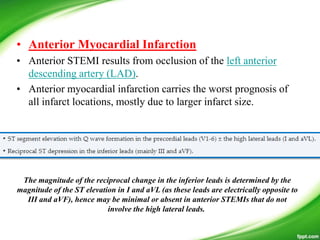
• Anterior Myocardial Infarction
• Anterior STEMI results from occlusion of the left anterior
descending artery (LAD).
• Anterior myocardial infarction carries the worst prognosis of
all infarct locations, mostly due to larger infarct size.
The magnitude of the reciprocal change in the inferior leads is determined by the
magnitude of the ST elevation in I and aVL (as these leads are electrically opposite to
III and aVF), hence may be minimal or absent in anterior STEMIs that do not
involve the high lateral leads.
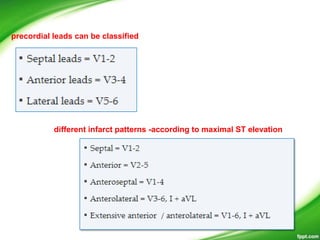
precordial leads can be classified
different infarct patterns -according to maximal ST elevation
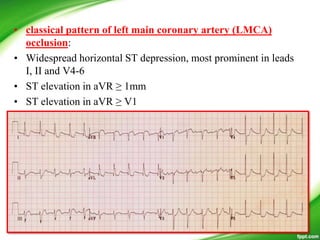
• classical pattern of left main coronary artery (LMCA)
occlusion:
• Widespread horizontal ST depression, most prominent in leads
I, II and V4-6
• ST elevation in aVR ≥ 1mm
• ST elevation in aVR ≥ V1
• However, ST elevation in aVR is not entirely specific to
LMCA occlusion.
• It may also be seen with:
– Proximal left anterior descending artery (LAD) occlusion
– Severe triple-vessel disease (3VD)
• ST elevation is aVR -two possible mechanisms:
• Diffuse subendocardial ischaemia (producing reciprocal
change in aVR)
• Transmural ischaemia / infarction of the basal interventricular
septum (e.g. due to a proximal occlusion within the left
coronary system)
• Predictive Value Of STE In AVR
• In the context of widespread ST depression + symptoms of
myocardial ischaemia:
• STE in aVR ≥ 1mm indicates proximal LAD / LMCA
occlusion or severe 3VD
• STE in aVR ≥ 1mm predicts the need for CABG
• STE in aVR ≥ V1 differentiates LMCA from proximal LAD
occlusion
• Absence of ST elevation in aVR almost entirely excludes a
significant LMCA lesion
Patients with ≥ 1 mm STE in aVR may potentially require early CABG;
therefore these patients should ideally be discussed with the interventional
cardiologist ( cardiac surgeon) before thienopyridines are given.
• Wellens' syndrome is characterized by classic T-waves found
in precordial leads especially V2-V3 during pain-free periods
in a patient presenting with chest pain.
• These findings reliably suggest a high-grade stenosis of the
proximal left anterior descending (LAD) coronary artery.
• 75% of patients will develop acute anterior wall myocardial
infarctions (MIs) within one week .
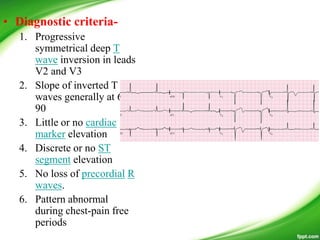
• Diagnostic criteria-
1. Progressive
symmetrical deep T
wave inversion in leads
V2 and V3
2. Slope of inverted T
waves generally at 60 -
90
3. Little or no cardiac
marker elevation
4. Discrete or no ST
segment elevation
5. No loss of precordial R
waves.
6. Pattern abnormal
during chest-pain free
periods
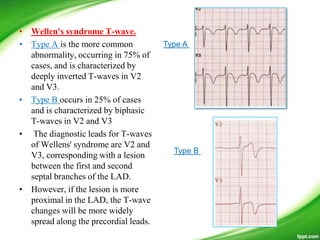
• Wellen's syndrome T-wave.
• Type A is the more common
abnormality, occurring in 75% of
cases, and is characterized by
deeply inverted T-waves in V2
and V3.
• Type B occurs in 25% of cases
and is characterized by biphasic
T-waves in V2 and V3
• The diagnostic leads for T-waves
of Wellens' syndrome are V2 and
V3, corresponding with a lesion
between the first and second
septal branches of the LAD.
• However, if the lesion is more
proximal in the LAD, the T-wave
changes will be more widely
spread along the precordial leads.
Type A
Type B
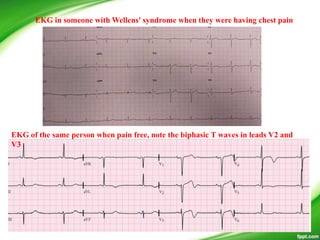
EKG in someone with Wellens' syndrome when they were having chest pain
EKG of the same person when pain free, note the biphasic T waves in leads V2 and
V3
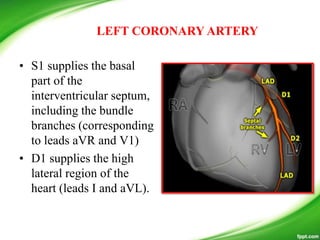
• S1 supplies the basal
part of the
interventricular septum,
including the bundle
branches (corresponding
to leads aVR and V1)
• D1 supplies the high
lateral region of the
heart (leads I and aVL).
LEFT CORONARY ARTERY
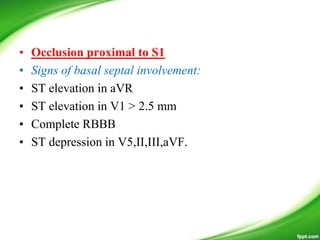
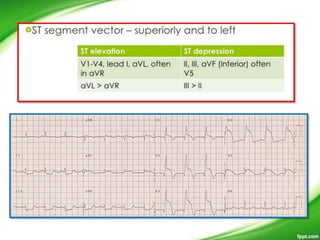
• Occlusion proximal to S1
• Signs of basal septal involvement:
• ST elevation in aVR
• ST elevation in V1 > 2.5 mm
• Complete RBBB
• ST depression in V5,II,III,aVF.
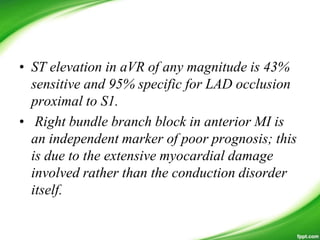
• ST elevation in aVR of any magnitude is 43%
sensitive and 95% specific for LAD occlusion
proximal to S1.
• Right bundle branch block in anterior MI is
an independent marker of poor prognosis; this
is due to the extensive myocardial damage
involved rather than the conduction disorder
itself.
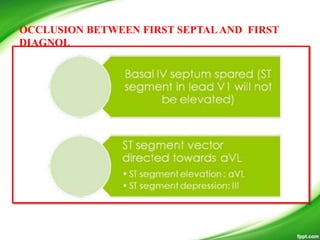
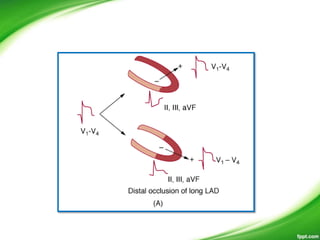
OCCLUSION BETWEEN FIRST SEPTALAND FIRST
DIAGNOL
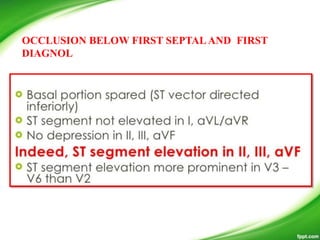
OCCLUSION BELOW FIRST SEPTALAND FIRST
DIAGNOL
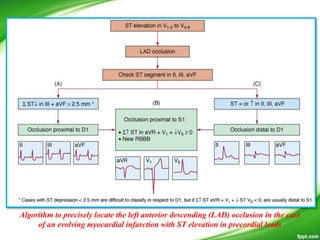
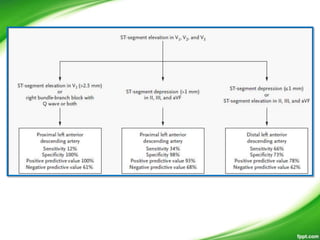
Algorithm to precisely locate the left anterior descending (LAD) occlusion in the case
of an evolving myocardial infarction with ST elevation in precordial leads
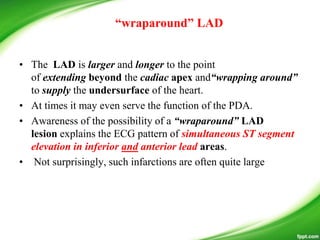
• The LAD is larger and longer to the point
of extending beyond the cadiac apex and“wrapping around”
to supply the undersurface of the heart.
• At times it may even serve the function of the PDA.
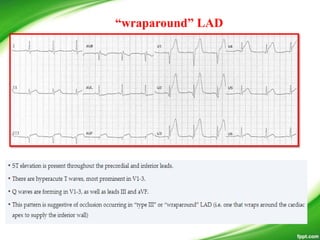
• Awareness of the possibility of a “wraparound” LAD
lesion explains the ECG pattern of simultaneous ST segment
elevation in inferior and anterior lead areas.
• Not surprisingly, such infarctions are often quite large
“wraparound” LAD
“wraparound” LAD
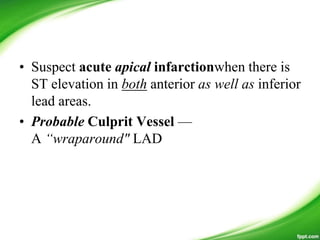
• Suspect acute apical infarctionwhen there is
ST elevation in both anterior as well as inferior
lead areas.
• Probable Culprit Vessel —
A “wraparound" LAD
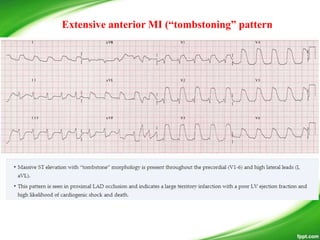
Extensive anterior MI (“tombstoning” pattern
• Inferior STEMI--Cinical Significance
• 40-50% of all myocardial infarctions.
• more favourable prognosis than anterior myocardial infarction (in-hospital
mortality only 2-9%).
• Up to 40% of patients with an inferior STEMI will have a
concomitant right ventricular infarction(severe hypotension in response to
nitrates and generally have a worse prognosis).
• Up to 20% of patients with inferior STEMI will develop significant
bradycardia due to second- or third-degree AV block. These patients have
an increased in-hospital mortality (>20%).
• Inferior STEMI may also be associated with posterior infarction, which
confers a worse prognosis due to increased area of myocardium at risk.
Result from occlusion of all three coronary arteries:
• The vast majority (~80%) of inferior STEMIs are due to
occlusion of the dominant (RCA).
• Less commonly (around 18% of the time), the culprit vessel is
a dominant (LCx).
• Occasionally, inferior STEMI may result from occlusion of a
―type III‖ or ―wraparound‖ left anterior descending artery
(LAD). This produces the unusual pattern of concomitant
inferior and anterior ST elevation.
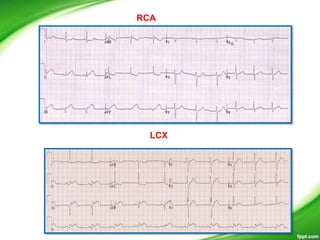
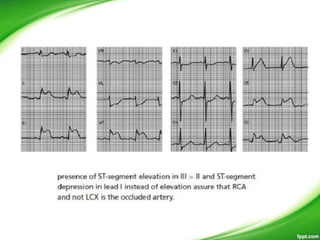
• The RCA territory covers the medial part of the inferior wall,
including the inferior septum.
• The injury current in RCA occlusion is directed inferiorly and
rightward, producing ST elevation in lead III > lead II (as lead
III is more rightward facing).
• The LCx territory covers the lateral part of the inferior wall
and the left posterobasal area.
• The injury current in LCx occlusion is directed inferiorly and
leftward, producing ST elevation in the lateral leads I and V5-
6.
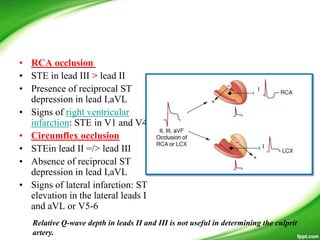
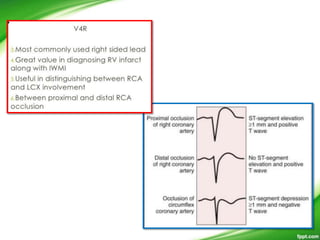
• RCA occlusion
• STE in lead III > lead II
• Presence of reciprocal ST
depression in lead I,aVL
• Signs of right ventricular
infarction: STE in V1 and V4R
• Circumflex occlusion
• STEin lead II =/> lead III
• Absence of reciprocal ST
depression in lead I,aVL
• Signs of lateral infarction: ST
elevation in the lateral leads I
and aVL or V5-6
Relative Q-wave depth in leads II and III is not useful in determining the culprit
artery.
RCA
LCX
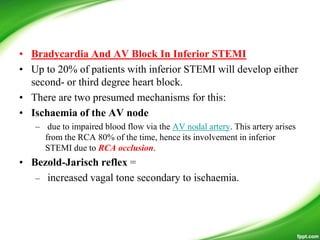
• Bradycardia And AV Block In Inferior STEMI
• Up to 20% of patients with inferior STEMI will develop either
second- or third degree heart block.
• There are two presumed mechanisms for this:
• Ischaemia of the AV node
– due to impaired blood flow via the AV nodal artery. This artery arises
from the RCA 80% of the time, hence its involvement in inferior
STEMI due to RCA occlusion.
• Bezold-Jarisch reflex =
– increased vagal tone secondary to ischaemia.
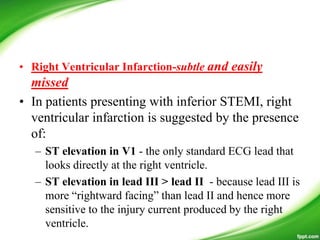
• Right Ventricular Infarction-subtle and easily
missed
• In patients presenting with inferior STEMI, right
ventricular infarction is suggested by the presence
of:
– ST elevation in V1 - the only standard ECG lead that
looks directly at the right ventricle.
– ST elevation in lead III > lead II - because lead III is
more ―rightward facing‖ than lead II and hence more
sensitive to the injury current produced by the right
ventricle.
• If the magnitude of ST elevation in V1 exceeds the magnitude
of ST elevation in V2.
• If the ST segment in V1 is isoelectric and the ST segment in
V2 is markedly depressed.
• The combination of ST elevation in V1 and ST depression in
V2 is highly specific for right ventricular MI.
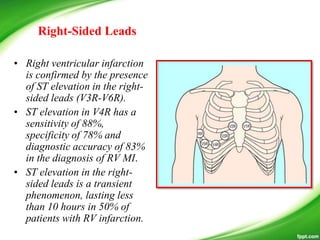
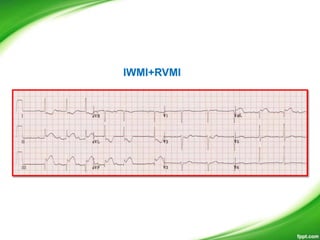
• Right ventricular infarction
is confirmed by the presence
of ST elevation in the right-
sided leads (V3R-V6R).
• ST elevation in V4R has a
sensitivity of 88%,
specificity of 78% and
diagnostic accuracy of 83%
in the diagnosis of RV MI.
• ST elevation in the right-
sided leads is a transient
phenomenon, lasting less
than 10 hours in 50% of
patients with RV infarction.
Right-Sided Leads
IWMI+RVMI
• Posterior Myocardial Infarction
• Posterior infarction accompanies 15-20% of STEMIs, usually
occurring in the context of an inferior or lateral infarction.
• Isolated posterior MI is less common (3-11% of infarcts).
• Posterior extension of an inferior or lateral infarct implies a
much larger area of myocardial damage, with an increased risk
of left ventricular dysfunction and death
Term posterior be abandoned and that the term inferior be applied to the
entire LV wall that lies on the diaphragm.
CIRCULATION,2006
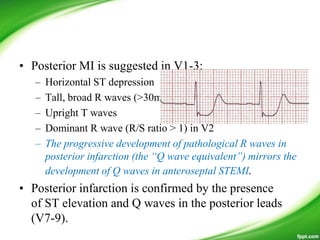
• Posterior MI is suggested in V1-3:
– Horizontal ST depression
– Tall, broad R waves (>30ms)
– Upright T waves
– Dominant R wave (R/S ratio > 1) in V2
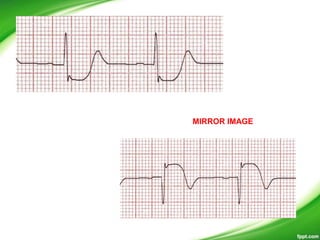
– The progressive development of pathological R waves in
posterior infarction (the “Q wave equivalent”) mirrors the
development of Q waves in anteroseptal STEMI.
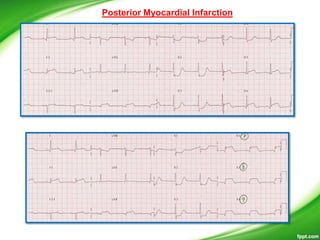
• Posterior infarction is confirmed by the presence
of ST elevation and Q waves in the posterior leads
(V7-9).
MIRROR IMAGE
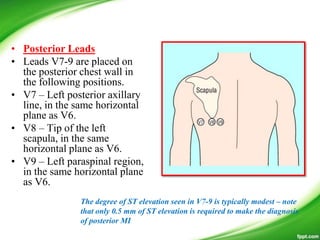
• Posterior Leads
• Leads V7-9 are placed on
the posterior chest wall in
the following positions.
• V7 – Left posterior axillary
line, in the same horizontal
plane as V6.
• V8 – Tip of the left
scapula, in the same
horizontal plane as V6.
• V9 – Left paraspinal region,
in the same horizontal plane
as V6.
The degree of ST elevation seen in V7-9 is typically modest – note
that only 0.5 mm of ST elevation is required to make the diagnosis
of posterior MI
Posterior Myocardial Infarction
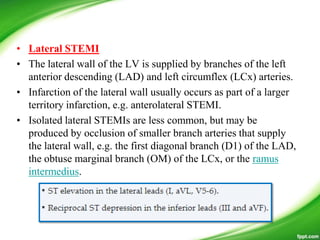
• Lateral STEMI
• The lateral wall of the LV is supplied by branches of the left
anterior descending (LAD) and left circumflex (LCx) arteries.
• Infarction of the lateral wall usually occurs as part of a larger
territory infarction, e.g. anterolateral STEMI.
• Isolated lateral STEMIs are less common, but may be
produced by occlusion of smaller branch arteries that supply
the lateral wall, e.g. the first diagonal branch (D1) of the LAD,
the obtuse marginal branch (OM) of the LCx, or the ramus
intermedius.
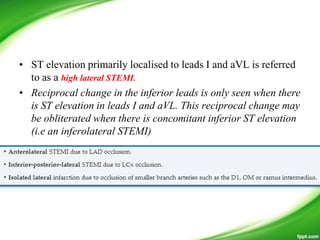
• ST elevation primarily localised to leads I and aVL is referred
to as a high lateral STEMI.
• Reciprocal change in the inferior leads is only seen when there
is ST elevation in leads I and aVL. This reciprocal change may
be obliterated when there is concomitant inferior ST elevation
(i.e an inferolateral STEMI)
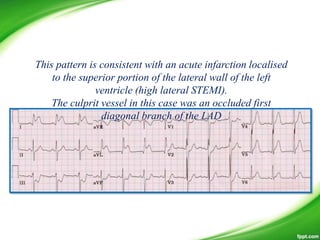
This pattern is consistent with an acute infarction localised
to the superior portion of the lateral wall of the left
ventricle (high lateral STEMI).
The culprit vessel in this case was an occluded first
diagonal branch of the LAD
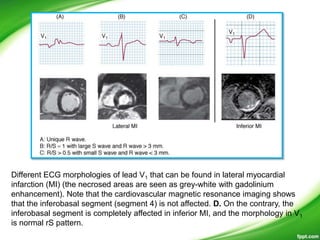
Different ECG morphologies of lead V1 that can be found in lateral myocardial
infarction (MI) (the necrosed areas are seen as grey-white with gadolinium
enhancement). Note that the cardiovascular magnetic resonance imaging shows
that the inferobasal segment (segment 4) is not affected. D. On the contrary, the
inferobasal segment is completely affected in inferior MI, and the morphology in V1
is normal rS pattern.
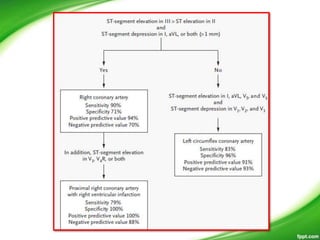
Algorithm to predict the culprit artery (right
coronary artery [RCA] vs left circumflex artery
[LCX]) in case of evolving myocardial
infarction with ST elevation in inferior leads
Algorithm to predict the culprit artery (right
coronary artery [RCA] vs left circumflex artery
[LCX]) in case of evolving myocardial
infarction with ST elevation in inferior leads
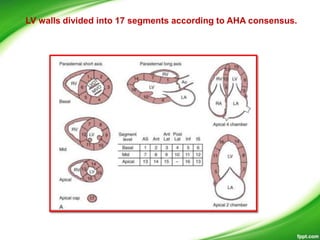
LV walls divided into 17 segments according to AHA consensus.
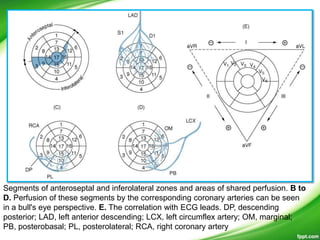
Segments of anteroseptal and inferolateral zones and areas of shared perfusion. B to
D. Perfusion of these segments by the corresponding coronary arteries can be seen
in a bull's eye perspective. E. The correlation with ECG leads. DP, descending
posterior; LAD, left anterior descending; LCX, left circumflex artery; OM, marginal;
PB, posterobasal; PL, posterolateral; RCA, right coronary artery
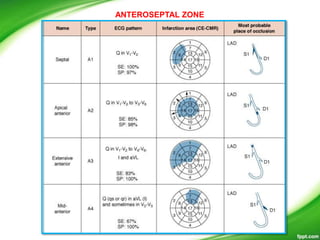
ANTEROSEPTAL ZONE
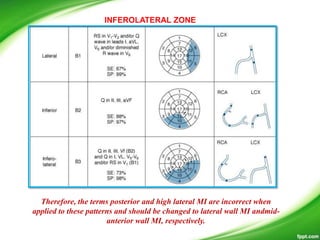
INFEROLATERAL ZONE
Therefore, the terms posterior and high lateral MI are incorrect when
applied to these patterns and should be changed to lateral wall MI andmid-
anterior wall MI, respectively.

Infarct localisation

  • 1.
    ECG in ACSwith ST-Segment Elevation (STE-ACS) Localisation of infarct related artery Dr.I.Tammi Raju,NIMS
  • 2.
    Threshold Values forST-Segment Changes
  • 3.
    • Typical ECGpattern: • The new occurrence of an ST-segment elevation >2 mm at 60 ms after the J point in V2 to V3 and >1 mm in other leads, present in at least two consecutive leads, is considered abnormal and evidence of acute ischemia in the clinical setting of ACS (presence of precordial pain or equivalents). • Whenever possible, it is important to compare this pattern with previous ECGs.
  • 4.
    • The STelevation prevails in the leads facing the affected zone as a direct ECG pattern. • In general, in some opposed leads, the ST-segment depression is seen as an indirect ECG pattern . • These same features also occur in the chronic phase, with a Q wave as the direct pattern and an R wave as the indirect pattern .
  • 5.
  • 6.
    • Anterior MyocardialInfarction • Anterior STEMI results from occlusion of the left anterior descending artery (LAD). • Anterior myocardial infarction carries the worst prognosis of all infarct locations, mostly due to larger infarct size. The magnitude of the reciprocal change in the inferior leads is determined by the magnitude of the ST elevation in I and aVL (as these leads are electrically opposite to III and aVF), hence may be minimal or absent in anterior STEMIs that do not involve the high lateral leads.
  • 7.
    precordial leads canbe classified different infarct patterns -according to maximal ST elevation
  • 8.
    • classical patternof left main coronary artery (LMCA) occlusion: • Widespread horizontal ST depression, most prominent in leads I, II and V4-6 • ST elevation in aVR ≥ 1mm • ST elevation in aVR ≥ V1
  • 9.
    • However, STelevation in aVR is not entirely specific to LMCA occlusion. • It may also be seen with: – Proximal left anterior descending artery (LAD) occlusion – Severe triple-vessel disease (3VD) • ST elevation is aVR -two possible mechanisms: • Diffuse subendocardial ischaemia (producing reciprocal change in aVR) • Transmural ischaemia / infarction of the basal interventricular septum (e.g. due to a proximal occlusion within the left coronary system)
  • 10.
    • Predictive ValueOf STE In AVR • In the context of widespread ST depression + symptoms of myocardial ischaemia: • STE in aVR ≥ 1mm indicates proximal LAD / LMCA occlusion or severe 3VD • STE in aVR ≥ 1mm predicts the need for CABG • STE in aVR ≥ V1 differentiates LMCA from proximal LAD occlusion • Absence of ST elevation in aVR almost entirely excludes a significant LMCA lesion Patients with ≥ 1 mm STE in aVR may potentially require early CABG; therefore these patients should ideally be discussed with the interventional cardiologist ( cardiac surgeon) before thienopyridines are given.
  • 11.
    • Wellens' syndromeis characterized by classic T-waves found in precordial leads especially V2-V3 during pain-free periods in a patient presenting with chest pain. • These findings reliably suggest a high-grade stenosis of the proximal left anterior descending (LAD) coronary artery. • 75% of patients will develop acute anterior wall myocardial infarctions (MIs) within one week .
  • 12.
    • Diagnostic criteria- 1.Progressive symmetrical deep T wave inversion in leads V2 and V3 2. Slope of inverted T waves generally at 60 - 90 3. Little or no cardiac marker elevation 4. Discrete or no ST segment elevation 5. No loss of precordial R waves. 6. Pattern abnormal during chest-pain free periods
  • 13.
    • Wellen's syndromeT-wave. • Type A is the more common abnormality, occurring in 75% of cases, and is characterized by deeply inverted T-waves in V2 and V3. • Type B occurs in 25% of cases and is characterized by biphasic T-waves in V2 and V3 • The diagnostic leads for T-waves of Wellens' syndrome are V2 and V3, corresponding with a lesion between the first and second septal branches of the LAD. • However, if the lesion is more proximal in the LAD, the T-wave changes will be more widely spread along the precordial leads. Type A Type B
  • 14.
    EKG in someonewith Wellens' syndrome when they were having chest pain EKG of the same person when pain free, note the biphasic T waves in leads V2 and V3
  • 15.
    • S1 suppliesthe basal part of the interventricular septum, including the bundle branches (corresponding to leads aVR and V1) • D1 supplies the high lateral region of the heart (leads I and aVL). LEFT CORONARY ARTERY
  • 16.
    • Occlusion proximalto S1 • Signs of basal septal involvement: • ST elevation in aVR • ST elevation in V1 > 2.5 mm • Complete RBBB • ST depression in V5,II,III,aVF.
  • 18.
    • ST elevationin aVR of any magnitude is 43% sensitive and 95% specific for LAD occlusion proximal to S1. • Right bundle branch block in anterior MI is an independent marker of poor prognosis; this is due to the extensive myocardial damage involved rather than the conduction disorder itself.
  • 19.
    OCCLUSION BETWEEN FIRSTSEPTALAND FIRST DIAGNOL
  • 20.
    OCCLUSION BELOW FIRSTSEPTALAND FIRST DIAGNOL
  • 22.
    Algorithm to preciselylocate the left anterior descending (LAD) occlusion in the case of an evolving myocardial infarction with ST elevation in precordial leads
  • 24.
    • The LADis larger and longer to the point of extending beyond the cadiac apex and“wrapping around” to supply the undersurface of the heart. • At times it may even serve the function of the PDA. • Awareness of the possibility of a “wraparound” LAD lesion explains the ECG pattern of simultaneous ST segment elevation in inferior and anterior lead areas. • Not surprisingly, such infarctions are often quite large “wraparound” LAD
  • 25.
  • 26.
    • Suspect acuteapical infarctionwhen there is ST elevation in both anterior as well as inferior lead areas. • Probable Culprit Vessel — A “wraparound" LAD
  • 27.
    Extensive anterior MI(“tombstoning” pattern
  • 28.
    • Inferior STEMI--CinicalSignificance • 40-50% of all myocardial infarctions. • more favourable prognosis than anterior myocardial infarction (in-hospital mortality only 2-9%). • Up to 40% of patients with an inferior STEMI will have a concomitant right ventricular infarction(severe hypotension in response to nitrates and generally have a worse prognosis). • Up to 20% of patients with inferior STEMI will develop significant bradycardia due to second- or third-degree AV block. These patients have an increased in-hospital mortality (>20%). • Inferior STEMI may also be associated with posterior infarction, which confers a worse prognosis due to increased area of myocardium at risk.
  • 29.
    Result from occlusionof all three coronary arteries: • The vast majority (~80%) of inferior STEMIs are due to occlusion of the dominant (RCA). • Less commonly (around 18% of the time), the culprit vessel is a dominant (LCx). • Occasionally, inferior STEMI may result from occlusion of a ―type III‖ or ―wraparound‖ left anterior descending artery (LAD). This produces the unusual pattern of concomitant inferior and anterior ST elevation.
  • 30.
    • The RCAterritory covers the medial part of the inferior wall, including the inferior septum. • The injury current in RCA occlusion is directed inferiorly and rightward, producing ST elevation in lead III > lead II (as lead III is more rightward facing). • The LCx territory covers the lateral part of the inferior wall and the left posterobasal area. • The injury current in LCx occlusion is directed inferiorly and leftward, producing ST elevation in the lateral leads I and V5- 6.
  • 31.
    • RCA occlusion •STE in lead III > lead II • Presence of reciprocal ST depression in lead I,aVL • Signs of right ventricular infarction: STE in V1 and V4R • Circumflex occlusion • STEin lead II =/> lead III • Absence of reciprocal ST depression in lead I,aVL • Signs of lateral infarction: ST elevation in the lateral leads I and aVL or V5-6 Relative Q-wave depth in leads II and III is not useful in determining the culprit artery.
  • 32.
  • 33.
    • Bradycardia AndAV Block In Inferior STEMI • Up to 20% of patients with inferior STEMI will develop either second- or third degree heart block. • There are two presumed mechanisms for this: • Ischaemia of the AV node – due to impaired blood flow via the AV nodal artery. This artery arises from the RCA 80% of the time, hence its involvement in inferior STEMI due to RCA occlusion. • Bezold-Jarisch reflex = – increased vagal tone secondary to ischaemia.
  • 34.
    • Right VentricularInfarction-subtle and easily missed • In patients presenting with inferior STEMI, right ventricular infarction is suggested by the presence of: – ST elevation in V1 - the only standard ECG lead that looks directly at the right ventricle. – ST elevation in lead III > lead II - because lead III is more ―rightward facing‖ than lead II and hence more sensitive to the injury current produced by the right ventricle.
  • 35.
    • If themagnitude of ST elevation in V1 exceeds the magnitude of ST elevation in V2. • If the ST segment in V1 is isoelectric and the ST segment in V2 is markedly depressed. • The combination of ST elevation in V1 and ST depression in V2 is highly specific for right ventricular MI.
  • 36.
    • Right ventricularinfarction is confirmed by the presence of ST elevation in the right- sided leads (V3R-V6R). • ST elevation in V4R has a sensitivity of 88%, specificity of 78% and diagnostic accuracy of 83% in the diagnosis of RV MI. • ST elevation in the right- sided leads is a transient phenomenon, lasting less than 10 hours in 50% of patients with RV infarction. Right-Sided Leads
  • 38.
  • 41.
    • Posterior MyocardialInfarction • Posterior infarction accompanies 15-20% of STEMIs, usually occurring in the context of an inferior or lateral infarction. • Isolated posterior MI is less common (3-11% of infarcts). • Posterior extension of an inferior or lateral infarct implies a much larger area of myocardial damage, with an increased risk of left ventricular dysfunction and death Term posterior be abandoned and that the term inferior be applied to the entire LV wall that lies on the diaphragm. CIRCULATION,2006
  • 42.
    • Posterior MIis suggested in V1-3: – Horizontal ST depression – Tall, broad R waves (>30ms) – Upright T waves – Dominant R wave (R/S ratio > 1) in V2 – The progressive development of pathological R waves in posterior infarction (the “Q wave equivalent”) mirrors the development of Q waves in anteroseptal STEMI. • Posterior infarction is confirmed by the presence of ST elevation and Q waves in the posterior leads (V7-9).
  • 43.
  • 44.
    • Posterior Leads •Leads V7-9 are placed on the posterior chest wall in the following positions. • V7 – Left posterior axillary line, in the same horizontal plane as V6. • V8 – Tip of the left scapula, in the same horizontal plane as V6. • V9 – Left paraspinal region, in the same horizontal plane as V6. The degree of ST elevation seen in V7-9 is typically modest – note that only 0.5 mm of ST elevation is required to make the diagnosis of posterior MI
  • 45.
  • 46.
    • Lateral STEMI •The lateral wall of the LV is supplied by branches of the left anterior descending (LAD) and left circumflex (LCx) arteries. • Infarction of the lateral wall usually occurs as part of a larger territory infarction, e.g. anterolateral STEMI. • Isolated lateral STEMIs are less common, but may be produced by occlusion of smaller branch arteries that supply the lateral wall, e.g. the first diagonal branch (D1) of the LAD, the obtuse marginal branch (OM) of the LCx, or the ramus intermedius.
  • 47.
    • ST elevationprimarily localised to leads I and aVL is referred to as a high lateral STEMI. • Reciprocal change in the inferior leads is only seen when there is ST elevation in leads I and aVL. This reciprocal change may be obliterated when there is concomitant inferior ST elevation (i.e an inferolateral STEMI)
  • 48.
    This pattern isconsistent with an acute infarction localised to the superior portion of the lateral wall of the left ventricle (high lateral STEMI). The culprit vessel in this case was an occluded first diagonal branch of the LAD
  • 49.
    Different ECG morphologiesof lead V1 that can be found in lateral myocardial infarction (MI) (the necrosed areas are seen as grey-white with gadolinium enhancement). Note that the cardiovascular magnetic resonance imaging shows that the inferobasal segment (segment 4) is not affected. D. On the contrary, the inferobasal segment is completely affected in inferior MI, and the morphology in V1 is normal rS pattern.
  • 50.
    Algorithm to predictthe culprit artery (right coronary artery [RCA] vs left circumflex artery [LCX]) in case of evolving myocardial infarction with ST elevation in inferior leads
  • 51.
    Algorithm to predictthe culprit artery (right coronary artery [RCA] vs left circumflex artery [LCX]) in case of evolving myocardial infarction with ST elevation in inferior leads
  • 53.
    LV walls dividedinto 17 segments according to AHA consensus.
  • 54.
    Segments of anteroseptaland inferolateral zones and areas of shared perfusion. B to D. Perfusion of these segments by the corresponding coronary arteries can be seen in a bull's eye perspective. E. The correlation with ECG leads. DP, descending posterior; LAD, left anterior descending; LCX, left circumflex artery; OM, marginal; PB, posterobasal; PL, posterolateral; RCA, right coronary artery
  • 55.
  • 56.
    INFEROLATERAL ZONE Therefore, theterms posterior and high lateral MI are incorrect when applied to these patterns and should be changed to lateral wall MI andmid- anterior wall MI, respectively.