© 2003 By Default!
A Free sample background from www.awesomebackgrounds.com
Slide 1
Visit for more
www.dnbpediatrics.com
OSCE PEDIATRICS
HEMATOLOGY
© 2003 By Default!
A Free sample background from www.awesomebackgrounds.com
Slide 2
Station 1
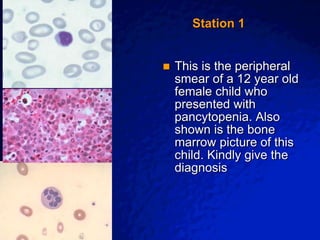
 This is the peripheral
smear of a 12 year old
female child who
presented with
pancytopenia. Also
shown is the bone
marrow picture of this
child. Kindly give the
diagnosis
© 2003 By Default!
A Free sample background from www.awesomebackgrounds.com
Slide 3
Answer Station 1
 Megaloblastic anemia
© 2003 By Default!
A Free sample background from www.awesomebackgrounds.com
Slide 4
Station 2
 What ancillary tests will you do to clinch the
diagnosis? Give any two.
© 2003 By Default!
A Free sample background from www.awesomebackgrounds.com
Slide 5
Answers Station 2
 LDH
 S. Bilirubin
 Vit B12 level
 S. Folic Acid levels
© 2003 By Default!
A Free sample background from www.awesomebackgrounds.com
Slide 6
Station 3
 What are the recommended dosages for the
treatment of Vitamin B 12 and Folic Acid deficiency
© 2003 By Default!
A Free sample background from www.awesomebackgrounds.com
Slide 7
Answers Station 3
 Vitamin B12: Intramuscular 100-200 mcg
biweekly or 1000 mcg weekly x 4 to 8 weeks,
followed by oral dose of 100 mcg per day.
 Folic acid: 0.5 to 1 mg or more daily; 5 mg
per week will also be effective. To be given
for 4-8 weeks.
© 2003 By Default!
A Free sample background from www.awesomebackgrounds.com
Slide 8
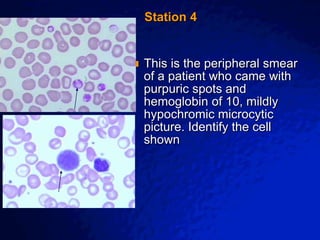
Station 4
 This is the peripheral smear
of a patient who came with
purpuric spots and
hemoglobin of 10, mildly
hypochromic microcytic
picture. Identify the cell
shown
© 2003 By Default!
A Free sample background from www.awesomebackgrounds.com
Slide 9
Answer Station 4
Giant Platelets
© 2003 By Default!
A Free sample background from www.awesomebackgrounds.com
Slide 10
Station 5
 This is the peripheral smear of a 4 year old child
who presented with a Hb of 10gm/dL, TLC 9000,
Platelet 30,000 and no organomegaly or
lymphadenopathy. The child had purpura but no
significant bleed. Was stable. Parents are well
educated and live in Delhi.
 What will be the drug to treat this patient?
 Will you do a bone marrow in this patient?
© 2003 By Default!
A Free sample background from www.awesomebackgrounds.com
Slide 11
Answers Station 5
 No treatment is required. Just observation
 No need for bone marrow
© 2003 By Default!
A Free sample background from www.awesomebackgrounds.com
Slide 12
Station 6
 Kindly counsel the parents of this child
© 2003 By Default!
A Free sample background from www.awesomebackgrounds.com
Slide 13
Answers Station 6
 Introduces himself and tries to make the parents
comfortable.
 Talks about the disease ITP
 Talks about the possibility of any other disease
 Talks about the need for injury prevention
 Tells about the warning signs when they have to
report to the hospital
 Talks about the self limiting nature of the disease
© 2003 By Default!
A Free sample background from www.awesomebackgrounds.com
Slide 14
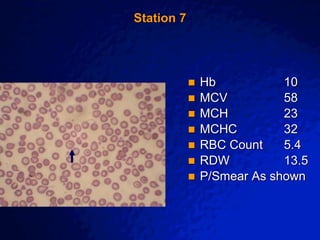
Station 7
 Hb 10
 MCV 58
 MCH 23
 MCHC 32
 RBC Count 5.4
 RDW 13.5
 P/Smear As shown
© 2003 By Default!
A Free sample background from www.awesomebackgrounds.com
Slide 15
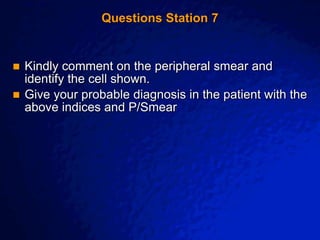
Questions Station 7
 Kindly comment on the peripheral smear and
identify the cell shown.
 Give your probable diagnosis in the patient with the
above indices and P/Smear
© 2003 By Default!
A Free sample background from www.awesomebackgrounds.com
Slide 16
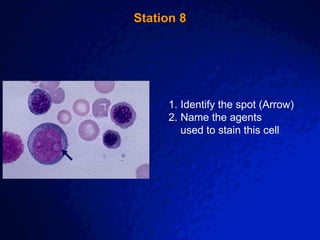
Station 8
1. Identify the spot (Arrow)
2. Name the agents
used to stain this cell
© 2003 By Default!
A Free sample background from www.awesomebackgrounds.com
Slide 17
Answers Station 8
 Myeloblast with 3 prominent nuclei
 Stains- Myeloperoxidase, Non specific esterase
and Sudan black
© 2003 By Default!
A Free sample background from www.awesomebackgrounds.com
Slide 18
Station 9
A 5 yr boy c/o pallor and passing dark-colored urine. Three
days prior the patient had low-grade fever and dry cough.
Initial CBC revealed a Hemoglobin level of 4.5 g/dL, an Hct
of 14%, a WBC count of 9,100/mm3. (N76%, L14%, M8%,
E1%) and a platelet count of 372,000/mm3. The patient had
been diagnosed with Hemoglobin H disease since 18
months of age. He had received 2 blood transfusions when
he had fever and acute anemia. Both parents are
thalassemia carriers.
Physical examination: Temp- 38.3 C, Markedly pale
Heart: Syst. ejection murmur grade II/VI at lt upper sternum
Abdomen: Splenohepatomegaly
© 2003 By Default!
A Free sample background from www.awesomebackgrounds.com
Slide 19
Station 9 (contd)
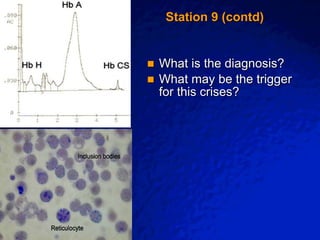
 What is the diagnosis?
 What may be the trigger
for this crises?
© 2003 By Default!
A Free sample background from www.awesomebackgrounds.com
Slide 20
Answers Station 9
 Hb H/Hb CS disease with hemolytic crisis
© 2003 By Default!
A Free sample background from www.awesomebackgrounds.com
Slide 21
Station 10
 2 yr old child was evaluated for anemia
and found to have a reticulocyte count
of 20% and a PCV of 25%.
 Calculate the Reticulocyte production
index taking maturation time as 2 days
and assuming a normal PCV of 0.45
 What does this signify? (In terms of
production rate)
© 2003 By Default!
A Free sample background from www.awesomebackgrounds.com
Slide 22
Answers Station 10
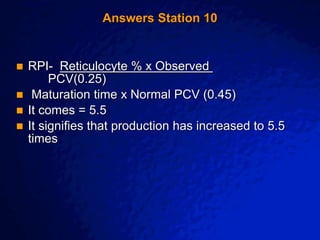
 RPI- Reticulocyte % x Observed
PCV(0.25)
 Maturation time x Normal PCV (0.45)
 It comes = 5.5
 It signifies that production has increased to 5.5
times
© 2003 By Default!
A Free sample background from www.awesomebackgrounds.com
Slide 23
Station 11
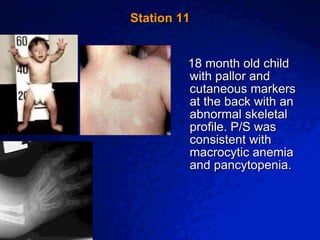
18 month old child
with pallor and
cutaneous markers
at the back with an
abnormal skeletal
profile. P/S was
consistent with
macrocytic anemia
and pancytopenia.
© 2003 By Default!
A Free sample background from www.awesomebackgrounds.com
Slide 24
Questions Station 11
 What is the most probable diagnosis?
 Name the cutaneous marker.
 What malignancies are expected in this patient?
© 2003 By Default!
A Free sample background from www.awesomebackgrounds.com
Slide 25
Answers Station 11
 Fanconi anemia
 Café au lait spot
 Acute leukemia
© 2003 By Default!
A Free sample background from www.awesomebackgrounds.com
Slide 26
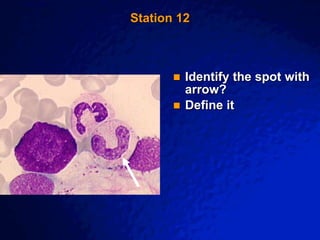
Station 12
 Identify the spot with
arrow?
 Define it
© 2003 By Default!
A Free sample background from www.awesomebackgrounds.com
Slide 27
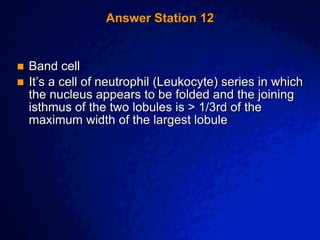
Answer Station 12
 Band cell
 It’s a cell of neutrophil (Leukocyte) series in which
the nucleus appears to be folded and the joining
isthmus of the two lobules is > 1/3rd of the
maximum width of the largest lobule
© 2003 By Default!
A Free sample background from www.awesomebackgrounds.com
Slide 28
Station 13
 Give the full form of SQUID and what it is best used
for?
 Give the full form of NESTROF and what it is used
for?
 What is the principle used in NESTROF test?
© 2003 By Default!
A Free sample background from www.awesomebackgrounds.com
Slide 29
Answer Station 13
 SQUID- Super-conducting Quantum Interference
Device & Provides the most accurate and best-
validated non-invasive method for measuring liver
iron
 NESTROF- Naked Eye Single Tube Red Cell
Osmotic Fragility Test and it is usefull in screening
for beta-thalassaemia and some of the common
haemoglobinopathies
 The principle of NESTROF is based on the limit of
hypotonicity which the red cell can withstand.
© 2003 By Default!
A Free sample background from www.awesomebackgrounds.com
Slide 30
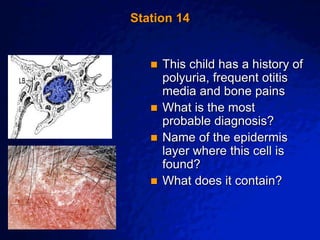
Station 14
 This child has a history of
polyuria, frequent otitis
media and bone pains
 What is the most
probable diagnosis?
 Name of the epidermis
layer where this cell is
found?
 What does it contain?
© 2003 By Default!
A Free sample background from www.awesomebackgrounds.com
Slide 31
Answer Station 14
 Langerhans cell Histiocytosis
 Prickle layer
 Birbeck granules
© 2003 By Default!
A Free sample background from www.awesomebackgrounds.com
Slide 32
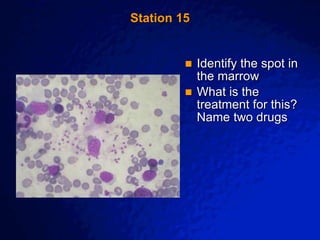
Station 15
 Identify the spot in
the marrow
 What is the
treatment for this?
Name two drugs
© 2003 By Default!
A Free sample background from www.awesomebackgrounds.com
Slide 33
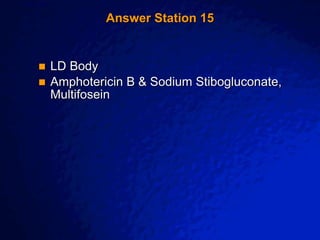
Answer Station 15
 LD Body
 Amphotericin B & Sodium Stibogluconate,
Multifosein
© 2003 By Default!
A Free sample background from www.awesomebackgrounds.com
Slide 34
www.dnbpediatrics.com

Hmatology

  • 1.
    © 2003 ByDefault! A Free sample background from www.awesomebackgrounds.com Slide 1 Visit for more www.dnbpediatrics.com OSCE PEDIATRICS HEMATOLOGY
  • 2.
    © 2003 ByDefault! A Free sample background from www.awesomebackgrounds.com Slide 2 Station 1  This is the peripheral smear of a 12 year old female child who presented with pancytopenia. Also shown is the bone marrow picture of this child. Kindly give the diagnosis
  • 3.
    © 2003 ByDefault! A Free sample background from www.awesomebackgrounds.com Slide 3 Answer Station 1  Megaloblastic anemia
  • 4.
    © 2003 ByDefault! A Free sample background from www.awesomebackgrounds.com Slide 4 Station 2  What ancillary tests will you do to clinch the diagnosis? Give any two.
  • 5.
    © 2003 ByDefault! A Free sample background from www.awesomebackgrounds.com Slide 5 Answers Station 2  LDH  S. Bilirubin  Vit B12 level  S. Folic Acid levels
  • 6.
    © 2003 ByDefault! A Free sample background from www.awesomebackgrounds.com Slide 6 Station 3  What are the recommended dosages for the treatment of Vitamin B 12 and Folic Acid deficiency
  • 7.
    © 2003 ByDefault! A Free sample background from www.awesomebackgrounds.com Slide 7 Answers Station 3  Vitamin B12: Intramuscular 100-200 mcg biweekly or 1000 mcg weekly x 4 to 8 weeks, followed by oral dose of 100 mcg per day.  Folic acid: 0.5 to 1 mg or more daily; 5 mg per week will also be effective. To be given for 4-8 weeks.
  • 8.
    © 2003 ByDefault! A Free sample background from www.awesomebackgrounds.com Slide 8 Station 4  This is the peripheral smear of a patient who came with purpuric spots and hemoglobin of 10, mildly hypochromic microcytic picture. Identify the cell shown
  • 9.
    © 2003 ByDefault! A Free sample background from www.awesomebackgrounds.com Slide 9 Answer Station 4 Giant Platelets
  • 10.
    © 2003 ByDefault! A Free sample background from www.awesomebackgrounds.com Slide 10 Station 5  This is the peripheral smear of a 4 year old child who presented with a Hb of 10gm/dL, TLC 9000, Platelet 30,000 and no organomegaly or lymphadenopathy. The child had purpura but no significant bleed. Was stable. Parents are well educated and live in Delhi.  What will be the drug to treat this patient?  Will you do a bone marrow in this patient?
  • 11.
    © 2003 ByDefault! A Free sample background from www.awesomebackgrounds.com Slide 11 Answers Station 5  No treatment is required. Just observation  No need for bone marrow
  • 12.
    © 2003 ByDefault! A Free sample background from www.awesomebackgrounds.com Slide 12 Station 6  Kindly counsel the parents of this child
  • 13.
    © 2003 ByDefault! A Free sample background from www.awesomebackgrounds.com Slide 13 Answers Station 6  Introduces himself and tries to make the parents comfortable.  Talks about the disease ITP  Talks about the possibility of any other disease  Talks about the need for injury prevention  Tells about the warning signs when they have to report to the hospital  Talks about the self limiting nature of the disease
  • 14.
    © 2003 ByDefault! A Free sample background from www.awesomebackgrounds.com Slide 14 Station 7  Hb 10  MCV 58  MCH 23  MCHC 32  RBC Count 5.4  RDW 13.5  P/Smear As shown
  • 15.
    © 2003 ByDefault! A Free sample background from www.awesomebackgrounds.com Slide 15 Questions Station 7  Kindly comment on the peripheral smear and identify the cell shown.  Give your probable diagnosis in the patient with the above indices and P/Smear
  • 16.
    © 2003 ByDefault! A Free sample background from www.awesomebackgrounds.com Slide 16 Station 8 1. Identify the spot (Arrow) 2. Name the agents used to stain this cell
  • 17.
    © 2003 ByDefault! A Free sample background from www.awesomebackgrounds.com Slide 17 Answers Station 8  Myeloblast with 3 prominent nuclei  Stains- Myeloperoxidase, Non specific esterase and Sudan black
  • 18.
    © 2003 ByDefault! A Free sample background from www.awesomebackgrounds.com Slide 18 Station 9 A 5 yr boy c/o pallor and passing dark-colored urine. Three days prior the patient had low-grade fever and dry cough. Initial CBC revealed a Hemoglobin level of 4.5 g/dL, an Hct of 14%, a WBC count of 9,100/mm3. (N76%, L14%, M8%, E1%) and a platelet count of 372,000/mm3. The patient had been diagnosed with Hemoglobin H disease since 18 months of age. He had received 2 blood transfusions when he had fever and acute anemia. Both parents are thalassemia carriers. Physical examination: Temp- 38.3 C, Markedly pale Heart: Syst. ejection murmur grade II/VI at lt upper sternum Abdomen: Splenohepatomegaly
  • 19.
    © 2003 ByDefault! A Free sample background from www.awesomebackgrounds.com Slide 19 Station 9 (contd)  What is the diagnosis?  What may be the trigger for this crises?
  • 20.
    © 2003 ByDefault! A Free sample background from www.awesomebackgrounds.com Slide 20 Answers Station 9  Hb H/Hb CS disease with hemolytic crisis
  • 21.
    © 2003 ByDefault! A Free sample background from www.awesomebackgrounds.com Slide 21 Station 10  2 yr old child was evaluated for anemia and found to have a reticulocyte count of 20% and a PCV of 25%.  Calculate the Reticulocyte production index taking maturation time as 2 days and assuming a normal PCV of 0.45  What does this signify? (In terms of production rate)
  • 22.
    © 2003 ByDefault! A Free sample background from www.awesomebackgrounds.com Slide 22 Answers Station 10  RPI- Reticulocyte % x Observed PCV(0.25)  Maturation time x Normal PCV (0.45)  It comes = 5.5  It signifies that production has increased to 5.5 times
  • 23.
    © 2003 ByDefault! A Free sample background from www.awesomebackgrounds.com Slide 23 Station 11 18 month old child with pallor and cutaneous markers at the back with an abnormal skeletal profile. P/S was consistent with macrocytic anemia and pancytopenia.
  • 24.
    © 2003 ByDefault! A Free sample background from www.awesomebackgrounds.com Slide 24 Questions Station 11  What is the most probable diagnosis?  Name the cutaneous marker.  What malignancies are expected in this patient?
  • 25.
    © 2003 ByDefault! A Free sample background from www.awesomebackgrounds.com Slide 25 Answers Station 11  Fanconi anemia  Café au lait spot  Acute leukemia
  • 26.
    © 2003 ByDefault! A Free sample background from www.awesomebackgrounds.com Slide 26 Station 12  Identify the spot with arrow?  Define it
  • 27.
    © 2003 ByDefault! A Free sample background from www.awesomebackgrounds.com Slide 27 Answer Station 12  Band cell  It’s a cell of neutrophil (Leukocyte) series in which the nucleus appears to be folded and the joining isthmus of the two lobules is > 1/3rd of the maximum width of the largest lobule
  • 28.
    © 2003 ByDefault! A Free sample background from www.awesomebackgrounds.com Slide 28 Station 13  Give the full form of SQUID and what it is best used for?  Give the full form of NESTROF and what it is used for?  What is the principle used in NESTROF test?
  • 29.
    © 2003 ByDefault! A Free sample background from www.awesomebackgrounds.com Slide 29 Answer Station 13  SQUID- Super-conducting Quantum Interference Device & Provides the most accurate and best- validated non-invasive method for measuring liver iron  NESTROF- Naked Eye Single Tube Red Cell Osmotic Fragility Test and it is usefull in screening for beta-thalassaemia and some of the common haemoglobinopathies  The principle of NESTROF is based on the limit of hypotonicity which the red cell can withstand.
  • 30.
    © 2003 ByDefault! A Free sample background from www.awesomebackgrounds.com Slide 30 Station 14  This child has a history of polyuria, frequent otitis media and bone pains  What is the most probable diagnosis?  Name of the epidermis layer where this cell is found?  What does it contain?
  • 31.
    © 2003 ByDefault! A Free sample background from www.awesomebackgrounds.com Slide 31 Answer Station 14  Langerhans cell Histiocytosis  Prickle layer  Birbeck granules
  • 32.
    © 2003 ByDefault! A Free sample background from www.awesomebackgrounds.com Slide 32 Station 15  Identify the spot in the marrow  What is the treatment for this? Name two drugs
  • 33.
    © 2003 ByDefault! A Free sample background from www.awesomebackgrounds.com Slide 33 Answer Station 15  LD Body  Amphotericin B & Sodium Stibogluconate, Multifosein
  • 34.
    © 2003 ByDefault! A Free sample background from www.awesomebackgrounds.com Slide 34 www.dnbpediatrics.com