


Basics of ECG
Presenter- Dr.Pranay
Moderator-Dr.Sivamurukan
Outline
• Introduction
• Approach to an ECG
• Waves and intervals
• RVH,LVH
Electrocardiogram
• It is a recording - of time versus voltage – of the
electrical activity of the heart using electrodes placed
on the skin.
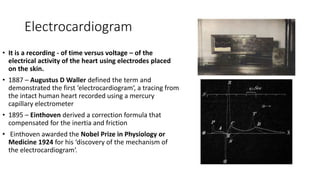
• 1887 – Augustus D Waller defined the term and
demonstrated the first ‘electrocardiogram‘, a tracing from
the intact human heart recorded using a mercury
capillary electrometer
• 1895 – Einthoven derived a correction formula that
compensated for the inertia and friction
• Einthoven awarded the Nobel Prize in Physiology or
Medicine 1924 for his ‘discovery of the mechanism of
the electrocardiogram‘.
ECG
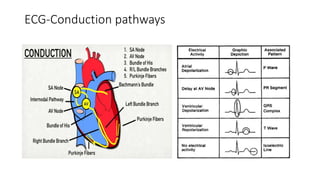
ECG-Conduction pathways
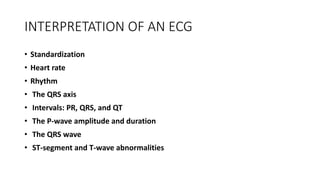
INTERPRETATION OF AN ECG
• Standardization
• Heart rate
• Rhythm
• The QRS axis
• Intervals: PR, QRS, and QT
• The P-wave amplitude and duration
• The QRS wave
• ST-segment and T-wave abnormalities
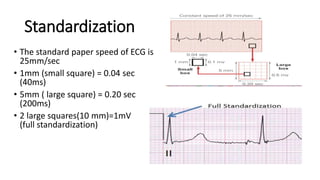
Standardization
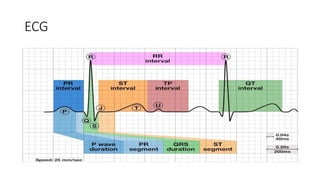
• The standard paper speed of ECG is
25mm/sec
• 1mm (small square) = 0.04 sec
(40ms)
• 5mm ( large square) = 0.20 sec
(200ms)
• 2 large squares(10 mm)=1mV
(full standardization)
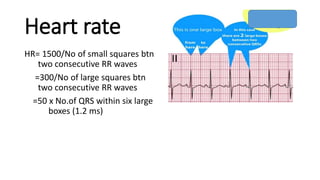
Heart rate
HR= 1500/No of small squares btn
two consecutive RR waves
=300/No of large squares btn
two consecutive RR waves
=50 x No.of QRS within six large
boxes (1.2 ms)
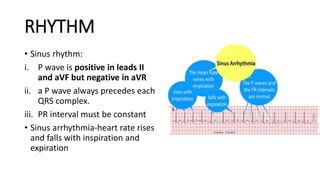
RHYTHM
• Sinus rhythm:
i. P wave is positive in leads II
and aVF but negative in aVR
ii. a P wave always precedes each
QRS complex.
iii. PR interval must be constant
• Sinus arrhythmia-heart rate rises
and falls with inspiration and
expiration
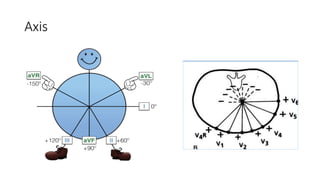
Axis
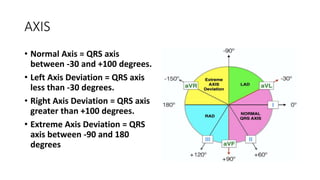
AXIS
• Normal Axis = QRS axis
between -30 and +100 degrees.
• Left Axis Deviation = QRS axis
less than -30 degrees.
• Right Axis Deviation = QRS axis
greater than +100 degrees.
• Extreme Axis Deviation = QRS
axis between -90 and 180
degrees
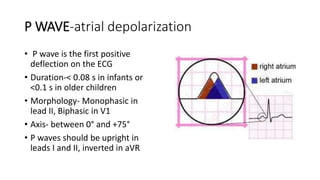
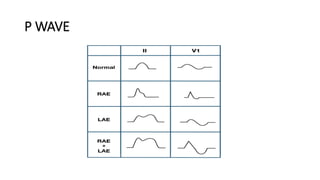
P WAVE-atrial depolarization
• P wave is the first positive
deflection on the ECG
• Duration-< 0.08 s in infants or
<0.1 s in older children
• Morphology- Monophasic in
lead II, Biphasic in V1
• Axis- between 0° and +75°
• P waves should be upright in
leads I and II, inverted in aVR
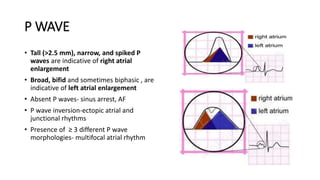
P WAVE
• Tall (>2.5 mm), narrow, and spiked P
waves are indicative of right atrial
enlargement
• Broad, bifid and sometimes biphasic , are
indicative of left atrial enlargement
• Absent P waves- sinus arrest, AF
• P wave inversion-ectopic atrial and
junctional rhythms
• Presence of ≥ 3 different P wave
morphologies- multifocal atrial rhythm
P WAVE
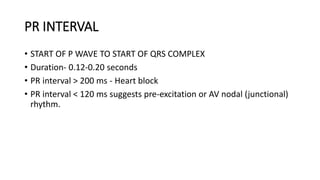
PR INTERVAL
• START OF P WAVE TO START OF QRS COMPLEX
• Duration- 0.12-0.20 seconds
• PR interval > 200 ms - Heart block
• PR interval < 120 ms suggests pre-excitation or AV nodal (junctional)
rhythm.
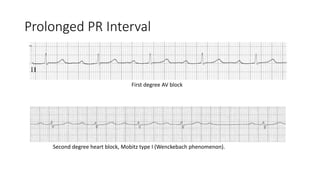
Prolonged PR Interval
First degree AV block
Second degree heart block, Mobitz type I (Wenckebach phenomenon).
Short PR interval (<120ms)
1. Preexcitation syndromes
• Wolff-Parkinson-White syndrome
are a short PR interval (<120ms),
broad QRS and a slurred upstroke to
the QRS complex, the delta wave.
2. AV nodal (junctional) rhythm
• Narrow complex, regular rhythms
arising from the AV node.
• P waves are either absent or
abnormal
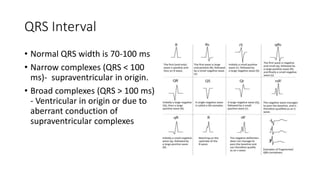
QRS Interval
• Normal QRS width is 70-100 ms
• Narrow complexes (QRS < 100
ms)- supraventricular in origin.
• Broad complexes (QRS > 100 ms)
- Ventricular in origin or due to
aberrant conduction of
supraventricular complexes
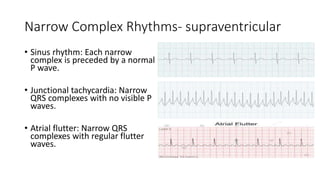
Narrow Complex Rhythms- supraventricular
• Sinus rhythm: Each narrow
complex is preceded by a normal
P wave.
• Junctional tachycardia: Narrow
QRS complexes with no visible P
waves.
• Atrial flutter: Narrow QRS
complexes with regular flutter
waves.
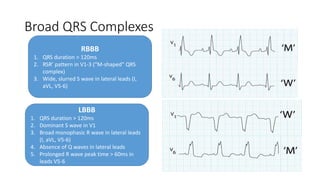
Broad QRS Complexes
RBBB
1. QRS duration > 120ms
2. RSR’ pattern in V1-3 (“M-shaped” QRS
complex)
3. Wide, slurred S wave in lateral leads (I,
aVL, V5-6)
LBBB
1. QRS duration > 120ms
2. Dominant S wave in V1
3. Broad monophasic R wave in lateral leads
(I, aVL, V5-6)
4. Absence of Q waves in lateral leads
5. Prolonged R wave peak time > 60ms in
leads V5-6
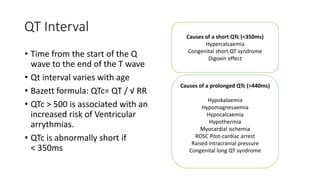
QT Interval
• Time from the start of the Q
wave to the end of the T wave
• Qt interval varies with age
• Bazett formula: QTc= QT / √ RR
• QTc > 500 is associated with an
increased risk of Ventricular
arrythmias.
• QTc is abnormally short if
< 350ms
Causes of a short QTc (<350ms)
Hypercalcaemia
Congenital short QT syndrome
Digoxin effect
Causes of a prolonged QTc (>440ms)
Hypokalaemia
Hypomagnesaemia
Hypocalcaemia
Hypothermia
Myocardial ischemia
ROSC Post-cardiac arrest
Raised intracranial pressure
Congenital long QT syndrome
T WAVE- Ventricular repolarisation
• The T wave is the positive deflection after each QRS complex. It
represents ventricular repolarisation.
• Upright in all leads except aVR and V1
• Amplitude < 5mm in limb leads, < 10mm in precordial leads
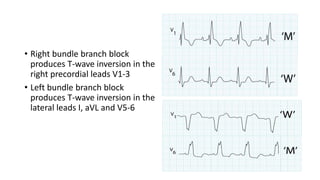
• Inverted T-waves in the right precordial leads (V1-3)
• Right bundle branch block
produces T-wave inversion in the
right precordial leads V1-3
• Left bundle branch block
produces T-wave inversion in the
lateral leads I, aVL and V5-6
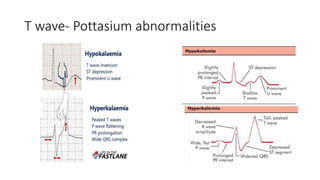
T wave- Pottasium abnormalities
LVH
• Left axis deviation
• Markedly increased LV voltages: huge
precordial R and S waves that overlap
with the adjacent leads (SV1 + RV6 > 35
mm).
• R-wave peak time > 50 ms in V5-6 with
associated QRS broadening.
• LV strain pattern with ST depression and
T-wave inversions in I, aVL and V5-6.
• ST elevation in V1-3.
• Prominent U waves in V1-3.
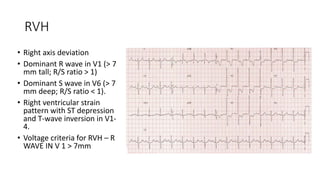
RVH
• Right axis deviation
• Dominant R wave in V1 (> 7
mm tall; R/S ratio > 1)
• Dominant S wave in V6 (> 7
mm deep; R/S ratio < 1).
• Right ventricular strain
pattern with ST depression
and T-wave inversion in V1-
4.
• Voltage criteria for RVH – R
WAVE IN V 1 > 7mm
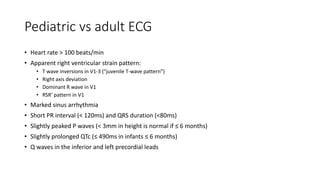
Pediatric vs adult ECG
• Heart rate > 100 beats/min
• Apparent right ventricular strain pattern:
• T wave inversions in V1-3 (“juvenile T-wave pattern”)
• Right axis deviation
• Dominant R wave in V1
• RSR’ pattern in V1
• Marked sinus arrhythmia
• Short PR interval (< 120ms) and QRS duration (<80ms)
• Slightly peaked P waves (< 3mm in height is normal if ≤ 6 months)
• Slightly prolonged QTc (≤ 490ms in infants ≤ 6 months)
• Q waves in the inferior and left precordial leads
References
• Evans, William & Acherman,
Ruben & Mayman, Gary &
Rollins, Robert & Kip, Kaan.
(2010). Simplified Pediatric
Electrocardiogram
Interpretation. Clinical
pediatrics. 49. 363-72.
10.1177/0009922809336206.
• https://litfl.com/
Basics of ECG.pptx

Basics of ECG.pptx

  • 1.
    Basics of ECG Presenter-Dr.Pranay Moderator-Dr.Sivamurukan
  • 2.
    Outline • Introduction • Approachto an ECG • Waves and intervals • RVH,LVH
  • 3.
    Electrocardiogram • It isa recording - of time versus voltage – of the electrical activity of the heart using electrodes placed on the skin. • 1887 – Augustus D Waller defined the term and demonstrated the first ‘electrocardiogram‘, a tracing from the intact human heart recorded using a mercury capillary electrometer • 1895 – Einthoven derived a correction formula that compensated for the inertia and friction • Einthoven awarded the Nobel Prize in Physiology or Medicine 1924 for his ‘discovery of the mechanism of the electrocardiogram‘.
  • 4.
  • 5.
  • 6.
    INTERPRETATION OF ANECG • Standardization • Heart rate • Rhythm • The QRS axis • Intervals: PR, QRS, and QT • The P-wave amplitude and duration • The QRS wave • ST-segment and T-wave abnormalities
  • 7.
    Standardization • The standardpaper speed of ECG is 25mm/sec • 1mm (small square) = 0.04 sec (40ms) • 5mm ( large square) = 0.20 sec (200ms) • 2 large squares(10 mm)=1mV (full standardization)
  • 8.
    Heart rate HR= 1500/Noof small squares btn two consecutive RR waves =300/No of large squares btn two consecutive RR waves =50 x No.of QRS within six large boxes (1.2 ms)
  • 9.
    RHYTHM • Sinus rhythm: i.P wave is positive in leads II and aVF but negative in aVR ii. a P wave always precedes each QRS complex. iii. PR interval must be constant • Sinus arrhythmia-heart rate rises and falls with inspiration and expiration
  • 10.
  • 11.
    AXIS • Normal Axis= QRS axis between -30 and +100 degrees. • Left Axis Deviation = QRS axis less than -30 degrees. • Right Axis Deviation = QRS axis greater than +100 degrees. • Extreme Axis Deviation = QRS axis between -90 and 180 degrees
  • 12.
    P WAVE-atrial depolarization •P wave is the first positive deflection on the ECG • Duration-< 0.08 s in infants or <0.1 s in older children • Morphology- Monophasic in lead II, Biphasic in V1 • Axis- between 0° and +75° • P waves should be upright in leads I and II, inverted in aVR
  • 13.
    P WAVE • Tall(>2.5 mm), narrow, and spiked P waves are indicative of right atrial enlargement • Broad, bifid and sometimes biphasic , are indicative of left atrial enlargement • Absent P waves- sinus arrest, AF • P wave inversion-ectopic atrial and junctional rhythms • Presence of ≥ 3 different P wave morphologies- multifocal atrial rhythm
  • 14.
  • 15.
    PR INTERVAL • STARTOF P WAVE TO START OF QRS COMPLEX • Duration- 0.12-0.20 seconds • PR interval > 200 ms - Heart block • PR interval < 120 ms suggests pre-excitation or AV nodal (junctional) rhythm.
  • 16.
    Prolonged PR Interval Firstdegree AV block Second degree heart block, Mobitz type I (Wenckebach phenomenon).
  • 17.
    Short PR interval(<120ms) 1. Preexcitation syndromes • Wolff-Parkinson-White syndrome are a short PR interval (<120ms), broad QRS and a slurred upstroke to the QRS complex, the delta wave. 2. AV nodal (junctional) rhythm • Narrow complex, regular rhythms arising from the AV node. • P waves are either absent or abnormal
  • 18.
    QRS Interval • NormalQRS width is 70-100 ms • Narrow complexes (QRS < 100 ms)- supraventricular in origin. • Broad complexes (QRS > 100 ms) - Ventricular in origin or due to aberrant conduction of supraventricular complexes
  • 19.
    Narrow Complex Rhythms-supraventricular • Sinus rhythm: Each narrow complex is preceded by a normal P wave. • Junctional tachycardia: Narrow QRS complexes with no visible P waves. • Atrial flutter: Narrow QRS complexes with regular flutter waves.
  • 20.
    Broad QRS Complexes RBBB 1.QRS duration > 120ms 2. RSR’ pattern in V1-3 (“M-shaped” QRS complex) 3. Wide, slurred S wave in lateral leads (I, aVL, V5-6) LBBB 1. QRS duration > 120ms 2. Dominant S wave in V1 3. Broad monophasic R wave in lateral leads (I, aVL, V5-6) 4. Absence of Q waves in lateral leads 5. Prolonged R wave peak time > 60ms in leads V5-6
  • 21.
    QT Interval • Timefrom the start of the Q wave to the end of the T wave • Qt interval varies with age • Bazett formula: QTc= QT / √ RR • QTc > 500 is associated with an increased risk of Ventricular arrythmias. • QTc is abnormally short if < 350ms Causes of a short QTc (<350ms) Hypercalcaemia Congenital short QT syndrome Digoxin effect Causes of a prolonged QTc (>440ms) Hypokalaemia Hypomagnesaemia Hypocalcaemia Hypothermia Myocardial ischemia ROSC Post-cardiac arrest Raised intracranial pressure Congenital long QT syndrome
  • 22.
    T WAVE- Ventricularrepolarisation • The T wave is the positive deflection after each QRS complex. It represents ventricular repolarisation. • Upright in all leads except aVR and V1 • Amplitude < 5mm in limb leads, < 10mm in precordial leads • Inverted T-waves in the right precordial leads (V1-3)
  • 23.
    • Right bundlebranch block produces T-wave inversion in the right precordial leads V1-3 • Left bundle branch block produces T-wave inversion in the lateral leads I, aVL and V5-6
  • 24.
    T wave- Pottasiumabnormalities
  • 25.
    LVH • Left axisdeviation • Markedly increased LV voltages: huge precordial R and S waves that overlap with the adjacent leads (SV1 + RV6 > 35 mm). • R-wave peak time > 50 ms in V5-6 with associated QRS broadening. • LV strain pattern with ST depression and T-wave inversions in I, aVL and V5-6. • ST elevation in V1-3. • Prominent U waves in V1-3.
  • 26.
    RVH • Right axisdeviation • Dominant R wave in V1 (> 7 mm tall; R/S ratio > 1) • Dominant S wave in V6 (> 7 mm deep; R/S ratio < 1). • Right ventricular strain pattern with ST depression and T-wave inversion in V1- 4. • Voltage criteria for RVH – R WAVE IN V 1 > 7mm
  • 27.
    Pediatric vs adultECG • Heart rate > 100 beats/min • Apparent right ventricular strain pattern: • T wave inversions in V1-3 (“juvenile T-wave pattern”) • Right axis deviation • Dominant R wave in V1 • RSR’ pattern in V1 • Marked sinus arrhythmia • Short PR interval (< 120ms) and QRS duration (<80ms) • Slightly peaked P waves (< 3mm in height is normal if ≤ 6 months) • Slightly prolonged QTc (≤ 490ms in infants ≤ 6 months) • Q waves in the inferior and left precordial leads
  • 28.
    References • Evans, William& Acherman, Ruben & Mayman, Gary & Rollins, Robert & Kip, Kaan. (2010). Simplified Pediatric Electrocardiogram Interpretation. Clinical pediatrics. 49. 363-72. 10.1177/0009922809336206. • https://litfl.com/

Editor's Notes

  • #11 Sum of vectors generated by individual cardiac myocytes
  • #16 (the presence of an accessory pathway between the atria and ventricles)
  • #18 Lown–Ganong–Levine syndrome (LGL): Proposed pre-excitation syndrome. Accessory pathway composed of James fibres. Characteristic ECG findings of short PR interval (<120ms); normal P wave axis; normal/narrow QRS morphology in the presence of paroxysmal tachyarrhythmia.
  • #19 Q wave represents the normal left-to-right depolarisation of the interventricular septum R wave is the first upward deflection after the P wave R wave represents early ventricular depolarisation
  • #21 Bundle branch block (RBBB or LBBB) Hyperkalaemia Poisoning with sodium-channel blocking agents (e.g. tricyclic antidepressants) Pre-excitation (i.e. Wolff-Parkinson-White syndrome) Ventricular pacing Hypothermia Intermittent aberrancy (e.g. rate-related aberrancy)
  • #22 Familial arrhythmogenic disease associated with paroxysmal atrial and ventricular fibrillation, syncope, and sudden cardiac death
  • #26 Left axis deviation Markedly increased LV voltages: huge precordial R and S waves that overlap with the adjacent leads (SV2 + RV6 >> 35 mm). R-wave peak time > 50 ms in V5-6 with associated QRS broadening. LV strain pattern with ST depression and T-wave inversions in I, aVL and V5-6. ST elevation in V1-3. Prominent U waves in V1-3.
  • #27 Right axis deviation (+150 degrees). Dominant R wave in V1 (> 7 mm tall; R/S ratio > 1) Dominant S wave in V6 (> 7 mm deep; R/S ratio < 1). Right ventricular strain pattern with ST depression and T-wave inversion in V1-4.