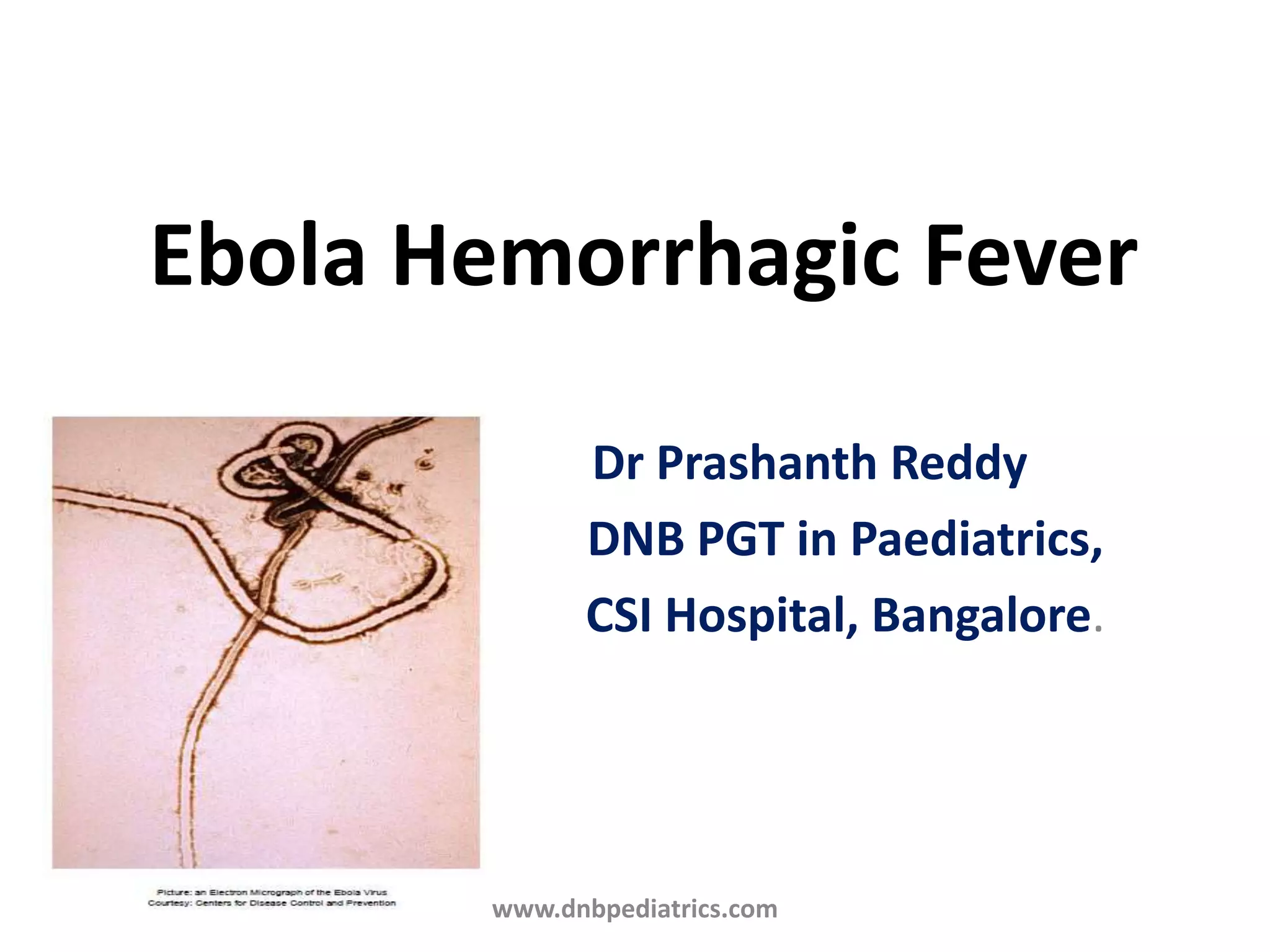
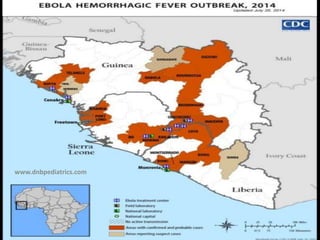
Ebola Hemorrhagic Fever
Dr Prashanth Reddy
DNB PGT in Paediatrics,
CSI Hospital, Bangalore.
www.dnbpediatrics.com
Ebola Hemorrhagic Fever
• Ebola HF is a severe, often-fatal disease in
humans and nonhuman primates (monkeys,
gorillas, and chimpanzees).
• Initial recognition in 1976.
• Caused by infection with Ebola virus, named
after a river in the Democratic Republic of the
Congo (formerly Zaire) in Africa, where it was
first recognized.
www.dnbpediatrics.com
• Ebola virus is a RNA virus and belongs to
family Filoviridae.
• Five identified subtypes of Ebola virus.
• Four of the five have caused disease in
humans: Ebola-Zaire,
Ebola-Sudan,
Ebola-Ivory Coast and
Ebola- Bundibugyo.
• The fifth, Ebola-Reston, has caused disease in
nonhuman primates, but not in humans.
www.dnbpediatrics.com
Origin of Virus
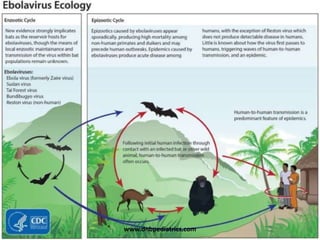
• The origin of the virus is unknown.
• Fruit bats (Pteropodidae) are considered the
likely host of the Ebola virus, based on
available evidence.
www.dnbpediatrics.com
How do people become infected with
the virus?
• Ebola is introduced into the human population
through close contact with the blood,
secretions, organs or other bodily fluids of
infected animals.
• Through the handling of infected
chimpanzees, gorillas, fruit bats, monkeys,
forest antelope and porcupines found ill or
dead or in the rainforest.
www.dnbpediatrics.com
• It is important to reduce contact with high-risk
animals including not picking up dead animals
found lying in the forest or handling their raw
meat.
www.dnbpediatrics.com
• Once a person comes into contact with an
animal that has Ebola, it can spread within the
community from human to human.
• Infection occurs from direct contact (through
broken skin or mucous membranes) with the
blood, or other bodily fluids or secretions
(stool, urine, saliva, semen) of infected
people.
www.dnbpediatrics.com
• Infection can also occur if broken skin or
mucous membranes of a healthy person come
into contact with environments that have
become contaminated with an Ebola patient’s
infectious fluids such as soiled clothing, bed
linen, or used needles.
www.dnbpediatrics.com
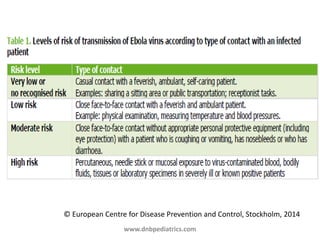
© European Centre for Disease Prevention and Control, Stockholm, 2014
www.dnbpediatrics.com
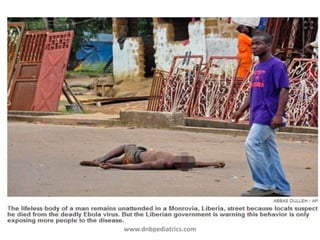
Who is most at risk?
During an outbreak, those at higher risk of infection
are:
• Health workers.
• Family members or others in close contact with
infected people.
• Mourners who have direct contact with the
bodies of the deceased as part of burial
ceremonies.
• Hunters in the rain forest who come into contact
with dead animals found lying in the forest.
www.dnbpediatrics.com
Incubation period
• Symptoms may appear anywhere from 2 to 21
days after exposure to ebolavirus though 8-10
days is most common.
• Not infective before the incubation period.
www.dnbpediatrics.com
Signs and symptoms
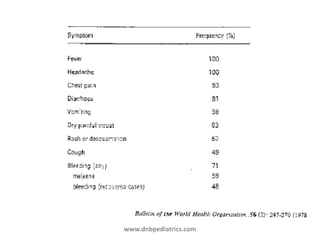
Symptoms of Ebola HF typically include:
• Fever
• Headache
• Joint and muscle aches
• Weakness
• Diarrhoea
• Vomiting
• Stomach pain
• Lack of appetite
www.dnbpediatrics.com
Some patients may experience-
• A rash
• red eyes
• Hiccups
• Cough
• Sore throat
• Chest pain
• Difficulty breathing
• Difficulty swallowing
• Bleeding inside and outside of the body
www.dnbpediatrics.com
• Health workers have frequently been exposed
to the virus when caring for Ebola patients.
• Burial ceremonies.
• People are infectious as long as their blood
and secretions contain the virus.
• Men who have recovered from the illness can
still spread the virus to their partner through
their semen for up to 7 weeks after recovery.
www.dnbpediatrics.com
• Abrupt onset of fever and chills with myalgia,
malaise, and headache.
• Multisystem involvement follows that includes
prostration; nausea, vomiting, abdominal pain,
diarrhea and pancreatitis; chest pain, cough, and
pharyngitis; vascular and neurologic
manifestations.
• Around Day 5, most patients develop a
maculopapular rash that is prominent on the
trunk followed by desquamation in survivors.
www.dnbpediatrics.com
• Central nervous system involvement is often
manifested by somnolence, delirium, or coma.
• Bleeding manifestations, such as petechiae and
haemorrhages, occur in half or more of the patients.
• During the second week, the patient defervesces and
improves markedly or dies in shock with multiorgan
dysfunction, often accompanied by DIC, anuria, and
liver failure.
• Convalescence may be protracted and accompanied by
arthralgia, orchitis, recurrent hepatitis, transverse
myelitis, psychosocial disturbances, or uvéites.
www.dnbpediatrics.com
Mortality
Ebola Sudan subtype: ~50%;
Ebola Zaire subtype: ~80-90%.
www.dnbpediatrics.com
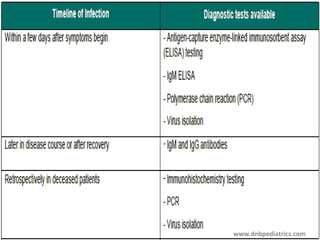
Diagnosis
• Diagnosing Ebola HF in an individual is difficult,
because the early symptoms, are nonspecific to
ebolavirus infection and are seen often in
patients with more commonly occurring diseases.
• However, if a person has the early symptoms of
Ebola HF and there is reason to believe that Ebola
HF should be considered, the patient should be
isolated and public health professionals notified.
• Samples from the patient can then be collected
and tested to confirm infection.
www.dnbpediatrics.com
Treatment
• Any cases of persons who are suspected to
have the disease should be reported to the
nearest health unit without delay.
• Prompt medical care is essential to improving
the rate of survival from the disease.
• It is also important to control spread of the
disease and infection control procedures need
to be started immediately.
www.dnbpediatrics.com
Standard treatment for Ebola HF is still limited
to supportive therapy. This consists of:
• balancing the patient’s fluids and electrolytes
• maintaining their oxygen status and blood
pressure
• treating them for any complicating infections
www.dnbpediatrics.com
• Ebola HF may be initially misdiagnosed.
• Supportive therapy can continue with proper
protective clothing until samples from the
patient are tested to confirm infection.
www.dnbpediatrics.com
Ways to prevent infection and
transmission
• Understand the nature of the disease, how it is
transmitted, and how to prevent it from
spreading further.
• Listen to and follow directives issued by your
country’s respective Ministry of Health.
• If you suspect someone close to you or in your
community of having Ebola virus disease,
encourage and support them in seeking
appropriate medical treatment in a care facility.
www.dnbpediatrics.com
• If you choose to care for an ill person in your home,
notify public health officials of your intentions so they
can train you and provide appropriate gloves and
personal protective equipment (PPE), as well as
instructions.
• Hand washing with soap and water is recommended
after touching a patient, being in contact with their
bodily fluids, or touching his/her surroundings.
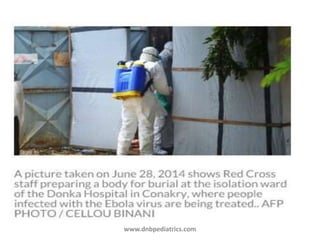
• People who have died from Ebola should only be
handled using appropriate protective equipment and
should be buried immediately
www.dnbpediatrics.com
Health workers protection
• In addition to standard health-care precautions,
health workers should strictly apply
recommended infection control measures to
avoid exposure.
• They should use personal protection equipment
such as individual gowns, gloves, masks and
goggles or face shields.
• They should use personal protective equipment
such as individual gowns, gloves, masks and
goggles or face shields.
www.dnbpediatrics.com
• They should not reuse protective equipment or
clothing unless they have been properly
disinfected.
• They should change gloves between caring for
each patient suspected of having Ebola.
• Invasive procedures that can expose medical
doctors, nurses and others to infection should be
carried out under strict, safe conditions.
• Infected patients should be kept separate from
other patients and healthy people, as much as
possible.
www.dnbpediatrics.com
WHO actions include:
• disease surveillance and information-sharing
across regions to watch for outbreaks.
• technical assistance to investigate and
contain health threats when they occur – such
as on-site help to identify sick people and
track disease patterns.
• advice on prevention and treatment options.
www.dnbpediatrics.com
• Deployments of experts and the distribution of
health supplies (such as personal protection gear
for health workers) when they are requested by
the country.
• Communications to raise awareness of the nature
of the disease and protective health measures to
control transmission of the virus.
• Activation of regional and global networks of
experts to provide assistance, if requested, and
mitigate potential international health effects and
disruptions of travel and trade.
www.dnbpediatrics.com
WHO’s general travel advice
• Travellers should avoid all contact with infected
patients.
• Health workers travelling to affected areas should
strictly follow WHO-recommended infection control
guidance.
• Anyone who has stayed in areas where cases were
recently reported should be aware of the symptoms of
infection and seek medical attention at the first sign of
illness.
• Clinicians caring for travellers returning from affected
areas with compatible symptoms are advised to
consider the possibility of Ebola virus disease.
www.dnbpediatrics.com

Ebl

  • 1.
    Ebola Hemorrhagic Fever DrPrashanth Reddy DNB PGT in Paediatrics, CSI Hospital, Bangalore. www.dnbpediatrics.com
  • 2.
  • 3.
  • 4.
  • 5.
    Ebola Hemorrhagic Fever •Ebola HF is a severe, often-fatal disease in humans and nonhuman primates (monkeys, gorillas, and chimpanzees). • Initial recognition in 1976. • Caused by infection with Ebola virus, named after a river in the Democratic Republic of the Congo (formerly Zaire) in Africa, where it was first recognized. www.dnbpediatrics.com
  • 6.
    • Ebola virusis a RNA virus and belongs to family Filoviridae. • Five identified subtypes of Ebola virus. • Four of the five have caused disease in humans: Ebola-Zaire, Ebola-Sudan, Ebola-Ivory Coast and Ebola- Bundibugyo. • The fifth, Ebola-Reston, has caused disease in nonhuman primates, but not in humans. www.dnbpediatrics.com
  • 7.
  • 8.
  • 9.
    Origin of Virus •The origin of the virus is unknown. • Fruit bats (Pteropodidae) are considered the likely host of the Ebola virus, based on available evidence. www.dnbpediatrics.com
  • 10.
    How do peoplebecome infected with the virus? • Ebola is introduced into the human population through close contact with the blood, secretions, organs or other bodily fluids of infected animals. • Through the handling of infected chimpanzees, gorillas, fruit bats, monkeys, forest antelope and porcupines found ill or dead or in the rainforest. www.dnbpediatrics.com
  • 11.
    • It isimportant to reduce contact with high-risk animals including not picking up dead animals found lying in the forest or handling their raw meat. www.dnbpediatrics.com
  • 12.
    • Once aperson comes into contact with an animal that has Ebola, it can spread within the community from human to human. • Infection occurs from direct contact (through broken skin or mucous membranes) with the blood, or other bodily fluids or secretions (stool, urine, saliva, semen) of infected people. www.dnbpediatrics.com
  • 13.
    • Infection canalso occur if broken skin or mucous membranes of a healthy person come into contact with environments that have become contaminated with an Ebola patient’s infectious fluids such as soiled clothing, bed linen, or used needles. www.dnbpediatrics.com
  • 14.
  • 15.
    © European Centrefor Disease Prevention and Control, Stockholm, 2014 www.dnbpediatrics.com
  • 16.
    Who is mostat risk? During an outbreak, those at higher risk of infection are: • Health workers. • Family members or others in close contact with infected people. • Mourners who have direct contact with the bodies of the deceased as part of burial ceremonies. • Hunters in the rain forest who come into contact with dead animals found lying in the forest. www.dnbpediatrics.com
  • 17.
  • 18.
    Incubation period • Symptomsmay appear anywhere from 2 to 21 days after exposure to ebolavirus though 8-10 days is most common. • Not infective before the incubation period. www.dnbpediatrics.com
  • 19.
    Signs and symptoms Symptomsof Ebola HF typically include: • Fever • Headache • Joint and muscle aches • Weakness • Diarrhoea • Vomiting • Stomach pain • Lack of appetite www.dnbpediatrics.com
  • 20.
    Some patients mayexperience- • A rash • red eyes • Hiccups • Cough • Sore throat • Chest pain • Difficulty breathing • Difficulty swallowing • Bleeding inside and outside of the body www.dnbpediatrics.com
  • 21.
  • 22.
    • Health workershave frequently been exposed to the virus when caring for Ebola patients. • Burial ceremonies. • People are infectious as long as their blood and secretions contain the virus. • Men who have recovered from the illness can still spread the virus to their partner through their semen for up to 7 weeks after recovery. www.dnbpediatrics.com
  • 23.
    • Abrupt onsetof fever and chills with myalgia, malaise, and headache. • Multisystem involvement follows that includes prostration; nausea, vomiting, abdominal pain, diarrhea and pancreatitis; chest pain, cough, and pharyngitis; vascular and neurologic manifestations. • Around Day 5, most patients develop a maculopapular rash that is prominent on the trunk followed by desquamation in survivors. www.dnbpediatrics.com
  • 24.
    • Central nervoussystem involvement is often manifested by somnolence, delirium, or coma. • Bleeding manifestations, such as petechiae and haemorrhages, occur in half or more of the patients. • During the second week, the patient defervesces and improves markedly or dies in shock with multiorgan dysfunction, often accompanied by DIC, anuria, and liver failure. • Convalescence may be protracted and accompanied by arthralgia, orchitis, recurrent hepatitis, transverse myelitis, psychosocial disturbances, or uvéites. www.dnbpediatrics.com
  • 25.
    Mortality Ebola Sudan subtype:~50%; Ebola Zaire subtype: ~80-90%. www.dnbpediatrics.com
  • 26.
    Diagnosis • Diagnosing EbolaHF in an individual is difficult, because the early symptoms, are nonspecific to ebolavirus infection and are seen often in patients with more commonly occurring diseases. • However, if a person has the early symptoms of Ebola HF and there is reason to believe that Ebola HF should be considered, the patient should be isolated and public health professionals notified. • Samples from the patient can then be collected and tested to confirm infection. www.dnbpediatrics.com
  • 27.
  • 28.
    Treatment • Any casesof persons who are suspected to have the disease should be reported to the nearest health unit without delay. • Prompt medical care is essential to improving the rate of survival from the disease. • It is also important to control spread of the disease and infection control procedures need to be started immediately. www.dnbpediatrics.com
  • 29.
    Standard treatment forEbola HF is still limited to supportive therapy. This consists of: • balancing the patient’s fluids and electrolytes • maintaining their oxygen status and blood pressure • treating them for any complicating infections www.dnbpediatrics.com
  • 30.
    • Ebola HFmay be initially misdiagnosed. • Supportive therapy can continue with proper protective clothing until samples from the patient are tested to confirm infection. www.dnbpediatrics.com
  • 31.
    Ways to preventinfection and transmission • Understand the nature of the disease, how it is transmitted, and how to prevent it from spreading further. • Listen to and follow directives issued by your country’s respective Ministry of Health. • If you suspect someone close to you or in your community of having Ebola virus disease, encourage and support them in seeking appropriate medical treatment in a care facility. www.dnbpediatrics.com
  • 32.
    • If youchoose to care for an ill person in your home, notify public health officials of your intentions so they can train you and provide appropriate gloves and personal protective equipment (PPE), as well as instructions. • Hand washing with soap and water is recommended after touching a patient, being in contact with their bodily fluids, or touching his/her surroundings. • People who have died from Ebola should only be handled using appropriate protective equipment and should be buried immediately www.dnbpediatrics.com
  • 33.
  • 34.
    Health workers protection •In addition to standard health-care precautions, health workers should strictly apply recommended infection control measures to avoid exposure. • They should use personal protection equipment such as individual gowns, gloves, masks and goggles or face shields. • They should use personal protective equipment such as individual gowns, gloves, masks and goggles or face shields. www.dnbpediatrics.com
  • 35.
    • They shouldnot reuse protective equipment or clothing unless they have been properly disinfected. • They should change gloves between caring for each patient suspected of having Ebola. • Invasive procedures that can expose medical doctors, nurses and others to infection should be carried out under strict, safe conditions. • Infected patients should be kept separate from other patients and healthy people, as much as possible. www.dnbpediatrics.com
  • 36.
    WHO actions include: •disease surveillance and information-sharing across regions to watch for outbreaks. • technical assistance to investigate and contain health threats when they occur – such as on-site help to identify sick people and track disease patterns. • advice on prevention and treatment options. www.dnbpediatrics.com
  • 37.
    • Deployments ofexperts and the distribution of health supplies (such as personal protection gear for health workers) when they are requested by the country. • Communications to raise awareness of the nature of the disease and protective health measures to control transmission of the virus. • Activation of regional and global networks of experts to provide assistance, if requested, and mitigate potential international health effects and disruptions of travel and trade. www.dnbpediatrics.com
  • 38.
    WHO’s general traveladvice • Travellers should avoid all contact with infected patients. • Health workers travelling to affected areas should strictly follow WHO-recommended infection control guidance. • Anyone who has stayed in areas where cases were recently reported should be aware of the symptoms of infection and seek medical attention at the first sign of illness. • Clinicians caring for travellers returning from affected areas with compatible symptoms are advised to consider the possibility of Ebola virus disease. www.dnbpediatrics.com
  • 39.