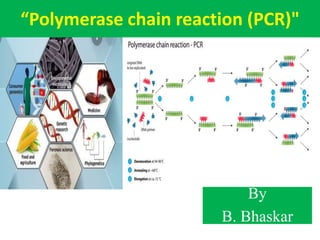
“Polymerase chain reaction (PCR)"
By
B. Bhaskar
Introduction
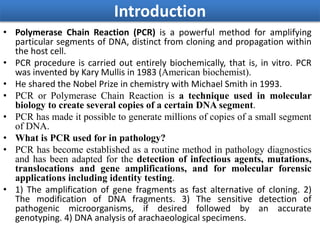
• Polymerase Chain Reaction (PCR) is a powerful method for amplifying
particular segments of DNA, distinct from cloning and propagation within
the host cell.
• PCR procedure is carried out entirely biochemically, that is, in vitro. PCR
was invented by Kary Mullis in 1983 (American biochemist).
• He shared the Nobel Prize in chemistry with Michael Smith in 1993.
• PCR or Polymerase Chain Reaction is a technique used in molecular
biology to create several copies of a certain DNA segment.
• PCR has made it possible to generate millions of copies of a small segment
of DNA.
• What is PCR used for in pathology?
• PCR has become established as a routine method in pathology diagnostics
and has been adapted for the detection of infectious agents, mutations,
translocations and gene amplifications, and for molecular forensic
applications including identity testing.
• 1) The amplification of gene fragments as fast alternative of cloning. 2)
The modification of DNA fragments. 3) The sensitive detection of
pathogenic microorganisms, if desired followed by an accurate
genotyping. 4) DNA analysis of arachaeological specimens.
Principle of PCR
• Principle of PCR
• PCR uses the enzyme DNA polymerase that directs the synthesis of DNA from
deoxynucleotide substrates on a single-stranded DNA template.
• DNA polymerase adds nucleotides to the 3` end of a custom-designed oligonucleotide when
it is annealed to a longer template DNA.
• Thus, if a synthetic oligonucleotide is annealed to a single-stranded template that contains a
region complementary to the oligonucleotide, DNA polymerase can use the oligonucleotide
as a primer and elongate its 3` end to generate an extended region of double stranded DNA.
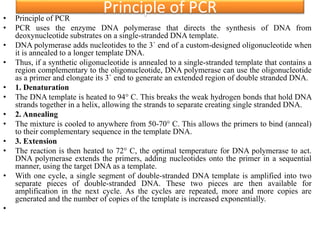
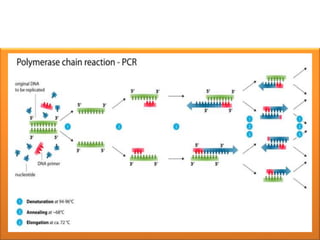
• 1. Denaturation
• The DNA template is heated to 94° C. This breaks the weak hydrogen bonds that hold DNA
strands together in a helix, allowing the strands to separate creating single stranded DNA.
• 2. Annealing
• The mixture is cooled to anywhere from 50-70° C. This allows the primers to bind (anneal)
to their complementary sequence in the template DNA.
• 3. Extension
• The reaction is then heated to 72° C, the optimal temperature for DNA polymerase to act.
DNA polymerase extends the primers, adding nucleotides onto the primer in a sequential
manner, using the target DNA as a template.
• With one cycle, a single segment of double-stranded DNA template is amplified into two
separate pieces of double-stranded DNA. These two pieces are then available for
amplification in the next cycle. As the cycles are repeated, more and more copies are
generated and the number of copies of the template is increased exponentially.
•
• What is the principle of PCR?
• Its principle is based on the use of DNA polymerase which is an in vitro replication
of specific DNA sequences.
• This method can generate tens of billions of copies of a particular DNA fragment (the
sequence of interest, DNA of interest, or target DNA) from a DNA extract (DNA
template).
• What are the 5 components of PCR?
In general, a complete PCR reaction requires five basic PCR reagents; DNA/RNA template,
DNA polymerase, primers (forward and reverse), deoxynucleotide triphosphates
(dNTPs) and PCR buffers.
• What are the types of PCR?
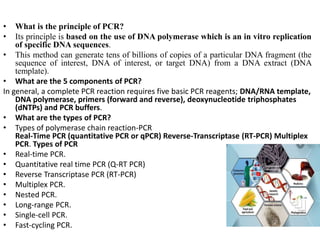
• Types of polymerase chain reaction-PCR
Real-Time PCR (quantitative PCR or qPCR) Reverse-Transcriptase (RT-PCR) Multiplex
PCR. Types of PCR
• Real-time PCR.
• Quantitative real time PCR (Q-RT PCR)
• Reverse Transcriptase PCR (RT-PCR)
• Multiplex PCR.
• Nested PCR.
• Long-range PCR.
• Single-cell PCR.
• Fast-cycling PCR.
Types of PCR
1. Real-time PCR
2. Quantitative real time PCR (Q-RT PCR)
3. Reverse Transcriptase PCR (RT-PCR)
4. Multiplex PCR
5. Nested PCR
6. Long-range PCR
7. Single-cell PCR
8. Fast-cycling PCR
9. Methylation-specific PCR (MSP)
10. Hot start PCR
11. High-fidelity PCR
12. In situ PCR
13. Variable Number of Tandem Repeats (VNTR) PCR
14. Asymmetric PCR
15. Repetitive sequence-based PCR
16. Overlap extension PCR
17. Assemble PCR
18. Intersequence-specific PCR(ISSR)
19. Ligation-mediated PCR
20. Methylation –specific PCR
21. Miniprimer PCR
22. Solid phase PCR
23. Touch down PCR, etc
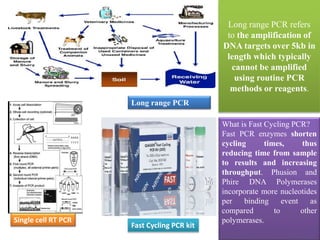
Long range PCR refers
to the amplification of
DNA targets over 5kb in
length which typically
cannot be amplified
using routine PCR
methods or reagents.
Single cell RT PCR
Fast Cycling PCR kit
What is Fast Cycling PCR?
Fast PCR enzymes shorten
cycling times, thus
reducing time from sample
to results and increasing
throughput. Phusion and
Phire DNA Polymerases
incorporate more nucleotides
per binding event as
compared to other
polymerases.
Long range PCR
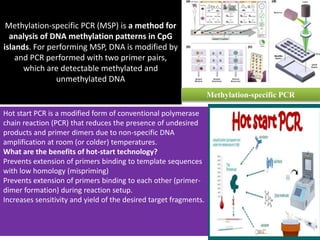
Methylation-specific PCR (MSP) is a method for
analysis of DNA methylation patterns in CpG
islands. For performing MSP, DNA is modified by
and PCR performed with two primer pairs,
which are detectable methylated and
unmethylated DNA
Methylation-specific PCR
Hot start PCR is a modified form of conventional polymerase
chain reaction (PCR) that reduces the presence of undesired
products and primer dimers due to non-specific DNA
amplification at room (or colder) temperatures.
What are the benefits of hot-start technology?
Prevents extension of primers binding to template sequences
with low homology (mispriming)
Prevents extension of primers binding to each other (primer-
dimer formation) during reaction setup.
Increases sensitivity and yield of the desired target fragments.
High-fidelity PCR enzymes
are used for applications
requiring high accuracy
during DNA amplification
such as cloning,
sequencing or
mutagenesis. Thermo
Scientific Phusion high-
fidelity DNA polymerases
were created by fusing a
dsDNA-binding domain to
a Pyrococcus
polymerase–like
proofreading enzyme
https://youtu.be/-
UP5A08UOQE
In Situ RT Polymerase Chain Reaction (In Situ RT-
PCR) is a powerful method that detects minute
quantities of rare or single-copy number nucleic
acid sequences in frozen or paraffin-embedded
cells or tissue sections for the localization of those
sequences within the cells.
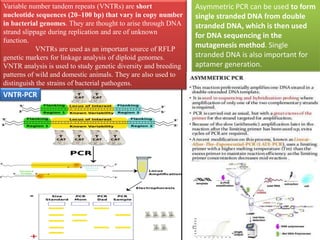
Variable number tandem repeats (VNTRs) are short
nucleotide sequences (20–100 bp) that vary in copy number
in bacterial genomes. They are thought to arise through DNA
strand slippage during replication and are of unknown
function.
VNTRs are used as an important source of RFLP
genetic markers for linkage analysis of diploid genomes.
VNTR analysis is used to study genetic diversity and breeding
patterns of wild and domestic animals. They are also used to
distinguish the strains of bacterial pathogens.
VNTR-PCR
Asymmetric PCR can be used to form
single stranded DNA from double
stranded DNA, which is then used
for DNA sequencing in the
mutagenesis method. Single
stranded DNA is also important for
aptamer generation.
• Repetitive element sequence-based
PCR (rep-PCR) is a new typing method
that differentiates microbes by using
primers complementary to interspersed
repetitive consensus sequences that
enable amplification of diverse-sized
DNA fragments consisting of sequences
between the repetitive elements (16,
25, 26, 28)
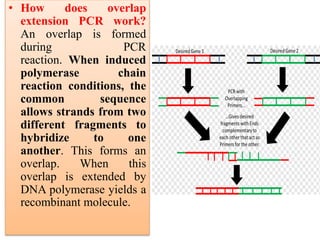
• How does overlap
extension PCR work?
An overlap is formed
during PCR
reaction. When induced
polymerase chain
reaction conditions, the
common sequence
allows strands from two
different fragments to
hybridize to one
another. This forms an
overlap. When this
overlap is extended by
DNA polymerase yields a
recombinant molecule.
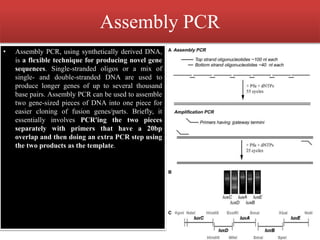
Assembly PCR
• Assembly PCR, using synthetically derived DNA,
is a flexible technique for producing novel gene
sequences. Single-stranded oligos or a mix of
single- and double-stranded DNA are used to
produce longer genes of up to several thousand
base pairs. Assembly PCR can be used to assemble
two gene-sized pieces of DNA into one piece for
easier cloning of fusion genes/parts. Briefly, it
essentially involves PCR'ing the two pieces
separately with primers that have a 20bp
overlap and then doing an extra PCR step using
the two products as the template.
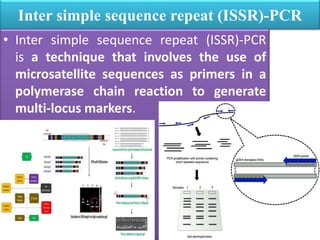
Inter simple sequence repeat (ISSR)-PCR
• Inter simple sequence repeat (ISSR)-PCR
is a technique that involves the use of
microsatellite sequences as primers in a
polymerase chain reaction to generate
multi-locus markers.
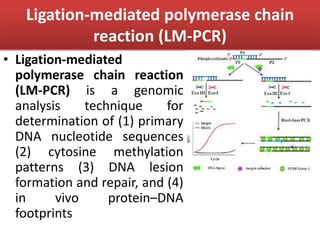
Ligation-mediated polymerase chain
reaction (LM-PCR)
• Ligation-mediated
polymerase chain reaction
(LM-PCR) is a genomic
analysis technique for
determination of (1) primary
DNA nucleotide sequences
(2) cytosine methylation
patterns (3) DNA lesion
formation and repair, and (4)
in vivo protein–DNA
footprints
Methylation-specific PCR (MSP)
• Methylation-specific PCR (MSP) is a
method for analysis of DNA
methylation patterns in CpG islands.
For performing MSP, DNA is modified
by and PCR performed with two primer
pairs, which are detectable methylated
and unmethylated DNA.
• The basic principle of MSP is
the specific PCR amplification of
bisulfite-converted DNA. Treatment of
genomic DNA with sodium bisulfite
results in the conversion of
unmethylated cytosines into uracil in
the DNA sample, while methylated
cytosines are resistant to this
modification and remain unchanged.
Miniprimer PCR
• Miniprimer PCR amplified a
greater proportion than did
standard primers of
sequences that were novel
or that poorly matched a
database of previously
isolated 16S rRNA gene
sequences. This confirmed a
prediction based on a
computational search of the
NCBI environmental
sequence database
Solid-phase PCR (SP-PCR)
• Solid-phase PCR (SP-PCR)
has attracted
considerable interest in
different research fields
since it allows parallel
DNA amplification on
the surface of a solid
substrate. However, the
applications of SP-PCR
have been hampered by
the low efficiency of the
solid-phase amplification.
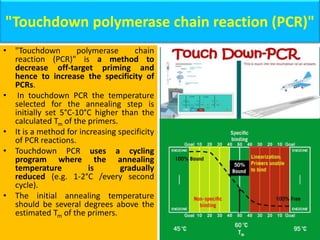
"Touchdown polymerase chain reaction (PCR)"
• "Touchdown polymerase chain
reaction (PCR)" is a method to
decrease off-target priming and
hence to increase the specificity of
PCRs.
• In touchdown PCR the temperature
selected for the annealing step is
initially set 5°C-10°C higher than the
calculated Tm of the primers.
• It is a method for increasing specificity
of PCR reactions.
• Touchdown PCR uses a cycling
program where the annealing
temperature is gradually
reduced (e.g. 1-2°C /every second
cycle).
• The initial annealing temperature
should be several degrees above the
estimated Tm of the primers.
Applications of PCR
A. PCR is used in analyzing clinical specimens for the presence of infectious
agents, including HIV, hepatitis, malaria, anthrax, etc.
B. PCR can provide information on a patient’s prognosis, and predict response or
resistance to therapy. Many cancers are characterized by small mutations in
certain genes, and this is what PCR is employed to identify.
C. PCR is used in the analysis of mutations that occur in many genetic diseases
(e.g. cystic fibrosis, sickle cell anaemia, phenylketonuria, muscular
dystrophy).
D. PCR is also used in forensics laboratories and is especially useful because
only a tiny amount of original DNA is required, for example, sufficient DNA
can be obtained from a droplet of blood or a single hair.
E. PCR is an essential technique in cloning procedure which allows generation of
large amounts of pure DNA from tiny amount of template strand and further
study of a particular gene.
F. The Human Genome Project (HGP) for determining the sequence of the 3
billion base pairs in the human genome, relied heavily on PCR.
G. PCR has been used to identify and to explore relationships among species in
the field of evolutionary biology. In anthropology, it is also used to understand
the ancient human migration patterns. In archaeology, it has been used to spot
the ancient human race. PCR commonly used by Paleontologists to amplify
DNA from extinct species or cryopreserved fossils of millions years and thus
can be further studied to elucidate on.
References
1) https://www.google.com/search?q=PCR+in+application+pathology&oq=PCR++in+application+pathology&aqs=chrome..69i57j0i22i30j0i390l2.23542j1j15&sourceid=chrome&ie=UTF-
8#imgrc=7KvApONzU3idBM
2) https://microbiologyinfo.com/polymerase-chain-reaction-pcr-principle-procedure-types-applications-and-animation/
3) https://microbiologyinfo.com/polymerase-chain-reaction-pcr-principle-procedure-types-applications-and-animation/
4) https://www.google.com/search?q=Quantitative+real+time+PCR+(Q-RT+PCR)&tbm=isch&ved=2ahUKEwix1Zzs_OP5AhVXj9gFHXshC0cQ2-cCegQIABAA&oq=Quantitative+real+time+PCR+(Q-
RT+PCR)&gs_lcp=CgNpbWcQAzIGCAAQChAYOgQIIxAnOgUIABCABDoECAAQQ1D2DVj2DWCSFWgAcAB4AIABXogBtQGSAQEymAEAoAEBqgELZ3dzLXdpei1pbWe4AQPAAQE&sclient=img&ei=JXUIY_GuLde
e4t4P-8KsuAQ&bih=625&biw=1366#imgrc=hwvNE8gmlCQXGM&imgdii=CAa5-rBiGhYaiM
5) https://www.google.com/search?q=Reverse+Transcriptase+PCR+(RT-PCR)&tbm=isch&ved=2ahUKEwiQ_faQ_eP5AhWcyKACHcIABPcQ2-cCegQIABAA&oq=Reverse+Transcriptase+PCR+(RT-
PCR)&gs_lcp=CgNpbWcQAzIECAAQGDoGCAAQChAYOgQIIxAnOgcIIxDqAhAnUN0LWMgfYJYjaAFwAHgDgAGeAYgBiRiSAQQyNi43mAEAoAEBqgELZ3dzLXdpei1pbWewAQq4AQPAAQE&sclient=img&ei=cnU
IY5D8K5yRg8UPwoGQuA8&bih=625&biw=1366#imgrc=p-sjo5weNSgsfM&imgdii=Nyid_L4vppuzYM
6) https://www.google.com/search?q=Reverse+Transcriptase+PCR+(RT-PCR)&tbm=isch&ved=2ahUKEwiQ_faQ_eP5AhWcyKACHcIABPcQ2-cCegQIABAA&oq=Reverse+Transcriptase+PCR+(RT-
PCR)&gs_lcp=CgNpbWcQAzIECAAQGDoGCAAQChAYOgQIIxAnOgcIIxDqAhAnUN0LWMgfYJYjaAFwAHgDgAGeAYgBiRiSAQQyNi43mAEAoAEBqgELZ3dzLXdpei1pbWewAQq4AQPAAQE&sclient=img&ei=cnU
IY5D8K5yRg8UPwoGQuA8&bih=625&biw=1366#imgrc=Nyid_L4vppuzYM&imgdii=q79XFWH9gIcc0M
7) https://www.google.com/search?q=Reverse+Transcriptase+PCR+(RT-PCR)&tbm=isch&ved=2ahUKEwiQ_faQ_eP5AhWcyKACHcIABPcQ2-cCegQIABAA&oq=Reverse+Transcriptase+PCR+(RT-
PCR)&gs_lcp=CgNpbWcQAzIECAAQGDoGCAAQChAYOgQIIxAnOgcIIxDqAhAnUN0LWMgfYJYjaAFwAHgDgAGeAYgBiRiSAQQyNi43mAEAoAEBqgELZ3dzLXdpei1pbWewAQq4AQPAAQE&sclient=img&ei=cnU
IY5D8K5yRg8UPwoGQuA8&bih=625&biw=1366#imgrc=q79XFWH9gIcc0M&imgdii=juEUgoeW29DHJM
8) https://www.google.com/search?q=Reverse+Transcriptase+PCR+(RT-PCR)&tbm=isch&ved=2ahUKEwiQ_faQ_eP5AhWcyKACHcIABPcQ2-cCegQIABAA&oq=Reverse+Transcriptase+PCR+(RT-
PCR)&gs_lcp=CgNpbWcQAzIECAAQGDoGCAAQChAYOgQIIxAnOgcIIxDqAhAnUN0LWMgfYJYjaAFwAHgDgAGeAYgBiRiSAQQyNi43mAEAoAEBqgELZ3dzLXdpei1pbWewAQq4AQPAAQE&sclient=img&ei=cnU
IY5D8K5yRg8UPwoGQuA8&bih=625&biw=1366#imgrc=juEUgoeW29DHJM&imgdii=fDccr8ocSovhDM
9) https://www.google.com/search?q=Fast-cycling+PCR&&tbm=isch&ved=2ahUKEwi8oujY1-T5AhWXKbcAHSLhDR8Q2-cCegQIABAA&oq=Fast-
cycling+PCR&gs_lcp=CgNpbWcQAzIECAAQHjoECCMQJzoECAAQGDoGCAAQHhAIOgcIIxDqAhAnUIgHWMtrYMlyaAJwAHgCgAF1iAGdCpIBBDEyLjOYAQCgAQGqAQtnd3Mtd2l6LWltZ7ABCrgBA8ABAQ&sclie
nt=img&ei=aNQIY7zOKJfT3LUPosK3-AE&bih=625&biw=1366#imgrc=LDjo3g2VGqDS0M
10) https://www.google.com/search?q=in+situ+pcr&hl=en&sxsrf=ALiCzsZRPt0yfPNVOxNz9CM_3NT4IuS1Ig:1661597432960&source=lnms&tbm=isch&sa=X&ved=2ahUKEwiXgYHm7Ob5AhWvxHMBHapZDr
UQ_AUoAXoECAEQAw&biw=1366&bih=625&dpr=1#imgrc=mtRzkiwYsvB2rM
11) https://www.google.com/search?q=Variable+Number+of+Tandem+Repeats+(VNTR)+PCR&tbm=isch&ved=2ahUKEwjzyvqX7eb5AhV8gGMGHXauD5UQ2-
cCegQIABAA&oq=Variable+Number+of+Tandem+Repeats+(VNTR)+PCR&gs_lcp=CgNpbWcQAzIECAAQGDoECCMQJzoFCAAQgAQ6BwgjEOoCECdQ7A1YpR9guCZoAXAAeAOAAZgBiAHaCZIBAzcuNZgBAKAB
AaoBC2d3cy13aXotaW1nsAEKuAEDwAEB&sclient=img&ei=YfcJY7OWK_yAjuMP9ty-qAk&bih=625&biw=1366&hl=en#imgrc=vMjO8DmxQXwL9M
12) https://www.google.com/search?q=Asymmetric+PCR&hl=en&sxsrf=ALiCzsaexFAj5VyIUQ8pWPE9RgnGzQuOKA:1661598575601&source=lnms&tbm=isch&sa=X&ved=2ahUKEwjFnu6G8eb5AhVLUWwGH
Qa2Cw8Q_AUoAXoECAEQAw&biw=1366&bih=625&dpr=1#imgrc=hg3lH0zZyI3mRM
13) https://www.google.com/search?q=Repetitive+sequence-based+PCR&tbm=isch&ved=2ahUKEwiL8a718eb5AhVTgGMGHZNhBlUQ2-cCegQIABAA&oq=Repetitive+sequence-
based+PCR&gs_lcp=CgNpbWcQAzIECAAQGDoECAAQQzoFCAAQgAQ6BggAEB4QBzoGCAAQHhAIOgQIABAeOgQIIxAnOgYIABAeEAU6BwgjEOoCECdQiA1Y5R9gpihoAXAAeAKAAYEBiAGhC5IBBDExLjSYAQCg
AQGqAQtnd3Mtd2l6LWltZ7ABCrgBA8ABAQ&sclient=img&ei=V_wJY8vpFNOAjuMPk8OZqAU&bih=625&biw=1366&hl=en#imgrc=i_INA-STniP9QM
14) https://www.google.com/search?q=Repetitive+sequence-based+PCR&tbm=isch&ved=2ahUKEwiL8a718eb5AhVTgGMGHZNhBlUQ2-cCegQIABAA&oq=Repetitive+sequence-
based+PCR&gs_lcp=CgNpbWcQAzIECAAQGDoECAAQQzoFCAAQgAQ6BggAEB4QBzoGCAAQHhAIOgQIABAeOgQIIxAnOgYIABAeEAU6BwgjEOoCECdQiA1Y5R9gpihoAXAAeAKAAYEBiAGhC5IBBDExLjSYAQCg
AQGqAQtnd3Mtd2l6LWltZ7ABCrgBA8ABAQ&sclient=img&ei=V_wJY8vpFNOAjuMPk8OZqAU&bih=625&biw=1366&hl=en#imgrc=mcdSmLjpmzzpiM&imgdii=pbCuh9_NyekcEM
15) https://www.google.com/search?q=Assemble+PCR&hl=en&sxsrf=ALiCzsYulWSzhDsIYbrGuM66M0IKTMgRGg:1661604058665&source=lnms&tbm=isch&sa=X&ved=2ahUKEwjH7LG9hef5AhU96nMBHZSF
Dt0Q_AUoAnoECAEQBA&biw=1366&bih=625&dpr=1#imgrc=iwvgir3ZyIUf3M
16) https://www.google.com/search?q=Inter+Sequence-
specific+PCR(ISSR)&sxsrf=ALiCzsYySU0YwzeK6Ffbcfvz53bd7ROfsA:1661604407128&source=lnms&tbm=isch&sa=X&ved=2ahUKEwiIscbjhuf5AhXH6XMBHTUjDAsQ_AUoAXoECAEQAw&biw=1366&bih=62
5&dpr=1#imgrc=AWLUPZt_91y4fM&imgdii=V0IwS00ExvPt_M
17) https://www.google.com/search?q=Ligation-mediated+PCR&tbm=isch&ved=2ahUKEwj6spKHh-f5AhXuk9gFHXmNC7cQ2-cCegQIABAA&oq=Ligation-
mediated+PCR&gs_lcp=CgNpbWcQAzIFCAAQgAQ6BAgjECdQhQ9YhQ9ghxhoAHAAeACAAVyIAbYBkgEBMpgBAKABAaoBC2d3cy13aXotaW1nuAEDwAEB&sclient=img&ei=gRIKY7ruLu6n4t4P-
ZquuAs&bih=625&biw=1366
18) https://www.google.com/search?q=Methylation+%E2%80%93specific+PCR&hl=en&sxsrf=ALiCzsYWZ6MKFDEVfnVuyNf1XWuXxbyDvQ:1661605263400&source=lnms&tbm=isch&sa=X&ved=2ahUKEwiU
ge37ief5AhUECbcAHYjGC5QQ_AUoAXoECAEQAw&biw=1366&bih=625&dpr=1#imgrc=-ZbWX8tQ0Q80lM
19) https://www.google.com/search?q=Miniprimer+PCR&tbm=isch&ved=2ahUKEwj_xPujiuf5AhXNitgFHZHvA2cQ2-
cCegQIABAA&oq=Miniprimer+PCR&gs_lcp=CgNpbWcQAzIFCAAQgAQ6BAgjECdQgw1Ygw1gkBVoAHAAeACAAXKIAcQBkgEDMS4xmAEAoAEBqgELZ3dzLXdpei1pbWe4AQPAAQE&sclient=img&ei=4xUKY7_
HH82V4t4Pkd-PuAY&bih=625&biw=1366&hl=en#imgrc=mNvjd35CE8EXLM
THANK YOU

PCR applications.pptx

  • 1.
    “Polymerase chain reaction(PCR)" By B. Bhaskar
  • 2.
    Introduction • Polymerase ChainReaction (PCR) is a powerful method for amplifying particular segments of DNA, distinct from cloning and propagation within the host cell. • PCR procedure is carried out entirely biochemically, that is, in vitro. PCR was invented by Kary Mullis in 1983 (American biochemist). • He shared the Nobel Prize in chemistry with Michael Smith in 1993. • PCR or Polymerase Chain Reaction is a technique used in molecular biology to create several copies of a certain DNA segment. • PCR has made it possible to generate millions of copies of a small segment of DNA. • What is PCR used for in pathology? • PCR has become established as a routine method in pathology diagnostics and has been adapted for the detection of infectious agents, mutations, translocations and gene amplifications, and for molecular forensic applications including identity testing. • 1) The amplification of gene fragments as fast alternative of cloning. 2) The modification of DNA fragments. 3) The sensitive detection of pathogenic microorganisms, if desired followed by an accurate genotyping. 4) DNA analysis of arachaeological specimens.
  • 3.
    Principle of PCR •Principle of PCR • PCR uses the enzyme DNA polymerase that directs the synthesis of DNA from deoxynucleotide substrates on a single-stranded DNA template. • DNA polymerase adds nucleotides to the 3` end of a custom-designed oligonucleotide when it is annealed to a longer template DNA. • Thus, if a synthetic oligonucleotide is annealed to a single-stranded template that contains a region complementary to the oligonucleotide, DNA polymerase can use the oligonucleotide as a primer and elongate its 3` end to generate an extended region of double stranded DNA. • 1. Denaturation • The DNA template is heated to 94° C. This breaks the weak hydrogen bonds that hold DNA strands together in a helix, allowing the strands to separate creating single stranded DNA. • 2. Annealing • The mixture is cooled to anywhere from 50-70° C. This allows the primers to bind (anneal) to their complementary sequence in the template DNA. • 3. Extension • The reaction is then heated to 72° C, the optimal temperature for DNA polymerase to act. DNA polymerase extends the primers, adding nucleotides onto the primer in a sequential manner, using the target DNA as a template. • With one cycle, a single segment of double-stranded DNA template is amplified into two separate pieces of double-stranded DNA. These two pieces are then available for amplification in the next cycle. As the cycles are repeated, more and more copies are generated and the number of copies of the template is increased exponentially. •
  • 5.
    • What isthe principle of PCR? • Its principle is based on the use of DNA polymerase which is an in vitro replication of specific DNA sequences. • This method can generate tens of billions of copies of a particular DNA fragment (the sequence of interest, DNA of interest, or target DNA) from a DNA extract (DNA template). • What are the 5 components of PCR? In general, a complete PCR reaction requires five basic PCR reagents; DNA/RNA template, DNA polymerase, primers (forward and reverse), deoxynucleotide triphosphates (dNTPs) and PCR buffers. • What are the types of PCR? • Types of polymerase chain reaction-PCR Real-Time PCR (quantitative PCR or qPCR) Reverse-Transcriptase (RT-PCR) Multiplex PCR. Types of PCR • Real-time PCR. • Quantitative real time PCR (Q-RT PCR) • Reverse Transcriptase PCR (RT-PCR) • Multiplex PCR. • Nested PCR. • Long-range PCR. • Single-cell PCR. • Fast-cycling PCR.
  • 6.
    Types of PCR 1.Real-time PCR 2. Quantitative real time PCR (Q-RT PCR) 3. Reverse Transcriptase PCR (RT-PCR) 4. Multiplex PCR 5. Nested PCR 6. Long-range PCR 7. Single-cell PCR 8. Fast-cycling PCR 9. Methylation-specific PCR (MSP) 10. Hot start PCR 11. High-fidelity PCR 12. In situ PCR 13. Variable Number of Tandem Repeats (VNTR) PCR 14. Asymmetric PCR 15. Repetitive sequence-based PCR 16. Overlap extension PCR 17. Assemble PCR 18. Intersequence-specific PCR(ISSR) 19. Ligation-mediated PCR 20. Methylation –specific PCR 21. Miniprimer PCR 22. Solid phase PCR 23. Touch down PCR, etc
  • 7.
    Long range PCRrefers to the amplification of DNA targets over 5kb in length which typically cannot be amplified using routine PCR methods or reagents. Single cell RT PCR Fast Cycling PCR kit What is Fast Cycling PCR? Fast PCR enzymes shorten cycling times, thus reducing time from sample to results and increasing throughput. Phusion and Phire DNA Polymerases incorporate more nucleotides per binding event as compared to other polymerases. Long range PCR
  • 9.
    Methylation-specific PCR (MSP)is a method for analysis of DNA methylation patterns in CpG islands. For performing MSP, DNA is modified by and PCR performed with two primer pairs, which are detectable methylated and unmethylated DNA Methylation-specific PCR Hot start PCR is a modified form of conventional polymerase chain reaction (PCR) that reduces the presence of undesired products and primer dimers due to non-specific DNA amplification at room (or colder) temperatures. What are the benefits of hot-start technology? Prevents extension of primers binding to template sequences with low homology (mispriming) Prevents extension of primers binding to each other (primer- dimer formation) during reaction setup. Increases sensitivity and yield of the desired target fragments.
  • 10.
    High-fidelity PCR enzymes areused for applications requiring high accuracy during DNA amplification such as cloning, sequencing or mutagenesis. Thermo Scientific Phusion high- fidelity DNA polymerases were created by fusing a dsDNA-binding domain to a Pyrococcus polymerase–like proofreading enzyme https://youtu.be/- UP5A08UOQE In Situ RT Polymerase Chain Reaction (In Situ RT- PCR) is a powerful method that detects minute quantities of rare or single-copy number nucleic acid sequences in frozen or paraffin-embedded cells or tissue sections for the localization of those sequences within the cells.
  • 11.
    Variable number tandemrepeats (VNTRs) are short nucleotide sequences (20–100 bp) that vary in copy number in bacterial genomes. They are thought to arise through DNA strand slippage during replication and are of unknown function. VNTRs are used as an important source of RFLP genetic markers for linkage analysis of diploid genomes. VNTR analysis is used to study genetic diversity and breeding patterns of wild and domestic animals. They are also used to distinguish the strains of bacterial pathogens. VNTR-PCR Asymmetric PCR can be used to form single stranded DNA from double stranded DNA, which is then used for DNA sequencing in the mutagenesis method. Single stranded DNA is also important for aptamer generation.
  • 12.
    • Repetitive elementsequence-based PCR (rep-PCR) is a new typing method that differentiates microbes by using primers complementary to interspersed repetitive consensus sequences that enable amplification of diverse-sized DNA fragments consisting of sequences between the repetitive elements (16, 25, 26, 28)
  • 13.
    • How doesoverlap extension PCR work? An overlap is formed during PCR reaction. When induced polymerase chain reaction conditions, the common sequence allows strands from two different fragments to hybridize to one another. This forms an overlap. When this overlap is extended by DNA polymerase yields a recombinant molecule.
  • 14.
    Assembly PCR • AssemblyPCR, using synthetically derived DNA, is a flexible technique for producing novel gene sequences. Single-stranded oligos or a mix of single- and double-stranded DNA are used to produce longer genes of up to several thousand base pairs. Assembly PCR can be used to assemble two gene-sized pieces of DNA into one piece for easier cloning of fusion genes/parts. Briefly, it essentially involves PCR'ing the two pieces separately with primers that have a 20bp overlap and then doing an extra PCR step using the two products as the template.
  • 15.
    Inter simple sequencerepeat (ISSR)-PCR • Inter simple sequence repeat (ISSR)-PCR is a technique that involves the use of microsatellite sequences as primers in a polymerase chain reaction to generate multi-locus markers.
  • 16.
    Ligation-mediated polymerase chain reaction(LM-PCR) • Ligation-mediated polymerase chain reaction (LM-PCR) is a genomic analysis technique for determination of (1) primary DNA nucleotide sequences (2) cytosine methylation patterns (3) DNA lesion formation and repair, and (4) in vivo protein–DNA footprints
  • 17.
    Methylation-specific PCR (MSP) •Methylation-specific PCR (MSP) is a method for analysis of DNA methylation patterns in CpG islands. For performing MSP, DNA is modified by and PCR performed with two primer pairs, which are detectable methylated and unmethylated DNA. • The basic principle of MSP is the specific PCR amplification of bisulfite-converted DNA. Treatment of genomic DNA with sodium bisulfite results in the conversion of unmethylated cytosines into uracil in the DNA sample, while methylated cytosines are resistant to this modification and remain unchanged.
  • 18.
    Miniprimer PCR • MiniprimerPCR amplified a greater proportion than did standard primers of sequences that were novel or that poorly matched a database of previously isolated 16S rRNA gene sequences. This confirmed a prediction based on a computational search of the NCBI environmental sequence database
  • 19.
    Solid-phase PCR (SP-PCR) •Solid-phase PCR (SP-PCR) has attracted considerable interest in different research fields since it allows parallel DNA amplification on the surface of a solid substrate. However, the applications of SP-PCR have been hampered by the low efficiency of the solid-phase amplification.
  • 20.
    "Touchdown polymerase chainreaction (PCR)" • "Touchdown polymerase chain reaction (PCR)" is a method to decrease off-target priming and hence to increase the specificity of PCRs. • In touchdown PCR the temperature selected for the annealing step is initially set 5°C-10°C higher than the calculated Tm of the primers. • It is a method for increasing specificity of PCR reactions. • Touchdown PCR uses a cycling program where the annealing temperature is gradually reduced (e.g. 1-2°C /every second cycle). • The initial annealing temperature should be several degrees above the estimated Tm of the primers.
  • 21.
    Applications of PCR A.PCR is used in analyzing clinical specimens for the presence of infectious agents, including HIV, hepatitis, malaria, anthrax, etc. B. PCR can provide information on a patient’s prognosis, and predict response or resistance to therapy. Many cancers are characterized by small mutations in certain genes, and this is what PCR is employed to identify. C. PCR is used in the analysis of mutations that occur in many genetic diseases (e.g. cystic fibrosis, sickle cell anaemia, phenylketonuria, muscular dystrophy). D. PCR is also used in forensics laboratories and is especially useful because only a tiny amount of original DNA is required, for example, sufficient DNA can be obtained from a droplet of blood or a single hair. E. PCR is an essential technique in cloning procedure which allows generation of large amounts of pure DNA from tiny amount of template strand and further study of a particular gene. F. The Human Genome Project (HGP) for determining the sequence of the 3 billion base pairs in the human genome, relied heavily on PCR. G. PCR has been used to identify and to explore relationships among species in the field of evolutionary biology. In anthropology, it is also used to understand the ancient human migration patterns. In archaeology, it has been used to spot the ancient human race. PCR commonly used by Paleontologists to amplify DNA from extinct species or cryopreserved fossils of millions years and thus can be further studied to elucidate on.
  • 22.
    References 1) https://www.google.com/search?q=PCR+in+application+pathology&oq=PCR++in+application+pathology&aqs=chrome..69i57j0i22i30j0i390l2.23542j1j15&sourceid=chrome&ie=UTF- 8#imgrc=7KvApONzU3idBM 2) https://microbiologyinfo.com/polymerase-chain-reaction-pcr-principle-procedure-types-applications-and-animation/ 3)https://microbiologyinfo.com/polymerase-chain-reaction-pcr-principle-procedure-types-applications-and-animation/ 4) https://www.google.com/search?q=Quantitative+real+time+PCR+(Q-RT+PCR)&tbm=isch&ved=2ahUKEwix1Zzs_OP5AhVXj9gFHXshC0cQ2-cCegQIABAA&oq=Quantitative+real+time+PCR+(Q- RT+PCR)&gs_lcp=CgNpbWcQAzIGCAAQChAYOgQIIxAnOgUIABCABDoECAAQQ1D2DVj2DWCSFWgAcAB4AIABXogBtQGSAQEymAEAoAEBqgELZ3dzLXdpei1pbWe4AQPAAQE&sclient=img&ei=JXUIY_GuLde e4t4P-8KsuAQ&bih=625&biw=1366#imgrc=hwvNE8gmlCQXGM&imgdii=CAa5-rBiGhYaiM 5) https://www.google.com/search?q=Reverse+Transcriptase+PCR+(RT-PCR)&tbm=isch&ved=2ahUKEwiQ_faQ_eP5AhWcyKACHcIABPcQ2-cCegQIABAA&oq=Reverse+Transcriptase+PCR+(RT- PCR)&gs_lcp=CgNpbWcQAzIECAAQGDoGCAAQChAYOgQIIxAnOgcIIxDqAhAnUN0LWMgfYJYjaAFwAHgDgAGeAYgBiRiSAQQyNi43mAEAoAEBqgELZ3dzLXdpei1pbWewAQq4AQPAAQE&sclient=img&ei=cnU IY5D8K5yRg8UPwoGQuA8&bih=625&biw=1366#imgrc=p-sjo5weNSgsfM&imgdii=Nyid_L4vppuzYM 6) https://www.google.com/search?q=Reverse+Transcriptase+PCR+(RT-PCR)&tbm=isch&ved=2ahUKEwiQ_faQ_eP5AhWcyKACHcIABPcQ2-cCegQIABAA&oq=Reverse+Transcriptase+PCR+(RT- PCR)&gs_lcp=CgNpbWcQAzIECAAQGDoGCAAQChAYOgQIIxAnOgcIIxDqAhAnUN0LWMgfYJYjaAFwAHgDgAGeAYgBiRiSAQQyNi43mAEAoAEBqgELZ3dzLXdpei1pbWewAQq4AQPAAQE&sclient=img&ei=cnU IY5D8K5yRg8UPwoGQuA8&bih=625&biw=1366#imgrc=Nyid_L4vppuzYM&imgdii=q79XFWH9gIcc0M 7) https://www.google.com/search?q=Reverse+Transcriptase+PCR+(RT-PCR)&tbm=isch&ved=2ahUKEwiQ_faQ_eP5AhWcyKACHcIABPcQ2-cCegQIABAA&oq=Reverse+Transcriptase+PCR+(RT- PCR)&gs_lcp=CgNpbWcQAzIECAAQGDoGCAAQChAYOgQIIxAnOgcIIxDqAhAnUN0LWMgfYJYjaAFwAHgDgAGeAYgBiRiSAQQyNi43mAEAoAEBqgELZ3dzLXdpei1pbWewAQq4AQPAAQE&sclient=img&ei=cnU IY5D8K5yRg8UPwoGQuA8&bih=625&biw=1366#imgrc=q79XFWH9gIcc0M&imgdii=juEUgoeW29DHJM 8) https://www.google.com/search?q=Reverse+Transcriptase+PCR+(RT-PCR)&tbm=isch&ved=2ahUKEwiQ_faQ_eP5AhWcyKACHcIABPcQ2-cCegQIABAA&oq=Reverse+Transcriptase+PCR+(RT- PCR)&gs_lcp=CgNpbWcQAzIECAAQGDoGCAAQChAYOgQIIxAnOgcIIxDqAhAnUN0LWMgfYJYjaAFwAHgDgAGeAYgBiRiSAQQyNi43mAEAoAEBqgELZ3dzLXdpei1pbWewAQq4AQPAAQE&sclient=img&ei=cnU IY5D8K5yRg8UPwoGQuA8&bih=625&biw=1366#imgrc=juEUgoeW29DHJM&imgdii=fDccr8ocSovhDM 9) https://www.google.com/search?q=Fast-cycling+PCR&&tbm=isch&ved=2ahUKEwi8oujY1-T5AhWXKbcAHSLhDR8Q2-cCegQIABAA&oq=Fast- cycling+PCR&gs_lcp=CgNpbWcQAzIECAAQHjoECCMQJzoECAAQGDoGCAAQHhAIOgcIIxDqAhAnUIgHWMtrYMlyaAJwAHgCgAF1iAGdCpIBBDEyLjOYAQCgAQGqAQtnd3Mtd2l6LWltZ7ABCrgBA8ABAQ&sclie nt=img&ei=aNQIY7zOKJfT3LUPosK3-AE&bih=625&biw=1366#imgrc=LDjo3g2VGqDS0M 10) https://www.google.com/search?q=in+situ+pcr&hl=en&sxsrf=ALiCzsZRPt0yfPNVOxNz9CM_3NT4IuS1Ig:1661597432960&source=lnms&tbm=isch&sa=X&ved=2ahUKEwiXgYHm7Ob5AhWvxHMBHapZDr UQ_AUoAXoECAEQAw&biw=1366&bih=625&dpr=1#imgrc=mtRzkiwYsvB2rM 11) https://www.google.com/search?q=Variable+Number+of+Tandem+Repeats+(VNTR)+PCR&tbm=isch&ved=2ahUKEwjzyvqX7eb5AhV8gGMGHXauD5UQ2- cCegQIABAA&oq=Variable+Number+of+Tandem+Repeats+(VNTR)+PCR&gs_lcp=CgNpbWcQAzIECAAQGDoECCMQJzoFCAAQgAQ6BwgjEOoCECdQ7A1YpR9guCZoAXAAeAOAAZgBiAHaCZIBAzcuNZgBAKAB AaoBC2d3cy13aXotaW1nsAEKuAEDwAEB&sclient=img&ei=YfcJY7OWK_yAjuMP9ty-qAk&bih=625&biw=1366&hl=en#imgrc=vMjO8DmxQXwL9M 12) https://www.google.com/search?q=Asymmetric+PCR&hl=en&sxsrf=ALiCzsaexFAj5VyIUQ8pWPE9RgnGzQuOKA:1661598575601&source=lnms&tbm=isch&sa=X&ved=2ahUKEwjFnu6G8eb5AhVLUWwGH Qa2Cw8Q_AUoAXoECAEQAw&biw=1366&bih=625&dpr=1#imgrc=hg3lH0zZyI3mRM 13) https://www.google.com/search?q=Repetitive+sequence-based+PCR&tbm=isch&ved=2ahUKEwiL8a718eb5AhVTgGMGHZNhBlUQ2-cCegQIABAA&oq=Repetitive+sequence- based+PCR&gs_lcp=CgNpbWcQAzIECAAQGDoECAAQQzoFCAAQgAQ6BggAEB4QBzoGCAAQHhAIOgQIABAeOgQIIxAnOgYIABAeEAU6BwgjEOoCECdQiA1Y5R9gpihoAXAAeAKAAYEBiAGhC5IBBDExLjSYAQCg AQGqAQtnd3Mtd2l6LWltZ7ABCrgBA8ABAQ&sclient=img&ei=V_wJY8vpFNOAjuMPk8OZqAU&bih=625&biw=1366&hl=en#imgrc=i_INA-STniP9QM 14) https://www.google.com/search?q=Repetitive+sequence-based+PCR&tbm=isch&ved=2ahUKEwiL8a718eb5AhVTgGMGHZNhBlUQ2-cCegQIABAA&oq=Repetitive+sequence- based+PCR&gs_lcp=CgNpbWcQAzIECAAQGDoECAAQQzoFCAAQgAQ6BggAEB4QBzoGCAAQHhAIOgQIABAeOgQIIxAnOgYIABAeEAU6BwgjEOoCECdQiA1Y5R9gpihoAXAAeAKAAYEBiAGhC5IBBDExLjSYAQCg AQGqAQtnd3Mtd2l6LWltZ7ABCrgBA8ABAQ&sclient=img&ei=V_wJY8vpFNOAjuMPk8OZqAU&bih=625&biw=1366&hl=en#imgrc=mcdSmLjpmzzpiM&imgdii=pbCuh9_NyekcEM 15) https://www.google.com/search?q=Assemble+PCR&hl=en&sxsrf=ALiCzsYulWSzhDsIYbrGuM66M0IKTMgRGg:1661604058665&source=lnms&tbm=isch&sa=X&ved=2ahUKEwjH7LG9hef5AhU96nMBHZSF Dt0Q_AUoAnoECAEQBA&biw=1366&bih=625&dpr=1#imgrc=iwvgir3ZyIUf3M 16) https://www.google.com/search?q=Inter+Sequence- specific+PCR(ISSR)&sxsrf=ALiCzsYySU0YwzeK6Ffbcfvz53bd7ROfsA:1661604407128&source=lnms&tbm=isch&sa=X&ved=2ahUKEwiIscbjhuf5AhXH6XMBHTUjDAsQ_AUoAXoECAEQAw&biw=1366&bih=62 5&dpr=1#imgrc=AWLUPZt_91y4fM&imgdii=V0IwS00ExvPt_M 17) https://www.google.com/search?q=Ligation-mediated+PCR&tbm=isch&ved=2ahUKEwj6spKHh-f5AhXuk9gFHXmNC7cQ2-cCegQIABAA&oq=Ligation- mediated+PCR&gs_lcp=CgNpbWcQAzIFCAAQgAQ6BAgjECdQhQ9YhQ9ghxhoAHAAeACAAVyIAbYBkgEBMpgBAKABAaoBC2d3cy13aXotaW1nuAEDwAEB&sclient=img&ei=gRIKY7ruLu6n4t4P- ZquuAs&bih=625&biw=1366 18) https://www.google.com/search?q=Methylation+%E2%80%93specific+PCR&hl=en&sxsrf=ALiCzsYWZ6MKFDEVfnVuyNf1XWuXxbyDvQ:1661605263400&source=lnms&tbm=isch&sa=X&ved=2ahUKEwiU ge37ief5AhUECbcAHYjGC5QQ_AUoAXoECAEQAw&biw=1366&bih=625&dpr=1#imgrc=-ZbWX8tQ0Q80lM 19) https://www.google.com/search?q=Miniprimer+PCR&tbm=isch&ved=2ahUKEwj_xPujiuf5AhXNitgFHZHvA2cQ2- cCegQIABAA&oq=Miniprimer+PCR&gs_lcp=CgNpbWcQAzIFCAAQgAQ6BAgjECdQgw1Ygw1gkBVoAHAAeACAAXKIAcQBkgEDMS4xmAEAoAEBqgELZ3dzLXdpei1pbWe4AQPAAQE&sclient=img&ei=4xUKY7_ HH82V4t4Pkd-PuAY&bih=625&biw=1366&hl=en#imgrc=mNvjd35CE8EXLM
  • 23.