Central and states schemes supporting Farmers for renewable energy sources with .pdf
Major schemes supporting renewable energy sources for farmers, with special focus central and state schemes, initiatives wayforward for supporting to fisheries sector.
Central and states schemes supporting Farmers for renewable energy sources with .pdf
1.
1
For promoting& supportingfarmers with alternative renewable energy sources to reduce electricity
expanses and alternative backup to food production- farming sector by B
Note on
Central and states schemes supporting Farmers for renewable energy sources: with special
focus on Aqua farmers for reducing electricity expanses in Aquaculture sector
Bhukya Bhaskar, Fisheries
Several schemes of Central and State Govt. directly and indirectly supports Farmers for reducing
excess electricity expanses for meeting & adopting renewable energy sources, including FIDF
scheme can be utilized by Fishers/Aquafarmers/Aqua industries for establishment of
new/modernization/upgradation/renovation and expansion of need based fisheries infrastructure
projects, starting from hatcheries to seed farms, shrimp farms, grow-out fish farms, net mending
units, feed plants, Ice plants, processing-value addition, e-fishing boats, reducing excessive
electricity expanses on their aquafarms.
The primary scheme supporting farmers with solar and renewable energy in 2025-26 is the
central government's PM-KUSUM (Pradhan Mantri Kisan Urja Suraksha evam Utthaan
Mahabhiyan) Scheme, which offers significant subsidies and income opportunities. State
governments provide additional incentives or implement the scheme with varying state-level
contributions.
Central Scheme: PM-KUSUM
The PM-KUSUM scheme, extended until March 2026, aims to de-dieselize the farm sector,
provide energy security, and enhance farmers' income by promoting solar energy use.
Central Government Scheme: PM-KUSUM
The Pradhan Mantri Kisan Urja Suraksha evam Utthaan Mahabhiyaan (PM-KUSUM) remains
the primary support vehicle with three main components:
Component Objective Subsidy Pattern (General
Category States)
Subsidy Pattern
(Special Category
States*)
Component
A
Grid-connected solar
plants (500kW to 2MW)
on barren/fallow land.
No direct capital subsidy;
farmers earn through Feed-in
Tariffs (FiT) by selling power to
DISCOMs.
Same as general
category.
2.
2
For promoting& supportingfarmers with alternative renewable energy sources to reduce electricity
expanses and alternative backup to food production- farming sector by B
Component
B
Standalone off-grid solar
pumps (up to 7.5 HP
capacity).
60% Total Subsidy: 30% Central
(CFA) + 30% State. Farmer
pays 10% upfront; 30% via bank
loan.
80% Total Subsidy:
50% Central + 30%
State. Farmer pays
20%.
Component
C
Solarization of existing
grid-connected pumps
(Individual or Feeder
level).
60% Total Subsidy: 30% Central
+ 30% State. Farmers can sell
surplus power to the grid.
80% Total Subsidy:
50% Central + 30%
State.
*Special Category includes North Eastern states, Sikkim, J&K, Himachal Pradesh, Uttarakhand,
and Island UTs.
It has three main components:
Component Focus Central Financial Assistance (CFA) / Subsidy
Pattern
Component
A
Setting up small (500 kW
to 2 MW) grid-connected
solar power plants on
barren land.
DISCOMs purchase the generated power at a State
Electricity Regulatory Commission (SERC)-
approved tariff. DISCOMs receive a performance-
based incentive (PBI) from the central government.
Farmers can also lease their land to developers for a
stable income.
Component
B
Installation of stand-alone
solar-powered agriculture
pumps (up to 7.5 HP
capacity) in off-grid areas.
General States: 30% CFA from Central Govt.,
minimum 30% subsidy from State Govt., and
remaining 40% (of which up to 30% can be a bank
loan) by the farmer. This means the farmer only
bears an initial 10% cost.
Component
C
Solarization of existing
grid-connected agriculture
pumps (up to 7.5 HP
capacity), including
feeder-level solarization.
The subsidy pattern for individual pump solarization
is the same as Component B. Farmers can use the
generated power for irrigation and sell the excess to
the grid, creating an additional income stream.
3.
3
For promoting& supportingfarmers with alternative renewable energy sources to reduce electricity
expanses and alternative backup to food production- farming sector by B
Special Category States/UTs (North-Eastern States, Sikkim, J&K, Ladakh, Himachal
Pradesh, Uttarakhand, A&N, and Lakshadweep): These regions receive a higher CFA of
50% from the Central Government, with the State Government providing at least 30% subsidy,
making the farmer's share only 20%.
State-Level Schemes and Variations
While PM-KUSUM is a central scheme, its implementation and additional incentives vary by
state. States like Haryana, Uttar Pradesh, Gujarat, Karnataka, Delhi, and Maharashtra have
introduced supplementary programs or top-up subsidies to encourage adoption.
State-Specific Top-up Schemes (2025-26)
Several states offer additional subsidies or specific programs for the 2025-26 period:
Haryana: Offers a total of 75% subsidy for solar pumps (30% Central + 45% State) for 3 HP to
10 HP capacities.
Karnataka: Increased its state contribution for Component-B to reduce the farmer's share to just
20%; targeting 40,000 pumps for 2025-26. Provide additional fixed subsidies per kW on top of
the central subsidy for certain categories.
Maharashtra: Allocated ₹15,000 crore under the Magel Tyala Solar Power Pump scheme to
provide pumps to 8.5 lakh farmers.
Tamil Nadu: Provides up to 70% subsidy for small, marginal, SC, and ST farmers under the
Chief Minister’s Scheme of Solar Powered Pumpsets.
Uttar Pradesh: Offers a high cumulative subsidy (up to 90% in some cases) for specific
categories like SC/ST and Vantangia farmers. The state government provides extra subsidies,
sometimes up to an additional 60% for specific farmer categories, to meet ambitious solar
targets.
Rajasthan: Earmarked ₹400 crore to install 50,000 solar pumps under Component-B for the
2025-26 "Green Budget".
Net Metering: Most states have standardized net metering policies, allowing farmers to sell
excess power back to the grid and earn credits or payments.
Additional Support Programs
4.
4
For promoting& supportingfarmers with alternative renewable energy sources to reduce electricity
expanses and alternative backup to food production- farming sector by B
PM Surya Ghar (Muft Bijli Yojana): While primarily for households, rural families and farmers
can install rooftop solar with subsidies up to ₹78,000 for systems up to 3 kW, providing up to
300 units of free electricity monthly.
National Bioenergy Programme: Approved through 2025-26 to support the installation of small
and medium-scale biogas plants in rural areas.
Solar Parks Scheme: Extended to March 2026, facilitating infrastructure for large-scale solar
projects on agricultural or non-agricultural land.
Way forward: for supporting Aquafarmers
Aqua Farmers also supported with various schemes both from State& Central schemes for
renewable source of electricity, with necessary handholding support to adopt alternative renewable
source of electricity, as Solar in Shrimp farms, To power 16 HP of aeration, a solar array (likely
15-20 kWp) and associated infrastructure would be required. total estimated price for a complete
solar-powered paddle wheel aeration system for a 1-hectare (ha) shrimp farm is approximately
INR 7 lakh to INR 12 lakh.
Fisheries and Aquaculture Infrastructure Development Fund, GoI
Fishers& Aquafarmers also can take advantage of ongoing central FIDF Scheme which supports
with concessional finance (with upto 3% interest subvention on project cost admissible for loan,
with loan repayment period of 12yrs on principal) 80% of approved project cost for as actual need
based integrated fisheries/Aqua infra projects including solar/alternative electricity integrated
subcomponents.
Other schemes for the 2025-26 fiscal year, the Indian government has extended major renewable
energy initiatives to support farmers, including those in the aquaculture and fisheries sectors. These
schemes primarily focus on solarizing irrigation and providing stable income through energy
generation.
Central Solar & Renewable Schemes (2025-26)
PM-KUSUM Scheme: Extended to March 31, 2026, this flagship program aims to add 34,800
MW of solar capacity.
Component A: Farmers can install grid-connected solar plants (500 kW to 2 MW) on barren or
fallow land.
Component B: Support for installing 14 lakh standalone solar agriculture pumps.
Component C: Solarization of 35 lakh grid-connected agriculture pumps.
PM Surya Ghar Muft Bijli Yojana: Targets 1 crore households in 2025 with up to 300 units of free
monthly electricity and subsidies for rooftop solar systems.
5.
5
For promoting& supportingfarmers with alternative renewable energy sources to reduce electricity
expanses and alternative backup to food production- farming sector by B
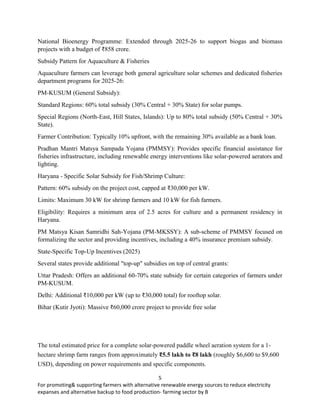
National Bioenergy Programme: Extended through 2025-26 to support biogas and biomass
projects with a budget of ₹858 crore.
Subsidy Pattern for Aquaculture & Fisheries
Aquaculture farmers can leverage both general agriculture solar schemes and dedicated fisheries
department programs for 2025-26:
PM-KUSUM (General Subsidy):
Standard Regions: 60% total subsidy (30% Central + 30% State) for solar pumps.
Special Regions (North-East, Hill States, Islands): Up to 80% total subsidy (50% Central + 30%
State).
Farmer Contribution: Typically 10% upfront, with the remaining 30% available as a bank loan.
Pradhan Mantri Matsya Sampada Yojana (PMMSY): Provides specific financial assistance for
fisheries infrastructure, including renewable energy interventions like solar-powered aerators and
lighting.
Haryana - Specific Solar Subsidy for Fish/Shrimp Culture:
Pattern: 60% subsidy on the project cost, capped at ₹30,000 per kW.
Limits: Maximum 30 kW for shrimp farmers and 10 kW for fish farmers.
Eligibility: Requires a minimum area of 2.5 acres for culture and a permanent residency in
Haryana.
PM Matsya Kisan Samridhi Sah-Yojana (PM-MKSSY): A sub-scheme of PMMSY focused on
formalizing the sector and providing incentives, including a 40% insurance premium subsidy.
State-Specific Top-Up Incentives (2025)
Several states provide additional "top-up" subsidies on top of central grants:
Uttar Pradesh: Offers an additional 60-70% state subsidy for certain categories of farmers under
PM-KUSUM.
Delhi: Additional ₹10,000 per kW (up to ₹30,000 total) for rooftop solar.
Bihar (Kutir Jyoti): Massive ₹60,000 crore project to provide free solar
The total estimated price for a complete solar-powered paddle wheel aeration system for a 1-
hectare shrimp farm ranges from approximately ₹5.5 lakh to ₹8 lakh (roughly $6,600 to $9,600
USD), depending on power requirements and specific components.
6.
6
For promoting& supportingfarmers with alternative renewable energy sources to reduce electricity
expanses and alternative backup to food production- farming sector by B
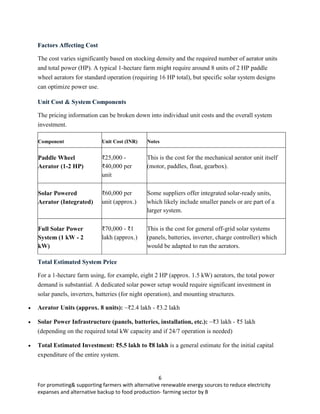
Factors Affecting Cost
The cost varies significantly based on stocking density and the required number of aerator units
and total power (HP). A typical 1-hectare farm might require around 8 units of 2 HP paddle
wheel aerators for standard operation (requiring 16 HP total), but specific solar system designs
can optimize power use.
Unit Cost & System Components
The pricing information can be broken down into individual unit costs and the overall system
investment.
Component Unit Cost (INR) Notes
Paddle Wheel
Aerator (1-2 HP)
₹25,000 -
₹40,000 per
unit
This is the cost for the mechanical aerator unit itself
(motor, paddles, float, gearbox).
Solar Powered
Aerator (Integrated)
₹60,000 per
unit (approx.)
Some suppliers offer integrated solar-ready units,
which likely include smaller panels or are part of a
larger system.
Full Solar Power
System (1 kW - 2
kW)
₹70,000 - ₹1
lakh (approx.)
This is the cost for general off-grid solar systems
(panels, batteries, inverter, charge controller) which
would be adapted to run the aerators.
Total Estimated System Price
For a 1-hectare farm using, for example, eight 2 HP (approx. 1.5 kW) aerators, the total power
demand is substantial. A dedicated solar power setup would require significant investment in
solar panels, inverters, batteries (for night operation), and mounting structures.
Aerator Units (approx. 8 units): ~₹2.4 lakh - ₹3.2 lakh
Solar Power Infrastructure (panels, batteries, installation, etc.): ~₹3 lakh - ₹5 lakh
(depending on the required total kW capacity and if 24/7 operation is needed)
Total Estimated Investment: ₹5.5 lakh to ₹8 lakh is a general estimate for the initial capital
expenditure of the entire system.