Water requirement for crop in Aquaculture and agriculture by B.pdf
Water requirements for Aquaculture and agricultural crops
Technological innovations for promoting per drop more crops, efficient sustainable farming and conservative precision farming practices
Water requirement for crop in Aquaculture and agriculture by B.pdf
1.
1
By Bhukya Bhaskar
Potentialfor integrated aqua cum agri crops diversification and integrated sustainable farming
Aquaculture technology wise water requirement for promoting Traditional, semi intensive,
intensive and precision aquaculture technology specific area Aquaculture
Bhukya Bhaskar
Aquaculture technology wise water requirement for growing 1 kg fish
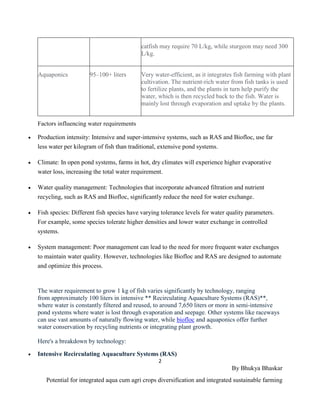
The water required to produce 1 kg of fish varies significantly by technology, ranging from over
7,650 liters for semi-intensive pond culture to under 100 liters in advanced aquaponics and
recirculating aquaculture systems (RAS). The primary difference lies in how effectively water is
filtered, reused, and conserved.
Water requirement per kg of fish by technology
Technology Water
Requirement
(per kg of fish)
Key Factors
Semi-intensive
pond culture
7,650–10,300+
liters
High water consumption is due to reliance on natural pond
cycles and substantial losses from evaporation and seepage.
Water is exchanged with a fresh supply during the growing
period, and ponds are drained between cycles.
Intensive pond
culture
~2,700–4,100
liters
By using aeration and supplementary feeding, farmers can
increase fish density and double water productivity. While
still high, this is more efficient than semi-intensive methods.
Biofloc
technology (BFT)
Minimal to near-
zero water
exchange
Highly water-efficient. The system cultivates beneficial
microbes that treat water by converting waste and uneaten
feed into a natural food source for the fish. Water is only
added to compensate for evaporation. Some studies have
achieved near-zero water exchange.
Recirculating
Aquaculture
System (RAS)
70–400 liters,
depending on
species
Extremely water-efficient. The use of mechanical and
biological filters cleans and recirculates up to 90% of the
water. Water is primarily added to replace what is lost to
evaporation and waste flushing. For example, African
2.
2
By Bhukya Bhaskar
Potentialfor integrated aqua cum agri crops diversification and integrated sustainable farming
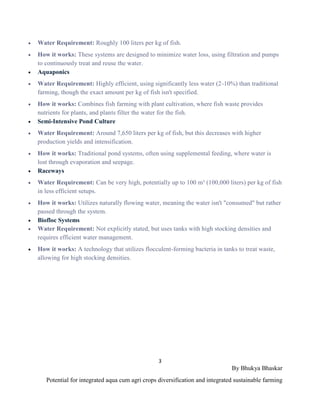
catfish may require 70 L/kg, while sturgeon may need 300
L/kg.
Aquaponics 95–100+ liters Very water-efficient, as it integrates fish farming with plant
cultivation. The nutrient-rich water from fish tanks is used
to fertilize plants, and the plants in turn help purify the
water, which is then recycled back to the fish. Water is
mainly lost through evaporation and uptake by the plants.
Factors influencing water requirements
Production intensity: Intensive and super-intensive systems, such as RAS and Biofloc, use far
less water per kilogram of fish than traditional, extensive pond systems.
Climate: In open pond systems, farms in hot, dry climates will experience higher evaporative
water loss, increasing the total water requirement.
Water quality management: Technologies that incorporate advanced filtration and nutrient
recycling, such as RAS and Biofloc, significantly reduce the need for water exchange.
Fish species: Different fish species have varying tolerance levels for water quality parameters.
For example, some species tolerate higher densities and lower water exchange in controlled
systems.
System management: Poor management can lead to the need for more frequent water exchanges
to maintain water quality. However, technologies like Biofloc and RAS are designed to automate
and optimize this process.
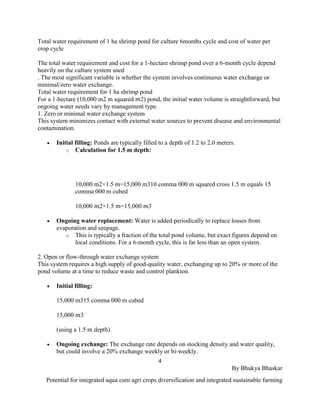
The water requirement to grow 1 kg of fish varies significantly by technology, ranging
from approximately 100 liters in intensive ** Recirculating Aquaculture Systems (RAS)**,
where water is constantly filtered and reused, to around 7,650 liters or more in semi-intensive
pond systems where water is lost through evaporation and seepage. Other systems like raceways
can use vast amounts of naturally flowing water, while biofloc and aquaponics offer further
water conservation by recycling nutrients or integrating plant growth.
Here's a breakdown by technology:
Intensive Recirculating Aquaculture Systems (RAS)
3.
3
By Bhukya Bhaskar
Potentialfor integrated aqua cum agri crops diversification and integrated sustainable farming
Water Requirement: Roughly 100 liters per kg of fish.
How it works: These systems are designed to minimize water loss, using filtration and pumps
to continuously treat and reuse the water.
Aquaponics
Water Requirement: Highly efficient, using significantly less water (2-10%) than traditional
farming, though the exact amount per kg of fish isn't specified.
How it works: Combines fish farming with plant cultivation, where fish waste provides
nutrients for plants, and plants filter the water for the fish.
Semi-Intensive Pond Culture
Water Requirement: Around 7,650 liters per kg of fish, but this decreases with higher
production yields and intensification.
How it works: Traditional pond systems, often using supplemental feeding, where water is
lost through evaporation and seepage.
Raceways
Water Requirement: Can be very high, potentially up to 100 m³ (100,000 liters) per kg of fish
in less efficient setups.
How it works: Utilizes naturally flowing water, meaning the water isn't "consumed" but rather
passed through the system.
Biofloc Systems
Water Requirement: Not explicitly stated, but uses tanks with high stocking densities and
requires efficient water management.
How it works: A technology that utilizes flocculent-forming bacteria in tanks to treat waste,
allowing for high stocking densities.
4.
4
By Bhukya Bhaskar
Potentialfor integrated aqua cum agri crops diversification and integrated sustainable farming
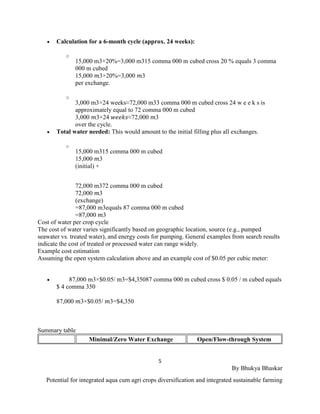
Total water requirement of 1 ha shrimp pond for culture 6months cycle and cost of water per
crop cycle
The total water requirement and cost for a 1-hectare shrimp pond over a 6-month cycle depend
heavily on the culture system used
. The most significant variable is whether the system involves continuous water exchange or
minimal/zero water exchange.
Total water requirement for 1 ha shrimp pond
For a 1-hectare (10,000 m2 m squared 𝑚2) pond, the initial water volume is straightforward, but
ongoing water needs vary by management type.
1. Zero or minimal water exchange system
This system minimizes contact with external water sources to prevent disease and environmental
contamination.
Initial filling: Ponds are typically filled to a depth of 1.2 to 2.0 meters.
o Calculation for 1.5 m depth:
10,000 m2×1.5 m=15,000 m310 comma 000 m squared cross 1.5 m equals 15
comma 000 m cubed
10,000 𝑚2×1.5 𝑚=15,000 𝑚3
Ongoing water replacement: Water is added periodically to replace losses from
evaporation and seepage.
o This is typically a fraction of the total pond volume, but exact figures depend on
local conditions. For a 6-month cycle, this is far less than an open system.
2. Open or flow-through water exchange system
This system requires a high supply of good-quality water, exchanging up to 20% or more of the
pond volume at a time to reduce waste and control plankton.
Initial filling:
15,000 m315 comma 000 m cubed
15,000 𝑚3
(using a 1.5 m depth).
Ongoing exchange: The exchange rate depends on stocking density and water quality,
but could involve a 20% exchange weekly or bi-weekly.
5.
5
By Bhukya Bhaskar
Potentialfor integrated aqua cum agri crops diversification and integrated sustainable farming
Calculation for a 6-month cycle (approx. 24 weeks):
o
15,000 m3×20%=3,000 m315 comma 000 m cubed cross 20 % equals 3 comma
000 m cubed
15,000 𝑚3×20%=3,000 𝑚3
per exchange.
o
3,000 m3×24 weeks≈72,000 m33 comma 000 m cubed cross 24 w e e k s is
approximately equal to 72 comma 000 m cubed
3,000 𝑚3×24 𝑤𝑒𝑒𝑘𝑠≈72,000 𝑚3
over the cycle.
Total water needed: This would amount to the initial filling plus all exchanges.
o
15,000 m315 comma 000 m cubed
15,000 𝑚3
(initial) +
72,000 m372 comma 000 m cubed
72,000 𝑚3
(exchange)
=87,000 m3equals 87 comma 000 m cubed
=87,000 𝑚3
Cost of water per crop cycle
The cost of water varies significantly based on geographic location, source (e.g., pumped
seawater vs. treated water), and energy costs for pumping. General examples from search results
indicate the cost of treated or processed water can range widely.
Example cost estimation
Assuming the open system calculation above and an example cost of $0.05 per cubic meter:
87,000 m3×$0.05/ m3=$4,35087 comma 000 m cubed cross $ 0.05 / m cubed equals
$ 4 comma 350
87,000 𝑚3×$0.05/ 𝑚3=$4,350
Summary table
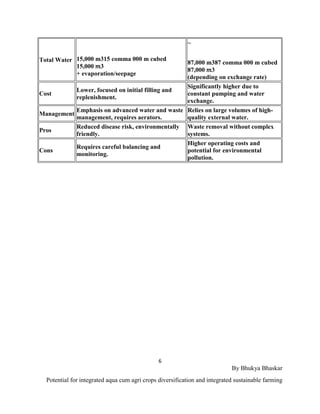
Minimal/Zero Water Exchange Open/Flow-through System
6.
6
By Bhukya Bhaskar
Potentialfor integrated aqua cum agri crops diversification and integrated sustainable farming
Total Water 15,000 m315 comma 000 m cubed
15,000 𝑚3
+ evaporation/seepage
~
87,000 m387 comma 000 m cubed
87,000 𝑚3
(depending on exchange rate)
Cost
Lower, focused on initial filling and
replenishment.
Significantly higher due to
constant pumping and water
exchange.
Management
Emphasis on advanced water and waste
management, requires aerators.
Relies on large volumes of high-
quality external water.
Pros
Reduced disease risk, environmentally
friendly.
Waste removal without complex
systems.
Cons
Requires careful balancing and
monitoring.
Higher operating costs and
potential for environmental
pollution.
7.
7
By Bhukya Bhaskar
Potentialfor integrated aqua cum agri crops diversification and integrated sustainable farming
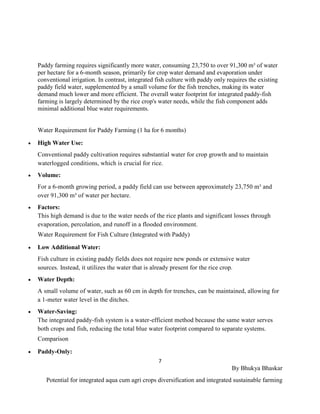
Paddy farming requires significantly more water, consuming 23,750 to over 91,300 m³ of water
per hectare for a 6-month season, primarily for crop water demand and evaporation under
conventional irrigation. In contrast, integrated fish culture with paddy only requires the existing
paddy field water, supplemented by a small volume for the fish trenches, making its water
demand much lower and more efficient. The overall water footprint for integrated paddy-fish
farming is largely determined by the rice crop's water needs, while the fish component adds
minimal additional blue water requirements.
Water Requirement for Paddy Farming (1 ha for 6 months)
High Water Use:
Conventional paddy cultivation requires substantial water for crop growth and to maintain
waterlogged conditions, which is crucial for rice.
Volume:
For a 6-month growing period, a paddy field can use between approximately 23,750 m³ and
over 91,300 m³ of water per hectare.
Factors:
This high demand is due to the water needs of the rice plants and significant losses through
evaporation, percolation, and runoff in a flooded environment.
Water Requirement for Fish Culture (Integrated with Paddy)
Low Additional Water:
Fish culture in existing paddy fields does not require new ponds or extensive water
sources. Instead, it utilizes the water that is already present for the rice crop.
Water Depth:
A small volume of water, such as 60 cm in depth for trenches, can be maintained, allowing for
a 1-meter water level in the ditches.
Water-Saving:
The integrated paddy-fish system is a water-efficient method because the same water serves
both crops and fish, reducing the total blue water footprint compared to separate systems.
Comparison
Paddy-Only:
8.
8
By Bhukya Bhaskar
Potentialfor integrated aqua cum agri crops diversification and integrated sustainable farming
High water consumption driven by crop requirements and a flooded environment.
Paddy-Fish:
Low overall water consumption, as the fish culture is integrated into the existing flooded rice
field, with minimal additional water input needed for the fish component.
Efficiency:
The integrated system is a more sustainable and efficient use of water resources, addressing
food and nutritional security simultaneously with reduced water usage, according to
the Department of Fisheries, GoI.
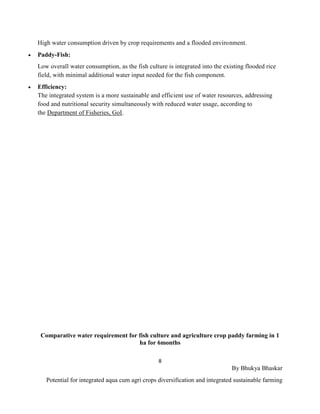
Comparative water requirement for fish culture and agriculture crop paddy farming in 1
ha for 6months
9.
9
By Bhukya Bhaskar
Potentialfor integrated aqua cum agri crops diversification and integrated sustainable farming
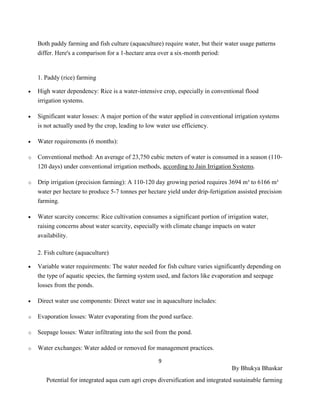
Both paddy farming and fish culture (aquaculture) require water, but their water usage patterns
differ. Here's a comparison for a 1-hectare area over a six-month period:
1. Paddy (rice) farming
High water dependency: Rice is a water-intensive crop, especially in conventional flood
irrigation systems.
Significant water losses: A major portion of the water applied in conventional irrigation systems
is not actually used by the crop, leading to low water use efficiency.
Water requirements (6 months):
o Conventional method: An average of 23,750 cubic meters of water is consumed in a season (110-
120 days) under conventional irrigation methods, according to Jain Irrigation Systems.
o Drip irrigation (precision farming): A 110-120 day growing period requires 3694 m³ to 6166 m³
water per hectare to produce 5-7 tonnes per hectare yield under drip-fertigation assisted precision
farming.
Water scarcity concerns: Rice cultivation consumes a significant portion of irrigation water,
raising concerns about water scarcity, especially with climate change impacts on water
availability.
2. Fish culture (aquaculture)
Variable water requirements: The water needed for fish culture varies significantly depending on
the type of aquatic species, the farming system used, and factors like evaporation and seepage
losses from the ponds.
Direct water use components: Direct water use in aquaculture includes:
o Evaporation losses: Water evaporating from the pond surface.
o Seepage losses: Water infiltrating into the soil from the pond.
o Water exchanges: Water added or removed for management practices.
10.
10
By Bhukya Bhaskar
Potentialfor integrated aqua cum agri crops diversification and integrated sustainable farming
Water requirements (6 months):
o Estimation: To estimate the amount of water needed to compensate for seepage and evaporation
losses during a six-month period, you need to consider the pond area, soil type, and climate.
o Example (loam soil, 1 ha pond):
o Seepage losses (after puddling): Approximately 810 m³ over six months.
o Evaporation losses: If the total evaporation for the period (April-September) is 319 mm, then for
a 1 ha (10,000 m²) pond, the loss would be 3190 m³, according to the FAO.
o Total losses: Adding the two values gives an indication of the total water needed to compensate
for losses.
o Water for filling: Initial filling and puddling of a 1 ha (10,000 m²) pond, with a loam soil, could
require around 4500 m³, according to the FAO.
Water productivity: Water productivity in aquaculture can vary greatly, with recirculating
aquaculture systems (RAS) being highly efficient (up to 0.71-2 kg of fish/m³ of water).
Integrated rice-fish farming
Synergistic approach: Combining paddy cultivation and fish farming in an integrated system
offers benefits like water conservation and increased overall productivity.
Higher water efficiency: Rice-fish farming can enhance water use efficiency by effectively
utilizing both blue (surface and groundwater) and green (rainwater and soil moisture) water
resources.
Potential challenges: Managing water quantity and quality, selecting appropriate fish species,
and controlling diseases and pests are some challenges in integrated systems.
In conclusion, while both paddy farming and fish culture require substantial amounts of water,
rice farming, especially with traditional methods, tends to consume more water. Integrated rice-
fish farming, however, offers a more water-efficient and sustainable approach to food
production.