By Bhukya Bhaskar for small scale fishers welfare initiatives
1
Recent Global initiatives, acts and policies for small scale traditional fishers:
with special focus on Ghana new Fisheries and Aquaculture Act, 2025,
introducing major reforms to tackle IUU fishing and protect artisanal fishers
By Bhukya Bhaskar
Fisheries
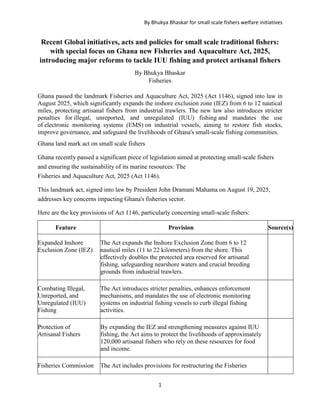
Ghana passed the landmark Fisheries and Aquaculture Act, 2025 (Act 1146), signed into law in
August 2025, which significantly expands the inshore exclusion zone (IEZ) from 6 to 12 nautical
miles, protecting artisanal fishers from industrial trawlers. The new law also introduces stricter
penalties for illegal, unreported, and unregulated (IUU) fishing and mandates the use
of electronic monitoring systems (EMS) on industrial vessels, aiming to restore fish stocks,
improve governance, and safeguard the livelihoods of Ghana's small-scale fishing communities.
Ghana land mark act on small scale fishers
Ghana recently passed a significant piece of legislation aimed at protecting small-scale fishers
and ensuring the sustainability of its marine resources: The
Fisheries and Aquaculture Act, 2025 (Act 1146).
This landmark act, signed into law by President John Dramani Mahama on August 19, 2025,
addresses key concerns impacting Ghana's fisheries sector.
Here are the key provisions of Act 1146, particularly concerning small-scale fishers:
Feature Provision Source(s)
Expanded Inshore
Exclusion Zone (IEZ)
The Act expands the Inshore Exclusion Zone from 6 to 12
nautical miles (11 to 22 kilometers) from the shore. This
effectively doubles the protected area reserved for artisanal
fishing, safeguarding nearshore waters and crucial breeding
grounds from industrial trawlers.
Combating Illegal,
Unreported, and
Unregulated (IUU)
Fishing
The Act introduces stricter penalties, enhances enforcement
mechanisms, and mandates the use of electronic monitoring
systems on industrial fishing vessels to curb illegal fishing
activities.
Protection of
Artisanal Fishers
By expanding the IEZ and strengthening measures against IUU
fishing, the Act aims to protect the livelihoods of approximately
120,000 artisanal fishers who rely on these resources for food
and income.
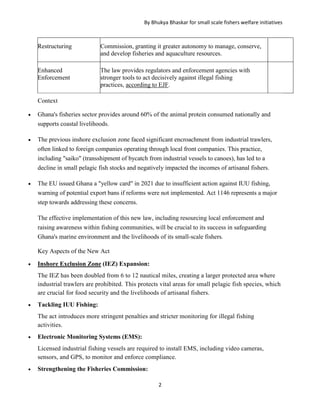
Fisheries Commission The Act includes provisions for restructuring the Fisheries
By Bhukya Bhaskar for small scale fishers welfare initiatives
2
Restructuring Commission, granting it greater autonomy to manage, conserve,
and develop fisheries and aquaculture resources.
Enhanced
Enforcement
The law provides regulators and enforcement agencies with
stronger tools to act decisively against illegal fishing
practices, according to EJF.
Context
 Ghana's fisheries sector provides around 60% of the animal protein consumed nationally and
supports coastal livelihoods.
 The previous inshore exclusion zone faced significant encroachment from industrial trawlers,
often linked to foreign companies operating through local front companies. This practice,
including "saiko" (transshipment of bycatch from industrial vessels to canoes), has led to a
decline in small pelagic fish stocks and negatively impacted the incomes of artisanal fishers.
 The EU issued Ghana a "yellow card" in 2021 due to insufficient action against IUU fishing,
warning of potential export bans if reforms were not implemented. Act 1146 represents a major
step towards addressing these concerns.
The effective implementation of this new law, including resourcing local enforcement and
raising awareness within fishing communities, will be crucial to its success in safeguarding
Ghana's marine environment and the livelihoods of its small-scale fishers.
Key Aspects of the New Act
 Inshore Exclusion Zone (IEZ) Expansion:
The IEZ has been doubled from 6 to 12 nautical miles, creating a larger protected area where
industrial trawlers are prohibited. This protects vital areas for small pelagic fish species, which
are crucial for food security and the livelihoods of artisanal fishers.
 Tackling IUU Fishing:
The act introduces more stringent penalties and stricter monitoring for illegal fishing
activities.
 Electronic Monitoring Systems (EMS):
Licensed industrial fishing vessels are required to install EMS, including video cameras,
sensors, and GPS, to monitor and enforce compliance.
 Strengthening the Fisheries Commission:
By Bhukya Bhaskar for small scale fishers welfare initiatives
3
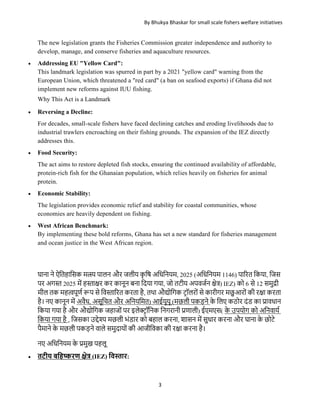
The new legislation grants the Fisheries Commission greater independence and authority to
develop, manage, and conserve fisheries and aquaculture resources.
 Addressing EU "Yellow Card":
This landmark legislation was spurred in part by a 2021 "yellow card" warning from the
European Union, which threatened a "red card" (a ban on seafood exports) if Ghana did not
implement new reforms against IUU fishing.
Why This Act is a Landmark
 Reversing a Decline:
For decades, small-scale fishers have faced declining catches and eroding livelihoods due to
industrial trawlers encroaching on their fishing grounds. The expansion of the IEZ directly
addresses this.
 Food Security:
The act aims to restore depleted fish stocks, ensuring the continued availability of affordable,
protein-rich fish for the Ghanaian population, which relies heavily on fisheries for animal
protein.
 Economic Stability:
The legislation provides economic relief and stability for coastal communities, whose
economies are heavily dependent on fishing.
 West African Benchmark:
By implementing these bold reforms, Ghana has set a new standard for fisheries management
and ocean justice in the West African region.
घाना ने ऐतिहातिक मत्स्य पालन और जलीय क
ृ ति अतितनयम, 2025 (अतितनयम 1146) पाररि तकया, तजि
पर अगस्त 2025 में हस्ताक्षर कर कानून बना तिया गया, जो िटीय अपवजजन क्षेत्र( IEZ) को 6 िे 12 िमुद्री
मील िक महत्वपूर्ज रूप िे तवस्ताररि करिा है, िथा औद्योतगक टरॉलरोों िे कारीगर मछु आरोों की रक्षा करिा
है। नए कानून में अवैि, अिूतिि और अतनयतमि( आईयूयू )मछली पकड़ने क
े तलए कठोर िोंड का प्राविान
तकया गया है और औद्योतगक जहाजोों पर इलेक्ट्रॉतनक तनगरानी प्रर्ाली( ईएमएि) क
े उपयोग को अतनवायज
तकया गया है , तजिका उद्देश्य मछली भोंडार को बहाल करना, शािन में िुिार करना और घाना क
े छोटे
पैमाने क
े मछली पकड़ने वाले िमुिायोों की आजीतवका की रक्षा करना है।
नए अतितनयम क
े प्रमुख पहलू
 तटीय बहिष्करण क्षेत्र (IEZ) हिस्तार:
By Bhukya Bhaskar for small scale fishers welfare initiatives
4
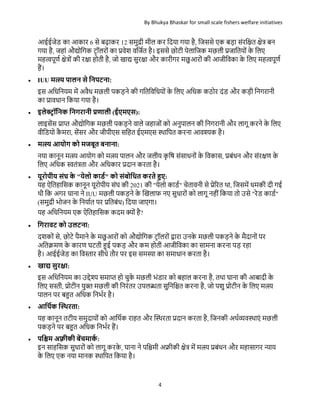
आईईजेड का आकार 6 िे बढाकर 12 िमुद्री मील कर तिया गया है, तजििे एक बड़ा िोंरतक्षि क्षेत्र बन
गया है, जहाों औद्योतगक टरॉलरोों का प्रवेश वतजजि है। इििे छोटी पेलातजक मछली प्रजातियोों क
े तलए
महत्वपूर्ज क्षेत्रोों की रक्षा होिी है, जो खाद्य िुरक्षा और कारीगर मछु आरोों की आजीतवका क
े तलए महत्वपूर्ज
हैं।
 IUU मत्स्य पालन से हनपटना:
इि अतितनयम में अवैि मछली पकड़ने की गतितवतियोों क
े तलए अतिक कठोर िोंड और कड़ी तनगरानी
का प्राविान तकया गया है।
 इलेक्ट्रॉहनक हनगरानी प्रणाली (ईएमएस):
लाइिेंि प्राप्त औद्योतगक मछली पकड़ने वाले जहाजोों को अनुपालन की तनगरानी और लागू करने क
े तलए
वीतडयो क
ै मरा, िेंिर और जीपीएि ितहि ईएमएि स्थातपि करना आवश्यक है।
 मत्स्य आयोग को मजबूत बनाना:
नया कानून मत्स्य आयोग को मत्स्य पालन और जलीय क
ृ ति िोंिािनोों क
े तवकाि, प्रबोंिन और िोंरक्षर् क
े
तलए अतिक स्विोंत्रिा और अतिकार प्रिान करिा है।
 यूरोपीय संघ क
े "येलो कार्ड" को संबोहित करते हुए:
यह ऐतिहातिक कानून यूरोपीय िोंघ की 2021 की "येलो काडज" िेिावनी िे प्रेररि था, तजिमें िमकी िी गई
थी तक अगर घाना ने IUU मछली पकड़ने क
े खखलाफ नए िुिारोों को लागू नहीों तकया िो उिे "रेड काडज"
)िमुद्री भोजन क
े तनयाजि पर प्रतिबोंि( तिया जाएगा।
यह अतितनयम एक ऐतिहातिक किम क्ोों है?
 हगरािट को उलटना:
िशकोों िे, छोटे पैमाने क
े मछु आरोों को औद्योतगक टरॉलरोों द्वारा उनक
े मछली पकड़ने क
े मैिानोों पर
अतिक्रमर् क
े कारर् घटिी हुई पकड़ और कम होिी आजीतवका का िामना करना पड़ रहा
है। आईईजेड का तवस्तार िीिे िौर पर इि िमस्या का िमािान करिा है।
 खाद्य सुरक्षा:
इि अतितनयम का उद्देश्य िमाप्त हो िुक
े मछली भोंडार को बहाल करना है, िथा घाना की आबािी क
े
तलए िस्ती, प्रोटीन युक्त मछली की तनरोंिर उपलब्धिा िुतनतिि करना है, जो पशु प्रोटीन क
े तलए मत्स्य
पालन पर बहुि अतिक तनभजर है।
 आहथडक स्थथरता:
यह कानून िटीय िमुिायोों को आतथजक राहि और खस्थरिा प्रिान करिा है, तजनकी अथजव्यवस्थाएों मछली
पकड़ने पर बहुि अतिक तनभजर हैं।
 पहिम अफ़्रीकी बेंचमाक
ड :
इन िाहतिक िुिारोों को लागू करक
े , घाना ने पतिमी अफ्रीकी क्षेत्र में मत्स्य प्रबोंिन और महािागर न्याय
क
े तलए एक नया मानक स्थातपि तकया है।
By Bhukya Bhaskar for small scale fishers welfare initiatives
5
Major country wise fisheries act on small scale fishers
This overview details major fisheries legislation and its specific impact on small-scale fishers in
several countries and regions. The legal frameworks generally aim for sustainable management
but often create conflicts with local, small-scale fishing communities through mismatched
regulations
.
European Union (EU)
The EU's Common Fisheries Policy (CFP), which covers all 27 member states, is the main legal
framework for fisheries and aquaculture.
 Regulations affecting small-scale fishers:
o Limited exemptions: The CFP contains specific provisions for small-scale coastal fisheries,
exempting them from some obligations that apply to larger vessels, such as certain reporting
requirements.
o Financial support: The European Maritime, Fisheries and Aquaculture Fund (EMFAF) provides
financial support to the small-scale fleet.
o Preferential access: Member states can grant preferential access to the 12-nautical-mile coastal
band for the small-scale fleet.
 Criticism and shortcomings: Historically, the CFP has focused on large-scale fleets, often
neglecting the needs of small-scale or artisanal fishers. Management decisions frequently fail to
consider the unique operational and social characteristics of smaller fleets.
 Challenges: The lack of accurate catch and position data for small vessels makes it difficult to
assess their impact and manage stocks sustainably.
India
India's fisheries regulations are a mix of central and state-level legislation.
 Key regulations:
o Maritime Zones of India Act (1981): Regulates the fishing activities of foreign vessels in India's
Exclusive Economic Zone (EEZ) and territorial waters.
By Bhukya Bhaskar for small scale fishers welfare initiatives
6
o Marine Fisheries Bill (2021 Draft): A proposed bill intended to regulate both Indian and foreign
vessels in the EEZ. It provides a definition for "small-scale fishers" and outlines penalties for
unlicensed or non-compliant fishing.
 Regulations affecting small-scale fishers:
o Coastal zonation: Several states, such as Andhra Pradesh, have regulations that reserve specific
zones near the coast for traditional or small-scale fishers, restricting larger mechanized boats to
operate further offshore.
o Gear and seasons: Conservation measures include regulating mesh sizes and implementing
seasonal bans during the monsoon to protect fish stocks during spawning season.
o Inland fisheries: Inland fisheries often have state-level management, where fishing rights to
water bodies are leased out, often to fishermen's cooperatives or through open tenders.
Brazil
Brazilian fisheries law is generally regarded as inadequate, particularly concerning the socio-
cultural needs of artisanal communities.
 Key legislation:
o Law No. 11,959/2009: The primary federal law governing fisheries, which has been criticized for
its centralized authority and lack of specific provisions for artisanal fishers.
o Bill 4789/2024 (Proposed): Introduced in the Senate to modernize fisheries policy. It aims to
better reflect the needs of artisanal fishers through decentralization and improved data collection.
 Regulations affecting small-scale fishers:
o State-level restrictions: Some states, like Mato Grosso, have passed highly restrictive laws that
ban the fishing of certain migratory species, severely impacting the livelihoods of artisanal
fishers. These laws have faced strong opposition for potentially eliminating traditional fishing
practices.
o Piracema: A closed fishing season during fish spawning (locally known as Piracema) requires
registered commercial fishers to stop fishing and provides them with financial support during
that period.
By Bhukya Bhaskar for small scale fishers welfare initiatives
7
 Challenges: Artisanal fishers frequently face political and economic marginalization from larger,
industrial interests. The lack of secure tenure rights and weak co-management systems are
significant issues.
China
China's fisheries policies have evolved from a focus on increasing production to improving
sustainability and resource management.
 Key legislation:
o Fisheries Law of the People's Republic of China (amended): The overarching law governing
fishing. It establishes a licensing system, regulates fishing activities, and defines penalties for
non-compliance.
o 14th Five-Year Plan for Fisheries Development (2021-2025): Includes adjustments for coastal
fisheries management, such as limiting the number of licenses and strengthening supervision of
small-scale vessels.
 Regulations affecting small-scale fishers:
o Decentralization: Recent reforms have given provincial governments more authority to set
control indicators for small-scale fishing fleets.
o Fishing zones: Regulations define different fishing zones, with small-scale fishing vessels often
restricted to Class A areas (near-shore).
o Vessel and owner limits: Rules may limit the number of small-scale vessels per family. In some
regions, licensing is prioritized for local professional fishers.
 Challenges: The precise legal definition of "small-scale fisheries" is often missing at the national
and local levels, leading to management gaps. There is also a lack of specific data collection for
small-scale operations, hindering science-based management decisions.
By Bhukya Bhaskar for small scale fishers welfare initiatives
8
Major country wise acts on small scale fishers both in marine
and inland fisheries
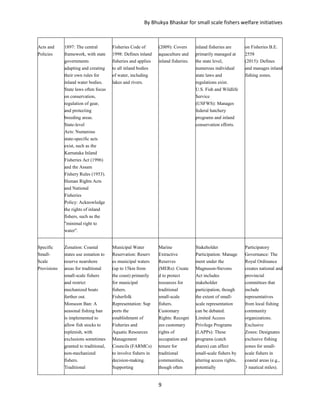
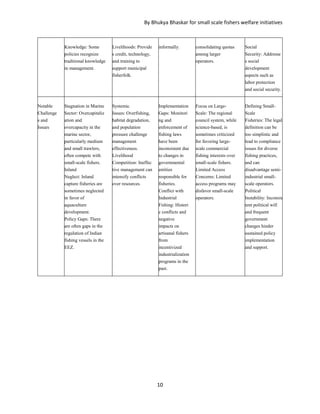
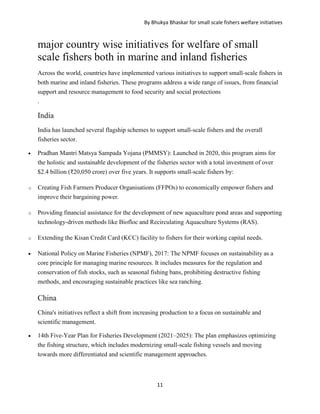
This table outlines the major acts, policies, and management approaches influencing small-scale
fishers in marine and inland fisheries across several countries
Major country-specific fisheries acts and approaches
Countr
y
India Philippines Brazil United States Thailand
Marine
Acts and
Policies
Indian Marine
Fisheries Bill (Draft
2021): Defines small-
scale fishers,
regulates Indian and
foreign fishing
vessels in the
Exclusive Economic
Zone (EEZ), and
promotes sustainable
practices.
Maritime Zones of
India (Regulation of
Fishing by Foreign
Vessels) Act,
1981: Regulates
foreign vessel fishing
in India's EEZ.
Marine Fishing
Policies: Includes the
Marine Fishing
Policy 2004 and the
National Policy on
Marine Fisheries
2017.
State-level
Acts: Many coastal
states have their own
Marine Fishing
Regulation Acts (e.g.,
Goa, Gujarat).
The Philippine
Fisheries Code of
1998 (Republic Act
8550) and its 2015
amendment
(Republic Act
10654): Promotes
sustainable
management,
poverty alleviation
for municipal
fisherfolk, and gives
preference to
municipal fishers
and their
cooperatives for
fishery rights in
municipal waters.
Law No. 11,959
on Sustainable
Development
Policy on
Fisheries and
Aquaculture
(2009): A
national policy
for sustainable
development.
Marine
Extractive
Reserves
(MERs): A key
government
effort to protect
common
property
resources used
by traditional
fishers.
Magnuson-Stevens
Fishery Conservation
and Management Act
(MSA): The primary
federal law governing
marine fisheries in the
EEZ. It established
eight regional councils
for science-based
fishery management.
Endangered Species
Act (ESA) of
1973: Protects
endangered or
threatened aquatic
species.
Royal Ordinance
on Fisheries B.E.
2558 (2015) and its
2017
Amendment: Regul
ates fisheries to
combat illegal,
unreported, and
unregulated (IUU)
fishing, designates
coastal zones for
small-scale fishers,
and incorporates
local communities
into management.
Marine Fisheries
Management Plan
(FMP): Applies the
Ecosystem
Approach to
Fisheries
Management and
aims to address
overfishing and
conflicts.
Inland Indian Fisheries Act, The Philippine Law No. 11,959 Varies by state: As Royal Ordinance
By Bhukya Bhaskar for small scale fishers welfare initiatives
9
Acts and
Policies
1897: The central
framework, with state
governments
adapting and creating
their own rules for
inland water bodies.
State laws often focus
on conservation,
regulation of gear,
and protecting
breeding areas.
State-level
Acts: Numerous
state-specific acts
exist, such as the
Karnataka Inland
Fisheries Act (1996)
and the Assam
Fishery Rules (1953).
Human Rights Acts
and National
Fisheries
Policy: Acknowledge
the rights of inland
fishers, such as the
"minimal right to
water".
Fisheries Code of
1998: Defines inland
fisheries and applies
to all inland bodies
of water, including
lakes and rivers.
(2009): Covers
aquaculture and
inland fisheries.
inland fisheries are
primarily managed at
the state level,
numerous individual
state laws and
regulations exist.
U.S. Fish and Wildlife
Service
(USFWS): Manages
federal hatchery
programs and inland
conservation efforts.
on Fisheries B.E.
2558
(2015): Defines
and manages inland
fishing zones.
Specific
Small-
Scale
Provisions
Zonation: Coastal
states use zonation to
reserve nearshore
areas for traditional
small-scale fishers
and restrict
mechanized boats
further out.
Monsoon Ban: A
seasonal fishing ban
is implemented to
allow fish stocks to
replenish, with
exclusions sometimes
granted to traditional,
non-mechanized
fishers.
Traditional
Municipal Water
Reservation: Reserv
es municipal waters
(up to 15km from
the coast) primarily
for municipal
fishers.
Fisherfolk
Representation: Sup
ports the
establishment of
Fisheries and
Aquatic Resources
Management
Councils (FARMCs)
to involve fishers in
decision-making.
Supporting
Marine
Extractive
Reserves
(MERs): Create
d to protect
resources for
traditional
small-scale
fishers.
Customary
Rights: Recogni
zes customary
rights of
occupation and
tenure for
traditional
communities,
though often
Stakeholder
Participation: Manage
ment under the
Magnuson-Stevens
Act includes
stakeholder
participation, though
the extent of small-
scale representation
can be debated.
Limited Access
Privilege Programs
(LAPPs): These
programs (catch
shares) can affect
small-scale fishers by
altering access rights,
potentially
Participatory
Governance: The
Royal Ordinance
creates national and
provincial
committees that
include
representatives
from local fishing
community
organizations.
Exclusive
Zones: Designates
exclusive fishing
zones for small-
scale fishers in
coastal areas (e.g.,
3 nautical miles).
By Bhukya Bhaskar for small scale fishers welfare initiatives
10
Knowledge: Some
policies recognize
traditional knowledge
in management.
Livelihoods: Provide
s credit, technology,
and training to
support municipal
fisherfolk.
informally. consolidating quotas
among larger
operators.
Social
Security: Addresse
s social
development
aspects such as
labor protection
and social security.
Notable
Challenge
s and
Issues
Stagnation in Marine
Sector: Overcapitaliz
ation and
overcapacity in the
marine sector,
particularly medium
and small trawlers,
often compete with
small-scale fishers.
Inland
Neglect: Inland
capture fisheries are
sometimes neglected
in favor of
aquaculture
development.
Policy Gaps: There
are often gaps in the
regulation of Indian
fishing vessels in the
EEZ.
Systemic
Issues: Overfishing,
habitat degradation,
and population
pressure challenge
management
effectiveness.
Livelihood
Competition: Ineffec
tive management can
intensify conflicts
over resources.
Implementation
Gaps: Monitori
ng and
enforcement of
fishing laws
have been
inconsistent due
to changes in
governmental
entities
responsible for
fisheries.
Conflict with
Industrial
Fishing: Histori
c conflicts and
negative
impacts on
artisanal fishers
from
incentivized
industrialization
programs in the
past.
Focus on Large-
Scale: The regional
council system, while
science-based, is
sometimes criticized
for favoring large-
scale commercial
fishing interests over
small-scale fishers.
Limited Access
Concerns: Limited
access programs may
disfavor small-scale
operators.
Defining Small-
Scale
Fisheries: The legal
definition can be
too simplistic and
lead to compliance
issues for diverse
fishing practices,
and can
disadvantage semi-
industrial small-
scale operators.
Political
Instability: Inconsis
tent political will
and frequent
government
changes hinder
sustained policy
implementation
and support.
By Bhukya Bhaskar for small scale fishers welfare initiatives
11
major country wise initiatives for welfare of small
scale fishers both in marine and inland fisheries
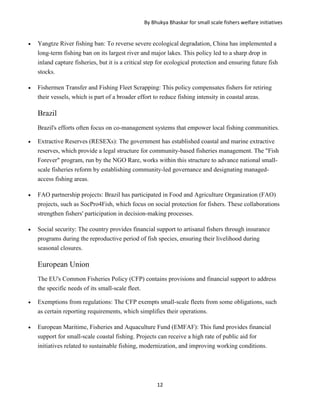
Across the world, countries have implemented various initiatives to support small-scale fishers in
both marine and inland fisheries. These programs address a wide range of issues, from financial
support and resource management to food security and social protections
.
India
India has launched several flagship schemes to support small-scale fishers and the overall
fisheries sector.
 Pradhan Mantri Matsya Sampada Yojana (PMMSY): Launched in 2020, this program aims for
the holistic and sustainable development of the fisheries sector with a total investment of over
$2.4 billion (₹20,050 crore) over five years. It supports small-scale fishers by:
o Creating Fish Farmers Producer Organisations (FFPOs) to economically empower fishers and
improve their bargaining power.
o Providing financial assistance for the development of new aquaculture pond areas and supporting
technology-driven methods like Biofloc and Recirculating Aquaculture Systems (RAS).
o Extending the Kisan Credit Card (KCC) facility to fishers for their working capital needs.
 National Policy on Marine Fisheries (NPMF), 2017: The NPMF focuses on sustainability as a
core principle for managing marine resources. It includes measures for the regulation and
conservation of fish stocks, such as seasonal fishing bans, prohibiting destructive fishing
methods, and encouraging sustainable practices like sea ranching.
China
China's initiatives reflect a shift from increasing production to a focus on sustainable and
scientific management.
 14th Five-Year Plan for Fisheries Development (2021–2025): The plan emphasizes optimizing
the fishing structure, which includes modernizing small-scale fishing vessels and moving
towards more differentiated and scientific management approaches.
By Bhukya Bhaskar for small scale fishers welfare initiatives
12
 Yangtze River fishing ban: To reverse severe ecological degradation, China has implemented a
long-term fishing ban on its largest river and major lakes. This policy led to a sharp drop in
inland capture fisheries, but it is a critical step for ecological protection and ensuring future fish
stocks.
 Fishermen Transfer and Fishing Fleet Scrapping: This policy compensates fishers for retiring
their vessels, which is part of a broader effort to reduce fishing intensity in coastal areas.
Brazil
Brazil's efforts often focus on co-management systems that empower local fishing communities.
 Extractive Reserves (RESEXs): The government has established coastal and marine extractive
reserves, which provide a legal structure for community-based fisheries management. The "Fish
Forever" program, run by the NGO Rare, works within this structure to advance national small-
scale fisheries reform by establishing community-led governance and designating managed-
access fishing areas.
 FAO partnership projects: Brazil has participated in Food and Agriculture Organization (FAO)
projects, such as SocPro4Fish, which focus on social protection for fishers. These collaborations
strengthen fishers' participation in decision-making processes.
 Social security: The country provides financial support to artisanal fishers through insurance
programs during the reproductive period of fish species, ensuring their livelihood during
seasonal closures.
European Union
The EU's Common Fisheries Policy (CFP) contains provisions and financial support to address
the specific needs of its small-scale fleet.
 Exemptions from regulations: The CFP exempts small-scale fleets from some obligations, such
as certain reporting requirements, which simplifies their operations.
 European Maritime, Fisheries and Aquaculture Fund (EMFAF): This fund provides financial
support for small-scale coastal fishing. Projects can receive a high rate of public aid for
initiatives related to sustainable fishing, modernization, and improving working conditions.
By Bhukya Bhaskar for small scale fishers welfare initiatives
13
 Regionalisation: The CFP has given regional groups of member states more control over
fisheries management, which can lead to measures that are better tailored to local small-scale
fishers.
 MedFish4Ever and Sofia Declarations: The EU and its partners have adopted regional action
plans in the Mediterranean and Black Sea to promote sustainable small-scale fisheries.
Norway
Norway's long history of managing its fisheries provides lessons for integrating small-scale fleets
into the national policy framework.
 Co-management institutions: The Norwegian Fishers' Association (NFA) and a network of
fishers' cooperative sales organizations have existed for decades. These institutions help
empower small-scale fishers both politically and economically.
 Quotas and regulations: The majority of Norway's small-scale fisheries are regulated by quotas
and other measures like seasonal closures, ensuring sustainability and providing more predictable
catches in the long term.
 International partnerships: Norway has also supported the FAO's implementation of the
Voluntary Guidelines for Securing Sustainable Small-Scale Fisheries in developing countries,
sharing its expertise in fishery management.
United States
While small-scale fisheries are often overlooked in US policy, there are growing efforts to
provide recognition and support.
 Community-based advocacy: A coalition of small-scale, community-based fishers, particularly in
Alaska, advocates for the protection of their traditional way of life.
 Non-profit initiatives: Organizations like the Oak Foundation support programs to increase
fisheries transparency and reduce labor rights abuses in the seafood supply chain, which can
benefit small-scale fishers.
 Research to inform policy: New research highlighting the global significance of small-scale
fisheries in nutrition and livelihoods is being used to inform policymakers and address the
vulnerability of these communities to issues like climate change.