1
Note on Precision Aquaculture world scenario and scope for Indian
Aquaculture sector
Bhukya Bhaskar, Fisheries
What is Precision Aquaculture?:
Precision aquaculture is an advanced aqua-farming approach that utilizes
various hardware, software, and services, including data analysis, such as AI, IoT,
and sensors, to optimize aqua-farming operations for more efficiency and
sustainability.
Precision aquaculture uses technology like sensors, data analytics, and
automation to monitor and control fish farming operations in real-time. This
approach moves the industry away from traditional manual methods toward a more
data-driven, evidence-based production paradigm.
The global precision aquaculture market size was valued at USD 91.20 billion
in 2024. The market is projected to grow from USD 98.87 billion in 2025 to USD
203.35 billion by 2032, exhibiting a CAGR of 10.85% during the forecast period.
Blue Ridge Aquaculture, Inc., Kaiko Yukinoya Co. Ltd., Avanti Feeds Limited,
Mowi ASA, and Grieg Aqua AS are the leading companies operating in the market.
Increasing aquaculture production across developing nations, including India,
China, and Brazil, will likely drive the demand for the practices. Companies
focusing on achieving sustainable fish farming are further driving the industry
growth.
Benefits of precision aquaculture
 Improved fish health and welfare: Continuous monitoring of water quality and
fish behavior allows farmers to detect signs of stress or disease outbreaks early. This
enables targeted interventions that can prevent the spread of pathogens, minimize
losses, and reduce the need for antibiotics or other chemical treatments.
 Enhanced production efficiency and profitability: Optimized feeding schedules
based on real-time data on fish appetite and biomass lead to improved growth rates
and feed conversion ratios. Better inventory management and reduced fish mortality
naturally lead to improved profit margins.
2
 Reduced environmental impact: Precision techniques minimize waste, such as
uneaten feed and nutrient discharge. This reduces the risk of water pollution,
eutrophication, and habitat degradation in and around the farm.
 Lower operational costs: Automation of tasks like feeding and monitoring reduces
dependence on manual labor. Over the long term, this can significantly reduce
operational costs, though initial investment can be high.
 Increased traceability and quality assurance: Detailed record-keeping facilitated
by precision technology improves product traceability and helps maintain high-
quality standards.
Economics of precision aquaculture
The adoption of precision aquaculture technology is driven by a strong cost-benefit
rationale, despite the high initial investment.
Cost analysis
 High initial investment: The primary hurdle for many farmers is the substantial
upfront cost of acquiring and installing technology. This includes sensors, control
systems, automated feeders, and data analytics software.
 Operational costs: Ongoing costs for precision aquaculture can include
maintenance of technology, data management fees, and the need for skilled labor to
manage the complex systems.
 Variable costs: In traditional aquaculture, variable costs like feed and labor
constitute a large portion of total expenses. Precision technologies help manage and
reduce these costs by automating processes and optimizing resource use.
Benefit analysis
 Feed optimization: Feed costs can account for 50–60% of total production costs.
By using automated feeders that dispense the correct amount of feed at the right
time, farmers can dramatically reduce feed waste and improve the feed conversion
ratio (FCR), leading to significant savings.
3
 Increased yield: Optimized growth conditions, reduced stress, and lower mortality
rates result in a higher overall yield. For example, some AI-based systems have
shown the potential for dramatic increases in production.
 Risk mitigation: Real-time monitoring and predictive analytics enable farmers to
detect and address potential problems like poor water quality or disease outbreaks
before they lead to catastrophic losses.
 Efficiency gains: Automating routine and difficult tasks reduces labor requirements
and allows staff to focus on more complex management tasks. This also improves
safety by reducing the need for manual underwater operations.
Challenges
 High costs: The high initial investment is a major barrier, especially for small and
medium-sized farms operating on tight margins.
 Technical expertise: Operating these sophisticated systems requires a certain level
of technical skill, which can be a hurdle for farmers more accustomed to traditional
methods.
 Infrastructure: Farms in remote areas may face challenges with reliable power and
internet connectivity, which are critical for real-time monitoring and data transfer.
 Data integration: The ecosystem of technologies involves different vendors and
systems, creating challenges related to connectivity, interoperability, and data
standardization.
Future outlook
Despite the challenges, the future of precision aquaculture looks promising, with
continued technological innovation poised to make it more efficient, sustainable, and
profitable. Future trends include:
 More accessible technology: Increased competition and innovation, along with
government initiatives and partnerships, are expected to make technologies more
affordable and scalable for smaller operations.
 Artificial intelligence and automation: Machine learning will enable more
predictive analytics for everything from feeding schedules to disease outbreaks. The
4
use of autonomous underwater vehicles (AUVs) will also likely become more
widespread for inspection and maintenance tasks.
 Integrated systems: Efforts toward industry-wide data standards will allow for
more cohesive systems that integrate data from multiple sources for better
management.
Examples of cost differences between basic and advanced water quality
sensors
The cost difference between basic and advanced water quality sensors in precision
aquaculture is primarily determined by their accuracy, durability, and the range of
parameters they can measure. While basic sensors can be very cheap, advanced
systems offer greater reliability and automation, justifying their higher price tag.
Basic sensors
Basic water quality sensors are a low-cost entry point into monitoring and are often
based on simple microcontrollers like Arduino.
 Cost: Individual sensors for parameters like pH or temperature can cost anywhere
from ₹240 to ₹2,000. Complete multi-sensor DIY kits can be assembled for
under ₹8,000 to ₹15,000.
 Key parameters: Typically measure one or a few basic parameters, such as:
o pH
o Temperature
o Total Dissolved Solids (TDS) or conductivity
 Features:
o Low accuracy: Readings can be less precise compared to professional-grade
sensors.
5
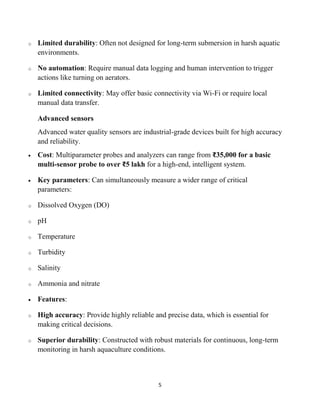
o Limited durability: Often not designed for long-term submersion in harsh aquatic
environments.
o No automation: Require manual data logging and human intervention to trigger
actions like turning on aerators.
o Limited connectivity: May offer basic connectivity via Wi-Fi or require local
manual data transfer.
Advanced sensors
Advanced water quality sensors are industrial-grade devices built for high accuracy
and reliability.
 Cost: Multiparameter probes and analyzers can range from ₹35,000 for a basic
multi-sensor probe to over ₹5 lakh for a high-end, intelligent system.
 Key parameters: Can simultaneously measure a wider range of critical
parameters:
o Dissolved Oxygen (DO)
o pH
o Temperature
o Turbidity
o Salinity
o Ammonia and nitrate
 Features:
o High accuracy: Provide highly reliable and precise data, which is essential for
making critical decisions.
o Superior durability: Constructed with robust materials for continuous, long-term
monitoring in harsh aquaculture conditions.
6
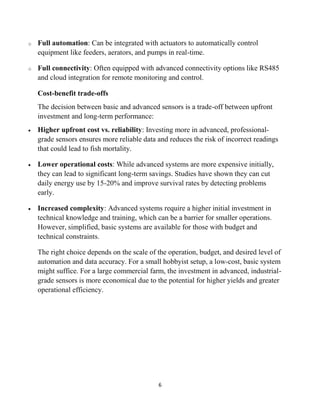
o Full automation: Can be integrated with actuators to automatically control
equipment like feeders, aerators, and pumps in real-time.
o Full connectivity: Often equipped with advanced connectivity options like RS485
and cloud integration for remote monitoring and control.
Cost-benefit trade-offs
The decision between basic and advanced sensors is a trade-off between upfront
investment and long-term performance:
 Higher upfront cost vs. reliability: Investing more in advanced, professional-
grade sensors ensures more reliable data and reduces the risk of incorrect readings
that could lead to fish mortality.
 Lower operational costs: While advanced systems are more expensive initially,
they can lead to significant long-term savings. Studies have shown they can cut
daily energy use by 15-20% and improve survival rates by detecting problems
early.
 Increased complexity: Advanced systems require a higher initial investment in
technical knowledge and training, which can be a barrier for smaller operations.
However, simplified, basic systems are available for those with budget and
technical constraints.
The right choice depends on the scale of the operation, budget, and desired level of
automation and data accuracy. For a small hobbyist setup, a low-cost, basic system
might suffice. For a large commercial farm, the investment in advanced, industrial-
grade sensors is more economical due to the potential for higher yields and greater
operational efficiency.
7
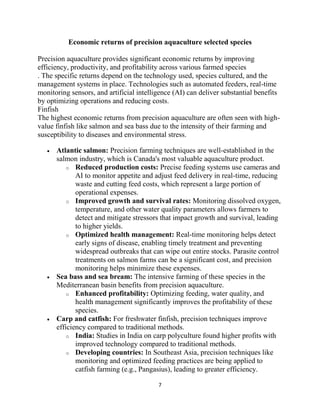
Economic returns of precision aquaculture selected species
Precision aquaculture provides significant economic returns by improving
efficiency, productivity, and profitability across various farmed species
. The specific returns depend on the technology used, species cultured, and the
management systems in place. Technologies such as automated feeders, real-time
monitoring sensors, and artificial intelligence (AI) can deliver substantial benefits
by optimizing operations and reducing costs.
Finfish
The highest economic returns from precision aquaculture are often seen with high-
value finfish like salmon and sea bass due to the intensity of their farming and
susceptibility to diseases and environmental stress.
 Atlantic salmon: Precision farming techniques are well-established in the
salmon industry, which is Canada's most valuable aquaculture product.
o Reduced production costs: Precise feeding systems use cameras and
AI to monitor appetite and adjust feed delivery in real-time, reducing
waste and cutting feed costs, which represent a large portion of
operational expenses.
o Improved growth and survival rates: Monitoring dissolved oxygen,
temperature, and other water quality parameters allows farmers to
detect and mitigate stressors that impact growth and survival, leading
to higher yields.
o Optimized health management: Real-time monitoring helps detect
early signs of disease, enabling timely treatment and preventing
widespread outbreaks that can wipe out entire stocks. Parasite control
treatments on salmon farms can be a significant cost, and precision
monitoring helps minimize these expenses.
 Sea bass and sea bream: The intensive farming of these species in the
Mediterranean basin benefits from precision aquaculture.
o Enhanced profitability: Optimizing feeding, water quality, and
health management significantly improves the profitability of these
species.
 Carp and catfish: For freshwater finfish, precision techniques improve
efficiency compared to traditional methods.
o India: Studies in India on carp polyculture found higher profits with
improved technology compared to traditional methods.
o Developing countries: In Southeast Asia, precision techniques like
monitoring and optimized feeding practices are being applied to
catfish farming (e.g., Pangasius), leading to greater efficiency.
8
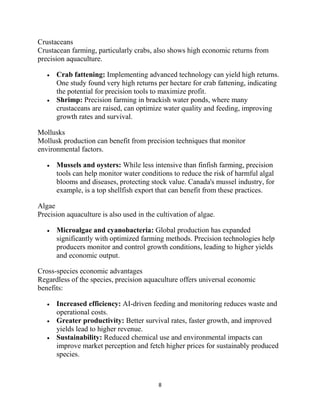
Crustaceans
Crustacean farming, particularly crabs, also shows high economic returns from
precision aquaculture.
 Crab fattening: Implementing advanced technology can yield high returns.
One study found very high returns per hectare for crab fattening, indicating
the potential for precision tools to maximize profit.
 Shrimp: Precision farming in brackish water ponds, where many
crustaceans are raised, can optimize water quality and feeding, improving
growth rates and survival.
Mollusks
Mollusk production can benefit from precision techniques that monitor
environmental factors.
 Mussels and oysters: While less intensive than finfish farming, precision
tools can help monitor water conditions to reduce the risk of harmful algal
blooms and diseases, protecting stock value. Canada's mussel industry, for
example, is a top shellfish export that can benefit from these practices.
Algae
Precision aquaculture is also used in the cultivation of algae.
 Microalgae and cyanobacteria: Global production has expanded
significantly with optimized farming methods. Precision technologies help
producers monitor and control growth conditions, leading to higher yields
and economic output.
Cross-species economic advantages
Regardless of the species, precision aquaculture offers universal economic
benefits:
 Increased efficiency: AI-driven feeding and monitoring reduces waste and
operational costs.
 Greater productivity: Better survival rates, faster growth, and improved
yields lead to higher revenue.
 Sustainability: Reduced chemical use and environmental impacts can
improve market perception and fetch higher prices for sustainably produced
species.
9
 Improved risk management: Predictive tools and continuous monitoring
reduce the risk of stock loss from disease or environmental factors, making
the industry more attractive to insurers and lenders.
Production cost economic returns of shrimp precision aquaculture
Precision aquaculture in shrimp farming aims to optimize production and
economic returns through the use of technology and data-driven methods, reducing
reliance on manual labor and subjective evaluations
. This approach holds significant promise for improving the profitability and
sustainability of shrimp farming operations.
Production Costs and Economic Returns
 Cost Optimization: Precision aquaculture can lead to lower operational
costs through efficient feed management, reduced water treatment, and
minimizing the need for intensive disease management, potentially using
microbiome profiling. Smart feeding systems and monitoring tools optimize
feed distribution, reducing waste and improving feed conversion ratios.
 Increased Yield and Profitability: Studies show that precision farming
practices, including integrated nursery systems and robust biosecurity, can
significantly boost yields and profitability. For instance, a farmer employing
intensive practices and careful management reported earnings of 60 Lakhs
per year (approximately $72,000 USD) from 10 ponds, translating to a
profit of ₹120-150 (approximately $1.45-$1.82 USD) per kilogram of
shrimp.
 Case Study Example: One analysis of shrimp farming in India found
average gross returns of ₹24,48,000 (approximately $29,788 USD) per
hectare and average net returns of ₹8,71,038.58 (approximately $10,601
USD) per hectare, demonstrating the profitability of the sector.
 Improved Efficiency: Precision aquaculture enhances production efficiency
by optimizing environmental conditions, improving growth rates, and
reducing feed conversion ratios. This leads to higher yields, faster returns,
and overall improved profit margins.
 Sustainability: Precision aquaculture techniques minimize waste and
resource use, contributing to more sustainable practices and potentially
attracting consumers willing to pay higher prices for sustainably sourced
seafood.
Key consideration
10
 Challenges in traditional shrimp farming, such as disease outbreaks, climate
change, and fluctuating water conditions, can significantly impact
profitability.
 High initial investment costs for precision aquaculture technology can be a
barrier for some farmers, particularly small and medium-sized enterprises.
 Lack of technical expertise among some aquaculture operators may hinder
the effective implementation and operation of advanced technologies.
 Government policies, funding, and R&D support play a crucial role in
promoting the adoption of precision aquaculture technologies.
 The global precision aquaculture market is experiencing rapid growth,
driven by the demand for sustainable seafood and technological
advancements.
Advantages and Potential challanges for promoting Precision Aquaculture in
India By Bhukya Bhaskar, Fisheries
India is one of leading country in the world, further transformation of current
aquaculture practices with environmentally friendly and economically viable
efficient farming practices, will not only reduce the overall feed quantity, electrical.
Fuel quantity, manpower use and reduce other production cost related expanses but
also increase the overall production per unit area, sustainability of production,
economic returns. However certain challenges as high cost of initial investment,
availability of equipment’s, precision aquafarming infrastructure/technological tools
involved, lack of skills for operating advanced aquaculture technologies among aqua
stakeholders, high use of electricity and plastic in advanced technologies, may
reduce manpower which is source of livelihood for aqua dependent workforce.
Scope for promoting precision aquaculture in India: Large-scale commercial
aquafarming, environmental sensitive area aquafarming to minimize anthropogenic
interventions and open sea/offshore risky area, sewage aquafarming can be
promoted with precision aquaculture, as vast coastal resources along maritime
states/UTs in India, with diversification of Mariculture species.