Development and Deployment of advanced electric renewable energy Deep-sea fishing by B
Worldwide Scenario on Development and Deployment of Advanced Electric, Other Alternative Renewable Energy sources and Eco-friendly Marine,Coastal, Inland Fishing Boats and Deep-sea fishing vessels. Recent Research and Development trends in transforming sector
Development and Deployment of advanced electric renewable energy Deep-sea fishing by B
1.
World Scenario onDevelopment and Deployment of Advanced
Electric, Other Alternative Renewable Energy Sources and
Environmental Friendly Sea Fishing Boats
By
Bhukya Bhaskar
Fisheries
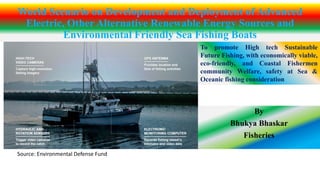
Source: Environmental Defense Fund
To promote High tech Sustainable
Future Fishing, with economically viable,
eco-friendly, and Coastal Fishermen
community Welfare, safety at Sea &
Oceanic fishing consideration
2.
Introduction
• While technologydrives sweeping changes in virtually every economic sector, the
$130 billion global fishing industry is still need eco-friendly transformation.
• Equipping boats with powerful digital tools could help stem industry losses while
targeting the biggest threat to our oceans.
• Marine industry is currently experiencing a true technological revolution with the
emergence of electric motors for boats. This trend is part of a global energy
transition approach that affects all transportation sectors.
• Now a boaters are increasingly sensitive to environmental issues and are seeking
propulsion solutions that respect the marine ecosystem. At the same time,
economic concerns related to rising fossil fuel costs are pushing boat owners to
explore sustainable alternatives.
• Electric motors represent a concrete response to these challenges, offering silent
and ecological navigation.
• However, this technology also raises practical questions regarding autonomy,
investment costs, and adaptation to different types of navigation.
3.
World Wide RecentAdvances in Fishing Boats R& D
• Recent advances in fishing boat technology are focused on improving sustainability,
efficiency, and safety through digitization, automation, and advanced materials. Key
innovations include hybrid-electric propulsion, smart systems for navigation and
monitoring, and gear designed to reduce bycatch and environmental impact.
• Electric or hybrid propulsion: A full-electric vessel uses a large battery pack for
propulsion and onboard systems, offering quiet operation and zero tailpipe emissions. A
hybrid system supplements a traditional diesel engine with a battery pack, which is
especially useful for high-power maneuvers like trawling and low-speed transit.
• Onboard renewable energy: These vessels can be equipped with technologies to
generate their own power, further reducing reliance on fossil fuels.
• Solar panels: Photovoltaic (PV) arrays can be integrated into the deck and
superstructure to help charge batteries or power auxiliary systems.
• Wind power: Small wind turbines can generate power while the vessel is at sea.
• Advanced battery technology: High-capacity, long-life marine-grade batteries are
crucial for deep-sea operations. Developments in lithium-ion and other battery
chemistries are making these vessels more viable by improving range and charging
times.
4.
Cost breakdown andfactors
• The total cost of these advanced fishing boats is not a single figure but depends on
several key variables:
• Vessel size and capacity: The cost scales with the length and gross tonnage of the
vessel. A smaller boat in India with solar panels might cost just a few thousand dollars,
while a large, modern steel-hulled freezer trawler can run into the millions.
• Propulsion system: The choice between a fully electric or hybrid system, and the size of
the battery bank, is a major cost driver. Electric systems can have a lower total cost of
ownership over their lifetime due to reduced fuel and maintenance costs, despite a
higher upfront cost.
• Renewable energy integration: The scale and complexity of onboard renewable
systems, such as solar panels and wind turbines, add to the initial build cost.
• Advanced equipment: Additional technologies for enhanced efficiency and safety
increase the total cost. These include automated systems for feeding or processing fish,
advanced navigation, and real-time data monitoring.
• Research and development (R&D): For new, groundbreaking vessels, the cost of
developing novel technologies and integrating complex systems is substantial.
5.
Specific project examplesillustrate the range of investment needed:
• Indian initiatives: In India, government-subsidized projects are helping fishermen
acquire modern vessels. One such program provides deep-sea fishing vessels
with a unit cost of around $145,000 (1.2 Cr INR).
• China-manufactured vessels: International trade platforms show commercial
deep-sea trawlers of 140 feet ranging from $1.35 million to $1.5 million.
• High-end vessels: The cost can reach several million dollars for larger or custom-
built vessels, especially those equipped for freezer trawling or other advanced
commercial applications.
6.
Cont…
• Long-term cost-effectiveness
•While the initial investment for advanced electric renewable energy boats is high,
the long-term cost-effectiveness is a major selling point. Studies show that a
lower total cost of ownership is possible due to:
• Reduced fuel costs: Electric and hybrid systems significantly cut or eliminate the
cost of diesel fuel.
• Lower maintenance: Electric motors and fewer moving parts reduce maintenance
expenses.
• Increased efficiency: Modern systems can improve operational efficiency and
potentially increase a vessel's time at sea.
7.
Example of FishingBoats with approximate cost
• Small-scale electric boats: For smaller-scale fishing, solar-assisted electric boats
have a total cost of ownership that is approximately 60% lower than traditional
petrol-operated boats due to reduced fuel and maintenance expenses.
• Indian electric fishing vessel "Vikalpika": The first electric fishing vessel in India,
"Vikalpika," with a hybrid-electric propulsion system and solar panels, had a
retrofitting cost of about ₹15,00,000 (approximately $18,000 USD) for a 10–40
HP engine.
• Deep-sea trawlers: Made-in-China lists a 110-foot (34m) steel commercial deep-
sea stern trawler with a price of $700,000–$720,000 USD. For an even larger 140-
foot (43m) vessel, the price increases to $1,350,000–$1,500,000 USD. These
examples do not represent a final price for an electric version but give a baseline
for comparison.
• Custom builds and commercial systems: Commercial-grade or fully custom
electric and hybrid fishing vessels with advanced systems and large battery packs
can easily exceed $50,000, with prices increasing significantly with vessel size.
8.
Cost-related challenges andconsiderations
• The lack of standardized systems and infrastructure creates high costs and development
hurdles for advanced electric deep-sea fishing.
• High initial investment: The main disadvantage of electric and hybrid vessels is the substantial
initial capital expenditure for the electric motors, high-capacity batteries, and renewable
energy systems. These costs can be two to three times higher than a comparable diesel-
powered vessel.
• Battery limitations: Battery energy density is still lower than fossil fuels, resulting in higher
weight and limited range compared to traditional vessels. For deep-sea applications, this
necessitates larger, heavier, and more expensive battery banks to achieve the required range.
• Charging infrastructure: The global charging infrastructure for large electric vessels is currently
inadequate. This makes operating electric boats on long deep-sea voyages unfeasible without
sufficient portside charging or onboard charging capabilities, which adds to the overall cost.
• Developmental stage of deep-sea electric technology: While electric propulsion is effective for
short-range or aquaculture vessels, its application in the high-power, long-endurance deep-sea
fishing sector is still in an early, unstandardized phase.
• High-pressure and power requirements: Deep-sea vessels operate under extreme conditions
and have high, fluctuating power needs for propulsion and fishing gear. This requires
specialized and expensive materials and engineering.
• Ongoing research and innovation: Research is still ongoing to identify the most suitable battery
chemistries and power systems for large, fully electric fishing vessels. The need for custom
design and integration drives up development costs.
9.
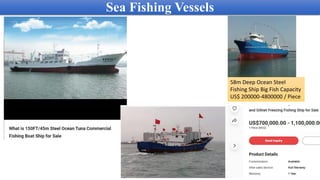
Sea Fishing Vessels
58mDeep Ocean Steel
Fishing Ship Big Fish Capacity
US$ 200000-4800000 / Piece
10.
World Wide RecentAdvances in Fishing Boats Developments
• Digitalization and artificial intelligence (AI)
• Integrating AI, machine learning, and the Internet of Things (IoT) is moving fishing from
traditional methods to data-driven operations.
• Precision fishing: AI-powered systems analyze environmental data, such as water
temperature and ocean currents, to predict fish locations and optimize routes. This
minimizes searching time, reduces fuel consumption, and enhances catch rates.
• Enhanced monitoring: Satellite-based tracking and AI-powered systems, like those used
by Global Fishing Watch, help enforce regulations and combat illegal, unreported, and
unregulated (IUU) fishing. They identify vessel activity, including "dark vessels" that turn
off their tracking systems.
• Automated processing: Onboard AI and robotics are automating the processing and
handling of catches. This includes advanced systems for filleting, sorting, and freezing
that reduce manual labor, improve product quality, and extend shelf life.
• Fishery monitoring: AI software is being used to automate catch monitoring. For
example, Australia's CSIRO developed WANDA software, which uses onboard cameras
to identify and count different species in real time, aiding stock assessment and
ensuring compliance.
11.
Cont…
Sustainable and efficientpropulsion
• To meet decarbonization goals and reduce operating costs, the industry is
transitioning toward cleaner, more efficient power systems.
• Hybrid and electric systems: Fishing vessels are increasingly adopting hybrid-
electric and all-electric propulsion systems. These combine conventional engines
with batteries to reduce fuel consumption and emissions, especially during low-
load operations. Some systems can use solar panels or wind assistance for
recharging.
• Smart energy management: Hybrid systems use an Energy Management System
(EMS) to control the flow of energy between different power sources, ensuring
optimal efficiency. This allows for zero-emission and silent operation in sensitive
areas, such as near ports.
• Advanced hull design: Computational Fluid Dynamics (CFD) is used to optimize
hull and propeller design, which can significantly reduce fuel consumption by
minimizing drag. Wärtsilä, for instance, uses CFD analysis to design efficient and
environmentally friendly vessels
12.
Cont…
Responsible fishing gear
•Innovations in fishing gear focus on improving selectivity to reduce the bycatch of
non-target species and minimize habitat damage.
• Bycatch reduction devices (BRDs):
• Turtle Excluder Devices (TEDs): Shrimp trawlers use TEDs to allow sea turtles and
other large animals to escape the net.
• Square mesh panels: Incorporating square-shaped mesh into nets allows
juveniles and undersized fish to escape before being caught.
• Acoustic deterrents: Devices called "pingers" are attached to gillnets to emit
underwater sounds that alert marine mammals and deter them from becoming
entangled.
• Bait and hook design: Modifications like circle hooks and weighted lines on
longline gear have proven effective at reducing seabird and sea turtle
interactions.
13.
Cont…
Enhanced safety andtraceability
New technologies are being developed to improve crew safety and increase transparency in
the seafood supply chain.
Automated safety monitoring: Integrated monitoring and early warning systems use multiple
sensors—such as GPS, cameras, and attitude sensors—to assess real-time risk. Fuzzy logic
algorithms process this data to generate a "danger score" and send alerts to the crew and
shore-based managers.
Real-time alerts: Communication systems like the Vessel Monitoring System (VMS) provide
real-time alerts for weather, distress signals, and restricted zones, enhancing safety for crews.
Underwater robotics: Israeli scientists have developed solar-powered underwater robots that
can count fish and monitor populations to help prevent overfishing.
Blockchain traceability: Blockchain technology is being tested to improve the traceability of
seafood from the boat to the consumer. It provides a secure, decentralized digital ledger of
transactions to combat seafood fraud and IUU fishing.
14.
Cont…
Design and comfortimprovements
• Modern materials: The shift from traditional wood to durable, high-
performance materials like steel, aluminum, and fiberglass-reinforced polymer
(FRP) has resulted in longer-lasting, lower-maintenance vessels.
• Innovative hull designs: New hull designs, such as catamarans, offer improved
stability and larger deck areas. Streamlined and high-bulbous bow designs
enhance seaworthiness and fuel efficiency.
• Onboard processing and storage: Advanced refrigeration and processing
systems allow for filleting, freezing, and packaging of fish on board, which
preserves freshness and quality for longer trips.
• Enhanced crew comfort: Modern vessels include better crew accommodations,
including more comfortable living spaces and communication systems,
improving quality of life during long voyages. Gyrostabilization technology also
creates a smoother ride for the crew.
15.
Cont.…
• Sustainable andenvironmental innovations
• Hybrid and electric propulsion: Hybrid diesel-electric and fully electric propulsion systems are
being developed and implemented to reduce reliance on fossil fuels, cut carbon emissions, and
lower operational costs. India, for example, recently launched its first electric fishing vessel,
"Vikalpika".
• Low-impact fishing gear: New designs for gear are focused on minimizing environmental
impact. Innovations include:
• Low-drag trawl nets, which use less fuel.
• Turtle Excluder Devices (TEDs), which prevent sea turtles from being caught in trawl nets.
• Bycatch Reduction Devices (BRDs), like the Juvenile Fish Excluder cum Shrimp Sorting Device
(JFE-SSD), which allows non-target species and juveniles to escape.
• Eco-friendly materials and coatings: The use of materials like carbon fiber and reinforced
fiberglass, as well as new anti-corrosive and anti-fouling paints, can improve a boat's
performance and longevity while reducing its environmental footprint.
• Alternative propulsion systems: Some designs incorporate alternative power sources like kite
sails or solar panels to supplement power needs and reduce fuel consumption.
16.
Cont….
• Technological advancements
•Artificial intelligence (AI) and the Internet of Things (IoT): Advanced onboard systems
use AI and machine learning to analyze satellite data, ocean currents, and weather
forecasts to predict fish locations and optimize routes, saving fuel and time. Sensors and
IoT devices monitor fishing activities in near-real-time, and some AI software can even
identify and count fish as they are caught.
• Automated systems and unmanned vehicles: Automated systems reduce manual labor for
fishermen by handling tasks like deploying and retrieving gear and processing catches
on board. Remotely controlled or unmanned fishing vessels are also being researched to
perform dangerous or difficult tasks, reducing the risk to human life and preventing
illegal fishing.
• Enhanced navigation and monitoring: Modern vessels use GPS, radar, sonar, and
advanced fish finders to locate fish schools quickly and safely. New electronic
monitoring (EM) and closed-circuit television (CCTV) systems are also being
implemented to track fishing practices and ensure compliance with sustainability
regulations.
• Cloud connectivity and data analysis: Data collected by smart boats can be transmitted
via satellite or cellular networks to scientists, managers, and buyers in near-real-time.
This connectivity enables better stock assessments, real-time quota tracking for
fishermen, and enhanced supply chain transparency.
17.
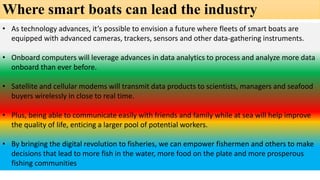
Where smart boatscan lead the industry
• As technology advances, it’s possible to envision a future where fleets of smart boats are
equipped with advanced cameras, trackers, sensors and other data-gathering instruments.
• Onboard computers will leverage advances in data analytics to process and analyze more data
onboard than ever before.
• Satellite and cellular modems will transmit data products to scientists, managers and seafood
buyers wirelessly in close to real time.
• Plus, being able to communicate easily with friends and family while at sea will help improve
the quality of life, enticing a larger pool of potential workers.
• By bringing the digital revolution to fisheries, we can empower fishermen and others to make
decisions that lead to more fish in the water, more food on the plate and more prosperous
fishing communities
18.
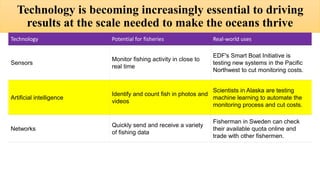
Technology is becomingincreasingly essential to driving
results at the scale needed to make the oceans thrive
Technology Potential for fisheries Real-world uses
Sensors
Monitor fishing activity in close to
real time
EDF's Smart Boat Initiative is
testing new systems in the Pacific
Northwest to cut monitoring costs.
Artificial intelligence
Identify and count fish in photos and
videos
Scientists in Alaska are testing
machine learning to automate the
monitoring process and cut costs.
Networks
Quickly send and receive a variety
of fishing data
Fisherman in Sweden can check
their available quota online and
trade with other fishermen.