Note on Opportunities for FPOs in the fisheries and Agri allied farming, marketi.pdf
1.
1
Note on
Opportunities forFPOs in the Fisheries and Agri allied Farming,
Marketing, Food processing and Export sector
By Shri. Bhukya Bhaskar, Fisheries
Farmers Producer Organizations (FPOs) in the fisheries sector, known as Fish Farmer Producer
Organizations (FFPOs), have significant opportunities to leverage collective bargaining and
economies of scale. By aggregating resources and outputs, they can improve income, increase
market access, and enhance sustainability.
Opportunities for FPOs in the fisheries sector
FFPOs can generate revenue and increase members' income through these opportunities:
Production and input aggregation: FPOs can procure inputs like seeds, fingerlings, fish feed,
and fishing nets in bulk, reducing costs for members. They can also aggregate fish from
members for collective marketing, ensuring better price realization.
Technology adoption: FFPOs can facilitate the adoption of modern aquaculture techniques such
as Recirculatory Aquaculture Systems (RAS), Biofloc technology, cage culture, and pen culture.
This enhances production, productivity, and profitability.
Post-harvest management: By investing in and managing shared infrastructure like ice plants,
cold storage, insulated vehicles, and processing units, FPOs can reduce post-harvest losses and
provide value-added services.
Value addition and processing: FFPOs can set up processing units to produce value-added
products like fish pickles, cutlets, and dried fish. This captures a larger share of the consumer
rupee and expands market access.
Market linkages: FPOs can establish direct market linkages with large-scale buyers such as
retailers, exporters, and food processing companies. They can also onboard members onto digital
platforms like e-NAM and ONDC to access broader markets.
Export business: With improved quality control, cold chain infrastructure, and value addition,
FFPOs can directly enter the export market, realizing higher profits for their members.
2.
2
Diversification: FPOscan explore other profitable activities such as ornamental fish farming,
seaweed cultivation, and integrated fish farming systems that combine fisheries with other
agricultural or livestock activities.
Enhanced production and inputs
Bulk procurement: FFPOs can purchase quality inputs like fish seed, fingerlings, broodstock,
and feed in bulk at lower prices, reducing operational costs for members.
Technology adoption: They can facilitate the adoption of modern aquaculture techniques,
including Recirculatory Aquaculture Systems (RAS), biofloc technology, and cage culture, to
boost productivity.
Seed production: Setting up hatcheries and brood banks enables FFPOs to control the quality of
seed and ensure a consistent, reliable supply for their members.
Improved post-harvest management and value addition
Logistics: By collectively owning or hiring insulated cargo vehicles and refrigerated vans,
FFPOs can reduce post-harvest losses and ensure the freshness of produce during transportation.
Processing: Setting up facilities for sorting, grading, cleaning, and packing adds value to the
catch, leading to better price realization. FFPOs can also establish advanced processing units for
creating value-added products like pickles, flakes, and cutlets.
Cold chain infrastructure: Developing ice plants and cold storage facilities helps members
preserve their catch and avoid distress sales during peak season.
Marketing and entrepreneurship
Market linkages: FPOs can secure better prices by eliminating middlemen and establishing
direct linkages with bulk buyers, retailers, and export markets.
Digital marketplaces: Platforms like the Open Network for Digital Commerce (ONDC), e-
NAM, and Government e-Marketplace (GeM) can be used to list and sell fish products online,
expanding their market reach.
Aquapreneurship: FFPOs can promote entrepreneurship among members in areas such as
ornamental fisheries, seaweed cultivation, and recreational fishing to diversify income streams.
3.
3
Branding: Creatinga collective brand for high-quality, processed fish products can enhance
market visibility and attract premium prices.
Relevant state and central government schemes
Central Sector Scheme for Formation and Promotion of 10,000 FPOs
Management cost: Provides financial assistance of up to ₹18 lakh per FFPO over three years.
Matching equity grant: Offers a matching equity grant of up to ₹15 lakh per FFPO, enhancing
its financial base and creditworthiness.
Credit guarantee facility: Facilitates access to institutional credit with a credit guarantee facility
of up to ₹2 crore for project loans.
Pradhan Mantri Matsya Sampada Yojana (PMMSY)
Financial assistance: Supports infrastructure development, including fishing harbors, fish
landing centers, markets, and processing units.
Sub-schemes for micro-enterprises: The sub-scheme Pradhan Mantri Matsya Kisan Samridhi
Sah-Yojana (PM-MKSSY) provides grants and credit facilitation for fisheries micro-enterprises.
Subsidy for fish farmers: Offers credit-linked subsidies for activities like pond construction,
hatcheries, cage installation, and aeration systems.
Promoting FFPOs: Specifically aims to establish 500 FFPOs under PMMSY to empower
fishers and fish farmers.
Fisheries and Aquaculture Infrastructure Development Fund (FIDF)
Interest subvention: Provides interest subvention of up to 3% per annum for infrastructure
projects related to fisheries, with a repayment period of 12 years.
Kisan Credit Card (KCC)
Working capital: Offers KCC facility to fishers and fish farmers to meet their working capital
requirements, including the purchase of inputs.
Agri-entrepreneurship models for output-based businesses
FFPOs can move beyond basic aggregation to create successful, output-based businesses.
4.
4
Integrated fishfarm models: Combining aquaculture with other activities like livestock or crop
farming to create a diversified, more resilient, and profitable enterprise. This can include:
o Pond-based systems: Using farm ponds for fish culture alongside the cultivation of vegetables,
fruits, or fodder crops on the bunds.
o Aquaponics: Combining fish culture with hydroponic plant cultivation to create a symbiotic
system where fish waste fertilizes plants.
Hub-and-spoke models: A centralized FFPO acts as a "hub" that collects, processes, and
markets produce from its member-producers (the "spokes"). The hub can establish a brand,
manage a cold chain, and handle forward market linkages with urban retailers, kiosks, and
mobile vending units.
Specialized product development: FFPOs can focus on high-value segments:
o Hatchery operations: Establishing hatcheries to produce high-quality, locally-sourced fish and
shrimp seed for members and other local farmers.
o Specialty fish: Cultivating specific high-demand species like sea bass or ornamental fish to cater
to niche markets.
Value chain integration models: FFPOs can create a fully integrated business:
o Feed production: Setting up small-scale feed mills to produce quality, cost-effective fish feed
using local ingredients.
o Processing and branding: Developing a unique brand for their products and managing the
entire process, from harvesting to packaging and retail.
o Digital marketing: Leveraging online platforms and social media for direct-to-consumer sales,
increasing profit margins by cutting out intermediaries.
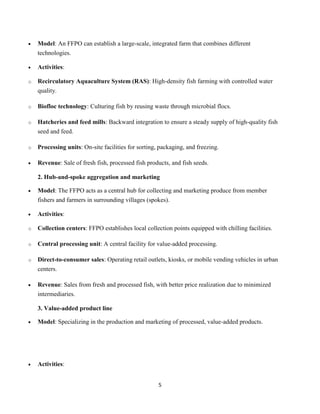
1. Integrated aquaculture farms
5.
5
Model: AnFFPO can establish a large-scale, integrated farm that combines different
technologies.
Activities:
o Recirculatory Aquaculture System (RAS): High-density fish farming with controlled water
quality.
o Biofloc technology: Culturing fish by reusing waste through microbial flocs.
o Hatcheries and feed mills: Backward integration to ensure a steady supply of high-quality fish
seed and feed.
o Processing units: On-site facilities for sorting, packaging, and freezing.
Revenue: Sale of fresh fish, processed fish products, and fish seeds.
2. Hub-and-spoke aggregation and marketing
Model: The FFPO acts as a central hub for collecting and marketing produce from member
fishers and farmers in surrounding villages (spokes).
Activities:
o Collection centers: FFPO establishes local collection points equipped with chilling facilities.
o Central processing unit: A central facility for value-added processing.
o Direct-to-consumer sales: Operating retail outlets, kiosks, or mobile vending vehicles in urban
centers.
Revenue: Sales from fresh and processed fish, with better price realization due to minimized
intermediaries.
3. Value-added product line
Model: Specializing in the production and marketing of processed, value-added products.
Activities:
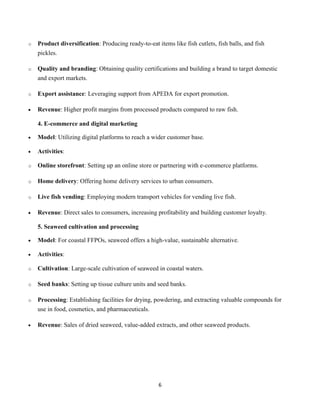
6.
6
o Product diversification:Producing ready-to-eat items like fish cutlets, fish balls, and fish
pickles.
o Quality and branding: Obtaining quality certifications and building a brand to target domestic
and export markets.
o Export assistance: Leveraging support from APEDA for export promotion.
Revenue: Higher profit margins from processed products compared to raw fish.
4. E-commerce and digital marketing
Model: Utilizing digital platforms to reach a wider customer base.
Activities:
o Online storefront: Setting up an online store or partnering with e-commerce platforms.
o Home delivery: Offering home delivery services to urban consumers.
o Live fish vending: Employing modern transport vehicles for vending live fish.
Revenue: Direct sales to consumers, increasing profitability and building customer loyalty.
5. Seaweed cultivation and processing
Model: For coastal FFPOs, seaweed offers a high-value, sustainable alternative.
Activities:
o Cultivation: Large-scale cultivation of seaweed in coastal waters.
o Seed banks: Setting up tissue culture units and seed banks.
o Processing: Establishing facilities for drying, powdering, and extracting valuable compounds for
use in food, cosmetics, and pharmaceuticals.
Revenue: Sales of dried seaweed, value-added extracts, and other seaweed products.
9
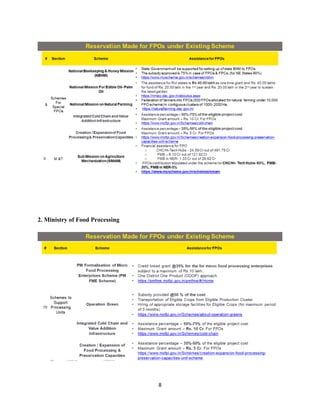
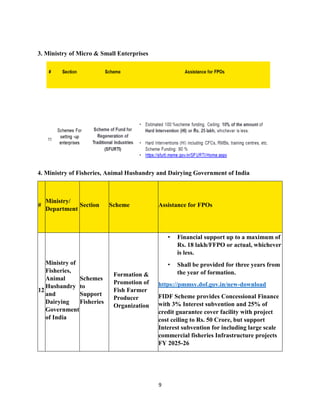
3. Ministry ofMicro & Small Enterprises
4. Ministry of Fisheries, Animal Husbandry and Dairying Government of India
#
Ministry/
Department
Section Scheme Assistance for FPOs
12
Ministry of
Fisheries,
Animal
Husbandry
and
Dairying
Government
of India
Schemes
to
Support
Fisheries
Formation &
Promotion of
Fish Farmer
Producer
Organization
• Financial support up to a maximum of
Rs. 18 lakh/FFPO or actual, whichever
is less.
• Shall be provided for three years from
the year of formation.
https://pmmsy.dof.gov.in/new-download
FIDF Scheme provides Concessional Finance
with 3% Interest subvention and 25% of
credit guarantee cover facility with project
cost ceiling to Rs. 50 Crore, but support
Interest subvention for including large scale
commercial fisheries Infrastructure projects
FY 2025-26
10.
10
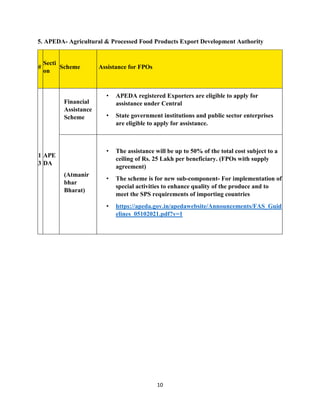
5. APEDA- Agricultural& Processed Food Products Export Development Authority
#
Secti
on
Scheme Assistance for FPOs
1
3
APE
DA
Financial
Assistance
Scheme
• APEDA registered Exporters are eligible to apply for
assistance under Central
• State government institutions and public sector enterprises
are eligible to apply for assistance.
(Atmanir
bhar
Bharat)
• The assistance will be up to 50% of the total cost subject to a
ceiling of Rs. 25 Lakh per beneficiary. (FPOs with supply
agreement)
• The scheme is for new sub-component- For implementation of
special activities to enhance quality of the produce and to
meet the SPS requirements of importing countries
• https://apeda.gov.in/apedawebsite/Announcements/FAS_Guid
elines_05102021.pdf?v=1
11.
11
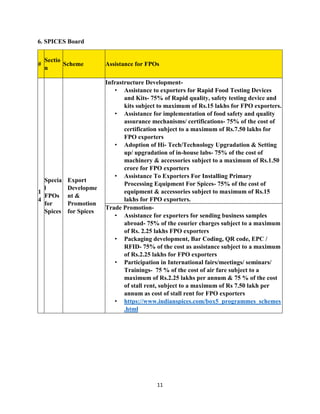
6. SPICES Board
#
Sectio
n
SchemeAssistance for FPOs
1
4
Specia
l
FPOs
for
Spices
Export
Developme
nt &
Promotion
for Spices
Infrastructure Development-
• Assistance to exporters for Rapid Food Testing Devices
and Kits- 75% of Rapid quality, safety testing device and
kits subject to maximum of Rs.15 lakhs for FPO exporters.
• Assistance for implementation of food safety and quality
assurance mechanisms/ certifications- 75% of the cost of
certification subject to a maximum of Rs.7.50 lakhs for
FPO exporters
• Adoption of Hi- Tech/Technology Upgradation & Setting
up/ upgradation of in-house labs- 75% of the cost of
machinery & accessories subject to a maximum of Rs.1.50
crore for FPO exporters
• Assistance To Exporters For Installing Primary
Processing Equipment For Spices- 75% of the cost of
equipment & accessories subject to maximum of Rs.15
lakhs for FPO exporters.
Trade Promotion-
• Assistance for exporters for sending business samples
abroad- 75% of the courier charges subject to a maximum
of Rs. 2.25 lakhs FPO exporters
• Packaging development, Bar Coding, QR code, EPC /
RFID- 75% of the cost as assistance subject to a maximum
of Rs.2.25 lakhs for FPO exporters
• Participation in International fairs/meetings/ seminars/
Trainings- 75 % of the cost of air fare subject to a
maximum of Rs.2.25 lakhs per annum & 75 % of the cost
of stall rent, subject to a maximum of Rs 7.50 lakh per
annum as cost of stall rent for FPO exporters
• https://www.indianspices.com/box5_programmes_schemes
.html