Global scenario of major countries and Proposed action plan for Indian Urban Aquaculture Policy by B.pdf
Global Scenario of promoting Policies in Advanced Urban Fish Farming technologies, recent trend in Urban Fish farming of major countries and Proposed action plan for Indian Urban Aquaculture Policy by B
Global scenario of major countries and Proposed action plan for Indian Urban Aquaculture Policy by B.pdf
1.
1
Bhukya Bhaskar@World FisheriesInitiatives
World wide major countries implementing urban aquaculture policies and Proposed action
plan for Urban Aquaculture Policy in India
By Bhukya Bhaskar, Fisheries
1. Introduction
Major countries worldwide are implementing urban aquaculture policies to address food
security, resource limitations, and sustainable development goals. These initiatives
leverage advanced technology and strategic urban planning to integrate aquatic food
production into city environments.
What is need for Urban Aquaculture policies?
As faster rate of urbanization of rural areas due to increasing population construction
activities, unemployment rate, conversation of land and other natural resources for
commercial use for multipurpose resulted in rise in price of land value due to significant
decreasing land areas for farming (including aqua) activities over the years, while
technological interventions and demand due to wider awareness among educated people
for small scale self employment generating business activities growing and potential scope
for urban Aquaculture
2. Major countries implementing Aquaculture Policies in the world
2.1 Singapore
As a dense city-state with limited land, Singapore is a global leader in urban aquaculture,
driven by its "30 by 30" goal to produce 30% of its nutritional needs locally by 2030.
Key policies:
i. Singapore Aquaculture Plan: This initiative, introduced in 2022, focuses on high-tech,
climate-resilient aquaculture.
ii. Recirculating Aquaculture Systems (RAS): The government encourages and supports the
use of vertical and container-based RAS, which efficiently grow fish indoors using very little
space and water.
iii. Research and development: Policies promote R&D to develop tropical aquaculture
technologies and commercially viable selective breeding programs.
iv. Environmental monitoring: Real-time monitoring of nutrient discharge is used to regulate
farms and prevent pollution, replacing traditional capacity limits.
2.
2
Bhukya Bhaskar@World FisheriesInitiatives
Key examples of urban Aquaculture initiatives:
i. Singapore’s first urban fish farm in a container, an urban fish farm was launched on
November 19th, 2023, in Tampines, an area located in East Singapore.
ii. The container fish farm utilizes a recirculating aquaculture system, reusing water to
grow fish under controlled environmental conditions within 15 square meters (about
half the area of a parking space). It has been scientifically proven to be 25 per cent
more efficient than traditional farming methods, a good aid to local fishmongers in
reaching the “30-by-30" goal.
iii. Considered a community project, employment benefits were brought about to
Tampines residents, with the need for workers to care for the jade perch fishes. The
Tampines Town Council is also working with the People’s Association to donate fish
bento sets to welfare organizations, on top of working with schools to create
educational opportunities.
2.2 China
The world's largest aquaculture producer, China has increasingly focused on balancing
production with ecological sustainability, particularly in urban and peri-urban areas. Policy
Frameworks and Infrastructure.
China’s aquaculture sector has undergone transformative growth since the 1970s, driven
by economic reforms, technological innovation, and strategic government support. Emerging as
the world’s largest producer and consumer of aquaculture products, the sector significantly
contributes to GDP, food security, and export revenue.
Three distinct policy phases have shaped the sector’s trajectory. Pre-2000, the focus was
on rapid expansion through subsidies, research funding, and systemic support for critical inputs
like seed, feed, and machinery. Post-2000, policies balanced productivity with sustainability,
formalized by the Fisheries Law and regulations on food safety, biosecurity, and environmental
protection. After 2012, ecological priorities dominated, exemplified by the 2016 “reducing
volume and increasing efficiency” policy and the 2019 Several Opinions on Accelerating Green
Development, which aligned aquaculture with national green development goals. These shifts
3.
3
Bhukya Bhaskar@World FisheriesInitiatives
were institutionalized through Five-Year Plans for National Fishery Development, particularly
emphasizing resource conservation, structural adjustment, and ecological integrity.
Financial and institutional reforms underpinned this transition. Economic autonomy
incentivized producers, while subsidies and quasi-property rights (e.g., long-term use rights for
farm lands and communal ponds) enabled investments in intensification. Public funding programs
and green subsidies further supported value chain development, though regulatory restrictions
sometimes hindered the effectiveness of green finance.
Success in Aquaculture is also anchored in robust infrastructure and technical innovation.
Carp farming especially relies on hatcheries and nurseries governed by the national aquatic
germplasm system under the Fisheries Law. Feed mills, cold-chain logistics, and rural
infrastructure such as roads, electricity, and irrigation facilitated intensification and market
connectivity. Collaborative networks between research institutions and farmers optimized
practices like stocking density and disease control, supported by extension services and
demonstration zones. This infrastructure created a virtuous cycle, where aquaculture revenues
funded rural development.
Policies recently had dual objectives, enabling growth through incentives while imposing
environmental safeguards. Direct subsidies, R&D funding, and technical training enhance
competitiveness, yet stricter water use, nutrient discharge, and lake aquaculture regulations have
increased compliance costs and reduced aquaculture farming areas. The “ecological civilization”
framework prioritizes green development. The global leader in aquaculture, China is shifting its
focus toward sustainable, quality-focused production, including in urban and peri-urban areas.
Policies: Government support and R&D institutions like the Chinese Academy of Fishery
Sciences have driven the country's dominance. Initiatives focus on improved water treatment and
efficiency. Urban Practice: In cities like Wuhan, extensive aquaculture practices involve stocking
large urban reservoirs with carp species like silver and bighead carp.
Key policies:
i. Ecological Civilization Framework: Since the 2000s, China's policies have shifted toward
green and sustainable development, prioritizing environmental safeguards over unbridled
growth.
ii. Prohibition of harmful practices: Cage and pen culture has been banned in many lakes and
reservoirs, and there are stricter regulations on nutrient discharge to protect water quality.
4.
4
Bhukya Bhaskar@World FisheriesInitiatives
iii. Modernization and technology: The government heavily promotes advanced technologies
like automated feeding, IoT monitoring, and biofloc systems to increase efficiency and reduce
environmental impact.
iv. Green subsidies and training: Direct subsidies, R&D funding, and technical training are used
to build the capacity of smallholder farmers and enhance industry competitiveness.
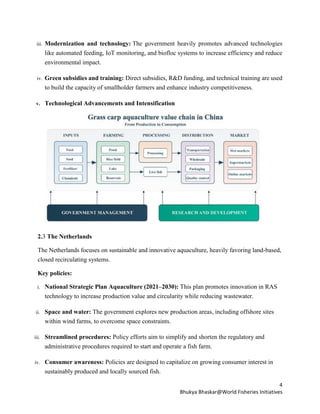
v. Technological Advancements and Intensification
2.3 The Netherlands
The Netherlands focuses on sustainable and innovative aquaculture, heavily favoring land-based,
closed recirculating systems.
Key policies:
i. National Strategic Plan Aquaculture (2021–2030): This plan promotes innovation in RAS
technology to increase production value and circularity while reducing wastewater.
ii. Space and water: The government explores new production areas, including offshore sites
within wind farms, to overcome space constraints.
iii. Streamlined procedures: Policy efforts aim to simplify and shorten the regulatory and
administrative procedures required to start and operate a fish farm.
iv. Consumer awareness: Policies are designed to capitalize on growing consumer interest in
sustainably produced and locally sourced fish.
5.
5
Bhukya Bhaskar@World FisheriesInitiatives
2.4 United States
While regulation is largely managed at the state level, federal policies in the U.S. are
increasingly supportive of aquaculture development, including urban systems.
Key policies:
i. National Aquaculture Development Plan (Updated 2024): This plan, updated for the first
time since 1983, emphasizes aquaculture's role in food security and climate resilience. It
includes strategies for regulatory efficiency and economic development.
ii. Strategic Plan to Enhance Regulatory Efficiency: Federal agencies are directed to reduce
regulatory burdens and provide greater clarity for aquaculture operators.
iii. State-level flexibility: Regulation is primarily managed by states, leading to diverse policies.
For instance, Florida's Division of Aquaculture offers certifications and implements Best
Management Practices to protect urban operations.
iv. Support for small enterprises: Programs at various universities and through the USDA
provide resources, grants, and loans for small and urban-based aquaculture businesses.
2.5 Norway: A leader in cold-water aquaculture, particularly salmon, Norway is known for its
highly regulated, high-tech approach, including moving production to more controlled offshore
or closed systems.
o Policies: The Norwegian government enforces strict environmental and biosecurity regulations,
and authorities like the Norwegian Food Safety Authority ensure traceability and fish health.
o Urban Practice: While focused on large-scale operations, Norway's investment in advanced,
land-based closed-containment systems is highly relevant for urban environments, as they can be
located near cities.
2.6 United States: Aquaculture policy and practice vary by state. The federal government is
promoting aquaculture in designated "Aquaculture Opportunity Zones".
6.
6
Bhukya Bhaskar@World FisheriesInitiatives
i.Policies: Federal initiatives aim to boost domestic seafood production and promote responsible
practices. Specific urban initiatives, such as those in Florida and New York, focus on economic
and environmental factors.
ii.Urban Practice: Projects in metropolitan areas like New York City explore the potential for
urban aquaculture, often with private funding and strict food safety regulations.
2.7 European Union (EU): The EU and member states, such as Spain and the Netherlands, have
policies and initiatives to promote and regulate aquaculture, especially near coastal and densely
populated areas.
i. Policies: Policies focus on sustainable growth, mitigating environmental risks like harmful algal
blooms, and adopting new technologies.
ii. Urban Practice: The Netherlands has explored indoor RAS and vertical farming, though high
initial costs remain a challenge. In Spain, research and regulatory bodies promote aquaculture,
including in urban regions like Valencia.
2.8 India
India is integrating fisheries and aquaculture development into its broader economic and
sustainability policies to ensure food and nutritional security.
Key policies:
i. Pradhan Mantri Matsya Sampada Yojana (PMMSY): Launched in 2020, this scheme
provides financial assistance for inland and marine aquaculture, including promoting
sustainable systems like RAS and biofloc technology.
ii. Coastal Aquaculture Authority (Amendment) Bill, 2023: This legislation aims to regulate
coastal aquaculture units (including hatcheries and farms), promoting biosecurity and
restricting the use of antibiotics.
iii. Mariculture policy: The draft National Mariculture Policy (2019) aims to formalize regulations
and provide support for developing marine aquaculture, including onshore facilities for seed
production and grow-out.
iv. Integrated Modern Coastal Villages: The government is investing in developing these villages
to maximize the social and economic benefits for fishing communities while minimizing
environmental impact.
7.
7
Bhukya Bhaskar@World FisheriesInitiatives
3.Urban aquaculture technologies
i. Recirculating Aquaculture Systems (RAS): These closed-loop systems filter and reuse
water, making them highly efficient for urban spaces where water conservation is critical.
Advantages: Precise control over water quality, minimized waste discharge, and high-density
production.
Unit Cost: High initial investment cost. Indian policy examples show varying government
subsidies based on the system size and location.
ii. Aquaponics: Integrates recirculating aquaculture with hydroponic vegetable production. Fish
waste provides nutrients for the plants, which in turn purify the water for the fish.
Advantages: Creates two products (fish and vegetables) and minimizes waste. It is a highly
sustainable model ideal for urban environments.
Unit Cost: Varies widely with scale. A case study in Brazil showed infrastructure and
electricity as the most significant costs.
iii. Biofloc Technology (BFT): This system uses beneficial microbes to convert organic waste
into a natural, protein-rich feed source.
Advantages: Improves water quality, reduces the need for prepared feed, and is highly efficient
for high-density production.
Unit Cost: Initial tank setup and energy costs are factors. A representative biofloc tank setup in
India has a detailed cost breakdown for a specific capacity.
iv. Cage Culture: While more common in open water, advanced, semi-closed and offshore cage
systems are being developed for controlled conditions near urban coasts.
Advantages: Uses existing water bodies, with newer systems designed to limit environmental
impact.
Unit Cost: Depends on the cage type (e.g., fixed, floating, submersible), material, and location.
v. Artificial Intelligence (AI) and Automation: Advanced feeding systems, water quality
sensors, and robotics are being used to optimize production and reduce labor costs.
Advantages: High efficiency, reduced manual labor, and better system control.
Unit Cost: High initial capital expenditure for technology, but potentially significant long-term
savings on labor and inputs.
Urban aquaculture relies on a range of technologies to maximize production in limited spaces,
ensure sustainability, and improve efficiency.
Recirculating aquaculture systems (RAS)
Function: RAS systems filter and reuse up to 90% of the water, minimizing discharge and
allowing for intensive, indoor farming.
8.
8
Bhukya Bhaskar@World FisheriesInitiatives
Urban application: Ideal for dense urban environments where land and water are scarce. Used
for high-value species like tilapia, barramundi, and trout.
Aquaponics and integrated systems
Function: An integrated system that combines aquaculture with hydroponic plant cultivation.
Nutrient-rich water from fish tanks fertilizes the plants, and the plants in turn filter the water for
the fish.
Urban application: Creates a symbiotic and resource-efficient system for producing both fish
and pesticide-free vegetables. Can be implemented on rooftops or in vertical farms.
Biofloc technology
Function: Promotes the growth of microbial protein (biofloc) in the fish tanks, which acts as a
bioreactor to control water quality and provides a protein-rich food source for the aquatic
animals.
Urban application: Allows for zero or minimal water exchange, reducing waste and preventing
environmental pollution. Suitable for small-scale urban projects.
IoT and precision technologies
Function: These systems use sensors, data analytics, and artificial intelligence to monitor water
quality (e.g., oxygen, pH), automate feeding, and optimize environmental conditions.
Urban application: Increases efficiency, minimizes labor, and ensures high animal welfare
standards in intensive urban farms. This approach is central to Singapore's strategy.
Floating farms and offshore cages
Function: Aquaculture operations located on or off the coast. Floating farms in Singapore utilize
closed containment for greater biosecurity. Offshore cages are used for large-scale production of
species like salmon.
Urban application: Provides a solution for coastal cities facing inland space constraints.
Research is exploring integrated, multi-level floating farm concepts.
9.
9
Bhukya Bhaskar@World FisheriesInitiatives
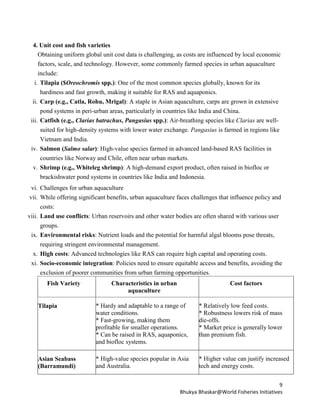
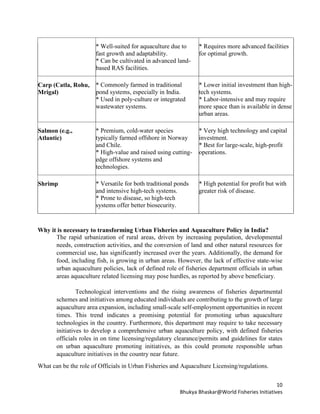
4. Unit cost and fish varieties
Obtaining uniform global unit cost data is challenging, as costs are influenced by local economic
factors, scale, and technology. However, some commonly farmed species in urban aquaculture
include:
i. Tilapia ($Oreochromis spp.): One of the most common species globally, known for its
hardiness and fast growth, making it suitable for RAS and aquaponics.
ii. Carp (e.g., Catla, Rohu, Mrigal): A staple in Asian aquaculture, carps are grown in extensive
pond systems in peri-urban areas, particularly in countries like India and China.
iii. Catfish (e.g., Clarias batrachus, Pangasius spp.): Air-breathing species like Clarias are well-
suited for high-density systems with lower water exchange. Pangasius is farmed in regions like
Vietnam and India.
iv. Salmon (Salmo salar): High-value species farmed in advanced land-based RAS facilities in
countries like Norway and Chile, often near urban markets.
v. Shrimp (e.g., Whiteleg shrimp): A high-demand export product, often raised in biofloc or
brackishwater pond systems in countries like India and Indonesia.
vi. Challenges for urban aquaculture
vii. While offering significant benefits, urban aquaculture faces challenges that influence policy and
costs:
viii. Land use conflicts: Urban reservoirs and other water bodies are often shared with various user
groups.
ix. Environmental risks: Nutrient loads and the potential for harmful algal blooms pose threats,
requiring stringent environmental management.
x. High costs: Advanced technologies like RAS can require high capital and operating costs.
xi. Socio-economic integration: Policies need to ensure equitable access and benefits, avoiding the
exclusion of poorer communities from urban farming opportunities.
Fish Variety Characteristics in urban
aquaculture
Cost factors
Tilapia * Hardy and adaptable to a range of
water conditions.
* Fast-growing, making them
profitable for smaller operations.
* Can be raised in RAS, aquaponics,
and biofloc systems.
* Relatively low feed costs.
* Robustness lowers risk of mass
die-offs.
* Market price is generally lower
than premium fish.
Asian Seabass
(Barramundi)
* High-value species popular in Asia
and Australia.
* Higher value can justify increased
tech and energy costs.
10.
10
Bhukya Bhaskar@World FisheriesInitiatives
* Well-suited for aquaculture due to
fast growth and adaptability.
* Can be cultivated in advanced land-
based RAS facilities.
* Requires more advanced facilities
for optimal growth.
Carp (Catla, Rohu,
Mrigal)
* Commonly farmed in traditional
pond systems, especially in India.
* Used in poly-culture or integrated
wastewater systems.
* Lower initial investment than high-
tech systems.
* Labor-intensive and may require
more space than is available in dense
urban areas.
Salmon (e.g.,
Atlantic)
* Premium, cold-water species
typically farmed offshore in Norway
and Chile.
* High-value and raised using cutting-
edge offshore systems and
technologies.
* Very high technology and capital
investment.
* Best for large-scale, high-profit
operations.
Shrimp * Versatile for both traditional ponds
and intensive high-tech systems.
* Prone to disease, so high-tech
systems offer better biosecurity.
* High potential for profit but with
greater risk of disease.
Why it is necessary to transforming Urban Fisheries and Aquaculture Policy in India?
The rapid urbanization of rural areas, driven by increasing population, developmental
needs, construction activities, and the conversion of land and other natural resources for
commercial use, has significantly increased over the years. Additionally, the demand for
food, including fish, is growing in urban areas. However, the lack of effective state-wise
urban aquaculture policies, lack of defined role of fisheries department officials in urban
areas aquaculture related licensing may pose hurdles, as reported by above beneficiary.
Technological interventions and the rising awareness of fisheries departmental
schemes and initiatives among educated individuals are contributing to the growth of large
aquaculture area expansion, including small-scale self-employment opportunities in recent
times. This trend indicates a promising potential for promoting urban aquaculture
technologies in the country. Furthermore, this department may require to take necessary
initiatives to develop a comprehensive urban aquaculture policy, with defined fisheries
officials roles in on time licensing/regulatory clearance/permits and guidelines for states
on urban aquaculture promoting initiatives, as this could promote responsible urban
aquaculture initiatives in the country near future.
What can be the role of Officials in Urban Fisheries and Aquaculture Licensing/regulations.
11.
11
Bhukya Bhaskar@World FisheriesInitiatives
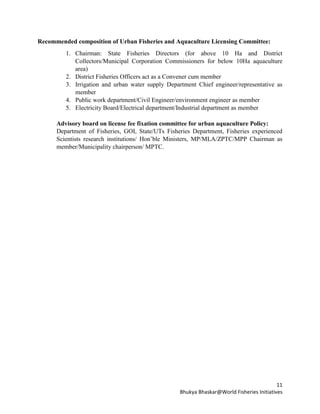
Recommended composition of Urban Fisheries and Aquaculture Licensing Committee:
1. Chairman: State Fisheries Directors (for above 10 Ha and District
Collectors/Municipal Corporation Commissioners for below 10Ha aquaculture
area)
2. District Fisheries Officers act as a Convener cum member
3. Irrigation and urban water supply Department Chief engineer/representative as
member
4. Public work department/Civil Engineer/environment engineer as member
5. Electricity Board/Electrical department/Industrial department as member
Advisory board on license fee fixation committee for urban aquaculture Policy:
Department of Fisheries, GOI, State/UTs Fisheries Department, Fisheries experienced
Scientists research institutions/ Hon’ble Ministers, MP/MLA/ZPTC/MPP Chairman as
member/Municipality chairperson/ MPTC.