Seminar presentation
On
“PCR and it is different types”
1. What is PCR
2. History of PCR
3. Types of PCR
4. Basic Components of PCR
5. Procedures or steps of PCR
6. Principles of PCR
7. Instrumentation of PCR
8. PCR Program
9. Application of PCR
10.Uses of PCR
11.Advantages of PCR
12.Disadvantages of PCR
13.Case study
14.Conclusion
15.References
What is Polymerase chain reaction (PCR):
 The polymerase chain reaction (PCR) is a scientific technique in
molecular biology to amplify a single or a few copies of a piece of
DNA across several orders of magnitude, generating thousands to
millions of copies of a particular DNA sequence.
 PCR methods rely on thermal cycling, which involves exposing the
reactants to cycles of repeated heating and cooling, permitting
different temperature- dependent reactions—specifically, DNA
melting and enzyme-driven DNA replication— to quickly proceed
many times in sequence
 1966- Thomas Brock discovers Thermus aquaticus, a thermostable
bacteria in the hot springs of Yellowstone national Park.
 This technique was developed in 1983 by Kary Mullis, he was awarded
Nobel Prize in 1993 for his work in PCR along with Michael Smith.
 1985- Saiki, publishes the first application of PCR(beta –Globin).
 1985-Cetus crop. Scientists isolate thermostable Taq polymerase
(from T. Aquaticus), which revolutionized PCR.

:
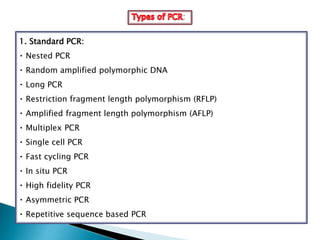
1. Standard PCR:
Nested PCR
Random amplified polymorphic DNA
Long PCR
Restriction fragment length polymorphism (RFLP)
Amplified fragment length polymorphism (AFLP)
Multiplex PCR
Single cell PCR
Fast cycling PCR
In situ PCR
High fidelity PCR
Asymmetric PCR
Repetitive sequence based PCR
Overlap extension PCR
Assemble PCR
Mini primer PCR
Solid phase PCR
Touch Down PCR
2. Reverse transcriptase Polymerase chain reaction (RT-PCR): for RNA
One step RT-PCR
Two step RT-PCR
3. Real time PCR: for DNA or RNA
Dye binding to ds DNA
Fluorescent probes
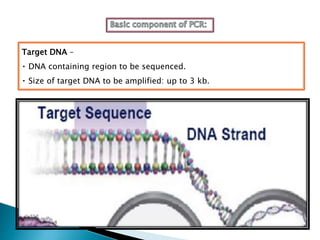
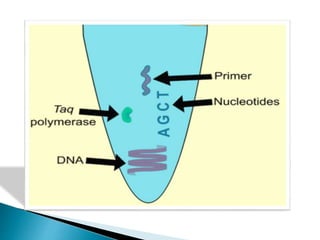
Target DNA –
DNA containing region to be sequenced.
Size of target DNA to be amplified: up to 3 kb.
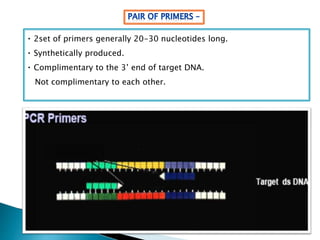
2set of primers generally 20-30 nucleotides long.
Synthetically produced.
Complimentary to the 3’ end of target DNA.
Not complimentary to each other.
dNTPs –
de oxynucleotide triphosphates: DNA building blocks.
Enzyme –
usually Taq polymerase or anyone of the natural or recombination
thermostable polymerases.
High processivity.
Taq polymerase has 5’-3’ exo only no proofreading.
Mg++ ion –
cofactor of the enzyme.
Buffer solution –
Maintains ph. and ionic strength of the reaction suitable for the active.
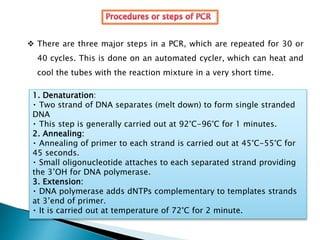
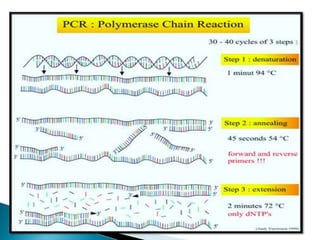
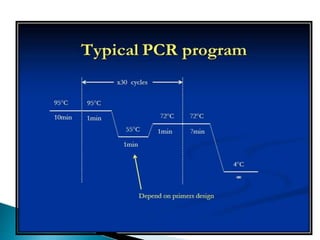
 There are three major steps in a PCR, which are repeated for 30 or
40 cycles. This is done on an automated cycler, which can heat and
cool the tubes with the reaction mixture in a very short time.
1. Denaturation:
Two strand of DNA separates (melt down) to form single stranded
DNA
This step is generally carried out at 92°C-96°C for 1 minutes.
2. Annealing:
Annealing of primer to each strand is carried out at 45°C-55°C for
45 seconds.
Small oligonucleotide attaches to each separated strand providing
the 3’OH for DNA polymerase.
3. Extension:
DNA polymerase adds dNTPs complementary to templates strands
at 3’end of primer.
It is carried out at temperature of 72°C for 2 minute.
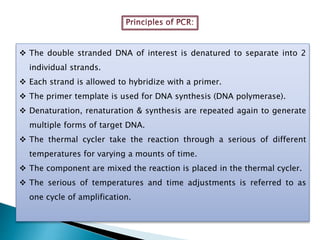
 The double stranded DNA of interest is denatured to separate into 2
individual strands.
 Each strand is allowed to hybridize with a primer.
 The primer template is used for DNA synthesis (DNA polymerase).
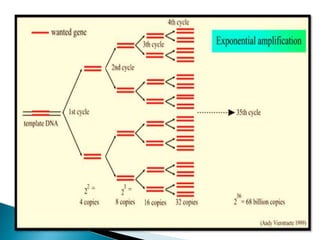
 Denaturation, renaturation & synthesis are repeated again to generate
multiple forms of target DNA.
 The thermal cycler take the reaction through a serious of different
temperatures for varying a mounts of time.
 The component are mixed the reaction is placed in the thermal cycler.
 The serious of temperatures and time adjustments is referred to as
one cycle of amplification.
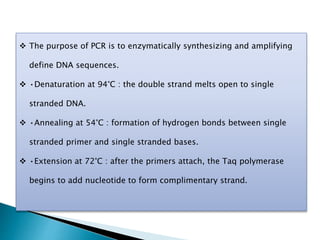
 The purpose of PCR is to enzymatically synthesizing and amplifying
define DNA sequences.
 •Denaturation at 94°C : the double strand melts open to single
stranded DNA.
 •Annealing at 54°C : formation of hydrogen bonds between single
stranded primer and single stranded bases.
 •Extension at 72°C : after the primers attach, the Taq polymerase
begins to add nucleotide to form complimentary strand.
:
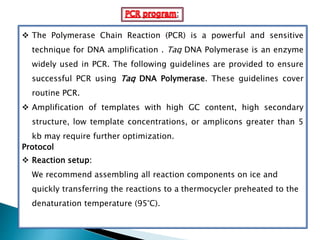
 The Polymerase Chain Reaction (PCR) is a powerful and sensitive
technique for DNA amplification . Taq DNA Polymerase is an enzyme
widely used in PCR. The following guidelines are provided to ensure
successful PCR using Taq DNA Polymerase. These guidelines cover
routine PCR.
 Amplification of templates with high GC content, high secondary
structure, low template concentrations, or amplicons greater than 5
kb may require further optimization.
Protocol
 Reaction setup:
We recommend assembling all reaction components on ice and
quickly transferring the reactions to a thermocycler preheated to the
denaturation temperature (95°C).
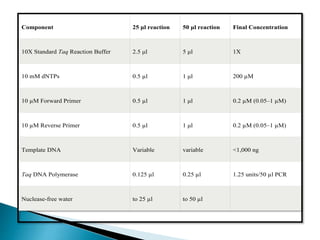
Component 25 μl reaction 50 μl reaction Final Concentration
10X Standard Taq Reaction Buffer 2.5 μl 5 μl 1X
10 mM dNTPs 0.5 µl 1 μl 200 µM
10 µM Forward Primer 0.5 µl 1 μl 0.2 µM (0.05–1 µM)
10 µM Reverse Primer 0.5 µl 1 μl 0.2 µM (0.05–1 µM)
Template DNA Variable variable <1,000 ng
Taq DNA Polymerase 0.125 µl 0.25 µl 1.25 units/50 µl PCR
Nuclease-free water to 25 µl to 50 µl
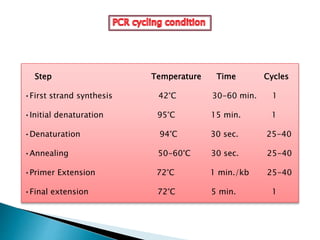
Step Temperature Time Cycles
•First strand synthesis 42°C 30-60 min. 1
•Initial denaturation 95°C 15 min. 1
•Denaturation 94°C 30 sec. 25-40
•Annealing 50-60°C 30 sec. 25-40
•Primer Extension 72°C 1 min./kb 25-40
•Final extension 72°C 5 min. 1
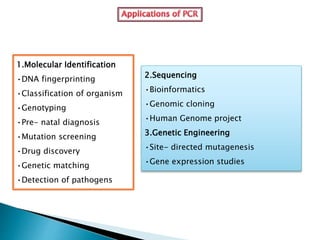
1.Molecular Identification
•DNA fingerprinting
•Classification of organism
•Genotyping
•Pre- natal diagnosis
•Mutation screening
•Drug discovery
•Genetic matching
•Detection of pathogens
2.Sequencing
•Bioinformatics
•Genomic cloning
•Human Genome project
3.Genetic Engineering
•Site- directed mutagenesis
•Gene expression studies
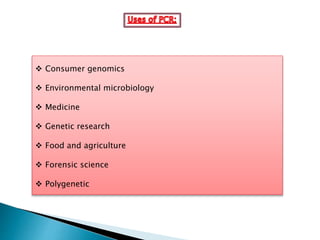
 Consumer genomics
 Environmental microbiology
 Medicine
 Genetic research
 Food and agriculture
 Forensic science
 Polygenetic
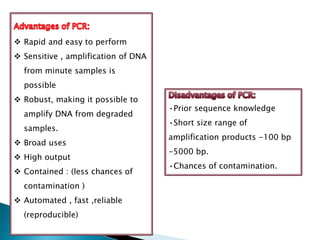
 Rapid and easy to perform
 Sensitive , amplification of DNA
from minute samples is
possible
 Robust, making it possible to
amplify DNA from degraded
samples.
 Broad uses
 High output
 Contained : (less chances of
contamination )
 Automated , fast ,reliable
(reproducible)
•Prior sequence knowledge
•Short size range of
amplification products -100 bp
-5000 bp.
•Chances of contamination.
Title- Estimation of genetic diversity in rice (Oryza sativa L.) genotypes
using SSR markers and morphological characters
Auther name -Meti et al.(2013)
Aim- simple sequence repeat (SSR) markers were used to determine the
allelic diversity and relationship among traditional indigenous aromatic
rice germplasm grown under Eastern part of India.
Material and method- The aromatic rice varieties/landraces were
collected, The genotypes were grown in Randomized Complete Block
Design with three replications during kharif season for three consecutive
years. The plot size for each variety was 3.0 x 3 m and a spacing of 20 cm
between lines and 10 cm between plants were provided. The molecular
analysis using the PCR, simple sequence repeat (SSR) markers, PCR.
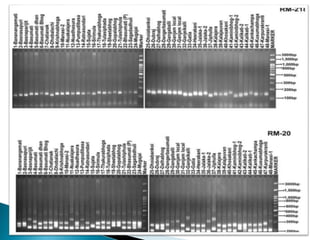
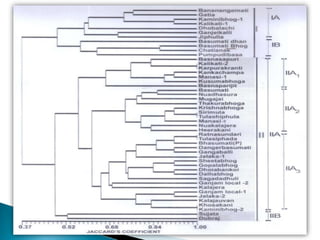
Result- Out of 30 primers, 12 primers showed DNA amplification and
polymorphism among 48 aromatic rice genotypes. A total of 28 bands
appeared by using 12 SSR primers in 48 aromatic rice varieties/landraces.
The number of alleles per locus ranged from 1 to 5 with an average 2.08.
Out of 28 bands, 25 bands were polymorphic and three were
monomorphic bands. The results reveal that all the tested primers showed
distinct polymorphism among the landraces/varieties indicating the robust
nature of SSR markers. Most of the primers showed highest polymorphic
information content (PIC). Phenotypic characteristics are significantly
correlated with genotypic characters. The cluster analysis indicates that
the 48 traditional indigenous aromatic rice genotypes were grouped into
two major clusters. Among the two major clusters, one cluster had 11
varieties and the second cluster had 37 varieties on the basis of the group
of land races. Based on this study, the larger range of similarity values
using SSR markers provides greater confidence for the assessment of
genetic relationships among the varieties. The information obtained from
the SSR profile helps to identify the variety diagnostic markers in 48
traditional indigenous aromatic rice genotypes. Significant genetic
variation at maximum number of loci between varieties indicates rich
genetic resources in rice.
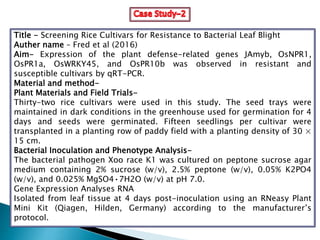
Title - Screening Rice Cultivars for Resistance to Bacterial Leaf Blight
Auther name – Fred et al (2016)
Aim- Expression of the plant defense-related genes JAmyb, OsNPR1,
OsPR1a, OsWRKY45, and OsPR10b was observed in resistant and
susceptible cultivars by qRT-PCR.
Material and method-
Plant Materials and Field Trials-
Thirty-two rice cultivars were used in this study. The seed trays were
maintained in dark conditions in the greenhouse used for germination for 4
days and seeds were germinated. Fifteen seedlings per cultivar were
transplanted in a planting row of paddy field with a planting density of 30 ×
15 cm.
Bacterial Inoculation and Phenotype Analysis-
The bacterial pathogen Xoo race K1 was cultured on peptone sucrose agar
medium containing 2% sucrose (w/v), 2.5% peptone (w/v), 0.05% K2PO4
(w/v), and 0.025% MgSO4•7H2O (w/v) at pH 7.0.
Gene Expression Analyses RNA
Isolated from leaf tissue at 4 days post-inoculation using an RNeasy Plant
Mini Kit (Qiagen, Hilden, Germany) according to the manufacturer’s
protocol.
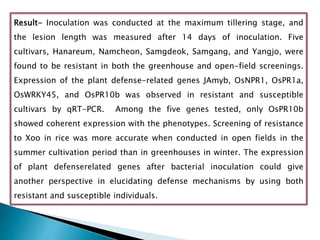
Result- Inoculation was conducted at the maximum tillering stage, and
the lesion length was measured after 14 days of inoculation. Five
cultivars, Hanareum, Namcheon, Samgdeok, Samgang, and Yangjo, were
found to be resistant in both the greenhouse and open-field screenings.
Expression of the plant defense-related genes JAmyb, OsNPR1, OsPR1a,
OsWRKY45, and OsPR10b was observed in resistant and susceptible
cultivars by qRT-PCR. Among the five genes tested, only OsPR10b
showed coherent expression with the phenotypes. Screening of resistance
to Xoo in rice was more accurate when conducted in open fields in the
summer cultivation period than in greenhouses in winter. The expression
of plant defenserelated genes after bacterial inoculation could give
another perspective in elucidating defense mechanisms by using both
resistant and susceptible individuals.
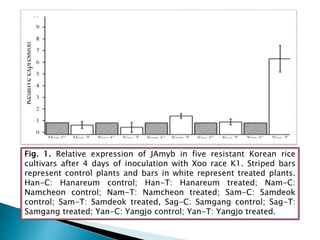
Fig. 1. Relative expression of JAmyb in five resistant Korean rice
cultivars after 4 days of inoculation with Xoo race K1. Striped bars
represent control plants and bars in white represent treated plants.
Han-C: Hanareum control; Han-T: Hanareum treated; Nam-C:
Namcheon control; Nam-T: Namcheon treated; Sam-C: Samdeok
control; Sam-T: Samdeok treated, Sag-C: Samgang control; Sag-T:
Samgang treated; Yan-C: Yangjo control; Yan-T: Yangjo treated.
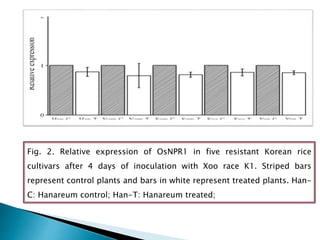
Fig. 2. Relative expression of OsNPR1 in five resistant Korean rice
cultivars after 4 days of inoculation with Xoo race K1. Striped bars
represent control plants and bars in white represent treated plants. Han-
C: Hanareum control; Han-T: Hanareum treated;
 PCR has proved to be a useful tool in research and diagnosis.
 Its use has also brought new challenges to research in terms of
interpreting the result due to sensitivity and quantitative
measurement.
 In medicine , PCR – based diagnostics are just becoming widely used
and because of the increased cost – effective of the newer assays,
knowledge for their interpretation will soon become available
Rajalakshmi, S.(2017). Different types of PCR techniques and its
applications. International J. Of Pharmaceutical, Chemical
And Biological Sci. Vol 7(3), 285-292
Mullis, K.B.(1990). The unusual origin of the polymerase chain reaction.
Bartlett, J. M. S., & Stirling D. A short history of the polymerase chain
reaction. Methods in Molecular Biology, 2003. 226, 3-6. Singh RK,
Sharma RK, Singh AK, Singh VP, Singh NK, Tiwari SP, Mohapatara T
(2004). Suitability of mapped sequence tagged microatellite site
markers for establishing distinctness, uniformity and stability in
aromatic rice. Euphytica, 135:135-Saiki, R.; Gelfand, D.; Stoffel, S.;
Scharf, S.; Higuchi, R.; Horn, G.; Mullis, K.; Erlich, H. (1988). "Primer-directed
enzymatic amplification of DNA with a thermostable DNA
polymerase". Science. 239 (4839): 487– 491.
PCR and it is different types.pptx

PCR and it is different types.pptx

  • 2.
    Seminar presentation On “PCR andit is different types”
  • 3.
    1. What isPCR 2. History of PCR 3. Types of PCR 4. Basic Components of PCR 5. Procedures or steps of PCR 6. Principles of PCR 7. Instrumentation of PCR 8. PCR Program 9. Application of PCR 10.Uses of PCR 11.Advantages of PCR 12.Disadvantages of PCR 13.Case study 14.Conclusion 15.References
  • 4.
    What is Polymerasechain reaction (PCR):  The polymerase chain reaction (PCR) is a scientific technique in molecular biology to amplify a single or a few copies of a piece of DNA across several orders of magnitude, generating thousands to millions of copies of a particular DNA sequence.  PCR methods rely on thermal cycling, which involves exposing the reactants to cycles of repeated heating and cooling, permitting different temperature- dependent reactions—specifically, DNA melting and enzyme-driven DNA replication— to quickly proceed many times in sequence
  • 5.
     1966- ThomasBrock discovers Thermus aquaticus, a thermostable bacteria in the hot springs of Yellowstone national Park.  This technique was developed in 1983 by Kary Mullis, he was awarded Nobel Prize in 1993 for his work in PCR along with Michael Smith.  1985- Saiki, publishes the first application of PCR(beta –Globin).  1985-Cetus crop. Scientists isolate thermostable Taq polymerase (from T. Aquaticus), which revolutionized PCR.
  • 6.
    : 1. Standard PCR: NestedPCR Random amplified polymorphic DNA Long PCR Restriction fragment length polymorphism (RFLP) Amplified fragment length polymorphism (AFLP) Multiplex PCR Single cell PCR Fast cycling PCR In situ PCR High fidelity PCR Asymmetric PCR Repetitive sequence based PCR
  • 7.
    Overlap extension PCR AssemblePCR Mini primer PCR Solid phase PCR Touch Down PCR 2. Reverse transcriptase Polymerase chain reaction (RT-PCR): for RNA One step RT-PCR Two step RT-PCR 3. Real time PCR: for DNA or RNA Dye binding to ds DNA Fluorescent probes
  • 8.
    Target DNA – DNAcontaining region to be sequenced. Size of target DNA to be amplified: up to 3 kb.
  • 9.
    2set of primersgenerally 20-30 nucleotides long. Synthetically produced. Complimentary to the 3’ end of target DNA. Not complimentary to each other.
  • 10.
    dNTPs – de oxynucleotidetriphosphates: DNA building blocks. Enzyme – usually Taq polymerase or anyone of the natural or recombination thermostable polymerases. High processivity. Taq polymerase has 5’-3’ exo only no proofreading. Mg++ ion – cofactor of the enzyme. Buffer solution – Maintains ph. and ionic strength of the reaction suitable for the active.
  • 12.
     There arethree major steps in a PCR, which are repeated for 30 or 40 cycles. This is done on an automated cycler, which can heat and cool the tubes with the reaction mixture in a very short time. 1. Denaturation: Two strand of DNA separates (melt down) to form single stranded DNA This step is generally carried out at 92°C-96°C for 1 minutes. 2. Annealing: Annealing of primer to each strand is carried out at 45°C-55°C for 45 seconds. Small oligonucleotide attaches to each separated strand providing the 3’OH for DNA polymerase. 3. Extension: DNA polymerase adds dNTPs complementary to templates strands at 3’end of primer. It is carried out at temperature of 72°C for 2 minute.
  • 13.
     The doublestranded DNA of interest is denatured to separate into 2 individual strands.  Each strand is allowed to hybridize with a primer.  The primer template is used for DNA synthesis (DNA polymerase).  Denaturation, renaturation & synthesis are repeated again to generate multiple forms of target DNA.  The thermal cycler take the reaction through a serious of different temperatures for varying a mounts of time.  The component are mixed the reaction is placed in the thermal cycler.  The serious of temperatures and time adjustments is referred to as one cycle of amplification.
  • 14.
     The purposeof PCR is to enzymatically synthesizing and amplifying define DNA sequences.  •Denaturation at 94°C : the double strand melts open to single stranded DNA.  •Annealing at 54°C : formation of hydrogen bonds between single stranded primer and single stranded bases.  •Extension at 72°C : after the primers attach, the Taq polymerase begins to add nucleotide to form complimentary strand.
  • 18.
    :  The PolymeraseChain Reaction (PCR) is a powerful and sensitive technique for DNA amplification . Taq DNA Polymerase is an enzyme widely used in PCR. The following guidelines are provided to ensure successful PCR using Taq DNA Polymerase. These guidelines cover routine PCR.  Amplification of templates with high GC content, high secondary structure, low template concentrations, or amplicons greater than 5 kb may require further optimization. Protocol  Reaction setup: We recommend assembling all reaction components on ice and quickly transferring the reactions to a thermocycler preheated to the denaturation temperature (95°C).
  • 19.
    Component 25 μlreaction 50 μl reaction Final Concentration 10X Standard Taq Reaction Buffer 2.5 μl 5 μl 1X 10 mM dNTPs 0.5 µl 1 μl 200 µM 10 µM Forward Primer 0.5 µl 1 μl 0.2 µM (0.05–1 µM) 10 µM Reverse Primer 0.5 µl 1 μl 0.2 µM (0.05–1 µM) Template DNA Variable variable <1,000 ng Taq DNA Polymerase 0.125 µl 0.25 µl 1.25 units/50 µl PCR Nuclease-free water to 25 µl to 50 µl
  • 21.
    Step Temperature TimeCycles •First strand synthesis 42°C 30-60 min. 1 •Initial denaturation 95°C 15 min. 1 •Denaturation 94°C 30 sec. 25-40 •Annealing 50-60°C 30 sec. 25-40 •Primer Extension 72°C 1 min./kb 25-40 •Final extension 72°C 5 min. 1
  • 22.
    1.Molecular Identification •DNA fingerprinting •Classificationof organism •Genotyping •Pre- natal diagnosis •Mutation screening •Drug discovery •Genetic matching •Detection of pathogens 2.Sequencing •Bioinformatics •Genomic cloning •Human Genome project 3.Genetic Engineering •Site- directed mutagenesis •Gene expression studies
  • 23.
     Consumer genomics Environmental microbiology  Medicine  Genetic research  Food and agriculture  Forensic science  Polygenetic
  • 24.
     Rapid andeasy to perform  Sensitive , amplification of DNA from minute samples is possible  Robust, making it possible to amplify DNA from degraded samples.  Broad uses  High output  Contained : (less chances of contamination )  Automated , fast ,reliable (reproducible) •Prior sequence knowledge •Short size range of amplification products -100 bp -5000 bp. •Chances of contamination.
  • 25.
    Title- Estimation ofgenetic diversity in rice (Oryza sativa L.) genotypes using SSR markers and morphological characters Auther name -Meti et al.(2013) Aim- simple sequence repeat (SSR) markers were used to determine the allelic diversity and relationship among traditional indigenous aromatic rice germplasm grown under Eastern part of India. Material and method- The aromatic rice varieties/landraces were collected, The genotypes were grown in Randomized Complete Block Design with three replications during kharif season for three consecutive years. The plot size for each variety was 3.0 x 3 m and a spacing of 20 cm between lines and 10 cm between plants were provided. The molecular analysis using the PCR, simple sequence repeat (SSR) markers, PCR.
  • 26.
    Result- Out of30 primers, 12 primers showed DNA amplification and polymorphism among 48 aromatic rice genotypes. A total of 28 bands appeared by using 12 SSR primers in 48 aromatic rice varieties/landraces. The number of alleles per locus ranged from 1 to 5 with an average 2.08. Out of 28 bands, 25 bands were polymorphic and three were monomorphic bands. The results reveal that all the tested primers showed distinct polymorphism among the landraces/varieties indicating the robust nature of SSR markers. Most of the primers showed highest polymorphic information content (PIC). Phenotypic characteristics are significantly correlated with genotypic characters. The cluster analysis indicates that the 48 traditional indigenous aromatic rice genotypes were grouped into two major clusters. Among the two major clusters, one cluster had 11 varieties and the second cluster had 37 varieties on the basis of the group of land races. Based on this study, the larger range of similarity values using SSR markers provides greater confidence for the assessment of genetic relationships among the varieties. The information obtained from the SSR profile helps to identify the variety diagnostic markers in 48 traditional indigenous aromatic rice genotypes. Significant genetic variation at maximum number of loci between varieties indicates rich genetic resources in rice.
  • 29.
    Title - ScreeningRice Cultivars for Resistance to Bacterial Leaf Blight Auther name – Fred et al (2016) Aim- Expression of the plant defense-related genes JAmyb, OsNPR1, OsPR1a, OsWRKY45, and OsPR10b was observed in resistant and susceptible cultivars by qRT-PCR. Material and method- Plant Materials and Field Trials- Thirty-two rice cultivars were used in this study. The seed trays were maintained in dark conditions in the greenhouse used for germination for 4 days and seeds were germinated. Fifteen seedlings per cultivar were transplanted in a planting row of paddy field with a planting density of 30 × 15 cm. Bacterial Inoculation and Phenotype Analysis- The bacterial pathogen Xoo race K1 was cultured on peptone sucrose agar medium containing 2% sucrose (w/v), 2.5% peptone (w/v), 0.05% K2PO4 (w/v), and 0.025% MgSO4•7H2O (w/v) at pH 7.0. Gene Expression Analyses RNA Isolated from leaf tissue at 4 days post-inoculation using an RNeasy Plant Mini Kit (Qiagen, Hilden, Germany) according to the manufacturer’s protocol.
  • 30.
    Result- Inoculation wasconducted at the maximum tillering stage, and the lesion length was measured after 14 days of inoculation. Five cultivars, Hanareum, Namcheon, Samgdeok, Samgang, and Yangjo, were found to be resistant in both the greenhouse and open-field screenings. Expression of the plant defense-related genes JAmyb, OsNPR1, OsPR1a, OsWRKY45, and OsPR10b was observed in resistant and susceptible cultivars by qRT-PCR. Among the five genes tested, only OsPR10b showed coherent expression with the phenotypes. Screening of resistance to Xoo in rice was more accurate when conducted in open fields in the summer cultivation period than in greenhouses in winter. The expression of plant defenserelated genes after bacterial inoculation could give another perspective in elucidating defense mechanisms by using both resistant and susceptible individuals.
  • 31.
    Fig. 1. Relativeexpression of JAmyb in five resistant Korean rice cultivars after 4 days of inoculation with Xoo race K1. Striped bars represent control plants and bars in white represent treated plants. Han-C: Hanareum control; Han-T: Hanareum treated; Nam-C: Namcheon control; Nam-T: Namcheon treated; Sam-C: Samdeok control; Sam-T: Samdeok treated, Sag-C: Samgang control; Sag-T: Samgang treated; Yan-C: Yangjo control; Yan-T: Yangjo treated.
  • 32.
    Fig. 2. Relativeexpression of OsNPR1 in five resistant Korean rice cultivars after 4 days of inoculation with Xoo race K1. Striped bars represent control plants and bars in white represent treated plants. Han- C: Hanareum control; Han-T: Hanareum treated;
  • 33.
     PCR hasproved to be a useful tool in research and diagnosis.  Its use has also brought new challenges to research in terms of interpreting the result due to sensitivity and quantitative measurement.  In medicine , PCR – based diagnostics are just becoming widely used and because of the increased cost – effective of the newer assays, knowledge for their interpretation will soon become available
  • 34.
    Rajalakshmi, S.(2017). Differenttypes of PCR techniques and its applications. International J. Of Pharmaceutical, Chemical And Biological Sci. Vol 7(3), 285-292 Mullis, K.B.(1990). The unusual origin of the polymerase chain reaction. Bartlett, J. M. S., & Stirling D. A short history of the polymerase chain reaction. Methods in Molecular Biology, 2003. 226, 3-6. Singh RK, Sharma RK, Singh AK, Singh VP, Singh NK, Tiwari SP, Mohapatara T (2004). Suitability of mapped sequence tagged microatellite site markers for establishing distinctness, uniformity and stability in aromatic rice. Euphytica, 135:135-Saiki, R.; Gelfand, D.; Stoffel, S.; Scharf, S.; Higuchi, R.; Horn, G.; Mullis, K.; Erlich, H. (1988). "Primer-directed enzymatic amplification of DNA with a thermostable DNA polymerase". Science. 239 (4839): 487– 491.