COURSE SEMINAR
ON
ROLE OF BIOACTIVE COMPOUNDS
CONTENT
o Introduction
o Definition
o Types of Bioactive Compounds
o Sources of Bioactive Compounds
o Main Group of Bioactive Compounds in Plant
o Function of Bioactive Compounds in the Living Plant
o Important plant Bioactive Compounds developed for the benefit of human
health
o Features of Bioactive Compounds
o Applications of Bioactive Compounds
o Conclusion
o Case study
o Reference
INTRODUCTION
 Bioactive compounds are experiencing a growing interest in
wide range of applications: geo-medicine, plant science,
modern pharmacology, agrochemicals, cosmetics, food
industry, nano-bio-science... etc.
 This is a very promising area in full development, which has
resulted in research works more and more numerous,
designed to diversify the resources of bioactive compounds
and improve their salvage pathways or synthesis.
DEFINITION
 Bioactive molecules are component of food that possess biological
activity that they have the ability to modulate one or more metabolic
process which results in the promotion of better health in addition to their
nutritional valve.
 Bioactive compounds are found in both plant and animal products or
can be synthetically produced.
• Examples: Plant bioactive compounds are carotenoids and polyphenols (from fruits and
vegetables), or phytosterols (from oils).
• In animal products are fatty acids, found in milk and fish.
CONTD…
• The term "bioactive" is composed by two words: bio- and -active. In
etymology: bio- from the Greek (βίο-) "bios" refers: life. And –active from
the Latin "activus", means: dynamic, full of energy, with energy, or
involves an activity.
• The term "bioactive" is an alternative term for "biologically active". A
bioactive compound is simply a substance that has a biological activity.
• A compound (or a substance) having biological activity, if it has a direct
effect on a living organism. These effects may be positive or negative
depending on the substance, the dose or the bioavailability.
• These compounds have a wide range of effects, starting with the good
maintenance of health even healing effect, or be dangerous even fatal.
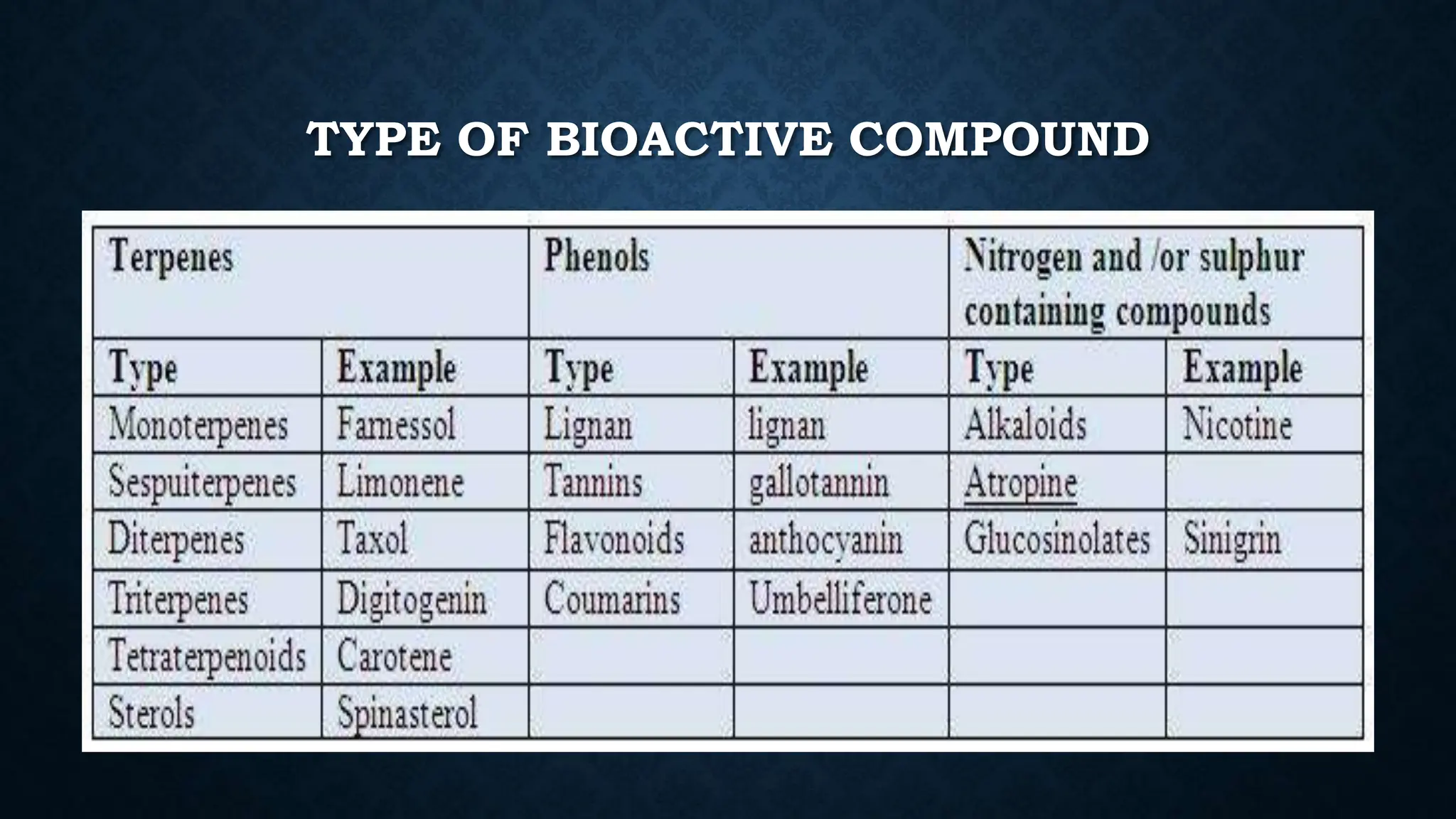
TYPE OF BIOACTIVE COMPOUND
SOURCES OF BIOACTIVE COMPOUND
Generally source of bioactive compound fruits and vegetables, or (from
oils).
 Citrus fruits
 Berries
 Vegetables
 Tea
 Cereals
 Legumes
 Nuts
 Olive oil
MAIN GROUPS OF BIOACTIVE COMPOUNDS IN
PLANTS
 Bioactive compounds in plants are classified according to different criteria. A
presentation based on clinical function – their pharmacological or toxicological
effects – is relevant for the clinician, toxicologist.
Glycosides
 The glycosides consist of various categories of secondary metabolites bound
to a mono- or oligosaccharide.
 The saccharide or uronic acid part is called glycone, and the other part the
aglycone. The main groups of glycosides are cardiac glycosides, cyanogenic
glycosides, glucosinolates, saponins and anthraquicnone glycosides.
 A glycones of cardiac glycosides have a steroidal structure. Their effect is
inhibition of Na+/K+-ATPase-pumps in the cell membranes.
CONTD…
 The cyanogenic glycosides have a glycones derived from amino acids.
Several of these compounds can interfere with the iodine utilisation and
result in hypothyroidism.
 Saponins- “Soap forming compound“- occur as glycosides. The a
glycones consist of either pentacyclic triterpenoids or tetracyclic steroids.
 They are structurally distinct, but have main functional properties in
common. The saponin glycosides are large molecules with a hydrophilic
glycone and a hydrophobic a glycone, which give emulsifying properties
and can be used as detergents.
 Anthraquinone glycosides show a relatively limited distribution within the
plant kingdom. In Polygonaceae (dock family) ). Their primary effect is
induction of water and electrolyte secretion as well as peristalisis in colon.
CONTD…
• Flavonoids and proanthocyanidins- Flavonoids consist of a
central three-ring structure. Proanthocyanidins are oligomers of
flavonoids. Both groups of compounds can occur as glycosides.
• All compounds contain phenol-groups involved in an effect as
general antioxidant.
• Flavonoids and proanthocyanidins are all pigments occurring in a
long range of plant families.
• Isoflavones are produced by species of Fabaeceae (bean family).
CONTD
Tannins
• There are two distinct types of tannins. Condensed tannins which are large
polymers of flavonoids and hydrolysable tannins which are polymers composed of a
monosaccharide core (most often glucose) with several catechin derivatives
attached.
• The two types of tannins have most properties in common, but hydrolysable tannins
are less stable and have greater potential to cause toxicity. The water solubility is
restricted and decrease in general with the size of the tannin molecule.
Mono- and sesqui-terpenoids, and phenylpropanoids
Monoterpenoids consist of two isoprene units and sesquiterpenoids of three units. They are
referred to as low-molecular-weight terpenoids
MONO- AND SEQUI-TERPENOIDS, AND
PHENYLPROPANOIDS
• Monoterpenoids consist of two isoprene units and sesqui-terpenoids of three units.
They are referred to as low-molecular-weight terpenoids.
• The less diverse phenylpropanoid are based on a nine carbon skeleton and are
synthesised via another pathway.
• Compounds of all three groups are lipophilic and tend also to volatilise readily. They
have strong odours and flavours.
• Importance are antineoplastic, antibacterial, antiviral effects as well as
gastrointestinal stimulation.
DITERPENOIDS
• Diterpenoids are composed of 4 isoprene units (20 carbons). They are very lipophilic and
tend to have strong flavours, but are not volatile and thus, odourless.
• Several of the compounds possess antineoplastic activity. Diterpenoids are found in several
plants, among them Coffea arabica (coffee). Diterpenoids are also typically present in resins
.
• Resins-The resins are complex lipid-soluble mixtures – usually both non-volatile and
volatile compounds.
• The non-volatile fraction may consist of diterpenoid and triterpenoid compounds.
• Most typical are resins secreted by wood structures, but resins are also present in
herbaceous plants.
• They are all sticky and the fluidity depends on their contents of volatile compounds.
• When exposed to air they harden.
LIGNANS
• Lignans are composed of two phenylpropanoid units to form an 18-carbon skeleton, with
various functional groups connected.
• They are generally lipophilic and have structural functions within the plant cell membranes.
Lignans are present at highest concentrations in oil seeds, but are also found in other parts
of a long range of plants of different families.
Alkaloids
• The alkaloids are heterocyclic, nitrogen containing compounds, usually with potent activity
and bitter taste.
• They are of limited distribution in the plant kingdom. The various groups have diverse
clinical properties.
PROTEINS AND PEPTIDES
• Proteins from plants are an important source in food and feed.
Amino acids are absorbed from the intestine of man and animals
and are built up into adapted proteins.
• There are also plant proteins and peptides with bioactivity. They
are often not hydrolysed in the digestive tract, but may to a
certain extent be absorbed and exert their specific action in the
body.
FEATURES OF BIOACTIVE COMPOUNDS
Essential compounds
Non-essential compounds (e.g., vitamins or polyphenols)
• Bioactive compounds including carotenoids, essential oils, antioxidants,
or flavours are widely incorporated into food products in order to enhance
their sensory properties or to develop their nutritional and health
properties.
• Bioactive compounds are found in fruits, vegetables, and whole grains
• Microencapsulation of bioactive compounds is defined as a process by
which particles or droplets are surrounded by a coating or embedded in a
homogeneous or heterogeneous matrix giving small capsules with active
properties.
FUNCTIONS OF BIOACTIVE COMPOUNDS IN THE LIVING
PLANTS
Flavonoids can protect against free radicals generated during
photosynthesis.
Terpenoids may attract pollinators or seed dispersers or inhibit competing
plants.
Alkaloids usually ward off herbivore animals or insect attacks
(phytoalexins). secondary metabolites function as cellular signalling
molecules.
The typical poisonous or medicinal plants contain higher concentrations of
more potent bioactive compounds than food and feed plants.
APPLICATION OF BIOACTIVE COMPOUNDS
Fruits and vegetables are the abundant sources of bioactive compounds.
Bioactive compounds react in human body that may promote good health
and effective in prevention of cancer, heart disease, and other chronic
diseases.
Bioactive compounds can be defined as the secondary plant metabolites
eliciting pharmacological effect in man and animals.
Natural components from plants and other organisms are being used as:
anti-oxidant, anti-microbial, anti-hypertensive, anti-cancer etc. It is also being
used as additives and food supplements in food industry.
SYNTHESIS AND PURPOSE IN PLANTS
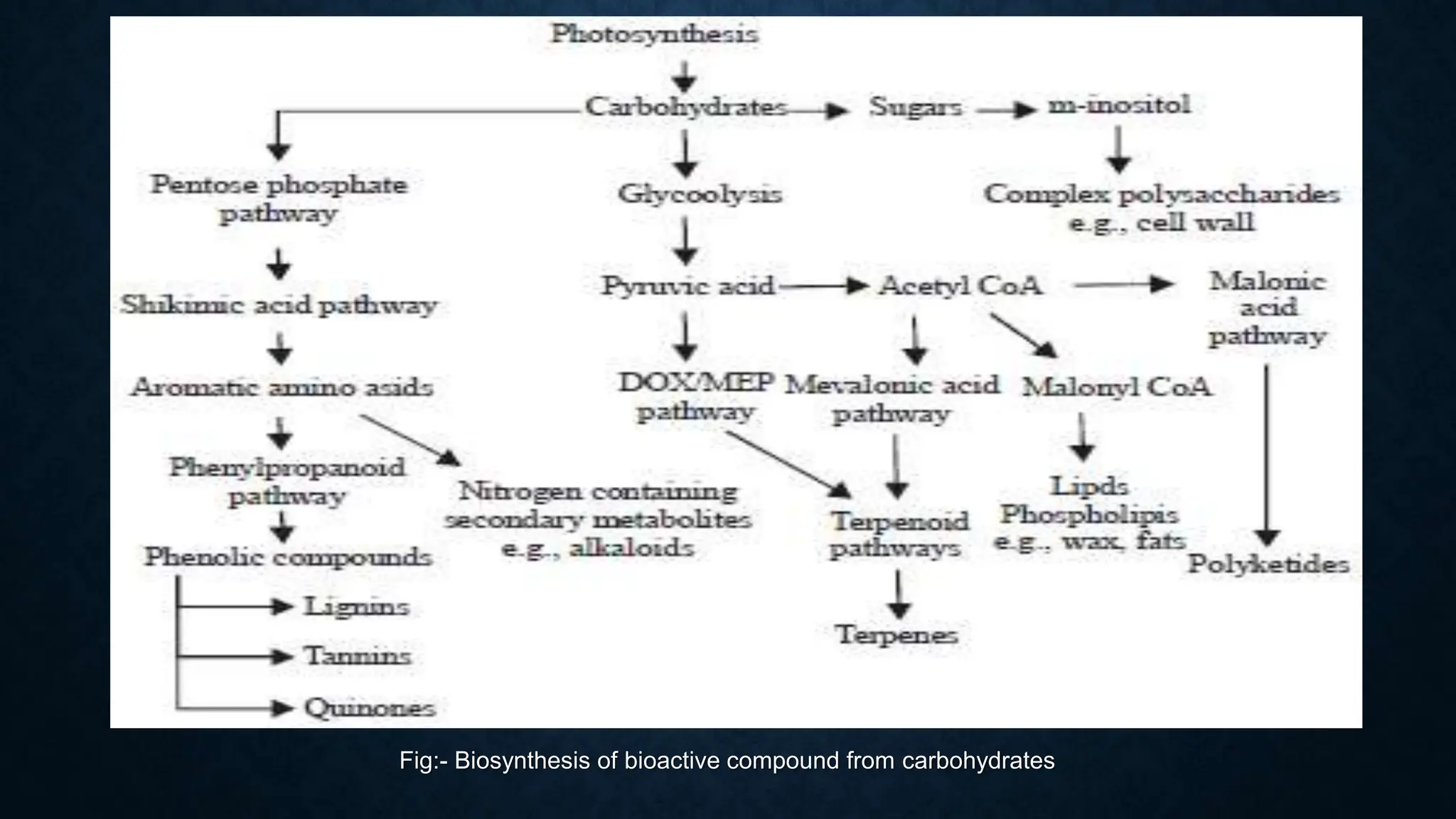
• Secondary metabolites are produced within the plants besides the
primary biosynthetic and metabolic routes of compounds aimed at
plant growth and development, such as carbohydrates, amino
acids, proteins and lipids. They can be regarded as products of
biochemical “side tracks” in the plant cells and not needed for
daily functioning of the plant.
Fig:- Biosynthesis of bioactive compound from carbohydrates
IMPORTANT PLANT BIOACTIVE COMPOUNDS
DEVELOPED FOR THE BENEFIT OF HUMAN HEALTH
• Opium alkaloids Opium poppy, Papaver somniferum, has given rise to four important
medicines. The plant is a very old pain killer and a sedative medicinal plant.
• Morphine is used as a painkiller and is a very good one.
• Codeine, another of the compounds found in opium, is primarily used against cough and is
mainly present in cough remedies.
• Noscapine is also an agent used against cough. This compound has fortunately no adverse
effects and is present in formulations both as tablets and mixtures as remedies to stop
cough.
• Papaverine was originally a remedy primarily used against the treatment of visceral spasm,
vasospasm (especially those involving the heart and the brain).
CONTD…
• Tubocurarine and Strychnine was isolated form the plant Strychnos nux-vomica,
This compound was shown to have the same type of effect as tubocurarine and
structurally they had certain similarities. Both of them were used as lead
compounds for the medical compound Atrakurium, registered as a medicine used
as a muscle relaxant in connection with operations.
• Atropine, hyoscyamine and scopolamine are all present in the plants Atropa
belladonna (deadly nightshade), Hyoscyamus niger (henbane) and Datura
stramonium (thorn apple or jimson weed). Datura stramonium leaves were in used
for relaxing the smooth muscle of the bronchial tubes, and cigarettes made from D.
stramonium leaves were smoked in order to treat an asthmatic's bronchial spasm.
CONTD…
• Quinine and artemisinin :- An well know remedy for treatment of malaria
is the quinine isolated from the bark of the tree Cinchona pubescens. The
use of the china-bark as a fever reducing agent.
• Podophyllotoxin is a resin compound isolated from the roots of
Podophyllum peltatum (May apple). This remedy had a traditional use
amongst others against constipation, warts, internal worms and as bile
stimulator.
CASE STUDY-01
• Title:- Bioactive Compounds and Antioxidant Activity of Tomato High Lycopene Content
advanced breeding lines.
• Author Name:- Riadh Ilahy., Chafik Hdider and Imen Tlili
• Journal:- The African Journal of Plant Science and Biotechnology (2009).
• Aim:- To evaluated for their total carotenoid, lycopene, total phenolics, flavonoids ascorbic
acid,as well as their hydrophilic and lipophilic antioxidant activities.
• Method:-
• Three tomato varieties were used in this experiment. Two advanced tomato high lycopene
content lines (F5 generation), with the assigned names HLT-F51 and HLT-F52, selected by
the National Agriculture Research Institute of Tunisia and the open pollinated variety Rio
Grande (Petoseed, Saticoy, CA, USA) commonly grown in Tunisia which was used as contol.
• All varieties were grown simultaneously in the same field and subjected to identical cultural
practices and, of course environmental conditions in order to mimimize the influence of pre –
and post harvest factors on genotype-related variability of field –grown tomatoes.
CONTD…
• A Sample of approximately 2Kg of marketable ripe tomatoes was collected from each
variety, weighed and delivered to the laboratory the same day.
↓
• Soluble solid content was determined in tomato juice using a digital refractometer and
expressed in Brix.
↓
• Titratable acidity was estimated by titration at pH 8.1 with 0.1 mol-1 Sodium hydroxide
solution and expressed as % citric acid.
↓
• Total carotenoid and lycopene were extracted with hexane /ethanol/acetone (2:1:1,
v/v/v) containing butylated hydroxytoluene (BHT) and analysed using a
spectrophotometer.
↓
CONTD…
• Total phenolic content was determined according to the Folin –Ciocalteu
colorimetric method as modified by Eberhardt et al (2000).
↓
• Total flavonoid content was determined as described by Jia et al.(1999)
on triplicate aliquots of the homogenous juice(0.3g).
↓
• Ascorbic acid(AsA) and Dehydroascorbic acid (DHA) were extracted by
using 6% metaphosphoric acid and detected at 525 nm in a
spectrophotometer and expressed in mg kg-1FW
CONTD…
Result:-
• Total Carotenoid and lycopene contents of the different tomato varieties
are presented .Total carotenoid values varied from 104.66mg kg-1FW in
the standard Rio Grande to 277.71mg kg-1 FW in HLT-F51. HLT-F51 and
HLT-F52 were determined to be the richest varieties in carotenoids with a
content 2.65 and 1.89 fold higher, respectively compared to the standard
Rio Grande.
• Total phenolic and flavonoid content
• Vitamin C content
• Hydrophilic and lipophilic antioxidant activities
REFERENCES
• Guaadaoui, A., Benaicha, S., Elmajdoub, N., Bellaoui, M. and Hamal V. (2014) What is a
bioactive compound? A combined definition for a preliminary consensus.International Journal
of Nutrition and Food Sciences. 3(3): 174-179
• Farzaneh, V. and Carvalho, I. S.(2015)A review of the health benefit potentials of herbal
plant infusions and their mechanism of actions. Industrial Crops and Products 65:247–258
• Ilahy, R., Hdider, C. and Tlili, I. (2009) Bioactive Compounds and Antioxidant Activity of
Tomato High Lycopene Content advanced breeding lines. The African Journal of Plant
Science and Biotechnology. 3:1-6
• Jeffery, E.H., Brown, A.F., Kurilich, A.C., Keck, A.S., Matusheski, N., Klein, J.A.and Juvik
(2003) Variation in content of bioactive components in broccoli. Journal of Food Composition
and Analysis 16:323–330
• Pimentel, M. R., Molina, G., and Pastore G. M.,(2011) The Use of Endophytes to Obtain
Bioactive Compounds and Their Application in Bio transformation Process. Biotechnology
Research International Volume 2011, Article ID 576286, 11 pages
Role of Bioactive Compounds.pptx

Role of Bioactive Compounds.pptx

  • 2.
    COURSE SEMINAR ON ROLE OFBIOACTIVE COMPOUNDS
  • 3.
    CONTENT o Introduction o Definition oTypes of Bioactive Compounds o Sources of Bioactive Compounds o Main Group of Bioactive Compounds in Plant o Function of Bioactive Compounds in the Living Plant o Important plant Bioactive Compounds developed for the benefit of human health o Features of Bioactive Compounds o Applications of Bioactive Compounds o Conclusion o Case study o Reference
  • 4.
    INTRODUCTION  Bioactive compoundsare experiencing a growing interest in wide range of applications: geo-medicine, plant science, modern pharmacology, agrochemicals, cosmetics, food industry, nano-bio-science... etc.  This is a very promising area in full development, which has resulted in research works more and more numerous, designed to diversify the resources of bioactive compounds and improve their salvage pathways or synthesis.
  • 5.
    DEFINITION  Bioactive moleculesare component of food that possess biological activity that they have the ability to modulate one or more metabolic process which results in the promotion of better health in addition to their nutritional valve.  Bioactive compounds are found in both plant and animal products or can be synthetically produced. • Examples: Plant bioactive compounds are carotenoids and polyphenols (from fruits and vegetables), or phytosterols (from oils). • In animal products are fatty acids, found in milk and fish.
  • 6.
    CONTD… • The term"bioactive" is composed by two words: bio- and -active. In etymology: bio- from the Greek (βίο-) "bios" refers: life. And –active from the Latin "activus", means: dynamic, full of energy, with energy, or involves an activity. • The term "bioactive" is an alternative term for "biologically active". A bioactive compound is simply a substance that has a biological activity. • A compound (or a substance) having biological activity, if it has a direct effect on a living organism. These effects may be positive or negative depending on the substance, the dose or the bioavailability. • These compounds have a wide range of effects, starting with the good maintenance of health even healing effect, or be dangerous even fatal.
  • 7.
  • 8.
    SOURCES OF BIOACTIVECOMPOUND Generally source of bioactive compound fruits and vegetables, or (from oils).  Citrus fruits  Berries  Vegetables  Tea  Cereals  Legumes  Nuts  Olive oil
  • 9.
    MAIN GROUPS OFBIOACTIVE COMPOUNDS IN PLANTS  Bioactive compounds in plants are classified according to different criteria. A presentation based on clinical function – their pharmacological or toxicological effects – is relevant for the clinician, toxicologist. Glycosides  The glycosides consist of various categories of secondary metabolites bound to a mono- or oligosaccharide.  The saccharide or uronic acid part is called glycone, and the other part the aglycone. The main groups of glycosides are cardiac glycosides, cyanogenic glycosides, glucosinolates, saponins and anthraquicnone glycosides.  A glycones of cardiac glycosides have a steroidal structure. Their effect is inhibition of Na+/K+-ATPase-pumps in the cell membranes.
  • 10.
    CONTD…  The cyanogenicglycosides have a glycones derived from amino acids. Several of these compounds can interfere with the iodine utilisation and result in hypothyroidism.  Saponins- “Soap forming compound“- occur as glycosides. The a glycones consist of either pentacyclic triterpenoids or tetracyclic steroids.  They are structurally distinct, but have main functional properties in common. The saponin glycosides are large molecules with a hydrophilic glycone and a hydrophobic a glycone, which give emulsifying properties and can be used as detergents.  Anthraquinone glycosides show a relatively limited distribution within the plant kingdom. In Polygonaceae (dock family) ). Their primary effect is induction of water and electrolyte secretion as well as peristalisis in colon.
  • 11.
    CONTD… • Flavonoids andproanthocyanidins- Flavonoids consist of a central three-ring structure. Proanthocyanidins are oligomers of flavonoids. Both groups of compounds can occur as glycosides. • All compounds contain phenol-groups involved in an effect as general antioxidant. • Flavonoids and proanthocyanidins are all pigments occurring in a long range of plant families. • Isoflavones are produced by species of Fabaeceae (bean family).
  • 12.
    CONTD Tannins • There aretwo distinct types of tannins. Condensed tannins which are large polymers of flavonoids and hydrolysable tannins which are polymers composed of a monosaccharide core (most often glucose) with several catechin derivatives attached. • The two types of tannins have most properties in common, but hydrolysable tannins are less stable and have greater potential to cause toxicity. The water solubility is restricted and decrease in general with the size of the tannin molecule. Mono- and sesqui-terpenoids, and phenylpropanoids Monoterpenoids consist of two isoprene units and sesquiterpenoids of three units. They are referred to as low-molecular-weight terpenoids
  • 13.
    MONO- AND SEQUI-TERPENOIDS,AND PHENYLPROPANOIDS • Monoterpenoids consist of two isoprene units and sesqui-terpenoids of three units. They are referred to as low-molecular-weight terpenoids. • The less diverse phenylpropanoid are based on a nine carbon skeleton and are synthesised via another pathway. • Compounds of all three groups are lipophilic and tend also to volatilise readily. They have strong odours and flavours. • Importance are antineoplastic, antibacterial, antiviral effects as well as gastrointestinal stimulation.
  • 14.
    DITERPENOIDS • Diterpenoids arecomposed of 4 isoprene units (20 carbons). They are very lipophilic and tend to have strong flavours, but are not volatile and thus, odourless. • Several of the compounds possess antineoplastic activity. Diterpenoids are found in several plants, among them Coffea arabica (coffee). Diterpenoids are also typically present in resins . • Resins-The resins are complex lipid-soluble mixtures – usually both non-volatile and volatile compounds. • The non-volatile fraction may consist of diterpenoid and triterpenoid compounds. • Most typical are resins secreted by wood structures, but resins are also present in herbaceous plants. • They are all sticky and the fluidity depends on their contents of volatile compounds. • When exposed to air they harden.
  • 15.
    LIGNANS • Lignans arecomposed of two phenylpropanoid units to form an 18-carbon skeleton, with various functional groups connected. • They are generally lipophilic and have structural functions within the plant cell membranes. Lignans are present at highest concentrations in oil seeds, but are also found in other parts of a long range of plants of different families. Alkaloids • The alkaloids are heterocyclic, nitrogen containing compounds, usually with potent activity and bitter taste. • They are of limited distribution in the plant kingdom. The various groups have diverse clinical properties.
  • 16.
    PROTEINS AND PEPTIDES •Proteins from plants are an important source in food and feed. Amino acids are absorbed from the intestine of man and animals and are built up into adapted proteins. • There are also plant proteins and peptides with bioactivity. They are often not hydrolysed in the digestive tract, but may to a certain extent be absorbed and exert their specific action in the body.
  • 17.
    FEATURES OF BIOACTIVECOMPOUNDS Essential compounds Non-essential compounds (e.g., vitamins or polyphenols) • Bioactive compounds including carotenoids, essential oils, antioxidants, or flavours are widely incorporated into food products in order to enhance their sensory properties or to develop their nutritional and health properties. • Bioactive compounds are found in fruits, vegetables, and whole grains • Microencapsulation of bioactive compounds is defined as a process by which particles or droplets are surrounded by a coating or embedded in a homogeneous or heterogeneous matrix giving small capsules with active properties.
  • 18.
    FUNCTIONS OF BIOACTIVECOMPOUNDS IN THE LIVING PLANTS Flavonoids can protect against free radicals generated during photosynthesis. Terpenoids may attract pollinators or seed dispersers or inhibit competing plants. Alkaloids usually ward off herbivore animals or insect attacks (phytoalexins). secondary metabolites function as cellular signalling molecules. The typical poisonous or medicinal plants contain higher concentrations of more potent bioactive compounds than food and feed plants.
  • 19.
    APPLICATION OF BIOACTIVECOMPOUNDS Fruits and vegetables are the abundant sources of bioactive compounds. Bioactive compounds react in human body that may promote good health and effective in prevention of cancer, heart disease, and other chronic diseases. Bioactive compounds can be defined as the secondary plant metabolites eliciting pharmacological effect in man and animals. Natural components from plants and other organisms are being used as: anti-oxidant, anti-microbial, anti-hypertensive, anti-cancer etc. It is also being used as additives and food supplements in food industry.
  • 20.
    SYNTHESIS AND PURPOSEIN PLANTS • Secondary metabolites are produced within the plants besides the primary biosynthetic and metabolic routes of compounds aimed at plant growth and development, such as carbohydrates, amino acids, proteins and lipids. They can be regarded as products of biochemical “side tracks” in the plant cells and not needed for daily functioning of the plant.
  • 21.
    Fig:- Biosynthesis ofbioactive compound from carbohydrates
  • 22.
    IMPORTANT PLANT BIOACTIVECOMPOUNDS DEVELOPED FOR THE BENEFIT OF HUMAN HEALTH • Opium alkaloids Opium poppy, Papaver somniferum, has given rise to four important medicines. The plant is a very old pain killer and a sedative medicinal plant. • Morphine is used as a painkiller and is a very good one. • Codeine, another of the compounds found in opium, is primarily used against cough and is mainly present in cough remedies. • Noscapine is also an agent used against cough. This compound has fortunately no adverse effects and is present in formulations both as tablets and mixtures as remedies to stop cough. • Papaverine was originally a remedy primarily used against the treatment of visceral spasm, vasospasm (especially those involving the heart and the brain).
  • 23.
    CONTD… • Tubocurarine andStrychnine was isolated form the plant Strychnos nux-vomica, This compound was shown to have the same type of effect as tubocurarine and structurally they had certain similarities. Both of them were used as lead compounds for the medical compound Atrakurium, registered as a medicine used as a muscle relaxant in connection with operations. • Atropine, hyoscyamine and scopolamine are all present in the plants Atropa belladonna (deadly nightshade), Hyoscyamus niger (henbane) and Datura stramonium (thorn apple or jimson weed). Datura stramonium leaves were in used for relaxing the smooth muscle of the bronchial tubes, and cigarettes made from D. stramonium leaves were smoked in order to treat an asthmatic's bronchial spasm.
  • 24.
    CONTD… • Quinine andartemisinin :- An well know remedy for treatment of malaria is the quinine isolated from the bark of the tree Cinchona pubescens. The use of the china-bark as a fever reducing agent. • Podophyllotoxin is a resin compound isolated from the roots of Podophyllum peltatum (May apple). This remedy had a traditional use amongst others against constipation, warts, internal worms and as bile stimulator.
  • 25.
    CASE STUDY-01 • Title:-Bioactive Compounds and Antioxidant Activity of Tomato High Lycopene Content advanced breeding lines. • Author Name:- Riadh Ilahy., Chafik Hdider and Imen Tlili • Journal:- The African Journal of Plant Science and Biotechnology (2009). • Aim:- To evaluated for their total carotenoid, lycopene, total phenolics, flavonoids ascorbic acid,as well as their hydrophilic and lipophilic antioxidant activities. • Method:- • Three tomato varieties were used in this experiment. Two advanced tomato high lycopene content lines (F5 generation), with the assigned names HLT-F51 and HLT-F52, selected by the National Agriculture Research Institute of Tunisia and the open pollinated variety Rio Grande (Petoseed, Saticoy, CA, USA) commonly grown in Tunisia which was used as contol. • All varieties were grown simultaneously in the same field and subjected to identical cultural practices and, of course environmental conditions in order to mimimize the influence of pre – and post harvest factors on genotype-related variability of field –grown tomatoes.
  • 26.
    CONTD… • A Sampleof approximately 2Kg of marketable ripe tomatoes was collected from each variety, weighed and delivered to the laboratory the same day. ↓ • Soluble solid content was determined in tomato juice using a digital refractometer and expressed in Brix. ↓ • Titratable acidity was estimated by titration at pH 8.1 with 0.1 mol-1 Sodium hydroxide solution and expressed as % citric acid. ↓ • Total carotenoid and lycopene were extracted with hexane /ethanol/acetone (2:1:1, v/v/v) containing butylated hydroxytoluene (BHT) and analysed using a spectrophotometer. ↓
  • 27.
    CONTD… • Total phenoliccontent was determined according to the Folin –Ciocalteu colorimetric method as modified by Eberhardt et al (2000). ↓ • Total flavonoid content was determined as described by Jia et al.(1999) on triplicate aliquots of the homogenous juice(0.3g). ↓ • Ascorbic acid(AsA) and Dehydroascorbic acid (DHA) were extracted by using 6% metaphosphoric acid and detected at 525 nm in a spectrophotometer and expressed in mg kg-1FW
  • 28.
    CONTD… Result:- • Total Carotenoidand lycopene contents of the different tomato varieties are presented .Total carotenoid values varied from 104.66mg kg-1FW in the standard Rio Grande to 277.71mg kg-1 FW in HLT-F51. HLT-F51 and HLT-F52 were determined to be the richest varieties in carotenoids with a content 2.65 and 1.89 fold higher, respectively compared to the standard Rio Grande. • Total phenolic and flavonoid content • Vitamin C content • Hydrophilic and lipophilic antioxidant activities
  • 29.
    REFERENCES • Guaadaoui, A.,Benaicha, S., Elmajdoub, N., Bellaoui, M. and Hamal V. (2014) What is a bioactive compound? A combined definition for a preliminary consensus.International Journal of Nutrition and Food Sciences. 3(3): 174-179 • Farzaneh, V. and Carvalho, I. S.(2015)A review of the health benefit potentials of herbal plant infusions and their mechanism of actions. Industrial Crops and Products 65:247–258 • Ilahy, R., Hdider, C. and Tlili, I. (2009) Bioactive Compounds and Antioxidant Activity of Tomato High Lycopene Content advanced breeding lines. The African Journal of Plant Science and Biotechnology. 3:1-6 • Jeffery, E.H., Brown, A.F., Kurilich, A.C., Keck, A.S., Matusheski, N., Klein, J.A.and Juvik (2003) Variation in content of bioactive components in broccoli. Journal of Food Composition and Analysis 16:323–330 • Pimentel, M. R., Molina, G., and Pastore G. M.,(2011) The Use of Endophytes to Obtain Bioactive Compounds and Their Application in Bio transformation Process. Biotechnology Research International Volume 2011, Article ID 576286, 11 pages